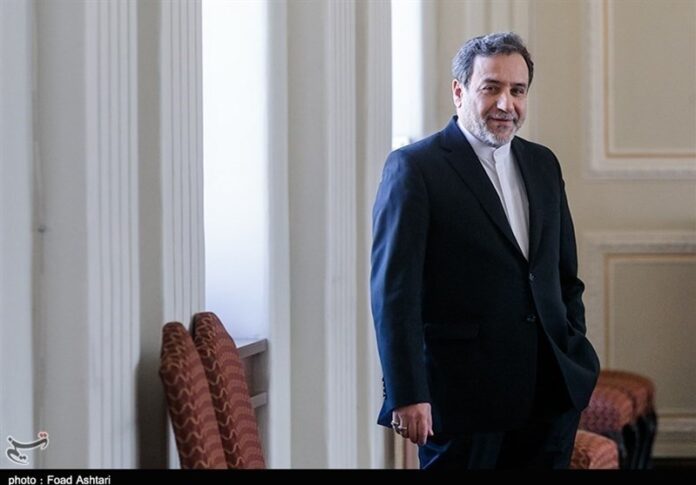
That came in a meeting in Doha between Ali-Asghar Khaji, a senior advisor to the Iranian foreign minister for special political affairs, and Qatari State Minister for Foreign Affairs Soltan bin Saad Al-Muraikhi.
The two sides exchanged views on issues of mutual interest, namely the promotion of mutual political and economic relations and the holding of a joint commission of the two countries in the near future.
The also discussed the ongoing developments in the region and stressed the need to move forward with consultations.
The top Iranian diplomat then touched upon recent trips to the region by American authorities, dismissing them as a move to further stoke Iranophobia and instability in the region.
1- Iran Needs a President Who Loves the Country: Politician
2- Concerns about the Money Withdrawn from Stock Exchange Market
Arman-e Melli Newspaper:
1- Rouhani: I’ve Received Over 23 Requests for Meeting from US
2- Makeshift Hospitals to Be Launched in Tehran
Ebtekar Newspaper:
1- Rouhani: We’re Not Afraid of Negotiation, Are Not After Show
2- Iran Doesn’t Count on US Elections: Spokesman
Etemad Newspaper:
1- End of US Hegemony
2- Tehran’s Prudence in Wake of Tel Aviv’s Traps
Ettela’at Newspaper:
1- Zarif: Post-Corona World Won’t Be Western Anymore
Iran Newspaper:
1- Rouhani: We’re Not After Negotiation; We Seek to Solve Our Problems
2- Clashes in Lebanon’s Border with Occupied Territories
Javan Newspaper:
1- Swiss Channel Launched with So Much Hype
2- Rouhani: Offer of Negotiation Just for Show
3- 90% of Those Hospitalized for Coronavirus Recover
Kayhan Newspaper:
1- Hatred for US Growing Everyday: Gallop
Khorasan Newspaper:
1- Rouhani’s Account of US’ Hypocrisy
2- Khorasan Razavi, Most Severe Conditions of Coronavirus in Iran
Mardom Salari Newspaper:
1- Defence Minister: Sanctions Let Iran Start Amazing Progress in Defence
2- Iran to Respond to US in Due Time: Spokesman
Shahrvand Newspaper:
1- Protest Coupled with Fear in Occupied Territories
Shargh Newspaper:
1- 23 Unsuccessful Attempts to Negotiation with Iran President
* Rouhani Says He’s Been Frequently Asked to Meet Americans
2- Raisi: We Won’t Let Profiteers Loot the Country’s National Wealth
The Health Ministry spokeswoman says the new fatalities increase the overall death toll to 16,147.
In her press briefing on Tuesday, Sima-Sadat Lari also confirmed 2,667 new cases of COVID-19 infection, increasing the total number of infections to 296,273.
According to the spokeswoman, 257,019 patients have so far recovered from COVID-19 or been discharged from the hospital, while 3,902 are still in critical conditions of the disease.
She said so far 2,380,122 COVID-19 tests have been taken across the country.
Lari added that Tehran, Ilam, Ardabil, Isfahan, East Azarbaijan, Alborz, Golestan, Kerman, North Khorasan, Semnan, Hormozgan, Lorestan, Mazandaran, Fars, and Khorasan Razavi are considered as “red zones”.
Saudi Arabia's Minister of State for Foreign Affairs Adel al-Jubeir and US Special Representative for Iran Brian Hook, check the display of the debris of ballistic missiles and weapons which were launched towards Riyadh. / File Photo by Reuters
Deputy Foreign Minister for Legal and International Affairs Mohsen Baharvand made the comment as US Special Representative for Iran Brian Hook travelled to the region in recent days in line with Washington’s efforts to extend the arms embargo on the Islamic Republic. Hook is to visit several European countries as well to pursue this objective.
“Our message to countries in the region and across world is that they should not be deceived by the US,” said the top Iranian diplomat.
He said the White House has launched propaganda campaigns to make others change their minds about the issue.
“The Americans know well that Iran is a logical player and has never been, and will never be a threat to the regional countries,” he said.
He noted the US seeks to scuttle the Iran nuclear deal known as the Joint Comprehensive Plan of Action (JCPOA) and stir up fresh chaos in the region.
“The outcome of this illogical behaviour of the US is that all countries in the region and beyond will lose,” he added.
Iran has, on numerous occasions, condemned Washington’s efforts to coerce the UN into extending an arms embargo on the Islamic Republic which expires in October, 2020.
The war games underway in the Persian Gulf and the Strait of Hormuz involve naval and aerospace forces of the IRGC.
The military exercises span Hormozgan province, the west of the Strait of Hormuz and the Persian Gulf all the way into the heart of the country. The war games feature land, sea, air and space drills.
In the final phase of the maneuvres, missile, vessel and drone units of the IRGC’s Naval Force as well as the missile, drone and radar units of the IRGC’s Aerospace Division carry out operations and drills.
The exercises feature combat operations against the position of the mock enemy and mine-laying drills as well as operation to cut off the communications lines of the mock enemy. Choppers will also conduct rocket operations and fire coast-to-sea missiles.
During the military exercises, the war game region is being monitored for the first time using images sent by the Iranian Noor satellite.
The versatile Iranian-made Noor satellite was successfully put into orbit on April 22, 2020. Noor is Iran’s first military satellite.
The UNESCO painting competition is held each year for different age groups. Fatemeh Andikfar from Iran stepped up to the finals in 2019 and 2020.
“The competition was to be canceled this year due to the coronavirus outbreak, but it was announced recently that the judges had reviewed the works and top ones had been introduced. Still, an exhibition that used to be held in previous years showcasing select works was called off along with the award-giving ceremony,” she said.
“I took part in the 18-25 age group. Every year in autumn, a call is made for taking part in the contest, and the organizers announce a subject, so that all those interested send works about that subject,” she added.
“The first year that I took part, the subject was ‘water.’ The second year, [the subject] was ‘global peace,’ the third year was ‘ancient itmes’ of each country, and the fourth year was ‘our planet, yesterday and today,’” she said.
Andikfar explained about her two works that had advanced to the finals.
Subject of UNESCO painting competition 2019: Calligraphy and antiquities of countries. This work found way into the final stage.
“For the contest with the subject ‘ancient items’ of each country, I went to the National Museum and say different works there. I wanted to incorporate an Achaemenid symbol into my painting. So, I painted the image of a bust, coloured it sapphire blue and navy blue and used Iranian and Islamic patterns on the background,” she said.
“And for the 2020 contest, I painted a woman from whose inside different plants had grown.
I had been inspired by Anahita, the Iranian goddess of nature, to paint that image,” she said.
“Anahita is the symbol of fertility, and I wanted my work to give a feeling of growth, a change of season and starting again,” she noted.
Andikfar is now a student of graphics. She says she had been interested in painting since she was a child.
“Since childhood, I had been keen on painting and arts, and I began painting since I was at school,” she said.
“I also showcased my works at two public exhibitions in 2018 and 2019,” she added.
“I took part in the UNESCO contest four times. I advanced to the finals in the last two years, and I was the only representative from Iran in my age group in 2019 when I was picked as a finalist,” she said.
That came after Turkey presented its proposal to the United Nations’ Educational, Scientific and Cultural Organization, asking the UN body to register the case at its 2021 meeting.
“As announced earlier, Turkey had not presented a case under ‘calligraphy’ for the year 2020, but has we have learned recently, Turkey has put forward a case titled ‘Islamic Calligraphy’ to UNESCO for the year 2021, which has met with Iran’s objection,” said Mohammadhassan Talebian, the deputy head of the Cultural Heritage, Handicrafts and Tourism Organization.
“As announced before, every country can have its intangible cultural heritage registered, but the adjective ‘Islamic’ indicates a span [of time and place] which goes beyond Turey, and this runs counter to the 2003 convention about protecting intangible cultural heritage,’ he added.
“The dossier presented by Turkey contains the adjective ‘Islamic’ which has met Iran’s official objection because the adjective ‘Islamic’ cannot be limited to Turkey only, not to mention the fact that the root of Islamic calligraphy should be sought in Iran,” he said.
“Iran, too, has sent its calligraphy case to UNESCO for the year 2021 in keeping with measures adopted to safeguard [a nation’s cultural heritage],” he noted.
“Different countries have had their calligraphy [systems] registered before. China, for instance, had Chinese calligraphy registered in 2009. Arab countries, too, have present a case under ‘Arabic Calligraphy’ for the year 2021,” he noted.
“Under the terms of the above-mentioned convention, the registration of a cultural element will not lead to monopoly and ownership, but our objection to the ‘Islamic Calligraphy’ case is a technical one, i.e., the adjective ‘Islamic’ refers to a span which goes beyond the Turkish territory, and Turkey cannot use this title to refer to the country’s calligraphy system,” the top official added.
Faith leaders pray with President Donald Trump during a rally for evangelical supporters at the King Jesus International Ministry church, Jan. 3, 2020, in Miami. / Photo by AP
Born in 1953, Masjed-Jamei is a religion scholar and researcher, with a special focus on Christianity. A former ambassador of the Islamic Republic of Iran to Vatican and Morocco, Masjed-Jamei has authored several books including “Christians and the New Era”, which deals with the geopolitics of modern Christianity in the contemporary era.
A PhD graduate in geopolitics from the University of Pisa in Italy,
Iranian scholar Mohammad Masjed-Jamei
has taught at the University of Religions and Denominations of Qom as well as the Iranian Foreign Ministry’s School of International Relations.
In a detailed interview with Iranian news website Khabar Online, Masjed-Jamei has weighed on the impact of evangelical Christianity on the US politics and the country’s foreign policy, especially since President Donald Trump assumed office.
An English version of the interview, originally conducted in Persian, is published by IFP News in several parts.
The second part mainly concerned the US government’s use of religion to prop up its regional ally Israel.
What follows is the third part of the interview, which mainly deals with the way evangelicals stepped into the realm of politics in the US, and why they seem to like Trump so much.
How did evangelicals in the US turn political?
They had been present in the US history since the 19th century, and continued to maintain their presence. At the time of Reagan’s presidency, the US federal government tried, for the first time, to get close to them and capitalize on their influence and presence in favour of its own foreign policy.
Was it because of Reagan’s good features?
Yes, because Reagan himself was an advocate of the Evangelical Church. For instance, during his first election campaign in a speech in summer 1980 addressing a huge gathering of evangelicals in the US state of Texas, Reagan said he knew that they (evangelicals) could not endorse him, but that he endorsed them and whatever they did. His words were met with an applause and great excitement from the crowd.
If Reagan was an evangelical himself, then why couldn’t they endorse him?
Probably that was just a pleasantry. Reagan was an expert in making such comments, and that is why he was popular in the US society. Of course, Reagan was not as devout an evangelical as are Mike Pence and Mike Pompeo now. Nevertheless, he was popular among evangelicals at the time and still is, and so is Trump. Although he is popular among evangelicals, he is not like those two. One can say that his popularity is not because he and evangelicals have common ground on the religious front; rather, it is because they share the same mentality, i.e. the same personality and political traits. In layman’s terms, this means they like Trump.
Is it because Trump is at their service?
Yes. Sometimes you are interested in a person because he or she shares the same religion and beliefs as you. However, sometimes you like that person because he or she serves to promote your objectives and programs. Take Pence, for example! Probably few vice presidents in the modern US history have been so obedient to their masters. He is not only obedient, but is loyal to Trump and, in one sense, feels inferior to him. From Trump’s perspective, Pence is an ideal individual. Pompeo is like Pence, too. As the US secretary of state, Pompeo is at the service of Trump’s ideas. Moreover, Pence strictly abides by Christian ethics and has never had a meeting with a woman in a closed space like his mentor Billy Graham, who was a very famous priest. Pompeo is probably like Pence, too.
Don’t you think that the story may be the other way round? I mean they, especially Pence,who seems smarter, only pretend to be obedient only because they want to take advantage of Trump? Otherwise, Trump, who is notorious worldwide for his immoral acts and behaviour, is not someone that Pence and Pompeo would like to look up to as a mentor?
No, that’s not the case. There is a religious saying which indicates that one of the practices of God Almighty is that he sometimes confirms his religion through wicked people and sinners. Pence and Pompeo have the same idea, too. They believe Trump is blessed by God. Trump’s behaviour is not important to them. What is important is that Trump helps advance their ideals. Mark Galli, the former editor-in-chief of Christianity Today, who himself is an evangelical minister and a critic of Trump, has written a critical article named “Trump Should Be Removed from Office” in which he disavowed Trump and said he is an immoral person and his behaviour runs counter to teachings of Christianity. But such evangelicals are in minority. The likes of Pence and the rest of evangelicals are not like that. They feel Trump is a divine blessing to promote evangelicalism as well as their objectives and ideals.
There is no denying that they are “using” Trump, but one can use a person in two ways: Sometimes one uses a person as a tool, but sometimes respects him and regards him highly.
Pence and Pompeo are of the second type. They regard him as someone handpicked by God in order to serve religion, someone destined to promote their religious ideas, no matter if he himself is not a favarouble personality from a religious perspective. They regarded Reagan in the same way.
Anyway, they began to step into the realm of politics at the time of Reagan’s presidency. Reagan, and the US politics in general, encouraged them a lot to make more and more trips to Latin America in order to, in their words, promote their beliefs, and it was very effective, too. The Guatemalan ambassador to the Vatican said they made half of that country’s population evangelical in ten years’ time, i.e., in the 1980s. This is a very arduous and important task.
How was their situation after Reagan?
After Reagan, this current faced ups and downs until Obama took power, which is an important period of time. During Obama’s presidency, evangelicals were annoyed very much. Obama was a favourable personality neither for evangelicals nor for American rightist nationalists, two spectrums which are usually mixed with one another.
For instance, in 2010, this very Mike Pompeo posted a tweet during his election campaign to become a lawmaker – and, of course, removed it very soon. In that tweet, he described President Obama with words like “usurper”, “wicked”, “communist” and “Muslim.” Well, it is unacceptable to talk about the then US president using such language. This is his mentality.
President Obama made them very coherent. If anyone other than Obama had become President, they would definitely not have become so much coherent. Therefore, a feeling of concern over the presence of Obama triggered a series of reactions that led to the election of Trump. When Trump launched his election campaign, they got so much provoked and came onto the scene to bring Trump to Presidency.
1- Hook: We’ll Continue Our Efforts to Have Iran Arms Embargo Extended
Afkar Newspaper:
1- Tehran Has Turned into Epicentre of Coronavirus in Iran
Aftab-e Yazd Newspaper:
1- Iranian Nurse: We Are Being Destroyed
2- Banks Main Disruptors of Iran’s Housing System
Arman-e Melli Newspaper:
1- Analyst: Power Is Shifting in the World; Forget about the US in 1990s
Ebtekar Newspaper:
1- Zarif: Iran Has Suffered a Lot in Past Times Because of Lack of Courage
2- Rouhani: If Exporters Cooperate, We’ll See More Stability in Forex Market
3- We’ll Have 200 COVID-19 Deaths Every Day If Number of People Hospitalized Doesn’t Drop: Official
Ettela’at Newspaper:
1- Guardian: Pompeo Convinced Trump to Order Assassination of Gen. Soleimani
2- US Protests Spread from Portland to Southern States
Iran Newspaper:
1- Difficult Path to Victory: Will Corona Lead to Trump’s Defeat in Nov. Elections?
2- Why Turkey Converted Hagia Sophia into Mosque?
Javan Newspaper:
1- Tel Aviv Terrified of Zero Hour of Revenge
Kayhan Newspaper:
1- Judiciary Chief Gives Ultimatum to Law-Breakers, Land Grabbers
2- Riot in Seattle, War in Portland: Los Angeles on Standby
3- Slaughtering Hajj Pilgrims in God’s House; Criminal Saudi Regime Must Be Held Accountable
4- NBC: US Move against Mahan Air Flight Reminds Us of Attack on Iran Air Flight 655 in 1988
Khorasan Newspaper:
1- Controversy over Land Grabbing in Damavand Mountain
Mardom Salari Newspaper:
1- Intelligence Ministry Identifies 80 Percent of Encroachments into Natural Resources
Shahrvand Newspaper:
1- Strange Story of ‘Waqf’ in Iran’s Highest Mountain
Shargh Newspaper:
1- Will Lavasan in Northern Tehran Get Rid of Corrupt Land Grabbers?
2- Integrated Power Only Way to Achieve Democracy: Analyst