Sunday, December 21, 2025
Home Blog Page 2703

‘Swiss Top Diplomat’s Visit to Tehran Has Nothing to Do with Iran-US Ties’

‘Swiss Top Diplomat’s Visit to Tehran Has Nothing to Do with Iran-US Ties’

Saeed Khatibzadeh’s Friday explanation came in response to questions raised by reporters on the programs of the top Swiss diplomat during his visit to Iran.

“As already planned, the Swiss foreign minister will arrive in Iran tomorrow morning, Saturday. First, he will make a short visit to [the central Iranian city of] Isfahan,” said the spokesman.

“After his short stop in Isfahan, the official programs of the Swiss foreign minister begin in Tehran as of Sunday,” he added.

The spokesman said the most significant event during the Swiss official’s Iran visit will be a meeting marking the 100th anniversary of the start of relations between the two countries.

Khatibzadeh said the top Swiss diplomat is to sit down with the Iranian president, foreign minister and some other ranking officials on Sunday and Monday.

The spokesman also touched upon the key topic on the agenda of the talks during the Swiss foreign minister’s trip.

He said Ignazio will exchange views with Iranian officials on issues of mutual interest at bilateral, regional and international levels as well as issues related to the Swiss financial channel.

“As announced before, two transactions have taken place so far via the Swiss financial channel. The first one was conducted in February 2020 on a trial basis. And back in June, the first official transaction was conducted through this channel,” he said.

“Both transactions included the transfer of medications using Iranian financial resources in Switzerland,” the spokesman added.

Iran’s foreign ministry spokesman appreciated and welcomed efforts by Switzerland in following up on this financial channel.

“Due to some destructive moves made by the US with regards to this financial channel, we have serious doubts about the United States’ intentions,” he noted.

“Of course, it is clear that everything conducted so far through this financial channel has been done with Iranian assets in Switzerland,” he added.

“We welcome any move that would see this channel get rid of the US pressure and ease the shipment of commodities and medicines by using Iran’s assets in other countries,” he added.

“This trip will be an opportunity to exchange views between the two countries to further activate the Swiss financial channel and examine possible ways of settling problems,” he added.

The spokesman also elaborated on the makeup of the Swiss foreign minister’s entourage.

“Some Swiss parliamentary officials will be accompanying him, too, during this visit. A meeting has been scheduled for him at the Iranian parliament,” added the spokesman.

He also elaborated on Tehran-Bern relations, saying, “Iran and Switzerland have always had forward-moving and progressive ties.”

“During the nuclear talks several rounds of which were held in Geneva, the Swiss government hosted the negotiations well in good faith,” he said.

“The two countries have always maintained their relations even in tough times,” the spokesman added.

“The Swiss government not only represents US interests in Iran, but also runs an interests section for Iran in Canada, and also mutually represents the interests of Iran and Saudi Arabia in the two countries,” he noted.

“So, in addition to bilateral dimensions, relations between Iran and Switzerland cover a wide-ranging domain in this regard as well,” he added.

“These relations are pursued at different levels within the framework of a road map approved during a trip to Iran by the Swiss president in 2016 and later on during Iranian President Hassan Rouhani’s visit to Switzerland in 2018,” he noted.
Khatibzadeh further touched upon reports on US Secretary of State Mike Pompeo’s contacts with the Swiss top diplomat.

“This trip has nothing to do with Iran-US issues.
This trip has already been planned within the framework of reciprocal ties and regular trips by both countries’ foreign ministers. Of course the trip takes place with delay due to the coronavirus pandemic,” he said.
“The US secretary of state’s hasty contacts with dignitaries who are going to visit Iran are nothing new,” he said.

“Out of desperation, Pompeo seeks to pursue Washington’s ‘maximum pressure’ policy one way or another. So, he tries to dissuade third countries from having normal relations with Iran. Of course, he has failed in his attempts so far. The Americans failed in their efforts, too, during a trip to Iran by director general of the International Atomic Energy Agency Rafael Grossi. This time, too, their pressure will fail to be effective,” he added.

“The Islamic Republic of Iran has, time and again, announced its official stance on the Trump regime’s recalcitrance, and Iran’s position has not changed,” he said.

Over 22,000 Iranians Die of COVID-19: Health Ministry

Over 22,000 Iranians Die of COVID-19: Health Ministry

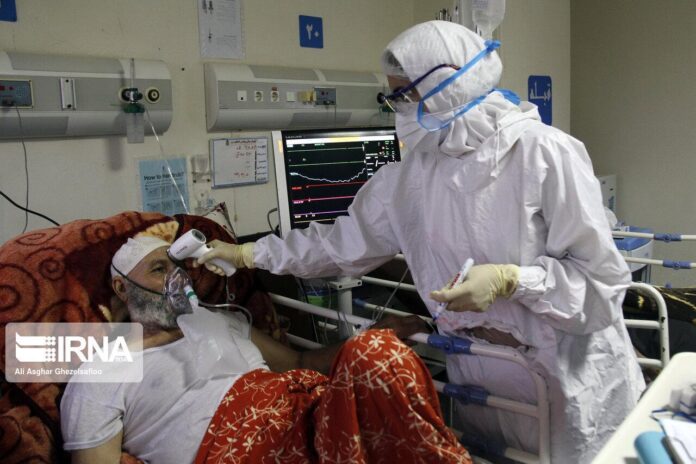
In a press briefing on Friday, Sima-Sadat Lari confirmed 2,026 new cases of COVID-19 infection, raising the total number of infections to 382,772.

The spokeswoman said 330,308 patients have so far recovered from COVID-19 or been discharged from hospital, but 3,695 are still in critical conditions of the disease.

Lari added that so far 3,331,073 COVID-19 tests have been taken across the country.

She said the high-risk “red” zones include Tehran, Qom, Mazandaran, East Azarbaijan, Isfahan, Yazd, Khorasan Razavi, North Khorasan, Semnan, Gilan, Zanjan, Qazvin, and Kerman provinces.

The “orange” zones also include Lorestan, Ardabil, Golestan, Markazi, Alborz, Hormozgan, Ilam, Fars, Bushehr, West Azarbaijan, Chaharmahal and Bakhtiari, Kermanshah, South Khorasan, Kohgiluyeh and Boyer-Ahmad, and Khuzestan provinces, she added.

Which Countries Can Travel to Italy?

As a member of the European Union and the Schengen Zone, Italy has similar travel requirements as its neighbouring countries, such as France, Spain, and Germany.

Under ordinary circumstances, people of all nationalities can travel to Italy. Travelers can be categorized into one of the following: EU passport holders, visitors from a country with a visa waiver agreement with the Schengen Area, or third-country nationals.
Entry requirements for a short term stay in Italy —whether for business, tourism, or transit purposes— depend on the traveller’s nationality.
EU citizens visiting Italy

Citizens of a Schengen member nation —whether they reside in their home country, in Iran, or elsewhere around the world— can circulate freely within other Schengen territories, including Italy.

These travellers don’t even need to carry a passport when crossing an internal Schengen border into Italy since their national identification document will suffice. 

Travelers that fall under this category are those holding passports from any of the following countries: Andorra, Austria, Belgium, Czech Republic, Denmark, Estonia, Finland, France, Germany, Greece, Hungary, Iceland, Latvia, Liechtenstein, Lithuania, Luxembourg, Malta, Monaco, Netherlands, Norway, Poland, Portugal, San Marino, Slovakia, Slovenia, Spain, Sweden, Switzerland, and Vatican City.

Non-EU nationals traveling to Italy

Depending on the passport they hold, some non-EU visitors can benefit from a visa waiver agreement with Italy, while others cannot. The required documentation to travel to Italy or the rest of the Schengen Area will vary in each case.

ETIAS eligible citizens visiting Italy

Travelers from countries that have a visa liberalization policy with the EU can stay in Italy for up to 90 days for leisure or business without having to apply for a visa.  

At the time of writing, visa-exempt citizens, residing in Iran or elsewhere in the world, can enter Italy just by holding a valid passport. However, these visitors will need to have an additional entry requirement known as the ETIAS from the last trimester of 2022 onwards.

ETIAS stands for European Travel Information and Authorisation System and has been under development since 2016. The system will improve security in Italy and the rest of the Schengen member nations for nationals, residents, and travellers alike.

Visitors from 60 countries, including the United States, the United Kingdom, Canada, India, and Australia will be required to register online for an ETIAS prior to their departure towards Italy by the end of 2022. — More information on ETIAS Italy requirements and eligibility.

ETIAS allows holders entry to Italy, all 26 Schengen countries, and the European microstates. Furthermore, the travel authorization can be obtained entirely online, eliminating the hassle of having to visit a diplomatic mission. 

Citizens from the following territories are all eligible to visit Italy with ETIAS: Albania, Antigua and Barbuda, Argentina, Australia, Bahamas, Barbados, Bosnia and Herzegovina, Brazil, Brunei, Canada, Chile, Colombia, Costa Rica, Dominica, El Salvador, Georgia, Grenada, Guatemala, Honduras, Hong Kong, Israel, Japan, Kiribati, Macao, Macedonia, Malaysia, Marshall Islands, Mauritius, Mexico, Micronesia, Moldova, Montenegro, New Zealand, Nicaragua, Palau, Panama, Paraguay, Peru, Saint Kitts and Nevis, Saint Lucia, Saint Vincent, Samoa, Serbia, Seychelles, Singapore, Solomon Islands, South Korea, Taiwan, Timor Leste, Tonga, Trinidad and Tobago, Tuvalu, Ukraine, United Arab Emirates, United States of America, Uruguay, Vanuatu, and Venezuela.

Iran, India, Saudi Arabia, and other nationalities

Third-country nationals from countries without a visa waiver agreement are required to obtain a Schengen visa to enter Italy for tourism and business purposes. Schengen visas, unlike ETIAS, cannot be obtained online and require a visit to an Italian Embassy or Consulate.

Travelers from Iran, India, and all the other countries in this list need to request a Schengen visa for short-term visits to Italy: Afghanistan, Algeria, Angola, Armenia, Azerbaijan, Bahrain, Bangladesh, Belarus, Belize, Benin, Bhutan, Bolivia, Botswana, Burkina Faso, Burma/Myanmar, Burundi, Cambodia, Cameroon, Cape Verde, Central African Republic, Chad, China, Comoros, Congo, Cote D’Ivoire, Cuba, Dem. Rep. Of Congo, Djibouti, Dominican Republic, Ecuador, Egypt, Equatorial Guinea, Eritrea, Ethiopia, Fiji, Gabon, Gambia, Ghana, Guinea, Guinea-Bissau, Guyana, Haiti, India, Indonesia, Iran, Iraq, Jamaica, Jordan, Kazakhstan, Kenya, Kosovo, Kuwait, Kyrgyzstan, Laos, Lebanon, Lesotho, Liberia, Libya, Madagascar, Malawi, Maldives, Mali, Mauritania, Mongolia, Morocco, Mozambique, Namibia, Nepal, Niger, Nigeria, North Korea, Northern Mariana’s, Oman, Pakistan, Palestinian Authority, Papua New Guinea, Philippines, Qatar, Russia, Rwanda, Sao Tome And Principe, Saudi Arabia, Senegal, Sierra Leone, Somalia, South Africa, South Sudan, Sri Lanka, Sudan, Suriname, Swaziland, Syria, Tajikistan, Tanzania, Thailand, Timor-Leste, Togo, Tonga, Tunisia, Turkey, Turkmenistan, Uganda, Uzbekistan, Vietnam, Yemen, Zambia, and Zimbabwe

Travel Restrictions to Italy due to Coronavirus Outbreak

The Covid-19 pandemic has changed travel around the world, and this includes Italy. Temporary entry restrictions to the nation do not depend solely on a passenger’s nationality but also on the country or countries the traveller has recently been to or resides in.

In this sense, Italy has placed provisional restrictions to prevent the entrance of travellers from countries that have a high risk of spreading the virus. 

The list of high-risk countries is regularly updated depending on the evolution of the epidemiological situation of each nation. As the spread of coronavirus cases continues to decline, more countries are added to the safe list and once more granted entry into Italy.

Iran Condemns Charlie Hebdo for Insulting Prophet Muhammad

Iran Condemns Charlie Hebdo for Insulting Prophet Muhammad

In a statement on Thursday, Khatibzadeh said any insult to and disrespect for Prophet Muhammad (PBUH) and other divine prophets is not acceptable at all.

“The French magazine’s offensive move, which has been repeated on the pretext of freedom of speech, has hurt the feelings of the world’s monotheists, is a provocative move and an insult to the Islamic values and beliefs of over one billion Muslims in the world,” he noted.

“Unlike the offensive move made by the magazine, freedom of speech is a great value which must be used in a constructive way in line with the peaceful coexistence of human beings and further understanding among religions,” the spokesman added.

The French satirical newspaper whose Paris offices were attacked in 2015 is reprinting the controversial caricatures of Islam’s Prophet Muhammad.

The move was announced on Tuesday, a day before 13 men and a woman accused of providing the attackers with weapons and logistics go on trial on charges of terrorism on Wednesday.

In an editorial this week accompanying the offensive caricatures, the paper said the drawings “belong to history, and history cannot be rewritten nor erased”.

Many consider the republishing of the offensive cartoons as a renewed provocation by a publication that has long courted controversy with its satirical attacks on religion.

The caricatures re-published this week were first printed in 2006 by the Danish newspaper Jyllands Posten, setting off sometimes violent protests by some Muslims who found the depictions offensive.

Charlie Hebdo, infamous for its irreverence and accused by critics of racism, regularly caricatures religious leaders from various faiths and republished them soon afterwards.

The January 2015 attacks against Charlie Hebdo and, two days later, a kosher supermarket, touched off a wave of killings claimed by the ISIS terrorist group across Europe.

Seventeen people died in the attacks – 12 of them at the editorial offices – along with all three attackers.

How to Fix & Flip Homes in 2020

Whether you’re looking to sell your current real estate or just launching a fix and flip business strategy, find out how the best hard money lenders in California can help you succeed.

Find the Right Neighborhood

The most important factor of a fix and flip property is location. Renovating a home in a less-than-desirable location or a neighborhood that isn’t growing may not produce the fast sale and improved price you want.

Instead, search for up-and-coming neighborhoods with great earning potential. It may be difficult to find these properties, so work with a reputable real estate agent in your chosen neighborhood to hear first about hot properties coming on the market.

Be sure you can improve the property and still ask for a higher price. Don’t invest so much into a single property that it becomes the most expensive property on the street, but look for a fixer-upper that needs a few updates to bring it up to the middle or upper middle of property values in the area. This will help make a quick sale at or above the asking price.

Act Fast

The best fix and flip properties go fast. You’ll need to have cash or a quick loan option available to get the most out of your fix and flip investment strategy. A traditional bank loan may not be available for properties that need to be fixed before they are resold. Even if you can secure a loan, this process may be too lengthy. Another investor can jump in with a cash offer and take a property.

Use a Hard Money Loan

Local hard money lenders have the solution for you. Instead of waiting for a loan to be approved, work with a reliable lender who can give you cash in no time. Compared to a traditional loan, hard money loans act remarkably fast to produce the kind of turnaround you need to secure a property, hire a reliable contractor and make a quick sale.

Bridge loans are perfect for this type of investment. The short-term nature of a fix and flip project means you aren’t as concerned about the interest rate, but are more concerned with fast approval times and flexible funding.

Hard money loans aren’t only for making the down payment on a property. Instead, you can use this capital to invest in contractors to improve the real estate. Hard money loans are cash, so you can make a cash offer on properties that may need extensive renovations to come up to code. These hidden gem properties are the best for fix and flip investments, as traditional real estate investors may not have the available cash or resources to renovate and resell the property.

Improve Your Real Estate Investment Opportunities

Work with a reputable lender today to enjoy the financing you need for your latest investment project. Work with residential bridge loan lenders who offer reliable rates, fast payments and trustworthy contracts to get the most out of your newest investment property.

Swiss Top Diplomat to Visit Iran on Monday

Swiss Top Diplomat to Visit Iran on Monday

On Monday, September 7, Iranian Foreign Minister Mohammad Javad Zarif will host Ignazio Cassis and the delegation accompanying him, Khatibzadeh said in a Thursday tweet.

Bilateral relations, the regional developments, and international issues will be the focus of talks between the two sides, he added.

There are unconfirmed reports that Cassis is to discuss how his country could expand a humanitarian channel meant to help Tehran avoid US sanctions.

During his visit to Tehran, Cassis will try to secure funds from the Iranian side for further activation of the Swiss Humanitarian Trade Arrangement (SHTA), chair of the Iran-Switzerland Joint Chamber of Commerce told ILNA on Wednesday.

Swiss authorities managed to accommodate a first official transaction under the SHTA in late July.

That proved critical for both Switzerland and Iran as it was a first time since the re-imposition of US sanctions in 2018 that funds belonging to the Central Bank of Iran (CBI) had got round the US sanctions and were processed by a European bank.

Switzerland has secured a special waiver from Washington to allow the SHTA to work. That comes despite repeated claims by the US government that Iran’s humanitarian needs, including medicine, are exempt from the unilateral bans imposed on the country.

In his Monday trip to Tehran, the Swiss diplomat will also mark the 100th anniversary of his country’s diplomatic presence in Iran.

The Swiss embassy in Tehran is in charge of US interests in Iran as the two countries have cut diplomatic ties since 1980 and more than a year after the victory of the Islamic Revolution in Iran.

Iran Inaugurates Three Major Power, Water Projects

Iran Inaugurates Three Major Power, Water Projects

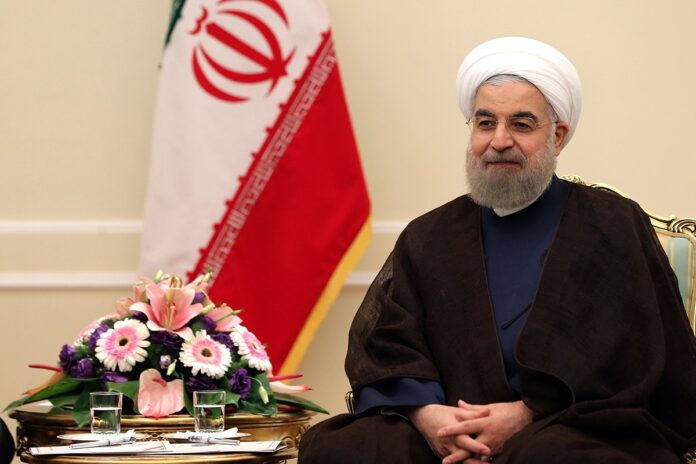
The projects, which were inaugurated by President Rouhani through videoconference calls on Thursday, include the second gas unit of Dalahoo Combined Cycle Power Plant in Eslamabad-e-Gharb County in Kermanshah province.

With a total capacity of 913 MW, the power plant has two 307 MW class F gas units and a 293 MW steam unit.

The plant has an efficiency rate of 56% and domestic manufacturers provided half the equipment used in the plant built for the western regions.

The first 310-megawatt gas unit of the power plant had been launched in December, 2019.

An undertaking of the private sector, the plant is owned and constructed by Farab Company that has built several power plants and is active in oil, gas and petrochemical projects plus construction of water, wastewater treatment and desalination plants.

The other projects launched by the president included the Kalghan Chay reservoir dam in Bostanabad, East Azarbaijan, and a solar power plant in Ardabil.

Iran Offers Sympathy to Pakistan over Flood in Sindh

Iran Offers Sympathy to Pakistan over Flood in Sindh

Zarif expressed his sympathy in a phone conversation with his Pakistani counterpart Shah Mahmood Qureshi on Thursday.

In the phone call, the Iranian top diplomat expressed pleasure with the recovery of Qureshi from COVID-19.

The two sides also conferred on issues related to bilateral ties, the joint commission for Iran-Pakistan cooperation, the Shanghai Cooperation Organization (SCO), the latest developments in Afghanistan as well as the issue of Kashmir.

Karachi, the capital and largest city of Sindh province, experienced its heaviest rains in almost a century, killing at least 41 people.

Flooding that resulted has completely inundated several neighborhoods, with the country’s National Disaster Management Agency (NDMA) saying that hundreds of thousands of people are still trapped due to waterlogging in low-lying slums.

Citizens were left without electricity and mobile phone connection as a result of the flooding.

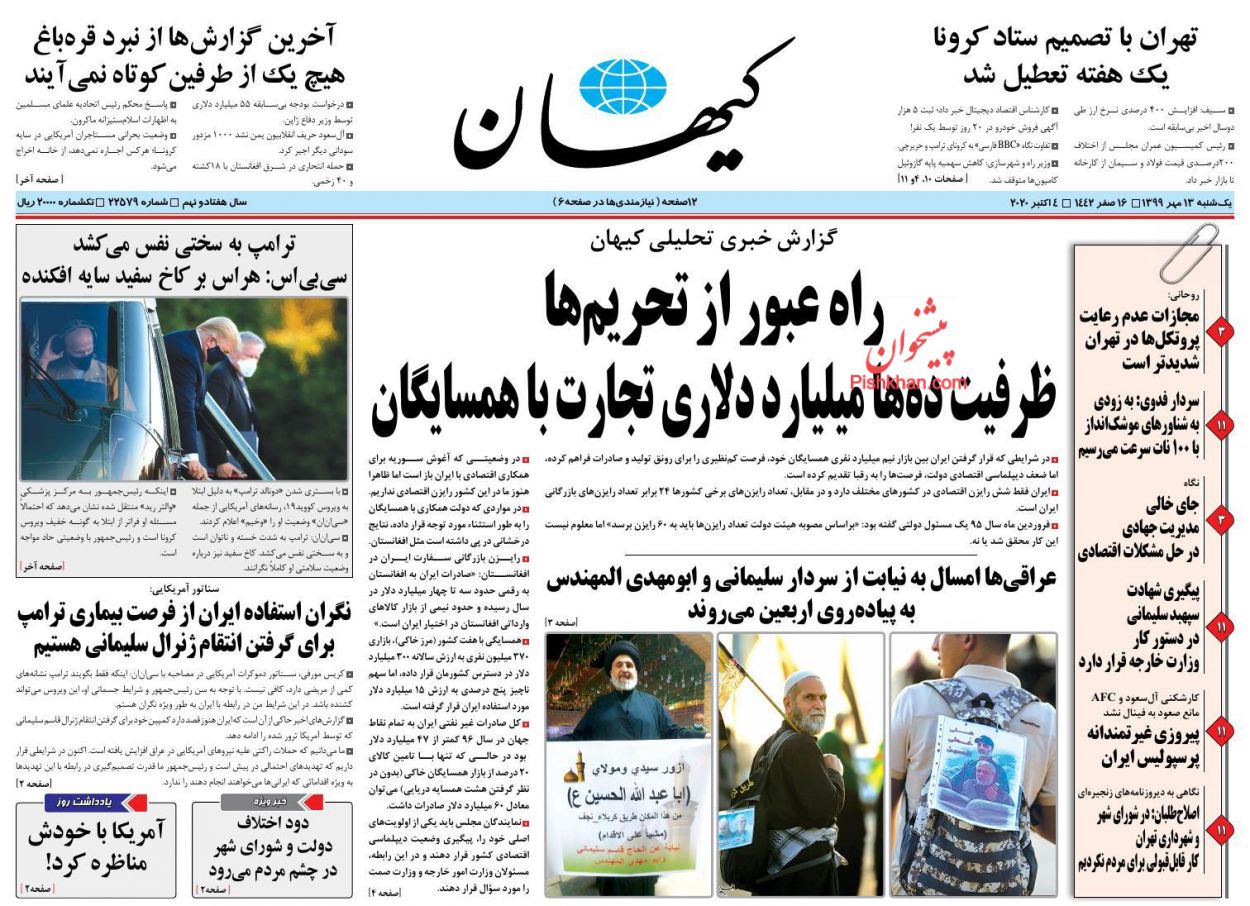
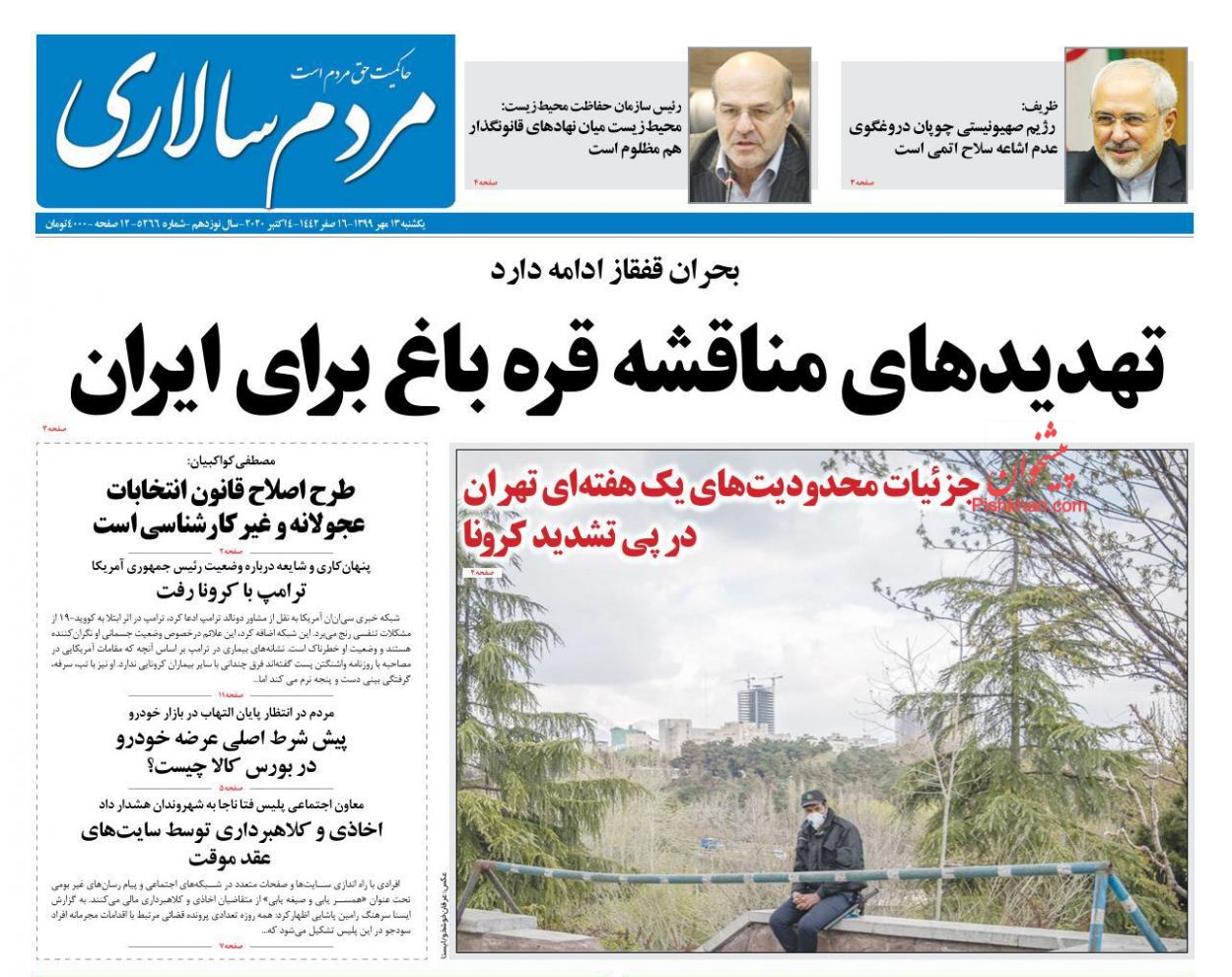
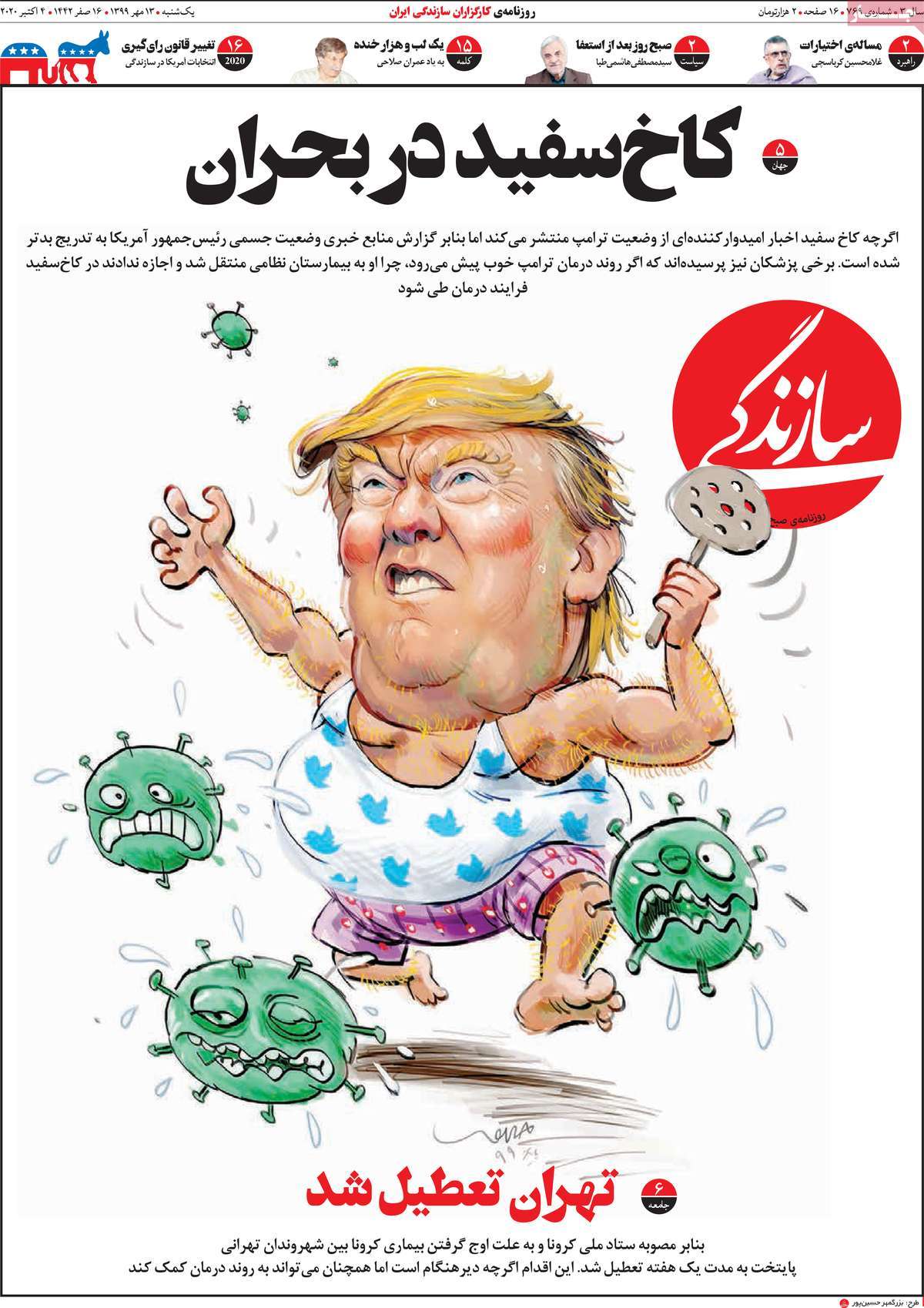
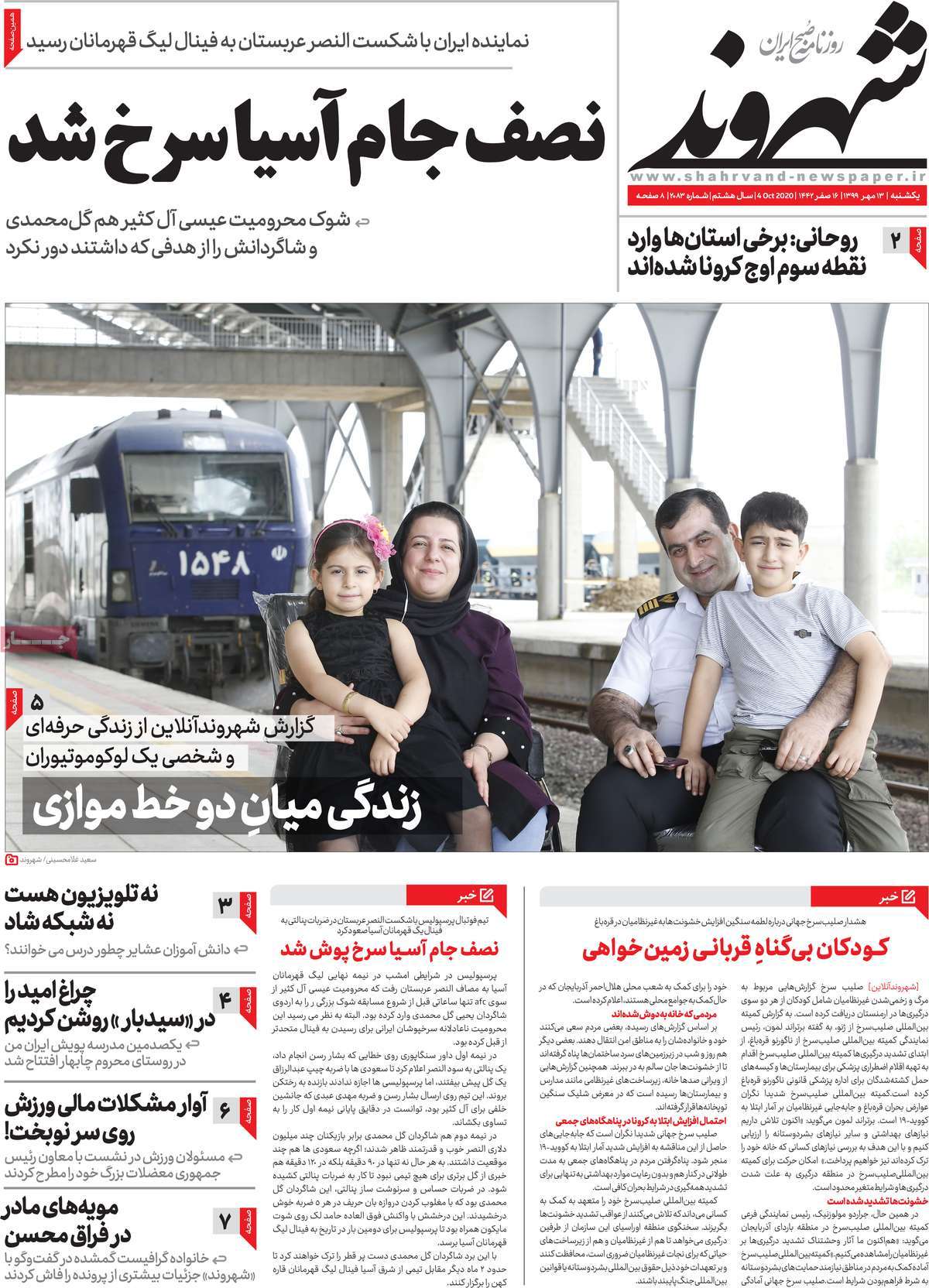
A Look at Iranian Newspaper Front Pages on September 3

Iranian Newspapers

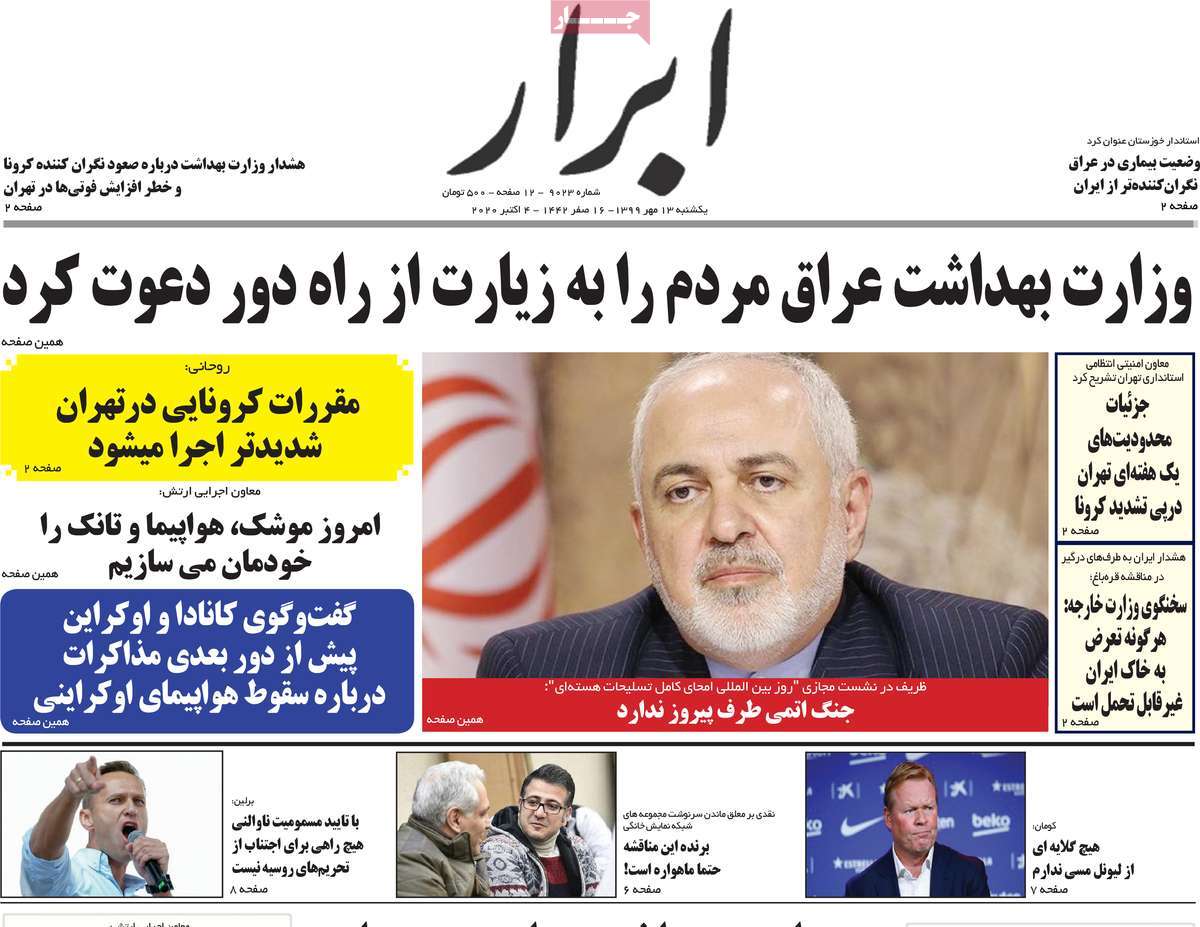
Abrar Newspaper:

1- EU Sanctions against Russian Nationals to Be Extended for 6 Months

2- Araqchi: Parties to JCPOA All Agree on Countering US Law-Breaking

3- Macron to Meet with Top Shiite Cleric Ayatollah Sistani in Najaf

4- Turkey Attacks Erbil, Duhok of Iraq

A Look at Iranian Newspaper Front Pages on September 3


Afkar Newspaper:

1- Iran’s Air Defence Can Destroy Any Target: General

2- Iran’s Airports to Become Smart in Order to Contain Coronavirus: Official

A Look at Iranian Newspaper Front Pages on September 3


Arman-e Melli Newspaper:

1- Rouhani Says No Child Should Be Deprived of Education as Digital Means Are Made Compulsory amid Pandemic

2- JCPOA Parties Vote in Favour of Iran against US

* Schmid: All Parties to JCPOA Stress Maintaining It

A Look at Iranian Newspaper Front Pages on September 3


Ebtekar Newspaper:

1- How Iran’s Exports Shrank to Zero: Why Are Ties with UAE Important to Iran?

2- JCPOA Victory over US in Vienna Front

3- Crises That Decrease Trump’s Chance for Win: 62 Days to US Elections

A Look at Iranian Newspaper Front Pages on September 3


Etemad Newspaper:

1- Iran’s New Presidential Election Law to Be Enforced as of Next Year

* Again No Place for Women

2- France’s Ambitions in Middle East: Macron Seeks New Position in West Asia by Visiting Beirut, Baghdad

A Look at Iranian Newspaper Front Pages on September 3


Ettela’at Newspaper:

1- Zarif: We’ll Spare No Effort in Serving Iran Nation’s Interests

2- Macron: I’ve Come to Iraq to Show My Support During Challenges

A Look at Iranian Newspaper Front Pages on September 3


Jomhouri Eslami Newspaper:

1- UNSC Explicitly Reject US Plan to Trigger Snapback Mechanism

2- Iran Unveils Kashef-99 Radar

3- Iran-China Deal for 25-Year Cooperation Not Possible If Tehran Doesn’t Approve FATF: Expediency Council

A Look at Iranian Newspaper Front Pages on September 3


Kayhan Newspaper:

1- Iraqi Parliament Urges PM to Immediately Expel American Troops

2- 16th Meeting of JCPOA Commission Discusses Everything Except for Lifting of Sanctions!

A Look at Iranian Newspaper Front Pages on September 3


Mardom Salari Newspaper:

1- Zarif Outlines Three Unprecedented Diplomatic Victories for Iran

A Look at Iranian Newspaper Front Pages on September 3


Sazandegi Newspaper:

1- Guardian of JCPOA: Araqchi’s Efforts Convinced JCPOA Parties to Condemn US Unlawful Behaviour

A Look at Iranian Newspaper Front Pages on September 3


Shargh Newspaper:

1- Trigger Mechanism Doesn’t Work for US, Reza Nasri Explains

2- Bin Zayed’s Ambitions for Hegemony over Seven Emirates

A Look at Iranian Newspaper Front Pages on September 3

Iran’s Coronavirus Cases Hit 380,000: Health Ministry

Iran Confirms over 3,500 New Cases of COVID-19 Infection

In a press briefing on Thursday, Sima-Sadat Lari said the virus has killed 129 patients since Wednesday noon, increasing the overall death toll to 21,926.

So far, she added, 328,595 patients have recovered from the disease or been discharged from the hospital.

Lari said 3,702 patients are also in critical conditions caused by more severe infection.
The spokeswoman noted that 3,307,383 COVID-19 tests have been taken across the country so far.

She said the high-risk “red” zones include Tehran, Qom, Mazandaran, East Azarbaijan, Isfahan, Yazd, Khorasan Razavi, North Khorasan, Semnan, Gilan, Zanjan, Qazvin, and Kerman provinces.

The “orange” zones also include Lorestan, Ardabil, Golestan, Markazi, Alborz, Hormozgan, Ilam, Fars, Bushehr, West Azarbaijan, Chaharmahal and Bakhtiari, Kermanshah, South Khorasan, Kohgiluyeh and Boyer-Ahmad, and Khuzestan provinces, she added.