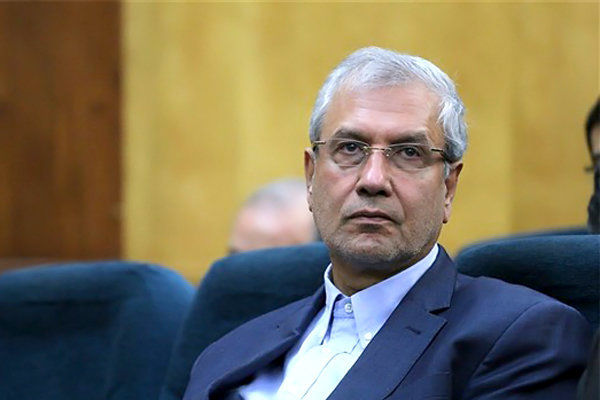
“We hope the US will not make a new strategic mistake, and if it makes any strategic mistakes, Iran’s resistance [front] will give an appropriate response,” Ali Rabiei said while slamming Washington’s policies against Iran.
Rabiei also lashed out at US President Donald Trump for making unfounded remarks about Iran.
“In the first place, it is regrettable that the president of a country which claims to be handling world management and order is making such baseless, straightforward, distorted and probably dictated comments,” he said.
“If you look at this text, you will realize that it is not based on a report by a foreign policy apparatus or an intelligence service. It is simply a hasty reaction to something heard on the grapevine,” the president said.
He said unsubstantiated claims by US officials also touched off the conflicts in Iraq and Afghanistan.
“Our historical experience in our region also shows that remarks by the US government based on distorted reports triggered the wars in Iraq and Afghanistan. We saw that the US started the Iraq war based on unfounded comments, and at the end US authorities announced that they had found nothing in Iraq (WMDs),” he said.
“Unfortunately, this is a common practice by the US, especially by the incumbent American president, which only stirs up tension in the region and upsets the psychological calm across the world,” he said.
“Such moves could only be a propaganda and election ploy. We urge Washington to avoid new adventures, not to provoke killings and not to disrupt psychological tranquility in the region to win the upcoming presidential election,” he added.
“Such a move is unforgivable and amounts to a betrayal of humanity.
He also touched upon Washington’s assassination of top Iranian general Qassem Soleimani.
“This disgrace cannot be obliterated and the Iranian nation will never forget this,” he added.
Director General of the Arab and African Bureau of the Trade Promotion Organization of Iran, Farzad Piltan, said the forum will be held on October 3 to discuss plans to boost the export of Iranian construction materials and equipment to the African countries.
The event is part of the plans devised by the Trade Promotion Organization to help the Iranian producers and exporters find new markets given the African nations’ needs and Iran’s capacity for the export of construction materials and equipment, he noted.
Piltan said the forum would be attended by the Iranian private companies and representatives of government organizations, such as the Foreign Ministry, the Ministry of Road and Urban Development, the chambers of commerce, the unions, and the freight transport companies.
He finally expressed hope that close interaction with the embassies of Iran in the African countries would help the Iranian and African business people and markets to get acquainted with each other and would raise the trade ties with Africa to the pre-coronavirus levels.
In an Instagram post on Monday, Abdolnasser Hemmati pointed to the statistics for Iran’s economic growth in the first quarter of the current Iranian year (March 20- June 20), saying the initial report from the Central Bank indicates that the country’s economy is on track to regain balance after the coronavirus shock.
“The country’s economic growth is promising in comparison with the countries that have not faced any sanctions and their economies have been struggling only with the coronavirus,” the top banker said.
The figures show that Iran’s oil-free economic growth in the first quarter of this year stood at minus 0.6 percent, while the economic growth with oil was minus 2.8%, he explained.
The oil-free economic growth rate results from a 3.8% growth in the agriculture sector, 2.5% increase in the industries and mines, and minus 1.6% growth in the service sector, Hemmati added, noting that the negative growth in the latter sector is caused by the coronavirus-related health restrictions.
He finally noted that the negative economic growth with oil incomes compared to the corresponding period a year before is natural and attributed to the pressure of sanctions and a decline in global oil demands due to the outbreak of COVID-19.
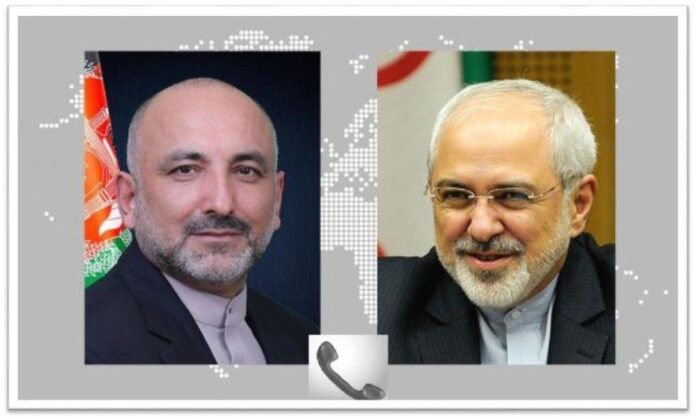
In the telephone conversation, Foreign Minister Zarif and Hanif Atmar talked about the latest status of negotiations among the Afghan parties within the framework of the peace process and the role of the neighbouring countries in the process.
The two senior diplomats also discussed the issues relating to bilateral relations between Iran and Afghanistan in various fields within the context of the comprehensive document on strategic cooperation.
During the phone call, Foreign Minister Zarif expressed satisfaction with the launch of intra-Afghan negotiations and voiced Iran’s readiness to provide whatever help necessary for the peace process in Afghanistan.
Tehran has already reaffirmed its commitment to supporting the peace process in Afghanistan under the guidance and ownership of Afghan people, expressing hope that the intra-Afghan dialogue would yield results with the inclusion of all Afghan groups.
In comments on Tuesday, Iran’s government spokesman Ali Rabiei said Tehran welcomes the beginning of intra-Afghan dialogue between the Afghan government, the country’s political groups and the Taliban.
“Iran hopes that the talks will yield its desired results without foreign interference and in a context of comprehensive understanding among Afghans, and will result in the establishment of permanent peace and stability in the country and security in the region,” he added.
He also expressed the Islamic Republic’s preparedness to use its maximum capacity to advance the peace process if the Afghan government and other parties involved would ask.
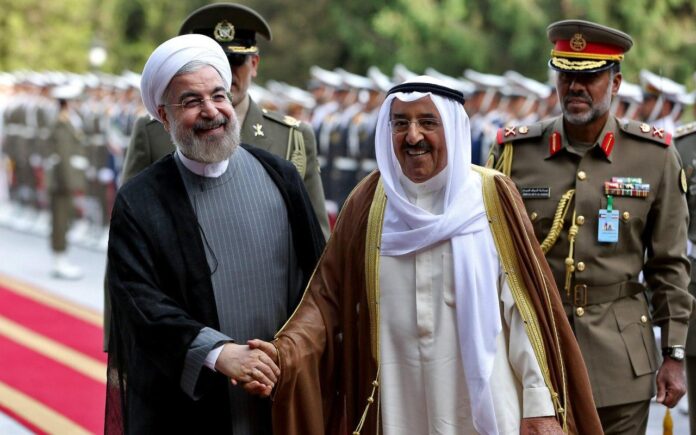
Kuwait's emir Sheik Sabah Al Ahmed Al Sabah, right, shakes hands with Iranian President Hassan Rouhani, left, during an official reception ceremony at the Saadabad Palace in Tehran, Iran, June 1, 2014. / Photo by AP
Seyyed Hadi Borhani, a professor of Israel Studies at Tehran University, says the always-negative approach adopted by Iran so far has led Israel to introduce Tehran as an enemy of the Arabs. It’s time for Iran to praise Kuwait and even Saudi Arabia for not joining the trend of making peace with Israel, which is considered a joint enemy of the Muslim world.
What follows are highlights of the remarks he made in a recent interview with Iranian news website Entekhab:
Kuwait is a small country on the shores of the Persian Gulf, surrounded by several major countries in the region including Iran, Saudi Arabia and Iraq. The total area of this Arab country is about 17,000 square kilometres, which is a small figure compared to the 1.5 and 2 million square kilometre areas of Iran and Saudi Arabia. The population of Kuwait, in proportion to its area, is not comparable to the population of its neighbouring countries.
The power of the neighbours has always been a concern for this small country and has led Kuwait to make an alliance with great world powers and a security and military coalition with them. In fact, if there was no such alliance, Iraq (which occupied Kuwait in 1990) would have swallowed and digested it by now.
Despite Kuwait’s small size and limited power and its vulnerability to pressure from major powers (especially the United States), it pursues an independent policy towards Palestine, which is admired by observers and analysts. The latest example of this courageous and principled policy is Kuwait’s stance on the UAE-Israel compromise. At this point, Kuwait opposed the policy of normalisation of ties with Israel and the passage of Israeli planes over the country, declaring that it would be the last Arab country to establish relations with Israel.
The Kuwaiti parliament also criticised the UAE-Israel agreement. Kuwait’s position on the UAE agreement can be considered the best position adopted in the Persian Gulf Cooperation Council and probably the most independent position in the entire Arab world.
Kuwait’s position on this issue is even stronger and more serious than the positions of Iran’s allies and members of the Axis of Resistance, including Iraq, Syria and Lebanon.
The independent and free positions of Kuwait on the Palestinian issue are not limited to this and are rooted in the history of this country. The positions of the Kuwaiti government and its parliament have always been considered as free positions on this issue during the past years.
Shortly after Donald Trump’s move to propose the deal of the century, Speaker of the Kuwaiti parliament, Marzouq al-Ghanim, said at a meeting of Arab Parliaments in Jordan that “In the name of the Arab nation, I declare that the deal of the century is born dead and its real place is the dustbin of history.”
The anti-Israel stance of the Speaker of the Kuwaiti Parliament is not limited to this and has a long history. Marzouq al-Ghanim is perhaps the most active and serious speaker of the world parliament against Israel’s policies.
The importance of this Kuwaiti policy becomes clear when we consider the country’s inability to provide security using its own limited domestic resources, as well as its dependence on US and Western powers for its security. Also, consider the relatively bad behaviour of some Palestinian organisations towards Kuwait during the occupation of this country by Iraq. Unfortunately, these organisations committed a shameful mistake by supporting Saddam’s regime during the occupation. That came as, throughout its history Kuwait has always supported the Palestinian liberation and has hosted about half a million Palestinian refugees and displaced persons.
Given these facts, Kuwait’s resistance to the US pressure, as well as its move to forgive Palestinian organisations and the continuation of an independent policy based on support for the Palestinian cause and people, can be considered a historic move.
A fundamental question regarding Kuwait’s policy towards Palestine is why and how Kuwait is supporting their cause. What are the reasons or factors that differentiate Kuwaiti policies from the policies of other countries in the region, especially the UAE, Bahrain, Oman and Saudi Arabia?
Answering this question requires independent research, but it seems that the influence of several factors in this case is clear. In addition to the experience, foresight and maturity of the Emir of Kuwait, who has always been praised by many leaders in the region, including Hezbollah leader, Sayyed Hassan Nasrallah, two important factors seem to be effective in this regard:
First, Kuwait is superior to all Persian Gulf Cooperation Council countries in terms of democracy and democratic governance.
Kuwait’s parliament is a serious, old and deep-rooted assembly that can represent a significant part of the Kuwaiti people and their demands and opinions.
The history of the Arab Middle East clearly shows that wherever the views of the people and their will have been the focus of attention, respect and influence, any interaction with Israel has been opposed.
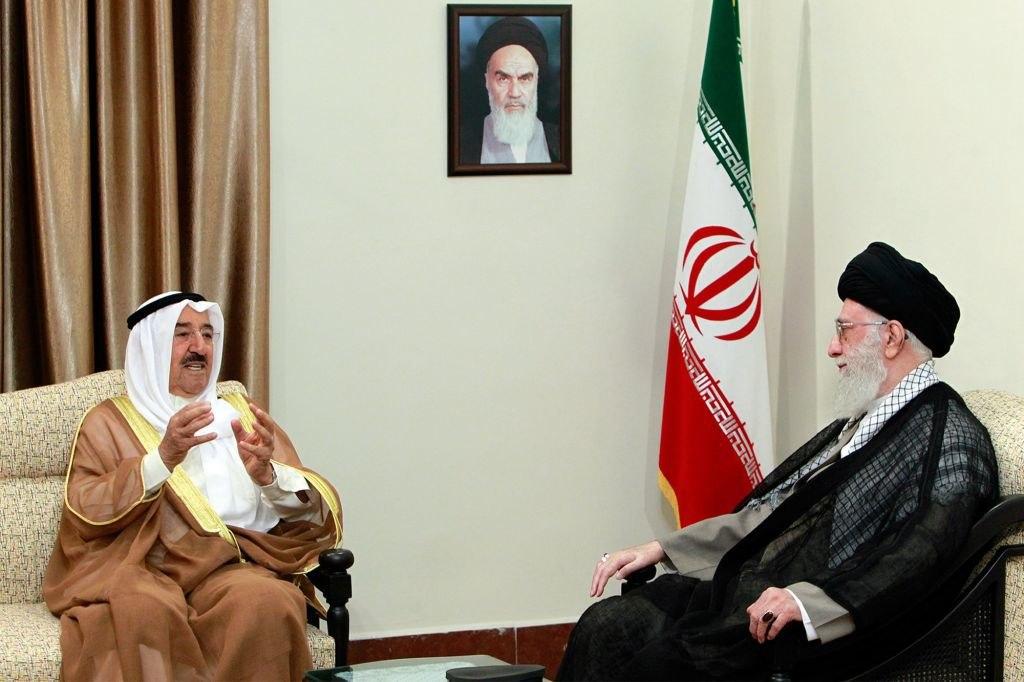
Kuwait’s emir Sheik Sabah Al Ahmed Al Sabah, left, meets with Iran’s Leader Ayatollah Seyyed Ali Khamenei in June 2014.
The second factor is probably the high level of education in Kuwait. Kuwait is a country that has been paying serious attention to the issue of education and culture for many years, and therefore its benefit from science, art, and expertise is commendable and undeniable. Therefore, one can expect the people of Kuwait and its elites to know the history of the region, the history of Palestine and the policies of Israel more deeply and accurately than other nations in the region do.
For this reason, Kuwait has nurtured numerous writers and elites who have been prolific and influential in various fields, including the study of Palestine.
In comparison, the UAE does not have these two factors. It does not have a serious democracy, nor does it benefit from Kuwait’s public knowledge of the Palestinian issue.
Iran’s Stance on Arabs’ Normalisation of Ties with Israel
After the ill-fated move of the United Arab Emirate in establishing relations with Israel, The Islamic Republic of Iran adopted a decisive and calculated policy to put pressure on the UAE and condemn it for making such a decision. This action by Iran is necessary, but may be insufficient.
Iran has a long history of condemning such acts and putting pressure on Arab countries. Almost all of Iran’s interaction with the subject has been a negative one. The positive dimension of this policy does not seem to resonate much in Iranian policies of dealing with Arab countries. This has made Iran’s official policy to seem like an anti-Arab one. It is as if Iran is looking for an excuse to denounce the Arab countries and their positions. This has helped Iran’s regional enemies or rivals to abuse the situation and portray Iran’s regional policy as an anti-Arab one.
Israel is trying hard to convince the Arab countries that Iran is the enemy of the Arab states and unfortunately (to some extent) it has succeeded in doing this. Iran’s positive interaction with positive and constructive positions of Arab countries, such as Kuwait’ policy regarding Palestine, can neutralise these efforts and put Iran’s regional policy in a reasonable and balanced direction.
This policy could encourage other Arab countries to follow the Kuwaiti-Qatari model of relations with Iran and take a stand against Israel.
At present, there seems to be some kind of inattention to such a policy, and the Islamic Republic’s regional policy is pursued more through pressure and coercion. For example, in the wake of the UAE-Israel compromise, Saudi Arabia has shown considerable resistance to the US and Israeli pressure to join Abu Dhabi and the peace agreement. Perhaps this policy should have been met with limited encouragement or a specific reward.
Contrary to this expectation, the attacks of the allied forces of Iran (the Ansarullah of Yemen) against the Saudi positions increased during this period and a heavy attack was carried out against the Abha airport in Saudi Arabia. Due to Riyadh’s resistance against the US pressures, Iran-backed forces could wait until the Arab League summit.
This patience, along with sending the necessary messages, could have encouraged Saudi Arabia to resist more (against US pressure) and play a positive role in the Arab League summit. Had such a move taken place, the possibility of taking a tougher stance against US pressure and taking a softer stance against Iran at the summit would have increased.
This problem (tendency to deal negatively with Arab countries) in Iran, of course, is not limited to the government and official bodies. It has been seen many times that as soon as a mistake is made by an Arab country, it is severely attacked by the public and media. Arab embassies in Tehran have been attacked, flags set on fire, or rallies have been held against Arab rulers.
However, a rally in praise of a right action or an admirable stance of an Arab country has never been held in Tehran.
Hoping for such a day, the author of this text offers a wreath on the occasion of Kuwait’s independent and courageous stance on the Palestinian issue.
Rabiei made the remarks in response to a question, raised in his weekly press briefing on Tuesday, about the US administration’s competence to lead the Afghan peace process considering the country’s history in Afghanistan.
The spokesman said the US invaded Afghanistan on the pretext of establishing security and fighting narcotics in the country. However, they have failed in both missions as admitted by American officials and commanders and their European partners.
“Now we are witnessing the growing presence and activity of ISIS in that country,” he added.
Rabiei said Iran views the presence of foreign forces in Afghanistan as one of the main reasons for the continuation of war in the country, and believes that the responsible withdrawal of these troops can serve as a major step to create peace and security in Afghanistan.
In Iran’s view, he said, the US-Taliban negotiations are not equal to Afghan peace talks. However, Iran would not oppose any move that would contribute to establishment of peace in Afghanistan.
Rabiei said Tehran welcomes the beginning of intra-Afghan dialogue between the Afghan government, the country’s political groups and the Taliban.
“Iran hopes that the talks will yield its desired results without foreign interference and in a context of comprehensive understanding among Afghans, and will result in the establishment of permanent peace and stability in the country and security in the region,” he added.
He also expressed the Islamic Republic’s preparedness to use its maximum capacity to advance the peace process if the Afghan government and other parties involved would ask.
In a press briefing on Tuesday, Sima-Sadat Lari said the virus has killed 140 patients since Monday noon, increasing the overall death toll to 23,453.
She said 407,353 patients have contracted the novel coronavirus so far, including 2,705 new cases identified in the past 24 hours.
Lari said 3,811 patients are also in critical conditions caused by more severe infection.
The spokeswoman noted that 3,613,891 COVID-19 tests have been taken across the country so far.
She said the high-risk “red” zones include Tehran, Qom, Mazandaran, East Azarbaijan, Isfahan, Yazd, Khorasan Razavi, North Khorasan, Semnan, Gilan, Zanjan, Qazvin, and Kerman provinces.
The “orange” zones also include Lorestan, Ardabil, Golestan, Markazi, Alborz, Hormozgan, Ilam, Fars, Bushehr, West Azarbaijan, Chaharmahal and Bakhtiari, Kermanshah, South Khorasan, Kohgiluyeh and Boyer-Ahmad, and Khuzestan provinces, she added.
Speaking at a Tuesday session of the Iranian Parliament, Bijan Namdar Zangeneh said Iran has made considerable progress in the natural gas and petrochemical sector.
He said one of the achievements has been an increase in the production of oil and natural gas in jointly-owned fields.
“The most important fields are the one in the West of the Karoon river and that in South Pars,” he added.
The minister noted agreements have also been concluded to develop jointly-owned oil fields.
He said Iran’s oil exports have also increased four-fold over the past eight years.
“We welcome investment in the petrochemical sector as well,” he noted.
Namdar Zangeneh also touched upon Iran’s efforts to find a way round oil sanctions.
“We sought help from whoever we could in order to avoid sanctions. We are facing an unequal battle against the Iranian nation, and we are at the frontline,” said the oil minister.
He also said projects have been under way to supply natural gas to different parts of the country.