Saturday, December 27, 2025
Home Blog Page 2526

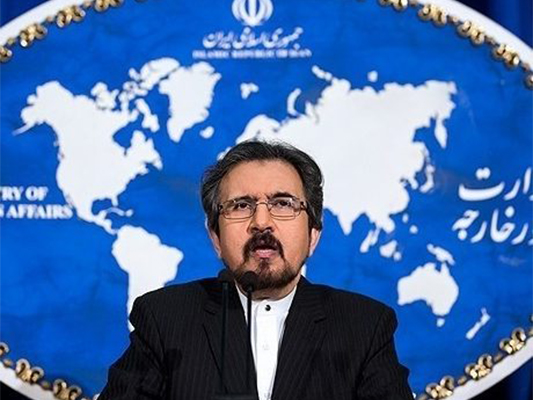
Iran, US Need to Sit for Talks on Selective Issues: Zarif

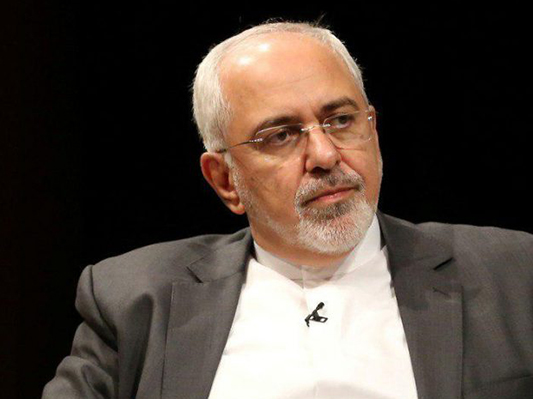
Iranian Foreign Minister Mohammad Javad Zarif (right) speaks in an interview with Etemad newspaper's Sara Massoumi (left)

Speaking in an exclusive interview with the Iranian daily newspaper Etemad, which was published on Saturday, Jan. 23, 2021, Zarif said Iran needs to draw a final shape of the future of its relations with the United States.

“In my personal view, which does not represent the country’s view, we should delineate the final shape of relations with the US. We should tell the US that we won’t cooperate with you on the issue of Israel, and we’ll continue to disagree with you on that. We won’t get along with you on the issue of hegemony, and won’t let you interfere in Iran’s domestic affairs, but we have no problem working with you on the issue of oil,” Zarif said.

“We also have no problem if the Persian Gulf security is ensured [through cooperation], even though we believe foreign presence in the Persian Gulf brings about insecurity, and you [Americans] should not be here.”

“We believe democracy needs to be established in Afghanistan, as we [Iran and the US] reached an understanding in Bonn in 2001, but we believe your presence in Afghanistan is dangerous,” he added.

“We need to have a serious picture of general [outline of relations] in the future with the US, and then hold negotiations [with the US] on issues we decide, not on all issues,” Zarif said.

He said he has never believed in tension and escalation, but he believes Iranian people have an identity to preserve.

“This is a cultural, civilizational, and national identity. National identity does not allow an American to say ‘if I stop supporting Iran for a week, they will be speaking Arabic, Russian or Chinese’,” Zarif said.

Zarif quoted former US secretary of state Henry Kissinger as saying that Iran is heir to the world’s oldest national identity. “This is why we cannot accept that someone rules over us with bullying.”

He said the Americans have been accustomed to dictating their demands to other sides, but that did not happen for them in the case of the 2015 nuclear deal between Tehran and world powers.
“The nuclear deal (JCPOA) was opposed by two groups: Iranians and Americans. Few people had any problem with the JCPOA in Europe. Why? Because Americans are used to dictating their demands whenever they have interaction with someone, but there was no dictation in the JCPOA,” the Iranian top diplomat said.

“Likewise, Iranians are accustomed to resisting, especially after the 1979 revolution. There was resistance in the JCPOA, but its final word was interaction. This was why there was opposition to the JCPOA both in Iran and the US,” he added.

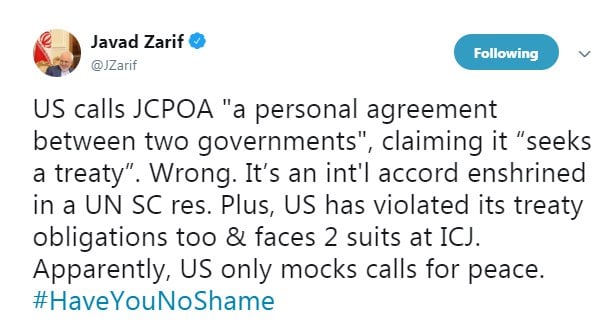
“Where do you think the US’ call for a change in the JCPOA’s timetables or inclusion of regional and missiles issues in the deal comes from? This is exactly where we disagree. It’s because they have a saying which says ‘what’s mine is mine, and what’s yours is open to negotiation’. This way of thinking may work in many parts of the world, but not with Iran.”

No Iranian City in ‘Red’ State: COVID-19 Official

Alireza Raisi said on Saturday the danger level throughout the country has decreased.
“I’m announcing the good news that fortunately there are no “red” towns or cities across the country,” he said.

“The cities in Mazandaran province which were in a “red” state have turned into “orange” ones today.

On the whole, we have around 19 “range” cities, around 157 “yellow” ones and 256 “blue” ones, and we can be happy about this,” the spokesman added.

“But I need to seriously remind you that there were some violations of health protocols as were there last week. There were reports from different cities of numerous cases of failure to comply with the protocols,” he added.

“One of the cities where health protocols were breached was Kashan where the necessary warnings were given. I hope they will begin to strictly abide by the protocols again,” he said.

Daily Rise in Iran’s COVID-19 Fatalities Down to Lowest Since June 7

In a press briefing on Saturday, Health Ministry spokeswoman Sima-Sadat Lari reported 6,207 new cases of COVID-19 infection, raising the total number of cases to 1,367,032.

So far, Lari added, 1,158,475 patients have recovered from the disease or been discharged from the hospital.

Lari said 4,106 patients are also in critical conditions caused by more severe infection.

The spokeswoman noted that 8,850,281 COVID-19 tests have been taken across the country so far.

She said currently 18 cities are in the “orange” zone, 154 are in the “yellow” zone, and 276 are in the “blue” zone in terms of coronavirus outbreak.

Iran’s Air Industry Made Considerable Progress despite Sanctions: DM

Brigadier General Amir Hatami made the comment while inspecting the process of building the second one of an advanced training jet plane named Yasin.

“During this visit, we are witnessing progress, innovation and new activities, and this forward-moving drive is based on the solid foundation laid in the past,” he noted.

“Any time the enemies sought to impose more restrictions, our industries moved toward more self-sufficiency and progress,” said the top general.

“It has been years that the air industry has been under tough and heavy sanctions, but has always manifested self-sufficiency with dynamism and self-confidence, and the air industry is really a clear example for the Armed Forces and the nation when it comes to countering sanctions,” he added.

He echoed remarks by Leader of Iran’s Islamic Revolution Ayatollah Seyyed Ali Khamenei that although sanctions created some problems, they led Iran to pay more attention to its domestic potential and capabilities.

“That is why today, despite what enemy wants, Iran is by far stronger that what it was in the early years following the revolution,” he said.

Iran Opens Auto Spare Parts Innovation Centre

The centre was inaugurated in a ceremony attended by Vice President for Science and Technology Sorena Sattari.

During the ceremony, he highlighted the importance of innovative moves by knowledge-based companies in the auto industry.
He said the fine line between owning a factory and an industry is the ability to design, manufacture, optimize and develop.

“These capabilities materialize only by opening the doors to innovation and welcoming innovative knowledge-based companies and start-ups,” he said.

The top official noted local knowledge-based companies are capable of producing auto software and parts.

The newly inaugurated spare parts industry innovation centre employs nearly 13,000 people.

Zarif to Visit Baku, Moscow, Yerevan, Tbilisi, Ankara in Regional Tour

Iran’s Foreign Minister Leaves Turkey for Russia

Saeed Khatibzadeh said the top Iranian diplomat, heading a delegation, is to visit the Azerbaijan Republic, the Russian Federation, the Republic of Armenia, the Republic of Georgia and the Republic of Turkey where he will sit down with his opposite numbers as well as other officials of those countries.

During his meetings, Zarif is to discuss bilateral issues, the latest developments in the Caucasus region, joints projects underway and ways of promoting peace and stability in the region, the spokesman added.

Iran to Conduct Closer Monitoring to Stem New COVID-19 Surge

President Hassan Rouhani said if a new wave of the disease hits the nation, businesses will be shut and restrictions will be imposed again.

“All of us should prevent a new wave of the disease in the country,” he said on Saturday.

Meanwhile, the president said a drop in fatalities from COVID-19 is a source of pride for the Iranian government and people.

He said the declining trend of infections came on the back of efforts by all and abidance by health instructions.

However, he expressed concern about a rise in the number of cases among the youth.

He said despite a drop in fatalities, two-digit figures for deaths are still a considerable statistic, and the declining trend should continue.

“We should keep closely observing health protocols for at least five or six months, so that the decline in the trend of the disease and the decrease in the death rate will continue,” he said.

The president said reports suggest that not only has the novel coronavirus not weakened across the world, but also its pathogenecity, transmission and danger levels have increased.

“In order to keep the new virus from entering the country from Europe and Africa, it is necessary that airports and all the country’s entrance points be carefully controlled,” he said.

President Rouhani then touched upon the national coronavirus vaccination drive and said efforts are being made to launch the inoculation process in the country in coming weeks.

Iran’s Production of Household Items Rises Considerably despite Sanctions: Minister

Iranian Minister of Industry, Mine and Trade Alireza Razmhosseini said domestic production of household items doubled at certain points.

“Sanctions, which created restrictions and problems, prompted the country’s home appliances sector to register a 48-percent growth over the past nine months compared to the similar period last year,” he said in a Saturday ceremony.

“The production of some home appliances has increased by up to 100% compared to the time before sanctions were imposed.”

“This is very good news. Domestic production has increased a lot. Based on a report, around 40% of spare parts are produced inside the country,” the minister explained.

Meanwhile, officials say the production of household products has increased both quantitatively and qualitatively.

“Our output capacity is 1,000 units per day. Energy-efficiency is one of the features of the product. We worked on the A+ category. It is the first time that we have domestically produced four-door fridges,” said a senior manager present at the same ceremony.

Iran’s Oil Exports Hit Record High amid Sanctions: Minister

Bijan Namdar Zangeneh said the achievement was a blow to those who wished to stop Iran’s petroleum exports.

“Our exports of oil products set a record in the history of our oil industry during the time we were under sanctions,” he said.

“Our enemies as well as Trump were seeking to destroy us. They wanted to bring our exports to zero, but it didn’t happen. Neither our non-oil exports, nor our exports of oil and oil products reached zero. … So, their intention of making Iran’s oil exports reach zero boomeranged on them,” he added.

“I cannot announce the figures now, but their intention backfired, and efforts by our colleagues not only kept Iran’s oil exports from reaching zero, but resulted in considerable figures,” the minister explained.

“They, including Trump, Pompeo and their criminal thoughts, died and were thrown into the dustbin of history, but we are alive, we are here, and will help build our country with more hope,” the oil minister said.

Elsewhere in his remarks, Zangeneh said Iran, during the past three years when it has been under sanctions, made every attempt to make investments in the oil industry.

“Over the past two or three years, we had serious shortage of resources for investment. So, many of our investment programs were delayed. But we tried to keep moving through methods such as attracting resources from the capital market in order to protect the country’s resources and keep them from being wasted,” he noted.

Iran Allots $10 Billion to Support Local Producers

Deputy Minister of Industry, Mines and Trade Mahdi Sadeqi said the move is aimed at making the local market more accessible to domestic producers.

“A major part of the foreign currency problems of producers have been settled over the past two months,” he said.

He added the ministry has adopted policies to further encourage foreign investment in the country.

He said one of the priorities of the ministry is to boost national brands.

Sadeqi noted several domestic producers of household appliances are designing new products to be able to compete with foreign commodities on world markets.