Tuesday, December 23, 2025
Home Blog Page 250

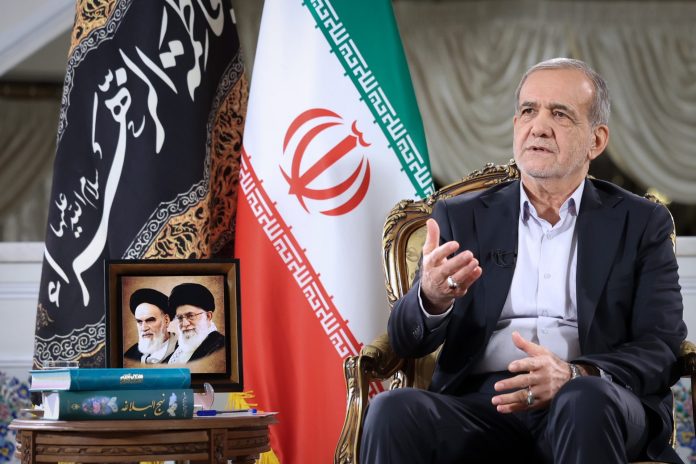
Iran’s president calls Israel project of imperial hegemony in region

In a meeting with Iraqi Minister of Interior Abdul Amir Al-Shammari in Tehran on Tuesday, President Pezeshkian said that Iran and Iraq must stand united against such a common enemy, support one another, and avoid division.

The president further described the relations between the two neighboring countries as brotherly and based on deep religious and cultural ties.

“We consider the government and people of Iraq and other Islamic countries as our brothers and will continue our efforts to strengthen unity, cohesion, and brotherhood among the Islamic community,” he added.

President Pezeshkian expressed gratitude for the hospitality of the Iraqi government and people towards Iranian pilgrims during the Arbaeen pilgrimage.

He expressed hope that the coordination between the two countries to facilitate the Arbaeen ceremony will become a turning point for cooperation in other areas, including activating border markets, joint investments, and academic exchanges.

The Iraqi minister, for his part, conveyed warm greetings from Prime Minister of Iraq Mohammed Shia’ al-Sudani to President Pezeshkian and congratulated the resistance of the Iranian people against the Zionist enemy.

He elaborated on the Iraqi government’s efforts to provide the necessary facilities for hosting millions of pilgrims during the Arbaeen pilgrimage, particularly in the areas of transportation, healthcare, and security.

Al-Shammari stated that the Iraqi government is utilizing all its capacities to hold this religious ceremony magnificently, and these actions and coordination will continue until the last pilgrim leaves the country.

Senior Iranian MP: No return to nuclear talks without UN condemnation of Israeli attacks

Araghchi Witkoff

Esmaeil Kosari, who is a member of the Iranian Parliament’s National Security and Foreign Policy Commission, told Lebanon’s Al-Mayadeen TV that Iran never abandoned the negotiating table. “It was the other side that violated agreements and even attacked Iran”, Kosari added. He said under such circumstances, talks cannot continue unless Iran’s conditions are met.

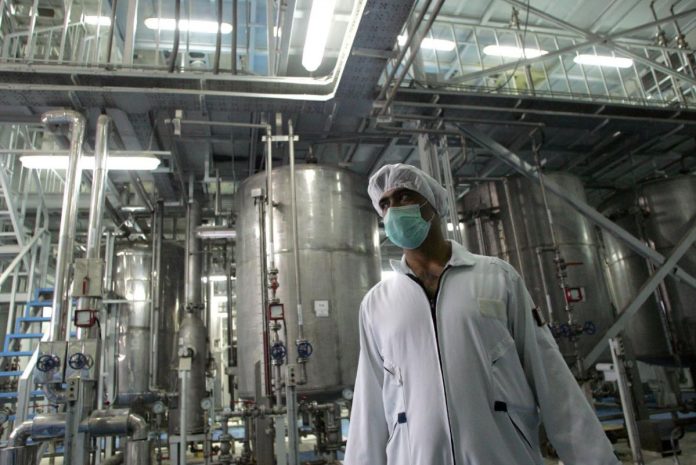
Kosari stressed that Iran will never halt its uranium enrichment, calling it a sovereign right and part of a purely peaceful program developed by Iranian scientists.

“No country can decide for Iran…we will never accept zero enrichment, and no one has the right to dictate terms on us”, the MP said.

Referring to the IAEA’s inspections, Kosari said the agency itself has confirmed there has been no deviation in Iran’s nuclear program.

He however accused some international bodies of misusing inspections to pressure Tehran.

“Iran’s cooperation with the IAEA will only resume when it stops its biased behavior,” said Kosari.

The lawmaker further touched upon the future of nuclear negotiations. Kosari said first, the UN and IAEA must condemn the Zionist regime’s aggression against Iran’s nuclear facilities and second, those responsible for the attacks must be held accountable under international law.

He also warned of military readiness on part of Iran.

“Iran will not start a war, but we will determine how it ends if we get attacked”, he said.

Regarding the Strait of Hormuz, Kosari acknowledged military preparations are complete and that Iran keeps on the table the option to close the vital waterway if necessary.

“The decision is ours alone,” he said.

Americans say Trump hasn’t been tough enough on Putin: Poll

Putin and Trump

Those respondents consist of 58 percent independents, 73 percent Democrats and 48 percent Republicans.

Additionally, 53 percent of surveyed voters said they are not satisfied with Trump’s handling of the negotiations between Russia and Ukraine.

“The poll shows a shift in attitudes against Putin and for more support for Ukraine. Putin’s rope a dope strategy is over,” stated the poll’s director, Mark Penn.

On Monday, Trump said the U.S. would impose 100 percent secondary economic sanctions on countries that trade with Russia if Moscow does not agree to a ceasefire in Ukraine in the next 50 days.

Trump has grown increasingly frustrated with Putin as the Russian president continues to fire missiles into Ukraine despite ceasefire efforts.

“The only one we haven’t been able to get to yet is Russia. And I’m not happy. And I will tell you that Ukraine wants to do something,” Trump said on Monday.

“It’s all talk and then missiles go into Kyiv and kill 60 people,” he added. “It’s got to stop. It’s got to stop.”

The Harvard CAPS/Harris Poll survey was conducted July 6-8, 2025, and surveyed 2,044 registered voters. It is a collaboration of the Center for American Political Studies at Harvard University and the Harris Poll.

The survey is an online sample drawn from the Harris Panel and weighted to reflect known demographics. The margin of error is plus or minus 2.2 percentage points.

Families of Israeli hostages reach out to Hamas over fate of ceasefire negotiations: MEE

Israel Hostages

Sources told MEE that the third party reached out to Hamas after the captives’ families feared Israeli Prime Minister Benjamin was trying to torpedo a possible deal.

A senior figure within Hamas told the representative to relay to the families that it was “serious” about reaching an agreement to end the war and release the captives, but that it was facing “intransigent Israeli positions”, sources told MEE.

“Hamas is serious about reaching an agreement to end the war and establish arrangements that ensure calm and stability. It has demonstrated significant flexibility and positive responsibility during the negotiation rounds,” the sources quoted Hamas as saying.

“Israel has insisted on continuing the war, destroying the Gaza Strip, displacing its population, and imposing a state of hunger, suffering, and ongoing massacres that have not ceased for a single day.”

Hamas and Israel reached a brief three-stage ceasefire in January, but the deal collapsed in March after Israel took back several of its captives and resumed bombing Gaza, walking away from the deal before talks with Hamas on a permanent end to the war could start.

Since then, the Donald Trump administration has given Israel full backing to wage war on Gaza.

According to sources, the Hamas official told the representative that the Palestinian movement had complied with “everything stipulated” in the first phase of the previous ceasefire, which was supposed to transition to phase two talks on ending the war.

Before withdrawing from the ceasefire, Hamas announced that Israel committed “hundreds of violations”, including deploying troops beyond “buffer zones”, killing 132 civilians, preventing the inflow of reconstruction material, and remaining in the Philadelphia Corridor that separates Gaza from Egypt.

Hamas reportedly told the representative that despite Israel unilaterally resuming the war, it responded to proposals by mediators to revive the ceasefire, “but Israel rejected them and insisted on releasing half of the Israeli prisoners without offering any guarantees that the war would cease. In fact, it openly insisted on its continuation”.

As it stands, there are believed to be around 20 living captives in Gaza and just over 30 dead Israelis. Since the 7 October 2023 attacks on southern Israel, the military has only rescued eight captives in raids that have seen hundreds of Palestinians killed.

In their conversation, Hamas also told the representative to relay to the captives’ families that Israel had “without any justification, returned to war in a shocking, more brutal, and more destructive manner than before, committing massacres on a daily basis.”

According to sources, the Hamas official told the representative that despite the mounting civilian death toll it had “no problem” with resuming negotiations and had “responded to several proposals presented by mediators, but Israel rejected them and insisted on releasing half of the Israeli prisoners without offering any guarantees that the war would cease.”

Hamas also reportedly told the representative that it was Israeli Prime Minister Benjamin Netanyahu who had “without any justification, returned to war in a shocking, more brutal, and more destructive manner than before, committing massacres on a daily basis.”

The movement added that despite the daily massacres, where on average 100 Palestinians are killed every 24 hours, it had “no problem” with resuming negotiations and “responded to several proposals presented by mediators, but Israel rejected them and insisted on releasing half of the Israeli prisoners without offering any guarantees that the war would cease.”

The group also maintained that it responded positively to US Special Envoy to the Middle East Steve Witkoff’s ceasefire proposal “in order to reach an agreement” but Netanyahu was taking “a hardline stance,” and seeking to control large swathes of the strip and displace more than 600,000 Palestinians.

The sources stated that the Hamas official reiterated that Netanyahu was to blame for the captives’ plight after he “rejected” the group’s offer to release “all Israeli prisoners at once in exchange for ending the war.”

The sources added that Hamas also told the representatives that it was ready to transfer power after the war ends to an “independent, professional committee to govern Gaza with full powers,” and that the group would not play any role in running the enclave.

On Sunday, President Trump said talks on a Gaza ceasefire were going along well, repeating remarks he made a week earlier when Netanyahu visited Washington.

In contrast, MEE reported on Saturday that Hamas negotiators were sceptical that a ceasefire agreement could be reached in the current round of talks in Doha, Qatar.

Sources close to Palestinian negotiators said talks have remained deadlocked over at least two of four key issues.

The first is the extent of the proposed Israeli withdrawal from the Gaza Strip during a 60-day truce. The second is the method of aid distribution.

The US has reportedly proposed postponing discussions on these two points, instead focusing on the names of Palestinian prisoners to be released by Israel in exchange for the remaining Israeli captives.

According to the sources, Hamas told the representative for the captives’ families that it asked to amend three points related to the distribution of aid, the deployment of Israeli soldiers in Gaza and guarantees on ending the war after an initial 60-day truce is over.

“However, Israel has taken a hardline stance, particularly in its redeployment maps, where it seeks to control approximately 36 percent of the Gaza Strip’s area and keep approximately 600,000 residents displaced and unable to return to their homes,” Hamas is reported to have said.

“Israel has repeatedly rejected our offer to return all Israeli prisoners at once in exchange for ending the war. They rejected it and preferred a partial solution. This is a clear indication of their intention to continue the war and their disregard for prisoners as a central issue for Israeli society,” it added.

For more than 21 months, Israel has relentlessly bombed the besieged Gaza Strip, displacing the entire 2.3 million population multiple times, and has killed more than 58,000 Palestinians, mostly civilians.

The figure also includes at least 1,400 health sector professionals, 280 United Nations aid workers – the highest staff death toll in UN history – and at least 228 journalists, with the highest number of media workers killed in conflict since the Committee to Protect Journalists began recording data in 1992.

Washington offers to oversee disputed Armenia-Azerbaijan corridor: US envoy

Although Armenia and Azerbaijan reached consensus on a draft peace agreement in March, Baku continues to insist on several additional conditions before formally signing the deal.

Azerbaijan demands that Yerevan amend its constitution to remove references to Azerbaijani territory, among other conditions.

One of the main sticking points remains the so-called Zangezur Corridor, which would connect Azerbaijan proper to its exclave, Nakhchivan, via Armenian territory.

Armenia refuses to use the term “Zangezur Corridor,” arguing that it has irredentist connotations on sovereign Armenian territory, known as Syunik.

Azerbaijan has insisted that the corridor should not be placed under Armenia’s total control, expressing concerns that Yerevan cannot be trusted to guarantee unfettered access.

Likewise, Armenia categorically opposes transferring control of the route to any third party.

The 32-km-long corridor has become a significant obstacle to achieving lasting peace between Armenia and Azerbaijan.

“They are arguing over 32 kilometers of road, but this is no trivial matter. It has dragged on for a decade – 32 kilometers of road,” Barrack told journalists during a briefing hosted in New York.

“So what happens is that America steps in and says: ‘Okay, we’ll take it over. Give us the 32 kilometers of road on a hundred-year lease, and you can all share it’.”

Barrack’s comments mark the first official confirmation that the Trump administration offered to manage the corridor through a private US commercial operator, which would serve as a neutral guarantor.

A recent report by Carnegie Endowment suggested that the plan is modelled on an earlier European Union proposal, which would put a US logistics firm in charge of managing and monitoring cargo transit along the route, sharing data transparently with all parties.

The report noted that the proposal draws on precedents of international oversight in Georgia’s breakaway regions, aiming to address Baku’s demand for robust, long-term security guarantees while preserving Yerevan’s sovereignty over the corridor.

Meanwhile, Turkey has quietly urged Baku to sign the peace agreement, reminding Azerbaijani officials of shifting regional dynamics, such as Iran’s waning influence.

A regional source familiar with the negotiations told Middle East Eye that it was Turkey that originally proposed the idea of a private company, approved by both Armenia and Azerbaijan, managing the corridor.

“However, the Armenian side demanded that the company should also work on the Nakhchivan side of the corridor, which was unacceptable for Baku,” the source said.

The conflict between Armenia and Azerbaijan dates back to the 1993 Nagorno-Karabakh war, when Armenian forces seized the disputed enclave, recognised as Azerbaijani territory by the United Nations, following the collapse of the Soviet Union.

After a bloody six-week war in late 2020, Azerbaijan launched a military operation in September 2023 to retake Nagorno-Karabakh, leading to a ceasefire agreement. Most ethnic Armenians fled, and the breakaway region was officially dissolved on 1 January 2024.

Turkey’s own normalisation process with Armenia is closely tied to the prospect of a peace deal between Azerbaijan and Armenia.

Turkish officials view Armenia as a vital link in the so-called Middle Corridor, which would directly connect Turkey to Central Asia. Turkish companies are also eager to participate in potential infrastructure projects within Armenia.

Despite Baku’s objections, Turkish President Recep Tayyip Erdogan hosted Armenian Prime Minister Nikol Pashinyan last month, marking the first official visit to Turkey by an Armenian leader.

Trump to slam Russia with ‘severe’ 100% tariffs if no agreement is made on Ukraine in 50 days

Trump said on Monday he has struck a deal with NATO to purchase the weapons that will be delivered to Ukraine, as he met NATO Secretary General Mark Rutte in Washington.

“We made a deal today where we will be sending weapons to (Ukraine) and NATO will be paying for it,” Trump announced at a press conference at the White House.

The US is ready to implement 100% tariffs on Russia in response to President Vladimir Putin’s lack of interest in ending his war in Ukraine, which could kick in in 50 days, according to Trump.

“We’re very unhappy with Russia and we’ll be doing very severe tariffs … at about 100%,” Trump said.

“We’ve spent $250 billion on this war … and we want to see it end. I am disappointed in Putin because I thought we’d have an agreement two months ago,” he added.

Trump has publicly expressed irritation with Russian President Vladimir Putin’s reluctance to reach a peace deal in Ukraine, accusing the Russian leader of throwing “bulls**t” at Washington.

“I am very disappointed with President Putin,” Trump said.

“I thought he was somebody that meant what he said. And he’ll talk so beautifully and then he’ll bomb people at night. We don’t like that.”

In an about-turn last week, Trump said that Washington would send sophisticated weapons, including Patriot air defence systems, to Ukraine via NATO.

The Patriot missile system can detect and intercept a wide range of oncoming air targets, high-end ballistic missiles in particular, and is regarded as one of the world’s best, at a time when Moscow is increasing its nightly missile and drone attacks amid its all-out war against Ukraine, now well into its fourth year.

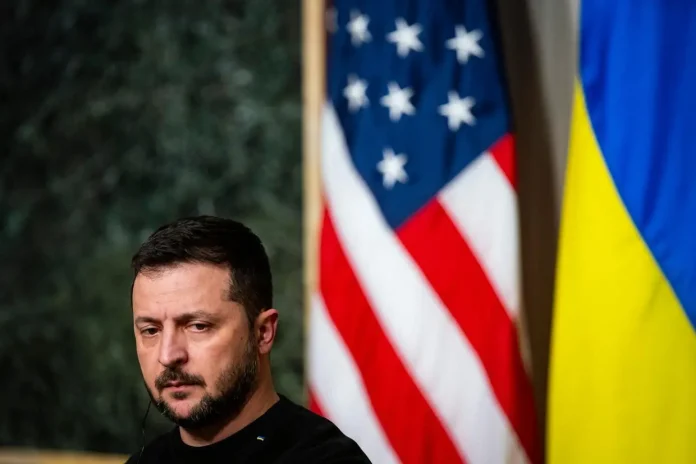
Speaking at the Ukraine Recovery Conference in Rome on Thursday, Ukraine’s President Volodymyr Zelensky said that Germany would pay for two of the systems, while Norway has agreed to supply one.

Other European partners have also said they are prepared to help, Zelensky said.

US Secretary of State Marco Rubio said on Friday that some of the US-made weapons that Ukraine is seeking are already deployed with NATO allies in Europe.

Those weapons could be transferred to Ukraine quickly, with European countries buying replacements from the US, he said.

“It’s a lot faster to move something, for example, from Germany to Ukraine than it is to order it from a (US) factory and get it there,” Rubio told reporters during a visit to the ASEAN summit in Kuala Lumpur.

After repeated Russian drone and missile onslaughts on Kyiv, authorities announced on Friday that they are establishing a comprehensive drone interception system under a project called Clear Sky.

The project includes a 260-million-hryvnia (approximately €5.3 million) investment in interceptor drones, operator training, and new mobile response units, according to Tymur Tkachenko, the head of the Kyiv military administration.

Rutte will be in Washington on Monday and Tuesday for talks with Trump, US Secretary of State Marco Rubio, US Defence Secretary Pete Hegseth and members of Congress.

Over 700 Palestinians killed by Israeli military fire while collecting water in Gaza: Report

“The Israeli occupation continues to wage a systematic and deliberate war of thirst against the Palestinian people in Gaza, in a flagrant violation of all international and humanitarian conventions,” Gaza’s government media office said in a statement.

The office accused Israeli forces of using water as a weapon of war “to deprive the Palestinians of their most basic rights.”

It noted that Israeli army forces had committed 112 massacres against Gazans collecting water, killing more than 700 people, mostly children, since October 2023.

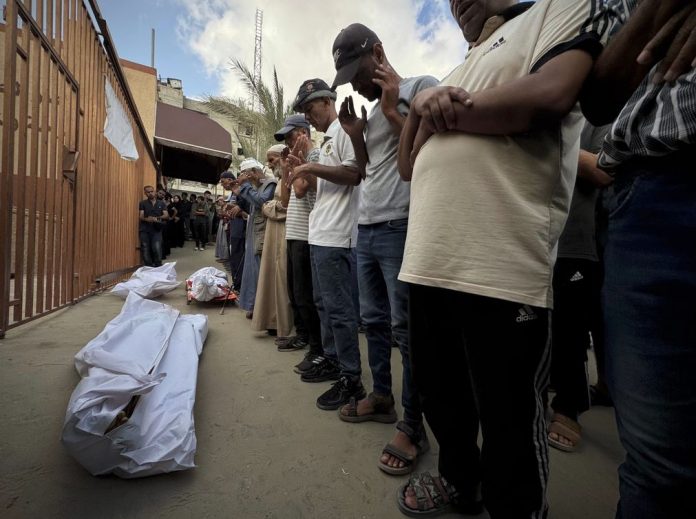
On Sunday, at least 12 people were killed, including eight children, by Israeli fire while waiting to collect water in the Nuseirat refugee camp in central Gaza.

The media office noted that over 720 water wells were deliberately destroyed by the Israeli army in Gaza.

“Attacks on water wells have deprived more than 1.25 million Palestinians of access to clean water,” it added.

According to the statement, the Israeli army has obstructed the entry of 12 million liters of fuel monthly, the necessary amount to operate the minimum number of water wells, sewage stations, waste collection mechanisms, and other vital sectors in Gaza.

“This has caused a complete paralysis in water and sewage networks and the spread of epidemics, mainly among the children,” it added.

The media office called on the international community and human rights organizations to take immediate action to stop Israel’s systematic and deliberate use of water as a war weapon and allow the necessary amount of fuel and heavy equipment to reoperate water wells and drainage stations.

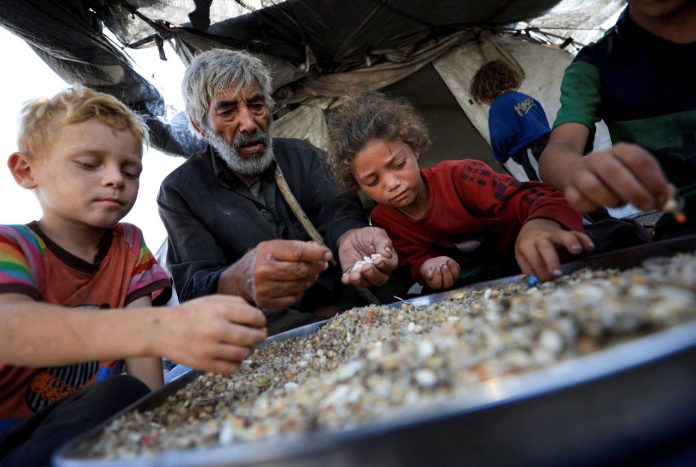
Israel has kept Gaza crossings closed to food, medical, and humanitarian aid since March 2, deepening an already severe humanitarian crisis in the enclave, affecting Gaza’s 2.4 million residents. The blockade has pushed the region into famine conditions, with many reported deaths due to hunger.

Rejecting international calls for a ceasefire, the Israeli army has pursued a brutal offensive on the Gaza Strip since Oct. 7, 2023, killing over 58,000 Palestinians so far, most of them women and children. The relentless bombardment has destroyed the enclave and led to food shortages and a spread of disease.

Last November, the International Criminal Court issued arrest warrants for Israeli Prime Minister Benjamin Netanyahu and his former Defense Minister Yoav Gallant for war crimes and crimes against humanity in Gaza.

Israel also faces a genocide case at the International Court of Justice for its war on the enclave.

Former Israeli PMs slam Netanyahu’s plans for ‘concentration camps’ in Gaza

Gaza War

Former Prime Ministers Yair Lapid and Ehud Olmert levelled the criticism on Sunday as Israeli forces continued to bombard Gaza.

Lapid, the leader of Israel’s biggest opposition party, told Israeli Army Radio that “nothing good” would come out of the plans to establish the “humanitarian city” on the ruins of the city of Rafah.

“It’s a bad idea from every possible perspective – security, political, economic, logistical,” he said.

“I don’t prefer to describe a humanitarian city as a concentration camp, but if exiting it is prohibited, then it is a concentration camp,” he added.

Lapid served as Israel’s prime minister for six months in 2022.

According to the Israeli government, the “humanitarian city” will initially house 600,000 displaced Palestinians currently living in tents in the overcrowded area of al-Mawasi along Gaza’s southern coast. But eventually, the enclave’s entire population of more than two million people is to be moved there.

Satellite images have shown Israeli troops have stepped up demolition operations in Rafah in recent months. On April 4, the number of destroyed buildings stood at about 15,800. By July 4, the number had gone up to 28,600.

Olmert, who served as Israel’s prime minister from 2006 to 2009, also slammed the Israeli plan.

“It is a concentration camp. I am sorry,” he told the United Kingdom’s Guardian daily newspaper.

“If they [Palestinians] will be deported into the new ‘humanitarian city’, then you can say that this is part of an ethnic cleansing,” he stated.

“When they build a camp where they [plan to] ‘clean’ more than half of Gaza, then the inevitable understanding of the strategy of this [is that] it is not to save [Palestinians]. It is to deport them, to push them and to throw them away. There is no other understanding that I have at least.”

Humanitarian officials also have announced the plan for the internment camp in Rafah would lay the groundwork for the ethnic cleansing of Palestinians from Gaza.

The Israeli government insisted the transfer of Palestinians to the internment camp in Rafah would be “voluntary” while Netanyahu and United States President Donald Trump have continued to tout their proposal to forcibly transfer all of the Palestinians in Gaza out of the enclave.

Netanyahu said during a dinner with Trump last week that Israel was working with the US “very closely about finding countries that will seek to realise what they always say, that they want to give the Palestinians a better future”.

For his part, the US president added “we’ve had great cooperation from [countries] surrounding Israel” and “something good will happen” soon.

Israel’s neighbours and other Arab states, however, have roundly rejected any plans to displace Palestinians from Gaza, and so have the war-weary Palestinians of the coastal enclave.

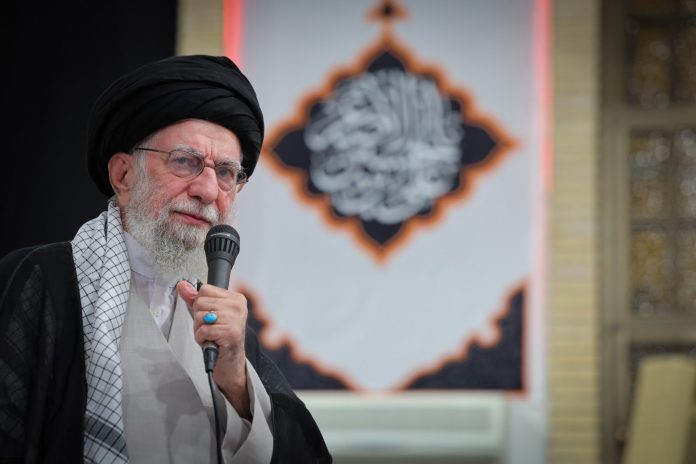
Iran leader’s advisor reiterates red line on uranium enrichment

Ali Akbar Velayati

Velayati also reiterated Iran’s openness to dialogue with the US, but only if national red lines, particularly on enrichment, are respected.

He however described the US as untrustworthy.

Velayati’s remarks came during a meeting in Tehran with Pakistan’s Interior Minister Syed Mohsin Naqvi. Velayati further condemned the Zionist regime’s aggression against Gaza, supported by the US, and urged unity among Islamic countries in confronting illegal actions by Tel Aviv.

The Pakistan side reaffirmed his country’s support for Iran and denounced recent acts of aggression by the Zionist regime and the US on Iranian soil.

Iranian MP warns European troika against activating snapback mechanism

Nuclear Negotiations in Vienna

Azizi called such a move hostile and illegitimate.

In a post on his official account on the social media platform X, Azizi wrote, “The Islamic Republic of Iran does not consider the activation of the snapback mechanism as a tool for pressure, but as a hostile act lacking any legal legitimacy”.

He added that the activation of the snapback mechanism will mark the beginning of a costly cycle for the European parties and that Iran, with full authority and preparedness, will make the three European states bear the consequences of this mistake.

The snapback mechanism, embedded in UN Security Council Resolution 2231, would allow the reimposition of international sanctions lifted under the JCPOA.

Iranian officials have repeatedly cautioned that such a move would prompt a decisive and firm response from Tehran.

Observers also warn the activation of the mechanism could deal a fatal blow to diplomatic efforts aimed at resolving the dispute over Iran’s nuclear program.