Tuesday, December 23, 2025
Home Blog Page 2356

Turkey says US should be honest with Americans about Syria

“Instead of blaming Turkey, the US should abandon its own wrong policies, and should be more honest with the American people and its Congress,” Mevlut Cavusoglu said during a joint news conference with his visiting Venezuelan counterpart Felix Plasencia.

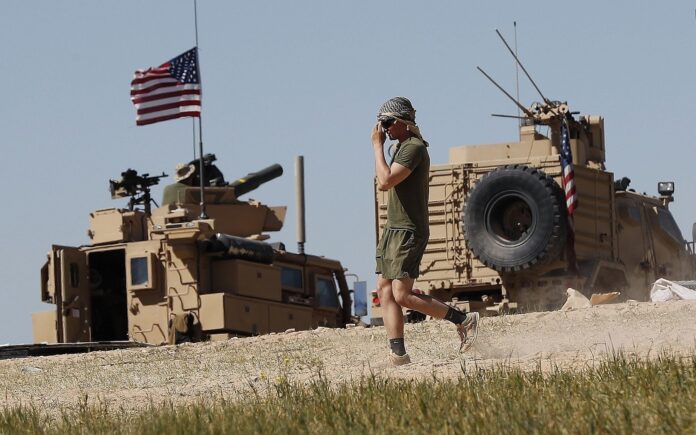
The US on Thursday extended the state of emergency decree issued in 2019 for another year, claiming that Turkey’s activities in Syria pose a threat to national security.

In 2019, then President Donald Trump withdrew most of the US troops in the region from Syria before Turkey’s anti-terror operation.

Cavusoglu, who described the letter as a “copy-paste”, noted the US administration had previously used the same sentences.

“The reason for this is the US’ cooperation with the YPG terrorist organization, which the US takes very seriously,” he asserted.

“We know very well that the purpose of being here is not to fight against Daesh,” he stated, emphasizing that this position is illegal under US law.

“We have fought against Daesh. The only army that is fighting against it is our army in NATO and the world,” he continued.

Around 4,000 terrorists have been killed as a result of this struggle, he said and added that Turkey is supporting the international efforts by taking measures against foreign terrorists.

He went on to say that the US’ Syria and Iraq policies, as well as all of its policies, are discussed in Europe and NATO. All of these policies are implemented without a plan and foresight, he added.

Since 2016, Ankara has launched a trio of successful anti-terror operations across its border in northern Syria to prevent the formation of a terror corridor and enable the peaceful settlement of residents: Euphrates Shield (2016), Olive Branch (2018), and Peace Spring (2019).

Blinken to talk Iran with Israeli, UAE FMs

his is the first such meeting since the signing in 2020 of the “Abraham Accords”, normalization agreements Israel struck with Bahrain and the UAE. It is a substantial step by the Joe Biden administration to strengthen the treaty between the countries.

Israel’s Yair Lapid and the UAE’s Abdullah Bin Zayed initiated the gathering, telling Blinken they would be coming to Washington at the same time and proposing the meeting, Israeli officials told Axios.

A similar meeting took place in secret in 2009 when the UAE’s ambassador to Washington, Yousef al-Otaiba, and his Israeli counterpart, Salay Meridor, reached out together to the Barack Obama administration to raise their concerns about Iran.

Jeremy Issacharoff, then the deputy head of mission at Israel’s embassy in Washington, reached out to Dennis Ross, then the State Department’s point man on Iran, and proposed the meeting.

Ross was surprised by the unprecedented proposal and agreed immediately. The meeting was held in secret in al-Otaiba’s suite at the Four Seasons in Georgetown.

This week’s trilateral meeting will be held in public and on foreign minister level.

Israeli officials say the meeting will focus on boosting U.S.-Israeli-Emirati cooperation on a set of issues as part of the strengthening of the Abraham Accords.

But Israeli officials say the meeting will also be an opportunity to present Israel and the UAE’s concerns about Iran’s nuclear program and regional activity.

“They will discuss progress made since the signing of the Abraham Accords last year, future opportunities for collaboration, and bilateral issues, including regional security and stability,” the State Department announced in a statement.

Iran FM: Pivot to East Doesn’t Mean Abandoning West

“Our keywords we use for the foreign policy in the 13th administration [government of President Ebrahim Raisei] are a balanced foreign policy coupled with an active, dynamic and smart diplomacy,” Hossein Amirabdollahian said when asked about his recent visit to Moscow and Iran’s focus on interaction with Asian countries.

“A focus to Asia does not mean we do not pay attention to other regions including the west,” he said.

Amirabdollahian stressed that a balanced foreign policy requires attention to priorities while tapping all opportunities in different areas of the world in line with national interests.

“However, the westerners should know this and we have clearly told them that […], due to the policies of the US and your own failure to fulfill your obligations to Iran, you are suffering losses every single day and are getting farther away from investments in and interaction with Iran in different areas of trade and economy,” he said.

Amirabdollahian also touched on the Vienna talks on the Iran nuclear deal. He said the negotiations will be advanced using the common wisdom of experts in the legal, technical, economic and other fields, but will be led by the foreign ministry’s deputy in charge of political affairs.

He added that the ministry is in the process of wrapping up its consultations on how to advance the talks.

Report: Khashoggi killers trained in U.S.

The 59-year-old, who had angered Crown Prince Mohammed bin Salman with his criticism of the kingdom, was murdered in October 2018, after he entered the Saudi consulate in Istanbul. His body has never been recovered, and Western intelligence services believe it was dismembered.

The prince, commonly known as MBS, has always denied any involvement in the writer and broadcaster’s death, though earlier this year the Biden administration released an intelligence report saying he knew about and approved of the plan.

Now a report claims that four of the dozen-strong “kill team” received paramilitary training in the United States, as part of a contract approved by the State Department.

The New York Timessaid the men received the training from the Arkansas-based security company Tier 1 Group, which is owned by the private equity firm Cerberus Capital Management.

The company has said the training, which included “safe marksmanship” and “countering an attack”, was intended for the protection of Saudi leaders.

It quoted Louis Bremer, a senior executive of Cerberus, the group’s parent company, as having confirmed its role last year in written answers to questions from politicians in Washington DC.

He was being questioned as part of his nomination for a senior Pentagon job during the Trump administration, a nomination that was later withdrawn.

It said that Mr Bremer provided his answers to the newspaper, and confirmed four members of the Khashoggi kill team had received Tier 1 Group training in 2017, and two of them had participated in a previous version that ran between October 2014 until January 2015.

“The training provided was unrelated to their subsequent heinous acts,” Mr Bremer said in his answers.

He said a review in 2019 review by Tier 1 Group “uncovered no wrongdoing by the company and confirmed that the established curriculum training was unrelated to the murder of Jamal Khashoggi”.

The training would have been carried out at a time when Barack Obama was president.

There was no immediate response from Cerberus to inquires from The Independent .

In a statement, State Department spokesman Ned Price said: “We are restricted under Section 126.10 of the International Traffic in Arms Regulations (ITAR) from commenting on individual companies’ licencing status or confirming related activities. As such, we can’t confirm or comment on any of the licenced defence export licensing activity alleged in media reporting.”

He added: “Saudi Arabia faces significant threats to its territory, and we are committed to working together to help Riyadh strengthen its defences. At the same time, the American people expect that US policy towards its strategic partnership with Saudi Arabia will prioritise the rule of law and respect for human rights, which are inseparable from the interests that the United States brings to that partnership.”

In March, lawyers for the fiancee of Mr Khashoggi said they had the crown prince legal complaint – allowing proceedings against the Saudi royal to proceed.

Report: One in six UK shoppers unable to buy goods

Some 17% of adults said they had not been able to purchase such goods because they were not available, according to newly released data from the Office for National Statistics (ONS).

Almost a quarter (23%) said the same for non-essential food items.

The figures, based on a weighted count of 52,375,337 adults by the ONS, emerged as separate estimates indicated the fuel supply crisis was easing, with only a small number of areas still suffering significant petrol shortages.

The ONS estimates were based on analysis of responses from 3,326 adults between 22 September and 3 October as part of its Opinions and Lifestyle survey.

Of those people asked about their experiences of shortages over the past fortnight, 57% said everything they needed had been available to buy – while one in seven (15%) could not buy fuel.

Six in 10 respondents said their food shopping experience had been different to usual, with 43% saying there was less variety, and 14% saying they had to go to more shops to get what they needed.

Meanwhile, a fifth said items they needed were not available but that they could find a replacement, with a further fifth saying they could not find a replacement.

A total of 13% of adults also reported waiting longer for prescriptions, with 4% saying they had to go to more pharmacies to find what they needed.

It came as the latest figures suggested the fuel supply crisis had eased significantly.

No areas of the country remain in the red fuel stocks category, meaning they have levels below 20%, while only three – eastern, London and South East – remain in the amber bracket, with supplies of between 20% and 40%.

All other areas are now classed as in the green category, meaning fuel stocks were deemed to be average.

Transport Secretary Grant Shapps told Sky News, “we’re right at the tail end” of the situation with fuel supply pressures”, adding problems had ended in “most parts of the country”.

He stated that around 3,500 people had applied for provisional HGV licences in the past week.

“They’re struggling to do what they love doing because there’s a shortage of food and of course it’s something that we’re going to have to find an answer to, and quickly as well because you know people are out there and they need the meals and especially going into winter,” he told BBC Breakfast.

Another 6mn Doses of COVID-19 Vaccines Arrive in Iran

The shipment touched down at Imam Khomeini International Airport to the west of the capital, Tehran, through the good offices of the Iranian Red Crescent Society (IRCS).

The vaccine batch is one of three consignments arriving in the country this week, says IRCS Director Karim Hemmati.

“With the coordination of the first vice president and the cooperation of the health ministry, the foreign ministry, the Central Bank and the Customs administration, for the first time in the country some 18 million doses of the Sinopharm vaccine will be imported in one week, and the first 6-million-dose shipment of the overall 18 million doses arrived in Iran today and was handed over to the health ministry,” he said.

He said the IRCS has imported more than 58 million doses of COVID-19 vaccines since May 2021, and the figure will cross 70 million once the mentioned 12 million doses enter the country.

He added the number of vaccination centres has increased across the country to speed up the pace of inoculation.

This comes as Iran itself has, so far, produced several types of coronavirus vaccines, which are widely used in the national COVID-19 vaccination drive.

Survey shows Americans trust in media drops to 7 percent

Just 36 percent of respondents said they had some level of trust in mass media, including newspapers, television, and radio, to report news accurately. That percentage included 29 percent who said they had “a fair amount” of trust in the media, while just 7 percent said they have “a great deal” of trust.

Meanwhile, 29 percent of respondents said they have “not very much” trust in media, and 34 percent said they have “none at all.” The only year in which Americans reported lower levels of trust in the media was 2016, when 32 percent said they had some level of trust in the news.

The Gallup survey also showed that reported trust in mass media has been much higher among Democrats than Republicans since 2017. In that year, 72 percent of Democratic respondents said they trusted the media, compared with 14 percent of Republicans and 30 percent of Independents.

In the latest survey, 68 percent of Democrats said they trust the media, while just 11 percent of Republicans said the same, along with 31 percent of Independents.

The Gallup poll was conducted from September 1-17, in interviews of 1,005 American adults age 18 or older. The survey has a 4 point margin of error for results based on the total sample of American adults.

The same survey found that Americans generally view the Republican Party as better able to promote domestic prosperity and international security than the Democratic Party. Those results come after the Joe Biden administration’s chaotic withdrawal from Afghanistan and amid continued low ratings for the president’s job performance.

The results were driven by shifts among independent voters, with 51 percent of independent respondents saying they trusted Republicans to bring prosperity to the U.S., compared with 43 percent in the previous year.

Eslami: Iran has over 120 kg of 20% enriched uranium

“We have exceeded 120 kilograms and in this matter, we are ahead of schedule. Earlier, based on the JCPOA, 20% uranium fuel was supposed to be provided for the Tehran reactor(from abroad), but it was not given, and if we had not started making this amount of fuel ourselves, this would have turned into one of our problems today,” Mohammad Eslami said in a live interview on national TV on Saturday evening.

The Iranian nuclear chief said the Atomic Energy Organization of Iran has almost fully adhered to the parliament’s law on sanctions removal.

The law was passed in December last year in response to a failure by remaining parties to the nuclear deal to fulfill their obligations and make up for unilateral U.S. sanctions against Tehran.

“20% and 60% nuclear fuel production has been carried out and planning is underway for the production of uranium metal, IR2M and IR6 centrifuges are being built,” he explained.

Eslami also criticized the International Atomic Energy Agency for failing to denounce a sabotage operation against Iran’s Karaj nuclear site back in June, adding that the IAEA’s silence effectively encouraged such terrorist acts. 

Several Iranian nuclear energy sites and many nuclear scientists have come under attack over the past years with Israel behind them.

Eslami explained that the agency was not allowed to replace damaged cameras at the Iranian sabotaged site as required under the Joint Comprehensive Plan of Action because the U.S. and the Europeans have failed to keep their part of the deal. 

Iran and the remaining parties to the 2015 nuclear deal namely Russia, China, Britain, France and Germany have held several rounds of talks over the past year on a possible U.S. return to the JCPOA. Iran says the talks will resume soon.

Number of COVID Patients, Deaths in Iran Falling: Official

“The trend of most coronavirus indicators is on the decline,” said Alireza Zali, the head of the Coronavirus Task Force.

“However, as COVID-19 has surged time and again over the past months, one should regard the conditions in all provinces, including Tehran, as unstable and fragile,” he noted.

He then touched upon the national coronavirus vaccination drive gaining momentum in the country, but noted that, “In order to control COVID-19, vaccination is a sine qua non, but not per se adequate.”

He also urged abidance by health protocols.

Zali then called on citizens to avoid nonessential gatherings such as family get-togethers.

“45% of over-12 students in Tehran have been vaccinated,” he said.

He added although vaccinated individuals acquire relative immunity against the disease, they can still be vulnerable.

“Inoculated people must receive both doses of the vaccine,” he explained.

He said the most important “point of vulnerability” these days is failure to comply with health protocols coupled with underestimating the danger posed by the virus.

He urged all Tehran residents to get vaccinated, so that “we can get close to mass immunization in Tehran as soon as possible.”

Taliban urges U.S. to unfreeze Afghanistan’s assets

An Afghan delegation has demanded that the nation’s foreign assets be unfrozen during negotiations with the United States in the Qatari capital Doha.

Aside from this, the delegation requested that the US not violate Afghanistan’s airspace and refrain from interfering in the nation’s internal affairs.

The US, for its part, pledged to provide Afghanistan with coronavirus vaccines, according to a statement by the Afghan Foreign Ministry.

The negotiations in Doha marked the first meeting between US officials and their counterparts from the Taliban after the militants established control over Afghanistan in August. The Taliban’s delegation described the talks as a push for a “new page” in relations between the two countries.

“The delegations of the Afghan government and the United States discussed turning the page on their relationship in Qatar as well as humanitarian assistance to Afghanistan and the implementation of the Doha peace agreement,” Afghanistan’s acting Foreign Minister Amir Khan Muttaqi told reporters.

The Afghan Foreign Ministry noted that the nation’s delegation is set to hold a meeting with EU officials alongside the American diplomats, with Muttaqi saying that the negotiations would resume on Sunday.

The request by the Afghan delegation to lift curbs on the country’s central bank reserves comes after the US Treasury greenlighted certain transactions with the Taliban and Haqqani Network, allowing financial operations necessary for humanitarian efforts in the war-ravaged nation.

Since the Taliban’s takeover of Afghanistan, the World Bank and the International Monetary Fund have suspended financial aid to the country’s new government, while the US has frozen billions of dollars in assets belonging to the Afghan Central Bank.

As Afghanistan is going through a major socio-economic crisis following its seizure by the Taliban, the national currency is facing devaluation, and Afghans are suffering month-long salary delays as they struggle to withdraw money from their accounts. The overwhelming majority of banking operations in the country were estimated to be withdrawals from accounts – an observation that raised concerns about the potential bankruptcy of the country’s banks in some two months unless there is change.