Monday, December 22, 2025
Home Blog Page 2334

Raeisi: Iran seeks to expand ties with Latin America

“Latin America, especially Venezuela, is one of the priorities of the Islamic Republic of Iran’s economic diplomacy, and we are determined to develop our relations with these countries,” Raeisi said in a Monday meeting with Venezuelan Foreign Minister Felix Plasencia in Tehran.

The Iranian president emphasized the need to expand Tehran-Caracas relations in different fields, adding that a clear and long-term plan should be devised for the development of bilateral relations.

Raeisi expressed hope that a visit by the Venezuelan president to Tehran in the near future will pave the way for long-term bilateral cooperation.

The visiting top diplomat described Iran and Venezuela as two friendly countries which are united against the system of domination in the world and those who seek to harm the two countries’ independence.

Plasencia called Iran an important and influential country in the region, stressing that the Bolivarian Republic of Venezuela will stand by Iran in defending multilateralism and countering U.S. interventionism.

The Venezuelan top diplomat also sat down for talks with his Iranian counterpart Hossein Amirabdollahian.

In a joint press conference, the Iranian foreign minister announced that Venezuelan President Nicolas Maduro will visit Tehran in the coming months and that during his trip the foreign ministers of Iran and Venezuela will sign a 20-year cooperation document.

“We have had good agreements in the technical, economic, commercial, science and technology, energy, and mining fields between the two countries in recent years and important parts of them are being implemented,” Amirabdollahian noted.

He also described U.S. policies against Venezuela as unconstructive, and condemned the recent extradition of a Venezuelan diplomat from Cape Verde to the United States calling it piracy and a violation of Venezuelan sovereignty.

NATO chief raises the alarm over ‘Rise of China’

In an interview with the Financial Times, Stoltenberg stated China was already having an impact on European security through its cyber capabilities, new technologies and long-range missiles.

How to defend NATO allies from those threats will be “thoroughly” addressed in the alliance’s new doctrine for the coming decade, he added.

The military alliance has spent decades focused on countering Russia and, since 2001, terrorism. The new focus on China comes amid a determined shift in the US’s geopolitical orientation away from Europe to a hegemonic conflict with Beijing.

“NATO is an alliance of North America and Europe. But this region faces global challenges: terrorism, cyber but also the rise of China. So when it comes to strengthening our collective defence, that’s also about how to address the rise of China,” Stoltenberg said.

“What we can predict is that the rise of China will impact our security. It already has,” he added.

NATO will adopt its new Strategic Concept at a summit next summer, which will outline the alliance’s purpose for the following 10 years. The current version, adopted in 2010, does not mention China.

The NATO alliance is seeking a new direction following the end of its 20-year deployment in Afghanistan, while discussions over the future of the US military presence in Europe are ongoing.

Stoltenberg, the former Norwegian prime minister who is set to step down next year after almost eight years at the helm, said that NATO allies would seek to “scale down” activities outside of their borders and “scale up” their domestic defensive resilience to better resist external threats.

“China is coming closer to us . . . We see them in the Arctic. We see them in cyber space. We see them investing heavily in critical infrastructure in our countries,” he noted.

“And of course they have more and more high-range weapons that can reach all NATO allied countries. They are building many, many silos for long-range intercontinental missiles,” he continued.

China tested a nuclear-capable hypersonic missile in August, the FT reported over the weekend, demonstrating an advanced long-range weapons capability that surprised US intelligence and underscored the rapid military progress China has made on next-generation weapons.

But any suggestion of a shift away from deterring Russian aggression would meet protests from Eastern European member states that view Moscow as an existential threat and the alliance as their sole security guarantor.

Stoltenberg stressed Russia and China should not be seen as separate threats.

“First of all China and Russia work closely together,” he said, adding, “Second, when we invest more in technology . . . that’s about both of them,” he added.

“This whole idea of distinguishing so much between China, Russia, either the Asia-Pacific or Europe: it is one big security environment and we have to address it all together. What we do on readiness, on technology, on cyber, on resilience matters for all these threats. You don’t put a label,” he added.

Stoltenberg said the hasty withdrawal of NATO forces from Afghanistan in August was “an obvious choice” after the US decision to leave the country.

He stated that while European militaries might have been able to remain without US support, political leaders could not justify a continued presence.

“It was partly a military aspect: capabilities. But I think fundamentally more important was the political aspect: we went into Afghanistan after an attack on the United States,” he said, adding, “Militarily it would have been possible [to stay]. But politically, I regard it as absolutely unrealistic . . . that was the main reason.”

Several injured in Kuwait oil refinery fire

A fire has broken out at the Mina al-Ahmadi oil refinery, the Kuwait National Petroleum Company reported on Monday.

The fire broke out at the refinery’s treatment unit, which removes sulfur from the oil products. According to the KNPC, the blaze caused several injuries.

At the same time, the company noted that refinery operations and exports won’t be affected by the incident.

“The refinery operations and export operations were not affected and there has been no impact to local marketing operations and supplies to the electricity and water ministry”, KNPC said on its Twitter account.

Locals in the Fahaheel district also reported the sound of an explosion. Several photos and videos, allegedly taken at the site of the fire, have since emerged online. They depicted a big cloud of smoke and flames rising high above the facility.

EU optimistic about fresh round of Iran nuclear talks

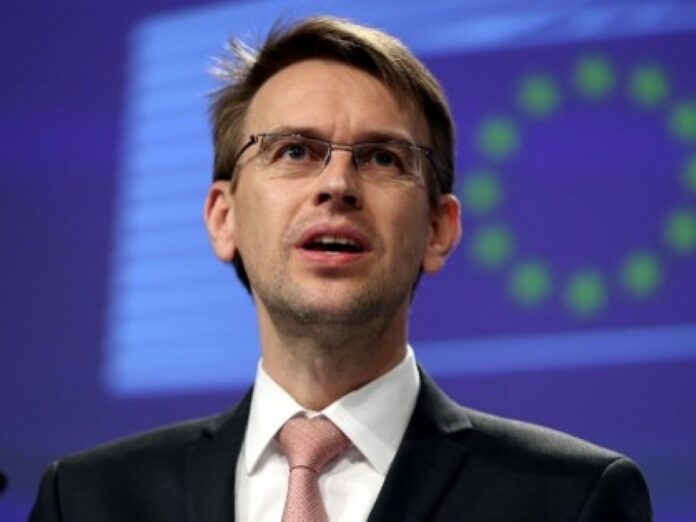
Borrell said on Monday he hoped EU and Iranian diplomats would meet soon to try and revive nuclear talks but declined to confirm reports of a meeting in Brussels on Thursday.

Bloomberg News reported that Iran’s foreign minister gave the date on Sunday, citing an Iranian lawmaker. A senior EU official last week confirmed that meetings were planned in Brussels, rather than Vienna, but gave no date.

“You never know, I am more optimistic today than yesterday,” Borrell stated in Luxembourg as he arrived for an EU foreign ministers meeting.

“No confirmation yet, but things are getting better and I am hope we will have preparatory meetings in Brussels in the days to come,” he added.

EU political director Enrique Mora, the chief coordinator for the talks, was in Tehran last Thursday to meet members of Iran’s nuclear negotiating team, four months after discussions broke off between Iran and world powers.

Iranian President Ebrahim Raisi has so far refused to resume indirect talks with the United States in Vienna on both sides returning to compliance with the deal, under which Iran curbed its nuclear program in return for economic sanctions relief.

But after Mora’s visit, Iran’s foreign ministry announced it would hold talks in the coming days with the EU in Brussels.

Western diplomats have said they are concerned Tehran’s new negotiating team – under a president known as an anti-Western hardliner, unlike his pragmatist predecessor – may make new demands beyond the scope of what had already been agreed.

Iran has long denied any ambition to acquire nuclear weapons.

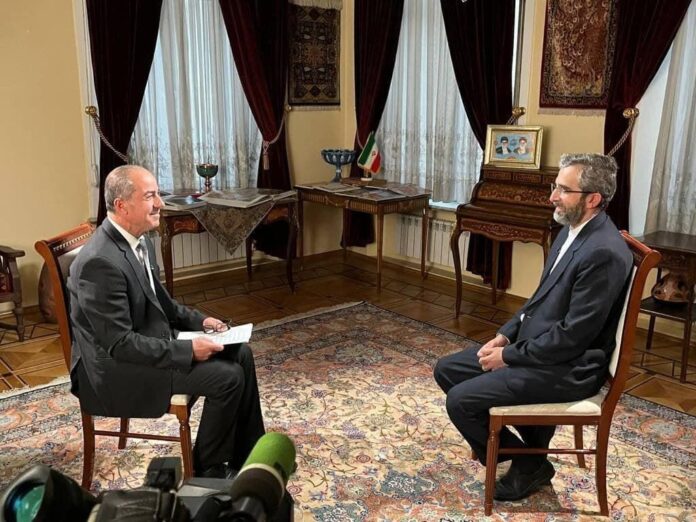
The Iranian foreign ministry spokesman has announced that Deputy Foreign Minister Ali Baqeri Kani will travel to Brussels in the coming days to continue talks with Mora.

“As previously announced, the visit by Deputy Foreign Minister Baqeri to Brussels will be solely for the purpose of continuing talks with European Union Foreign Policy Chief Josep Borrell’s deputy Enrique Mora based on an agreement reached in Tehran,” Saeed Khatibzadeh stated on Sunday evening.

His explanation came after some interpreted remarks made by Foreign Minister Hossein Amirabdollahian in a closed session of the parliament on Sunday as an announcement of a new round of talks between Iran and the remaining parties to the Joint Comprehensive Plan of Action.
An Iranian lawmaker said on Sunday negotiations will resume in the coming days on the 2015 Iran nuclear deal known as the Joint Comprehensive Plan of Action (JCPOA).

Behrouz Mohebbi made the comment in a tweet on the sidelines of a closed-door meeting with Abdollahian.

Mora and Baqeri met in Tehran last week to discuss Iran-EU relations, regional issues, and lifting of anti-Iran sanctions.

They agreed to continue talks in Brussels over the possibility of further negotiations between Iran and the P4+1 group in the Austrian capital Vienna.

Belarus expels French envoy

France’s ambassador to Belarus has left the country after the authorities in Minsk demanded he leave by Monday, the embassy announced.

But according to reports in the Belarusian media, ambassador Nicolas de Lacoste never met President Alexander Lukashenko to give him copies of his credentials.

France, like other EU countries, has not recognised the Belarusian strongman’s claim to a sixth presidential term in disputed elections in August last year.

“The Belarusian foreign ministry demanded that the ambassador leave before October 18,” an embassy spokeswoman told AFP Sunday.

“Ambassador Nicolas de Lacoste left Belarus today,” she added.

“He said goodbye to the staff of the embassy and recorded a video message to the Belarusian people, which will appear tomorrow morning on the embassy’s website,” she continued.

The European Union has imposed waves of sanctions on Lukashenko’s regime over a post-vote crackdown on dissent in Belarus after the country erupted in historic protests against his rule.

Lukashenko has since put down the demonstrations, with authorities jailing hundreds of protesters and closing dozens of independent media outlets and NGOs.

All of the country’s top opposition leaders are either in prison or have fled the country.

Report: Newcastle new chief involved in Saudi “anti-corruption” campaign

Yasir al-Rumayyan, the new non-executive chairman of Newcastle United, was involved in a controversial “anti-corruption” campaign in Saudi Arabia that included the transfer of assets on behalf of the crown prince.

Details of Rumayyan’s role – including the transfer of a charter jet company to the Public Investment Fund (PIF), where he serves as governor – are contained in court documents that shed light on his relationship with Prince Mohammed.

The inner workings of the PIF have been a source of intense interest after it led a consortium that acquired Newcastle United this month. The state-owned sovereign wealth fund is run by Rumayyan and chaired by the crown prince.

The Saudi-led consortium withdrew its bid to acquire Newcastle in 2020 amid concerns that the PIF was part the Saudi state. But the Premier League approved the deal this month and said it had been given “legally binding assurances that the Kingdom of Saudi Arabia will not control” the club. The Premier League has not disclosed the nature of the assurances.

Internal Saudi documents filed to a civil court in Canada as part of an unrelated case show that in 2017 a close aide to Prince Mohammed ordered Rumayyan – who is formally referred to in memos as “his excellency” and the “supervisor” of the PIF – to transfer 20 companies to the sovereign wealth fund as part of the anti-corruption campaign.

One of 20 seized companies, the documents show, was a charter jet company that was later alleged to have been used in the Saudi plot to kill Jamal Khashoggi. US intelligence agencies concluded in an intelligence report that was declassified in February that Prince Mohammed approved Khashoggi’s gruesome murder.

There is no suggestion that Rumayyan had any involvement in or knowledge of the alleged use of the jets in the operation that killed the Washington Post journalist.

The documents suggest, however, that a senior aide to the crown prince was able to order Rumayyan to take actions related to the PIF on Prince Mohammed’s behalf. The PIF declined to comment. A spokesperson for the Saudi embassy in Washington did not return a request for comment.

Rumayyan is a former banker who serves as governor of the PIF and chairman of the oil firm Saudi Aramco. He has overseen billions of dollars in investment by the PIF, including in Uber, Facebook, Disney and Citibank.

The Harvard Business School-educated executive is reportedly due to attend his first Newcastle match on Sunday in his new role as non-executive chairman of the club.

The internal Saudi documents were filed in a Canadian court as part of a civil case that has been brought by Saudi-owned entities against a former senior Saudi intelligence official, Saad Aljabri, a critic of Prince Mohammed who in turn has accused the Saudi government of trying to assassinate him in Canada. The Saudi government has denied the claims.

The court records include copies of memos that were sent to his “excellency the supervisor of the Public Investment Fund” by Mohammad al-Sheikh, a senior Saudi adviser to Prince Mohammed.

They relate to the infamous anti-corruption campaign led by the crown prince from November 2017, when 400 of Saudi Arabia’s richest individuals – including princes and ministers – were rounded up and held at the Ritz-Carlton hotel in Riyadh in what was later condemned by witnesses and critics as a purge involving torture, coercion and the expropriation of billions in assets into Saudi coffers.

Mohammad al-Sheikh, the close adviser to the crown prince, defended the campaign in a 2018 interview on CBS.

“The anti-corruption crackdown was very simple. We had a serious problem with corruption,” he said, adding, “We had to do what we did at the Ritz.”

The memos are labelled “top secret, not for circulation and very urgent”. The first memo, sent on 22 December 2017, calls on Rumayyan to “transfer” a number of companies to the PIF’s ownership that were seized as part of the anti-corruption purge.

The second memo, dated two days later, repeats the order with greater urgency and tells Rumayyan to “immediately approve the completion of the necessary procedures”.

Saudi documents filed to the court show that in response, Rumayyan sent a handwritten and signed memo on 26 December 2017 to an associate ordering him to “do what’s necessary as fast as possible” to comply with the order. Among the 20 companies included on a list to be transferred to the PIF was Sky Prime Aviation Services, a charter jet company based in Riyadh.

The name of the charter jet company resurfaced in 2019 in a report by Agnes Callamard, the former UN special rapporteur who investigated the Khashoggi killing. She concluded that the team of Saudi agents who killed the journalist used two jets operated by Sky Prime Aviation to travel to and from Istanbul before the murder in the Saudi consulate on October 2018.

CNN first reported in February 2021 that court documents showed that the two private jets used by the Saudi assassination squad were owned by a company that had previously been seized by Prince Mohammed. But other details from the court documents relating to Rumayyan’s role in PIF’s acquisition of the charter jet firm and other companies have not previously been reported.

The PIF declined to respond to a request for comment from Rumayyan and did not respond to a question about the control of Sky Prime Aviation Services. The Saudi embassy in Washington and the Premier League also declined to comment.

Rumayyan has in the past described the abrupt manner in which he was selected by the crown prince to lead the PIF as governor in 2015.

“I received a call … The crown prince heard of me. I got the call. I thought it was an interview [to lead the PIF], but it was, like: ‘Here is what I want you to do. One, two, three,’” Rumayyan stated in a 2020 interview with the Carlyle Group chief executive, David Rubenstein.

After Rumayyan initially noted he could start the job in three months, the crown prince told him he had “one month, and you will do it”. A week later Prince Mohammed called back and told Rumayyan he was starting “immediately”.

“We are all very proud to be Saudis and to participate in the positive changes the country is living and doing right now,” Rumayyan announced in the Rubenstein interview.

Kazak envoy: Iran SCO membership beneficial to body

Askhat Orazbai also referred to the SCO’s meeting next month in Kazakhstan, saying his country has sent an invitation to Iran’s first vice president.

Orazbai said Iran was among the first countries to recognize Kazakhstan following the collapse of the former Soviet Union and that “we will not forget this”.

In other remarks, Orazbai spoke of trade ties between the two countries, saying Kazakhstan has expanded the economic relations with Iran steadily in spite of two main obstacles, namely the Covid pandemic and the US sanctions.

He said the trade volume between Iran and Kazakhstan is 230 million dollars which is not large enough given the potential of the two countries and must be increased. Orazbai noted that what matters is that Tehran and Astaneh are determined to expand relations.

He referred to the US sanctions, saying they have affected the trade ties but Iran and Kazakhstan are capable of exchanging some products like agricultural crops.

Iranian MP: Removal of sanctions first step in resuming talks

Mahmoud Abbaszadeh Meshkini said the ball is now in the West’s court and the notion of returning to the nuclear deal applies to those who left it or failed to live up to their commitments under the deal.

Abbaszadeh Meshkini added that under the current circumstances, it’s Iran that must set conditions for the other side.

He maintained that if the EU intends to act as a mediator, it must base its assumption on the fact that the US and the European troika including Britain, France and Germany are to blame for this stalemate in talks in the first place. Diplomat efforts to resume the nuclear talks have intensified in recent days. But no date has been set to start the negotiations nor has the venue of the talks been determined yet.

Britons think Johnson’s promises to ‘level up’ not sincere

Almost half (47 per cent) of those questioned by pollsters Savanta ComRes for The Independent said they did not believe the prime minister’s claim that “levelling up” was a central goal of his administration, with scepticism about his pronouncements strongest in the northern and Midlands areas which he has promised to help.

One third of those questioned (31 per cent) said that the target of levelling up the UK would never be achieved, and a further 16 per cent said it would take more than 10 years to complete the task that Johnson has set himself. 

Just 10 per cent said that the project could be concluded within the five-year timescale needed if the PM is to be able to boast of success by the time of the next election and a further 21 per cent said it would take up to 10 years.

The poll found deep levels of concern about financial prospects in the coming year, with more than half (56 per cent) expecting their standard of living to be hit by rises in the cost of essentials like energy, housing and food. Large numbers also said they expect to lose out financially from changes to tax rates and benefit levels, as well as the fallout from Brexit.

Overall, a quarter of those questioned (25 per cent) said they expect to be worse-off in the coming year than they were last year and one in five (21 per cent) said they would be worse-off than they were in 2019 before the Covid pandemic struck.

The gloomy picture came ahead of Rishi Sunak’s crucial autumn budget and spending review on 27 October, at which the chancellor is expected to impose tight restraints on state spending as he starts the job of paying down the £407bn bill for support during the Covid pandemic.

A new report from low-pay thinktank the Resolution Foundation called on the chancellor to prioritise action to help families hit by increases in energy bills, expected to reach an average £1,650 a year by April – a 50 per cent increase on 2020.

The Foundation said that low-income households will be disproportionately affected, as they currently spend three times as much on energy, as a proportion of their incomes, as the richest fifth of households.

By next year, energy costs could make up more than 10 per cent of the spending of the poorest tenth of households, compared to around 3.6 per cent for the richest tenth.

Resolution Foundation senior economist Jonny Marshall said that the best way to alleviate the crisis would have been for Sunak to preserve the £20-a-week uplift to Universal Credit introduced last year in response to Covid and scrapped earlier this month.

If that was no longer possible, he should instead immediately increase the Warm Homes Discount for low-income groups from its current £140 to £161, with a further uprating to £208 in April to keep pace with rising bills, said Marshall. And he said that the £25 Cold Weather Payment – issued when temperatures drop below zero for seven consecutive days – should be extended to an additional 4 million means-tested households.

“While much of the debate around rising gas prices has focused on protecting affected firms, the chancellor must prioritise protecting affected families in his upcoming budget, not least as average bills are set to increase by 50 per cent in just two years,” said Marshall.

“Having missed the best opportunity to help families by failing to maintain the uplift to Universal Credit, he should now to look to improving schemes like the Warm Homes Discount and Cold Weather Payments to help low-income families in particular,” he added.

“The current crisis reminds us all of the need to wean Britain off fossil fuels, and to heat and insulate our homes in a more sustainable way. Fixing those problems will be the ultimate test of the government’s energy policy this autumn,” he continued.

Today’s poll found that fears over rising cost of living are strongest among the elderly, with 73 per cent of over-65s saying they expect their finances to be hit by inflation on essentials – including 31 per cent who expect their standard of living to get significantly worse over the next 12 months.

Some 43 per cent of those responding to the Savanta ComRes poll said they expect their financial position to worsen over the coming year as a result of tax rises, against just 12 per cent who said changes to taxation would benefit them. Three in 10 (29 per cent) of voters said their finances will take a hit from changes to welfare benefits and a quarter (25 per cent) from problems with employment.

More than a third of voters (37 per cent) said they expect their personal finances to suffer over the coming year from the impact of Brexit on the UK economy, compared to just 17 per cent who thought EU withdrawal would be good for them financially.

No region of the UK, social class or age group believed on balance that Brexit would benefit them financially. And even among Leave voters there was little sign of hope that Brexit would deliver a boost to finances, with just 22 per cent saying they would be better off over the coming year as a result, against 21 per cent who said it would leave them worse-off.

Concerns over the cost of living crisis were strongest in the Yorkshire and Humber region and West Midlands, which include many of the so-called Red Wall seats seized from Labour by Conservatives in the 2019 general election on a promise of “levelling up” living standards.

The poll found strong support for the levelling up agenda, with 43 per cent saying it was right to make it the government’s top priority and backing highest in London, Yorkshire and the Humber, the northwest, northeast and West Midlands. Just 29 per cent said it should not be the top priority.

But just 28 per cent said they believed Johnson was sincere in his claim to have put the project at the heart of his agenda, against 47 per cent who said he was not and 25 per cent who did not know. Even among Tory voters, more than a quarter (27 per cent) did not believe the PM was sincere about it, against 48 per cent who said he was.

Meanwhile, 28 per cent said they did not understand what “levelling up” means and 17 per cent said they had never heard of it. Fewer than half (47 per cent) had heard the phrase and believed they knew what it meant.

Iran resumes exports to Saudi Arabia

Iran Saudi Flags

Rouhollah Latifi said exports to Saudi Arabia restarted after one and a half year concurrently with negotiations between Tehran and Riyadh, which is “good news”. 

He said Iran has just exported 39 thousand dollars worth of goods to Saudi Arabia that include 6 thousand dollars worth of tiles and 33 thousand dollars worth of round-shaped glass used in traffic signs. 

He said the resumption of exports to the Arab kingdom heralds a thaw in political, economic and cultural ties. Iran and Saudi Arabia have been holding talks over the past months on ways of normalizing their relations following years of tensions over a host of issues including the war in Yemen and the Syria crisis.