Friday, December 26, 2025
Home Blog Page 205

Iran expands quantum research across nine leading universities

Iran University

Iran’s quantum infrastructure includes a national laboratory with high-cost facilities, several mission-driven quantum centers, research labs at universities, and educational laboratories.

Three quantum centers have so far received the largest investments, while critical infrastructure at the national laboratory has been completed.

Nearly all active experimental quantum researchers in Iran have received financial support, with previously unfunded groups now included in this year’s program.

Six underfunded research labs have been equipped and financed in 2025, with additional facilities set to receive backing later this year.

The expansion focuses on Sharif University of Technology, University of Tehran, Isfahan University of Technology, Shahid Beheshti University, Iran University of Science and Technology, Kharazmi University, Ferdowsi University of Mashhad, Shahid Bahonar University of Kerman and Shiraz University.

UN condemns Israeli killing of Gaza journalists

“Yesterday, colleagues of our Al Jazeera friends here who were working in Gaza were victims yet again of the conflict,” UN spokesperson Stephane Dujarric said during a news conference on Monday, conveying Guterres’ condemnation of the “killing of the six Palestinian journalists in an Israeli airstrike” in Gaza City Sunday.

“These latest killings highlight the extreme risks that journalists continue to face when covering this ongoing conflict,” he added.

Noting that Guterres “calls for an independent and impartial investigation into these latest killings,” Dujarric reported that “at least 242 journalists have been killed in Gaza since the war began.”

Emphasizing the need to respect journalists and media workers, Dujarric further stated that media workers “must be protected” and must be allowed to work “free from fear and free from harassment.”

Asked about how an investigation into the killing of the journalists can be done amid the ongoing conflict, Dujarric said: “Accountability tragically takes time, especially in conflict.”

“We’ve seen it in other recent conflicts, where it sometimes takes a long time to find accountability,” he added.

Urging respect for the Geneva Conventions, Dujarric said that “the secretary-general feels that this investigation should identify any perpetrators”.

“There needs to be personal accountability for what’s happened in this conflict, as to what’s happening in other conflicts that we’re seeing around the world,” he added.

When asked how Israel is “allowed to get away” with the killing of journalists, Dujarric reiterated the need for accountability.

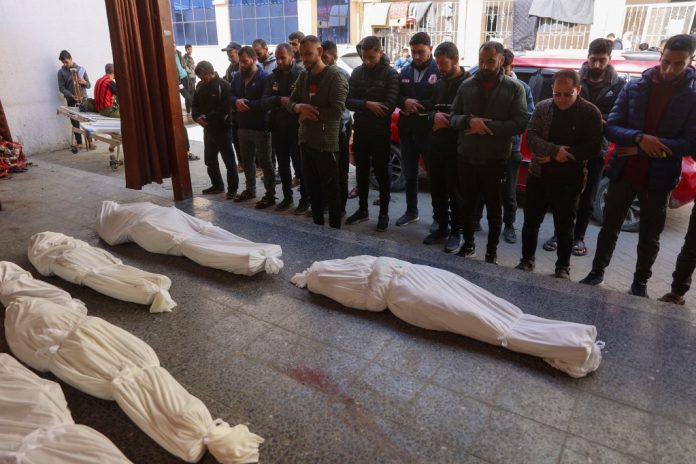
Al Jazeera journalists Anas al-Sharif and Mohamed Qraiqea were killed Sunday evening, along with three camera operators with the same network and a local freelance reporter, in an Israeli strike targeting a journalists’ tent near the Al-Shifa Hospital in western Gaza City, according to the Gaza Government Media Office.

Israel is facing mounting condemnation for its genocidal war on Gaza, where it has killed nearly 61,500 victims since October 2023. The military campaign has devastated the enclave and brought it to the verge of famine.

Last November, the International Criminal Court issued arrest warrants for Israeli Prime Minister Benjamin Netanyahu and his former Defense Minister Yoav Gallant for war crimes and crimes against humanity in Gaza.

Israel also faces a genocide case at the InternationalCourt of Justice for its war on the enclave.

NATO chief concedes future peace accord may acknowledge Russian control of occupied Ukrainian land

Ukraine NATO

“The question will be how to go forward past a ceasefire, including what it means in terms of security guarantees for Ukraine,” Rutte told ABC News.

“When it comes to this whole issue of territory, when it comes to acknowledging, for example, maybe in a future deal that Russia is controlling de facto, factually some of the territory of Ukraine, it has to be effectual recognition, and not a political de jure recognition,” he added.

The statement comes as U.S. President Donald Trump is set to meet with Russian President Vladimir Putin in Alaska on Aug. 15 to discuss ending Russia’s war in Ukraine.

“Next Friday will be important because it will be about testing Putin, how serious he is on bringing this terrible war to an end,” Rutte said.

“When it comes to full-scale negotiations, and let’s hope that Friday will be an important step in that process. … It will be about territory. It will be, of course, about security guarantees, but also about the absolute need to acknowledge that Ukraine decides on its own future, that Ukraine has to be a sovereign nation, deciding on its own geopolitical future — of course, having no limitations on its own military troop levels. And for NATO, to have no limitations on our presence on the eastern flank,” Rutte added.

Russia has issued maximalist demands to Kyiv in previous direct peace talks, including that Ukraine give up its NATO aspirations and demilitarize, as well as withdraw troops from four oblasts partially occupied by Russia — Kherson, Donetsk, Luhansk, and Zaporizhzhia.

Months earlier, U.S. attempts to broker a peace deal between Ukraine and Russia failed. Kyiv and Moscow later held three rounds of direct peace talks in Istanbul, which were largely inconclusive.

In direct talks, Ukraine and Russia agreed to several prisoner exchanges, but progress toward a ceasefire was not made amid Russia’s maximalist demands.

Trump previously announced an Aug. 8 deadline for Russia to reach a ceasefire in its war against Ukraine. Despite Russia’s refusal to halt hostilities, Trump never imposed sanctions on Moscow once the deadline passed.

President Pezeshkian warns against covert ambitions by external actors under guise of Zangezur project   

Masoud Pezeshkian

Pezeshkian was speaking during a telephone conversation, initiated by Armenia’s Prime Minister Nikol Pashinyan, about the project that involves the US and the Republic of Azerbaijan.

The Iranian president warned against potential covert ambitions by external actors disguised as economic investments and peace efforts.

“Efforts must guarantee this corridor is genuinely a path toward peace and progress, not a tool for foreign hegemony,” said Pezeshkian.

The Armenian prime minister for his part provided a detailed report on the recent peace memorandum signed between Armenia and Azerbaijan and elaborated on the corridor’s scope.

He appreciated Iran’s principled policy of preserving Armenia’s sovereignty and territorial integrity, calling Tehran’s stance “valuable and essential”.

Pashinyan underscored that Armenia will not endorse any agreement without full assurance that Iranian interests and sensitivities are respected.

Pashinyan further underlined the strategic nature of Armenia’s relationship with Iran.

“All significant decisions and actions will be made in close consultation and coordination with Tehran”, he said.

Pashinyan further put emphasis on transparency and sincerity as foundational principles governing bilateral ties.

Pezeshkian described Iran-Armenia relations as strategic and constructive, rooted in neighborly goodwill and mutual respect.

He reiterated that any attempts to damage this historic relationship would be categorically rejected by both nations.

The president went on to speak about Iran’s role as a bastion of peace and stability in the region and welcomed all agreements strengthening regional harmony, especially among Iran, Armenia, and Azerbaijan.

Pezeshkian noted that sustaining and enhancing these relations requires vigilance, cooperation, solidarity, and avoiding foreign interference.

Armenian PM briefs Iranian president on Washington talks with Azerbaijan

That’s according to Armenia’s state news agency Armenpress. During a phone conversation, Pashinyan outlined the results of the talks and spoke about the opportunities that peace between Armenia and Azerbaijan could bring to the region.

He underscored that regional routes will operate within the framework of the principles of territorial integrity, sovereignty, and jurisdiction of states, and on the basis of reciprocity.

The Armenian side further appreciated Pezeshkian’s impartial assessment of the Washington agreement and underlined the importance of the Iranian president’s upcoming visit to Armenia.

On Sunday, Armenian Foreign Minister Ararat Mirzoyan also noted that the Zangezur route project, which is intended to connect Azerbaijan to Nakhchivan, will operate under Armenia’s jurisdiction and without third-party control.

Iranian, Iraqi security chiefs discuss regional, bilateral cooperation

During the meeting, Larijani praised the Iraqi people for their hospitality toward pilgrims of Imam Hussein, describing them as “brave and generous”.

Larijani also hailed Iraq’s balanced foreign policy and the stability it brings to the country and the wider region.

Al-Araji for his part said the Iraqi government is committed to preventing any security violations aimed at targeting neighboring countries.

The two sides also reviewed the implementation of the bilateral security agreement and discussed the regional security situation.

They also spoke about the ongoing humanitarian crisis in Gaza, condemning Israel’s starvation and killing of Gazans as a crime.

Larijani and al-Araji underlined the need for international action to stop the Zionist regime’s atrocities.

This is Larijani’s first foreign visit since he was appointed as Iran’s security chief.

Ukraine’s backers reneging on military personnel pledges: Sunday Times

Back in March, UK Prime Minister Keir Starmer announced that London was prepared to deploy “boots on the ground and planes in the air, together with others.” French President Emmanuel Macron made a similar statement.

The hypothetical contingent would be acting in a “peacekeeping” capacity if and when Kiev and Moscow agree to a ceasefire. However, Germany, Poland, Spain, and Italy have all expressed a reluctance or refused to commit troops for the potential mission.

Russia has strongly opposed the stationing of NATO military personnel in the neighboring country under any pretext.

In an article on Saturday, the Sunday Times predicted that should the upcoming meeting between Russian President Vladimir Putin and his US counterpart Donald Trump result in a cessation of hostilities in Ukraine, Kiev would likely want to see “international monitors on the ground.”

However, according to the British newspaper, “it is unlikely that the answer here will be the ‘coalition of the willing’.”

The publication quoted an unnamed UK defense official as acknowledging that “no one wants to send their troops to die in Ukraine.”

Back in May, the Financial Times, citing an anonymous source, reported that the coalition’s plans for a deployment in Ukraine were “dead” now that the US had refused to provide backing.

A little earlier, The Times similarly claimed that the plan was unrealistic due to personnel shortages faced by European militaries.

Last month, Kremlin spokesman Dmitry Peskov accused the European NATO member states of pursuing a “militaristic [and] confrontational” course.

Back in April, Sergey Shoigu, secretary of Russia’s National Security Council and former defense minister, warned that the arrival of NATO troops in Ukraine could lead to a third world war.

The Kremlin has repeatedly described the Ukraine conflict as a proxy war being waged against Russia by the West, with Kiev being used as an expendable battering ram.

Three-quarters of UN members support Palestinian statehood: AFP

The Israel-Hamas war, raging in Gaza since the Palestinian militant group’s attack on October 7, 2023, has revived a global push for Palestinians to be given a state of their own.

The action breaks with a long-held view that Palestinians could only gain statehood as part of a negotiated peace with Israel.

According to an AFP tally, at least 145 of the 193 UN members now recognise or plan to recognise a Palestinian state, including France, Canada and Britain.

Here is a quick recap of the Palestinians’ quest for statehood:

On November 15, 1988, during the first Palestinian intifada, or uprising against Israeli rule, Palestinian leader Yasser Arafat unilaterally proclaimed an independent Palestinian state with Jerusalem as its capital.

He made the announcement in Algiers at a meeting of the exiled Palestinian National Council, which adopted the two-state solution as a goal, with independent Israeli and Palestinian states existing side-by-side.

Minutes later, Algeria became the first country to officially recognise an independent Palestinian state.

Within a week, dozens of other countries, including much of the Arab world, India, Turkey, most of Africa and several central and eastern European countries followed suit.

The next wave of recognitions came in late 2010 and early 2011, at a time of crisis for the Middle East peace process.

South American countries, including Argentina, Brazil and Chile, answered calls by the Palestinians to endorse their statehood claims.

This came in response to Israel’s decision to end a temporary ban on Jewish settlement-building in the occupied West Bank.

In 2011, with peace talks at a standstill, the Palestinians pushed ahead with a campaign for full UN membership.

The quest failed, but in a groundbreaking move on October 31 of that year, the UN cultural agency UNESCO voted to accept the Palestinians as a full member, much to the dismay of Israel and the United States.

In November 2012, the Palestinian flag was raised for the first time at the United Nations in New York after the General Assembly overwhelmingly voted to upgrade the status of the Palestinians to “non-member observer state”.

Three years later, the International Criminal Court also accepted the Palestinians as a state party.

Israel’s offensive in Gaza after the October 7, 2023 attack has boosted support for Palestinian statehood.

Four Caribbean countries (Jamaica, Trinidad and Tobago, Barbados and the Bahamas) and Armenia took the diplomatic step in 2024.

So did four European countries: Norway, Spain, Ireland and Slovenia, the latter three EU members.

Within the European Union, this was a first in 10 years since Sweden’s move in 2014, which resulted in years of strained relations with Israel.

Other member states, such as Poland, Bulgaria and Romania, had already done so in 1988, long before joining the EU.

On the other hand, some former Eastern bloc countries, such as Hungary and the Czech Republic, do not or no longer recognise a state of Palestine.

Australian Prime Minister Anthony Albanese said Monday that “Australia will recognise the right of the Palestinian people to a state of their own” at the UN General Assembly.

France said last month it intends to recognise a Palestinian state come September, while Britain said it would do the same unless Israel takes “substantive steps”, including agreeing to a ceasefire in Gaza.

Canada also plans to recognise a Palestinian state in September, Prime Minister Mark Carney said, marking a dramatic policy shift that was immediately rejected by Israel.

Among other countries that could also formally express recognition, Malta, Finland and Portugal have raised the possibility.

US VP says Ukraine peace accord not gonna make ‘anybody super happy’

Russia Ukraine War

Vance’s comments come ahead of a bilateral meeting between Trump and Russian President Vladimir Putin set to take place on Aug. 15 in Alaska. The leaders will discuss a deal to end the war that would reportedly involve Ukraine ceding new territories to Russia.

The meeting represents “a major breakthrough for American diplomacy,” Vance told Fox News’ Maria Bartiromo.

Vance indicated that a trilateral meeting involving Trump, Putin, and President Volodymyr Zelensky was on the table, saying Trump had worked “aggressively” to convince the two leaders to come together.

“We’re now trying to figure out, frankly, scheduling and things like that around when these three leaders can sit down and discuss an end to this conflict,” he added.

Vance did not say whether this trilateral summit would occur at the Aug. 15 meeting in Alaska, and stated he did not think it would be “that productive” for Putin and Zelensky to meet with one another before meeting with Trump.

A White House official has told CNN that Zelensky’s participation in the upcoming Alaska meeting remains a possibility.

The aim of the leader-level meetings is to find a workable peace agreement, Vance said, though he did not provide details as to what such an agreement might entail. The plan will likely not be popular with either Russia or Ukraine, he said.

“We’re gonna try to find some kind of negotiated settlement that the Ukrainians and Russians can live with, where they can live in relative peace, where the killing stops,” Vance added.

“It’s not gonna make anybody super happy. Both the Russians and the Ukrainians probably at the end of the day are gonna be unhappy with it. But I don’t think you can actually sit down and have this negotiation absent the leadership of Donald J. Trump.”

Zelensky has firmly rejected the idea of ceding any Ukrainian territory to end Russia’s war, stating that “Ukrainians will not gift their land to the occupier.” He warned that peace deal favoring Moscow would give Russia a chance to regroup and launch a new invasion.

Iran to accept temporary nuclear restrictions if US lifts sanctions, says official

Majid Takht Ravanchi

Speaking to a Japanese media outlet, Takht-Ravanchi emphasized that Iran seeks a “win-win and fair agreement” that includes time-bound restrictions on peaceful nuclear activities.

The talks between Iran and the US have stalled amid significant disagreements, particularly over uranium enrichment levels.

Takht-Ravanchi rejected calls to halt enrichment entirely, calling such demands “unacceptable.”

He added that Iran remains flexible on enrichment capacities and limits but insists on maintaining its nuclear activities independently, not relying on “empty promises.”

He warned that if the US insists on zero enrichment, no deal will be reached.

Takht-Ravanchi criticized the US for “deceptive negotiations” and reaffirmed Iran’s readiness for dialogue, contingent on the US guaranteeing no further attacks on Iranian soil.

He condemned recent Israeli and US strikes on Iranian nuclear sites and dismissed demands to curb Iran’s missile program.

Despite rising tensions, diplomatic channels seemingly remain open through intermediaries, with Iran signaling willingness to continue talks with the US and Europe.