Friday, December 26, 2025
Home Blog Page 204

Ukraine softens stance on land concessions: Telegraph

Russia Ukraine War

The proposed deal would see Ukraine concede control over the Lugansk People’s Republic (LPR) and Crimea as well as Russian-held parts of the Donetsk People’s Republic (DPR) and Zaporozhye and Kherson regions. These regions overwhelmingly voted to join Russia in referendums in 2014 and 2022.

However, despite the apparent change of tune, Ukraine remains strongly opposed to any settlement in which it gives up more land than what is currently controlled by Russian forces, the report claims. In exchange, however, Ukraine would demand “robust security guarantees,” including weapons deliveries from the West and a clear path to NATO membership, according to the report.

The apparent softening of Zelensky’s stance comes ahead of the highly anticipated summit between Russian President Vladimir Putin and his US counterpart, Donald Trump, on Friday.

An unnamed Western official told the British daily that “the plan can only be related to the current positions held by the militaries,” adding that the weekend saw some frantic diplomacy between Kiev and its Western backers. The report also claims that the EU had decided to support Ukraine’s vision for peace in an effort to boost its diplomatic position in dealing with both Trump and Russia.

On Monday, Trump said that he and Putin would discuss a potential deal that would involve a land swap between Russia and Ukraine, noting it would be “to the betterment of both.” Apart from the aforementioned territory, Moscow also currently controls swaths of land in Kharkov, Sumy and Dnepropetrovsk regions.

Zelensky has publicly rejected any territorial concessions to Russia. Moscow has insisted that any peace deal must involve Ukraine’s withdrawal from Donbass, Zaporozhye Region and Kherson Region, Kiev’s commitment to stay out of NATO, as well as the country’s demilitarization and denazification.

‘No sign’ Russia preparing for ending war: Zelensky says ahead of Trump-Putin summit in Alaska

Volodymyr Zelensky

Zelensky’s warning comes days ahead of Russian President Vladimir Putin’s meeting with U.S. President Trump on Aug. 15. The leaders will meet in Alaska to discuss a possible settlement to end Russia’s full-scale war against Ukraine.

“(Putin) is definitely not preparing for a ceasefire and an end to the war,” Zelensky said.

“Putin is only interested in presenting the meeting with America as his personal victory and continuing to act as before, putting pressure on Ukraine as before.”

Ukrainian intelligence and military officers briefed the president on Russia’s ongoing military preparations, Zelensky said.

“There is no sign that the Russians have received signals to prepare for the post-war situation, at least not yet. On the contrary, they are moving their troops and forces in such a way as to launch new offensive operations. If someone is preparing for peace, they are not doing this.”

While the Trump administration has touted the Aug. 15 summit as a major breakthrough in the peace process, Ukrainian and European leaders have been skeptical of peace negotiations that exclude Kyiv.

Trump himself admitted that the talks might not produce a peace deal, telling reporters on Aug. 11 that his face-to-face with Putin was a “feel-out meeting” to gauge Russia’s readiness for peace.

“At the end of that meeting, probably in the first two minutes, I’ll know exactly whether or not a deal can be made,” Trump said.

Trump also told reporters that a potential deal would involve “some land swapping.”

While the details of such a deal remain unclear, a source in Ukraine’s Presidential Office told the Kyiv Independent that Moscow seeks Kyiv’s full withdrawal from the partially occupied Donetsk and Luhansk oblasts. In return, Russia is offering to withdraw its forces from the limited areas it holds in the northeastern Sumy and Kharkiv oblasts.

Zelensky has rejected ceding territory to Russia and urged a ceasefire as the first step toward peace talks, a position backed by Kyiv’s European partners.

Trump said on Aug. 11 that after his meeting with Putin, Zelensky would be involved in the negotiations, either in bilateral talks with Putin or trilateral talks with the Russian president and Trump.

Trump will hold an online meeting with Zelensky and European Union leaders on Aug. 13, two days ahead of the summit with Putin.

EU leaders say Ukraine should have freedom to decide its future

EU Ukraine

“Meaningful negotiations can only take place in the context of a ceasefire or reduction of hostilities,” the leaders said, adding that “we share the conviction that a diplomatic solution must protect Ukraine’s and Europe’s vital security interests.”

The statement, which was agreed late on Monday and published on Tuesday, was endorsed by leaders of all EU member countries except Hungary.

Ukrainian President Volodymyr Zelensky and European leaders are scheduled to meet with President Donald Trump on Wednesday.

Trump has been vague about his expectations for the Alaska summit with Putin on Friday, describing it as a “feel-out meeting” to gauge the Russian leader’s ideas for ending the war in Ukraine.

Zelensky has ruled out ceding territory seized by force. Trump — who publicly berated Zelensky at a White House meeting in February — said he was a “little bothered” by Zelensky’s stance and insisted land swaps would need to take place.

“There’ll be some swapping, there’ll be some changes in land,” he said.

But Trump said he would also tell Putin that “you’ve got to end this war”.

Europe ‘lacks strength’ to support Ukraine: Times

Over the weekend, US Vice President J.D. Vance told Fox News that Americans were “sick” of spending tax dollars on Ukraine and that Washington was “done funding” Kiev. He suggested that if European nations “care so much about this conflict” they should play a more direct role “in funding this war yourself.”

The Times noted that despite its unwavering diplomatic support for Ukraine, Europe “lacks the strength to back Kiev” in negotiations or in guaranteeing settlement terms. The outlet recalled that the “coalition of the willing,” led by the UK and France, had previously planned to send a European contingent to Ukraine to monitor a future ceasefire. UK Prime Minister Keir Starmer announced a target of 64,000 troops, despite Russia opposing any Western military presence, warning it could trigger a world war.

However, Starmer’s target looks “highly unlikely,” The Times noted, adding that European defense ministers say there is “no chance” of meeting it and that even 25,000 troops as a joint effort would “be a push.”

“Russia has 800,000 [troops],” Lithuanian Defense Minister Dovile Sakaliene told European counterparts earlier this year.

“If we can’t even raise 64,000…that is weak.”

In January, Ukraine’s Volodymyr Zelensky called for a foreign force of “at least 200,000 European peacekeepers” as a “baseline for security.”

The Times also stated that while Kiev’s European backers have overtaken the US in total military aid, spending over $78 billion compared to Washington’s $70 billion, most of Ukraine’s advanced weaponry still comes from the US.

Although the EU has launched an €800 billion ($867 billion) readiness plan to modernize its military, The Times said progress has been slow and “hindered by fragmented industries, political divisions and lack of a shared strategy.”

Russia has repeatedly criticized continued Western military aid to Ukraine, saying it prolongs the conflict. Moscow has also criticized Europe’s increased military spending, accusing it of pursuing “rabid militarization” threatening regional stability.

FM says Armenia-Azerbaijan agreement should not cut off Iran’s access to transportation routes

Seyed Abbas Araghchi, In a telephone conversation with his Armenian counterpart, Ararat Mirzoyan,
underlined that in any decision or action, respect for the national sovereignty and territorial integrity of countries must be fully observed.

Referring to certain aspects and sensitivities related to the issue, the Iranian Foreign Minister noted that consideration of factors related to the stability and security of the region and surrounding countries is an essential requirement for any plan or agreement in this regard.

The Armenian Foreign Minister, in turn, stressed that Armenia is a friendly and neighboring country to Iran, and emphasized that Yerevan prioritizes maintaining friendly relations based on good-neighborliness and mutual interests with Tehran, and attaches great value to these relations.

The Armenian Foreign Minister valued and regarded as important the principled position of the Islamic Republic of Iran in respecting Armenia’s national sovereignty and territorial integrity, as well as its attention to geopolitical sensitivities and peace and stability in the region.

He assured that Yerevan, in its decision-making regarding transportation routes, gives fundamental attention to regional peace and stability and to the mutual interests of Iran and Armenia.

Iran security chief: Resistance movements enjoy significant political maturity

At a press conference in Baghdad following consultations with Iraqi officials, Ali Larijani said: “On Monday, I met with the President, the Speaker of Parliament, the Foreign Minister, and influential political figures in Iraq, and we discussed the situation in the region.”

Regarding the security agreement signed between Iran and Iraq, Larijani added: “The core of the memorandum of understanding with Iraq is for both countries to prevent others from harming the security of either country.”

In response to some analyses about Iran’s interference in Iraq’s elections, Larijani said: “I think such analyses are inaccurate. The peoples of Iraq and Lebanon are mature and courageous; they do not need us to tell them what to do. Iran is a friend to both countries and shares ideas with them, but it does not issue orders.”

The Secretary of Iran’s Supreme National Security Council also spoke about the role of the resistance movements in the region, saying: “Hezbollah and the resistance movements possess a very good level of political thinking and do not need guardians. Iran is also not a country to be shaken by such winds.”

Most Lebanese oppose Hezbollah disarmament: Survey

Hezbollah

The survey conducted by Lebanon’s Consultative Center for Studies and Documentation revealed that 58 percent of the Lebanese are against the surrender of Hezbollah’s weapons “without a defensive strategy.”

The opposition to Hezbollah disarmament was the strongest among the Shias (96 percent), followed by Druze (50 percent), Sunnis (46 percent), and Christians (32 percent), according to the poll.

It also found that 71.7 percent of the Lebanese do not believe the army is capable of confronting Israeli attacks on its own.

It further revealed that 76 percent believe Lebanon’s diplomatic relations are not enough to deter Israel.

The survey was carried out among 600 respondents from across Lebanon on July 27-August 4.

Last week, the Lebanese cabinet endorsed the objectives of the US proposal for disarming Hezbollah by the end of the year.

Hezbollah condemned the government’s decision as a “grave sin,” warning that it fully serves the interests of Israel, which still occupies areas in Lebanon and carries out near-daily violations of a November 2024 ceasefire.

The move would weaken Lebanon and leave it exposed to the Israeli enemy without any deterrence, the resistance group added.

It also vowed to treat the government’s decision “as if it does not exist,” stressing Hezbollah remains “open to dialogue on national security strategy, but … Israel must first implement agreements and withdraw from all Lebanese territories.”

US puts Balochistan armed group on ‘foreign terrorist’ list

The designation, announced by the Department of State on Monday, comes after the BLA, which is also known as the Majeed Brigade, was designated a “specially designated global terrorist” (SDGT) organisation in 2019.

The new designation is more severe and comes as US President Donald Trump has sought increased contacts with Pakistan’s government.

In a statement, US Secretary of State Marco Rubio said the move “demonstrates the Trump Administration’s commitment to countering terrorism”.

“Terrorist designations play a critical role in our fight against this scourge and are an effective way to curtail support for terrorist activities,” the statement said.

The BLA was designated as an SDGT following a series of attacks in 2019. More recently, in March this year, the secessionist group claimed responsibility for the siege of a train travelling from Quetta to Peshawar, in which dozens of passengers and soldiers were killed.

The new designation makes it a crime for anyone in the US to provide support to the group, while the previous designation only targeted financial resources.

Balochistan is the largest but least populous and poorest province in Pakistan. The region has experienced at least five secessionist uprisings since Pakistan’s formation in 1947.

The latest iteration began in the early 2000s, and has since broadened its focus from securing the province’s natural resources to full-fledged independence.

Supporters of the secessionist movement have alleged that Pakistan’s government has exploited the region’s resources, while neglecting its population of 15 million. The province remains key to trade, housing the deep-sea ports at Gwadar, a key component in plans to link southwestern China to the Arabian Sea through Pakistan.

Recent BLA attacks have further inflamed tensions between Pakistan and India, with Islamabad accusing New Delhi of fuelling the violence. India has denied the claims.

Last month, the administration of US President Donald Trump also labelled The Resistance Front (TRF), which Rubio described as an offshoot of Pakistan-based Lashkar-e-Taiba (LeT), a “foreign terrorist” group following an attack in Indian-administered Kashmir in April that killed 26 people.

Trump later said he was behind a ceasefire that ended a brief military confrontation between India and Pakistan in May, a claim rejected by India. Relations between New Delhi and Washington have further soured over Trump’s tariff campaign against India.

Meanwhile, in June, Trump hosted Pakistani Army chief Asim Munir, considered one of the most powerful men in the country, for lunch at the White House.

The Trump administration has also sought new investments with Pakistan, with particular emphasis on the South Asian country’s natural resources and fledgling cryptocurrency industry.

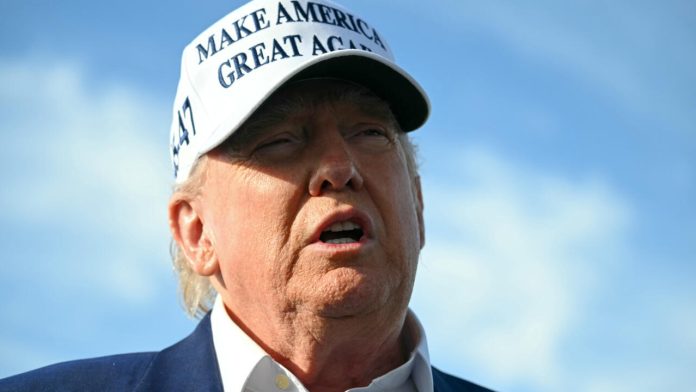
Trump says Zelensky won’t attend Alaska summit with Putin, but Ukraine-Russia negotiations should follow

Donald Trump

“He wasn’t part of it,” Trump told reporters.

“I would say he could go, but he’s gone to a lot of meetings; he’s been there for three and a half years, and nothing happened.”

As Washington seeks a path to end the war in Ukraine, the upcoming meeting between Trump and Putin will mark their first face-to-face talks since the start of Trump’s second term.

Trump said after his meeting with Putin, a meeting between the Ukrainian and Russian leaders should take place.

“Ultimately, I’m going to put the two of them (Putin and Zelensky) in a room, I’ll be there or I won’t be there, and I think it’ll get solved,” Trump added.

During the press conference, Trump added that he was “a little bothered” by Zelensky’s words regarding “constitutional approval” for land swaps as part of a potential peace agreement.

“He’s got approval to go into war and kill everybody, but he needs approval to do a land swap? There’ll be some land swapping going on,” Trump said.

“We’re going to change the battle lines. Russia has occupied a big portion of Ukraine. They’ve occupied some very prime territory. We’re going to try and get some of that territory back for Ukraine,” he added.

Trump described the upcoming meeting with Putin as a “feel-out meeting” and added that the Russian president wants “to get involved” and “to get over” the war.

“At the end of that meeting, probably in the first two minutes, I’ll know exactly whether or not a deal can be made,” Trump noted.

Trump had announced a summit with Putin and reportedly told Ukraine and European leaders that the Kremlin is open to negotiations if “land swaps” are part of the deal.

Though it remains unclear what such a deal would entail, a source in Ukraine’s Presidential Office told the Kyiv Independent that Moscow seeks Kyiv’s full withdrawal from partially occupied Donetsk and Luhansk oblasts in the east while offering to withdraw its forces from the limited areas it holds in the northeastern Sumy and Kharkiv oblasts.

Publicly, Putin has demanded a ban on Ukraine’s NATO membership and a full Ukrainian withdrawal from partially occupied Donetsk, Luhansk, Kherson, and Zaporizhzhia oblasts as a precondition for peace talks.

In turn, Zelensky has rejected ceding territory to Russia and urged a ceasefire as the first step toward peace talks, a position backed by Kyiv’s European partners.

Zelensky is also expected to hold talks with European leaders and Trump two days before the summit in Alaska.

Iran breaks US monopoly with advanced nano-radiopharmaceutical for cancer detection

NANO

The innovation, named Chimanocept, can identify tumors with over 95% accuracy in less than 15 minutes.

This breakthrough marks a significant leap in medical science and positions Iran as a new player in high-tech cancer diagnostics. Beyond its scientific value, Chimanocept symbolizes a major stride toward scientific independence and offers renewed hope for thousands of patients in Iran.

With its speed, precision, and accessibility, the drug has the potential to transform cancer detection in Iran and to inspire further advancements in the country’s medical technology sector.