Russia trying to ‘raise true hell’: Ukrainian governor
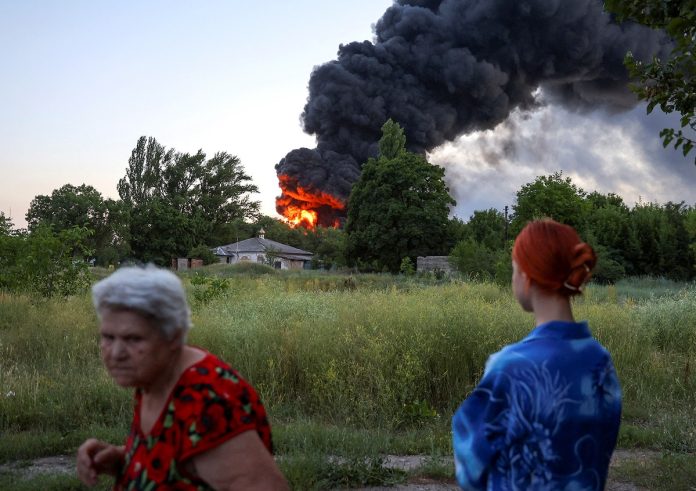
Russian forces are managing to “raise true hell” in Ukraine’s eastern industrial heartland despite reports of them taking an operational pause, a regional governor has said.
Deadly Russian shelling was reported in Ukraine’s east and south.
The governor of Luhansk, Serhiy Haidai stated Russia launched more than 20 artillery, mortar and rocket attacks in the province overnight and its forces were pressing toward the border with neighbouring Donetsk.
“We are trying to contain the Russians’ armed formations along the entire front line,” Haidai added.
Zelensky sacks Ukraine’s envoy to Germany, other ambassadors
President Volodymyr Zelensky has dismissed Kyiv’s ambassador to Germany as well as several other top foreign envoys, the presidential website says.
In a decree that gave no reason for the move, he announced the sacking of Ukraine’s ambassadors to Germany, India, Czech Republic, Norway and Hungary.
It was not immediately clear if the envoys would be handed new jobs.
Rocket hits residential building in Kharkiv
A Russian rocket has hit a residential building in the centre of Ukraine’s second-largest city, Kharkiv, injuring six people, according to regional authorities.
“The enemy rocket hit near the two-storey residential building, the building is partially ruined. The total area of destruction is around 400 square metres (4,305 square feet),” Yevgen Vasylenko, spokesperson for the Department of Emergency Situations in Kharkiv Oblast said.
“Representatives of the emergency services and national police have arrived at the site. Two men, a woman and a 12-year-old child were rescued from the ruins,” Vasylenko added.
Ukrainian army recruits begin UK military training
The first batch of up to 10,000 inexperienced Ukrainian military recruits set to train in Britain over the coming months have started drills, according to the ministry of defence.
The new British-led programme involves 1,050 UK service personnel training the Ukrainian volunteers, who have little to no military experience, in England for several weeks.
The crash course is based on Britain’s basic soldier training, covering weapons handling, battlefield first aid, fieldcraft, patrol tactics and the laws around armed conflict.
Russia calls out American goal in arming Ukraine
The US government is aiming to protract the armed conflict in Ukraine for as long as possible, and it is for this purpose that Washington is providing Kiev with four more HIMARS units, the Russian embassy in Washington claimed.
The diplomatic mission’s statement went on to suggest that the planned delivery of additional multiple launch systems is intended to make up for growing casualties among Ukrainian forces.
The Russian embassy’s statement went on to suggest that the planned delivery of additional multiple launch systems is intended to make up for growing casualties among Ukrainian forces.
It dismissed the Pentagon’s claim that such weapons are being used by Kiev for defensive purposes.
The Ukrainian military and “nationalist groups are deploying US-supplied weapons to destroy cities of Donbass,” the statement insisted.
The Russian diplomats claimed that the “Ukrainian Armed Forces are constantly deliberately targeting residential areas of Donetsk,” including parts of the city where there are no Russian troops. As a result of this, “civilians are dying,” according to the embassy.
“The goal of the Russian Federation is to put an end to the terror of the Kiev regime,” the embassy proclaimed, adding that “Washington with its actions is not bringing peace closer, but on the contrary, is encouraging the Ukrainian authorities to commit new blood crimes.”
Earlier on Friday, a senior Pentagon official revealed that the “White House will be announcing” a new round of military aid for Ukraine, which would include, among other things, four high-mobility artillery rocket systems, HIMARS, and additional ammunition for those units.
The US Department of Defense official stressed that these weapons are “especially important and effective in assisting Ukraine and coping with the Russian artillery battle in the Donbass.”
When asked by a journalist about the total number of HIMARS units that Ukraine would have after receiving the new four ones, the Pentagon representative said Kiev would have 12 such systems at its disposal.
They went on to rebut Russia’s claims that its forces had managed to destroy some of the HIMARS units Washington had previously supplied.
“That is not correct,” the unnamed DoD official insisted, adding that the “Ukrainians have those systems and are making use of them.”
He also revealed that the $400 million package would include 1,000 rounds of 155 millimeter high-precision artillery ammunition.
HIMARS ‘hasn’t been used’ to attack Russian territory
Ukraine has not used advanced US-made high mobility artillery rocket systems (HIMARS) to strike Russian targets outside of Ukraine territory, according to a senior US defence official disputing Russian accusations.
“The Russian claims about using HIMARS to strike outside of Ukrainian territory – those claims are false,” the official quoted by the Reuters news agency, speaking on condition of anonymity.
“Ukraine is using those capabilities to fight the battle that its forces are facing, and they are using them effectively in that battle,” the official added.
Russia assembling reserve forces near Ukraine: UK
Russia is moving reserve forces from across the country and assembling them near Ukraine for future offensive operations, according to British military intelligence.
A large proportion of the new Russian infantry units are probably deploying with MT-LB armoured vehicles taken from long-term storage as their primary transport, Britain’s Ministry of Defence tweeted in a regular bulletin.
Ukraine pleads for weapons at G20 meeting
Ukraine has urged its allies to send more weapons as its forces dig in, saying that a turning point has been reached in the war.
Mykhailo Podolyak, the Ukrainian chief negotiator in stalled talks with Moscow, stated Russia’s military had been forced to take an operational pause due to losses and to resupply.
“It is clear that they have to redeploy things, bring forward new troops and weaponry, and this is very good. A certain turning point is beginning to take shape because we are proving we are going to attack storage facilities and command centres,” Podolyak told Ukraine’s 24 Channel television.
Ukraine’s deputy PM calls on residents to not wait and evacuate Kherson region
Iryna Vereshchuk, Ukraine’s deputy prime minister, called on residents Friday to evacuate the southern Kherson region.
“I urge you to evacuate as soon as possible, by all means. Don’t wait,” Vereshchuk said.
She warned residents they could be used as human shields by the Russians and staying in the occupied districts of Zaporizhzhia and Kherson regions is dangerous.
“People must look for an opportunity to leave because our Armed Forces will de-occupy. There will be huge battles,” she warned.
On Thursday, Oleksandr Starukh, head of the Zaporizhzhia region military administration, stated last month almost 40,000 evacuees arrived to Zaporizhzhia.
Starukh added approximately 30,000 people arrived from parts of the Zaporizhzhia region (Melitopol, Vasylivka, Berdiansk and Enerhodar), approximately 6,000 people came from the Kherson region and approximately 1,700 people came from the besieged city of Mariupol.
US ambassador: “No way” Putin and leadership can argue they were unaware of crimes committed in Ukraine
The US ambassador-at-Large for Global Criminal Justice said “there’s no way” that Russian President Vladimir Putin “and his leadership and the military side can argue that they were unaware” of the crimes being committed in Ukraine.
Ambassador Beth Van Schaack told CNN that because there has been so much attention on those crimes, the Russian president and his inner circle could face international prosecution.
“There are legal doctrines that enable prosecutors to work all the way up the chain of command, including to the commander-in-chief, and individuals in leadership positions can be held responsible for ordering abuses if there’s evidence of an order to do so. They can be held responsible for failing to properly train and supervise their troops, and they can be held responsible for failing to adjudicate violations when they become aware of them,” Van Schaack added.
She also noted that based upon “the patterns of abuses that we’re seeing, it’s hard to conclude that these are the acts of rogue individuals or rogue units.”
Van Schaack stated there are “plenty of courts with jurisdiction” to prosecute Putin for war crimes, but “the question is getting custody over him, and so as long as he remains within Russia, he may be out of reach.”
“There’s no question that this is a long game and it has to be a long game. There’s no way this can be accomplished in six months or a year,” she continued.
Van Schaack said they still have not made a formal determination of genocide in Ukraine, noting that “genocide is difficult to prove — the special element is this intent to destroy the group in whole or in part — but we’re obviously tracking these events very carefully.”
US President Joe Biden accused Putin of committing genocide in Ukraine in April.
Van Schaack told CNN that Russia’s crimes against civilians Ukraine have clear roots in its past atrocities, including those committed in Syria, and said Moscow “probably does perceive that they have had a green light here when it came to using certain tactics.”
However, she announced she hoped Russia learns from the international community’s response to Ukraine.
She discussed the US work — along with the EU and the UK — on the Atrocity Crimes Advisory Group, comprised of two main components: veteran advisors who are embedded with the Prosecutor General in Ukraine and the deployment of “multidisciplinary, multinational mobile justice teams that are being deployed out into the field to work side by side with” Ukrainian investigators who are working at the sites of attacks.
Van Schaack also added the Department of Justice’s efforts, though she explained the US war crimes statute requires there to be a nexus to the United States for people to be prosecuted in the US.
Zelenskk praises US for sending more arms
Ukraine’s president Volodymyr Zelensky has thanked his counterpart Joe Biden for “continuing effective support” for his country in its fight against Russia, including new supply of HIMAR launchers.
“It is what helps us press on the enemy. We appreciate the support! Let’s go to victory together!,” he stated.
The US will send another $400m in military equipment to Ukraine, including four more advanced rocket systems, a senior defence official has announced, in an effort to bolster Ukrainian efforts to attack deeper behind Russian front lines in the eastern Donbas region.
The defense official added that the eight High Mobility Artillery Rocket Systems, or HIMARS, that were previously sent are still being used by Ukraine forces in the fight.
Sanctions ‘catastrophic’ for energy market: Putin
Russian President Vladimir Putin has warned of possible “catastrophic consequences” of Western sanctions on the global energy market.
“Continuing to use the politics of sanctions can lead to even more serious, without exaggeration, catastrophic, consequences on the world energy market,” he said during a televised government meeting.
Putin had warned Russian companies to be ready for an oil embargo and new European Union sanctions package.
“As you know, the European Union introduced another sanctions package against Russia with an oil embargo. Domestic companies should be ready for this decision. We spoke about the prospects for such restrictions at the last meeting on the fuel and energy complex,” he stated.
In May, the European Union agreed to an embargo on 90% of the oil it imports from Russia.
Putin also added that the West is trying to force other countries to increase energy production, but “the Russian market is stable and does not tolerate fuss.”
“Since the beginning of the year, the level of oil production has exceeded the previous year by 3.5%. Gas production for the period from January to May decreased, but only slightly – by only 2%,” the Russian president continued.
Ukraine FM accuses Russia of “cynical” strategy to destroy country’s agriculture
Ukrainian Foreign Minister Dmytro Kuleba has told the G20 Foreign Ministers Meeting that Russia has embarked on a “a well-thought and cynical strategy” to destroy Ukraine’s agriculture.
Kuleba addressed the G20 meeting in Indonesia by video link.
“The Russian naval blockade of Ukrainian ports has already shredded global chains of food supply and has a detrimental effect on global food security. Adding insult to injury, Russia steals Ukrainian grain and bombs Ukrainian granaries,” he said.
“Russia is essentially playing hunger games with the world by keeping the naval blockade of Ukrainian ports with one hand and shifting the blame for it on Ukraine with the other hand. Russia sees dependence of other countries on any type of resources as weakness and an invitation to use this dependence as a leverage to Russia’s gain,” he added.
Kuleba said that Russian forces had struck Ukraine’s second largest grain terminal complex at the port of Mykolaiv in June, claiming that “Russia knew exactly where it fired its missiles.”
The strike was aimed at causing destruction in Ukraine and “blackmailing the world,” he added.
Kuleba told the foreign ministers that for decades, Ukraine — often described as “a global breadbasket” — has been essential to worldwide food security, but is now being “attacked, bombed, and looted by Russian criminals.”
Responding to Russian claims that Ukraine was blocking its own ports, Kuleba noted: “Their accusations defy basic logic. How can we be interested in blocking our own food exports when they provide one of our main sources of revenues for the budget? We are interested in exporting our food products just as much as our consumers are interested in getting them as soon as possible.”
Separately, the Ukrainian Defense Ministry has alleged that Russia is using munitions to set farmland on fire as harvest season gets underway. A recent video shows combine harvesters in parts of southern Ukraine trying to gather in grain as fires burn through fields.
The UN has announced Russia’s blockade of Ukrainian ports has already raised global food prices and threatens to cause a catastrophic food shortage in some parts of the world.
On Thursday, Ukraine’s Foreign Ministry said the release of a Russian ship allegedly carrying stolen Ukrainian grain from Turkish waters was “unacceptable.” Turkey ignored a request to arrest the vessel and cargo and the ship was released on July 6, according to a ministry statement. The Russian merchant ship, Zhibek Zholy, had carried the grain from the occupied port of Berdiansk to the Turkish port of Karasu.
Russia has repeatedly denied it is blocking the ports or stealing grain.