Western intelligence agencies involved in ‘sabotage’: Putin
President Vladimir Putin says there was reason to believe Western intelligence agencies were involved in what he said were sabotage and “terrorist acts” carried out by Ukraine.
In a meeting of the Kremlin’s Security Council with the heads of the four Ukrainian regions that Moscow said it had annexed last year, Putin accused Ukraine of committing crimes against Russian administrators, security personnel, journalists and teachers with the help of Western intelligence services.
“There is every reason to say that the resources of third countries, Western intelligence services, are engaged in the preparation of such sabotage and acts of terrorism,” Putin added.
Russia frequently accuses Ukraine of killing civilians with shelling in parts of Ukraine that Russia controls and in Russian border regions close to Ukraine.
EU, Russia relations ‘seriously degraded’: Putin
President Vladimir Putin told the EU’s ambassador, Roland Galharague, at a Kremlin ceremony that relations between Russia and the bloc had “seriously degraded” and that the EU had begun a “confrontation” with Russia.
“The European Union initiated a geopolitical confrontation with Russia,” Putin stated.
The Russian leader also urged Denmark to support Russia’s proposal to establish an independent international commission to investigate the blasts that ruptured the Nord Stream undersea pipelines bringing gas from Russia to Germany last September.
In his opening remarks, Putin said Russia was open to constructive partnership with every country and would not isolate itself, despite the complex situation in the world.
Relations between Russia and the West were already severely strained before it began what it calls its “special military operation” in Ukraine, but have worsened since then.
US responsible for deteriorating relations: Putin
President Vladimir Putin told the new US ambassador they were responsible for a dramatic deterioration in relations since Russia sent its armed forces into Ukraine last year.
The ambassador was among 17 who formally presented their diplomatic credentials to Putin at a televised ceremony in the Kremlin.
Putin told new US ambassador Lynne Tracy that US support for a revolution in Ukraine in 2014 had led to the current situation where Russia and Ukraine were in conflict.
He added relations were in “a deep crisis” that was “based on fundamentally different approaches to the formation of the modern world order”.
“Dear Madam Ambassador, I know you may not agree, but I cannot but say that the United States’ use … of such tools as support for the so-called ‘colour revolutions’, support in this regard for the coup in Kyiv in 2014, ultimately led to today’s Ukrainian crisis,” Putin continued.
Russia will be doing everything so that no country supplies depleted-uranium munitions to Kiev, Foreign Ministry Spokeswoman Maria Zakharova said on Wednesday.
“I will stress this again: We will do everything so that no one will resolve to make this irresponsible step,” she stated at a news conference, when asked about preventing the supplies and use of depleted-uranium munitions in Donbass and Ukraine.
According to a statement published in March, UK Minister of State for Defense Annabelle Goldie wrote in response to an inquiry from a member of the House of Lords that the British government would send Ukraine munitions containing depleted uranium and featuring enhanced effectiveness against armored vehicles.
The UK Defense Ministry described depleted uranium as “a standard component” of armor-piercing shells, which has been used for decades.
Russian President Vladimir Putin said that Russia will have to react appropriately to the fact that the “collective West begins using weapons with a nuclear component.”
Turkey did not join sanctions against Russia and intends to continue pursuing this policy, Ibrahim Kalin, official Turkish presidential spokesperson, said in an interview with the Anadolu news agency on Wednesday.
“We have not joined the sanctions because they were not introduced by the UN. That said, we recognize and support the Ukrainians’ right to defense and protection as well as defend the principles of territorial integrity. And we have been pursuing this balanced policy until now and will continue to do so,” he stated.
Russia says it will ignore media lobbying for release of arrested US reporter
Russian foreign ministry spokeswoman Maria Zakharova says Moscow will ignore a letter from media groups urging the release of a US reporter accused of spying because they have not shown the same regard for a Russian pro-war blogger killed by a bomb.
Wall Street Journal reporter Evan Gershkovich was detained in the Russian city of Yekaterinburg last week and remanded in custody for two months in a closed court hearing, to protests from the United States, the European Union and his employer and fellow journalists.
“Why on earth should we issue a reaction to the letter if we see their absolute hypocrisy?” Zakharova stated.
She added Vladlen Tatarsky had also been a journalist, “but I haven’t seen any reaction, either collective or individual, from any of those who signed this letter. And if I’m honest, this appeal has completely lost any significance for me.”
US looking into ‘wrongful detention’ label for arrested WSJ reporter
The US is working through the process to determine whether Wall Street Journal reporter Evan Gershkovich’s arrest is “wrongful”, US Secretary of State Antony Blinken said, adding it would soon be completed.
“It’s something that we’re working through very deliberately, but expeditiously, as well. And I’ll let that process play out,” Blinken stated in a news conference in Brussels.
“In my own mind, there’s no doubt that he’s being wrongfully detained by Russia, which is exactly what I said to Foreign Minister [Sergey] Lavrov when I spoke to him over the weekend and insisted that Evan be released immediately,” Blinken added.
The “wrongfully detained” designation means the responsibility for the case would be transferred from the Department of State’s Bureau of Consular Affairs to the office of the Special Envoy for Hostage Affairs, raising the issue’s political profile and allowing the government to allocate more resources to securing Gershkovich’s release.
Last week, Russia’s FSB security service said it had arrested Gershkovich and accused him of gathering information about a Russian defence company that was a state secret.
Russia-China joint statement amounted to ’empty promises’: NATO
Russia’s announcement that it will station tactical nuclear weapons in Belarus shows that a Russia-China joint statement amounted to “empty promises”, NATO Secretary General Jens Stoltenberg said.
Russian President Vladimir Putin’s announcement came just days after Russia and China jointly declared countries should not deploy nuclear weapons outside their borders, Stoltenberg told reporters at NATO headquarters in Brussels.
He stated this showed such statements are “empty promises and what we need to watch closely is what Russia is doing.”
However, Stoltenberg said NATO had not seen any signs that Russia was following through on Putin’s announcement.
China has a ‘major role’ in Ukraine’s peace process: France
French President Emmanuel Macron says China has a “major role” to play in finding a path to peace in Ukraine during the first speech of his three-day visit to Beijing.
Speaking at a gathering of the French community in Beijing, Macron stated France would seek to work with China “in this shared responsibility for peace and stability” in Ukraine.
“China, with its close relationship with Russia, which has been reaffirmed in recent days, can play a major role,” he added.
Speaking to journalists after his remarks, Macron said, “We have decided since the beginning of the conflict to help the victim, and we have also made it very clear that anyone helping the aggressor would be an accomplice in breach of international law.”
Macron is expected to meet his Chinese counterpart, Xi Jinping, on Thursday.
‘Corresponding decisions’ will be taken in Bakhmut: Zelensky
Ukraine’s President Volodymyr Zelensky says the situation in Bakhmut is really difficult and that the “corresponding decisions” would be taken if Kyiv’s troops’ risk being encircled by Russian forces.
Zelensky told a news conference in Poland that protecting soldiers’ lives was the most important thing to him.
“We are in Bakhmut and the enemy does not control it,” he stated, adding, “For me, the most important is not to lose our soldiers and of course if there is a moment of even hotter events and the danger we could lose our personnel because of encirclement – of course the corresponding correct decisions will be taken by generals there.”
The more ammunition Kyiv receives from western partners, the faster it would be able fight back in Bakhmut and elsewhere, he said, adding, “There is success in some districts of Bakhmut – we’re going forward. Or there’s no (success) and we’re again leaving for positions.”
Poland to seek security guarantees for Kyiv at NATO summit
Polish President Andrzej Duda says Warsaw will seek additional security guarantees for Kyiv at a NATO summit in July as he hosted Zelenskyy.
“Today we are trying to get for Ukraine… additional guarantees, security guarantees, which will strengthen Ukraine’s military potential,” Duda told reporters following talks with Zelensky, adding that Poland supports full NATO membership for Ukraine.
Duda also handed over four MiG-29 fighters to Kyiv and said the transfer of four more fighter jets is in the process.
IAEA chief holds talks with Russian officials
The head of the International Atomic Energy Agency (IAEA), Rafael Grossi, has met with Russian officials in Kaliningrad for talks on the Moscow-held Zaporizhzhya nuclear power plant in southern Ukraine.
An IAEA spokesperson stated earlier this week that Grossi would visit the Russian Baltic exclave of Kaliningrad on Wednesday to discuss the safety of the nuclear plant, which is located near the front line of fighting between Russian and Ukrainian forces.
Grossi visited the plant last week, where he said the situation had grown worse and military activity around the site had intensified in recent months.
Anyone helping Russia would become an ‘accomplice’: France
French President Emmanuel Macron says that anyone helping the “aggressor”, Russia, in the Ukraine conflict would become an “accomplice”.
Speaking to journalists following his first speech in China after arriving for a three-day visit, Macron said, “We have decided since the beginning of the conflict to help the victim, and we have also made it very clear that anyone helping the aggressor would be an accomplice in breach of international law.”
Prospects for peace negotiations not yet visible: Kremlin
The Kremlin says any prospects for peace negotiations with Kyiv are not yet visible, the TASS news agency reported.
When asked how the Kremlin views the possibility of resuming negotiations with Kyiv or negotiating the future of Ukraine, Kremlin spokesperson Dmitry Peskov said, “we do not see any prospects for this yet, so there is nothing to add here”.
Finland accession proves Russia is no longer a ‘political player’: Adviser
Ukrainian presidential adviser, Mikhail Podolyak, says Finland’s accession into the NATO military alliance proves that Russia is no longer a “global political player”.
Podolyak tweeted, “Fast accession of Finland to NATO ultimately nullifies the role of RF [Russian Federation] as a global political player.
“Next goes mandatory demilitarisation, denuclearisation, destruction of pro-Russian economic and information lobby, self-isolation and hysterical whining of offended propagandists,” he added.
Turkey, US discuss Sweden’s NATO bid
Turkey’s Foreign Minister Mevlut Cavusoglu discussed Sweden’s NATO bid and developments regarding Ankara’s purchase of F-16 fighter jets with US Secretary of State Anthony Blinken.
Cavusoglu met Blinken on the sidelines of a NATO meeting in Brussels, during which alliance members welcomed Finland to the bloc.
Zelensky arrives in Poland for official visit
President Volodymyr Zelensky has arrived in neighbouring Poland for an official visit, according to a Polish presidential aide.
During the visit, the Ukrainian president will meet his Polish counterpart, Andrzej Duda, and Prime Minister Mateusz Morawiecki.
Zelensky will also speak to Ukrainian refugees, Polish members of the public and business leaders who could be involved in rebuilding Ukraine.
“I can say that President Zelensky has crossed the Polish border,” presidential aide Marcin Przydacz told private broadcaster TVN24.
On Tuesday, Przydacz had said the visit “should be taken as a sign of trust and of thanking Poland and Poles”.
Poland has been essential in persuading other Western powers to supply battle tanks and other weaponry to Ukraine.
Macron: China could play significant role in ‘path to peace’
French President Emmanuel Macron says China could play a significant role in finding a “path to peace” in Ukraine in his first speech since arriving in the capital for a three-day state visit.
Speaking to French citizens in Beijing about various issues, including Russia’s war in Ukraine, Macron stated: “China, with its close relationship with Russia, which has been reaffirmed in recent days, can play a major role.”
He added France would engage “in this shared responsibility for peace and stability”.
Macron is in China for a visit hoping to dissuade Beijing from supporting Russia’s invasion of Ukraine while also forging closer ties with a crucial trade partner.
He also stated that Europe must not “separate” from China economically.
Failure to ban Russia and Belarus from Olympics represents loss: Ukraine
The head coach of the Ukrainian freestyle skiing team said a failure to ban Russian and Belarusian athletes from the international competition represents a loss for Ukraine.
Ukraine’s government has said its athletes will not be allowed to take part in Paris 2024 qualifying games if they have to compete against Russians.
“Every effort must be made to ensure that they are not allowed to participate in international competitions,” Enver Ablaev told Ukraine’s public broadcaster Suspilne on Tuesday.
“If we do not achieve this, it will be our loss. If they compete and if our athletes are allowed to compete next to them, it will also be a loss. If we decided to ban our athletes from competing alongside the Russians, then this is also a loss,” Ablaev added.
Last month, the International Olympic Committee (IOC) recommended Russians and Belarusians be allowed to return to international competition as neutrals since their ban due to Russia’s invasion of Ukraine.
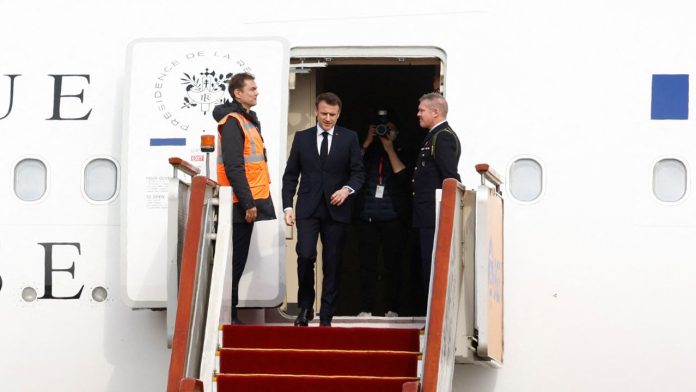
French President Emmanuel Macron landed in Beijing’s Shoudu Airport on Wednesday. China’s CCTV showed the footage of the arrival of an aircraft carrying the French leader.
During his three-day stay, Macron will meet with Chinese leader Xi Jinping, Premier of China’s State Council Li Qiang and Zhao Leji, the chairman of the Standing Committee of the National People’s Congress of China.
This is Macron’s first visit to China in the past three and a half years. Macron last visited during his first presidency in October 2019.
Sources at Elysee Palace stated that, while in Beijing, the French leader is planning to discuss the Ukrainian conflict and measures to boost relations between France and China, mostly in the economic sphere.
The European Union will discuss the 11th package of sanctions against Russia after this weekend’s Catholic Easter holidays, Politico’s European edition reported on Wednesday.
A new round of consultations between the European Commission and EU ambassadors is expected “just after the Easter holiday,” three EU diplomats told the newspaper.
Earlier, European Commission President Ursula von der Leyen said that the 11th package would be aimed at countering loopholes and any circumvention.
Reuters reported earlier this week, the EU was mulling the imposition of sanctions on Russia’s nuclear energy industry in Europe and Rosatom by offering Hungary specific carve-outs. Last year, Budapest was similarly allowed to buy Russian pipeline oil on which the other EU countries put their embargo effective from December 5, 2022.
The EU failed to slap sanctions on Russia’s state-owned nuclear energy corporation in its 10th package on February 25 over opposition from Hungary.
Spain delays sending Leopard tanks to Ukraine
The six Leopard 2A4 tanks Spain has promised to send to Ukraine will leave the country in the second half of April, Defence Minister Margarita Robles told state broadcaster TVE on Wednesday, pushing back the estimated shipment date.
The German-made battle tanks have not been used since the 1990s and had been mothballed in reserve, requiring refitting and battle readiness tests after initial doubts as to whether they could go into combat again.
Zelensky invited to NATO summit in July: Alliance’s chief
NATO Secretary General Jens Stoltenberg has indicated that Ukrainian President Volodymyr Zelensky has been invited to the alliance’s summit taking place in the Lithuanian capital of Vilnius in July.
“A strong independent Ukraine is vital for the stability of the Euro-Atlantic area, and we look forward to meeting President Zelensky at our Vilnius summit in July,” Stoltenberg stated.
He made the remark in Brussels on Tuesday, following a meeting of the NATO-Ukraine Commission – the body responsible for the relationship between Ukraine and the alliance
Ukraine hopes to receive $1.8bn this year in two tranches from IMF
Ukraine hopes to receive two more tranches worth $1.8bn from the International Monetary Fund this year under its newly approved four-year lending programme, top Ukrainian central bank officials have stated.
“We hope to receive all planned tranches this year with an overall amount of $4.6bn” said Serhiy Nikolaichuk, one of the central bank’s deputy governors.
Ukraine faces an unprecedented budget deficit this year and is relying heavily on Western financial support. The finance ministry said it had already received a total of $12.6bn in foreign aid so far this year.
Ukraine must meet certain conditions to ensure the IMF financing, including steps to boost tax revenue, maintain exchange rate stability, preserve central bank independence and strengthen anti-corruption efforts.
UN appoints special rapporteur for Russia amid domestic crackdown
Amid a long line of resolutions passed on the last day of its main annual session, the UN Human Rights Council has agreed to appoint Bulgarian human rights expert Mariana Katzarova to monitor the situation inside Russia.
The move came last September when the council decided a special rapporteur was needed for Russia, amid concerns about an intensifying domestic crackdown by Moscow as its war rages in Ukraine.
UN demands access to Ukrainian children transferred to Russian territory
The United Nations Human Rights Council has demanded that Russia provide access to and information about Ukrainian children and other civilians forcibly transferred to territory under its control.
The top UN rights body passed a resolution demanding that Moscow “cease the unlawful forced transfer and deportation of civilians and other protected persons within Ukraine or to the Russian Federation”.
The Kremlin’s alleged deportation of tens of thousands of children from war-ravaged Ukraine to Russia or areas occupied by Russian forces has been a hot-button topic throughout the nearly six-week session of the Geneva-based council.
Kyiv maintains that more than 16,000 Ukrainian children have been deported to Russia as of February this year.
Ukrainians will start training on Abrams tanks soon: Defense official
Training for Ukrainians on US M1-A1 Abrams tanks has not yet started, but will begin “relatively soon,” a senior defense official told reporters Tuesday.
“Abrams training has not yet begun…We are still working on the equipment procurement so we haven’t we have not yet begun the training, but I would expect that that will happen relatively soon,” the official said during a background briefing.
In total, the official stated the US has trained more than 7,000 Ukrainian troops since the beginning of Russia’s invasion more than a year ago. The US plans to send 31 M1-A1 tanks to Ukraine — the size of a Ukrainian tank battalion.
The US agreed to send the tanks in January after a sudden reversal on its stated policy that Abrams were too complex and difficult to maintain for Ukrainian forces in the middle of a war.
The Joe Biden administration relented under pressure from Germany, which said that it would only approve the transfer of its Leopard 2 tanks to Ukraine if the US agreed to send Abrams tanks as well.
But the US cautioned that delivering tanks to Ukraine would take time.
“We just don’t have these tanks available in excess in our US stocks,” noted Pentagon press secretary Sabrina Singh shortly after the US announcement
US announces new $2.6 billion military aid package to Ukraine
US President Joe Biden’s administration announced an additional package of military aid to Ukraine totaling $2.6 billion on Tuesday.
The package includes $500 million in drawdown equipment, such as ammunition for High Mobility Artillery Rocket System (HIMARS) and additional munitions for the Patriot missile system, artillery and mortar rounds, heavy fuel tankers, and tactical recovery vehicles. It is the 35th drawdown of US equipment for Ukraine since August 2021.
The administration is also allocating $2.1 billion in Ukraine Security Assistance Initiative funds, which intend to produce a “significant package of air defense capabilities” including air surveillance radars and counter-unmanned aerial system 30mm gun trucks, as well as Javelin anti-armor systems and 23 million rounds of small arms munition.
The Pentagon’s release announcing the aid on Tuesday reiterated that the US would continue to work with its allies to “provide Ukraine with capabilities to meet its immediate battlefield needs and longer-term security assistance requirements.