Wednesday, December 31, 2025
Home Blog Page 143

UN principles ‘under siege’: Secretary-General

None

“The pillars of peace and progress are buckling under the weight of impunity, inequality, and indifference,” Guterres told world leaders, stressing that the UN’s founding values are being tested in ways “more urgent, more intertwined, and more unforgiving” than at its creation.

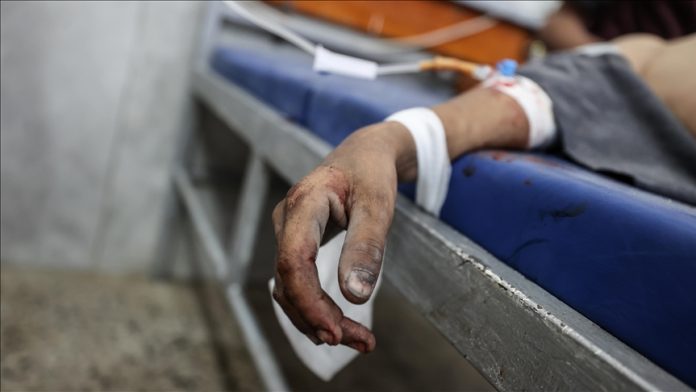
Guterres painted a grim picture of Gaza and said: “In Gaza, the horrors are approaching a third monstrous year.”

He added that the situation in Gaza is “the result of decisions that defy basic humanity.”

Guterres also warned that “the scale of death and destruction is beyond any other conflict in my years as secretary-general.”

He recalled that the International Court of Justice (ICJ) had issued “legally binding” provisional measures in the case of genocide in Gaza, but “since then, a famine has been declared, and the killing has intensified.”

The UN chief further called for those measures to be “implemented fully and immediately.”

Urging the UN Security Council to rise to the moment, Guterres said: “The Security Council must live up to its responsibilities. It must be more representative, more transparent, and more effective.”

Highlighting the worsening humanitarian situation, the UN chief denounced international aid cuts, calling them “a death sentence for many” and “a stolen future for many more.”

Beyond the conflict, Guterres urged world leaders to intensify their climate action, adding, “We need stepped-up action and ambition, especially through strengthened national climate plans.”

He noted that the G20 nations, as the largest emitters, “must lead, guided by common but differentiated responsibilities.”

“80 years on, we confront again the question our founders faced: What kind of world do we choose to build together?” Guterres asked.

NATO’s chief to Russia: We’re ready for you

On Friday, the alliance scrambled several fighter jets after three Russian MiG-31 aircraft entered Estonian airspace for 12 minutes. Earlier this month, Moscow also sent drones into Poland and Romania.

“We have all the defensive systems in place to make sure that we can defend every inch of allied territory,” Rutte told reporters.

“That’s what we have shown both in the Polish case as well as in the Estonian case.”

Alliance members met Tuesday after Estonia invoked NATO’s Article 4, triggering urgent consultations among allies.

In a statement published after the meeting, NATO ambassadors announced that they would “not be deterred by these and other irresponsible acts by Russia from their enduring commitments to support Ukraine.”

“Russia should be in no doubt: NATO and Allies will employ, in accordance with international law, all necessary military and non-military tools to defend ourselves,” the statement added.

The meeting also came after Norway and Denmark detected drones in their airspace on Monday night, prompting airports in Oslo and Copenhagen to temporarily shut down. Danish Prime Minister Mette Frederiksen said Tuesday she “cannot rule out” Russia’s involvement, an accusation the Kremlin rejected.

In repose to the Russian drones in Poland, Rutte announced the launch of the Eastern Sentry mission to bolster defenses on the alliance’s eastern flank.

That incident, which saw multimillion-euro NATO jets shoot down cut-price drones made of wood and foam, has triggered criticism that the alliance is unprepared for growing aerial threats and Moscow’s low-cost warfare — at least economically.

Rutte stated that the alliance was actively working to fix that problem.

“One of the reasons why we launched Eastern Sentry,” he noted, is “it is not sustainable to take down … a let’s say, $1,000 or $2,000-costing drone, [with] a half a million or a million [dollar]-costing missile.”

Meanwhile, the incidents have prompted some NATO allies to issue unilateral warnings to Russia and search for new ways to shore up their defenses. Poland and Sweden this week said they would shoot down any Russian aircraft entering their territory, while Estonia has said it is ready to host British nuclear-capable fighter jets.

Russia insisted it is doing nothing wrong.

“Allegations that our aircraft have allegedly violated airspace have never been substantiated by reliable data or convincing evidence,” said Kremlin spokesperson Dmitry Peskov, according to the government-controlled TASS news agency.

However, Rutte signaled the incidents would not lead to NATO overhauling its rules of military engagement with Russia.

“The decisions on whether to engage in shooting aircraft … are always based on available intelligence regarding the threat posed by the aircraft,” he stated, arguing “no immediate threat” was detected in Estonia.

“But if necessary, you can be assured we will do what is necessary to defend our cities, our people, our infrastructure” he added.

Iran’s President congratulates Saudi King, Crown Prince on National Day

In his message to King Salman issued on Tuesday, President Pezeshkian highlighted the many commonalities between the Islamic Republic of Iran and the Kingdom of Saudi Arabia, describing them as a strong foundation for friendship between the two Muslim nations. He expressed hope that, through mutual efforts, bilateral ties would continue to expand across all fields.

In a separate message to the crown prince, who also serves as the prime minister of the kingdom, the Iranian president voiced optimism that joint efforts and the full use of existing capacities would pave the way for broader cooperation between Tehran and Riyadh in political, economic, and cultural spheres.


Ali Larijani: U.S. demanded Iran cut missile range to below 500 km

Ali Larijani

Speaking at a meeting with members of Iran’s Chamber of Commerce, Larijani denounced the demand as an affront to national dignity, stressing that no patriotic Iranian could ever accept such a restriction.

He explained that in the course of diplomatic efforts, two separate proposals had been put forward — one by European countries and another by Russia.

Iran, he said, accepted both initiatives with certain reservations, and a six-month timeframe was set for negotiations. Nevertheless, the other parties failed to honor their commitments and instead pursued the reactivation of the so-called “snapback” mechanism at the UN Security Council.

Highlighting two key points, Larijani stated:

1. “In the initial American plan, they set a condition that no man of honor could accept — to cut the missile range to less than 500 kilometers. Is such a thing imaginable for any Iranian? The problem lies precisely here: they put forward demands that are fundamentally unacceptable.”

2. “Under the JCPOA, a mechanism was provided whereby if one side violated its commitments, the other side would have the right to respond. Who was the first to break commitments? First the U.S. withdrew, then the Europeans failed to abide, and ultimately they even resorted to bombing. So who should rightly lodge the complaint?”

Iran confirms arrival of Russian MiG-29 jets, announces upcoming delivery of Su-35 fighters

Abolfazl Zohrevand stated on Wednesday that the MiG-29s mark the initial phase of an expanded military cooperation plan with Russia.

He added that advanced Sukhoi Su-35 fighter jets will be delivered to Iran gradually as part of a long-term strategy to boost the country’s aerial defense capabilities.

The lawmaker further announced that two strategic air defense systems, the Chinese HQ-9 and the Russian S-400, are also slated to enter Iran in stages. “Once these systems are fully in place, our enemies will understand the language of power,” Zohrevand emphasized.

Also referring to the Cairo agreement signed between Iran and the International Atomic Energy Agency earlier this year, he described the development as a “victory card” for Iran at a time when Western states were considering reactivating the so-called snapback mechanism against Tehran. “We should not view this negatively; it strengthens our hand,” he underlined.

Kayhan: shadow of war to never disappear via negotiations

Iran US Flags

According to the paper, Israel’s Channel 13 recently aired a documentary on the war, revealing operational details and high-level discussions within the Zionist regime.

In the program, Israeli Defense Minister Yisrael Katz described negotiations as a tool to lull Iran into complacency, saying that Washington deliberately scheduled talks for June 15, 2025, to distract Tehran ahead of military action. An Israeli analyst in the documentary added that the goal was to create a false sense of normalcy and optimism surrounding the diplomatic process.

Kayhan also cited earlier reports by The Wall Street Journal about U.S.-Israeli coordination to mislead Iran during talks, including staged media leaks portraying differences between Trump and Netanyahu while the U.S. was fully informed of Israel’s strike plans.

The newspaper concluded that these revelations prove war threats cannot be eliminated through negotiations. Rather, it argued, the 12-day conflict showed U.S.-Iran talks became part of the military strategy of surprise, assisting Israel’s assault instead of preventing it.

German military reveals expected losses from conflict with Russia

“Realistically, we are talking about a figure of around 1,000 wounded troops per day,” Surgeon General Ralf Hoffmann told Reuters on Monday, when asked about the Bundeswehr’s potential casualty rate. The military is looking at hospital trains and buses as it considers its potential needs, he added.

The Bundeswehr would also need German hospitals to allocate some 15,000 beds for it as soldiers would be mostly treated in civilian medical facilities after evacuation, according to Hoffmann.

Berlin has repeatedly spoken about the possibility of a direct military confrontation between NATO and Russia since the escalation of the Ukraine conflict in 2022. Germany’s chief of defense staff, General Carsten Breuer, had previously stated that the nation must be ready to confront Moscow by 2029.

Earlier this year, Kremlin spokesman Dmitry Peskov warned that “Germany is becoming dangerous again” in response to a statement by German Defense Minister Boris Pistorius suggesting that the nation’s troops were ready to kill Russian soldiers in the event of a confrontation. Peskov has also called Chancellor Friedrich Merz a “fierce apologist for confrontation with Russia.”

Merz had earlier vowed to make the Bundeswehr the “strongest conventional army in Europe.” He also labeled Russian President Vladimir Putin “perhaps the most serious war criminal of our time” and urged Kiev’s Western backers to pursue “economic exhaustion” of Russia.

Since the escalation of the Ukraine conflict in 2022, Berlin has significantly increased military spending and has become the second-largest supplier of arms to Kiev after the US. Ukraine used German Leopard tanks in its incursion last year into Russia’s Kursk Region.


Poland threatens to shoot down Russian aircraft

Earlier this month, Warsaw accused Moscow of “deliberately” sending at least 19 drones into Polish airspace, which Russia dismissed as “hysteria” promoted by the “European party of war.” The latest warning came during a meeting convened by another NATO member, Estonia, which also accused Russia of an airspace violation.

“You have been warned,” Sikorski said.

“If another missile or aircraft enters our airspace without permission – either deliberately or by mistake – and gets shot down and the wreckage falls on NATO territory, please don’t come here to whine about it.”

Moscow responded by saying that “neither Warsaw nor Brussels need the truth,” with Deputy Ambassador to the UN Dmitry Polyansky referring to the gathering as the second part of the “blame Russia for everything” spectacle.

Polyansky noted that the only confirmed damage from the alleged Russian drone incursion was actually caused by a Polish missile fired from a NATO F-16, which struck a residential building. Moscow offered to hold bilateral consultations over the incident but received “no adequate response,” and Warsaw has yet to provide any evidence that the drones were of Russian origin. Poland needed “only a reason for a new round of a Russophobic campaign,” the diplomat added.

As for Estonia’s claims that three Russian military aircraft violated its airspace for 12 minutes last week, “there is no proof except the Russophobic hysteria coming from Tallinn,” Polyansky stated.

Russia is treating any accusations against its military “very seriously,” but wants to see clear evidence rather than EU “hysteria” aimed at pushing US President Donald Trump onto “an anti-Russian course and undermining the agreements and understandings reached by the Russian and American presidents in Alaska a month ago,” Polyansky continued.


US could sanction entire ICC: Reuters

The International Criminal Court (ICC)

Washington has already blacklisted individual judges and prosecutors, but placing the court itself on the sanctions list could cripple its day-to-day operations, from paying staff salaries to accessing banking services and basic software. One US official said entity-wide sanctions were under consideration, though no final decision has been announced.

The pressure campaign against The Hague-based court comes after the ICC issued arrest warrants last year for Israeli Prime Minister Benjamin Netanyahu and former Defense Minister Yoav Gallant over war crimes in Gaza, alongside charges against members of Hamas.

According to three sources, the ICC has already begun preparing for potential sanctions by paying staff salaries in advance through the end of 2025 and seeking alternative providers for banking and office software. Emergency meetings were held among court officials and with diplomats from member states to assess the potential impact.

The threat of broader sanctions has triggered pushback among the ICC’s 125 member countries, several of which plan to raise concerns at the United Nations General Assembly this week, three diplomats told Reuters.

“The road of individual sanctions has been exhausted. It is now more about when, rather than if, they will take the next step,” one senior diplomat stated.

The ICC was established in 2002 under the Rome Statute to prosecute genocide, war crimes, and crimes against humanity. The court recognizes Palestine as a member, which it says grants jurisdiction over alleged crimes committed in Gaza. Israel and the US reject this interpretation and do not recognize the court’s jurisdiction.

Last month, while announcing sanctions against two ICC judges and two prosecutors, US Secretary of State Marco Rubio described the court as “a national security threat that has been an instrument for lawfare” against the US and Israel. In February, Washington also sanctioned the ICC’s lead prosecutor, Karim Khan, after he sought arrest warrants against Israeli officials. Khan is currently on leave amid an investigation into sexual misconduct allegations, which he denies.


Moldova arrests dozens over alleged Russian plot to stir up unrest around key election

The raids targeted more than 100 people and took place in multiple localities across the country, police said.

Seventy-four people were detained for up to 72 hours, said Victor Furtuna, Moldova’s chief prosecutor from the Office for Combating Organised Crime and Special Cases.

Moldova’s police announced that the unrest plot was “coordinated from the Russian Federation, through criminal elements.”

Furtuna added that most of the suspects “systematically traveled” to Serbia, where they received training and that they were aged between 19 and 45 years old.

Moldovans will vote on Sunday to choose the new 101-seat legislature, in an election many view as a choice between the country’s continued path toward European Union membership or closer ties with Russia.

Online disinformation aimed at discrediting Moldova’s pro-European government in the run-up to the vote.

Moldovan President Maia Sandu and her Party of Action and Solidarity (PAS) are hoping to stay in power and keep Moldova — which is flanked by Romania to the west and Ukraine to the east — on its path towards European Union (EU) membership.

But ballots in the country have traditionally been the target of intense disinformation and destabilisation campaigns, including vote-buying and bribery schemes.

It means Moldova has been caught in the crossfire of an information war pitting EU membership against closer alignment with Russia.

Pro-Europeans fear the Kremlin’s hybrid warfare techniques could skew the vote.

A sophisticated pro-Russian disinformation campaign, dubbed Matryoshka, has ramped up its efforts to spread propaganda in Moldova. It aims to discredit its pro-European Union government as parliamentary elections loom, according to a study.

The transparency tool NewsGuard said that the operation promoted false claims that Moldovan President Maia Sandu embezzled $24 million (€20 million) and that she’s addicted to “psychotropic drugs.”

It added that one campaign alone targeted Moldova with 39 made-up stories in three months since the elections were called in April this year, compared to zero the year before.

The Matryoshka campaign is a coordinated pro-Russian operation, known among fact-checkers for spreading false news reports in the style of legitimate media outlets.

And after last year’s presidential election, Maia Sandu denounced what she called an “assault on democracy and freedom” as she stated criminal groups had bought Moldovan citizens’ votes prior to a referendum on whether to enshrine seeking EU membership in the constitution.

Sandu claimed that “criminal entities” had the goal of buying 300,000 votes and that “the state institutions documented 150,000 people being paid to vote,” as the justice system failed to do enough to prevent vote theft and corruption.