Kyiv claims counter-offensive ‘moving forward’
Ukraine says its forces were moving forward, just after Russian President Putin said the long-expected counteroffensive was failing.
“Both defensive and offensive fierce fighting is ongoing in the east and south of our nation. We have certain gains, implementing our plans, moving forward,” the chief of the Ukrainian armed forces Valery Zaluzhny said on social media.
NATO chief says Ukraine is making advances in its counteroffensive
NATO Secretary-General Jens Stoltenberg says that Ukrainians are making advances in their counteroffensive but added that it was still the early days of Kyiv’s renewed push against Russia’s invasion.
His comments came ahead of a meeting with US Secretary of State Antony Blinken.
Stoltenberg added that NATO was also preparing for the military alliance’s summit in the Lithuanian capital of Vilnius in July and expected members to step up further support for Ukraine during the summit.
Putin says Russia ready for talks if West stops arming Ukraine
In a televised meeting with Russian military bloggers, Russian President Vladimir Putin said his country is open to peace talks over Ukraine, but said Western countries must end their arms supplies to Kyiv.
Putin also repeated his accusation that the West was seeking to defeat Russia in Ukraine and said that Moscow had its own “peace plan” for that country.
He added the Black Sea grain deal between Russia and Ukraine does not benefit his country and added that Moscow was considering withdrawing from the agreement.
The president stated that Moscow had been “cheated” over the implementation of the parts of the accord that concerned its own exports, in a televised meeting with pro-Kremlin war correspondents.
Putin added that the deal, brokered by the United Nations and Turkey, was intended to help “friendly” countries in Africa and Latin America. He said Europe was the largest importer of Ukrainian grain and was providing a key source of foreign currency to Kyiv.
The president stated that the country’s missile attacks targeting Ukraine’s energy infrastructure are a response to Kyiv breaching Moscow’s “red lines”.
Putin also said that while Russia’s quality of weapons is improving, the country still lacks “high-precision ammunition and drones”.
He added that “Russia had increased its production of key weapons 2.7 times over the past year.”
The president said there is no need to impose marital law in Russia even as its territory comes under drone and artillery attack.
He noted that no conscripted soldiers would be sent to Ukraine and added that additional mobilisations would depend on what the country wants.
“We have recruited more than 150,000 contract fighters, 156,000 volunteers. The defence ministry says there is no need for additional mobilisation,” Putin continued.
“People are standing up by their own will to defend the fatherland,” he stressed and accused the West of breaching international law by continuing to supply weapons to Ukraine.
Putin said Moscow could have been more prepared to defend attacks inside the country.
“We have to strengthen our border,” he stated and added that if shelling from Ukraine continues, “Russia might have to set up a sanitary zone inside Ukraine.”
He noted that these attacks mean Russia might also have to draw resources from elsewhere.
Putin also said that Ukraine’s counteroffensive is “large-scale.”
He added that Kyiv’s offensive involves attacks in different directions but highlighted that Ukraine has not been successful in many areas.
“Ukraine’s losses are ten times bigger than Russia’s,” he said and added that “Ukraine lost 25-30 percent of vehicles supplied from abroad.”
He declined to comment about whether his country will launch a new counteroffensive in Ukraine, amid Kyiv’s ongoing offensive.
Putin said that Russia’s plans would depend on its military potential.
He stressed that the goals of Moscow’s military campaign will not fundamentally change and will evolve with the situation.
US to give more than $300m in new military aid to Ukraine
The US has announced a new $325m military aid package for Kyiv that will include munitions for air defence systems, ammunition and vehicles, Secretary of State Anthony Blinken said in a news release.
“The United States continues to stand with the people of Ukraine, whose enduring courage and solidarity inspires the world,” he added.
The aid is being rushed to Ukraine using Presidential Drawdown Authority, which authorises the president to transfer articles and services from US stocks without congressional approval during an emergency.
Moscow-backed official says top Russian officer killed in Ukraine
A top Russian officer has been killed in a Ukrainian missile attack during Kyiv’s counteroffensive against Russian forces, a Russian-backed official in Ukraine has said.
Vladimir Rogov said Major-General Sergei Goryachev had been killed on the Zaporizhia front on Monday, where Ukrainian forces have been retaking some territory.
“The army has lost one of its brightest and most effective military commanders, who combined the highest professionalism with personal courage. Deepest and most sincere condolences to the family and friends of the deceased!”
Death toll in Kryvyi Rih strike rises to 11 as rescue operation ends
An 11th person has died after an overnight missile attack by Russia on an apartment building in the central Ukrainian city of Kryvyi Rih, according to Ukrainian authorities.
Officials said a body was pulled from the rubble by emergency crews.
“The search and rescue operation has been completed. The dismantling of the structures is underway,” stated Serhii Lysak, head of Dnipropetrovsk region military administration.
Wagner chief ‘not sure’ if his troops will remain in Ukraine
Russia’s private paramilitary group Wagner’s chief, Yevgeny Prigozhin, has said that he was “not sure” if his troops would stay in Ukraine after having taken the eastern Ukrainian city of Bakhmut following a months-long battle.
His comments come after Russia passed a new law aimed at controlling private armies fighting on Moscow’s behalf in Ukraine and called on all “volunteer units” to sign a contract with the country’s defence ministry.
Prigozhin refused to sign the contract and said the Kremlin’s defence minister “can’t properly control military formations”.
Ukraine could force Putin to negotiating table if counteroffensive is successful: Blinken
Kyiv could force Russia’s President Vladimir Putin to negotiate an end to the war in Ukraine if its counteroffensive against Russian forces is successful, US Secretary of State Antony Blinken said.
Speaking at a Washington news conference Monday alongside the Italian Foreign Minister Antonio Tajani, Blinken told reporters that “Ukraine’s success in the counteroffensive would do two things.”
“It would strengthen its position at any negotiating table that emerges, and it may have the effect, as well, of actually causing Putin to finally focus on negotiating an end to the war that he started,” Blinken stated.
“In that sense, it can actually bring peace closer, not put it further away,” he added.
Ukraine has repeatedly said that a prerequisite for any peace talks with Russia would be the withdrawal of Moscow’s troops from Ukrainian territory, a demand the West has backed.
Kyiv have made some gains on the battlefield in recent days as its counteroffensive appears to be underway, according to Ukrainian officials and Russian accounts.
Germany preparing to send over 100 Leopard 1A5 tanks to Ukraine this year
Germany’s defence minister Boris Pistorius says the country is preparing to send over 100 Leopard 1A5 to Ukraine by the end of this year, according to a report by German daily Die Welt.
“We will not be able to replace every disabled tank at the moment,” Pistorius said.
“We will continue to supply Leopard 1A5 tanks that have been refitted, and by the end of the year, there will be over 100 of them,” he added.
France uncovers disinformation campaign by Russia
France’s Foreign Minister, Catherine Colonna, has said in a statement that the country has prevented an attack on its website that was likely carried out by Russian or Russian-speaking individuals.
She added that authorities had prevented an indentity-hack attempt on their site, as well as other French government and media sites.
Colonna highlighted that France believed it was part of a broader disinformation campaign by Russia.
The spread of disinformation and propoganda has increased since Russia invaded Ukraine.
At least 10 killed in overnight missile strikes in Kryvyi Rih: Officials
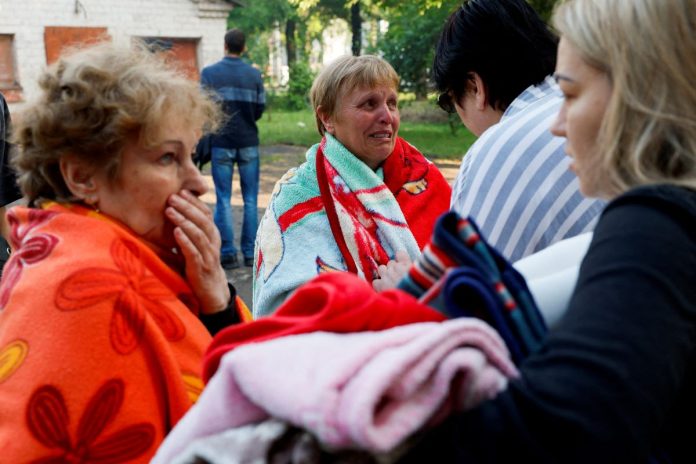
At least 10 people were killed and 28 people injured in overnight Russian strikes on the central Ukrainian city of Kryvyi Rih, according to city officials.
Rescue workers are still trying to reach one person trapped under the rubble of a residential building hit by a missile.
Earlier, authorities said rescue operations were taking place at a five-story apartment building that caught fire and at a warehouse hit in the strikes.
A day of mourning for the victims has been declared on Wednesday.
Ukraine says it has gained ground from Russia in Zaporizhzhia
Ukraine has claimed that it has gained ground from Russia in the southern Zaporizhzhia region as fierce fighting continues there and in the eastern Donetsk region.
“Ukrainian Defense forces continue the defense operation in the Bakhmut direction. Our soldiers are advancing, the enemy is losing ground on the flanks,” Oleksandr Syrskyi, Commander of the Ukrainian Land Forces, said Tuesday.
Ukrainian officials also claimed advances towards the direction of Berdiansk over the past day.
Ukrainian military spokesman Andriy Kovalov also stated Tuesday that the area taken under control amounted to three square kilometers (1.5 square miles).
Ukrainian officials say Russia is “in no hurry” to rescue people from floods as dozens remain missing
Water levels are gradually receding after the Nova Kakhovka dam collapse caused flooding across the Kherson region, but some settlements are still under water, according to Ukrainian officials.
Up to 42 people are still missing after the dam collapsed eight days ago and 10 are now known to have died on the Ukrainian-controlled side, the Head of Kherson region military administration, Oleksandr Prokudin, stated Tuesday.
Russia currently controls the east bank of Dnipro near the dam site but the number of dead in those areas is unclear.
“As of this morning, the average level of flooding is 2.7 meters (8.9 feet), which is 27 centimetres (10.6 inches) less than last night,” Prokudin said in a statement posted to Telegram.
On the Ukrainian-held west bank of the Dnipro river, 3,600 houses in 31 settlements remain flooded, but over the past day water receded from 200 houses.
Ukrainian rescue workers have managed to rescue 2,757 people from the flooded settlements, including “263 children and 77 people with limited mobility,” Prokudin added.
The Russian-occupied east bank, however, “remains extremely critical,” with 17 settlements still flooded,” Prokudin continued, adding, “Russia is in no hurry to rescue people from any of them, who are in mortal danger because of them. We are doing everything we can to save our people from there.”
Ukrainian President Volodymyr Zelensky has blamed Moscow for the collapse of the Nova Kakhovka dam and said Russia should bear “criminal liability” for “ecocide.”
Dam breach will sow huge problems for food security: UN
The United Nations has said the breach of the huge Soviet-era dam on the Dnipro in Ukraine will have a huge impact on global food security, lead to a rise in food prices and could cause drinking water problems for hundreds of thousands.
The dam, part of the Kakhovka Hydroelectric Power Plant, was breached in the early hours of June 6, allowing some of the 18 cubic kilometres (4.3 cubic miles) of water to surge down across a swathe of southern Ukraine.
It is still unclear what caused the breach, although Norwegian seismologists and US satellites picked up what looks like an explosion. Ukraine and Russia blamed each other for blowing up the dam.
UN aid chief Martin Griffiths told the BBC that the impact on food security could be significant.
Lukashenko says Belarus will not hesitate to use nuclear weapons in case of aggression
Belarus’s President Alexander Lukashenko says the country will not hesitate to use nuclear weapons in case of aggression, according to a report by the Belarusian Telegraph Agency.
Lukashenko also stated that the deployment of Russian tactical nuclear weapons in Belarus is a deterrent to discourage potential aggressors.
In May, Moscow and Minsk signed a deal to formalise the deployment of Russian tactical nuclear missiles on Belarusian territory.
Russia announced the step was driven by rising tensions with the West and will start deploying tactical nuclear weapons in July.
Russia says its forces captured German tanks and US-made fighting vehicles in Ukraine
Russia’s defence ministry has released a video showing German-made Leopard tanks and US-made Bradley Fighting Vehicles captured by Russian troops in their battle with Ukrainian forces.
“Servicemen of the subdivisions of the Vostok group inspect enemy tanks and infantry fighting vehicles captured in battle,” the ministry said in a statement on the Telegram messaging app.
US expected to send ‘Depleted-Uranium’ tank rounds to Ukraine: Report
The US is expected to send “Depleted-Urainium” tank rounds to Ukraine, according to a report by the Wall Street Journal.
In May, the British government also announced it will provide Ukraine with armour-piercing rounds containing depleted uranium – a byproduct of the uranium-enrichment process needed to create nuclear weapons.
While the tanks are not bombs, the United Nations Environment Programme (UNEP) has described such ammunition as “chemically and radiologically toxic heavy metal”.
Death toll rises to 6 after Russian strikes on Kryvyi Rih
At least six people have now been confirmed dead after Russian missile strikes hit the city of Kryvyi Rih in central Ukraine overnight, as rescue teams work to free people still trapped under the rubble, Ukrainian officials stated.
“Unfortunately, there are already 6 dead. The rescue operation continues,” said Oleksandr Vilkul, head of the Kryvyi Rih city military administration, in a Telegram post.
Vilkul noted earlier that at least three people had died, dozens of others were wounded and rescuers were working to free at least seven people trapped in the rubble.
Their exact location remains unclear; rescue operations were taking place at a five-story apartment building that caught fire and at a warehouse hit in the strikes, authorities said.
“Three of the victims work at a private enterprise. They were hospitalized. There are probably people under the rubble of the destroyed warehouse, and rescuers are looking for them,” Serhii Lysak, head of the Dnipropetrovsk region military administration, said in a Telegram post earlier Tuesday.
Air defenses shot down three cruise missiles over the city but there were also “incomings,” that hit civilian infrastructure, Lysak added.
Ukrainian President Volodymyr Zelensky has condemned the attacks and offered condolences to the victims.
At least 3 dead, 25 wounded in Russian missile attacks on Kryvyi Rih
At least three people were killed and 25 others wounded after Russian missile attacks on central Ukraine’s Kryvyi Rih early Tuesday, according to Ukrainian officials.
Serhii Lysak, head of the Dnipropetrovsk region military administration, said on Telegram that air defenses shot down three cruise missiles over the city but there were also “incomings.”
“Civilian facilities were damaged,” he continued, adding that 19 of the wounded were hospitalized.
“There was a massive missile attack on Kryvyi Rih. The Russians carried out another terrorist attack on the residential sector — overnight. This was insidious. Cruel,” Lysak said earlier on Telegram.
Mayor Oleksandr Vilkul stated earlier that a five-story apartment building was hit and victims were likely trapped under the rubble.
“Apartments from the first to the fifth floors are on fire. The fire has covered 700 square meters. Rescuers are extinguishing it,” the mayor said in an update.
Four people were also injured at another location in the city where a building and a car had caught fire, he added.
The mayor also reported Russian shelling of the nearby Nikopol district overnight.
In a Telegram post, Ukrainian President Volodymyr Zelensky offered his condolences to the victims.
“More terrorist missiles, Russian killers continue their war against residential buildings, ordinary cities, and people,” he said.
“Unfortunately, there are dead and wounded. The rescue operation in Kryvyi Rih continues. My condolences to all those who have lost their loved ones! Terrorists will never be forgiven, and they will be held accountable for every missile they launch,” the president added.
Russian accounts report heavy fighting in Zaporizhzhia and acknowledge Ukrainian gains
Russian-backed officials and military bloggers have reported intense fighting along the border of Donetsk and Zaporizhzhia regions, in an area where Ukrainian forces have made gains in recent days.
The fighting is taking place south of the town of Velyka Novosilka along both sides of the Mokri Yaly river, an area where the Ukrainians appear to have had greater success than elsewhere in the initial stages of their counter-offensive.
Late Monday, a senior Russian-appointed official, Vladimir Rogov, spoke of heavy fighting in an area known as the Vremivka ridge, claiming that higher ground remained under Russian control.
Rogov, a member of the Russian-installed Zaporizhzhia administration, said on Telegram that Russian attack helicopters were in action, and that “reciprocal shelling and heavy fighting of ultra-high intensity continues” in the vicinity of the village of Urozhaine.
Rogov conceded that Ukrainian forces were “holding their positions on the northern and eastern outskirts of the village.”
He also claimed that in the nearby village of Makarivka, “the enemy has already been driven out by the quick and effective counterattack of the 127th Division,” although other accounts paint a gloomier picture for Russian forces around Makarivka.
Rogov added heavy fighting about 10 kilometers to the west had turned the area into a “gray zone,” but that Ukrainian units had dispersed from the area —around the village of Levadne.
Russian military bloggers have also been reporting intense combat in the area, with one Telegram channel (Our Donetsk) saying “the enemy managed to deepen and advance through the wooded areas, threatening with further advance to encircle” nearby Russian units.
There is no way to verify these unofficial reports, but they are consistent with a pattern in the fighting that has evolved in the last week.
“Our Donetsk” acknowledged that Russian troops had been forced to abandon Neskuchne — just south of Velyka Novosilka — for a second time, “retreating to positions where they would not be encircled.”
It said the Ukrainians were “accumulating forces” in the area, and heavy fighting continued.
Also late on Monday, Ukrainian President Volodymyr Zelensky commented on the fighting in the Donetsk and Zaporizhzhia border region, stating “the enemy’s losses are exactly what we need.”
By contrast, Russian military bloggers are claiming that Ukrainian efforts to advance south of Orikhiv, in another part of the southern front, have been resisted, with several saying that the Ukrainians had lost a significant number of de-mining tanks in an area known to have been heavily fortified by the Russians with minefields and tank traps.
Geolocated video appears to show Ukrainian armor losses in this area.
Zelensky says battles are fierce but Ukraine is moving forward and recapturing territory
Ukrainian President Volodymyr Zelensky said in his nightly address on Monday that fighting is tough but Ukrainian forces are “moving forward” and recapturing territory.
“The battles are fierce, but we are moving forward, and this is very important. The enemy’s losses are exactly what we need,” Zelensky stated.
“Although the weather is unfavorable these days — the rains make our task more difficult — the strength of our warriors still yields results, and I thank everyone who is in combat now, everyone who supports our combat brigades in the relevant areas,” he added.
Zelensky also said that “the most important and hottest” operational areas are in the Tavria and the Khortytsia directions, and he received reports from the commanders in those areas during his staff meeting on Monday.
The General of the Ukrainian Land Forces and the General of the Tavria operational-strategic group reported “on the success we have achieved, on the front areas where we need to reinforce and on the actions we can take to break more Russian positions,” according to Zelensky.
“We are maintaining and strengthening our operational dominance,” Zelensky continued, adding, “I am particularly grateful for Bakhmut as we are increasing our control in this area.”
Earlier on Monday, Ukraine’s Deputy Defence Minister Hanna Maliar said that within the past week, Ukrainian forces in the Bakhmut area recaptured 16 square kilometers. On the left flank in Bakhmut, Ukrainian troops advance 1.5 kilometers, and on the right flank, they advanced 3.5 kilometers, according to Maliar.
“This week, as always, will be very meaningful,” Zelensky added in his address.
“First, we are preparing new weapons support from our partners for our warriors. Second, we are preparing to involve more global actors in the implementation of the Peace Formula. Third, we are working to make the [NATO] Vilnius Summit truly meaningful,” the president noted.
Ultimate goal of counteroffensive is to win back all territories, including Crimea: Presidential adviser
Ukrainian President Volodymyr Zelensky’s chief diplomatic adviser Igor Zhovkva said Monday that the “ultimate goal of the counteroffensive campaign is to win back all the territories, including Crimea.”
During an interview with CNN’s Christiane Amanpour, Zhovkva said some counteroffensive actions were already underway, but would not give details.
He also sought to tamp down any expectations that the campaign would achieve rapid results, saying it could take many months for Ukraine to achieve its aims.
In the same vein, he reminded Amanpour that this was not Ukraine’s first counteroffensive – a reference to the Ukrainian army’s successful advances in September and October when Russian forces were pushed out of the Kharkiv region and the northern part of the Kherson region.
The current push would “probably would not be the last counteroffensive operation,” he added.
He also stated that if Ukraine was going to be successful it needed Western partners to supply more artillery and ammunition.
Putin visits defense ministry hospital and urges wounded soldiers to continue their military service
Russian President Vladimir Putin made a visit to the central Ministry of Defense Hospital in Moscow on Monday and told wounded soldiers that their country needed them.
Putin visited the hospital as one of several public appearances to mark Russia Day.
He bestowed state awards on fighters wounded in Ukraine and said that he understood the conflict is “not some movie, it’s all happening in reality.”
Putin told soldiers, “There’s no doubt that your country, your homeland, and the Armed Forces need people like you,” urging them to continue their military service once they recover.
Putin’s visit to soldiers comes amid Ukraine’s defense officials claiming to have recaptured several settlements in the Donetsk region.
Ukrainian forces recaptured 7 villages in past week: Defense official
Ukrainian forces have recaptured seven villages within the last week, according to Deputy Defense Minister Hanna Maliar.
In Donetsk and Tavria, “the advance of the offensive troops amounted to 6.5 kilometers,” Maliar said Monday on Telegram.
“The area taken under control amounted to 90 square kilometers,” she continued.
Maliar added the villages of Lobkove, Levadne, Novodarivka, Neskuchne, Storozheve, Makarivka, and Blahodatne were liberated.
Earlier, Ukraine’s Tavria Defense Forces posted a video on Facebook of soldiers holding up the Ukrainian flag in Storozheve, claiming to have recaptured the village in the Donetsk region, but it is not clear when the video was taken.
“The national flag is flying again over Storozheve, and it will be the same with every settlement until we liberate all Ukrainian land,” the Tavria Defense Forces said, adding, “Thanks to the 35th Separate Marine Brigade named after Rear Admiral Mykhailo Ostrohradsky.”
Dam collapse is the “largest catastrophe by Russian invaders” since the war began: Ukraine
Ukraine’s Minister of Environmental Protection and Natural Resources Ruslan Strilets told CNN on Monday that the collapse of the Nova Kakhovka dam in southern Ukraine last week was the “largest catastrophe by Russian invaders” since the invasion began.
“The blowing up of the Nova Kakhovka dam is the largest catastrophe by Russian invaders since the full-scale invasion began in February last year,” Strilets told CNN’s Becky Anderson in an interview on Connect the World.
“The Russian act of terrorism has catastrophic consequences for the environment, not only in Ukraine but also in the entire region,” he added.
Nearly one week after the collapse of the dam, evacuation efforts in the southern city of Kherson continue, despite receding water levels.
The minister said the Dnipro River, where the dam is located, is one of the largest rivers in Europe. Due to the dam breach, he says the river’s reservoir has already lost 72% of its water.
“Russia has wasted 18 cubic kilometers of freshwater – this amount of water is enough for the entire planet to consume for two days,” he continued.
Ukrainian authorities have warned that the debris washed along the Dnipro River is turning Odesa’s Black Sea coastline into “a garbage dump and animal cemetery”.
Ukraine’s Environment Minister echoed those concerns saying that about 20,000 wild animals who lived in the flooded areas are now dead.
“We also understand the impact on climate change is that over 50,000 hectares of Ukrainian forest have been flooded, and at least half of them will die,” the official added.
Ukrainian troops make incremental gains in Bakhmut: Official
Ukrainian troops made incremental gains in the eastern city of Bakhmut, according to the spokesperson for the Eastern Grouping of the Ukrainian Armed Forces.
“There was position fighting there over the past 24 hours. The enemy tried to attack, we counterattacked on the flanks, moving forward from 250 to 700 meters,” Serhii Cherevatyi said on Monday during a national telethon.
He also stated Russian forces fired artillery and rockets at Ukrainian positions on Monday.
“The enemy fired artillery and MLRS at our positions 249 times,” Cherevatyi added, referring to multiple launch rocket systems. There were three combat engagements and two air raids during the day.”
Over 2,500 Ukrainians repatriated through prisoner of war exchanges since start of war: Zelenksy
Ukrainian President Volodymyr Zelensky stated on Monday that 2,526 Ukrainians have been returned in prisoner of war exchanges since the start of the Russian invasion.
Russia and Ukraine exchanged more than 200 prisoners of war Sunday, according to statements from officials in Moscow and Kyiv.
Ukraine’s 95 returnees included prisoners of war captured on Snake Island and from the Azovstal steel plant in Mariupol, among a number of different locations, according to presidential aide Andrii Yermak.
“Every time we bring our people back from Russian captivity, we remember our fundamental goal: we will not leave anyone of ours, nothing of Ukraine to the enemy,” Zelensky said in a tweet posted with a video of the swap.