Russia will ‘99.99 percent’ quit the Black Sea grain deal: Ukraine
A senior Ukrainian diplomat says Russia is 99.99 percent certain to quit the Black Sea grain deal when it expires on July 17.
Olha Trofimtseva, Ukraine’s foreign ministry ambassador at large, said Russian ammonia producer Uralchem had found an alternative route and does not need to export ammonia via Odesa.
Last month, Uralchem CEO Dmitry Konyaev confirmed the alternative route and said the first construction of a specialised ammonia terminal will be completed on the Taman Peninsula in Russia by the end of 2023.
The Black Sea export deal, brokered by Turkey and the United Nations, allows for the safe export of ammonia but, so far, none has been shipped under the initiative.
Moscow has repeatedly threatened not to extend the agreement beyond July unless a series of obstacles to grain and fertiliser exports are met.
Wagner Group chief accuses Russian generals of lying to Putin
Russian mercenary chief Yevgeny Prigozhin has accused Russian military chiefs of lying to President Vladimir Putin about the scale of Russian losses.
In a series of emotional audio messages, Prigozhin escalated his repeated criticism of Defence Minister Sergey Shoigu and Chief of the General Staff Valery Gerasimov.
“Total trash is being put on the president’s desk. Shoigu and Gerasimov have a simple approach: The lie must be monstrous for people to believe it. That is what they are doing,” Prigozhin said in one message.
“It’s all being hidden from everyone. Russia will wake up one day and learn that [Russian-annexed] Crimea has been handed over to the Ukrainians,” he continued.
“They are misleading the Russian people, and if it keeps on like this, we’ll be left without the most important thing: Russia,” he added.
UN calls out Russia for the deaths of 136 children
United Nations Secretary-General Antonio Guterres condemned Russia for killing 136 children in Ukraine in 2022, adding its armed forces to a global list of offenders, according to a report to the UN Security Council seen by the Reuters news agency.
According to the report, Russian armed forces and affiliated groups maimed 518 children and carried out 480 attacks on schools and hospitals, and 91 children were used as human shields.
Ukrainian armed forces also killed 80 children, maimed 175 children and carried out 212 attacks on schools and hospitals, the report found.
Russia has repeatedly denied targeting civilians since it invaded Ukraine last year.
Ukrainian forces limiting activity: Russia
Russia says Ukrainian forces in eastern and southern Ukraine are temporarily limiting their efforts after launching a highly anticipated counteroffensive two weeks ago, Russian news agencies reported.
Russian Defence Minister Sergey Shoigu said, “After conducting active hostilities over the past 16 days and having suffered significant losses, the enemy has reduced its activity and is currently regrouping.”
Shoigu added that Western military aid for Ukraine was not seriously impacting the battlefield, despite the Kremlin routinely saying deliveries prolong and escalate the conflict.
President Vladimir Putin, who has argued several times within the last week that the Ukrainian counter-offensive is a failure, told a security council meeting on Thursday that Kyiv’s forces had an “offensive potential”.
“It must be assumed that this offensive potential of the adversary is not exhausted. A series of strategic reserves are not employed, and I ask that this reality be taken into account,” he stated.
Counter-offensive ‘will take time’: Ukraine
Ukraine’s Prime Minister Denys Shmygal warned that his country’s counter-offensive against invading Russian forces “will take time” but said he was “optimistic” about its success.
Early this month, Kyiv’s military launched its highly anticipated counter-offensive in an effort to claw back territory lost since Moscow’s troops invaded Ukraine in February last year.
“We will do very smart, offensive operations. And because of this, it (the counter-offensive) will take time,” Shmygal said on the sidelines of a Ukraine reconstruction conference in London.
“But we have the intention to move and go ahead. We are going to go ahead… and I’m absolutely optimistic for the liberation of all our lands occupied by Russians,” he added.
He said the counter-offensive “is a number of military operations. Sometimes it’s offensive. Sometimes it’s defensive”.
“Unfortunately, during our preparation for this counter-offensive Russians were preparing too, so there are so many minefields, which really makes it slower to move,” he added.
Ukraine’s President Volodymyr Zelensky in a BBC interview on Wednesday admitted that battlefield progress had been “slower than desired”.
Ukraine’s PM is confident that Kyiv will receive recovery money it needs
Ukraine’s Prime Minister Denys Shmyhal stated Thursday that he was “sure” Ukraine will get the money it needs to help the recovery of the country.
Speaking on the last day of the Ukraine Recovery Conference in London, Shmyhal said: “During our multi-agency donor coordination platform yesterday, we discussed these needs, additional needs for $6.5 [billion]. I’m sure that [in the] nearest time, after this conference… we will collect all needed money and will invest this for rapid recovery needs in Ukraine.”
“We understand how to cooperate with G7 countries and with international financial organizations,” Shmyhal added.
Ukrainian counteroffensive is “not meeting expectations” in its early stages: Western officials
In its early phases, Ukraine’s counteroffensive is having less success and Russian forces are showing more competence than western assessments expected, two western officials and a senior US military official tell CNN.
The counteroffensive is “not meeting expectations on any front,” one of the officials said.
According to Western assessments, Russian lines of defense have been proving well-fortified, making it difficult for Ukrainian forces to breach them. In addition, Russian forces have had success bogging down Ukrainian armor with missile attacks and mines and have been deploying air power more effectively. Several officials also told CNN that adverse weather was proving an issue for Ukrainian forces.
Despite the assessment, officials cautioned that the counteroffensive is still in its early stages – and that the US and its allies “remain optimistic” that Ukrainian forces will be able to make territorial gains over time. The US and its allies are likely to wait until at least July for a fuller assessment of the progress of the counteroffensive which was gradually launched over the last few weeks.
In addition, these officials note that Ukrainian forces have themselves been adapting to Russian tactics and defenses, including carrying out more dismounted operations. In recent days, Ukrainian forces have also had more success targeting and shooting down Russian aircraft.
Ultimately, the counteroffensive is proving a “tough drive” for Ukraine and Russia, one of the Western officials said, with both sides incurring heavy losses.
Ukrainian President Volodymyr Zelensky admitted Wednesday that progress had been “slower than desired.”
EU disburses 1.5 billion euros in macro assistance to Ukraine
Head of the European Union, Ursula von der Leyen, said the bloc has disbursed “another” 1.5 billion euros ($1.650bn) in macro-financial assistance to Ukraine.
On Twitter, von der Leyen wrote, “We help keep Ukraine’s services and infrastructure afloat in its brave fight for freedom. More will come. We just proposed steady financial support until 2027. We are in it for the long haul.”
Kremlin denies Zelensky claim Russia is “considering” attack on Zaporizhzhia nuclear plant
The Kremlin has denied a claim made by Ukrainian President Volodymyr Zelensky that Russia is “considering” a “terrorist attack” at the Zaporizhzhia nuclear power plant (ZNPP) in occupied southern Ukraine.
Zelensky made the allegation in a video message published by his office, in which he said that Ukrainian intelligence “has received information that Russia is considering a scenario of a terrorist attack at the Zaporizhzhia nuclear power plant.”
Zelensky said they believed the alleged attack would involve “radiation leakage.”
Kremlin spokesperson Dmitry Peskov refuted Zelensky’s claim in his regular press briefing on Thursday.
“This is another lie,” Peskov stated, adding, “You know, there have just been contacts with the IAEA (International Atomic Energy Agency) there, on the ground. A very high assessment from the IAEA. They saw everything – everything they wanted to see.”
Ukraine’s military intelligence chief, Kyrylo Budanov, told state TV on Tuesday that the Russians had mined the Zaporizhzhia plant.
“And the most horrifying part is that a cooler is mined. If they disable it by blowing it up… there is a great chance that there will be significant problems,” Budanov said.
The ZNNP is the largest in Europe. Fighting around the plant as Russia occupied the region last year sparked fear that it could be the site of another nuclear accident in Ukraine.
Those fears have grown since the recent breach of the Nova Kakhovka reservoir – a source of the water used to cool the reactors at the plant.
IAEA director Rafael Grossi said Wednesday that staff at the plant are “exploring alternative ways of getting water” in light of the dam breach.
Missiles fired at Chonhar bridge: Russia’s Investigative Committee
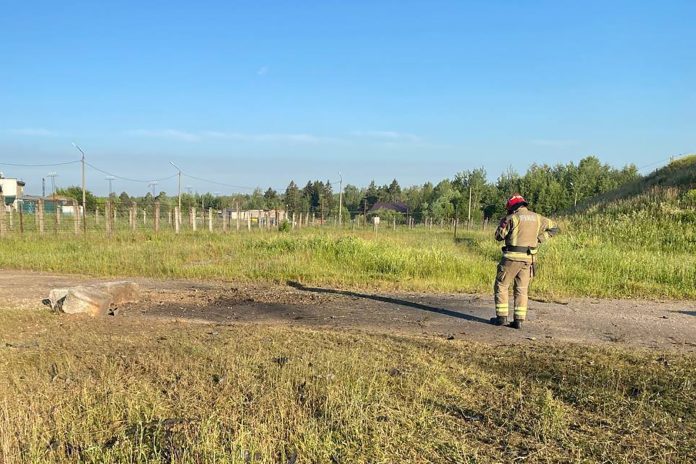
Four missiles were fired at the Chonhar road bridge Thursday morning, with one hitting the structure, a representative of Russia’s Investigative Committee said in comments reported by Russian state news agency RIA.
“According to preliminary data, four incomings of unidentified missiles were recorded. During the inspection of the scene elements of these missiles were seized, one of which has a marking on its nameplate indicating that this missile was made in France,” RIA cited the unnamed representative as saying.
The representative said that one of the four missiles hit the road bridge.
Earlier, the Moscow-installed head of the occupied Kherson region, Vladimir Saldo, said the bridge could have been hit by “Storm Shadow” missiles. The Storm Shadow is a long-range cruise missile with stealth capabilities, jointly developed by the UK and France.
The Chonhar (‘Chongar’ in Russian) bridge connects the Russian-held parts of Ukraine’s southern Kherson region with the Crimean peninsula, which Russia illegally annexed from Ukraine in 2014.
There are two land crossings out of Crimea, Andriy Zagorodnyuk, a former Ukrainian defense minister, told CNN on Thursday: Chonhar bridge and the crossing at Perekop.
“The Chonhar bridge is critical for [Russia] moving troops, ammunition and equipment to and from Crimea, from the Zaporizhzhia direction,” he added.
“Crimea is a key logistics hub for Russian operational support [to troops] in the south [of Ukraine]. If the bridge is lost, damaged or under Ukrainian fire, it becomes a logistics choking point for all Russia’s southern military operations,” he continued.
Traffic between Crimea and occupied Kherson has been “temporarily rerouted” to two crossing points west of Chonhar – Armyansk and Perekop – Crimea’s transport minister, Nikolai Lukashenko, wrote on Telegram.
Asked about the strike on the Chonhar bridge, Andrii Yusov, a representative of Ukraine’s defense intelligence, told state television: “The work is ongoing and will continue – the work of the security and defense forces, resistance movement, the local population, who are waiting for the return of the Ukrainian legitimate authorities to these territories.”
Kyiv says Russia fired cruise, ballistic missiles in overnight strike
Kyiv says Russia used cruise and ballistic missiles, as well as strike drones, at targets in Ukraine, causing damage in the cities of Odesa and Kryvy Rih.
Air defences downed three of the four drones fired in the overnight attack involving three Kinzhal hypersonic and three cruise missiles, Ukraine’s air force said in a statement.
“The enemy rockets did not reach their targets in the Dnipropetrovsk region… the occupiers are continuing their terror against the Ukrainian people, attacking Ukraine’s critical infrastructure facilities,” the air force added.
The drones were shot down over the Black Sea region of Odesa in southwestern Ukraine, but one of them struck a warehouse, regional administration spokesman Serhiy Bratchuk said. In the Kryvy Rih area, a Russian missile strike damaged at least 10 homes, the regional administration said.
Ukrainian shelling hits bridge connecting Kherson with Crimea: Russia-backed official
A bridge connecting Ukraine’s southern Kherson region to the Crimean peninsula was the target of Ukrainian shelling overnight, a Russia-backed official stated Thursday.
Vladimir Saldo, the Moscow-installed head of the occupied Kherson region, said on Telegram that Kyiv’s forces carried out “barbaric shelling of civilian facilities,” including a bridge near the village of Chonhar [known as Chongar in Russian].
The surface of the bridge was damaged, but there were no casualties, Saldo continued, adding that traffic between Kherson and Crimea has been temporarily diverted.
The Russia-appointed head of Crimea, Sergei Aksenov, said bomb experts are assessing the type of ammunition used in the alleged attack. Without providing any evidence, Saldo said long-range Storm Shadow cruise missiles given to Ukraine by the UK could have been used.
There are three vehicle crossing points connecting Kherson and Crimea, which was annexed by Russia in 2014 in violation of international law.
“Failure of one of [the bridges] cannot cardinally disrupt the transport logistics of the land transport corridor,” said Oleg Kryuchkov, an adviser to the head of Crimea, adding people should use the two other crossing points near the town of Armiansk.
Ukraine has consistently said that it wants to recapture all of its territory controlled by Russia, including Crimea, which has served as a key logistics hub for Moscow’s forces during the invasion.
Zelensky says Russia is considering ‘terrorist act’ at Zaporizhzhia plant
Ukrainian President Volodymyr Zelensky says intelligence agencies have received information that shows Russia is considering carrying out a “terrorist” attack at the Zaporizhzhia nuclear plant.
Accompanying a video statement, Zelensky wrote on Telegram, “Intelligence has received information that Russia is considering the scenario of a terrorist act at the Zaporizhzhia nuclear plant – a terrorist act with the release of radiation. They have prepared everything for this.
“Unfortunately, I had to be reminded more than once that radiation knows no national borders, and who it hits is determined only by the direction of the wind,” he continued.
Zelenskyy added that the information was being shared with allies and international organisations.
“This time, it should not be like with Kakhovka: the world has been warned, therefore, the world can and must act,” Zelensky stated.
Wagner chief accuses Moscow of ‘misleading Russians’ over Ukraine war
The chief of mercenary group Wagner has accused Moscow’s top brass of deceiving Russians about the course of Ukraine’s offensive and pointed to Kyiv’s progress on the battlefield.
Yevgeny Prigozhin, whose forces had for months led an assault for towns in eastern Ukraine including Bakhmut, accused the defence ministry of not telling the truth and losing territory to Ukrainian troops.
“They are misleading the Russian people,” he said in an audio message released by his spokespeople.
A number of villages including Pyatykhatky has been lost, Prigozhin said, pointing to a lack of arms and ammunition.
“Huge chunks have been handed over to the enemy,” he continued, adding that Ukrainian troops have already sought to cross the Dnipro River, a natural border on the front line.
“All of this is being totally hidden from everyone,” the 62-year-old stressed.
World Bank will provide $1.75 billion in aid to restore Ukraine
The World Bank Group announced an additional $1.75 billion in support for Ukraine on Wednesday.
“The financing is composed of a $500 million World Bank loan guaranteed by the United Kingdom, a $1.25 billion grant from the United States, and a $15 million grant from the Government of Finland,” a news release from the group stated.
“This additional financing for the PEACE (Public Expenditure Support for Enhanced Sustainable Governance in Ukraine) project builds on previous funding and will continue to provide support in key sectors such as health care, education, payment of pensions, social assistance programs, and wages for employees providing core government services,” the news release continued.
More than 400 global companies pledged support Wednesday for rebuilding the war-torn economy at the Ukraine Recovery Conference in London.
Ukrainian FM discussed maintaining Black Sea grain deal with Turkish counterpart
Ukrainian Foreign Minister Dmytro Kuleba met with his Turkish counterpart, Hakan Fidan, on Wednesday on the sidelines of the Ukraine Recovery Conference in London.
“We discussed a wide range of areas where Ukraine and Turkey can advance bilateral cooperation. I reaffirmed Ukraine’s interest in maintaining and expanding the Black Sea Grain Initiative, as well as mobilizing global support for the Peace Formula,” Kuleba said in a tweet.
In an update on Tuesday, the United Nations said exports under the initiative had “dropped significantly from a peak of 4.2 million metric tonnes in October 2022 to 1.3 million metric tonnes in May, the lowest volume since the Initiative began last year.”
“The Secretary-General is disappointed by the slowing pace of inspections and the exclusion of the port of Yuzhny/Pivdennyi from the Black Sea Initiative. This has resulted in a reduction in the movement of vessels coming in and out of Ukrainian sea ports, leading to a drop in the supply of essential foodstuffs to global markets,” the statement added.
The Black Sea Initiative agreement is up for renewal on July 17.
The deal, which is key for preventing a global food crisis, was last renewed in May.
Ukraine is a major supplier of grain to the World Food Programme. According to the European Commission, Ukraine accounts for 10% of the world wheat market, 15% of the corn market, and 13% of the barley market. It is also a key global player in the market of sunflower oil.
Last week, President Vladimir Putin said Russia is contemplating withdrawing from the grain deal, noting Moscow took part in the agreement to maintain relationships with “friendly” countries.
Mines displaced by flooding after dam collapse could wash up near Black Sea: UN official
Mines displaced by flooding after the collapse of the Nova Kakhovka dam could end up on beaches around the Black Sea, the head of a United Nations mine program said on Wednesday.
“I would not be surprised to see that those mines have either got down as far as the sea, or (will) over the coming months, as the water is continuing to flow, (and the mines) will be transported down there,” Paul Heslop of the Mine Action at the UN Development Programme in Ukraine told journalists at news conference in Geneva, adding, “Unfortunately, we could see anti-personnel pressure mines washing up on beaches around the Black Sea.”
According to Heslop, “butterfly mines” – which are small, airtight and plastic – are filled with liquid explosives and able to float on water. Heslop stated that he is certain these mines will have been “dispersed in different places.” Other, heavier explosives, like anti-tank mines, would not be able to travel as far.
“Obviously, a 10-kilo anti-tank mine is not going to go the same distance as a 50-to-60-gram anti-personnel mine,” he continued, adding, “So, yes, there will be contamination. There will be some in the sea, there will be some in the rivers. How we deal with that? That’s another one to add to the list of problems to solve.”
Heslop said that the collapse of the dam was “almost a biblical disaster — and that’s before you throw in the mine equation.”
“We don’t know what we don’t know,” he continued, adding, “We do know that there was widespread use of mines on that south bank, obviously to prevent an attack across the river. … I can only draw the conclusion that a number of explosive devices, be they UXO (unexploded ordnances) or mines and anti-personnel mines, will have been washed downriver.”
The city of Kherson, which sits on the west bank of the Dnipro river, was taken back by the Ukrainian military in November 2022 after eight months of Russian occupation. But much of the east bank of the river south of the Nova Kakhovka dam remains under Russian control.
EU imposes 11th round of sanctions against Russia
European Union ambassadors have agreed on the 11th package of sanctions against Russia, the Swedish Presidency of the EU Council said Wednesday.
“The package includes measures aimed at countering sanctions circumvention and individual listings,” it said on Twitter.
The President of the EU Commission Ursula von der Leyen welcomed the sanctions package, saying “it will deal a further blow to Putin’s war machine with tightened export restrictions, targeting entities supporting the Kremlin.”
“Our anti-circumvention tool will prevent Russia from getting its hands on sanctioned goods,” she tweeted.
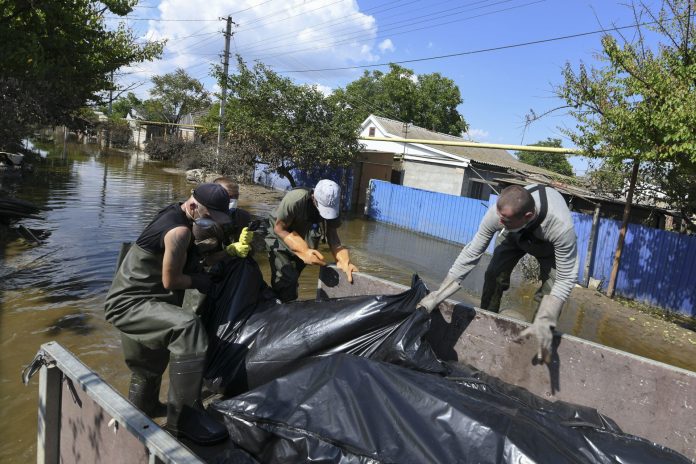
Ukrainian authorities: Floodwaters decrease in Russian-occupied southern town, but bodies remain under rubble
The destruction in flooded parts of the Russian-occupied town of Hola Prystan is “catastrophic” and bodies are still under the rubble, the settlement’s Ukrainian military administration said in a Telegram post on Wednesday.
“The water level is gradually decreasing. The eastern, central and coastal parts of Hola Prystan remain partially flooded,” according to the post.
“The destruction of houses in the flooded parts of the town is catastrophic. The bodies of the dead remain under the rubble,” it added.
The town was flooded following the collapse of the Nova Kakhovka dam in the southern Kherson region on June 6. Russia and Ukraine have both blamed each other for the collapse.
There is no gas and electricity supply in most of the town, it said, and sewage systems in parts of the town are still underwater.
The post said that some residents had to cook “on fires in their yards.”