Friday, December 26, 2025
Home Blog Page 1323

Iran releases first images of newly unveiled modern e-warfare systems

Iranian Armed Force

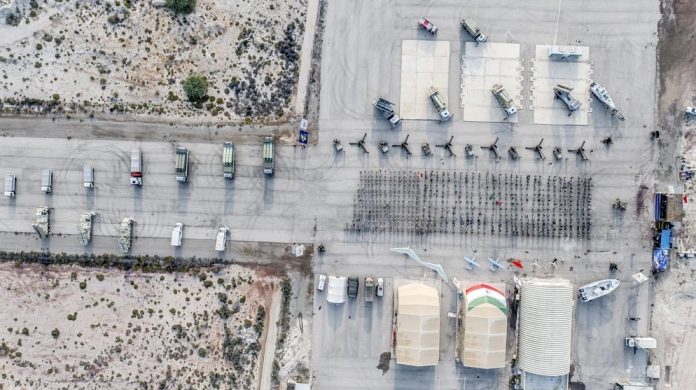
In a ceremony on Saturday, the IRGC’s Naval Force unveiled new strategic systems and devices including missile, drone and electronic warfare equipment.

Different types of unmanned aerial vehicles, namely reconnaissance, intelligence and combat drones, as well as various kinds of logistical vehicles, along with electronic defense and combat systems were among the military devices unveiled.

The equipment and systems have been developed on the back of efforts by scientists and experts at the Iranian Defense Ministry, specialized IRGC centers, domestic knowledge-based companies and the private sector.

Live Update: Russia’s “Special Operation” in Ukraine; Day 529

Kyiv launched British-supplied missiles at bridges between Crimea and occupied Ukraine: Official

Explosions on two bridges to Crimea Sunday were caused by Storm Shadow long-range missiles supplied to Ukraine by the United Kingdom, according to Vladimir Saldo, the Russian-appointed acting head of Kherson region.

Saldo said the two bridges were used by civilian and not military traffic, and that a rupture to a gas pipeline running alongside the bridge cut off supplies to 20,000 residents of the city of Henichesk in Kherson.

Saldo added the attack targeted civilians and did not impact military operations.

“These strikes do not do anything for the special military operation that is currently underway,” he said.

“They have decided to take petty revenge on civilians and those who are now moving through the territory of the Kherson region,” Saldo added.

The Russia-backed leader stated the missiles did not cause structural damage to the Chonhar bridge, which links the Kherson region and Crimea. The bridge is now closed to traffic, but Saldo predicted it would reopen by the end of the day.

In May, the United Kingdom delivered multiple Storm Shadow cruise missiles to Ukraine, giving the nation a new long-range strike capability to use during the counteroffensive against Russian forces, senior Western officials said.

The Storm Shadow is a long-range cruise missile with stealth capabilities, jointly developed by the UK and France, which is typically launched from the air. With a firing range in excess of 250 kilometers (155 miles), it is just short of the 185-mile range capability of the US-made Army Tactical Missile Systems, or ATACMS, that Ukraine has long asked for.

The extended range gives Ukraine the ability to strike deep into Russian-held territory in eastern Ukraine.


Multiple explosions hit road bridges between Crimea and occupied Ukraine: Russian-installed officials

Multiple explosions have been reported on critical road bridges linking Crimea with parts of the Russian-occupied Kherson region in Ukraine, according to Russian-installed officials.

A bridge connecting the Arabat Spit, which is located on Crimea’s east coast, and the Ukrainian city of Henichesk was among the reported targets. Explosions have been heard in the city, according to an unofficial Telegram channel, RIA Melitopol.

Strikes also hit the Chonhar bridge, which links the Kherson region and Crimea, said Vladimir Rogov, a member of the Russian-installed government in Zaporizhzhia.

“A total of three or four hits are reported. The extent of the damage is still unknown,” he said.

The Russian-appointed leader of occupied Kherson, Vladimir Saldo, said Ukraine fired 12 missiles at the Chonhar bridge and nine had been shot down.

Saldo claimed Kyiv used advanced British Storm Shadow missiles in the attack. He also said the strikes hit a village school, and that one civilian who was on the bridge at the time of the attack was wounded.

Saldo added officials were still sorting through details of the attack and the extent of the damage to the bridge, a gas pipeline and nearby towns.

The Russian-appointed head of Crimea, Sergey Aksyonov, also acknowledged the attack, saying on Telegram that a bridge for cars and trucks was damaged, and “repair work is already beginning.”

Russia annexed the peninsula of Crimea in 2014, in a move condemned by Ukraine and its allies as illegal under international law. Kyiv has vowed to retake Crimea along with the territory occupied by Russia since it launched its full-scale invasion in 2022.

Key bridges connect the peninsula to mainland Russia and to areas of Ukraine occupied by Moscow’s troops, which are now controlled by Russia-installed leaders.

Crimean bridges have emerged as key targets in Ukrainian drone and missile attacks, especially as Ukraine vows to ramp up its assault on Russian targets in and around the Black Sea, and as Ukrainian President Volodymyr Zelensky says Kyiv’s troops are working “to bring the war back where it came from.”


Kremlin spokesman says no grounds for peace agreement with Kiev currently seen

There are no grounds for any agreement with Kiev on settling the conflict in Ukraine, Russian presidential press secretary Dmitry Peskov said in an interview with The New York Times.

“There are currently no grounds for an agreement. We will continue the operation for the foreseeable future,” he stated.

Russia only want to control those territories that are Russian under its constitution, he continued

“No,” he said when asked whether Russia wants to add more Ukrainian territories.

“We just want to control all the land we have now written into our Constitution as ours,” Peskov added.


Russian bomb hits blood transfusion center in Kharkiv region: Zelensky

A Russian guided aerial bomb struck a blood transfusion center in the country’s northeastern Kharkiv region Saturday, according to Ukrainian President Volodymyr Zelensky.

He said on Telegram that there are dead and wounded victims as a result of the attack, but did not provide any specific numbers.

Zelensky said the blood transfusion center is located in the Kupyansk community, where Russia has recently amassed troops on the eastern front line. A fire broke out at the center following the attack, he added.


Peace talks at Ukraine summit in Saudi Arabia productive and honest so far: Official

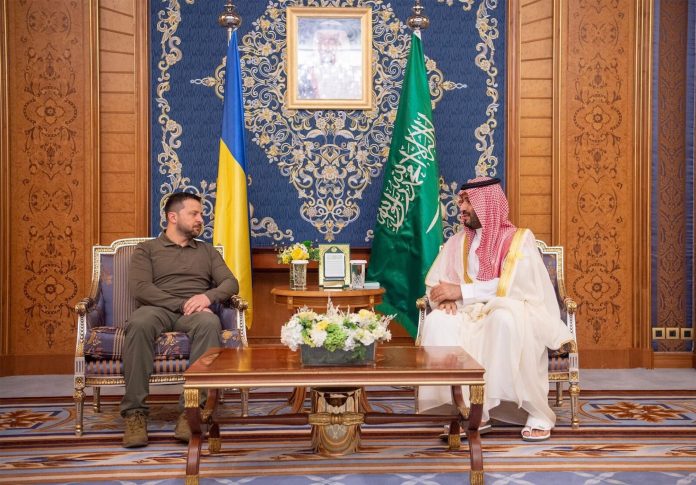
The second meeting on restoring peace in Ukraine took place in Jeddah, Saudi Arabia, with more than 40 countries participating.

A senior official from Ukrainian President Volodymyr Zelensky’s office said the peace talks, so far, have been productive.

“We had an extremely honest, open conversation, during which representatives of each country could voice their position and vision,” Andriy Yermak, head of Ukraine’s presidential office, stated.

Yermak added all the participants demonstrated their countries’ commitment to the principles of the UN Charter. He described the peace consultations as “very productive.”

Among the participants are senior officials from the European Union, United States, Germany, United Kingdom, China, India, South Africa and Turkey. Russia was not represented.

The meeting is expected to continue through Sunday.

The talks involve Ukraine, Western nations and representatives from developing countries — some of whom have refused to take sides in the conflict. Host country Saudi Arabia is hoping the summit results in support for Kyiv’s peace proposals from beyond its core Western backers.

The meetings are likely to center more around the talking stages rather than concrete steps towards peace, as Ukraine and Russia continue to express conditions that are unacceptable to the other. Despite all this, the conference is being closely watched.


Russia hasn’t made major advances as fighting rages along the eastern front: Ukrainian military

There has been heavy fighting along the eastern front line in the war, with hundreds of recent engagements, but Russia has failed to make any significant advances, a Ukrainian military official said Sunday.

Kyiv’s soldiers have been particularly successful around Bakhmut, where some of the bloodiest fighting of the war has taken place, Serhii Cherevatyi, a deputy commander and spokesperson for Ukrainian forces in the country’s east, told CNN.

Cherevatyi said Ukrainian troops were advancing “hundreds of meters every day” despite a tough Russian resistance. Kremlin forces fired more than 650 shells there in the past day alone, he said.

“The enemy is putting up fierce resistance,” Cherevatyi told CNN.

He added that movement along the front line was broadly static despite the intensity of the fighting.

While Ukraine is advancing on Bakhmut, Russia is trying to move toward Kupyansk, a city to the north in the Kharkiv region, Cherevatyi said.

Six attacks had taken place in settlements close to Kupyansk and Kharkiv’s border with the region of Luhansk. Some involved fighter jets and attack helicopters.

“The Russians are concentrating their forces in this area, with powerful units there. However, we can see their intentions, we know what they want to do and what areas to attack,” Cherevatyi stated.

The Russian military announced its forces had taken a village near Kupyansk on Saturday. Cherevatyi denied claims that Russia had made any ground, “unless we are talking about tens of meters. Nothing significant.”

Cherevatyi also shot down any assertions that Kyiv had lost territory south of Svatove, another hotspot on the front that runs along the border of Kharkiv and Luhansk regions.


Important Ukrainian air base targeted in wave of Russian strikes: Kyiv

Russian forces attempted to strike a key air base in western Ukraine as they launched a wave of missiles and drones overnight into Sunday.

The Starokostiantyniv airfield, in the Ukrainian region of Khmelnytskyi, has previously been targeted.

“The Starokostiantyniv airfield keeps troubling the enemy,” said Yurii Ihnat, a spokesperson for the Ukrainian Air Force command.

“And we can understand why — our pilots are hauling the enemy over the coals,” Ihnat added.

A local official said several homes were damaged in the attack and a fire had broken out on the premises of a grain elevator.

Missiles also struck the Khmelnytskyi region on Wednesday.

Ukraine’s Air Force said Russia fired 70 aerial attack weapons at targets across Ukraine in the latest wave of strikes.

All 27 drones used in the barrage were shot down, as were 18 of the 26 cruise missiles used by Russia’s troops, according to Ukrainian officials. Kyiv did not specify how many hypersonic missiles made it through its air defenses.

“Unfortunately, we do not always succeed in shooting down everything,” Ihnat continued.


Flights at Moscow airport disrupted during a drone alert

Flights at Moscow’s Vnukovo Airport were temporarily disrupted during a drone alert.

Citing the airport’s press service, Russian state news agency TASS said flight restrictions began at 10:26 a.m. in the capital due to “reasons beyond the airport’s control.”

Nearly 30 flights were affected.

Separately, Moscow Mayor Sergei Sobyanin stated a drone attempted to break through Moscow’s air defenses at about 11 a.m. local time but was destroyed on approach.

The Russian Defense Ministry later announced that a drone attack at 11:27 a.m. local time was “thwarted.”

Drone attacks on Moscow and inside Russia have become increasingly common in recent weeks. Officials in Kyiv have warned of more to come.


Russia ‘destroys’ hostile drone approaching Moscow: Mayor

A hostile drone was destroyed by air defences as it approached Moscow on Sunday, city mayor Sergei Sobyanin has said.

Sobyanin wrote on messaging app Telegram: “Today at around 11 am a drone attempted to make a breakthrough toward Moscow. It was destroyed while approaching by air defence forces.”

The Russian Defence Ministry announced the Ukrainian drone was destroyed over the Podolsky district in the Moscow region.

“There were no casualties or damage,” the ministry added.

Temporary restrictions that had been introduced at Moscow’s Vnukovo international airport were lifted, Russian-state run news agency RIA Novosti said.

Russia accused Ukraine of two drone attacks on its capital last week. A skyscraper in Moscow was attacked twice in two days over the past week, according to Sobyanin. Several drones had been shot down but “one flew into the same tower at the Moskva City complex” that was targeted last Sunday.


Japan’s PM deplores ‘Russia’s nuclear threat’ on 78th anniversary of Hiroshima

Japan’s prime minister has hit out at Russian threats to use nuclear weapons as the country marked the 78th anniversary of the atomic bombing of Hiroshima.

Around 140,000 people died in Hiroshima on August 6, 1945 and 74,000 in Nagasaki three days later, when the United States dropped atomic bombs on the two Japanese cities days before the end of World War II.

“Japan, as the only nation to have suffered atomic bombings in war, will continue efforts towards a nuclear-free world,” said Fumio Kishida at a ceremony in Hiroshima on Sunday.

“The path towards it is becoming increasingly difficult because of deepening divisions in the international community over nuclear disarmament and Russia’s nuclear threat,” he added.

Speaking at the ceremonies, the Hiroshima mayor urged the abolition of nuclear weapons and called the G7 leaders’ notion of nuclear deterrence a “folly”.

“Leaders around the world must confront the reality that nuclear threats now being voiced by certain policymakers reveal the folly of nuclear deterrence theory,” stated the Hiroshima mayor, Kazumi Matsui.

Russia attacks Ukraine with waves of missiles and drones: Kyiv

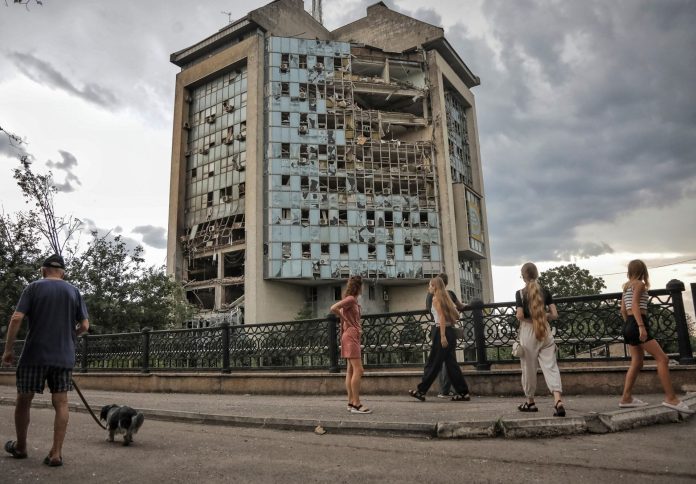
Russia launched a multi-wave overnight attack on Ukraine, using 70 air assault weapons, including cruise and hypersonic missiles and attack drones, Kyiv’s air force said on Sunday, according to Reuters.

The air force announced Ukraine’s air defence destroyed 30 out of 40 cruise missiles and all 27 of the attack drones that Russia launched overnight.

In total, in several waves of attacks, from the evening of 5 August to the morning of 6 August 2023, the enemy used 70 means of air assault weapons.

It was not immediately clear whether there was any damage from the attack or what happened to the 10 cruise missiles that were not shot down.

There was no immediate comment from Russia.

Air force spokesperson Yuriy Ihnat stated one of the key targets for Russia’s overnight attack was the Khmelnytskiy region.

Russia had earlier targeted the Starokostiantyniv military airfield in the Khmelnytskiy region at the end of July.


Zelensky says his team has taken an active role in this weekend’s peace talks in Saudi Arabia

Ukrainian President Volodymyr Zelensky said in his nightly address Saturday that his team is taking an active part in the Ukraine peace talks in Saudi Arabia.

According to Zelensky, 42 countries are represented at the event, and “everyone is united by the priority of international law.”

“It is very important that there, on the sidelines of the meeting in Jeddah, bilateral negotiations with partners take place,” he said.

Zelensky added his delegation is working on “consolidation of the world” for the sake of restoring a “just peace.”

The talks — which include representatives from the US — are aimed at developing shared principles to end the war and discussing the kind of security assistance Kyiv will need to deter Russia from ever attacking Ukraine again, US officials have said.

Russia is not present at the summit, and the talks appear mostly aimed at shaping strategies and winning developing nations over to Ukraine’s side, rather than fostering any major breakthroughs between Moscow and Kyiv at this time.


UN condemns Russian attacks on Ukrainian ports, says damaged grain could feed 66 million people

The United Nations condemned Russia for recent attacks on Ukrainian grain storage and port infrastructure in a statement on Saturday.

“I visited the Port of Izmail today and was shocked to see the level of destruction left by the Russian strikes on grain storage facilities on August 2,” Denise Brown, a humanitarian coordinator for Ukraine, said in a statement.

According to Brown, “the thousands of tonnes of grains that were damaged would have been enough to feed approximately 66 million people for a day.”

The humanitarian coordinator added Russia’s decision to pull out of the Black Sea grain deal and its repeated attacks on Ukrainian ports and infrastructure “are causing insurmountable damage to the agricultural sector in Ukraine and may further accentuate hunger for the world’s poorest people.”

In the August 2 attack Brown referred to, overnight drone strikes in Ukraine’s southern Odesa region targeted the Danube River port of Izmail, causing damage to some of its structures, the Ukrainian Ministry of Defense said.

Russia terminated the deal that allowed for the safe passage of Ukrainian food exports on July 17. In the time since, Moscow has unleashed a flurry of attacks on grain supplies in key Ukrainian cities, and the Danube River became a key target.

The Danube ports — which lie on Ukraine’s border with Romania — are Kyiv’s main way to ship millions of tons of Ukrainian grain to the rest of the world.


Russia says Ukrainian attack on oil tanker “won’t be left without a response”

The Ukrainian attack on a Russian oil tanker late Friday “won’t be left without a response,” according to a spokesperson for the Russian foreign ministry.

“There can be no justification for such barbaric actions; they will not be left without a response; the people who orchestrated it will inevitably be punished,” spokesperson Maria Zakharova said in a statement Saturday.

Zakharova stated Kyiv carried out the attack “using new terrorist methods,” and called for Western countries and international organizations to condemn the assault.

The attack, she added, “threatened not only the death of its crew, but also carried the threat of a large-scale environmental disaster.”

(Russia’s Federal Agency for Marine and River Transport has said no casualties were reported and that the ship was not carrying oil when attacked. Ukrainian officials, however, said some crew members were injured and that the tanker was carrying fuel for the Russian military.)

Friday’s attack targeted one of Russia’s biggest oil tankers with a maritime drone, the latest salvo in an emerging Ukrainian military campaign employing unmanned vehicles to attack far-away Russian targets by air and by sea.

Maritime drones are proving very difficult to defend and can travel hundreds of miles to their target. Ukrainian officials have vowed to carry out more attacks on Black Sea targets.

Vasyl Maliuk, the head of the Ukrainian Security Service (SBU), has said any attacks on Russian ships or the Crimean bridge are “an absolutely logical and effective step” and “completely legal” because they occur in Ukraine’s territorial waters.

Zakharova stressed Saturday that she doubted the attack was “completely legal” and called Maliuk’s statement “inhumane.” She argued the attack was “aimed at killing unarmed civilians.”


Zelensky: Russia targets southern and western Ukraine with missiles, including advanced Kinzhals

Ukrainian President Volodymyr Zelensky said the southern city of Zaporizhzhia and the western Khmelnytskyi region were attacked by Russian Kinzhal and Kalibr missiles on Saturday.

The country’s air defense intercepted at least some of the missiles, the president said in his nightly address. Motor Sich, a Ukrainian company that produces aviation engines and gas turbine units appears to have been the target in Zaporizhzhia, he added.

Zelensky didn’t provide any further information about the attacks.

Russian President Vladimir Putin and the Russian military have touted the Kinzhal, or Kh-47, as an example of Russia’s modernized missile arsenal, claiming that its hypersonic speed makes it extremely difficult to intercept.

Ukraine has acknowledged that the missiles are tough to defend against, though it has knocked at least one out of the sky using a US Patriot defense battery.

The Ukrainian Air Force warned residents earlier Saturday that Russia had fired Kinzhals into the country’s airspace and that the Khmelnytskyi region appeared to be the target. Officials in the region reported explosions, but scant further details were immediately available about the attack.

In his nightly speech, Zelensky reiterated a current Ukrainian narrative: Kyiv is working “to bring the war back to where it came from.”

“The results are there, everyone can see them, and they are fair results,” Zelensky stated, adding, “They show the aggressor state what its aggression means … He who brings problems to others must feel what problems are.”

Ukraine hit one of Russia’s largest oil tankers with a sea drone and attacked a naval base in Russia’s Black Sea port of Novorossiysk in the span of 24 hours on Friday. Kyiv has promised more attacks on Russian shipping and a key Crimean bridge.

Document shows MKO, ISIS colluded to assassinate commanders of resistance groups

Daesh

The document indicates the MKO had provided the ISIS with information about the headquarters of resistance groups, resulting in the martyrdom of one of the senior commanders of the resistance front in Syria, reported ISNA.

The MKO, which had also committed crimes against Iranian people and even assisted the former Iraqi regime during its imposed war on Iran in the 1980s, was in cahoots with the Takfiri ISIS group during the Syria war, added ISNA.

As the document suggests, said the agency, the MKO had hatched a scheme to spy on the type, number and functions of forces stationed at the headquarters of resistance groups.

According to the document, the intelligence provided by the MKO about one of the positions of the resistance front corresponds to the location where the senior resistance commander was martyred.

The Al-Zojaji headquarters was one of the head offices of Lebanese resistance movement Hezbollah near the Damascus International Airport and was set as a special and common target to be spied on by the MKO and several other Takfiri groups.

Speculation had already been rife as to the MKO’s role in gathering intelligence, spying by tapping phone calls, transferring money and even helping recruit and dispatch new members for Takfiri groups.

Japanese ambassador to Tehran slams Russian onslaught on Ukraine 

Russia Ukraine War

He noted that Russia’s onslaught on Ukraine is a breach of the UN Charter and it’s unforgivable.

Kazutoshi said Russia should observe neighborliness rules in dealing with its neighbors, but, unfortunately, it does not do.

The comments come as Iran has repeatedly reaffirmed its opposition to the war in Ukraine, saying it does not side with either of the warring sides.

In other comments, Kazutoshi further spoke about North Korea. He said the North’s threats against Japan are real. According to the Japanese ambassador, North Korea fired 31 ballistic missiles toward the Sea of Japan last year and it did 11 ballistic missiles in 2023 as well.

He described North Korea as one of the biggest security threats to Japan.

“Our assessment is that North Korea has acquired the know-how of making small nukes that can be put on ballistic missiles”, Kazutoshi said.

Ex-Israeli military officials discuss regime collapse to draw ‘action plans’

Israel Protest

The ex-officials held an emergency conference on Saturday to discuss ways to protect the Supreme Court, the military, and the police in case of the regime’s collapse, the Israeli daily Yedioth Ahronoth reported.

According to the newspaper, participants discussed action plans to defend the Supreme Court, the military, and the police ‘in crisis situations within the Israeli entity, “particularly if the Supreme Court annuls government decisions, resulting in an unprecedented constitutional crisis in Israel.”

The conference was attended by personnel from Israeli intelligence agencies Mossad, Shin Bet, police, and the Israeli military, including major generals, brigadier generals, and senior commanders, it stated.

The latest development comes amid calls for overturning a controversial law that restricts judicial power after Israel’s parliament approved the first bill of the plan last week.

The new legislation, known as the reasonableness bill, was approved in a tumultuous session on Monday, which resulted in the opposition legislators walking out in protest and shouting “shame”.

It removes the ability of the Supreme Court to strike down the far-right cabinet decisions deemed unreasonable.

Monday’s bill was passed as part of a broader plan to overhaul the judiciary.

Additional plans for reform include major changes to the basic laws in an attempt to reshape the balance of power between the Knesset, Israel’s Parliament, and the High Court of Justice, splitting the Attorney General’s role and limiting the ability to petition against ruling cabinet actions.

Netanyahu introduced the plan in January, triggering months of unprecedented anti-regime protests, with critics describing the plan as a threat to the independence of the courts by the prime minister, who is on trial on graft charges.

Those in favor of the scheme allege that it introduces some balance in the power that is wielded by the different branches of the regime. Its opponents, on the other side of the ledger, say upon ratification, the plan would empower the ruling class to act in a more authoritarian fashion.

Faced with raging protests as well as a wave of mass industrial actions in support of those protests, Netanyahu announced a pause in late March in his drive to get the plan approved by the Knesset.

The judicial overhaul plan originally sought to render the Supreme Court incapable of striking down politicians’ decisions.

Pro-Netanyahu lawmakers have indicated that the new bill would be a far softer version of previous proposals that sought to almost totally roll back the Supreme Court’s power to rule against the executive. The opposition, however, says the new bill would still open the door to corruption.

Israeli man critically injured in Tel Aviv shooting

Tel Aviv Shooting

Israel’s national emergency rescue service, Magen David Adom, said that paramedics were working to resuscitate the man, who is in his 40s. He was being taken to Ichilov Hospital.

The man in critical condition is a municipal patrol worker, according to the city’s mayor, who said the worker had approached the attacker after noticing something suspicious before being shot.

Israeli police said that the alleged shooter had been shot and killed to prevent “a larger terror attack”.

The Inspector General of the Israel Police said the attacker was “apparently” a resident of the Palestinian town of Jenin, in the occupied West Bank.

The shooting took place on a central street in Tel Aviv.

The incident happened one day after Israeli settlers in the occupied West Bank fatally shot one Palestinian and wounded two others. The person killed was identified as 19-year-old Qusai Jamal Maatan.

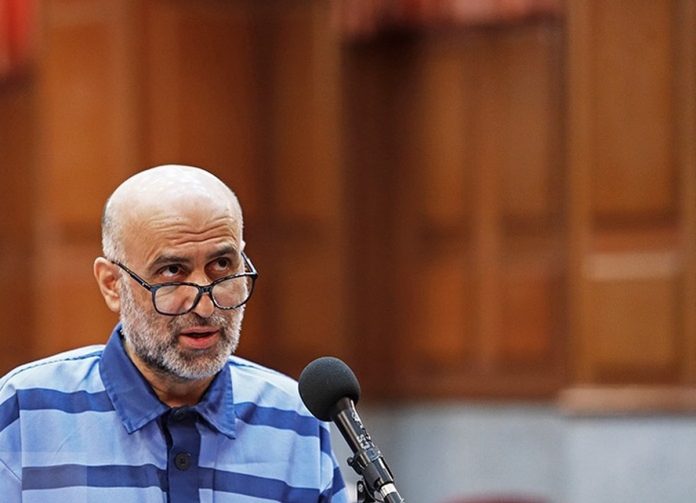
Former judicial official returned to Evin Prison in graft case after being released 

Akbar Tabari

The media center of the Judiciary said Tabari was freed after he filed for a retrial and the Iranian Supreme Court revoked the previous sentence.

Tabari was then freed on a 300-billion-toman bail. Later, he was sentenced to 12.5 years in prison plus 74 lashes.

The sentence was also upheld by the Supreme Court.

However, Tabari faces other charges on which he will be tried while serving his 12.5-year term in prison.

Existence of aliens could be proven in less than 1 month: Harvard physicist

Atomic isotopes

Tiny metal fragments recovered from the crash site of a meteor-like UFO that plunged into the Pacific Ocean in 2014 were strong enough to potentially be “some artificial alloy”, according to Harvard physics professor Avi Loeb.

“There is a chance that it’s artificial – that it’s a spacecraft,” said Loeb, leader of the recovery efforts to dredge the fragments off the coast of Manus Island this June.

Loeb, who is also the director of the Institute for Theory and Computation at the Harvard-Smithsonian Center for Astrophysics, stated that the results of this month’s analysis could “definitely” reveal humanity’s “first contact” with aliens.

“I am expecting further news within a month,” Loeb told the Daily Star, adding, “That’s the hope.”

Loeb reports that no less than four research institutions are currently training their scientific equipment and personnel on samples from the recovered metal fragments.

The fragments, 50 mostly iron spheres about 0.1 to 0.7mm in diameter, likely came from an object that originated outside of our solar system — based on analysis by Loeb and a former student as well as scientists with US Space Command.

Loeb’s colleagues in Germany, Papua New Guinea and at two top universities in the United States are now busy scrutinizing the spheres to determine if their atomic isotopes, chemical composition and other details can prove an otherworldly origin.

“We are in the process of finding out, within a month or so, what this meteor was made of and whether it is perhaps technological in origin or not,” Loeb added.

Loeb and his colleagues have taken to calling the object IM1, for “Interstellar Meteor 1”, although it also carries another more technical name with NASA’s Center for Near-Earth Object Studies (CNEOS) meteor catalog: CNEOS 20140108.

IM1 is currently ranked first in terms of material strength out of all 273 fireballs in the NASA CNEOS meteor catalog, an early clue to its scientific value.

“It was moving faster than 95 perecnt of the nearby stars near the Sun because of some propulsion it had,” according to Loeb.

“It was also made of some very tough material,” he continued.

Existence of aliens could be proven in less than 1 month: Harvard physicist
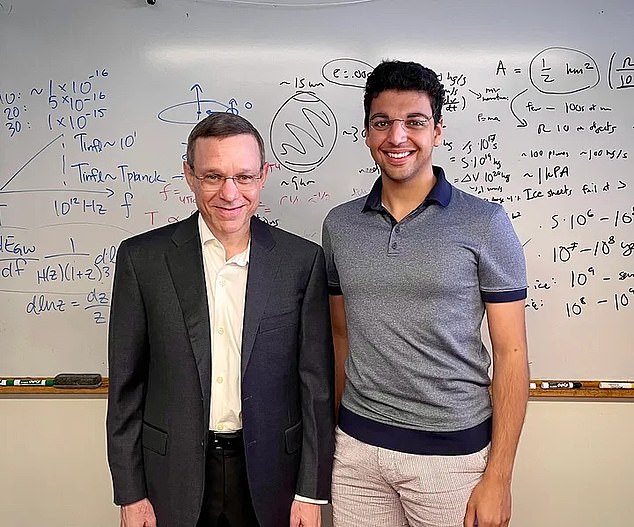
UFO chasing Harvard astrophysicist Professor Avi Loeb (left) and his team including Amir Siraj (right) recovered meteor fragments from the Pacific Ocean that may prove alien life exists.

Loeb has left open the possibility that IM1 — which is estimated to have been about 3 ft. in diameter and approximately half a US ton in weight as it burned through Earth’s atmosphere shedding tiny molten metal droplets — might have been an alien probe.

The size of meteor-like object is within the ballpark of humanity’s own probes now sailing deeper into the cosmos, like the Voyager 1 and Voyager 2 spacecrafts, which at the longest points of their high-gain antennas come to a length of 12 ft.

The unmanned exploratory probe Voyager 2 is currently itself an interstellar object, now over 12.3 billion miles away from Earth but still beaming its ‘heartbeat signal’ back to NASA.

“If it’s something like the Voyager spacecraft colliding with the planet, that would appear as a meteor,” Loeb noted, adding, “We will find out.”

Saudi-hosted conference over Ukraine kicked off, Russia absent

Ukrainian President Volodymyr Zelensky on Friday welcomed the wide range of countries represented in the talks that began on Saturday, including developing countries hit hard by the surge in food prices triggered by the war.

“This is very important because, on issues such as food security, the fate of millions of people in Africa, Asia and other parts of the world directly depends on how fast the world moves to implement the peace formula,” he said.

Russia last month halted its participation in a United Nations-brokered grain deal that enabled the shipment of Ukrainian produce through the Black Sea to parts of the world struggling with hunger.

Zelensky stated he hoped the initiative will lead to a “peace summit” of world leaders this autumn to endorse the principles, which he believed should be based on Kyiv’s 10-point formula for a settlement.

Ukraine’s formula includes respect for its territorial integrity and the withdrawal of Russian troops from territories that Moscow claims to have annexed.

The forum excludes Russia, which has rejected Ukraine’s peace formula. The Kremlin announced it will “keep an eye” on the meeting.

Kremlin spokesman Dmitry Peskov said earlier this week that Russia would “need to understand what goals are set and what will be discussed”.

“Any attempt to promote a peaceful settlement deserves a positive evaluation,” he added.

The summit is important for Ukraine as it presented an opportunity to reach out to nations that have remained neutral, including India and Brazil. Especially significant was the attendance of China, a staunch Russian ally.

China, which says it is a neutral party in the conflict but has been criticised by Western capitals for refusing to condemn the invasion of Ukraine, announced on Friday it would participate in the Jeddah talks by sending Special Envoy for Eurasian Affairs Li Hui.

“We have many disagreements and we have heard different positions, but it is important that our principles are shared,” he said.

Wang Wenbin, a spokesperson at the Chinese ministry, stated in a statement that “China is willing to work with the international community to continue to play a constructive role in promoting a political solution to the crisis in Ukraine.”

Beijing and Moscow have repeatedly spoken of their strong relations since presidents Xi Jinping and Vladimir Putin announced a “no limits” partnership in February 2022, when Putin visited Beijing.

However, China’s embassy in Russia on Friday criticised the treatment of five Chinese citizens who were refused entry into Russia, calling the incident inconsistent with the overall friendly relations between the two countries.

Saudi Arabia said the weekend talks underscored Riyadh’s “readiness to exert its good offices to contribute to reaching a solution that will result in permanent peace,” the official Saudi Press Agency (SPA) reported.

Saudi Arabia, the world’s biggest crude exporter which works closely with Russia on oil policy, has touted its ties to both Moscow and Kyiv and positioned itself as a possible mediator in the war.

The SPA report added the kingdom anticipated the meeting would reinforce “dialogue and cooperation … to ensure a solution for the crisis through political and diplomatic means”.

Crown Prince Mohammed bin Salman, the kingdom’s de facto ruler, was isolated following the 2018 slaying of Jamal Khashoggi, a Saudi columnist for The Washington Post, at the Saudi consulate in Istanbul. But the energy crisis produced by the Ukraine war elevated Saudi Arabia’s global importance, helping to facilitate his rehabilitation.

Saudi Arabia has backed UN Security Council resolutions denouncing Russia’s invasion as well as its unilateral annexation of territory in eastern Ukraine.

The meeting follows Ukraine-organised talks in Copenhagen in June that were designed to be informal and did not yield an official statement.

In May, the kingdom hosted Zelensky at an Arab League summit in Jeddah, where the Ukrainian president accused some Arab leaders of turning “a blind eye” to the horrors of Russia’s invasion.

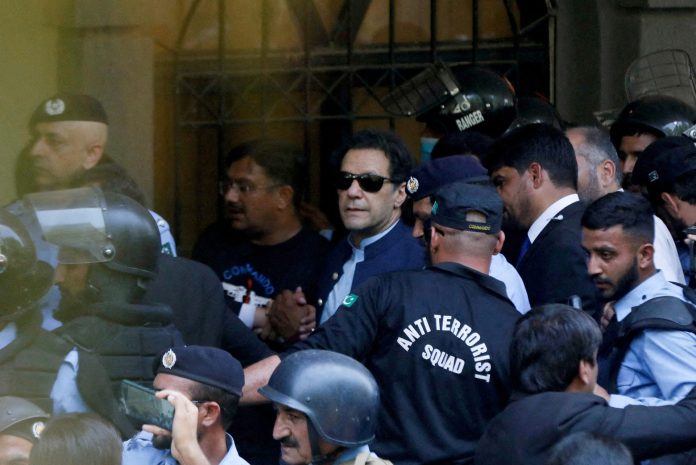
Former Pakistan PM Imran Khan given 3-year jail sentence, arrested by police

Imran Khan

The 70-year-old cricketer-turned-politician was accused of misusing his premiership minister from 2018 to 2022 to buy and sell gifts in state possession that were received during visits abroad and worth more than 140 million Pakistani rupees ($635,000).

“Judge Humayun Dilawar announced that involvement in corrupt practices has been proven,” Pakistan TV said on Saturday.

The verdict includes a 100,000 rupees fine ($355) which, if not paid, could amount to a further six months in jail.

Khan’s lawyer Intezar Panjotha told the Reuters news agency police arrested Khan from his residence.

“We are filing a petition against the decision in high court,” Panjotha added.

In a video recorded before his arrest and posted on social media platform X, formerly known as Twitter, Khan called on his supporters to take to the streets in protest.

“I only have one request, one appeal for you. You must not sit quietly inside your homes. The struggle I am doing is not for my own self, it’s for my nation, for you. For the future of your children,” he said.

“If you don’t stand up for your rights, you will live lives of slaves and slaves don’t have a life,” he added.

His arrest and detention for several days in May over a separate case had sparked intense political turmoil and deadly clashes had erupted between Khan supporters and police.

There have been no reports of emerging protests in any of the major cities immediately after Saturday’s arrest. The opposition leader’s residence had been sealed off and that security forces were patrolling the area.

Protocol requires prime ministers to store the objects in the state’s safe house, while Khan is accused of having sold them at a profit.

The gifts allegedly included watches, perfumes, diamond jewellery and dinner sets.

Babar Awan, a member of the Pakistan Tehreek-e-Insaf (PTI) party and of Khan’s legal team, said the ruling was a “ridiculous verdict by a sham court”.

“Imran Khan was not given a fair trial, which according to country’s constitution is the right of every citizen,” Awan told Al Jazeera.

“We are going to appeal the verdict in high court under Pakistani laws and there is every likelihood of suspension of the verdict and early release of Imran Khan,” he added.

Khan was not present in court for the hearing. Over 150 cases were brought against him since he was ousted in April last year.

He has denied any wrongdoing, saying the charges are politically motivated.

Pakistani law does not provide for the possibility of holding trials in absentia, under which Khan was charged. Therefore, Awan said, there was “every likelihood of suspension of the verdict and early release of Imran Khan” following the appeal to the high court.

Senior PTI leader Asad Umar also criticised the ruling in a post on X.

“Today’s decision does not meet the basic principle of law and justice should be seen. This decision will not stand in the Supreme Court. And meaningful decisions about politicians are made in the hearts of the people, not in the courts,” he wrote.

Legal experts say a conviction in the case could end his chances of participating in national elections that have to be held before early November.