16 dead after Russian missile hits center of town in Donetsk region: Ukrainian prime minister
A Russian missile has struck a market in the the eastern Donetsk region town of Kostiantynivka, killing at least 16 — including one child— according to Ukrainian Prime Minister Denys Shmyhal.
The attack is one of the deadliest in months.
“At least 20 people are wounded. My sincere condolences to the families and friends,” he said on Telegram.
“All services are working. The fire has been localized. We are helping the victims,” he added.
“Russian troops are terrorists who will not be forgiven and will not be left in peace. There will be a just retribution for everything,” he continued.
A Russian S-300 missile appears to have landed in the middle of the town, according to reports from the scene. Videos from the ground show a fierce fire and thick black smoke rising, with at least one casualty visible on the ground.
According to the unofficial reports, the market is located near a shopping center.
Kostiantynivka is close to the front lines around Bakhmut and frequently crowded with military personnel.
Ukrainian President Volodymyr Zelensky has described the attack as “utter inhumanity,” saying that the number of dead and injured may rise.
“This Russian evil must be defeated as soon as possible.”
Kremlin says the US is intent on keeping the war going “until last Ukrainian”
Commenting on US Secretary of State Antony Blinken’s visit to Kyiv, Kremlin spokesman Dmitry Peskov stated Wednesday that the United States has expressed its commitment to continue keeping Ukraine in a state of war “until the last Ukrainian.”
“We have repeatedly heard statements that they intend to continue to support Kyiv as long as necessary. In other words, they are essentially going to continue to keep Ukraine in a state of war and to wage and continue this war until the last Ukrainian, without sparing any money for it,” Peskov said.
He added that this would not alter the course of the war.
Rustem Umerov becomes Ukrainian defense minister after parliament vote
The Ukrainian parliament has approved the appointment of Rustem Umerov as the new defense minister.
Umerov, a Crimean Tatar, was formerly chairman of the State Property Fund, whose mission is to attract investment into Ukraine.
He replaces Oleksii Reznikov, whose long tenure – he had been in the post since before the full-scale war started – had been damaged by contract scandals involving the defense ministry.
Reznikov submitted his resignation on Monday after Ukrainian President Volodymyr Zelenksy cited the need for “new approaches,” with the conflict entering a critical phase.
Blinken praises “good progress” of Ukraine’s counteroffensive during Kyiv visit
US Secretary of State Antony Blinken noted the “good progress” Ukraine has made in its counteroffensive, as he met with Ukrainian Foreign Minister Dmytro Kuleba in Kyiv on Wednesday.
In brief remarks at the foreign ministry, Kuleba said he was “looking forward to a productive, result-oriented conversation with you [Blinken].”
Blinken stated that on his third visit since the Russian invasion, he was again “struck by the extraordinary bravery and resilience of the Ukrainian people, the Ukrainian forces, Ukraine’s leadership.”
“And I’m here, first and foremost, to demonstrate our ongoing and determined support for Ukraine as it deals with this aggression,” he added.
“We’ve seen good progress in the counteroffensive, which is very heartening. We want to make sure that Ukraine has what it needs not only to succeed in the counteroffensive, but it has what it needs for the long term, to make sure that it has a strong deterrent, a strong defense capacity, so that in the future, aggressions like this don’t happen again,” Blinken continued.
He said: “We’re also determined to continue to work with our partners as they build and rebuild a strong economy, a strong democracy.”
Russian air attacks ‘very close’ to Romania: President
Romanian President Klaus Iohannis stated Russian air raids took place less than one kilometre from its border with Ukraine.
“We had attacks just today, the minister of defence told me, which were verified at 800 metres from our border. So very, very close,” said Iohannis, speaking in a joint press conference with Luxembourg’s Prime Minister Xavier Bettel.
“I can tell you no piece, no drone and no part of a device landed in Romania,” he added, according to a translation from Romanian broadcaster DigiTV.
Since Moscow quit the grain deal in July that lifted a Russian blockade of Ukraine’s Black Sea ports, it has repeatedly struck Ukrainian river ports and grain infrastructure across the Danube river.
The Wagner Group does not ‘legally’ exist: The Kremlin
The Kremlin has announced the Wagner mercenary group did not legally exist after being asked to comment on a British decision to designate it as a “terrorist organisation”.
Kremlin spokesman Dmitry Peskov told reporters: “There’s nothing to comment on. Perhaps one can add only that, legally speaking, there is no such group.”
British Home Secretary Suella Braverman described Wagner, a private militia formerly led by the late Yevgeny Prigozhin, as “violent and destructive” and said it acted as a “military tool of Vladimir Putin’s Russia overseas”.
Wagner has operated in Syria, Libya and a number of countries across Africa. It recruited thousands of convicts from Russian prisons to fight in Ukraine, becoming the main fighting force behind the battle for Bakhmut.
Romania confirms parts of Russian drone fell on Romanian soil
Romania’s defense minister, Angel Tilvar, has confirmed that parts of a Russian drone fell on Romanian territory after it had targeted a Ukrainian port on the River Danube, which runs along the border between the two countries.
The defense ministry had initially denied reports earlier this week that parts of a Russian drone had fallen on the Romanian side of the Danube.
Ukraine’s Danube ports have come under heavy and prolonged Russian bombardment in recent weeks, as Moscow targets Ukraine’s grain storage facilities and infrastructure after allowing the Black Sea grain deal to lapse in July.
Many of the strikes have landed just across the border from Romania, a NATO member. Romania’s defense ministry condemned an attack earlier this week “in the strongest possible terms,” calling it “unjustified and in deep contradiction with the rules of international humanitarian law.”
There were further drone attacks on the Ukrainian side of the river in the early hours of Wednesday, one of them killing an agricultural worker, according to a Ukrainian official.
Blinken arrives in Kyiv for talks
US Secretary of State Antony Blinken arrived in Kyiv Wednesday for meetings with key Ukrainian officials, including President Volodymyr Zelensky and Foreign Minister Dmytro Kuleba.
His trip comes as Ukraine’s counteroffensive has been going slower than hoped.
Blinken is also expected to announce more than $1 billion in new funding for Ukraine, according to a senior State Department official.
Kyiv was targeted by Russian missiles overnight, which were intercepted, according to the city’s military administration.
UK to classify Wagner Group as a terrorist organization
The United Kingdom is set to classify Russian mercenary group Wagner as a terrorist organization, giving officials the power to prosecute its members and seize assets.
In a statement Wednesday, the UK Home Office said Home Secretary Suella Braverman has put a draft order before Parliament to proscribe the Wagner Group, which will come into effect on September 13.
Once passed, the order will render it “illegal to be a member or support Wagner Group and punishable by up to 14 years in jail,” and allow the government to seize Wagner’s assets, the statement added.
“Wagner is a violent and destructive organisation which has acted as a military tool of Vladimir Putin’s Russia overseas. While Putin’s regime decides what to do with the monster it created, Wagner’s continuing destabilising activities only continue to serve the Kremlin’s political goals,” Braverman said in the statement.
“They are terrorists, plain and simple – and this proscription order makes that clear in UK law. Wagner has been involved in looting, torture, and barbarous murders. Its operations in Ukraine, the Middle East and Africa are a threat to global security,” Braverman added.
The future of the Wagner Group remains uncertain following the death of its founder Yevgeny Prigozhin in a plane crash last month. Most security experts doubt Wagner can survive without Prigozhin, posing major questions about what will happen to the group’s fighters, weapons and operations.
Russia’s withdrawal from Robotyne was tactical: Moscow-backed official
Russian forces “tactically left” the southeastern village of Robotyne after losing control of it to Ukrainian troops, a Moscow-backed official said Tuesday.
The Ukrainians breached Russian defenses near the village and are now focusing on expanding their gains in the area.
Speaking on local television, the Russia-appointed acting governor of the occupied Zaporizhzhia region, Yevgeniy Balitskiy, said Robotyne “almost no longer exists as a result of quite large and prolonged fighting.”
“This settlement remains only on the map,” he stated
Holding the bare ground where the village used to be is “not expedient,” so Russian forces withdrew to the hills where they enjoy height advantage, Balitskiy added.
Much has been made of the strategic importance of Robotyne for Ukraine’s three-month-long southern counteroffensive and the remains of what was a village of 500 before the war continue to be pounded day and night.
Ukrainian efforts are now focused on widening the bridgehead near the village, with fighting near Verbove, a few kilometers to the east, according to Ukrainian sources.
Ukraine: Situation remains difficult along eastern front
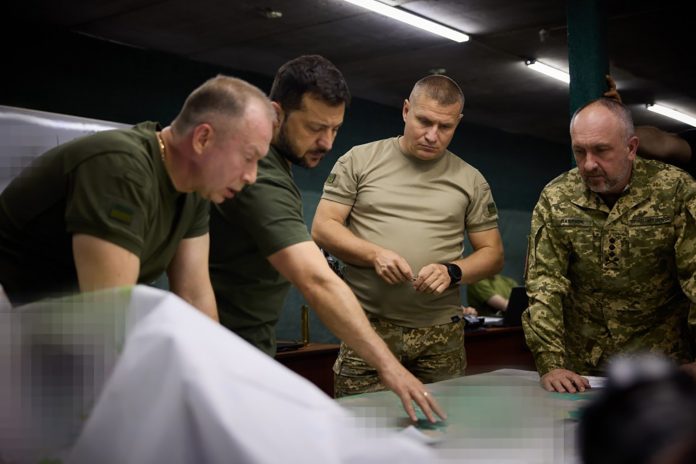
The situation along the eastern front line remains difficult and the main task for Ukraine’s troops is to ensure reliable defence and prevent the loss of strongholds, Oleksandr Syrskyi, commander of Ukraine’s ground forces, stated.
“The enemy does not abandon his plans to reach the borders of Donetsk and Luhansk regions,” the ground forces cited Syrskyi as saying on the Telegram messaging app.
“Our main task is to ensure reliable defence, to prevent the loss of our strongholds and positions in the Kupiansk and Lymansk directions, as well as to successfully move forward and reach the designated lines in the Bakhmut direction,” he added.
Kyiv repels Russian missile attack
Ukraine’s air defenses rebuffed a Russian missile attack on Kyiv, Ukrainian officials said Wednesday.
In a Telegram post, the Kyiv city military administration announced all cruise missiles and presumed ballistic missiles fired by Russia were destroyed.
No casualties were reported and fires caused by missile fragments have been extinguished, Ukraine’s State Emergency Service added.
White House official: Talks between North Korea and Russia show sanctions have hit Moscow’s defenses
US national security adviser Jake Sullivan told reporters Tuesday that discussions between North Korea and Russia on a potential deal that would allow Pyongyang to provide military support for Moscow’s invasion of Ukraine are evidence that economic sanctions against Russia have succeeded in shrinking the country’s defense industrial base.
“We will continue to call it out, and we will continue to call on North Korea to abide by its public commitments not to supply weapons to Russia that will end up killing Ukrainians. Over time, we have not seen them actively supply large amounts of munitions or other military capacity to Russia for the war in Ukraine,” Sullivan said during Tuesday’s White House press briefing.
“I cannot predict you what will happen at the end of this, I can only say that the discussions have been actively advancing and the Russians have imbued them with an increased intensity, as reflected in the fact that their defense minister (Sergei Shoigu) — their number-one guy in their defense establishment — actually got on a plane and flew to Pyongyang to try to push this forward,” he added.
The national security adviser stated President Joe Biden’s administration has been discussing the possibility of North Korea providing Russia with weapons “for quite some time,” and it’s possible in the near future that those discussions may see North Korea’s Kim Jong Un participate in “leader-level discussions, perhaps even in-person leader-level discussions.”
“We have also imposed sanctions, specific targeted sanctions, to try to disrupt any effort to use North Korea as a conduit or as a source for weapons going to Russia; we did so as recently as mid-August, and we have continued to convey that privately as well as publicly to the North Koreans and asked allies and partners to do the same,” Sullivan continued.
“Our view is that they should abide by their publicly stated commitments that they’re not going to provide these weapons,” he concluded.
US urges North Korea to cease arms negotiations with Russia upon reports of upcoming meeting
US State Department Deputy spokesperson Vedant Patel acknowledged Tuesday that arms negotiations between Russia and North Korea “are actively advancing” after reports that North Korea’s Kim Jong Un would be meeting in Russia with President Vladimir Putin.
“As you all know, some of you reported, that last month that Sergei Shoigu, the Russian defense minister, traveled to the DPRK to try and convince Pyongyang to sell artillery ammunition to Russia and we have information that Kim Jong Un expects these discussions to continue, to include leader-level diplomatic engagement in Russia,” Patel said.
“We urge the DPRK to cease its arms negotiations with Russia and to abide by the public commitment that Pyongyang has made to not provide or sell arms to Russia,” he added.
Patel stated that it was notable Russia “has been forced to search desperately around the world” for weapons that can be used in war in Ukraine because of US sanctions.
Meanwhile, Pentagon spokesperson Brig. Gen. Pat Ryder said Tuesday that the Defense Department is also urging North Korea to refrain from selling ammunition and arms to Russia “which would unnecessarily prolong this conflict.”
“In terms of the report about a potential meeting between the North Korea leader and President (Vladimir) Putin, I don’t have anything specific to provide in terms of a potential meeting or nor am I going to speculate on when such a meeting could occur,” Ryder continued, referencing reports that North Korea’s Kim Jong Un would be visiting with Putin in Russia.
“You have heard the White House talk about the fact that Kim Jong Un is seeking to continue diplomatic engagement with Russia as a follow-on to the Russian Defense Minister’s recent visit where Russia is seeking to purchase artillery ammunition from the DPRK,” he added.
Ryder noted that “such a sale would violate multiple United Nations Security Council resolutions and it would prolong the unnecessary suffering of Ukrainian civilians who are impacted by Russia’s war of aggression in Ukraine.”
Russia is covering aircraft with car tires, potentially to protect them from Ukrainian drones
Russian forces have started covering some of its attack aircraft with car tires, which experts say could be a makeshift attempt to protect them from Ukrainian drone strikes.
Satellite imagery from Maxar of Engels Airbase, deep inside Russia, shows two Tu-95 strategic bombers with car tires on top of the airframes.
Experts say it could be a crude attempt at not only adding another layer of protection against Ukrainian drones but also to reduce the aircrafts’ detectability aircrafts visibly, especially at night.
The makeshift attempt may have limited effect in terms of mitigating damage, according to Francisco Serra-Martins of drone manufacturer One Way Aerospace whose drones have been used by Ukrainian forces.
“It may reduce the thermal signature for exposed strategic aviation assets placed on airfield aprons, but they will still be observable under infrared cameras,” he told CNN.
“While it seems pretty goofy, they seem to be trying to do the best they can to up-armor the planes that are otherwise sitting ducks. Whether it works depends on what the warhead is on the missile/drone,” stated Steffan Watkins, an open-source research consultant who tracks aircraft and ships, adding that the tires could be used to stop fragmentation of an airburst above the plane from piercing the aircraft.
A NATO military official told CNN the alliance had seen the makeshift attempt. The official spoke on the condition of anonymity, as they were not authorized to speak to the media.
“We believe it’s meant to protect against drones,” a NATO military official told CNN, adding, “We don’t know if this will have any effect.”
Ukrainian forces continue to push near the Zaporizhzhia village of Robotyne
Ukrainian forces continued to try and expand their gains around the southeastern Zaporizhzhia village of Robotyne after they were able to breach Russian defenses, according to Ukrainian sources.
Efforts are now focused on widening the bridgehead, with fighting near Verbove, a few kilometers to the east.
“There have been heavy battles near Verbove, and a very tough fight is going on near the trenches of the first line of defense of the Russians. Fighting is mainly southwest of the settlement for access to the heights,” Ukraine’s 46th Brigade said on Tuesday.
“The enemy is putting up fierce resistance. There is a constant transition of positions from hand to hand. While some are restraining the Russians, others are expanding the bridgehead,” it continued.
Both sides are relying heavily on artillery and drones to try and prevent each other from advancing, with the situation at the front remaining very fluid, according to both Ukrainian sources and well-connected Russian military bloggers.
“Heavy fighting continues in the southern part of Robotyne in the Zaporizhzhia direction,” stated one Russian military blogger, Voenkor Lisitsin, on Telegram Tuesday.
“The enemy is pulling more and more reserves to this area, which are being hit by the artillery of Russian units. The AFU still managed to advance on the Robotyne-Verbove line towards Ocherevate and Novopokrovka,” the blogger continued.
Another pro-Russian blogger, Dva Maiora, added that Russian forces had been able to strike some Western donated equipment.
“In the Zaporizhzhia front at the Robotyne-Verbove line, a number of AFU armored vehicles, including Leopards, were hit,” Maiora wrote on Telegram Tuesday.
“The enemy’s attacks were concentrated on Verbove,” Maiora stated.
For its part, Ukrainian forces say they continue to advance in the area.
“In the direction of Robotyne – Novoprokopivka, the Ukrainians continue to consolidate to the east of the settlement. Yesterday the guys took a very important enemy stronghold. It was hard work – almost 5 days of fighting, but it was necessary,” the 46th Brigade announced.
The brigade said the Russians “have reinforced the northern flank between Robotyne and Novoprokopivka and moved their reserves there, one has to work in an ‘inconvenient’ direction to the east and northeast.”
“This narrows the space for maneuver, but at least the guys are moving,” it added.
As is customary, officials in Kyiv have remained relatively silent on military progress at the front. The Ukrainian military’s General Staff said only that its forces “continue to conduct offensive operation in the Bakhmut and Melitopol direction,” adding they were consolidating their gains.
The Russian Defense Ministry for its part rejected any Ukrainian advances saying its forces had successfully repelled two Ukrainian attacks near Robotyne.
“In the Zaporizhzhia direction, units of the Russian grouping of troops, aviation, artillery, and heavy flamethrower systems have repelled two attacks by the 47th Mechanised Brigade of the Ukrainian Armed Forces in the area of the village of Robotyne, Zaporizhzhia region,” the Russian Ministry of Defense announced in a statement on Tuesday.