Ukrainian forces are ‘gradually gaining ground’: NATO
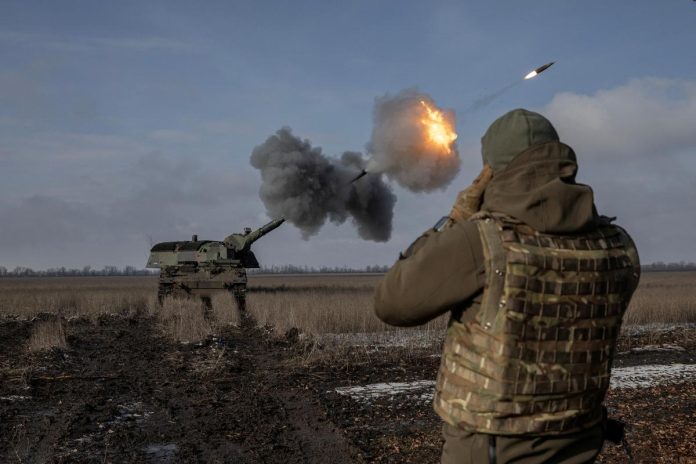
During an unannounced visit to Kyiv, NATO Secretary General Jens Stoltenberg says Ukrainian forces are “gradually gaining ground” in their counteroffensive against Russia.
Speaking at a joint press conference with President Volodymyr Zelensky, Stoltenberg also stated Russian troops were fighting for Moscow’s “imperial delusions”.
He added that NATO has framework contracts in place for 2.4 billion euros ($2.53bn) of ammunition for Ukraine, including 1 billion euros ($1.05bn) in firm orders.
Russia set for defence spending hike in 2024: Finance ministry
Russia is set to increase defence spending by almost 70 percent in 2024, a finance ministry document published on Thursday showed, as Moscow pours resources into its full-scale offensive in Ukraine.
The document said defence spending was set to jump by at least 68 percent year on year to almost 10.8 trillion rubles ($111.15bn), totalling about 6 percent of gross domestic product – more than spending allocated for social policy.
“It is obvious that such an increase is necessary, absolutely necessary, because we live in a state of hybrid war, which is unleashed against us, we continue a special military operation, and this requires high costs,” the Russian news agency TASS quoted a Kremlin spokesman as saying.
‘We don’t need this grain war and neither does Poland’: Ukrainian FM
In an interview with Interfax-Ukraine, Ukrainian Foreign Minister Dmytro Kuleba said an escalating grain exports dispute between Kyiv and Warsaw was detrimental to both countries.
Poland has extended an embargo on Ukrainian grain, going against a European Commission decision to end the restrictions and triggering a diplomatic spat between the allies.
“We have conveyed clear signals to Poland about our commitment to a constructive solution to this situation. We don’t need this grain war and neither does Poland,” Kuleba stated.
“The fact that the narrative about the ungratefulness of Ukraine and Ukrainians is planted in the heads of Polish people can have extremely negative consequences for security,” Kuleba added, labelling the allegations of ingratitude an “outright lie”.
“Ukraine is very sincerely and deeply grateful to the Polish people and the Polish government,” he continued.
No plans to raise crude oil supply to compensate for fuel export ban: Kremlin
The Kremlin says Russia has not discussed with OPEC+, an alliance of major oil-producing countries, the possibility of a crude oil supply increase to compensate for Russia’s fuel export ban.
Kremlin spokesman Dmitry Peskov said Russia is sticking to its agreements with OPEC+, which is reducing the global oil supply to prop up energy prices.
Asked if any administrative measures could be applied to Russian companies over domestic fuel market shortages, Peskov stated there was no need for that, but “work” with the companies would be carried out.
Ukraine opens five new gas wells in drive to increase domestic production
Ukrainian state-owned oil and gas firm Naftogaz, aiming to cover the country’s needs with domestic production, has brought five new gas wells into operation, the company said on Thursday.
Ukraine has not imported natural gas directly from Russia since 2015, opting to buy gas from the EU and stepping up efforts to increase domestic production.
The company traditionally has not disclosed the location of the wells, but most of Ukraine’s gas fields are in the Kharkiv and Poltava regions that have come under frequent missile fire since the full-scale Russian invasion in February 2022.
Naftogaz is Ukraine’s largest gas producer, with output of 12.5 billion cubic metres (bcm) in 2022. It plans to increase output to 13.5 bcm in 2023 and to 14 bcm in 2014.
Operations resume after ‘massive cyberattack from abroad’: Rostec
Russian state conglomerate Rostec says it has restored normal operations at its Leonardo air booking system following what it called a “massive cyberattack from abroad”.
“The cyberattack has been successfully repelled,” Rostec said in a statement.
It described the incident as a distributed denial of service (DDoS) attack, in which the attacker floods a server with internet traffic to prevent users from accessing connected online services and sites.
Rostec gave no further information. The company controls much of Russia’s weapons industry.
German cartel office clears defence contractor to work with Kyiv
Germany’s cartel office has cleared the formation of a joint venture between German defence contractor Rheinmetall and the state-owned Ukrainian Defense Industry (UDI).
The joint venture is to be based in Kyiv and will work on service and maintenance for military vehicles there, so it poses no competitive overlaps in Germany, the cartel office said.
Rheinmetall manufactures military vehicles, including the Leopard main battle tank and Puma infantry fighting vehicle.
UDI is a Ukrainian state-owned company in the defence sector with about 67,000 employees.
British defense minister meets with new Ukrainian counterpart in Kyiv
Ukraine’s Defense Minister Rustem Umerov said Thursday he has met with his British counterpart Grant Shapps in Kyiv.
The ministers, who are both new in their jobs, spoke about Ukraine’s demand for increased air defenses, artillery and anti-drone systems, Umerov said on the platform X, formerly known as Twitter.
“Winter is coming but we are ready. Stronger together,” Umerov noted.
Umerov added that he briefed Shapps on Kyiv’s progress in its sweeping counteroffensive efforts in southeastern Ukraine.
Earlier on Thursday, Shapps convened with Ukrainian President Volodymyr Zelensky during his unannounced visit to Ukraine, according to Zelensky’s office. It is unclear when the two met.
Russia launches “massive” drone attack on south: Ukrainian military
Russian forces launched a “massive” drone attack on southern Ukraine overnight, scrambling air defenses across the region, a Ukrainian military spokesperson stated Thursday.
Speaking on Ukrainian television, Natalia Humeniuk, spokesperson for Operational Command South, said air defenses destroyed more than 30 drones but the impact of the attack remained unclear.
“The operational situation [in the south] is quite tense,” she continued, adding, “Air defense systems were operating along the entire southern direction — in Odesa and Mykolaiv regions, and much higher up in the central regions.”
Earlier Thursday, a Ukrainian military official said no casualties or damage were reported after Russia launched a drone attack on the southern Odesa region overnight.
New UK defense minister meets with Zelensky on surprise visit to Ukraine
Britain’s new defense secretary Grant Shapps met with Ukrainian President Volodymyr Zelensky on a surprise visit to Ukraine, Zelensky’s office said Thursday.
“A meaningful meeting with Secretary of State for Defense Grant Shapps,” Zelensky wrote on Telegram Thursday.
“Thank you for your strong financial, defense, and humanitarian support for Ukraine! Our cooperation in the military sphere significantly enhances the capabilities of Ukrainian soldiers on the battlefield.”
It’s unknown when exactly Zelensky and Shapps met.
Zelensky stated cooperation between both countries “allows the Ukrainian army to significantly expand its capabilities on the battlefield, in particular by means of long-range weapons,” according to a statement from his office.
The two also discussed bolstering Ukraine’s air defense, saying it is “particularly important in the run-up to the winter season,” the statement added.
Russia launches drone attack on Odesa: Ukrainian official
No casualties or damage were reported after Russia launched a new drone attack on the southern Odesa region overnight, a Ukrainian military official stated Thursday.
“Only a few small fires in dry grass were registered as a result of falling wreckage,” said Oleh Kiper, head of the Odesa regional military administration, in a Telegram post.
Russian forces have repeatedly targeted Odesa’s port infrastructure since the collapse of the Black Sea Grain deal in July. On Monday, Ukrainian officials said Russian strikes killed at least two people and caused “significant damage” in the city.
Meanwhile, Ukraine’s air force announced Thursday it destroyed 34 of 44 attack drones launched by Russian forces overnight. Six reconnaissance drones were also intercepted over the past day, it said.
UK, French defence ministers in Ukraine to discuss military aid
The British and French defence ministers have arrived in Kyiv to discuss supplying further military aid to Ukraine, which is seeking more weapons to bolster its counteroffensive against Russian forces.
The visits come ahead of Kyiv’s first Defence Industries Forum, where Ukrainian officials are to meet representatives from more than 160 defence firms and 26 countries.
UK Defence Secretary Grant Shapps reiterated the UK’s “unwavering” support for Ukraine shortly after his arrival in Kyiv with a post on the social media platform X.
French Defence Minister Sebastien Lecornu’s arrival was more understated with his presence in Kyiv verified by an Agence France-Presse reporter on the ground.
Moscow is ready for talks on Ukraine, which would take the situation on the ground and Russian security interests into account, Russian Foreign Minister Sergey Lavrov stated in an interview with TASS.
“Our position remains the same: we are ready to make agreements provided that the current situation on the ground is taken into account, as well as our position that everyone is well aware of and our security interests, including the need to prevent the creation of a hostile Nazi regime near Russian borders, which is openly declaring the goal to eliminate all things Russian in the areas in Crimea and Novorossiya that Russian people have been exploring and developing for centuries,” he pointed out.
Moscow currently sees no serious proposals from the West on talks on Ukraine, Russian Foreign Minister Sergey Lavrov said in an interview with TASS.
“As for how all this will end, we don’t see any serious proposals from the West,” he noted, commenting on prospects for the relaunch of talks between Russia and Ukraine.
Lavrov pointed out that African delegations had earlier visited Russia, calling for resolving the issue peacefully; peace proposals had come from China, Brazil and other countries, as well as from the Arab League.
“All of them were guided by a sincere desire to facilitate an agreement, which would consider the root causes of the current situation and the need to eliminate them, and will also ensure equal security for all parties,” the top Russian diplomat stressed.
“The West is now talking about the possibility of talks but at the same time, it is openly and categorically stating that [Ukrainian President Vladimir] Zelensky’s ‘peace formula’ is the sole basis for negotiations. There is no point in discussing it as it is nothing but an ultimatum,” Lavrov added.
He noted that no sane person would promote such an ultimatum as the sole basis for talks, “unless they seek to disrupt talks.”
“Here’s where things actually stand,” the Russian foreign minister concluded.
The West is seeking a ceasefire in Ukraine in order to flood Kiev forces with weapons, Russian Foreign Minister Sergey Lavrov said in an interview with TASS.
When asked if there were any signs that talks on Ukraine could be launched in the fall, he answered in the negative.
“By spreading such instigating rumors, the West seems to be testing our readiness to accept its terms. In fact, they make no secret of their terms, which include a few months break and no agreements, except for the one on a ceasefire, as they seek to buy time to flood Ukraine with more weapons in addition to what has already been provided and is now being steadily destroyed by our armed forces,” Lavrov added.
The top Russian diplomat stressed that the West had used the same logic with regard to the Minsk Agreements.
“They have actually admitted that no one was going to implement the Minsk Agreements. Nor Germany nor France had such plans, and much less Ukraine,” Lavrov noted.
Ukraine documents 534 offenses against cultural heritage sites since Russian invasion
Russia has committed at least 534 offenses against Ukrainian cultural heritage sites since the 2014 annexation of Crimea, according to figures by a nongovernmental organization registered in Kyiv.
Elmira Ablialimova-Chyigoz, project manager at The Crimean Institute for Strategic Studies (CISS), presented the findings on Wednesday at a news conference in Kyiv.
Violations include “appropriation of cultural heritage sites, use of cultural property for military purposes, transfer of cultural property from the occupied territories, looting of museums, illegal archaeological works, modification and reconstruction of monuments and decontextualization of historical sites,” Ablialimova-Chyigoz said.
The organization has been researching cultural heritage violations dating back to 2014, when Russia illegally invaded annexed Crimea, where Ablialimova-Chyigoz noted 200 offenses have been recorded.
In other Ukrainian regions occupied by Russia since 2022 (Kherson, Luhansk, Zaporizhzhia and Donetsk), 334 cultural heritage violations have been recorded, she added.
On the homepage of the organization’s website, the CISS describes its work as “focusing on researching the state of protection of cultural heritage sites in the temporarily occupied territories of Ukraine and identifying the major trends in the course of events in this area through the lens of international humanitarian law.”
Ukraine names 3 new deputy defense ministers after mass dismissal
Ukraine’s Defense Minister Rustem Umerov named three new deputies on Wednesday, more than a week after he announced the department was “rebooting” following a mass dismissal of personnel.
On his official Facebook account, Umerov said “the changes will be notable by our soldiers.”
He named the following people as “Deputy Minister of Defense of Ukraine” with varying portfolios:
- Yurii Dzhygyr (finance)
- Nataliia Kalmykova (social development)
- Kateryna Chernogorenko (digital development)
The recent shake-up of defense officials comes after Ukrainian President Volodymyr Zelensky fired his defense minister, Oleksii Reznikov, at the beginning of the month, citing the need for “new approaches.”
The change of leadership followed several military corruption scandals.
Ukraine says former Wagner fighters are back in Bakhmut, but officials downplay their significance
Fighters who had previously fought in Ukraine for the Russian mercenary group Wagne have returned to the battlefield in the east, according to the Ukrainian military.
Wagner mercenaries had withdrawn from the eastern Ukrainian city of Bakhmut in May as they handed control of the area to Russia’s military.
Following the shadowy group’s failed mutiny in June, security experts predicted that the Kremlin would seek to further absorb the group into the Russian military.
On Wednesday, the Deputy Commander of Communications for Ukrainian troops in the East, Serhii Cherevatyi, said the former Wagner fighters who had returned to Ukraine were now working for the Russian Ministry of Defense or its affiliated structures and had joined as individuals not as a unit.
“As of now, there are several hundred of them in our direction, on the Eastern Front, in different areas,” Cherevatyi told CNN.
But he sought to downplay the significance of their return, stating Russian forces in Ukraine “are short of everyone there now, so any man is good for them.”
Ukrainian soldiers taking part in the offensive near the beleaguered city of Bakhmut also told CNN former Wagner troops had returned to the area.
“Wagner is here too,” a drone operator with call-sign “Groove” told CNN’s Fred Pleitgen on the ground in eastern Ukraine on Tuesday.
“They came back, they swiftly changed their commanders and returned here.”
Mykhailo Podolyak, adviser to Ukrainian President Volodymyr Zelensky, added Wagner fighters had signed contracts with the Russian MoD “as an agreement to play the last chord, plugging the Russian hole in the Bakhmut direction for a short time.”
Podolyak, too, was keen not to inflate the return of the former mercenaries.
“Remember: the Wagner PMC no longer exists,” Podolyak wrote on X, formerly known as Twitter, on Wednesday.
The Ukrainian general leading the southern counteroffensive, Oleksandr Tarnavsky, told CNN last week that Wagner fighters continue to pop up “here and there” on the frontlines.
“The fact is that their badges appear here and there — that’s been constant,” he continued.
Newly published video shows Russian admiral being asked about Sevastopol attack
New video of Russian Admiral Viktor Sokolov shows him being asked by a reporter about last week’s Sevastopol attack, in which he was alleged to have been killed, offering the strongest proof yet he is alive.
In the video, published on Telegram Wednesday by Russian state news agency TASS, a reporter can be heard asking: “Could you please tells us in a few words what happened to reassure Sevastopol residents?”
Sokolov then replies, “Nothing happened to us, life goes on. The Black Sea Fleet is carrying out the tasks assigned to it by the command.”
Ukraine claimed on Monday that Sokolov had been killed in a strike on the Black Sea Fleet headquarters in Sevastopol, Crimea, last week, along with 33 other officers.
Two other videos of Sokolov had been shared by the Russian military in the past two days, but neither gave firm indication of when they had been filmed.
US calls Russian bid to rejoin UN Human Rights Council “preposterous”
A US spokesperson balked at Russia’s bid to rejoin the United Nations Human Rights Council after being expelled last April following Moscow’s invasion of Ukraine.
“We hope UN members will firmly reject its preposterous candidacy as they overwhelmingly did last year,” the US spokesperson told CNN.
“Russia has committed violations of international humanitarian law and crimes against humanity in Ukraine, as well as violations and abuses of human rights in Russia, including the arbitrary arrests of Russians endeavoring to exercise their freedom of expression to condemn Putin’s brutal war,” the spokesperson continued.
“In fact, the council created a special rapporteur last October on the human rights situation in Russia, further demonstrating Russia’s unfitness for membership on the council,” the spokesperson added.
Russia has been accused of a huge number of human rights abuses over the course of its war in Ukraine, and the International Criminal Court has issued an arrest warrant for its President Vladimir Putin over an alleged scheme to deport Ukrainian children to Russia.
Bulgarian parliament approves additional weapons to Ukraine
Bulgaria’s parliament has approved the provision of additional military aid to Ukraine in its war with Russia.
At a closed-door meeting, lawmakers voted 141-40, with three abstentions, in favor of supplying Ukraine with defective surface-to-air missiles for the Russian-made S-300 air defence system and small-calibre automatic weapon ammunition discarded by the Interior Ministry, the state-run BTA news agency reported.
Military experts said the missiles cannot be repaired in Bulgaria, but Ukraine has the needed facilities to fix them or use them for spare parts.
The chief of defence, Admiral Emil Eftimov, assured lawmakers that the provided weapons do not harm Bulgaria’s defensive capabilities.
Poland-Ukraine talks on track after grain import ban: Warsaw
Poland’s agriculture minister has said talks with Ukraine were on track as the two countries try to resolve a dispute about a ban imposed by Warsaw on Polish grain imports.
“I am glad that we are talking about the future, that we are building mechanisms for the future and we are calming certain emotions that have not served us well, and this is probably a good direction,” the Polish minister, Robert Telus, told a news conference after online talks with Ukrainian Agriculture Minister Mykola Solsky.
Warsaw and Kyiv are allies, but relations have soured since Poland, Hungary and Slovakia decided to extend a ban that was introduced to protect farmers from a surge in grain and food imports from Ukraine after Russia’s invasion last year.
The Polish government is also under pressure from the far right to take a tougher stance on Ukraine before an election on October 15.