Netanyahu reiterates there will be no ceasefire without release of hostages
Israeli Prime Minister Benjamin Netanyahu insisted Thursday that there would be “no ceasefire” without the release of hostages held by Hamas.
“The fighting continues and there will be no ceasefire without the release of our hostages,” Netanyahu said in a statement.
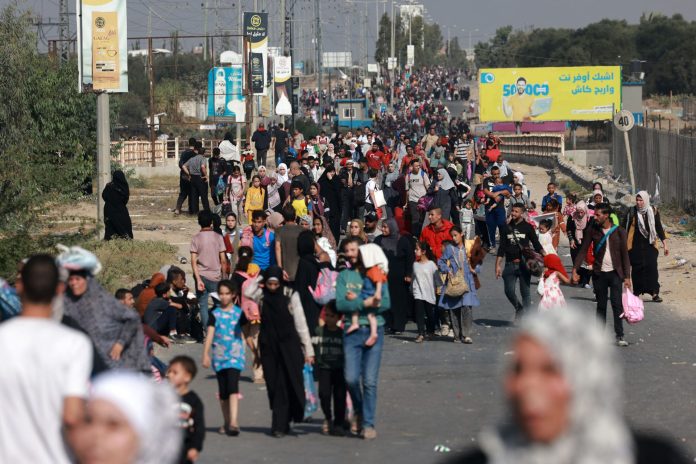
“Israel is allowing safe passage corridors from the northern strip to its south, as 50,000 Gazans did just yesterday.”
“We call again upon the Gazan civilian population to evacuate to the south,” he added.
The statement coincided with US National Security Council spokesperson John Kirby saying that Israel will begin to implement daily four-hour pauses of military operations in areas of northern Gaza.
Israel has already been opening hours-long evacuation corridors since Saturday. Israel on Thursday opened an evacuation corridor for six hours, allowing civilians to flee from northern Gaza south of Wadi Gaza.
Israel will begin 4-hour pauses of military operations in northern Gaza each day: US
Israel will begin to implement four-hour pauses of military operations in areas of northern Gaza each day, the White House announced, to allow for humanitarian assistance and to allow civilians to flee.
Israel will announce the timing of the pauses three hours beforehand, according to John Kirby, a spokesperson for the US National Security Council.
“We’ve been told by the Israelis that there will be no military operations in these areas over the duration of the pause, and that this process is starting today,” Kirby said.
The US welcomed the development, calling the pauses “steps in the right direction.”
“We have been urging the Israelis to minimize civilian casualties and to do everything that they can to reduce those numbers,” Kirby continued, adding the pauses would provide “breathing space for a few hours” for civilians to move out of harm’s way.
The pauses would also provide “brief windows of opportunity” for the potential safe passage of hostages being held by Hamas, Kirby stated.
UN aid chief warns that Gaza conflict is “a wildfire that could consume region”
The United Nations emergency relief chief warned on Thursday that the war between Israel and Hamas could spread to the wider region.
“War, indeed, is a virus that always wants to expand, and the current conflict is a wildfire that could consume the region,” stated the Under-Secretary-General for Humanitarian Affairs and Emergency Relief Coordinator at the United Nations Martin Griffiths.
“It could spread, and that we will think these would be the good days when we see what may happen tomorrow,” he said in his remarks at the International Humanitarian Conference for Gaza hosted by France in Paris.
Griffiths added that “the UN cannot be part of a unilateral decision to expulse thousands of people in Gaza into so-called safe zones.”
“Civilians must be protected. Their needs must be met anywhere they are,” he continued.
Griffiths reiterated the UN’s call for ceasefire.
“There’s been a lot of discussion about the value of pauses, and I’m not one to deny the value of pauses. But that is not the same as a ceasefire,” he stressed.
Egypt condemns ‘international silence on violations of law’ by Israel
Egypt has condemned “international silence on violations of international humanitarian law committed by Israel” amid the continuing attacks on Gaza.
“What the Israeli government is doing far exceeds the right to self-defence,” Egypt’s Foreign Minister Sameh Shoukry said at the Paris conference on humanitarian aid for Gaza, complaining of an “imbalance” in “the international conscience”.
Delegations from more than 80 countries and organisations have gathered in France for the conference that is due to discuss providing aid to civilians with proposals for a humanitarian maritime corridor and floating field hospitals.
UN staff sign letter condemning double standard in statement by Special Advisor on the prevention of genocide
Around 50 United Nations staff, including Palestinians, have signed a letter addressed to the UN’s Special Adviser on the Prevention of Genocide, Alice Wairimu Nderitu, condemning a statement she issued in mid-October.
In the letter, the staff say they are “deeply disturbed and personally traumatised by the bombardment and recent escalation of the collective punishment in Gaza. We are equally disturbed and concerned over the active threat to the lives of thousands of our colleagues and to millions of Palestinians residing in Gaza.”
The letter adds: “while we join you in condemning the intentional attacks and abduction of Israeli civilians by Hamas, we expected that your statement regarding Israel’s attacks on and collective punishment of Palestinian civilians would have been equally clear and unequivocal.”
The letter states that the statement makes no mention of the 16-year blockade on Gaza and the collective punishment imposed on Gaza’s population, as well as the withholding of water, medicine, electricity, fuel and other basic humanitarian needs.
“The 16 October public statement seemed to ignore the illegal and inhumane order issued by Israel, which demanded that the UN and 1.1 million Palestinian civilians transfer themselves from the north to the south of the Gaza Strip, even as Israel was relentlessly bombing.”
The letter lists numerous instances where Israeli officials have used dehumanising and threatening language aimed at Palestinians.
ICC suit filed against Israel over ‘genocide’
A new lawsuit has been filed with the International Criminal Court (ICC) alleging that Israel’s conduct in Gaza amounts to war crimes.
Three Palestinian groups are urging the ICC to expand its investigation into Israeli war crimes to include genocide and apartheid. It also calls for arrest warrants to be issued for top Israeli officials.
This is not the first time a file against Israel has been brought to the ICC during its one-month war in Gaza.
Israeli army needs to remove threat posed by Hamas rockets: DM
The Israeli army’s goal is to stop Hamas from launching rockets towards Israel which disrupt civilian life and consequently, the economy, stated Defence Minister Yoav Gallant.
“We are in a prolonged war, and the issue of the civilian economy is a main factor in the management of the war. We need to resolve things quickly, even if not perfectly,” Gallant was quoted as saying during a meeting with Israeli officials.
“The rocket fire by Hamas these days is mainly intended to disturb the routine of life … We need to make sure that the citizens are given security and the ability to have an uninterrupted daily routine,” he added.
Israel ‘crushing all humanitarian values’
Israel is “crushing all humanitarian values” as it continues its attack on Gaza that have killed more than 10,000 people since October 7, Turkey’s President Recep Tayyip Erdogan said.
“Israel continues to bomb schools, mosques, churches, hospitals, crushing all humanitarian values,” Erdogan stated, adding that 73 percent of those killed are women and children.
He added that Turkey has sent 10 planes carrying 230 tonnes of humanitarian aid to El Arish airport for Gaza with the help of Egypt.
Another Israeli soldier killed in Gaza ground offensive, death toll rises to 35
Another Israeli soldier was killed in the Gaza Strip, taking the death toll to 35 since Israel expanded a ground offensive in the blockaded enclave on Oct. 27, the army confirmed on Thursday.
An Israeli military statement said a soldier from the Combat Engineering Corp’s 8219th Battalion was killed in the fighting in the central Gaza Strip on Wednesday.
Five more soldiers were seriously injured in the seaside territory, the Israeli public broadcaster KAN reported.
Israel announced 35 soldiers have been killed and more than 260 others injured since it began expanded ground operations in the Gaza Strip on Oct. 27.
Palestine files complaint with atomic agency over Israel’s nuclear bomb threat
Palestinian Foreign Minister Riyad al-Maliki has filed a formal complaint with the International Atomic Energy Agency (IAEA) against Israel over its minister’s threat to drop a nuclear bomb on Gaza.
According to the Palestinian news agency Wafa, al-Maliki sent an official letter to IAEA Director-General Rafael Mariano Grossi on Wednesday, stating that the nuclear threat is “completely consistent with the prevailing discourse in Israel” against Palestinians.
The threat entails “an official recognition that Israel possesses nuclear weapons and weapons of mass destruction”, he said.
Earlier this week, Israeli Heritage Minister Amihai Eliyahu, a member of the far-right Otzma Yehudit party, told Israeli media that dropping a “nuclear bomb” on Gaza is “an option”. The Israeli government distanced itself from the comments and Eliyahu was suspended from ministerial meetings.
Israel launches strikes across Gaza with warplanes and ground artillery
Israel launched strikes across the Gaza Strip Wednesday night and into Thursday morning using combined air and artillery fire as heavy fighting was reported on the ground between the Israeli military and Palestinian fighters.
At least 30 Palestinians, including women and children, were killed overnight in a fresh Israeli bombardment of Jabalia refugee camp in northern Gaza.
Israel also launched strikes on Khan Younis in southern Gaza on Wednesday night, using combined fire from Israeli fighter jets and ground artillery. The strikes killed at least five people according to Palestinian news outlet Wafa.
At least eight Palestinians were killed and dozens injured by Israeli strikes in al-Sabra east of Gaza City.
Israel also launched fresh strikes near al-Shifa hospital on Thursday.
Local sources told Wafa news that Israeli military aircraft fired several missiles around the hospital, the Gaza Strip’s largest, with some fragments falling in the hospital’s courtyard.
Palestinian fighters and Israeli military battling in Jenin refugee camp amid assault
Palestinian fighters and the Israeli military are battling in the occupied West Bank city of Jenin after Israel launched a fresh attack on the refugee camp.
According to reports, the Israeli military is currently engaging in “armed clashes” with Palestinian fighters in Jenin.
Fighting broke out after Israeli troops supported by an attack helicopter and bulldozer attacked the camp from multiple directions, according to Palestinian news agency, Wafa news.
Videos and photos posted on social media platform X showed a large smoke cloud rising as a result of Palestinian fighters targeting the Israeli military with an explosive device. Volleys of small arms fire are also being reported.
Palestinian president rejects Israel’s move to divide Gaza into 2 sections
Palestinian President Mahmoud Abbas said Wednesday that any move by the Israeli occupation forces to divide Gaza into two sections is unacceptable and emphasized that the enclave is an integral part of Palestine.
Abbas held separate phone calls with Dutch Prime Minister Mark Rutte and Australian Prime Minister Anthony Albanese, according to the Palestinian news agency WAFA.
During his conversation with Rutte, he said the Israeli military’s recent statement that its forces have divided Gaza into two as it reaches a “significant stage” in its war against the Palestinian group Hamas is unacceptable and there is no separate political or security solution for Gaza as it is an inseparable part of the Palestinian state.
“Today there is north Gaza and south Gaza,” Israel’s military spokesperson Rear Admiral Daniel Hagari stated Sunday after Israeli troops reached the coastline.
Abbas stressed the necessity of implementing a politically legitimate solution based on international standards for the freedom, independence and sovereignty of the Palestinian people.
When contacted by Albanese, Abbas emphasized the immediate need to stop the massacre against the Palestinian people.
Abbas noted that they are the legal representatives of the Palestinian people and that the right to make national decisions is vested in the Palestine Liberation Organization.
59 mosques destroyed in Israeli airstrikes on Gaza since Oct. 7: Interior Ministry
Israeli airstrikes on Wednesday damaged two mosques in the city of Khan Yunis in the southern Gaza Strip, bringing the total number of completely destroyed mosques in the current conflict to 59 and partially destroyed mosques to 136, according to Gaza’s Interior Ministry.
“Israeli occupation aircraft bombed and completely destroyed Khalid bin al-Walid and Al-Ikhlas mosques in Khan Yunis,” said a ministry statement.
Ikrami al-Mudallal, spokesman for the Ministry of Endowments in the Gaza Strip, added that Israel also targeted a third mosque in Gaza, Al-Sahwa Mosque, bringing the total number of completely destroyed mosques to 59.
Israeli aircraft completely destroyed Al-Sahwa Mosque in Khan Yunis, and also completely destroyed the Khalid bin al-Walid and Al-Ikhlas mosques, al-Muduallah told Anadolu
He continued: “The number of mosques completely demolished has risen to 59, in addition to varying degrees of damage to 136 mosques and three churches, since the start of the Israeli war on Gaza on Oct. 7.”
Israel’s arbitrary detentions on rise: Amnesty
The prominent rights group announced Israel has dramatically increased its use of administrative detention since the start of the war, while also turning a blind eye to cases of torture and degrading treatment in prisons.
Administrative detention is a procedure under which prisoners are held without charges.
Citing local NGOs, Amnesty said in a statement Israel has detained more than 2,200 Palestinians since October 7.
The UK-based organisation interviewed released detainees, who described being subjected to beatings and humiliation.
“Israeli authorities must not use these [Hamas’s] attacks to justify their own unlawful attacks and collective punishment of civilians in the besieged Gaza Strip and the use of torture, arbitrary detention and other violations of the rights of Palestinian prisoners,” stated Heba Morayef, Amnesty’s regional director for the Middle East and North Africa.
US officials confirm drone shot down by Yemen’s Houthis
US officials have confirmed to Reuters that an American drone was shot down off the coast of Yemen.
Yemen’s pro-Iranian Houthi rebels announced that they had shot down a drone in airspace over Yemeni territorial waters, although the US officials didn’t specify where exactly the drone was brought down.
The Houthis have launched a number of projectiles towards Israel in the last few weeks.
Top Hamas official calls for ‘freedom for all political prisoners’
Hamas deputy chief Saleh al-Arouri said the October 7 attack in southern Israel was launched for several reasons, mainly to “ensure the freedom and independence of our people, which begins with the freedom of our political prisoners”.
Hamas won’t let Palestinian prisoners who have been detained “for all these years” remain in Israeli jails, he added.
“All of our prisoners must be released from prisons,” Arouri said, adding that the group made an offer and reiterated its readiness for a “comprehensive deal”.
“Take everyone we have and give us all of the prisoners you have,” he stated, referring to the captives taken in Israel on October 7.
Addressing Israel, Arouri noted: “Its best to take your hostages alive. Come forward and agree to an exchange deal now.”
Israel wants to “kill all of their hostages”, he said, adding that it cannot “escape from a comprehensive offer”.
UN rights chief says war crimes have been committed by both Israel and Hamas
The UN High Commissioner for Human Rights said both Hamas and Israel have committed war crimes since the conflict erupted last month.
“The atrocities perpetrated by Palestinian armed groups on 7 October were heinous, brutal and shocking, they were war crimes — as is the continued holding of hostages,” commissioner Volker Türk stated.
“The collective punishment by Israel of Palestinian civilians amounts also to a war crime, as does the unlawful forcible evacuation of civilians.”
The UN rights chief delivered the remarks Wednesday after visiting the Rafah crossing, which he called a symbolic lifeline for the 2.3 million people in Gaza.
“The lifeline has been unjustly, outrageously thin,” he added as he called for more humanitarian aid to be delivered to the enclave.
Türk also urged both sides to agree to a ceasefire on the basis of three human rights imperatives: the delivery of aid to Gaza, the release of hostages by Hamas as well as the implementation of “a durable end to the occupation, based on the rights of both Palestinians and Israelis to self-determination and their legitimate security interests.”
“Even in the context of a 56-year-old occupation, the current situation is the most dangerous in decades, faced by people in Gaza, in Israel, in the West Bank but also regionally,” he continued.
Palestinian Authority would be appropriate governance for Gaza: US officials
The United States believes that the Palestinian Authority “is the appropriate place to look for governance eventually” of the Gaza Strip, a State Department official said.
“The Palestinian Authority, as we all know, is the only Palestinian government that has come out of the Oslo Accords,” Assistant Secretary of State for Near Eastern Affairs Barbara Leaf told the House Foreign Affairs Committee on Wednesday.
“Whatever its shortcomings, it is the government for the Palestinians in the West Bank. We do believe that ultimately, Palestinian voices and aspirations have to be the centerpiece of post-conflict governance and security in Gaza,” she added.
Leaf stated that the State Department is “looking at all of these questions right now” and “would like to begin those discussions sooner rather than later.”
The US has been urging Israel to avoid an occupation of Gaza if and when Hamas no longer governs the territory, but Israeli Prime Minister Benjamin Netanyahu sparked concern among US officials when he said earlier this week that Israel would be responsible for Gaza’s security for an “indefinite period.”
Leaf’s comments echo what Secretary of State Antony Blinken said during a press conference in Tokyo on Wednesday, which is that a sustained peace must include “Palestinian-led governance and Gaza unified with the West Bank under the Palestinian Authority.”
Blinken added that peace must also include “a sustained mechanism for reconstruction in Gaza, and a pathway to Israelis and Palestinians living side by side in space of their own with equal measures of security, freedom, opportunity, and dignity.”
The US’ Arab partners have expressed concerns over the possibility that Palestinians are forcibly displaced from Gaza, officials have said, and want to focus for now on reaching a ceasefire.
“I would say our Arab partners are very focused on the here and now,” Leaf continued, adding, “They’re very focused on the issues of humanitarian crises and their focus on obtaining a ceasefire.”
Blinken reassured those partners on Wednesday that the US believes “key elements” of a peace deal “should include no forcible displacement of Palestinians from Gaza. Not now; not after the war.”
Hezbollah’s Russian anti-ship missiles threaten US naval vessels: Report
Hezbollah leader Seyyed Hassan Nasrallah’s threats towards the US in a speech given last week were a reference to anti-ship missiles acquired from Russia, two sources in Lebanon familiar with the group’s weaponry told Reuters.
That arsenal includes the Russian-made Yakhont missile, which has a range of 300km (186 miles).
The US has deployed two aircraft carriers and supporting ships to the eastern Mediterranean in what it says is an attempt to prevent the Israel-Hamas conflict from spreading.
Nasrallah said in a highly-anticipated speech on Friday that the ships “do not scare us, and will not scare us”.
“We have prepared for the fleets with which you threaten us,” he added.
40,000 people have trekked on foot to southern Gaza since November 4: UN
At least 40,000 people have trekked on foot from northern Gaza to southern regions since the establishment of periodic evacuation “corridors” by the Israel Defense Forces on November 4, according to a statement by the United Nations Agency for Palestinian Refugees published on Wednesday.
The IDF has repeatedly called on civilians to move south of Wadi Gaza – a waterway bisecting the center of the enclave – as it intensifies its assault on Hamas in Gaza City and northern Gaza. The agency said that UN monitors and non-government organizations are providing water and biscuits to evacuees just south of the Wadi Gaza.
Almost 1.5 million people in the Gaza Strip have been displaced since Hamas attacked Israel on October 7, the agency added.
218 Israeli settler attacks against Palestinians since start of war
The attacks include 28 incidents which resulted in Palestinian casualties, 157 incidents that caused damage to Palestinian-owned property, and 33 that resulted in both, according to the United Nations Office for the Coordination of Humanitarian Affairs (OCHA).
“This reflects a daily average of seven incidents, compared with three since the beginning of the year. Over one-third of these incidents included threats with firearms, including shootings,” the UN agency said.
“In nearly half of all incidents, Israeli forces were either accompanying or actively supporting the attackers,” it added.
Head of aid group says “absolute minimum” of a 5-day ceasefire urgently needed in Gaza
International Rescue Committee President David Miliband on Wednesday called for a humanitarian ceasefire in Gaza for “a period of at least five days,” emphasizing that’s the “absolute minimum” timeframe needed to allow aid agencies to relieve some of the humanitarian suffering.
“It’s beyond urgent to get this humanitarian ceasefire so that our teams can do the work and the partners that we have on the ground inside Gaza can do their work. Because many, many are dead already, but many, many more are going to lose their lives soon,” Miliband said in an interview with CNN’s Christiane Amanpour.
Miliband oversees the IRC’s humanitarian relief operations in more than 40 war-affected countries, according to the aid organization.
On Wednesday, he stated that any coordinated halt in the fighting in Gaza “needs to have sufficient duration if it’s really to relieve the humanitarian suffering and save lives,” adding that it is “desperately beyond time for the world community to get serious about what a humanitarian halt in the fighting” or a ceasefire or pause looks like in practice.
“The words matter much less to us as a humanitarian agency than the substance of the action that takes place,” Miliband continued.
“There needs to be a flow of aid — at the moment, it’s a trickle of aid,” Miliband told CNN.
“There needs to be a massive scale-up of the aid flows — that’s medicines, that’s non-food items, that is food, that is water, the basics of life and the fuel to get those goods around the Gaza Strip.”
“Second, you can’t deliver aid without aid workers,” he added, noting that it’s not safe for aid workers on the ground at the moment and scores of aid workers have died.
“Thirdly — essential — we’ve got to be able to have safety for civilians who come to receive aid when they bring their kids when they bring their wounded, they’ve got to be able to be safe in a health center.”
Miliband also said it’s vital that injured people who require medical treatment are able to evacuate.
“Our teams on the ground are saying that […] we’re on the verge of something much, much worse. Because the threat of communicable diseases, the threat of cholera, the threat of measles and typhoid, this is there,” he added, reiterating the IRC’s position that there is an urgent need for a ceasefire of at least five days.
“We’re saying that the imperative of relieving the suffering in Gaza now is absolutely core to the humanitarian mission.”
In a social media post on Wednesday, Israeli Prime Minister Benjamin Netanyahu reiterated “there will not be a ceasefire without the release of our hostages.”
Children in Gaza face starvation, disease, dehydration: NGO
Children in Gaza who are not killed by bombs run the risk of dying from starvation, disease and dehydration, said Alexandra Saieh of Save the Children.
“The situation is catastrophic. Civilians, especially children, continue to pay the heaviest price of the ongoing violence,” she stated.
“Last week, Save the Children warned that the total number of children killed in just a few weeks in Gaza is higher than the annual number of children killed in all conflicts combined since 2019.”
Since the organisation made that announcement, another 1,000 children have been killed.
“We know that more than a 1,000 children are missing or trapped under the rubble with almost no means to rescue them,” Saieh added.
“If we don’t have a ceasefire, the numbers will continue to worsen.”
99 United Nations workers have been killed in Gaza: UN spokesperson
The death toll among employees working in Gaza for the United Nations Relief and Works Agency for Palestine Refugees in the Near East (UNRWA) has risen to 99, United Nations secretary general spokesperson Stephane Dujarric said at a news briefing on Wednesday.
The latest death toll came just hours after UNRWA chief Philippe Lazzarini mourned the dozens of his employees killed in Gaza since the October 7 attacks on Israel by Hamas.
“We are never going to be the same without them,” Lazzarini wrote on X, the platform formerly known as Twitter.
“Once again I call for a ceasefire for the sake of humanity,” he added.
UN relief chief says situation in West Bank “is getting increasingly dire”, citing rising death toll
The United Nations emergency relief chief on Wednesday said “the situation is getting increasingly dire in the West Bank” as the number of dead and displaced people rises there.
“Again, enough is enough,” UN Under-Secretary-General for Humanitarian Affairs and Emergency Relief Coordinator Martin Griffiths wrote on X, the platform formerly known as Twitter, listing the numbers of dead, wounded and displaced.
Tensions in the West Bank – already high prior to the October 7 Hamas attacks and the ensuing war with Israel — have been mounting further, with the number of Palestinians killed in confrontations with Israeli forces and settlers continuing to grow.
At least 159 Palestinians have been killed in the West Bank in the last month, according to a statement Monday from the Palestinian Ministry of Health in Ramallah.
More than 1,000 people have been displaced, Griffiths wrote on X Wednesday, including 424 children.
It’s too soon to develop a post-conflict governance plan for Gaza: White House
It is still too soon to formulate a governance plan for Gaza, the White House said Wednesday, as Israel continues to mount an aggressive ground offensive, but any future plans will be made in close consultation with regional partners in the aftermath of the conflict.
National Security Council spokesperson John Kirby echoed comments from US Secretary of State Antony Blinken, who said earlier Wednesday that Israel cannot occupy Gaza, but “there may be a need for some transition period at the end of the conflict.”
“Governance in Gaza has got to be something we all think through carefully here post-conflict. Obviously, we can’t have it be what it was on October 6 with Hamas in control,” Kirby said in an interview on CNN.
He added, “It would be a mistake for Israel to try to reoccupy Gaza. There’s going to have to be a different solution, a different set of governance and governing principles, and we’re going to have to work together with our partners to figure that out.”
Those comments come after Israeli President Benjamin Netanyahu said earlier this week that Israel will have the overall security responsibility in Gaza for an “indefinite period.”
Kirby acknowledged that there will be a period after the conflict is over “where Israeli forces will likely still be in Gaza and will have some initial security responsibilities,” but said it was too soon to predict the length and scale of those responsibilities.
He added there will be “significant conversations with partners in the region.”
“We know what we don’t want to see in Gaza post-conflict. We don’t want to see Hamas in control. We don’t want to see a reoccupation by Israel. But what we are going to see, what we want to see, I think we’re still flushing that out. … We’re going to have to have diplomatic conversations with folks in the region to figure this out,” he continued.
Blinken: Israel cannot occupy Gaza, but “there may be a need for some transition period” at end of war
US Secretary of State Antony Blinken said Wednesday that it’s “clear that Israel cannot occupy Gaza,” but “there may be a need for some transition period at the end of the conflict” between Israel and Hamas.
The top US diplomat’s mention of a “transition period” came in response to comments from Prime Minister Benjamin Netanyahu, who earlier this week said Israel will have the “overall security responsibility” in Gaza for an “indefinite period” after the war with Hamas ends.
Blinken stated he heard from Israeli officials that “they have no intent to reoccupy Gaza and retain control of Gaza.”
In an implicit rebuttal to Netanyahu’s comments, Blinken explicitly laid out the United States’ terms for “durable peace and security” in Gaza after the war, stressing that its territory must not be reduced or occupied.
“It is imperative that Palestinian people be central to the governance in Gaza, and in the West Bank as well, and that again, we don’t see a reoccupation,” Blinken said at a news conference following the G7 foreign ministers’ meeting in Tokyo.
“The only question is, is there some transition period that might be necessary? And what might be the mechanisms that you could put in place for that to make sure that there is security. But we’re very clear on no reoccupation, just as we’re very clear on no displacement of the Palestinian population,” he continued.
“As we’ve said before, we need to see and get to, in effect, unity of governance when it comes to Gaza and the West Bank, and ultimately to a Palestinian state,” Blinken added.
Gaza’s Al-Quds Hospital scaling back operations due to fuel shortage: Palestine Red Crescent Society
The Al-Quds Hospital in Gaza City is scaling back most of its operations amid a fuel shortage to ensure minimal services over the next few days, the Palestine Red Crescent Society (PRCS) announced in a statement Wednesday.
“The hospital is facing an acute shortage of fuel and was expected to run out of fuel today,” the PRCS statement said.
The hospital’s main generator has been turned off, PRCS added, and the hospital is operating on a small generator instead.
The hospital has shut down its surgical ward, MRI and medical imaging ward, and oxygen generation plant, the statement said. Each hospital building is now receiving two hours of electricity per day after 5 p.m. local time to ensure that the 14,000 displaced people sheltering there have enough power to meet their basic needs.
“(I)t has now become impossible for PRCS to obtain fuel from within the Gaza Strip,” it noted, adding, “PRCS hopes that it will not be forced to completely shut down Al Quds hospital in the coming few days as fuel and basic supplies run out.”
PRCS is urgently appealing to health and relief organizations to allow humanitarian aid, medical supplies, and fuel to reach the Al-Quds Hospital.