Thursday, January 1, 2026
Home Blog Page 1086

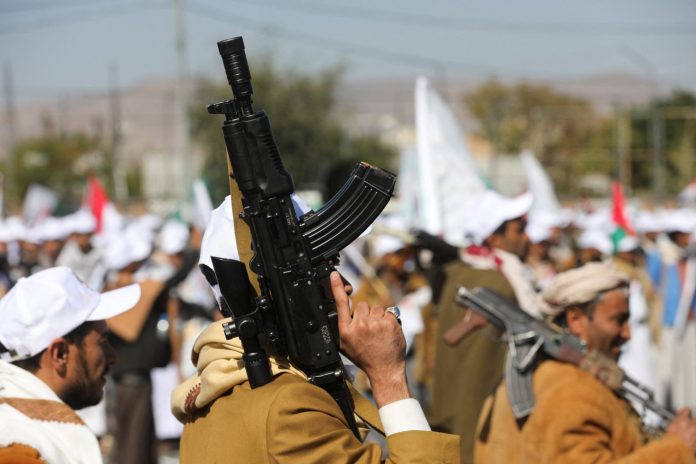
Report: US conducts new airstrikes on Yemen

US UK Yemen Attack

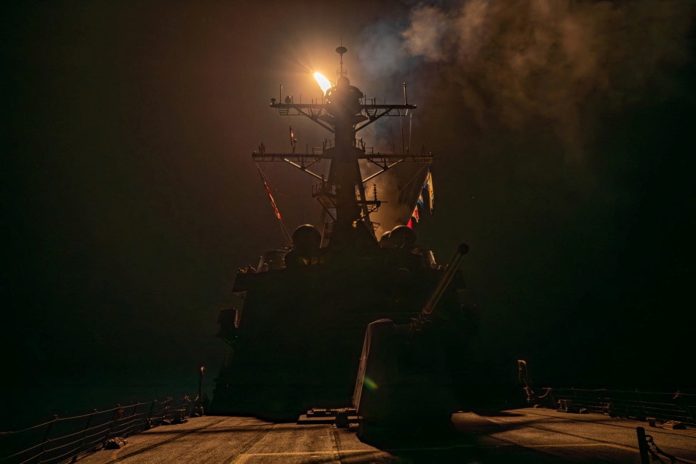
The missile salvo was fired from US Navy ships stationed in the Red Sea and targeted sites that were “prepared to launch attacks”, unnamed US officials stated.

Over a dozen locations were said to have been hit in the strikes.

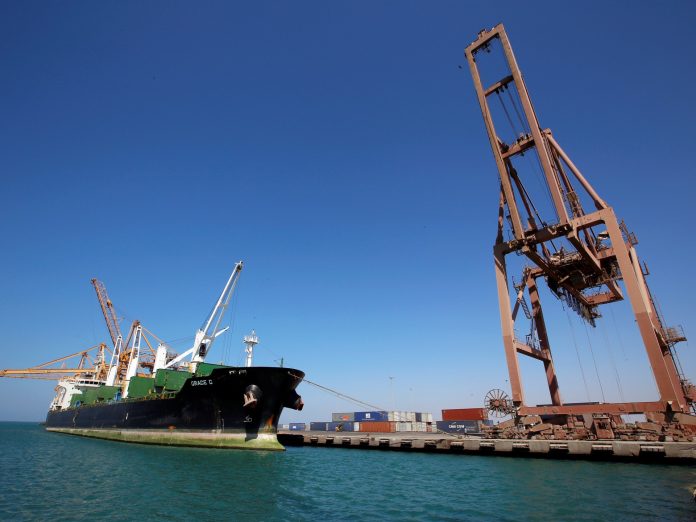
The operation follows a Houthi strike against a US-owned bulk carrier ship Genco Picardy in the Gulf of Aden earlier on Wednesday, with group spokesman Yahya Sarea claiming a “direct hit” on the cargo vessel.

“The naval forces will not hesitate to target all sources of threat in the Red and Arabian sea within the legitimate right to defend Yemen and to continue supporting the oppressed Palestinian people,” he added.

US Central Command (CENTCOM), the agency responsible for overseeing operations in the Middle East and Central Asia, announced there were no injuries in the attack and that the vessel remained seaworthy, but noted “some damage” to the ship.

The attack on the cargo vessel comes on the heels of several similar strikes in recent weeks, after the Houthis vowed to target any ship affiliated with Israel amid the ongoing war in Gaza. Washington has responded with three previous rounds of missile strikes on Houthi targets, and earlier on Wednesday announced the redesignation of the group as a terrorist organization.

“The Houthis must be held accountable for their actions, but it should not be at the expense of Yemeni civilians,” Secretary of State Antony Blinken said in a statement.

“As the Department of State moves forward with this designation, we are taking significant steps to mitigate any adverse impacts this designation may have on the people of Yemen.”

However, the top US diplomat added that the decision would be reversed if the Houthis ceased their attacks on ships transiting the Red Sea.

The group had previously been placed on the Foreign Terrorist Organization list under the administration of President Donald Trump, but were delisted in February 2021.

The Houthis has confirmed the latest round of US airstrikes in Yemen, according to a statement on the Houthis-run Saba news agency on late Wednesday night in to Thursday morning (local time).

“The American-British aggression renewed its targeting of a number of Yemeni governorates,” the statement read.

“The American-British aggression aircraft targeted the governorates of Hodeidah, Taiz, Dhamar, Al-Bayda and Saada,” it added.
IMF warns of “negative” impact if Red Sea disruption escalates due to Yemen’s strikes

Shipping Firm

Current Houthi strikes on shipping are “not significant enough to impact the global economy, the risk is more spillover of violence and prolonging the conflict and then uncertainty is high,” Kristalina Georgieva told CNN’s Richard Quest at the World Economic Forum in Davos Wednesday.

“How would that impact the world? I worry it could be quite negative.”

Attacks by Yemeni fighters in the Red Sea effectively closed one of the world’s main trade routes to most container ships.

In solidarity with the Palestinians in besieged territory, the Yemeni armed forces have targeted ships in the Red Sea with owners linked to Israel or those going to and from ports in the occupied territories.

In response, the US has formed a military coalition against Yemeni forces in the Red Sea and endangered maritime navigation in the strategic waterway.

The US and the UK, backed by Bahrain, Australia, Canada and the Netherlands, struck more than 60 targets at almost 30 locations in Yemen on Friday, killing five people and injuring six others.

On Saturday, the US Central Command (CENTCOM) announced that a “follow-on action” was conducted against a Yemeni radar facility in Sana’a by the Navy destroyer USS Carney using Tomahawk land attack missiles.

Palestinian Investment Fund says Gaza needs at least $15bn to rebuild housing units

Gaza War

Mustafa stated, while speaking at the World Economic Forum (WEF) in Davos, that reconstruction efforts will be huge and the financial needs will be significant.

More people in Gaza are likely to die of hunger and famine than war, he added.

The United Nations has warned Israel’s war in Gaza has brought famine with “such incredible speed”, cautioning that hundreds of thousands of Palestinians are starving in the besieged strip.

Late last year, data from the International Labour Organization (ILO) and the Palestinian statistics office showed nearly 66 percent of jobs have been lost in the Gaza Strip since the start of the war between Israel and Hamas on October 7.

Palestinians have seen their employment reduced by two-thirds in the Gaza Strip – equivalent to 192,000 jobs – since the outbreak of the war, the ILO and Palestinian Central Bureau of Statistics (PCBS) said.

Palestinians in Gaza have long grappled with persistently high rates of poverty, vulnerability and one of the highest unemployment rates in the world, it added.

“The crisis has caused a huge distortion in the Palestinian economic structure,” stated PCBS president Ola Awad.

Peter Rademaker, ILO’s deputy regional director for Arab states, told Al Jazeera that Palestinians in Gaza “will be in poverty for many months and years to come” because of Israel’s war on the enclave.

Nearly 40,000 buildings, or about 18 percent of all pre-conflict structures have been damaged or destroyed in the Gaza Strip since the conflict started, a UN assessment showed in mid-December.

In early December, the International Monetary Fund (IMF) issued a stern warning about the economic impact of Israel’s war on the Gaza Strip on the regional economic outlook, and stressed that the onslaught on the besieged enclave is expected to “severely depress” the Palestinian economy.

“We do expect the conflict to severely depress economic activity in both the West Bank and Gaza, where even before the conflict GDP growth was set to decline over the medium term,” the IMF communications chief, Julie Kozack, told reporters.

She added that while the economies of the occupied West Bank, Gaza will be the hardest hit, “the ultimate impact will depend on the duration and intensity of the conflict.”

Russia says UK working to prevent peace

Russia Ukraine War

On Friday, UK Prime Minister Rishi Sunak announced a £2.5 billion ($3.2 billion) military assistance package for Ukraine – Britain’s largest to date. The two sides also signed a ten-year security guarantee, with the UK pledging “swift and sustained” aid for Ukraine in the event of a Russian attack in future. Kiev also promised to come to Britain’s defense in the event of Russian “aggression” against the country.

Speaking at a press briefing on Wednesday, Zakharova suggested that the deal was an indication that “Ukraine is literally being stripped of any chance to get out of the conflict through negotiations”.

As a result, Kiev is being turned into “a bargaining chip in the reckless ventures of the Anglo-Saxons”, she added, claiming that the UK wants to keep the country in conflict with Russia.

She also ridiculed Ukraine’s commitment to defend the UK.

“No sane person would believe that. The regime of [Ukrainian President Volodymyr] Zelensky is crying in every corner that, if not one more dollar … is transferred to it, Ukraine will cease to exist. And under these conditions, Ukraine undertakes to help Britain in the event of a military threat to the kingdom.”

Russia has never closed the door on peace negotiations with Kiev despite Zelensky barring talks with the current leadership in Moscow in the autumn of 2022. This was made law after four former Ukrainian regions overwhelmingly voted to become part of Russia.

Meanwhile, both Russian and Ukrainian officials have confirmed that Moscow and Kiev were close to settling the conflict in the spring of 2022, but the process was derailed by then-UK Prime Minister Boris Johnson, who convinced Ukraine to keep fighting. One of Russia’s key demands was that Ukraine stay neutral and refrain from joining military alliances.

Last week – months after the first reports of his role in the talks emerged – Johnson dismissed the allegations that he had sabotaged a peace deal as “total nonsense and Russian propaganda”.

Russian President Vladimir Putin said on Tuesday that Kiev could have ended the conflict if it had ignored Johnson. Now,

“Ukrainian statehood could be dealt an irreparable and very serious blow… if things carry on this way,” he warned, noting that Russian troops had regained the initiative on the battlefield after Kiev’s failed counteroffensive.

IRGC colonel assassinated in Iran’s Sistan and Baluchestan

IRGC

The IRGC Ground Force’s Quds Base said in a statement that Colonel Hossein-Ali Javdanfar, a serviceman at IRGC’s Salman unit in the province, was killed in a targeted shooting attack on the road linking Khash city to the provincial capital city of Zahedan.

The statement described Javdanfar as an IRGC advisor, who had traveled to Saravan County on a mission to oversee cultural activities and projects there.

Efforts are underway to identify the attackers, it noted.

This came on the same day that the IRGC Ground Force managed to fight off a team of militants affiliated with the Pakistan-based so-called Jaish al-Adl terrorist group in the same Iranian province.

According to a statement released by the IRGC Ground Force’s Quds Base, IRGC servicemen, having fully detected the fully-armed terrorists and been informed of their plans for terrorist activities, clashed with them in Kastag village of Rask County.

The statement added that a terrorist was killed in the operation, while the rest fled the area into southwestern Pakistan. An amount of ammunition, weapons and explosives was also recovered from the militants.

Sistan and Baluchestan province, which borders Pakistan, has witnessed several terror attacks targeting both civilians and security forces over the past years.

Iran’s security forces have invariably protected the border areas and managed to repel almost all terrorist attacks by foreign-backed anti-revolution elements across the country.

Back on December 15 last year, the Jaish al-Adl terrorist group claimed responsibility for a vicious terrorist assault on Rask County’s police headquarters.

Alireza Marhamati, deputy provincial governor in security and political affairs, stated at the time that 11 police forces, including officers and conscripts, were killed in the attack.

US re-designates Yemen’s Houthis as specially designated global terrorists

Yemen Houthis

The White House’s National Security Adviser Jake Sullivan made the announcement on Wednesday, saying it was a response to Houthi attacks on shipping in the Red Sea.

“Today, in response to these continuing threats and attacks, the United States announced the designation of Ansarallah, also known as the Houthis, as a Specially Designated Global Terrorist,” Sullivan stated in a statement.

However, he added that the designation – which comes into effect in 30 days – could be reevaluated if the Houthis cease attacks in the Red Sea and the Gulf of Aden.

Administration officials say the designation is aimed at deterring the Houthis from their ongoing aggression in the Red Sea.

It is the latest in a series of US actions targeting the armed group, and comes as the specter of a wider regional war in the Middle East looms large amid Israel’s war against Hamas in Gaza.

The Biden administration claimed that the re-designation of the Houthis, which comes with harsh sanctions, will not have a negative impact on the people of Yemen since the sanctions will include “unprecedented” humanitarian carve-outs.

“We are sending a clear message: commercial shipments into Yemeni ports on which the Yemeni people rely for food, medicine and fuel should continue and are not covered by our sanctions,” the White House announced in a news statement on Wednesday.

The administration removed the Houthis’ SDGT designation and de-listed it as a foreign terrorist organization (FTO) in February 2021, after it was designated by former President Donald Trump’s administration in its final weeks.

Rights advocates have warned that blacklisting the Houthis would complicate the work of humanitarian organisations operating in areas under the group’s control. Yemen is enduring one of the world’s worst humanitarian crises where millions of people are dependent on international aid.

A spokesman for the Yemeni group has stated that the attacks on ships in the Red Sea heading to Israel will continue, despite the designation.

The US designation of Yemen’s Houthis as a terrorist group will not affect their operations to prevent Israeli ships or ships heading to Israel from crossing the Red Sea, the Arabian Sea, and the Bab al-Mandab Strait, Houthi spokesman Mohammed Abdulsalam told Reuters on Wednesday.

In solidarity with the Palestinians in besieged territory, the Yemeni armed forces have targeted ships in the Red Sea with owners linked to Israel or those going to and from ports in the occupied territories.

In response, the US has formed a military coalition against Yemeni forces in the Red Sea and endangered maritime navigation in the strategic waterway.

The US and the UK, backed by Bahrain, Australia, Canada and the Netherlands, struck more than 60 targets at almost 30 locations in Yemen on Friday, killing five people and injuring six others.

On Saturday, the US Central Command (CENTCOM) announced that a “follow-on action” was conducted against a Yemeni radar facility in Sana’a by the Navy destroyer USS Carney using Tomahawk land attack missiles.

“We cannot have in Lebanon another Gaza”: UN chief

António Guterres

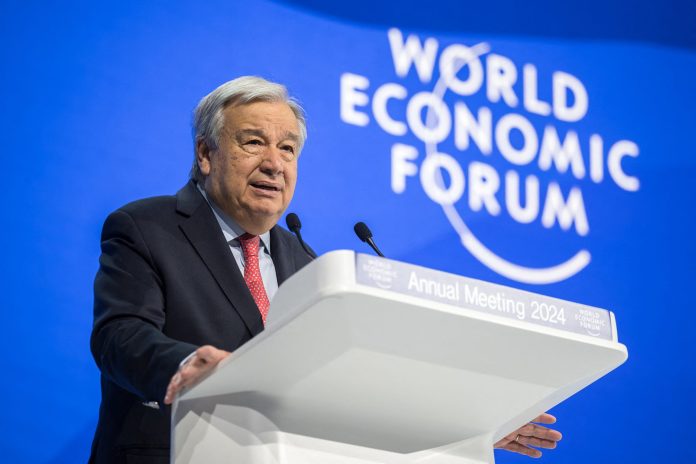
Speaking at the World Economic Forum in Davos, Guterres warned that he is “extremely worried about Lebanon”.

“We cannot have in Lebanon another Gaza,” said Guterres, adding that he sees serious efforts being made by the Lebanese government, the United States and other parties.

“It is absolutely crucial to avoid a messy confrontation in Lebanon that will be the devastation of the country.”

Guterres also called for a humanitarian ceasefire in order to facilitate the liberation of hostages “immediately and unconditionally”, to provide “effective humanitarian aid to the people of Gaza” and to “facilitate a serious negotiation for de-escalation in Lebanon”.

Tensions have flared along the border between Lebanon and Israel amid intermittent exchanges of fire between Israeli forces and Hezbollah in the deadliest clashes since the two sides fought a full-scale war in 2006.

Dozens of Hezbollah members have been killed in clashes with Israeli forces near Lebanon’s border with Israel since the outbreak of the Gaza conflict on Oct. 7.

The border tension comes amid an Israeli military offensive in the Gaza Strip following a cross-border attack by the Palestinian group Hamas on Oct. 7.

Israel has pounded Gaza since then, killing nearly 24,500 Palestinians and injuring 61,000 others, according to local health authorities.

About 85% of Gazans have been displaced, while all of them are food insecure, according to the UN. Hundreds of thousands of people are living without shelter and ⁠less than half the aid trucks are entering the territory than before the start of the conflict.

Pakistan recalls envoy from Tehran, bars Iranian ambassador from returning to post over missile, drone attacks

Iran’s missile defense systems

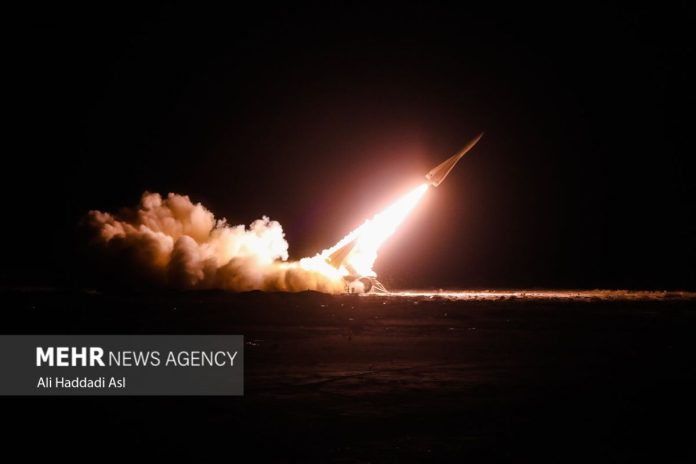
The Islamic Revolution Guards Corps (IRGC) has targeted two main bases of the anti-Iran terror group the so-called Jaish al-Adl in Pakistan’s southwestern province of Balochestan on Tuesday night. These headquarters were destroyed by missiles and drones.

“Last night’s unprovoked and blatant breach of Pakistan’s sovereignty by Iran is a violation of international law and the purposes and principles of the Charter of the United Nations,” foreign ministry spokeswoman Mumtaz Zahra Baloch said in a statement on Wednesday.

She told reporters Islamabad had summoned home its back its ambassador from Iran and that his Iranian counterpart, who is travelling, “may not return for the time being”.

Following the attacks, Pakistan’s Ministry of Foreign Affairs said it had lodged a “strong protest” and summoned the Iranian charge d’affaires over what it called an “unprovoked violation” of its airspace by Tehran.

“This violation of Pakistan’s sovereignty is completely unacceptable and can have serious consequences,” the ministry noted in a statement posted to its website.

“It is even more concerning that this illegal act has taken place despite the existence of several channels of communication between Pakistan and Iran,” it added.

“Pakistan has always said terrorism is a common threat to all countries in the region that requires coordinated action. Such unilateral acts are not in conformity with good neighbourly relations and can seriously undermine bilateral trust and confidence.”

Jaish al-Adl is a terrorist group which largely operates across the border in Pakistan. It is also a U.S.-designated terrorist group.

Last month, the terrorist group claimed responsibility for a deadly attack on a police station in the southeastern Iranian city of Rask. The terrorist attack left 11 police officers dead and six others injured.

Pakistan PM urges joint Tehran-Islamabad fight against terror

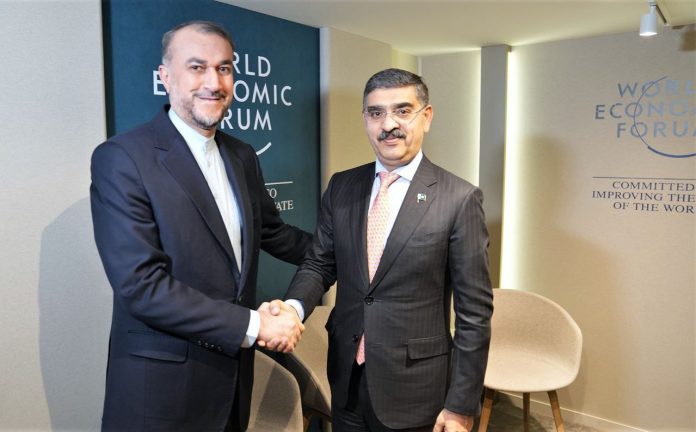
Pakistan's Caretaker Prime Minister Anwar ul Haq and Iranian Foreign Minister Hossein Amirabdollahian

Anwar ul Haq raised the matter in a meeting with Iranian Foreign Minister Hossein Amirabdollahian on the sidelines of the World Economic Forum’s Annual Meeting in Davos, Switzerland.

In the meeting, Amirabdollahian termed Tehran-Islamabad relations as deep-rooted and age-old, highlighting Iran’s readiness to further enhance bilateral ties.

He expressed content with the growing trend of bilateral ties, adding both countries’ leaders have set the $5billion target for mutual trade, which currently stands at $2.5.
“We need to reach the common target through joint efforts,” he said.

Amirabdollahian welcomed efforts to expand border markets between the two countries, adding Iran is prepared to boost cooperation with Pakistan in the domains of energy, namely oil, gas and electricity.

Iran’s diplomacy chief said the issue of fighting terrorism is of utmost importance to both countries, underscoring the need to follow up on the implementation of agreements already reached between the two countries on fighting terror.

The Iranian foreign minister also referred to the Gaza crisis, adding the crisis is spreading from Palestine to other parts of the region.

He said it is essential that Islamic countries, namely Iran and Pakistan, step up their efforts to help end the Israeli regime’s war against Gaza.

Pakistan’s caretaker prime minister, in turn, said Pakistan and Iran face common challenges in the region, and touched upon the recent terrorist attack in the Iranian city of Kerman.

Anwar ul Haq highlighted the need for both countries to work together closely to rein in such terrorist threats.

He touched upon the crisis in Gaza, and dismissed as unjustifiable and indefensible the killing of civilians, including women and children, in Gaza.

He underscored the need to establish a ceasefire as well as a corridor to send in humanitarian aid to Gaza.

Biden to officially relist Yemen’s Houthis as terrorist group

Yemen Houthi

The source stated on Wednesday the Biden administration is expected to announce plans in which it will redesignate the Houthi movement in Yemen as specially designated global terrorists.

The administration removed the Houthis’ Specially Designated Global Terrorist (SDTG) designation and de-listed it as a Foreign Terrorist Organization (FTO) in February 2021, after it was designated by the Donald Trump administration in its final weeks.

At the time, Secretary of State Antony Blinken said the decision to remove the group’s designations was driven by concerns that it could imperil the ability to deliver crucial assistance to the people of Yemen.

He added it was “a recognition of the dire humanitarian situation in Yemen”.

Both the designations trigger an asset freeze, but only an FTO designation imposes immigration restrictions on members, according to the State Department.

The SDGT designation also does not impose sanctions on those who provide “material support” to the group.

Pressure has grown on the administration to reimpose the designations as the group carries out attacks on vessels in the Red Sea.

In solidarity with the Palestinians in besieged territory, the Yemeni armed forces have targeted ships in the Red Sea with owners linked to Israel or those going to and from ports in the occupied territories.

In response, the US has formed a military coalition against Yemeni forces in the Red Sea and endangered maritime navigation in the strategic waterway.

The US and the UK, backed by Bahrain, Australia, Canada and the Netherlands, struck more than 60 targets at almost 30 locations in Yemen on Friday, killing five people and injuring six others.

On Saturday, the US Central Command (CENTCOM) announced that a “follow-on action” was conducted against a Yemeni radar facility in Sana’a by the Navy destroyer USS Carney using Tomahawk land attack missiles.

The assaults prompted Yemen’s Supreme Political Council to issue a statement, saying “all American-British interests have become legitimate targets”.