
Because of its unique geopolitical position in the Persian Gulf and the Gulf of Oman, the Islamic Republic of Iran has long been at the forefront of confronting maritime threats from adversaries.
The importance of these waters is unmatched not only in military terms but also in the fields of energy, commerce, and global security.
The presence of foreign forces in waters surrounding Iran has reinforced the necessity of strengthening naval defense and deterrence — especially given that a large portion of Iran’s oil exports and foreign trade transit this vital route.
Accordingly, enhancing the ability to counter maritime threats is not merely a military option but a strategic necessity to preserve Iran’s sovereignty, security, and national interests.
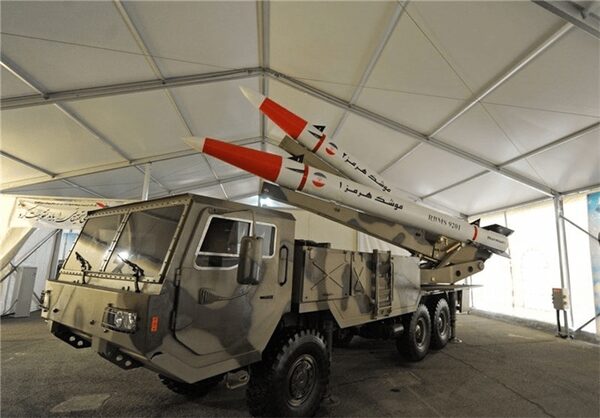
Given their strong similarity to the Fateh-class missile, the Hormuz-1 and Hormuz-2 missiles can be regarded as optimized and upgraded extensions of that family, and are considered among Iran’s most precise missiles.
The Hormuz missile’s range is reported to be approximately 300 kilometers, and the Hormuz-2’s speed has been described as between four and five times the speed of sound.
Unlike anti-ship missiles such as the Khalij-e Fars, which use optical guidance, or the Fateh-110, which relies on a precise inertial guidance system, the Hormuz (anti-radar) missile employs radar-wave seekers and attacks the source of emission.
The missile’s warhead is estimated to weigh between 450 and 600 kilograms.
Martyr Brigadier General Amir-Ali Haji-Zadeh, former commander of the IRGC Aerospace Force, said: “Hormuz-1 can destroy the radars aboard an aircraft carrier, a Patriot site on land, or a radar search site.”
Another potential target for the Hormuz missile is the many large military vessels that currently operate in the Persian Gulf.
Firing this missile in combination with one like the Khalij-e Fars could become a real nightmare for any enemy at sea.
