Sunday, December 21, 2025
Home Blog Page 934

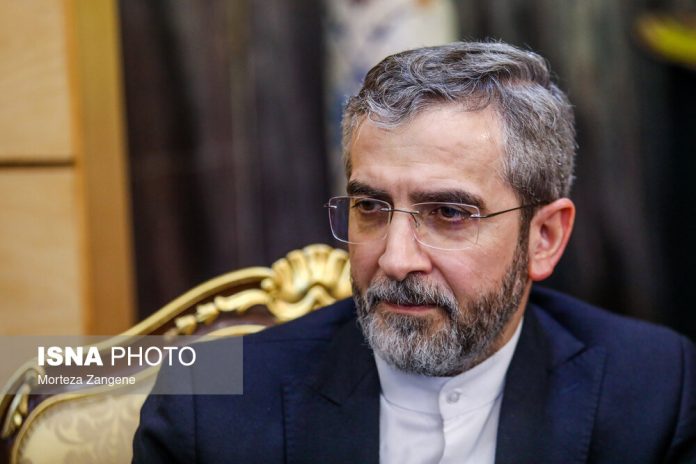
Senior diplomat warns Iran to respond to any Israeli attack ‘within seconds’

Ali Bagheri Kani

“In case of repetition of another mistake, they should expect a harsher, faster, and more immediate response,” he said on Monday.

“This time, the Zionists should know this that they will not have a 12-day-long timespace,” the official noted, adding, “The response that they are going to receive [this time around] cannot be measured by [such time standards as] days or hours, but [will come in a matter of] seconds.”

On April 1, the Israeli regime committed a terrorist attack against Iran’s diplomatic premises in the Syrian capital Damascus.

The Israeli attack resulted in the martyrdom of Brigadier General Mohammad Reza Zahedi, a commander of the Quds Force of Iran’s Islamic Revolution Guards Corps (IRGC), his deputy, General Mohammad Hadi Haji Rahimi, and five of their accompanying officers.

In retaliation, the IRGC targeted the occupied territories late on Saturday with a barrage of drones and missiles. The retaliatory strikes, dubbed Operation True Promise, has inflicted damage on Israeli military bases across the Palestinian occupied territories.

“If there is any [measure of] rationality within the Zionist regime, they [will know this that they] must not repeat their strategic mistake with another mistake,” Bagheri said.

The Zionists, the official stated, should know that if their mistake concerning the Iranian consulate warrants such a crushing retaliation, then their likely malign intentions against the Iranian soil would “principally entail a much more vehement response”.

Amid speculation about the potential Israeli attack, senior Iranian political and military leaders, including President Ebrahim Raisi and Foreign Minister Hossein Amirabdollahian, have warned of a stronger and more severe response.

Italy warns Israeli retaliation for Iran military operation could lead to spiral of violence

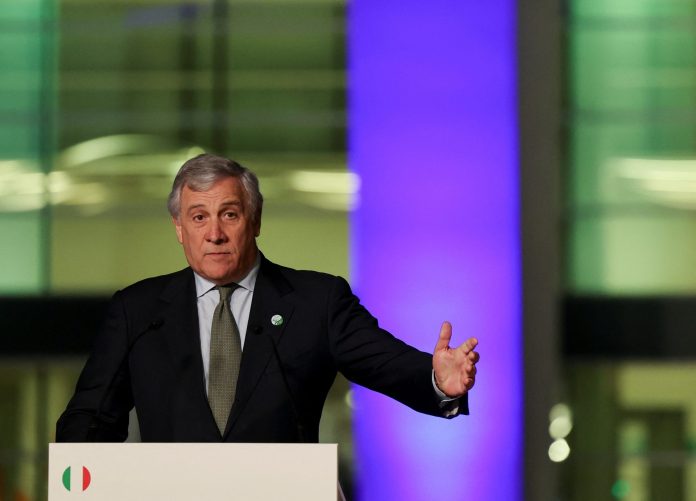
“We hope that Israel, strengthened by its military victory, will want to make common sense prevail by desisting from further reactions that could trigger a spiral of violence harmful to everyone,” Foreign Minister Antonio Tajani said during a hearing of the Italian parliament’s Foreign Affairs Commission.

“We demand that Iran and affiliated groups cease their attacks and stand ready to take further measures in response to any new destabilizing initiatives,” he added.

Speaking at the same hearing, Italian Defense Minister Guido Crosetto said that Iran’s attack increased the risk of collateral damage in the Red Sea and Lebanon, where Italy has a warship and troops, respectively in the scope of the United Nations Interim Force in Lebanon (UNIFIL) mission.

On the risk of possible escalation deriving from Israel’s possible reaction, he stated, “I am not and do not want to call myself pessimistic, but I am certainly worried: there could be a reaction from Israel and a new spiral of violence and war could still be triggered.”

Iran on Saturday launched an airborne attack on Israel in retaliation for an April 1 airstrike on its diplomatic compound in the Syrian capital. It reportedly fired more than 300 drones and missiles.

Iranian Foreign Ministry spokesman Nasser Kanaani said the reprisal on Israel was “necessary and appropriate” and was aimed at military targets. Israel has vowed to respond to the attack.

Iranian Foreign Minister Hossein Amirabdollahian vowed that any further Israeli attack will be met with a “stronger” and “extensive” response.

Zelensky calls on West to treat Ukraine like Israel

Zelensky in US

Zelensky issued the appeal in a Telegram post on Monday, showering praise on the “allied action” to help Israel during Iran’s strikes.

“It demonstrated how truly effective unity in defending against terror can be when it is based on sufficient political will. Israel, the United States, the United Kingdom, France, and Jordan acted together and with maximum efficiency,” Zelensky asserted.

The president said that “no one was dragged into the war” due to the action against Iran, while noting that “Israel is not a NATO member, so no action, such as triggering Article 5, was required”. Zelensky then urged the collective West to provide Ukraine with the same level of support and protect it from Russian long-range strikes.

“European skies could have received the same level of protection long ago if Ukraine had received similar full support from its partners in intercepting drones and missiles,” he stated, pledging to raise the issue with the country’s backers.

Over the course of the conflict, Kiev has repeatedly urged Western nations to provide protection from Russian airstrikes one way or another, up to establishing a NATO-enforced no-fly zone over Ukraine.

These ideas, however, have never come to fruition over fears that such moves would drag the West into an all-out war with Russia. Moscow has repeatedly warned that it would treat such attempts by any parties as a direct entrance into the conflict on Kiev’s side.

White House national security spokesman John Kirby told journalists on Monday the US will not shoot down Russian drones and missiles fired at Ukraine, in contrast to how American forces protected Israel from the Iranian attack.

The US, the UK and France helped Israel repel a massive barrage launched by Iran in retaliation for an Israeli strike on its consulate in Damascus earlier this month. Kirby was asked during a daily briefing whether the same tactics could be used in the Ukraine conflict.

“I knew this question was coming,” he responded.

“Look: different conflicts, different airspace, different threat picture. And [President Joe Biden] has been clear from the beginning [of the Ukraine hostilities] that the US is not going to be involved in that conflict in a combat role.”

Western powers have pledged to provide assistance to Kiev “for as long as it takes” to defeat Russia. However, they have repeatedly rejected the idea of directly engaging Russian forces. Even the French government, which has not ruled out deploying troops to Ukraine, made it clear that any hypothetical mission would be to relieve Ukrainian soldiers of non-combat duties, so that Kiev could send more of its own troops to the front line.

British Foreign Secretary David Cameron was asked the same question as Kirby during an interview with LBC on Monday.

“Actually, putting NATO forces directly in conflict with Russian forces – I think that would be a dangerous escalation,” he said. Instead of “Western planes over [its] skies trying to shoot things down,” Ukraine instead requires air defense systems, Cameron suggested.

Moscow perceives the Ukraine conflict as a US-led proxy war on Russia, in which Ukrainians are being used as ‘cannon fodder’. It has warned that it will consider any military assets directly engaged in hostilities as legitimate targets, regardless of who operates them.

Statements from some Western officials appear to back up the Russian view of the situation. Former British Prime Minister Boris Johnson claimed last week that the US and its allies are getting “fantastic value” from the money spent on Ukraine, because “those guys without a single pair of American boots on the ground are fighting for the West.”

2 Mass graves discovered in Gaza Strip

Gaza War

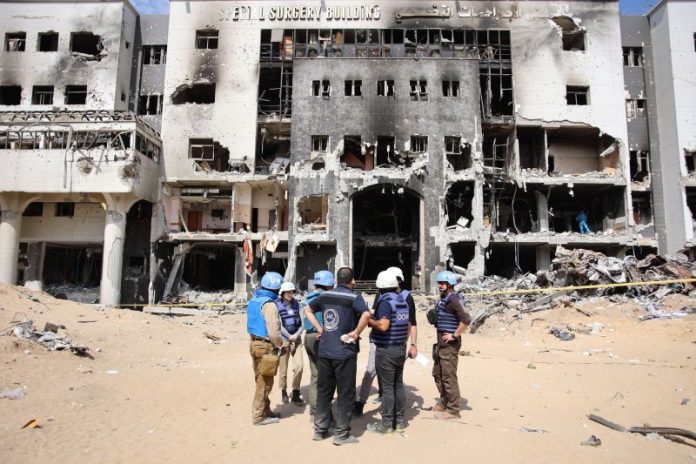
The first mass grave was discovered at al-Shifa Hospital in Gaza City, and the second was found in Beit Lahiya.

Al Jazeera Arabic reported nine bodies were found at al-Shifa Hospital before the health officials stopped digging, fearing that they could get targeted by the Israeli drones hovering in the skies above them.

But Gaza residents and medical crews told CNN fifteen bodies were recovered from around Al-Shifa Hospital following the withdrawal of the Israeli military from the area two weeks ago.

The uncovered bodies had not fully decomposed, which indicated that they had been killed recently.

Some of the people who had been killed and buried appear to have been patients at the hospital and had medical bandages and catheters attached to their bodies.

Family members of the deceased who identified the bodies confirmed that some of those killed were patients. They include an elderly man, a woman, and a man in his 20s.

Doctors and staff from the hospital stated that some people were killed outside the main gate (building number 80) of the hospital. Medical staff said they witnessed killings and burials.

In Beit Lahiya, northern Gaza, another mass grave containing about 20 decomposed bodies was discovered.

Residents said the bodies belong to the Al-Assaf family, and added they were killed during an incursion by the Israeli military forces in the area four months ago.

The Palestinian group Hamas announced the new mass grave discovered at al-Shifa Hospital in Gaza is “horrifying”.

The group stressed the mass grave includes “several decomposing bodies” that Israeli forces, using military bulldozers, hid under the rubble before withdrawing from the medical complex earlier this month.

Israeli forces have attacked and besieged the hospital several times since October 7, leaving it largely in ruins. Thousands of medical staff, patients, and displaced families were at the facility during the attacks, with witnesses saying hundreds lost their lives as a result.

The latest discovery indicates that there are “no limits” to what Israeli forces are willing to do, Hamas noted.

Their crimes are continuing because of the international community’s silence in the face of this “genocide” against Palestinians in Gaza, the group added.

“The series of ongoing violations, including the discovery of mass graves in al-Shifa, cases of execution, and the hundreds of bodies that remain under the rubble … are clear and well-documented war crimes,” it said.

Hamas called on the international community to bring those responsible to justice.

Iran says warned US over consequences of repeated Israeli adventurism

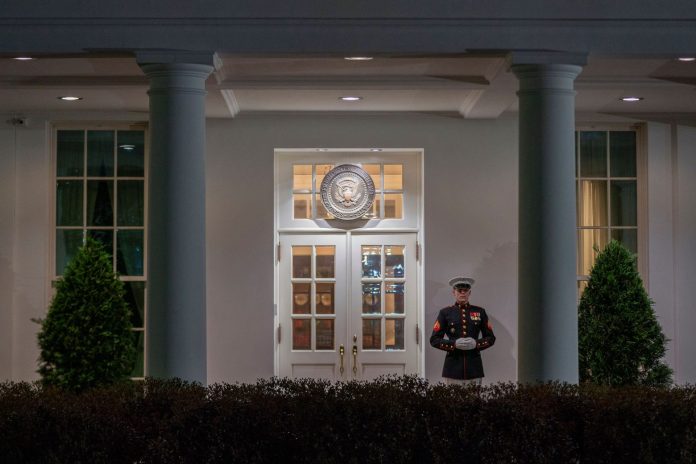
White House

Amirabdollahian made the remarks in a Monday phone call with his Chinese counterpart Wang Yi.

“We have clearly warned the White House that, in case of [fresh] adventurism by the Zionist regime in repeating terrorist aggression against Iran’s interests and security, Tehran’s subsequent response and action would be decisive, immediate, and extensive,” the Iranian minister said.

On April 1, the Israeli regime committed a terrorist attack against Iran’s diplomatic premises in the Syrian capital Damascus.

The Israeli attack resulted in the martyrdom of Brigadier General Mohammad Reza Zahedi, a commander of the Quds Force of Iran’s Islamic Revolution Guards Corps (IRGC), his deputy, General Mohammad Hadi Haji Rahimi, and five of their accompanying officers.

Retaliating against the attack, the IRGC targeted the occupied territories late on Saturday with a barrage of drones and missiles. The retaliatory attack, dubbed Operation True Promise, has inflicted damage on Israeli military bases across the occupied territories.

Following the reprisal, Iran both relayed the message that it viewed the matter as “concluded”, and also warned the US, the Israeli regime’s biggest ally, against trying to involve itself in the conflict.

For his part, the Chinese official said Beijing vehemently condemned the attack on the Iranian Embassy in Damascus, considering it to be in violation of international rules and principles.

Wang noted how his country had likewise supported the Islamic Republic’s just demands at the United Nations Security Council, despite double-standard practices on the part of the US and its Western allies, which saw them refusing to condemn the Israeli atrocity.

He said he had notified his American counterpart, Antony Blinken, about the Iranian party’s principled position concerning the recent developments.

“China and the Islamic Republic are strategic partners,” Wang added, saying, “Beijing always attaches great importance to Iran’s positions and standpoint.”

Iran FM to UN chief: Anti-Israeli military operation could have been wider in scope

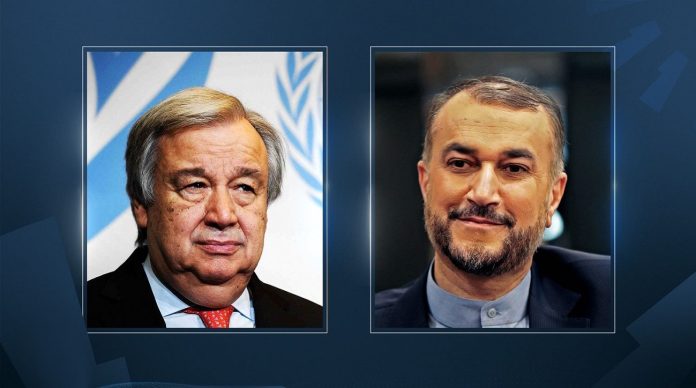
Antonio Guterres and Hossein Amir Abdollahian

Amirabdollahian made the remarks in a telephone conversation with the United Nations Secretary-General Antonio Guterres on Monday.

The top diplomat was referring to the Islamic Republic’s Saturday reprisal against the Israeli regime’s deadly attack of April 1 against the country’s diplomatic premises in the Syrian capital Damascus.

“Although, the Islamic Republic was capable of conducting this operation across a wider radius, it just targeted parts of the Zionist regime’s positions, from which the [Israeli] attack against our country’s Embassy in Damascus had taken place,” the foreign minister said.

The retaliation, he added, fitted within the country’s right to legitimate defense and the international law.

Due to the UN Security Council’s refusal to condemn the attack, the Islamic Republic was left with no option but to resort to the defensive operation and punish the Zionist regime, he stated.

Elsewhere in his remarks, the foreign minister pointed to the Israeli regime’s genocidal war against the Gaza Strip, which began on October 7 last year following Operation al-Aqsa Storm by the coastal sliver’s resistance groups.

“The United States and its allies refuse to stop the regime,” he noted, and denounced the international community’s failure to put an end to the genocide.

The Iranian official welcomed the United Nations’ efforts towards cessation of the warfare and transfer of humanitarian aid to the Palestinian territory.

For his part, Guterres pointed to Iran’s retaliation against the Israeli regime, advising parties to regional conflicts to exercise restraint.

The UN chief noted how he had condemned acts of violation targeting diplomatic premises on several occasions.

He expressed delight in Iran’s current refusal to take additional measures against the occupying regime, advising Tel Aviv to refrain from committing fresh aggression against the Islamic Republic.

Any slightest move against Iran to face harsh response: President Raisi

Raisi Qatar Emir

President Raisi made the remarks in a phone conversation with Sheikh Tamim bin Hamad Al Thani the Emir of Qatar on Monday evening.

He referred to the Zionist regime’s terror attack on the Iranian consulate in Damascus, adding the move signifies the regime’s desperation and failure in achieving its objectives, including those in the Gaza war.

The Iranian president said, due to the inaction of the United Nations Security Council to stop the Zionists’ crimes, the Islamic Republic of Iran, under Article 51 of the UN Charter regarding the right to legitimate defense and in a punitive measure, targeted those centers inside the occupied Palestinian territories from which the Damascus raid had been carried out.

During the operation “True Promise”, the armed Forces of the Islamic Republic of Iran attacked two centers in the occupied territories using drones and missiles.

President Raisi once again underlined the need to adopt deterrent measures against the Israeli regime, particularly by Islamic states. He reiterated the blind support of some western countries for the Israeli regime, paves the way for fostering tension in the region.

Referring to the Gaza war, Iran’s president said the Israeli regime, supported by some western countries, keeps its campaign of genocide and child-killing, but the oppressed Palestinian people are resisting these horrible crimes and will emerge victorious.

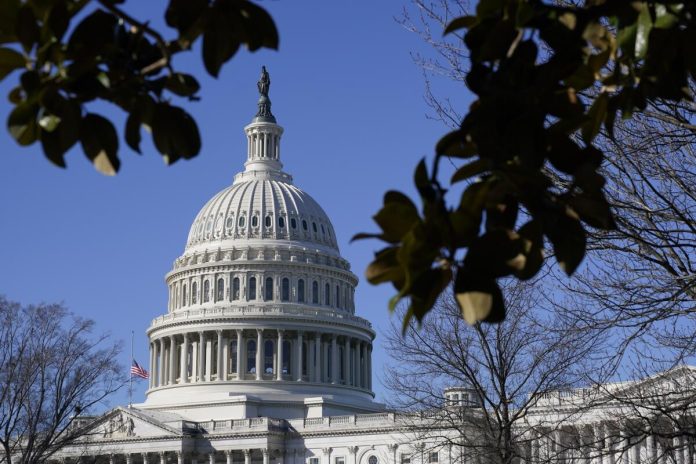
US House passes series of bills aimed at “squeezing Iran financially” after Israel attack

Three separate bills were brought to the floor Monday under suspension of the rules, a fast-track process that requires two-thirds support for passage, allowing for floor votes to be taken immediately.

The bills largely seek to impose financial penalties on Iran, those that support it and “its network of proxies”.

The bills voted for on Monday night are largely noncontroversial and enjoy support from a majority of Democrats.

They include a bill to terminate the tax-exempt status of nonprofit organizations found to be supporting terrorist groups; legislation aimed at disrupting the Chinese purchase of Iranian oil and petroleum products; and an effort to cut off the Iranian government from using the US financial system.

But even as Democrats support this package of bills, they are critical of Republicans for failing for weeks to bring to a vote the Senate-passed $95 billion national security supplemental, which includes aid for not only Israel but also Ukraine and Taiwan.

Rep. Brad Schneider (D-Ill.) expressed support for H.R. 6408 — a bill that would terminate the tax-exempt status of terrorist-supporting organizations, which he co-sponsored with Rep. David Kustoff (R-Tenn.).

But Schneider pleaded with Republicans to bring the national security supplemental legislation to the floor.

“I again want to thank my colleague, Rep. Kustoff, for his partnership and work on this legislation … and I urge all of my colleagues to not only support this legislation, but also, as we have said, to support the essential security funding that came from the Senate,” he said.

House Speaker Mike Johnson (R-La.) on Monday evening unveiled a plan to Republicans to move four separate bills to address aid for Ukraine, Israel, Taiwan and other national security priorities. It’s not yet clear how Democrats will respond to the proposals.

The White House earlier on Monday announced it opposed a stand-alone bill for aid for Israel.

Earlier on Monday, a bipartisan group of lawmakers called for Johnson to put to a vote on Monday night the Senate-passed national security supplemental.

Israel pledges response to Iran military operation

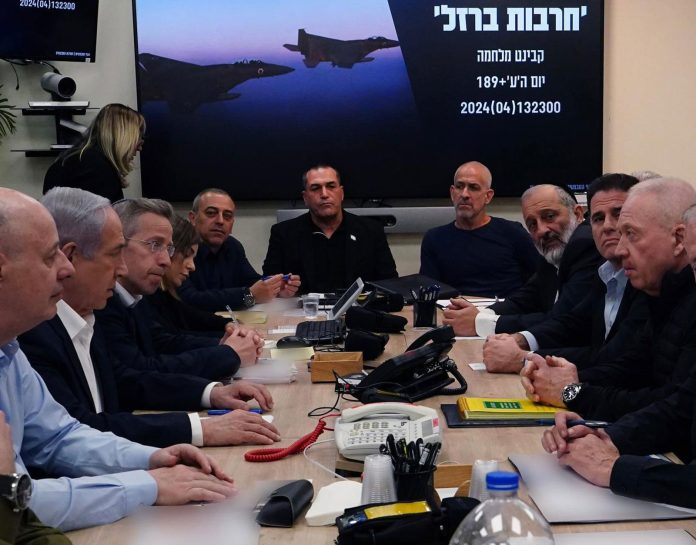
Prime Minister Benjamin Netanyahu summoned his war cabinet for the second time in less than 24 hours on Monday over Iran’s missile and drone attack.

Israel’s military Chief of Staff Herzi Halevi stated Tel Aviv would respond but did not provide details.

“This launch of so many missiles, cruise missiles, and drones into Israeli territory will be met with a response,” he said at the Nevatim Airbase in southern Israel.

Iran’s attack – launched in retaliation for an Israeli strike on its embassy compound in Damascus earlier this month – has increased fears of open warfare between Israel and Iran and heightened concerns that violence rooted in Israel’s war on Gaza is spreading further in the region.

“We’re on the edge of the cliff and we have to move away from it,” Josep Borrell, the European Union’s High Representative for Foreign Affairs and Security Policy, told Spanish radio station Onda Cero.

“We have to step on the brakes and reverse gear,” he added.

French President Emmanuel Macron, German Chancellor Olaf Scholz and United Kingdom Foreign Secretary David Cameron made similar appeals, echoing calls for restraint by Washington and United Nations Secretary-General Antonio Guterres.

“Neither the region nor the world can afford more war,” Guterres said late on Sunday, adding, “Now is the time to defuse and de-escalate.”

Russia has refrained from criticising its ally Iran in public over the strikes, but expressed concern about the risk of escalation on Monday and also called for restraint.

“Further escalation is in no one’s interests,” Kremlin spokesman Dmitry Peskov noted.

The attack came in response to an Israeli air strike on the Iranian consulate in Damascus on April 1, which killed seven members of the Islamic Revolutionary Guard Corps, including two generals.

Tehran’s retaliatory attack on Israel has heightened concerns that violence will spread further in the region.

Wary of the dangers, US President Joe Biden has told Netanyahu that Washington will not take part in any Israeli counteroffensive against Iran.

Since the start of Israel’s war on Gaza in October, clashes have erupted between Israel and Iran-aligned groups in Lebanon, Syria, Yemen and Iraq.

Israel says it is seeking to destroy the Palestinian group Hamas after it led an attack on Israel on October 7, killing at least 1,139 people, mostly civilians, and taking around 250 others captive.

Nearly 34,000 people, mostly women and children, have been killed in the Israeli assault on Gaza, according to Palestinian authorities, and large parts of the territory have been reduced to rubble. Aid agencies have warned that parts of Gaza are facing a looming famine amid severe Israeli restrictions on supplies of food and humanitarian aid.

Netanyahu’s government ‘existential threat’ to Israel: Lapid

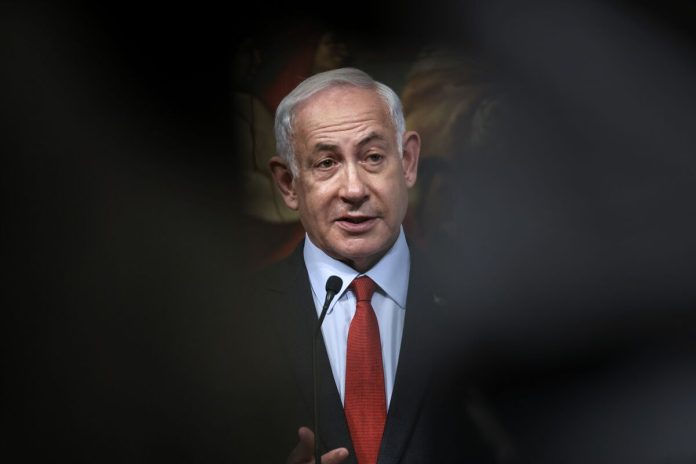
Benjamin Netanyahu

“If we don’t move this government, it will bring destruction upon us,” Lapid said on social media platform X.

Recent days saw attacks by illegal Israeli settlers on Palestinian towns in the West Bank following the death of a settler in the occupied territory.

At least two Palestinians were killed and several Palestinian homes and vehicles were torched in the settler violence.

Under Netanyahu’s rule, the “Jewish terrorist violence” became out of control, Lapid added, renewing his call for holding early elections in Israel.

Tensions have been running high across the West Bank since Israel launched a deadly military offensive that killed nearly 33,800 people in the Gaza Strip following an Oct. 7 Hamas attack.

At least 465 Palestinians have since been killed and 8,400 others injured by Israeli army fire in the occupied territory, according to the Palestinian Health Ministry.