Wednesday, December 31, 2025
Home Blog Page 826

Analysts warn Israel-Hezbollah war would plunge Egypt into further darkness

Egypt blackout

Israel would likely suspend production on its key offshore gas fields in the north to protect against potential attacks and would rely upon one operational gas field for domestic consumption only.

“In that case, Israel won’t export at all to Egypt,” said Elai Rettig, assistant professor in energy politics at Bar Ilan University in Israel and senior researcher at the Begin-Sadat Center for Strategic Studies.

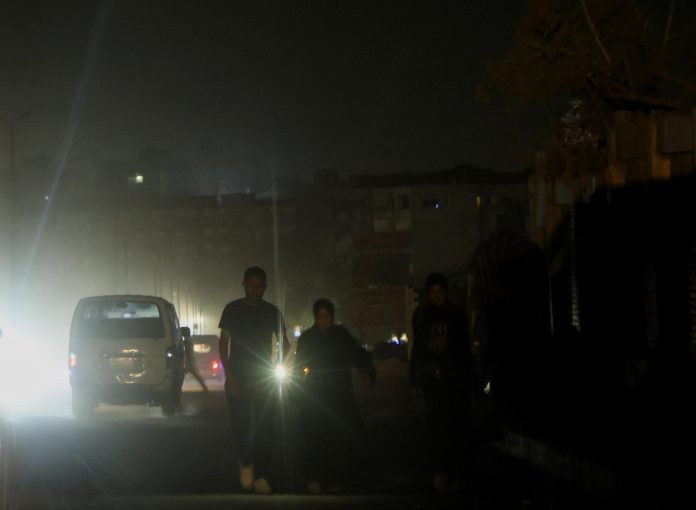
“If war starts tomorrow, Cairo is going to be in the dark more than it is currently. Egypt will definitely feel it.”

The looming risk to Egypt shows just how reliant it has become on Israeli gas, only a few short years after a massive offshore discovery gave rise to plans of transforming Egypt into an energy powerhouse.

In the intervening years, increased consumption, poor planning and an economic crisis, along with falling output from Zohr, the field that was discovered, have left Egypt scrambling for gas.

Last July, after nearly a decade of consistent electricity supplies, scheduled two-hour daily power cuts began across Egypt to deal with the energy crisis.

Last month, Prime Minister Mostafa Madbouly announced that this summer’s blackouts would be extended by another hour and that $1.8bn worth of fuel and gas would be imported to stop the power cuts by the end of July.

He pointed blame at a 12-hour outage of a gas field in “a neighbouring country” without elaborating.

But analysts say the problem was not a brief outage in Israel in June, but rather a structural one, years in the making, that has left Israel with significant leverage over Egypt.

Khaled Fouad, an independent energy analyst and researcher, stated that relying on Israeli gas is inevitable for Egypt in the foreseeable future.

“Egypt currently heavily relies on a single source to secure gas supplies, and this source is Israel, a state with a highly complex relationship with us, no matter how much relations improve,” he added.

Rettig said it was “absurd” of Madbouly to blame Israel.

“If it wasn’t for Israel, they’d have much worse blackouts,” he continued, adding, “It’s the only thing keeping lights on in Cairo right now.”

Two decades ago, Egypt was a net gas exporter and it was Egypt that was selling gas to Israel and Jordan, amongst others – often at below market rates.

But by 2015, after years of energy sector mismanagement and political instability, Egypt had become a net importer of gas.

That same year, after the government awarded exploration licences with more attractive terms for investors, Egypt’s fortune turned with the discovery of Zohr, the largest offshore gas field in the Eastern Mediterranean.

“They got lucky in finding Zohr and thought it had solved all of their problems,” said Robin Mills, CEO of Qamar Energy, a UAE-based energy consultancy, and non-resident fellow at Columbia University’s Center on Global Energy Policy.

The field came on-stream quickly and supplied enough gas to allow Egypt to stop importing gas in 2018.

So when Egypt agreed to buy $15bn worth of Israeli gas in the same year, the deal seemed questionable to some.

But discussing the deal publicly, Sisi stressed Egypt had “scored a goal”. This was Egypt’s opportunity to be a regional energy hub.

Using two LNG liquefaction plants and terminals at Idku and Damietta, Egypt could export its own gas and re-export gas from neighbouring countries to Europe and beyond.

In 2022, after Russia invaded Ukraine and European countries were looking for alternatives to Russian gas, Egypt cashed in, exporting $8.4bn in LNG overall, a 140 percent jump from the year before.

But analysts say a combination of factors have put a dampener on Egypt’s energy hub dreams.

For one, Zohr has underperformed, largely as a result of water seepage into the field which had been producing nearly 40 percent of Egypt’s gas output.

Mills said problems with Zohr were “unlucky”. But when it became obvious two years ago that there was a problem, he said the government should have put contingencies in place, including getting prepared much sooner to import gas and pursuing renewable energy projects more aggressively.

There have also been no major gas discoveries since Zohr. Meanwhile, consumption has continued to increase rapidly.

Rettig said energy companies can find it difficult to work in Egypt, one factor which has likely slowed further discoveries.

He added the government has been slow at times to pay off debts owed to firms and also demands low prices for gas produced from its fields.

“I can’t blame them completely because they have 110 million people so they need the gas price to be as cheap as possible.”

“But it’s not always the best market for an energy company to work with. You need to give a lot of promises in advance for them to come to Egypt and make the effort.”

If more operators were “paid more and paid on time”, Mills said more gas would probably be produced.

Israeli gas now accounts for at least 10 percent of Egypt’s annual gas consumption, which includes an increase in the amount of gas exported, agreed last August, Rettig said.

It’s a significant amount considering the context, said Francesco Sassi, research fellow at Ricerche Industriali Energetiche in Bologna.

“The population of Egypt is already suffering from blackouts and the curtailment of electricity,” Sassi continued, adding, “So from this point of view, and even if the total amount of gas imported from Israel pales compared to the volumes produced domestically, Egypt is considerably dependent on Israel’s gas.”

That dependency was evident when Israel suspended production at Tamar, one of the fields producing gas exported to Egypt, after the Hamas-led 7 October attacks.

With Israeli imports cut off, Egypt was forced to import LNG in November to fill the gap in its gas supply.

If Israel and Hezbollah go to war, Rettig said Israel would suspend production at Leviathan for at least a month and would rely on Tamar for its domestic needs, again cutting off exports to Egypt.

That dependency, he stated, will have motivated Egypt – and Jordan which also relies on Israeli gas as well as water – to moderate its criticism of Israel.

“It creates an incentive to cooperative or to at least seek an end to hostilities as quickly as possible,” Rettig added.

In a May report for the Begin-Sadat Center for Strategic Studies in Israel, Rettig and former Israeli ambassador Michael Harari wrote that it was possible that Jordan had been motivated by its need for water and gas when it intercepted Iranian missiles and drones headed for Israel in April.

For Fouad, Egypt’s dependency on a single source for gas supplies brings troubling ramifications for its energy and national security.

“Can Israel cut off gas to Egypt? Yes, and we witnessed this first-hand at the beginning of the war last October when Israel shut down the Tamar field production platform,” he said.

Fouad estimated that losing Israeli gas now would result in power outages lasting up to five hours daily on top of the current three-hour outages.

“This means that, for a third of the day, Egypt, a country with regional significance, would be without electricity, disrupted by Israel without using heavy weapons,” he added.

Over half a million students compete to enter universities in Iran

Konkour in Iran

512,610 applicants sat for tests in four categories of humanities, mathematics, art, and foreign languages on the first day of the exam.

The exam for science and experimental studies will be held on Friday.

The national university entrance exam, better known as Konkour in Iran, is a highly competitive test that applicants need to pass in order to gain admission to higher education institutions in Iran.

A total of 1,152,518 Iranian applicants have registered to take the exam that could see them enrolled at universities for the upcoming academic year.

Iranian students apply for the test after they finish high school at the end of their 12-year education. So, applicants are about 18 when they normally finish secondary education.

In this year’s exam, an 81-year-old man and a 71-year-old woman were the oldest applicants. The youngest one was a 13-year-old girl.

Hezbollah has no fear of war with Israel: Nasrallah

Seyed Hassan Nasrallah

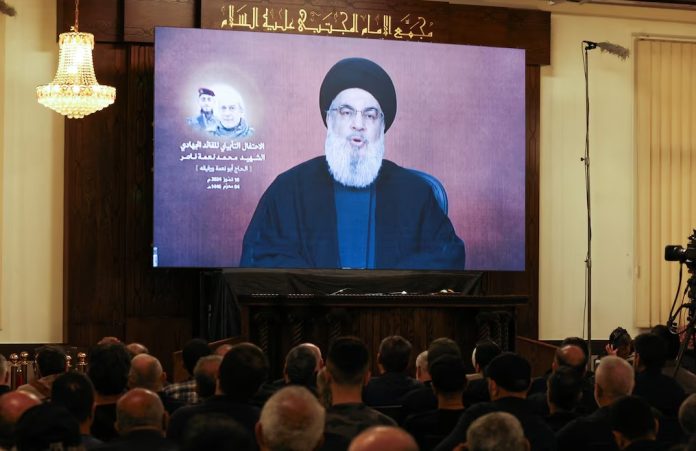
“The resistance knows no fear of war, as is evidenced by its responses to infiltration operations reaching up to 30 kilometers deep into the occupied territories, targeting sensitive objectives, while the enemy’s responses are limited,” Nasrallah stated during a memorial in Beirut for Mohammad Neameh Nasser, a fallen Hezbollah commander.

In light of threats by Israeli officials to launch a war on Lebanon, Nasrallah said, “We heard statements from [Israeli war minister Yoav] Gallant that if the war in Gaza stops, it is not necessary to stop in Lebanon. We tell him, if the enemy attacks the south, we will defend ourselves and not tolerate any aggression.”

Nasrallah highlighted engagement with Israeli forces, which has hindered the regime’s focus on Gaza.

The Hezbollah chief underlined the Lebanese had managed to disrupt the enemy’s concentration on the battle in Gaza, affirming that the northern occupied territories is linked to Gaza, and for calm in the north, “the war in Gaza must cease.”

He added sustained pressure exerted on Israel has compelled it to adopt measures such as prolonging the term of mandatory military service and integrating ultra-Orthodox Jews into the military, in turn, sparking internal societal challenges.

“If the enemy had achieved a quick victory in Gaza,” Nasrallah said, “Lebanon would have been the first to be threatened.”

However, he added, this did not happen due to the steadfastness of Palestinian resistance.

The Hezbollah leader underscored the Israeli regime’s failure to meet its goals in Gaza.

“The enemy’s war minister said tanks leaving Rafah can reach the Litani [river in southern Lebanon], but we see them destroyed in videos from Palestinian resistance.”

Benjamin Netanyahu’s persistence on the Rafah offensive is a clear indication of Israel’s inability to fulfill its aims, Nasrallah said.

Israel had claimed the Rafah operation would take “two weeks” but “it has now lasted two months and four days, possibly extending to four months”, Nasrallah said.

Israeli leaders are stalling a ceasefire to serve their personal agendas, he said, adding, “Today, Netanyahu, Itamar Ben Gvir, and Smotrich obstruct reaching an agreement for their own interests and to ensure their staying in power.”

Nasrallah also stated that Hezbollah’s operations against Israel would cease only with the end of Israel’s barbarous campaign in Gaza.

“If there is an agreement on a ceasefire in Gaza, our front is committed to ceasefire because we are a supporting front.”

“Hamas represents the axis of resistance in negotiations; what satisfies Hamas satisfies all of us because it coordinates with Palestinian factions.”

In his speech, Nasrallah also pointed to Iran’s presidential election, extending congratulations to President-elect Masoud Pezeshkian. He expressed gratitude to Pezeshkian for his response to the congratulatory message, wherein the Iranian president-elect reaffirmed his unwavering support for regional resistance efforts.

“Successive governments in Iran have increasingly supported resistance movements, and the response of the Iranian president to my message confirm this.”

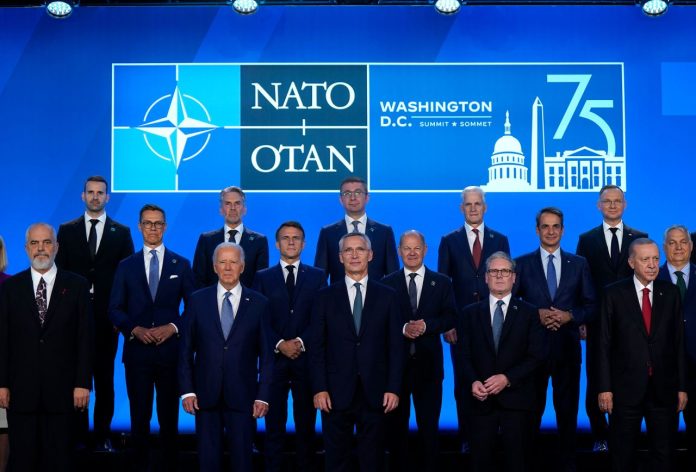
NATO promises Ukraine $43bn in aid for war with Russia, ‘irreversible path’ to membership

NATO

The pledges, included in a final communique following a NATO summit in Washington, DC, on Wednesday, came as the alliance’s members also announced individual and joint steps to boost Ukraine’s and Europe’s security.

This includes the United States, Netherlands and Denmark announcing that the first NATO-provided F-16 fighter jets would be in the hands of Ukrainian military pilots by this summer. The US also announced it will be deploying longer-range missiles in Germany in 2026, a major step aimed at countering what the allies say is Russia’s growing threat to Europe.

The move will send Germany the most potent US weapons to be based on the European continent since the Cold War. It would have been banned under the Intermediate-Range Nuclear Forces Treaty signed by the US and the Soviet Union in 1987, but that collapsed in 2019.

Ukrainian President Volodymyr Zelenskyy posted on social media platform X his appreciation of NATO’s effort to strengthen his air force, saying the new fighter jets “bring just and lasting peace closer, demonstrating that terror must fail”.

The alliance’s communique, declaring “Ukraine’s future is in NATO”, promised to continue to support Kyiv “on its irreversible path to full Euro-Atlantic integration, including NATO membership”. But the invitation would come “when Allies agree and conditions are met”, it added.

NATO Secretary-General Jens Stoltenberg stressed that Ukraine will not join the alliance’s ranks immediately, but insisted that must happen after the war is over to ensure that Russia never attacks Kyiv again.

Of the overall NATO assistance, he said, “We are not doing this because we want to prolong a war. We are doing it because we want to end a war as soon as possible.”

The US and some other countries have opposed membership for Ukraine during the conflict with Russia to avoid an escalation of tensions that could lead to a larger war. They also have stressed that Ukraine must take significant steps to address corruption as well as other systemic reforms.

The NATO communique also strengthened past language on China, calling it a “decisive enabler” of Russia’s war effort in Ukraine and stressing Beijing continues to pose systemic challenges to Euro-Atlantic security.

NATO members also hit out at relations between Beijing and Moscow in the declaration issued at the bloc’s 75th anniversary summit in Washington DC on Wednesday, claiming that China continues to “challenge our interests, security and values”.

“The deepening strategic partnership between Russia and the PRC and their mutually reinforcing attempts to undercut and reshape the rules-based international order, are a cause for profound concern,” added the document, which was signed by the heads of state and government of NATO members.

The US-led military bloc further accused China of shoring up the Russian defense industry by transferring dual-use materials and components, as well as engaging in “malicious cyber and hybrid activities”.

Responding to the allegations on Thursday, a spokesperson for the Chinese Mission to the EU described them as “provocative with obvious lies and smears”. Beijing has “lodged serious representations with” the bloc, the spokesperson added.

The mission reiterated that China “is not the creator to the Ukraine crisis” and insisted that Beijing is seeking to “promote peace talks and seek [a] political settlement”.

“[China] never provide[s] lethal weapons to either party of the conflict, and exercise[s] strict export control on dual-use goods,” the spokesperson said, adding NATO has been “fanning the flames” of the Ukraine conflict while scapegoating others.

Beijing also warned NATO from expanding into the Asia-Pacific and disrupting peace in the region, accusing a “certain power” of attempting to “maintain hegemony”.

“NATO should stop hyping up the so-called China threat and provoking confrontation and rivalry,” the mission’s statement concluded.

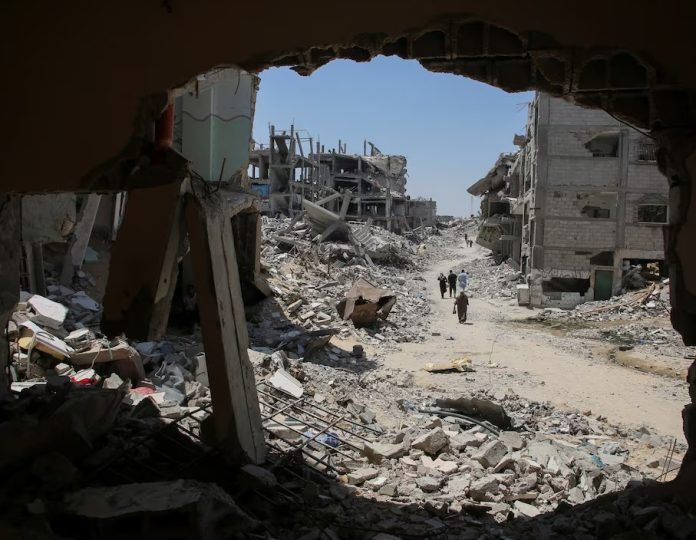
Israel’s army orders Palestinians to leave Gaza City

Gaza War

Leaflets dropped from the air on Wednesday urged “everyone in Gaza City” to leave and to take “safe routes” south towards Deir el-Balah and az-Zawayda.

Gaza’s Interior Ministry has called on residents in Gaza City to refrain from following Israeli evacuation orders, saying the instructions are a part of the Israeli army’s psychological warfare against Palestinians.

The United Nations noted the latest evacuations “will only fuel mass suffering for Palestinian families, many of whom have been displaced many times”.

“The civilians must be protected,” stressed UN Secretary-General Antonio Guterres’s spokesman, Stephane Dujarric.

At least 38,295 people have been killed and 88,241 wounded in Israel’s war on Gaza since October, according to Palestinian officials.

The stepped-up Israeli military activity comes as United States, Egyptian and Qatari mediators met with Israeli officials in Qatar’s capital, Doha, for talks seeking a long-elusive ceasefire deal and an exchange of captives held by Hamas for Palestinians held in Israeli prisons.

Hamas officials have raised concerns that heavy Israeli strikes in recent days along the length of the territory could derail the negotiations.

Ismail Haniyeh, the leader of Hamas, said on Monday that Israel’s escalating assault has threatened talks at a crucial time and could bring negotiations “back to square one”.

Hamas, however, still wants international mediators to guarantee that truce talks in Doha conclude with a permanent ceasefire. But Israeli Prime Minister Benjamin Netanyahu has insisted he will not agree to any deal forcing Israel to stop its campaign in Gaza without eliminating Hamas.

More than a dozen provinces in Iran shut down over power shortage

Iran power shortage

As the country is experiencing above-normal temperatures, the government announced on Wednesday that the provinces, mainly in the western, southern and central parts of the country were closed in order to reduce electricity consumption and bypass blackouts.

Electricity consumption in the country hit a record of over 77,000 megawatts and the upward trend is expected to continue as the country is bracing for a major heatwave in the western and southern provinces.

Iran’s Power Generation, Distribution, and Transmission Company, Tavanir, sent text messages nationwide on Wednesday asking citizens to keep their power consumption at a minimum.

Last year, power outages turned into a significant issue especially for industries, causing considerable disruption and drawing complaints from business owners.

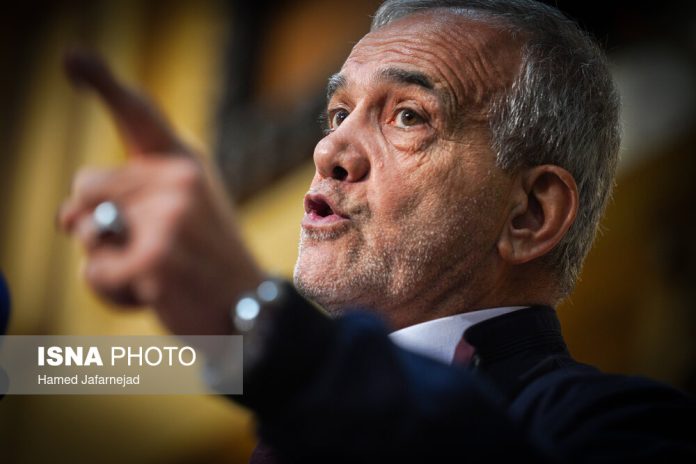
Pezeshkian to Haniyeh: Palestinians will certainly achieve victory against Israel

Masoud Pezeshkian

Pezeshkian made the remarks in a message that he addressed to Haniyeh on Wednesday as means of responding to the Palestinian resistance movement leader’s earlier congratulation of his victory in the Islamic Republic’s run-off presidential vote.

“I am certain that, under the aegis of the resisting people of Palestine and the oppressed and strong Gaza’s historic steadfastness, and the heroic diligence of the fighters of the Palestinian resistance in the ongoing war, triumph and divine victory will be awarded to dear Palestine,” he wrote.

The regime has been waging the war since October 7 following Al-Aqsa Storm, a retaliatory operation by Gaza’s resistance movements, during which hundreds were taken captive.

The war has so far claimed the lives of at least 38,200 Palestinians, most of them women, children, and adolescents.

Gaza’s resistance groups have pledged to defend the coastal sliver with all their resources, asserting that it would be impossible to eliminate the resistance from the Palestinian territory’s rule.

Pezeshkian also pledged “all-out support” on the part of the Islamic Republic for the oppressed Palestinian nation “until realization of all of its ideals and rights as well as liberation of the noble al-Quds” from Israeli occupation.

The support, he noted, was in line with the “lofty goals” of the country’s Islamic Revolution and within the framework of the late founder of the Islamic Republic, Imam Khomeini’s ideals and Leader of the Islamic Revolution Ayatollah Seyyed Ali Khamenei’s directives.

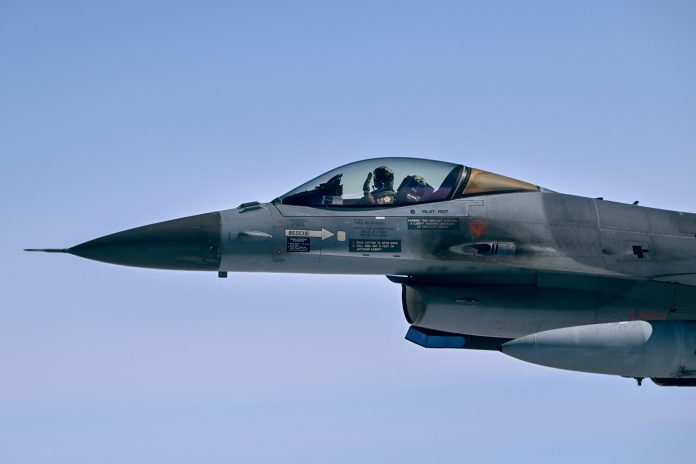
US says F-16s will fly in Ukraine this summer

F-16 jet fighter

Blinken, speaking at the NATO public forum, said the advanced fighter jets are expected to be defending Ukraine’s sky’s “this summer”.

Blinken did not identify the number of F-16s being sent to Ukraine from the Netherlands and Denmark. A joint statement from Washington, the Hague and Copenhagen said other details are being withheld for “operational security”.

The delivery of F-16s comes on top of President Joe Biden’s announcement that NATO allies are providing five more air defense systems to Ukraine, as the country continues to face devastating Russian missile strikes.

“Those jets will be flying in the skies of Ukraine this summer, to make sure that Ukraine can continue to effectively defend itself against the Russian aggression,” Blinken announced in a statement.

President Biden first announced in June 2023 that NATO-partners would pledge to provide F-16s to Ukraine. In May, the first Ukrainian pilots graduated from a U.S.-training program.

Ukrainian President Volodymyr Zelensky welcomed the announcement as bolstering Ukraine’s air defense. The urgent need for such help was underscored by a Russian missile attack on Sunday that hit a children’s hospital in Kyiv — with an estimated 300 reported injured, including four children, and two deaths, including a young doctor.

In remarks at the Reagan Foundation on Tuesday night, Zelensky stressed Ukraine needs 128 F-16s to defend against Russia’s aerial attacks.

“We need 128, this is the fleet, all these numbers our partners have,” Zelensky added.

“So till moment when we will have 128 with them in the sky — anyway it will be difficult.”

US Gaza aid pier to be permanently dismantled after operating for less than 3 weeks: Report

US Gaza aid pier

The Associated Press (AP) reported that the pier, which has had to be moved repeatedly to avoid bad weather, would be reconnected to the Gaza coastline on Wednesday but would operate for just the next few days before being disassembled by the US army and navy.

The AP quoted unnamed officials as saying that the pier would be put back in place only long enough to move humanitarian supplies which have accumulated in Cyprus and on a floating dock offshore since the pier went out of action on 28 June as a result of weather conditions.

The chief Pentagon spokesperson, Maj Gen Pat Ryder, said on Tuesday that the pier was currently at the Israeli port of Ashdod, the haven used during bad weather, but added: “My understanding is that CENTCOM [US Central Command] intends to tentatively re-anchor the pier this week.”

Ryder did not comment on the longer term prospects for the pier. Aid workers familiar with the project had been predicting for weeks that the pier would not survive beyond July.

The pier scheme, first unveiled by Joe Biden in his State of the Union address in March, was always intended to be a temporary measure to complement the meagre amount of aid being allowed across land crossings by Israel, but US officials told Reuters in June it would last until August or September.

The eastern Mediterranean off the Gaza coast had been choppier in the summer months than had been expected with stormy weather making it necessary to move the pier in and out of position repeatedly.

Since it was first manoeuvred into position on 17 May, the pier has been operational for fewer than 20 days, and for most of those days, aid deliveries were simply unloaded on the beach without being distributed around Gaza because of security concerns.

The World Food Programme (WFP) suspended distribution convoys on 9 June, after the Israel Defense Forces (IDF) conducted a hostage rescue operation that saved four Israeli hostages but killed 274 Palestinians. Apart from a day’s operations to clear the backlog of humanitarian assistance on the beach, the WFP has continued to suspend its convoys pending a full security review.

Over its two months in operation, about 8,800 metric tons of aid has been unloaded off the pier, about 500 truckloads, equivalent to a single day of deliveries before the war began.

Critics of the scheme warned that the spectacular $230m project would divert attention from the international effort to pressure Israel to open the land crossings into Gaza, the most efficient means of delivering assistance to the 2.3 million Palestinians trapped in Gaza, more than a quarter of whom are in imminent danger of famine.

Land deliveries have dwindled dramatically since Israel launched an offensive on the southern border city of Rafah in May. According to UN figures, the number of trucks entering Gaza through two remaining open crossings, Keren Shalom and Erez West, fell from 840 in May, to 756 in June to only 18 so far in July.

The US Agency for International Development (USAID) referred questions about the pier’s future to the defence department but a spokesperson stated: “What we continue to focus on is getting urgently needed aid to people in need across Gaza through all available mechanisms.”

“Ashdod port is open for humanitarian deliveries and we expect humanitarians will increasingly use this route,” the spokesperson continued.

“Erez West and Kerem Shalom are also open, though insecurity and kinetic operations are constraining onward distributions within Gaza. The United States is actively involved in discussions with Israel, the UN, and other humanitarian organizations to determine ways to overcome these constraints and allow assistance to reach people in desperate need.”

Netanyahu contemplating layover in Europe amid fears of arrest warrant over Gaza war

Benjamin Netanyahu

Kan News reported on Wednesday that the prime minister’s plane, dubbed the “Wing of Zion”, may be unable to fly directly to the US due to a lack of preparedness.

Netanyahu’s office has been evaluating the feasibility of such a layover in Europe, given that the ICC is seeking arrest warrants for Netanyahu and Defence Minister Yoav Gallant.

Gallant and Netanyahu face charges of war crimes and crimes against humanity, including the starvation of civilians in Gaza as a method of war, wilfully causing great suffering, wilful killing, intentional attacks on a civilian population and extermination, among other charges.

No warrants have been issued yet. The ICC prosecution has submitted an application, which is currently under consideration by ICC judges in the pre-trial chamber.

The prosecutor also seeks the arrest of Hamas leader in Gaza Yahya Sinwar, its military wing’s commander-in-chief Mohammed Diab Ibrahim al-Masri, better known as Mohammed Deif, and its political leader Ismail Haniyeh.

The ICC has jurisdiction over nationals of its 124 member states and crimes committed within their territories. It also has jurisdiction over cases referred to by a UN Security Council resolution.

Israel is not a member of the ICC. However, the state of Palestine was granted membership in 2015. The court can, therefore, investigate Israeli individuals for crimes committed in occupied Palestine, including Gaza, the West Bank and East Jerusalem.

Although the US is not a member of the court, the UK, France and several of Israel’s western allies are ICC members.

Should the pre-trial chamber approve the arrest warrant, ICC member states, as signatories of the Rome Statute, would be obliged to arrest the indicted individuals.

“Member states have a legal obligation to cooperate fully with the court, which includes arresting those subject to an arrest warrant,” Eitan Diamond of the Diakonia International Humanitarian Law Centre in Jerusalem told MEE in May.

“Israel and the Israeli officials concerned would not want to take the risk that states would discharge their obligation.”

As the arrest warrant has not yet been approved, the legality of Netanyahu’s travel to and from member states remains unclear.

Historically, the ICC pre-trial judges have approved the prosecutor’s applications in nearly all previous cases of arrest warrants.

Travel restrictions are a reality that Russian President Vladimir Putin has faced since he and another senior official were indicted by the ICC in March last year for their roles in Moscow’s war on Ukraine.

In December, Brazilian President Luiz Inacio Lula da Silva suggested that Putin could face arrest if he attended the G20 summit in Rio later this year.

Member states have previously flouted that obligation: South Africa and Jordan failed to arrest indicted former Sudanese President Omar Hassan al-Bashir during visits to their respective countries, drawing criticism from human rights groups and the ICC itself.

The Guardian reported on Monday that the new Labour government is expected to drop a UK attempt to delay the ICC’s decision on Netanyahu’s arrest warrant.