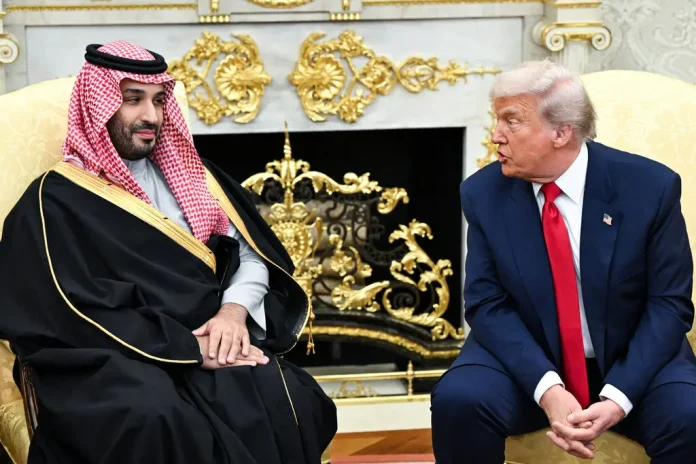
The White House rolled the literal red carpet out for Prince Mohammed, known as MBS, on Tuesday. Trump greeted him with a ceremony that featured marching bands, flag-carrying horsemen and a military flyover.
The opulent display of hospitality signalled Trump’s embrace of what he sees as a new Middle East driven by financial investments and US partnerships with allies in the region, chiefly Saudi Arabia.
After Prince Mohammed’s arrival through the South Portico, he and Trump took questions from journalists in the Oval Office. The two leaders spoke of business opportunities, peace, artificial intelligence and the tech business.
The Trump-MBS meeting also led to major announcements, including in the already strong defence relationship between the US and Saudi Arabia.
Here are the key takeaways from the meeting:
‘Good talks’ on Saudi Arabia-Israel ties
In recent months, Trump has repeatedly said he would like Saudi Arabia to join the so-called Abraham Accords, which established formal relations between Israel and several Arab countries.
On Tuesday, Prince Mohammed and Trump signalled possible progress on the issue without providing details or a timeline for a potential deal. The crown prince, however, did reiterate that Riyadh wants to advance the establishment of a Palestinian state as part of a potential agreement.
“We believe having a good relation with all Middle Eastern countries is a good thing, and we want to be part of the Abraham Accords,” Prince Mohammed told reporters.
“But we want also to be sure that we secure a clear path [to a] two-state solution. And today we have a healthy discussion with Mr President that we’ve got to work on that, to be sure that we can prepare the right situation as soon as possible to have that.”
Saudi officials have previously stressed that Riyadh is committed to the Arab Peace Initiative, which conditions the recognition of Israel on the establishment of a Palestinian state.
Trump stated that he had “good talks” with Prince Mohammed about the issue.
“We talked about one state, two states. We talked about a lot of things. In a short period of time, we’ll be discussing it further too,” the US president added.
Major non-NATO ally status for Saudi Arabia and a defence deal
At a black-tie dinner he hosted at the White House for the Saudi leader, Trump announced the US has decided to recognise Riyadh as a “major non-NATO ally”.
That status allows a country expedited access to US military hardware, sales and other cooperation without some of the elaborate licensing protocols that other buyers of advanced American weapons systems need to go through.
Saudi Arabia joins 19 other countries that are major non-NATO allies of the US: Argentina, Australia, Bahrain, Brazil, Colombia, Egypt, Israel, Japan, Jordan, Kenya, Kuwait, Morocco, New Zealand, Pakistan, the Philippines, Qatar, South Korea, Thailand and Tunisia. The US also treats Taiwan at par with major non-NATO allies.
Separately, the White House announced that Trump and MBS signed a strategic defence agreement “that strengthens our more than 80-year defense partnership and fortifies deterrence across the Middle East”. Details of the agreement are unclear, but the White House said it would secure “new burden-sharing funds from Saudi Arabia to defray US costs” and would affirm that the “Kingdom views the United States as its primary strategic partner”.
The agreement comes weeks after Saudi Arabia signed a mutual defence agreement with Pakistan following Israel’s September attack on Qatar, which had sparked concerns across the region over whether the US could be trusted by its Gulf allies as a security partner.
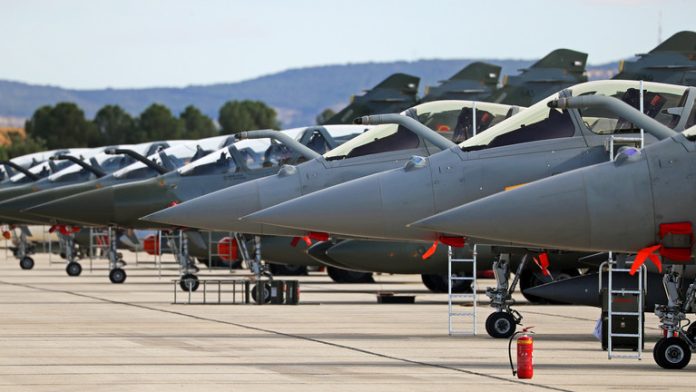
On Monday, Trump confirmed that he will authorise the sale of F-35 fighter jets to Saudi Arabia.
During the meeting with MBS, he stated the jets would not be downgraded to ensure Israel’s military superiority in the region, a departure from a US policy known as “qualitative military edge”.
“They’d like you to get planes of reduced calibre. I don’t think that makes you too happy,” he told the Saudi crown prince.
“They’ve been a great ally. Israel has been a great ally, and we’re looking at that exactly right now. But as far as I’m concerned, I think they are both at a level where they should get top of the line.”
Trump says Iran wants deal
Trump once again expressed pride in the US strikes against Iran’s nuclear facilities in June.
“We did that on behalf of everybody, and the outcome was extraordinary because we have the best pilots, the best equipment, the best planes, the best everything,” he said.
The US president later shifted to a softer tone on Iran, claiming Tehran is seeking a diplomatic resolution with Washington, which has sought the dismantlement of its nuclear programme.
“I am totally open to it, and we’re talking to them,” Trump added.
“And we start a process. But it would be a nice thing to have a deal with Iran. And we could have done it before the war, but that didn’t work out. And something will happen there, I think.”
Saudi Arabia’s official news agency, SPA, had reported that MBS had received a handwritten letter addressed to him from Iranian President Masoud Pezeshkian before his trip to Washington. No details were available about its content.
On Tuesday, Prince Mohammed said Saudi Arabia would back a US-Iran deal.
“We will do our best to help to reach a deal between the United States of America and Iran,” he told reporters.
“And we believe it’s good for Iran’s future to have a good deal that would satisfy the region and the world and the United States of America,” he added.
$1 trillion in investments?
At the outset of the two leaders’ public remarks, Trump expressed gratitude for anticipated Saudi investments in the US, which he said will be in the hundreds of billions of dollars.
“I want to thank you because you’ve agreed to invest $600bn into the United States. And because he’s my friend, he might make it $1 trillion, but I’m going to have to work on him,” Trump said.
He added that the Saudi funds will create jobs and resources for US companies and Wall Street investment firms.
For his part, MBS said the Saudi investments in the US will likely rise to $1 trillion.
“The agreement that we are signing today in many areas – in technology and AI, in rare materials, magnet, etc – that will create a lot of investment opportunities,” he added.
The crown prince echoed Trump’s assessment that the US is now the “hottest country” in the world, adding that the kingdom wants to be part of the “foundation of emerging technologies” in the US.
Praise and smiles
Trump and MBS were all smiles as they exchanged flattering comments from the moment the crown prince arrived at the White House.
At one point, Trump reached for Prince Mohammed’s hand and held it as he criticised former US President Joe Biden for giving MBS only a fist bump when he visited Riyadh during the COVID-19 pandemic in 2021.
“I grabbed that hand. I don’t give a hell where that hand’s been,” Trump said.
The US president described the Saudi crown prince as “fantastic” and “brilliant”.
“We have an extremely respected man in the Oval Office today, and a friend of mine for a long time – very good friend of mine,” Trump added.
“I’m very proud of the job he’s done. What he’s done is incredible in terms of human rights and everything else.”
The US president went on to rebuke an ABC News reporter for asking a challenging question of Prince Mohammed, accusing her of disrespecting his guest.
When the same journalist later asked Trump why he would not voluntarily release government files related to sex offender Jeffrey Epstein, Trump said ABC News’s broadcasting licence should be revoked.
“You’re a terrible person and a terrible reporter,” he added.