Thursday, December 25, 2025
Home Blog Page 642

Saudi Arabia scales back Neom plans to focus on sports

Saudi Arabia Neom

The $500bn new Saudi project – which organisers claim will be 33 times the size of New York City – was planned to include a 170km-long city built in a straight line (known as The Line), an eight-sided city that floats on water, and a ski resort with a folded vertical village, amongst other grandiose schemes.

However, rising costs and fast-approaching deadlines have forced Saudi authorities to rein in some of the plans, according to three sources cited by Reuters.

“When the [Neom] project was first pitched as an idea, costs were $500bn. However, The Line alone was going to cost over a trillion which was why it’s been scaled back,” a consultant with knowledge of the matter said.

One of the sources added that work on The Line was now solely focused on the completion of 2.4km stretch that would include a stadium expected to host the final of the 2034 World Cup.

The kingdom is the only country bidding for FIFA’s 2034 football tournament, and is expected to be confirmed as hosts during a vote next month.

Saudi Arabia announced in August that Neom Stadium – one of 15 stadiums to be used during the 2034 competion – would be built within The Line and would stand 350 metres above the ground.

“The Line changed its plans [in] September and October to integrate the stadium which brought utility to the project because it will be used for the World Cup,” one of the sources told Reuters.

The same source stated that Neom had been “scaled down and broken into chunks”, adding that the planned mountain resort Trojena was a priority, as it is set to host the 2029 Asian Winter Games.

It comes days after the unexpected departure of Nadhmi al-Nasr as the chief executive of Neom.

Two sources familiar with the matter told Reuters the departure was partly due to an inability to deliver key goals.

Nasr had earned a chilling reputation managing Neom. He reportedly bragged that he drove everyone “like a slave”, adding: “When they drop down dead, I celebrate. That’s how I do my projects.”

A documentary released last month, Kingdom Uncovered: Inside Saudi Arabia, found that labourers working on The Line were being forced to work gruelling hours far beyond legal limits.

According to an undercover reporter, workers were regularly working longer than the 60 hours maximum, including overtime, prescribed each week under Saudi law.

Many labourers were also forced to take an unpaid, three-hour bus commute to get to the desert site and back on top of their long shift, which left them with around four hours to sleep.

The Neom megacity is a centrepiece of Saudi Crown Prince Mohammed bin Salman’s Vision 2030 strategy to move the Gulf kingdom away from oil reliance and enhance its reputation on the global stage.

In May, Middle East Eye reported that Saudi security officers were ordered to use lethal force to kill people who resisted eviction from areas earmarked for the city, according to a former Saudi intelligence officer.

The Saudi government has been accused of forcibly displacing members of the Howeitat tribe, who have lived for centuries in the region of Tabuk, to make way for Neom.

At least 47 members of the tribe have been arrested or detained for resisting eviction, including five who have been sentenced to death, according to a report by the UK-based Alqst rights group.
Britain threatened with court-ordered ban on weapons exports to Israel

Israel Fighter Jet

The case, brought by the UK-based Global Legal Action Network (Glan) and human rights group Al-Haq against the business secretary, is scheduled to resume in the High Court on Monday.

When the challenge was launched last December, the groups argued that the UK should ban all arms exports due to a clear risk that Israel might use British-made weapons to violate international humanitarian law in the Gaza Strip.

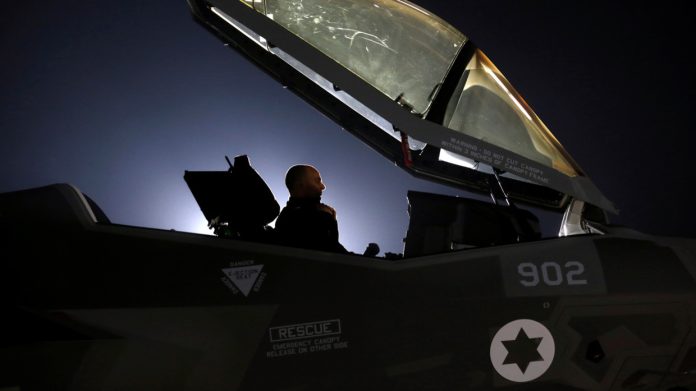
This September, after the newly elected Labour government suspended 30 arms export licences to Israel after a review showed a clear risk they could be used in such violations, the focus of the case shifted to UK-manufactured F-35 components, which can still be exported through third countries, with Israel as the final destination.

Arms control experts and researchers say Israel has relied on F-35s for a high volume of air strikes in Gaza and, more recently, in Lebanon over the past 13 months. UK-made parts make up 15 percent of the jets.

The government announced it cannot suspend components exported through third countries without undermining the global F-35 programme, saying that tracking parts across the programme’s complex, 20-plus country supply chain is difficult.

Foreign Secretary David Lammy has defended the decision, recently telling MPs that restricting the programme could have serious unintended consequences globally.

“I am not prepared to ground planes that are saving lives in other theatres, which is why we made this decision, and I stand by it. It was the right decision,” he stated on 29 October.

Glan and Al-Haq argue that the government has not properly reviewed its decision to exempt the parts from indirect export, nor developed red lines about what, if anything, would compell it to suspend them.

Had a thorough review been conducted, the groups say it would have determined that suspending all exports, directly or indirectly, was the only lawful option.

Such an assessment, they argue, is particularly critical given recent developments in northern Gaza, where 15 leaders of UN and humanitarian agencies warned on 1 November that the entire population “is at imminent risk of dying from disease, famine and violence”.

Earlier this week, lawyers for the groups gave the government until 4pm on Friday to reverse course on its F-35 “carve-out”.

If it does not comply, they say will seek a mandatory order from a judge which, if granted, would enforce a full suspension of UK arms exports to Israel as an investigation was carried out.

Charlotte Andrews-Briscoe, a lawyer with Glan, told Middle East Eye on Friday that they had imposed the deadline “due the the extreme urgency of the situation”.

She noted the General’s Plan, an Israeli strategy to ethnically cleanse northern Gaza which soldiers have been reported as saying is being carried out, and Israeli air strikes earlier this week that killed at least 40 people.

“British-made F-35s are playing a crucial role in that extermination campaign so that’s why the short deadline,” Andrews-Briscoe added.

The Department for Business and Trade declined to comment on the deadline on Friday, citing the ongoing legal case.

A Foreign Office spokesperson stated: “We have suspended relevant export licences to Israel for use in military operations in the Gaza conflict, following a review which concluded there is a clear risk that UK export items might be used to commit or facilitate serious violations of international humanitarian law.”

“We would not comment on ongoing or potential future legal proceedings.”

Amnesty and Human Rights Watch (HRW), which have intervened in the case and provided evidence to the government and the High Court of Israel’s lack of commitment to comply with their obligations under international humanitarian law, said on Friday that the government was long overdue to ban all arms exports to Israel.

“The Government is in court defending the indefensible,” Yasmine Ahmed, HRW’s UK director, said, adding, “International law is not discretionary and failing to adhere to it consistently not only risks the lives of innocent civilians, but weakens the entire system, not just in the Middle East but in Ukraine, Sudan and every other conflict.”

Sacha Deshmukh, Amnesty International UK’s chief executive, said: “It should never have required a legal challenge to the Government over its arms to Israel policy, but if ministers won’t uphold international law of their own accord then there was little choice.

“Evidence of Israeli war crimes and other violations in Gaza and the West Bank is overwhelming. All UK arms transfers to Israel need to be halted immediately – with no exemptions and no loopholes,” Deshmukh added.

Monday’s hearing at the Royal Courts of Justice in London is scheduled to begin at 10:30 am.

EU’s top diplomat proposes suspension of ‘political dialogue with Israel’, citing Gaza, Lebanon wars

European Parliament

In a blog post, Borrell highlighted that in other cases of violations of international law, the EU had imposed numerous sanctions, but that “until now Israel has been spared from any meaningful consequences”.

“This has to change. This is why I have proposed an import ban on illegal settlement products, based on the recent advisory opinion of the International Court of Justice, similar to the existing import ban on products from occupied Ukrainian territories – because even-handedness is the lynchpin of Europe’s credibility,” he stressed.

The Foreign Affairs Council will discusses the proposed measures next week.

Israel launched the war on Gaza on October 7, 2023, after the Palestinian resistance movement Hamas waged the surprise Operation Al-Aqsa Storm against the occupying entity in response to the Israeli regime’s decades-long campaign of bloodletting and devastation against Palestinians.

The regime’s bloody onslaught on Gaza has so far killed more than 43,730 Palestinians, mostly women and children, and injured over 103,000 others. Thousands more are also missing and presumed dead under rubble.

Israel launched a massive air campaign in late September in Lebanon against what it claims are Hezbollah targets in an escalation in a year of cross-border warfare between Israel and the group since the start of Israel’s brutal assault on Gaza.

More than 3,300 people have been killed and over 14,500 injured in Israeli aggression since last October, according to Lebanese health authorities.

Israel expanded the conflict by launching an incursion into southern Lebanon in early October.

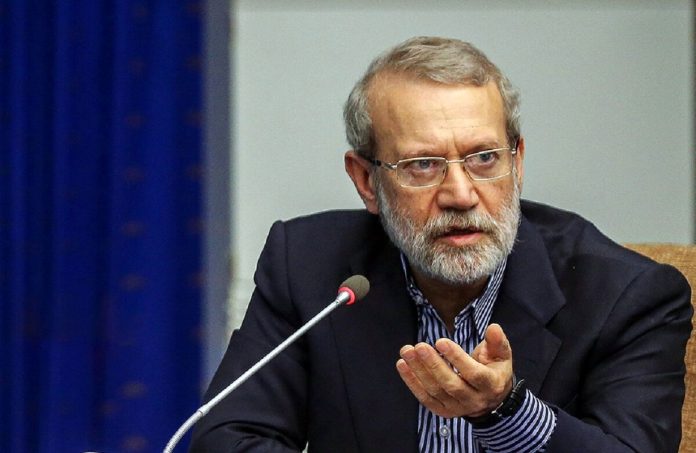
Leader advisor dismisses claims Iran has abandoned resistance as a “joke” 

Upon arriving at the Rafik Hariri International Airport in Beirut, Larijani told journalists that he had brought a message from Ayatollah Khamenei to Lebanese Parliament Speaker Nabih Berri.

Asked by a reporter if he was visiting Lebanon to scuttle an initiative purportedly put forth by the US to end the Israeli war on Lebanon, Larijani said, “We are not seeking to scuttle anything. Rather, we intend to resolve the problems”.

Larijani further reaffirmed Iran’s support for the Lebanese people.

He also urged the Lebanese to distinguish a friend from a foe.

Another reporter asked Larijani if Iran has abandoned the axis of resistance.

He flatly dismissed the claim, saying, “I think you take jokes too seriously”.

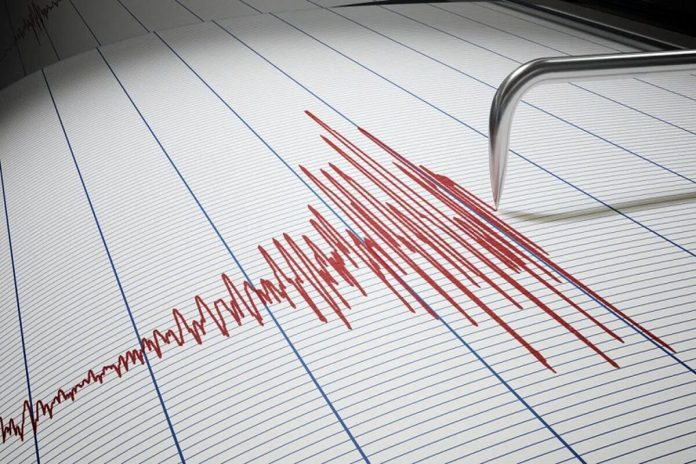
Iran’s northeastern city of Kashmar jolted by  earthquake, third in 24 hours 

According to Kashmar’s Governor Hojjatollah Shariatmadari, the first quake on Friday struck at 5:13 a.m. with a magnitude of 3.1 and a depth of 10 kilometers and the second, more powerful earthquake, measured 4.0 in magnitude and struck at 9:01 a.m. at a depth of 9 kilometers. Another earthquake of 4.3 magnitude shook the city on Thursday.

Shariatmadari reported that all emergency response teams are on full alert.

Assessors have been dispatched to check the potential damage, although no casualties have been reported so far.

Shariatmadari urged residents to exercise caution during earthquakes, advising them to protect themselves and their families and avoid standing in hazardous areas.

The tremors were also felt in surrounding areas, and residents of unsafe and damaged homes were advised to take extra precautions due to potential aftershocks from Thursday’s earthquake that left 11 injured.

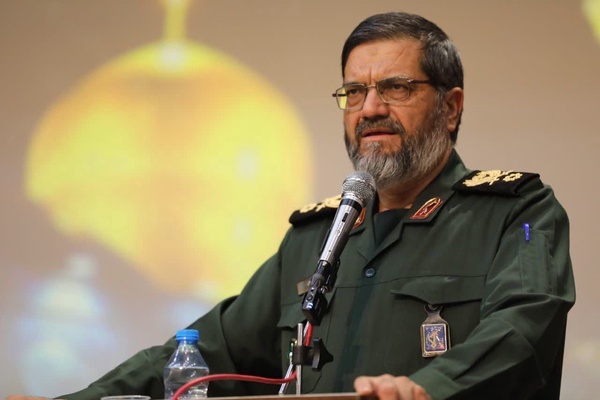
Spokesman: Around two dozen Terrorists killed, scores arrested in southeastern Iran

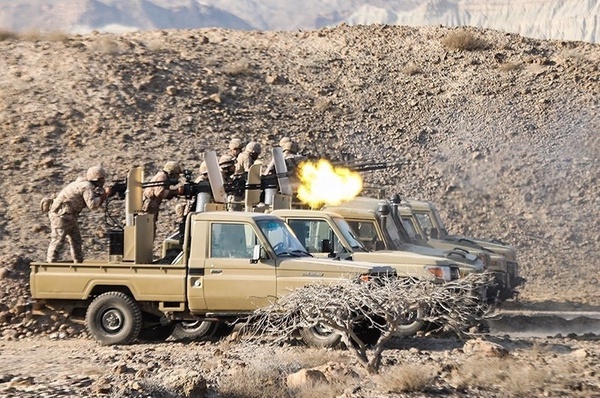
Major General Ahmad Shafaei, the spokesperson for the military exercises, said on Friday that due to the sacrifices made by the IRGC’s Ground Force Quds Base in the province, scores of Zionist-affiliated terrorists were killed and apprehended, while seven others surrendered in Sistan and Baluchestan.

The spokesman added that the weapons seized from the terrorists are among the most advanced models in the world, proving their affiliation with the intelligence service of the Zionist regime.

He also highlighted that many of those arrested are non-Iranian mercenaries hired by foreign intelligence services.

In addition to the local IRGC Quds Base, the provincial Intelligence Department and popular forces are involved in the anti-terror operation in southeastern Iran.

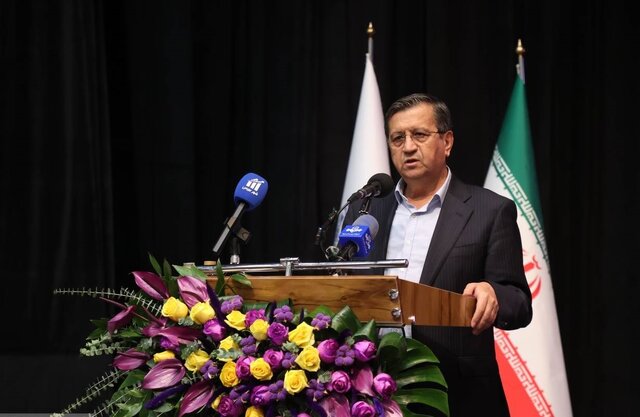
Economy minister: Remaining on FATF blacklist unjustly labels Iran as money launderer 

Speaking at the National Non-Oil Export Development Conference in the northwestern Iranian city of Tabriz on Thursday, Abdolnasser Hemmati emphasized that while Iran is actively combating money laundering and implementing regulations, it is unjust to face such accusations due to the blacklist status.

He warned that remaining on the blacklist legitimizes U.S. sanctions and creates global restrictions for Iranians.

Hemmati asserted that even countries like Russia and China avoid FATF blacklisting, emphasizing the need for Iran to navigate the complex international financial waters to safeguard its economic interests.

Meanwhile, the minister highlighted the Iranian government’s priority to facilitate exports, noting that despite severe sanctions, there are significant governance and economic management issues that need to be addressed.

Hemmati called for a predictable economy and reduced export regulations to improve the country’s export future.

He pointed out that Iran’s export volume, including oil, does not exceed $80-90 billion, whereas the top ten Asian countries average around $500 billion.

Discussing financial challenges, Hemmati mentioned the budget deficit, banking imbalances, and issues with pension funds, water, and energy as key obstacles impacting exports.

Iranian MP slams internet filtering, slow managerial changes 

Social Media

In an interview with Eslahat News outlet, Fazlollah Ranjbar commented on the 100-day performance of the administration, noting that critical issues like the slow pace of managerial changes and appointments, economic stability, and improving people’s livelihoods should be addressed.

The lawmaker said despite the government’s diligent efforts, many managerial positions in various provinces and levels remain unfilled, potentially leading to decreased employee motivation and dissatisfaction within ministries.

Ranjbar highlighted the government’s positive actions, such as the timely submission of the budget bill to parliament.

He said the parliament is also focused on these issues, recently discussing the government’s economic team and enhancing coordination among its members.

Regarding the internet filtering issue, Ranjbar stressed the need for transparency and honesty from the government.

He warned that inconsistent behavior and negative social effects could erode public trust if officials use restricted resources themselves.

Ranjbar also touched on the administration’s foreign policy, noting it has been successful in reducing tensions and strengthening relations with neighboring countries, which could benefit Iran in the long term.

Four terrorists killed, six arrested in Iran’s Sistan and Baluchestan

Major General Ahmad Shafaei said that following a public report regarding the presence of some terrorist elements in Rask, a group of anti-terror forces was dispatched to the area, and a shootout ensued, leading to the killing of four terrorists, including three foreign nationals.

General Shafaei added that six more terrorists were arrested, while three Iranian forces with the IRGC’s local Quds Base were martyred.

The military exercise is being conducted by the Islamic Revolution Guard Corps (IRGC) Ground Force, the General Intelligence Department of Sistan and Baluchestan, as well as popular forces.

The military spokesman added that following the shootout in Rask, the area was cleared of terrorists.General Shafaei earlier reassured that the military operation will continue in the region until the elimination of all terrorists, who are mainly non-Iranian mercenaries backed by the Israeli regime.

Iran president says Tehran ready to cooperate with IAEA to remove misunderstandings 

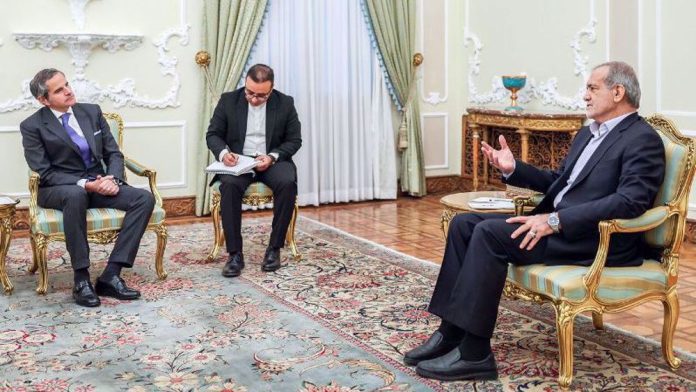
In a meeting with director of the International Atomic Energy Agency (IAEA) Rafael Grossi in Tehran on Thursday, President Pezeshkian stressed that Iran’s nuclear efforts are fully in line with the frameworks and legal authorizations of the IAEA.

“As we have repeatedly demonstrated our goodwill in the past, we express our readiness to cooperate and align with this international body to resolve any ambiguities and allegations concerning the peaceful nature of our nuclear activities,” he added.

His comments came just a day after European powers were reported to be pushing for a new anti-Iran resolution at the IAEA’s Board of Governors meeting next week.

The Iranian president highlighted a religious decree (fatwa) by the Supreme Leader of the Islamic Revolution, prohibiting the building of nuclear weapons.

“According to the clear fatwa of the Supreme Leader of the Islamic Revolution Ayatollah Seyyed Ali Khamenei, we have never sought and will never seek to build nuclear weapons, and no one will be allowed to deviate from his policy,” he said.

Pezeshkian also said Iran does not seek war, but will strongly respond to any aggression.

“We believe that war is neither in our interest, nor in the interest of the region, nor in the interest of the world. No sane person seeks to start a war and develop it, but we will definitely react decisively against any action against our security.”

Grossi, for his part, praised Pezeshkian’s peace-oriented and consensus-driven approach during this meeting, expressing gratitude for the diligent cooperation of the officials of the Atomic Energy Organization of Iran and the Ministry of Foreign Affairs with the IAEA.

The UN nuclear agency’s chief then provided an overview of the positive relations and interactions between Iran and the agency.

“We deeply believe that your presidency will mark a new chapter in the positive and good relations between Iran and the IAEA,” Grossi told Pezeshkian.

“Certainly, good interaction and cooperation between Iran and the agency will neutralize any schemes against Iran’s nuclear activities,” Grossi stressed.