Wednesday, December 31, 2025
Home Blog Page 585

Israel launches air strikes on several regions in Yemen

“Following the approval of attack plans by Defence Minister Israel Katz, Air Force fighter jets, under the direction of the Intelligence and Navy branches, recently attacked military targets of the Houthi terrorist regime in the western coastal strip and deep inside Yemen,” the Israeli military said in a statement on Thursday morning.

“The targets attacked are used by the Houthi forces for their military operations,” the military added.

Al Masirah TV, the main news outlet run by Yemen’s Houthi movement controlling much of the country, said seven people were killed in an Israeli attack on the port of as-Salif and the rest in two strikes on the Ras Isa oil facility; both are located in the western province of Hodeidah.

“The enemy launched four aggressive raids targeting the port … and two raids targeting” an oil facility, Al Masirah reported.

The series of “aggressive raids” also targeted two central power stations south and north of the capital, Sanaa, it added.

Yemen’s SABA news agency also reported that four raids targeted Hodeidah, with two hitting the Ras Isa oil facility, killing and injuring some of its employees.

Israel’s military spokesman Daniel Hagari stated Israeli forces had carried out strikes on Houthi military sites, including ports and energy infrastructure in Yemen’s capital Sanaa, following the firing of a Houthi missile towards Israel overnight – which was destroyed – and repeated attacks over the past 14 months.

Houthi fighters in Yemen have carried out months of attacks on Israel, and shipping linked to the regime in the Red Sea and Gulf of Aden, in what it says is a campaign of solidarity with Palestinians amid Israel’s war on the Gaza Strip, which has killed more than 45,000 people – the majority being women and children.

First flight since Assad’s overthrow takes off from Damascus Airport

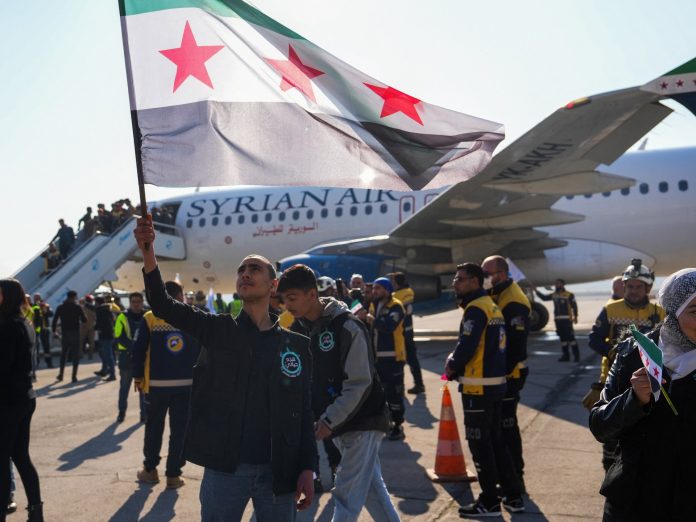
The first commercial flight in Syria since the toppling of al-Assad earlier this month has taken off from Damascus airport.

The flight landed in Aleppo, in the country’s north, on Wednesday with 43 people on board including a group of journalists.

Pro-Assad forces abandoned the airport in the capital on December 8 as opposition fighters closed in on the city following a lightning offensive that began on November 27. Since then, no flights had taken off or landed due to security reasons.

Earlier this week, airport staff painted the pro-opposition three-star flag on aeroplanes, a symbol of the 2011 uprising now adopted by the transitional authorities. Inside the terminal, the new flag has also replaced the one associated with the government of al-Assad, who fled to Russia.

An airport official told the AFP news agency on condition of anonymity that international flights would resume on December 24, following maintenance work.

Meanwhile, neighbouring Jordan has reopened the Jaber border crossing with for trade, resuming the flow of goods and freight traffic between the two countries.

More than 13 years after a brutal crackdown on anti-government protests morphed into a multisided war that killed hundreds of thousands and displaced millions, Syria is struggling to get back on its feet as it comes to terms with the scars of torture, disappearances and summary executions.

The group at the helm of Syria’s new ruling coalition, Hayat Tahrir al-Sham (HTS), has sought to keep its institutions going and kickstart its economy. Once rooted in Syria’s branch of al-Qaeda and designated a “terrorist” organisation by several Western governments, HTS has softened its rhetoric and pledged to protect the nation’s diverse religious and ethnic communities.

While the new caretaker administration in Damascus has set out few details on its thinking for the next steps for the country, newly appointed Prime Minister Mohammed al-Bashir, who formerly led an HTS-affiliated government in Idlib province, has said he will remain in office until March.

On Wednesday, a day after meeting HTS leader Ahmed al-Sharaa in Damascus, United Nations Special Envoy Geir Pedersen called for “free and fair elections” in Syria after the transition and urgent humanitarian assistance for the country.

Pedersen, who on Tuesday warned that the war has not yet ended, told reporters in Damascus that “there is a lot of hope that we can now see the beginning of a new Syria”.

He also expressed hope for a “political solution” in the Kurdish-held northeast, where the US-backed, Kurdish-led Syrian Democratic Forces (SDF) are battling Turkish-backed groups who have captured several Kurdish towns since the offensive began in the rest of the country last month.

Speaking to AFP, HTS military chief Murhaf Abu Qasra said Kurdish-held areas would be integrated under the country’s new leadership, adding that the group rejects federalism and that “Syria will not be divided”.

“The Kurdish people are one of the components of the Syrian people … Syria will not be divided and there will be no federal entities,” he continued.

Abu Qasra, known by his nom de guerre Abu Hassan al-Hamawi, also said the group would be “the first” to dissolve its armed wing and integrate into the armed forces.

Meanwhile, Hadi al-Bahra, head of the Syrian National Coalition that grouped opponents of al-Assad during the war, stated on Wednesday that Syria’s transitional government should be credible and not exclude any Syrian party or be based on sectarianism.

The Turkiye-based Syrian National Coalition would return to Syria and set up headquarters there, al-Bahra told journalists at a news briefing, adding that he intended to return as well.

“Logistics should be worked out and freedom of speech should be guaranteed,” he added.

His comments came a day after members of the UN Security Council in a statement called for the implementation of “an inclusive and Syrian-led and Syrian-owned political process” that they said should meet the legitimate aspirations of all Syrians, protect all of them and “enable them to peacefully, independently and democratically determine their own futures”.

The 15-member body also emphasised battling “terrorism” across the country, stressing that Syria must abide by council resolutions on non-conventional weapons and reiterating support for UN peacekeepers and the inviolability of diplomatic premises.


US imposes sanctions on several individuals, entities over links to Iranian military

United States Department of the Treasury

The US Departments of State and Treasury on Wednesday announced separate sanctions related to Iran’s production of unmanned aerial vehicles (UAVs) and missiles.

A total of three individuals and four entities, one of them based outside Iran, were targeted by the sanctions.

The US Department of State said on its website that it had targeted Islamic Revolution Guards Corps Aerospace Force (IRGC ASF) Deputy Commander Brigadier General Majid Mousavi for engaging in activities that have “materially contributed” to Iran’s ballistic missile program.

It also imposed sanctions on two entities, which it did not name, but said had assisted Iran’s production of Shaheed-136 one-way attack UAVs.

The Department repeated its previous claims that Iran had supplied Shaheed-136 UAVs to Russia for use in its war with Ukraine.

Meanwhile, the Office of Foreign Assets Control (OFAC) also released a statement on the Treasury’s website saying that it had imposed sanctions on the Iran-based Sanat Danesh Rahpuyan Aflak Company, its CEO Mohammed Abedini Najafabadi and Chief Technology Officer Kaveh Merat as well as on the Switzerland-based Illumove SA, which it said was directly controlled by the Iranian company and its CEO.

OFAC added the two companies and the managers had been sanctioned because of their role in developing and procuring components for sensitive navigational systems for the Self-Sufficiency Jihad Organization, an entity run by the IRGC ASF.

Iran has repeatedly rejected accusations about its missile and UAV production programs, including claims it has been supplying the weapons to Russia for use in the Ukraine war.

Iranian authorities say Washington’s sanctions are solely aimed at forcing Iran to accept a series of political and military concessions.

Iran’s president: Aid routes to Gaza must not be blocked

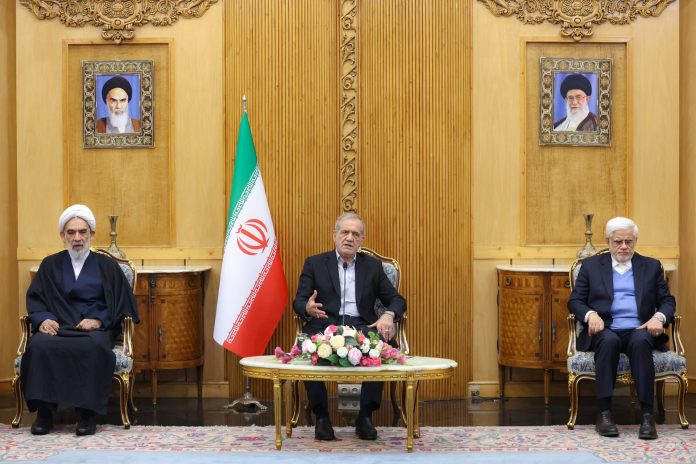
On Wednesday, before departing for Cairo, the capital of Egypt, to participate in the D-8 summit, President Pezeshkian told reporters that discussions would take place at the summit regarding the regional developments  , with the aim of defending the rights of the people of Gaza, Palestine, Lebanon, and Syria.

Pezeshkian pointed to the severe restrictions on the delivery of food and medicine to Gaza, adding that efforts would be made at the summit, with the presence of the leaders of participating countries, to reach agreements for coordinated and effective diplomacy.

He emphasized that aid routes to Gaza must not be blocked under any circumstances.

He stressed that Islamic countries must defend the rights of the oppressed people of Gaza, Palestine, and Lebanon against the oppression, crimes, and killings by the Zionists with a unified voice and perspective, and they should resolve their differences through dialogue as much as possible.

Pezeshkian also highlighted the importance of the Cairo summit in expanding economic, political, cultural, and social cooperation among D-8 members.

The President of the Islamic Republic of Iran also emphasized that Egypt is a country with a long history and a significant civilization that has a major impact in the Islamic world.

The summit meeting of the D-8 Organization for Economic Cooperation, which includes Iran, Turkey, Egypt, Pakistan, Indonesia, Nigeria, Malaysia, and Bangladesh, will be held on Thursday in Cairo.

Zelensky admits impossibility of reclaiming Ukraine’s Donbass, Crimea

Russia Ukraine War

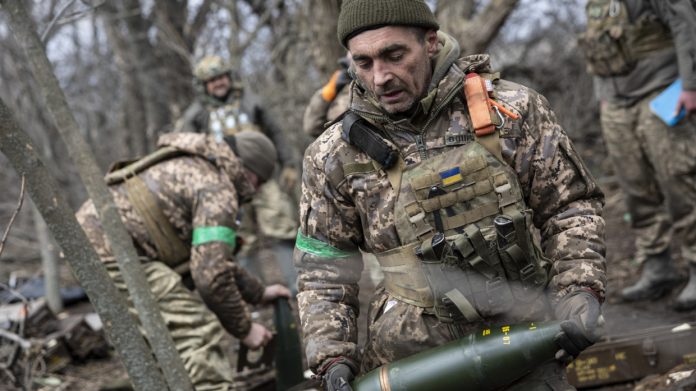
“De facto, these territories are currently under Russian control. We don’t have the resources to regain them. We can only rely on diplomatic pressure from the international community to compel [Russian President Vladimir] Putin to engage in negotiations,” he told Le Parisien in a video interview.

Zelensky was asked about the compromises Ukraine is willing to make “to end the war”.

However, he responded negatively when asked whether Kiev could temporarily abandon its claims to Crimea or Donbass.

Previously, former NATO Secretary General Jens Stoltenberg, now head of the Munich Security Conference, acknowledged the possibility of temporary territorial concessions by Ukraine to secure peace.

He suggested that the ceasefire line should encompass the Russian-controlled regions of Donbass and Novorossiya, which Ukraine still considers its own, “though this is not entirely realistic in the near future”. He added that NATO membership for Ukraine could be considered only for the territories it currently controls, provided Ukraine permanently renounces claims to the disputed areas.

Russian President Vladimir Putin previously outlined the conditions for resolving the conflict in Ukraine, which include the withdrawal of Ukrainian forces from Donbass and Novorossiya, Kiev’s refusal to join NATO, the lifting of Western sanctions against Russia, and the establishment of a neutral, non-nuclear status for Ukraine.

US ‘aware’ of Israel’s nuclear weapons production for decades: Declassified doc.

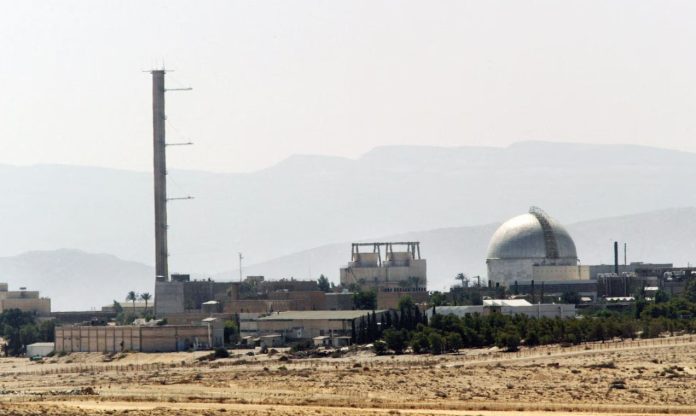
The newly released Joint Atomic Energy Intelligence Committee (JAEIC) report from December 1960, published by the National Security Archive on Tuesday, is the first and only known US intelligence report to explicitly and unequivocally state that Israel’s Dimona nuclear facility would include a reprocessing plant for plutonium production and was weapons related.

Subsequent US intelligence products treated the reprocessing issue as unsettled until the late 1960s, when Israel reached the threshold of a nuclear weapons capability and the United States and Israel reached a secret agreement to accommodate its status as an undeclared nuclear power.

Declassified US intelligence analysis also revealed that several Israeli sources had informed the US embassy in February 1967 that Israel “either has or is about to complete” a reprocessing plant at Dimona, and that “the Dimona reactor has been operated at full capacity”. The bottom line was that Israel was “6-8 weeks” from the bomb.

The State Department’s Bureau of Intelligence and Research’s (INR) evaluated some of the statements as “plausible” and urged the next inspection team in April 1967 to explore them.

This is the first known document that treated the possibility that Israel was systematically deceiving the United States about Dimona as a factual claim.

The newly released intelligence report is the latest in a series of declassified documents concerning US policy toward the Israeli nuclear weapons program.

Israel, which pursues a policy of deliberate ambiguity about its nuclear weapons, is estimated to possess 200 to 400 nuclear warheads in its arsenal, making it the sole possessor of non-conventional arms in West Asia.

It has, however, refused to either allow inspections of its military nuclear facilities or sign the Nuclear Non-Proliferation Treaty (NPT) with the invariable support of Washington.

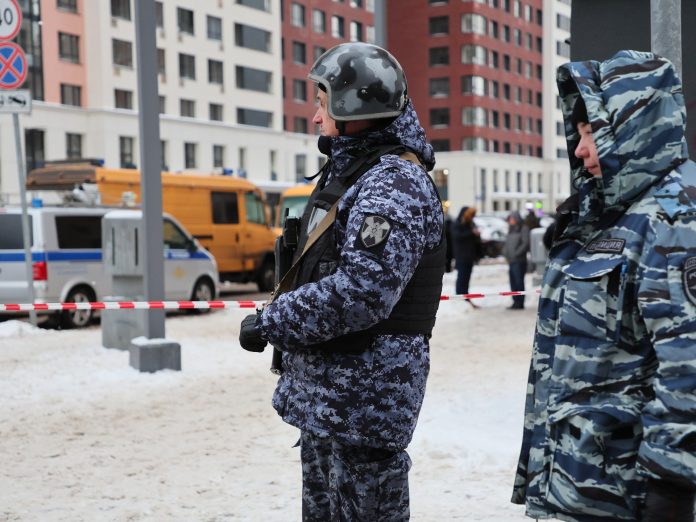
Moscow says arrested Uzbek national behind assassination of Russian general

The detainee is a 29-year-old Uzbek citizen who was recruited by Ukraine’s intelligence services and promised a $100,000 reward and a trip to an EU country, according to the press office of Russia’s Federal Security Service (FSB).

“The FSB, in collaboration with the Russian Interior Ministry and the Russian Investigative Committee, conducted joint operational and investigative actions. As a result, they identified and detained a 1995-born Uzbek national who detonated a homemade explosive device near a residential building on Ryazansky Avenue in Moscow, killing Lieutenant General Igor Kirillov, born in 1970, and his assistant, Major Polikarpov, born in 1983,” the press office said.

“The terrorist confessed to being recruited by Ukrainian intelligence. He was sent to Moscow on their orders, where he received a powerful improvised explosive device and placed it on an electric scooter, which he parked near the entrance to Kirillov’s residence. To monitor the address, he rented a car-sharing vehicle and installed a Wi-Fi video camera, which broadcasted live to organizers in Dnepr (formerly Dnepropetrovsk),” the FSB explained.

After receiving a video feed showing the officers leaving the building, the explosive device was remotely detonated.

“The Ukrainian intelligence services promised the Uzbek citizen $100,000 and a trip to a European Union country for the assassination of the Russian defense official,” the press office added.

The detainee has been transferred to the Russian Investigative Committee to document his criminal actions within the framework of the criminal case, which includes charges under Article 205 of the Russian Criminal Code (Terrorist Act), Article 105 (Murder), Article 222.1 (Illegal Storage of Explosives and Explosive Devices), and Article 223.1 (Illegal Manufacture of Explosives and Explosive Devices). “He faces potential life imprisonment for these crimes,” the FSB stated. “Employees of the Ukrainian intelligence services involved in organizing the terrorist attack will also be located and punished,” the press office concluded.

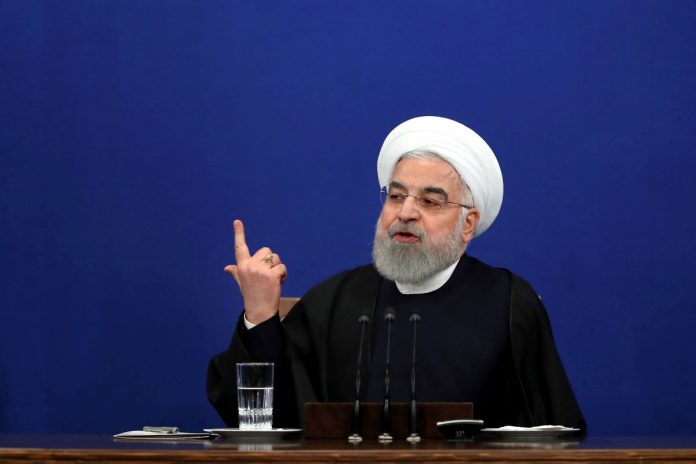
Iran’s ex-president Rouhani says shocked by hijab law, cites “contradictions with Qur’an, Constitution”

Hassan Rouhani

Rouhani, in a meeting on Wednesday with ministers and vice presidents from his cabinets, stated that the controversial law “contradicts the Qur’an and the Constitution.”

The former president noted that the 2021 protests and deadly unrest in Iran that began with an incident involving a woman over her hijab, and now the issue has resurfaced.

Rouhani pointed out the weakening of social capital and national cohesion in recent years, noting that elections, which should boost national unity, have instead highlighted internal problems.

He mentioned that the recent presidential elections saw low participation, with only 40% in the first round and 50% in the second, due to public distrust.

Many officials, experts and even religious authorities have expressed outrage over the law. Opponents of the law also believe its implementation will lead to social unrest in Iran. This is while those supporting the Hijab law says it aligns with the Islamic teachings.

Rouhani also commented on the recent events in Syria, stating that they were planned months in advance, not just a few weeks ago.

He noted that the war against Daesh and other militants in Syria remained incomplete, with many terrorists fleeing or gathering in Idlib in Syria.

Turkey, the US, Israel, and Qatar took advantage of the situation to topple Bashar al-Assad, he pointed out.

US lawmakers call on Biden to halt offensive weapons to Israel

Gaza War

In a letter addressed to Secretary of State Antony Blinken on Tuesday, the Congress members called on Washington to uphold its own laws that restrict military aid to countries that commit war crimes and block US-backed humanitarian assistance.

“We believe continuing to transfer offensive weapons to the Israeli government prolongs the suffering of the Palestinian people and risks our own national security by sending a message to the world that the US will apply its laws, policies, and international law selectively,” the letter said.

It added that failure to act would prolong Israeli Prime Minister Benjamin Netanyahu’s war on Gaza, “isolating Israel on the international stage and creating further instability in the region”.

The letter was led by Summer Lee and Greg Casar, who was recently elected to lead the Congressional Progressive Caucus next year, succeeding Pramila Jayapal.

The push is unlikely to convince Biden and Blinken, who have repeatedly pledged their “ironclad” support for Israel, to change course. But it underscores the persisting progressive pressure on the US administration over its Middle East policy.

It also highlights Casar as a critic of Israel before he becomes the chair of the influential Progressive Caucus.

The congressional statement focuses on the Biden administration’s ultimatum to Israel in October, when US officials warned Israel in a letter to enable the flow of humanitarian aid into Gaza within 30 days or face consequences.

Although several humanitarian groups have said that Israel failed to meet the conditions outlined by Washington to improve the situation in Gaza, the Biden administration said after the deadline that it would continue to provide weapons to Israel.

“While Israel made nominal progress in some areas, it overwhelmingly failed to meet the minimum standards laid out in the Administration’s own letter,” the lawmakers wrote.

For example, US officials demanded allowing 350 aid trucks to the besieged Palestinian territory. But an average of 42 trucks were allowed into Gaza daily during the 30-day period.

In fact, humanitarian groups – including the Norwegian Refugee Council, Oxfam, Refugees International and Save the Children – accused Israel of taking “actions that dramatically worsened the situation on the ground, particularly in northern Gaza” after the US warning.

“Israel has failed to comply with its ally’s demands – at enormous human cost for Palestinian civilians in Gaza,” the groups announced in a joint statement last month.

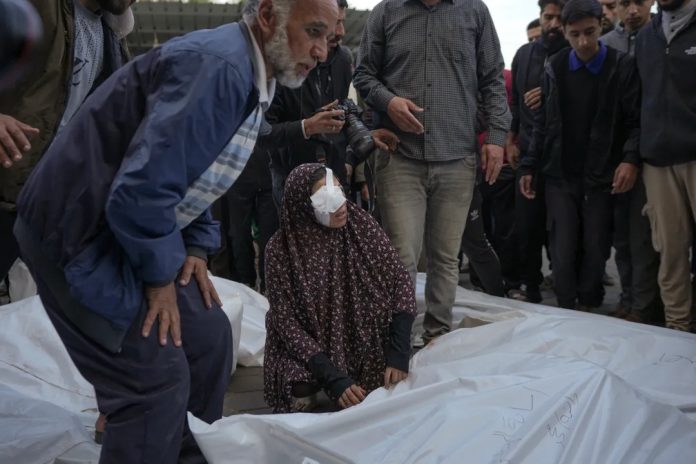
A suffocating Israeli blockade has brought deadly hunger to Gaza. The war, which has destroyed large parts of Gaza, has killed more than 45,000 people, according to local health authorities.

United Nations experts and several rights groups have accused Israel of committing genocide in Gaza – an effort to destroy the Palestinian people in part or in full.

The International Criminal Court last month issued arrest warrants for Netanyahu and his former Defence Minister Yoav Gallant over suspected war crimes in Gaza, including using hunger as a weapon of war.

But the US has remained unflinching with its support for its ally. A recent Brown University study estimated that the Biden administration provided $17.9bn to Israel to help fund the first year of the war on Gaza.

Tuesday’s congressional letter coincided with the filing of a lawsuit by Palestinians in Gaza, the West Bank and the US aiming to compel Washington end military support to Israeli army units engaging in human rights violations.

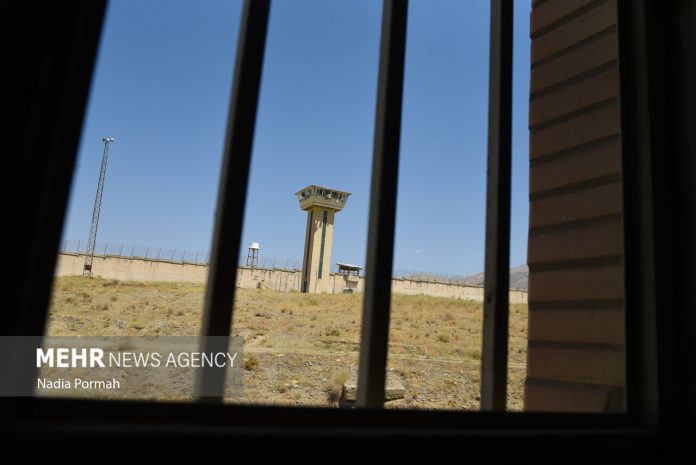
Assailant of women in Tehran executed

Iran Prison

The execution of the assailant, identified as Rastgooyi Kondelaj, took place on Wednesday, the judiciary’s Mizan news agency reported.

In November 2018, multiple complaints from women across Tehran reported a motorcyclist attacking them. Kondelaj, who concealed his identity, approached women from behind on his motorcycle, injuring them with an awl before fleeing.

The case was prioritized by law enforcement and judicial authorities.

Following extensive police and judicial efforts, the culprit was arrested and the court confirmed the injuries following several sessions.

He was convicted of “spreading corruption on earth through terrorizing women in various parts of Tehran and injuring them” and sentenced to death and compensation for the victims.

Kondelaj appealed the verdict, but the Supreme Court upheld the death sentence. His request for a retrial was also denied.