Thursday, April 9, 2026
Home Blog Page 5104

Iranian FM Underlines Enhancement of Ties with Africa

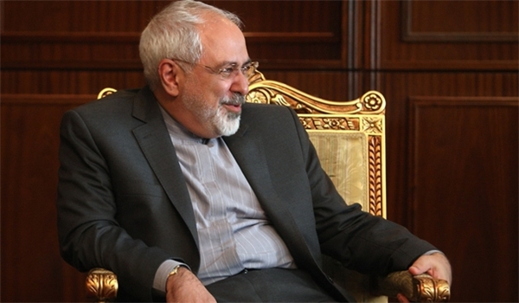
Mohammad Javad Zarif Iranian FM

Iran should develop deep and reasonable relations with Africa, based on mutual interests, Zarif said, addressing Iranian ambassadors to the African countries in Tehran on Wednesday.

The foreign minister said that there are abundant capacities for economic cooperation with the African nations.

He briefed the ambassadors on Iran’s foreign policy willing to enhance level of ties with the African nations, and voiced his readiness to pay visits to African countries to boost Iran’s economic cooperation with the continent.

Iran has striven hard to maximize relations with the African continent.

Iran is also an observing member of the AU and has shown an active presence in previous AU summit meetings.

The country is considered as one of the AU’s strategic partners along with India, Japan, China, several South American states and Turkey, while Tehran is also believed to be prioritizing promotion of its economic and political ties with the African states.

Iran mass-produces advanced batteries for missiles

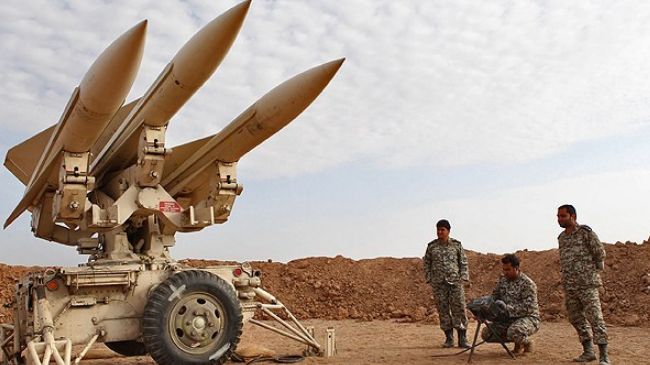
An Iranian Hawk missile system

The production lines, which will enhance the range and accuracy of the country’s missile systems, were inaugurated on Thursday in a ceremony attended by Iranian Defense Minister Brigadier General Hossein Dehqan on the eve of National Defense Industry Day.

With these production lines coming on stream, said the defense chief, the country has achieved the capability to design state-of-the-art defensive products and achieved self-sufficiency in raw materials required for various missile defense systems.

Dehqan said the accomplishment will contribute to the nation’s deterrence capability.

The breakthrough will help meet all the defensive needs of Iran’s Armed Forces as far as energy storage on a large scale is concerned, and help run future development plans in the field of defense systems, the minister underlined.

Given its cutting-edge defense industry, said the top commander, the Islamic Republic will make anyone that threatens Iran regret its move.

In recent years, Iran has made great achievements in its defense sector and reached self-sufficiency in producing essential military equipment and systems.

On June 2, Iran’s Islamic Revolution Guards Corps (IRGC) officially put into service a domestically developed long-range radar system, named Ghadir, capable of detecting stealth aircraft.

The modern radar system uses three-dimensional (3-D) technology to detect airborne targets, including radar-evading aircraft, cruise and ballistic missiles, and satellites in low orbits.

Tehran has repeatedly assured other countries that its military might poses no threat to other states, insisting that the country’s defense doctrine is entirely based on deterrence.


Hezbollah condemns ISIL killing of James Foley as savagery

Hezbollah

Hezbollah cited “financial and military support of terrorist groups,” paired with “political and media protection” and international silence over crimes committed by ISIL in Iraq and Syria, as the main causes behind the “terrible crime.”

Hezbollah also condemned an Israeli airstrike on Gaza that killed three senior Hamas commanders from the al-Qassam Brigade, saying that the assault reinforces the movement towards resistance and liberation.

“Past experiences have proven that the killing of the brigade leaders won’t break the will of the resistance; instead it will increase the persistence and force behind the drive towards jihad and liberation,” the Hezbollah statement said.

Hezbollah expressed condolences to the families of the victims, lauding the martyrs for “sacrificing themselves in resistance to occupation and in defense of their families’ people and nation.”

Hezbollah reiterated its condemnation of ongoing Zionist crimes in Gaza, warning that “assaults are escalating brutally among a fatal Arab and international silence.”

The lack of international condemnation constituted a “protective umbrella for Zionist terrorism” and covered the continued assault that “targets all forms of life in Palestine,” the statement argued.

Oil tankers return to Iran’s ports

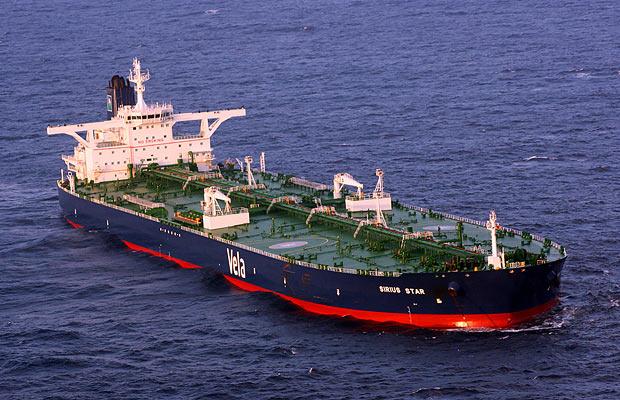
Oil Tanker
Oil Tanker

Iran’s oil minister has said according to Geneva Joint Plan of Action, foreign oil tankers could easily enter Iran’s oil terminals.

Bijan Namdar Zanganeh told Mehr News that his ministry would finish the development of different phases of South Pars fields by 2017. “Geneva Joint Plan of Action posed no restrictions on insuring oil tankers entering Iran’s waters and ports to carry Iran’s oil to importing countries by world insurance giants,” Zanganeh added.

In line with developments in Geneva, a foreign oil tanker will enter Iran’s ports for the first time since sanction relief covered by Western insurance companies; it is Alexandra-1 tanker ship owned by Transland Bulk Carriers Ltd., under the coverage of insurance provided by West of England P&I Club, which entered Assaluyeh in July 25 and harbored in Kharg to load LNG.

Zanganeh pointed to new oil export agreements in 2015. “Iran would not limit its exports to any certain figure, and would continue to export amounts of oil decided by the government policies,” added the oil minister.

On ministry’s plan for seeking a way out of economic recession, he cited rises in gas exports as possible scenarios. “With increased gas production and provision to industry and power plants, we could export up to $5bn in oil products in the current year and $12bn next year,” Zanganeh said.

This week the Oil Ministry delivered a report to Parliament Planning and Budget Committee in which it announced exports of crude oil and gas condensates worth up to $7.9bn in the first four months of the year. “In the same period, $13bn of Iran’s oil income has been unfrozen,” said the minister, and that “we have planned to raise Iran’s natural gas production 200 million cubic meters per day by the next two years.”

Zanganeh predicted that South Pars field project would be finished by 2017. “The priority set for production from shared fields in South Pars would bring about a decline in fuel consumption in industry and power plants which help the economy out of the recession.”

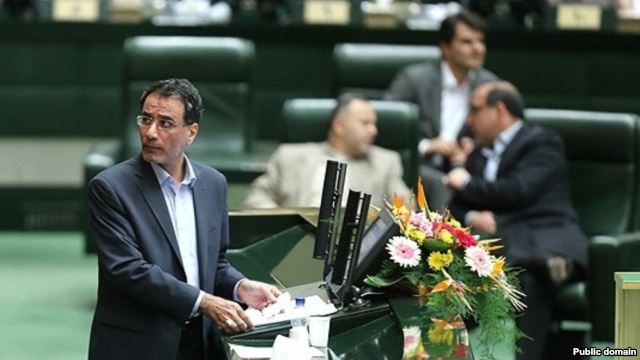
Science minister fails to win vote of confidence in parliament

Minister of Science, Research and Technology Reza Faraji-Dana

The Islamic Republic News Agency reported on August 20, 2014 that Minister of Science, Research and Technology Reza Faraji-Dana did not survive a no-confidence vote in the Islamic Consultative Assembly. Here is the translation of the short report the agency filed on the vote:

In an open session of the Islamic Consultative Assembly on Wednesday, 145 MPs voted for the science minister to be dismissed. Of the 270 votes cast in total, 110 were in favor of Faraji-Dana staying on. An additional 15 deputies abstained.

Following the vote, Parliament Speaker Ali Larijani called on the president to name a replacement for Mr. Faraji-Dana.

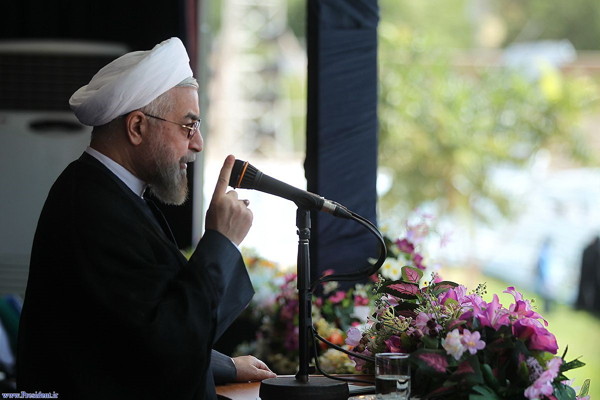
Inflation to slip below 20 percent by March 2015

President Hassan Rouhani

Fars News Agency on August 20, 2014 quoted President Hassan Rouhani as telling a crowd in the northwestern province of Ardebil that his government is determined to push down inflation even further. Here is an excerpt of a report the news agency ran on day one of the president’s provincial tour of Ardebil:

President Rouhani told the crowd at Takhti Sports Stadium that his government is trying its best to fulfill its promise to salvage the economy, revive ethics in society and resume constructive interaction with the international community. […]

He further said the country’s economic growth which stood at minus 6.8 percent in the 12 months to March 2013 is expected to land in positive territory by yearend [March 21, 2015].

On the impeachment of his minister of science, research and technology [which was in progress as he spoke], the president said his government will respect whatever verdict parliament deputies hand down. […]

As for nuclear talks between Iran and P5+1, the president stated the nation’s veteran diplomats who represent the country at the talks will stand up for Iranian rights and make sure peace of mind and welfare makes a comeback to the country. […]

Shifting to regional issues, the president denounced the Israeli shelling of innocent Palestinians as “unacceptable” and said Tehran stands by Palestinian, Iraqi, Syrian and other Muslim nations who seek Iranian assistance. […]

Mr. Rouhani blamed the displacement of millions of Iraqis throughout their country on disunity and said at this juncture all Muslims should join forces to help security and stability return to Iraq and to the wider region. […]

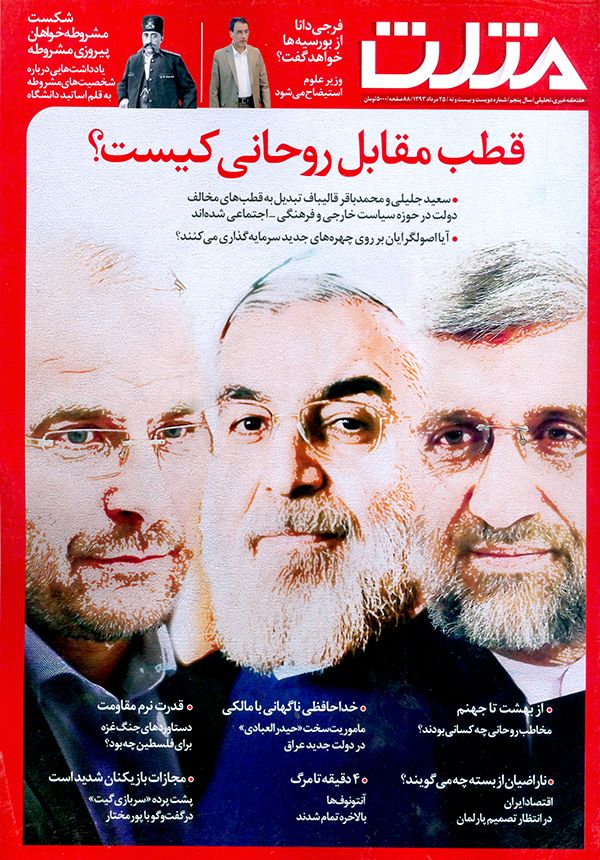
Cover Stories of the Latest Issues of Selected Magazines

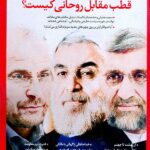
Issue No. 229 of Mosalas (Triangle) hit the newsstands on August 16, 2014. The cover story of the weekly magazine is titled “Who is the real opponent of President Rouhani? Jalili who is critical of the President’s foreign policy? Or Ghalibaf who opposes his sociocultural policy?” It also wonders whether the principlists will invest in new figures. “Sudden farewell to Maliki; the formidable task of al-Abadi” is another title that appears on the cover of the magazine.

No nuclear deal with P5+1 unless UNSC bans lifted: Iran FM

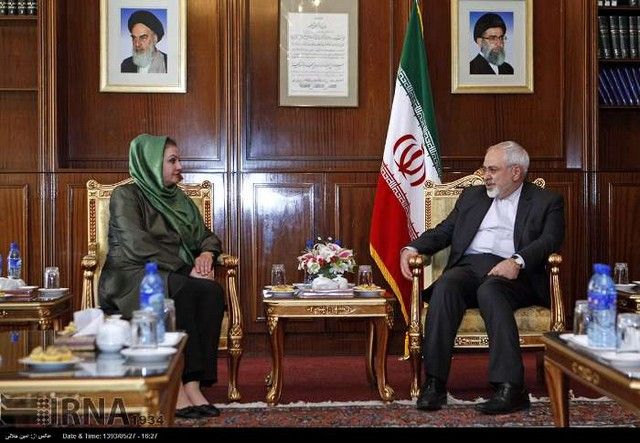
Mohammad Javad Zarif and Romanian Deputy Foreign Minister Carmen Burlaco

Iranian Foreign Minister Mohammad Javad Zarif says there will be no agreement with P5+1 over Tehran’s nuclear energy program unless the UN Security Council’s sanctions against Iran are repealed.

“The P5+1 members should implement their commitment for the annulment of the UN Security Council’s sanctions,” Zarif told reporters after his meeting with Romanian Deputy Foreign Minister Carmen Burlaco in Tehran on Monday.

He added that the six countries should contribute to the lifting of sanctions against Iran through “UN Security Council’s mechanisms.”

“The P5+1 group cannot annul the UN Security Council’s sanctions by itself but as the five permanent members of the Security Council, they should know that no agreement will go into effect unless the P5+1 members fulfill their obligation to lift the Security Council’s sanctions against Iran,” Zarif pointed out.

In July, Iran and the five permanent members of the UN Security Council – Russia, China, France, Britain and the US – plus Germany agreed on the extension of their discussions until November 24 in an effort to achieve a permanent nuclear deal.

Iran and the Sextet clinched a landmark interim deal in Geneva, Switzerland on November 23, 2013. The agreement took effect on January 20 and expired six months later on July 20.

Iran’s Deputy Foreign Minister for Legal and International Affairs Abbas Araqchi said on Monday that Iran and the P5+1 may hold talks at the ministerial level on the sidelines of the upcoming UN General Assembly in September.

The two sides are expected to discuss ways of reaching a final agreement over Tehran’s nuclear energy program. Iran’s right to enrich uranium is a bone of contention between the two sides.

Iranian national soccer team captain Javad Nekounam summoned to court

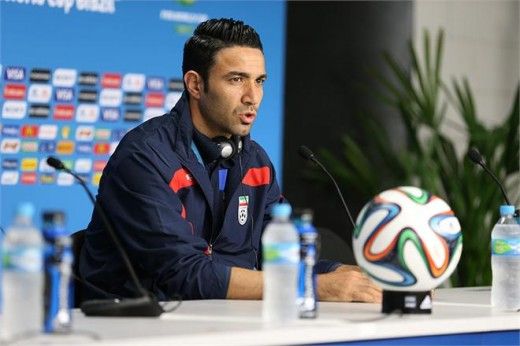
Javad Nekounam

The Islamic Republic News Agency (IRNA) on August 19, 2014 quoted the vice-president of Tehran’s Esteghlal Cultural and Athletic Club as saying that the national soccer team captain Javad Nekounam has been summoned to court. The following is an excerpt of the report the official news agency filed on the issue:

Javad Nekounam, a former player of the capital’s blue-clad team who has made allegations against Amir Ghalenoei, the head coach of Esteghlal Football Club, has been summoned to court after the latter filed a formal complaint against Nekounam for slander.

In an interview with IRNA, Mohsen Bozorgi, the vice-president for legal affairs at Tehran’s Esteghlal Cultural and Athletic Club, said the football federation has been informed of the citation which gives Nekounam three days to appear in the courthouses that exclusively hears cultural and media-related cases in order to answer some questions.

“Ghalenoei seeks to file libel charges against a sports newspaper and Hossein Kaabi, another national team player, in the days to come,” Bozorgi said. […]

Hardliners denigrating a representative gov’t that enjoys the leader’s support

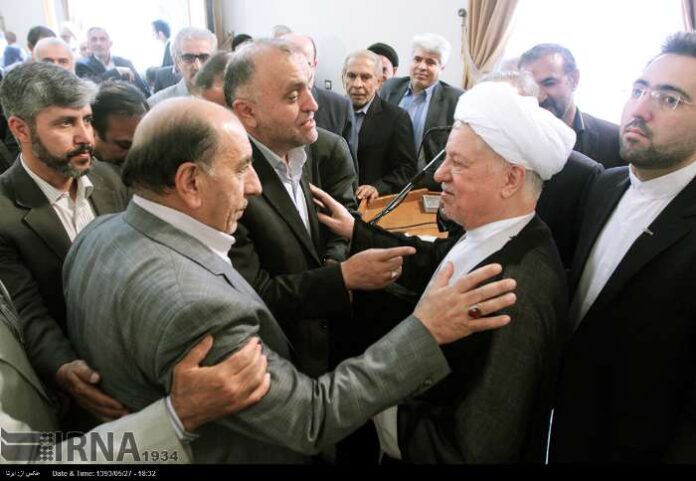
Ali Akbar Hashemi Rafsanjani

The Islamic Republic News Agency (IRNA) on August 18, 2014 quoted the chairman of the State Expediency Council as saying that the Center for Parliament Deputies, Past and Present, is a valuable club whose potential has not been fully tapped. The following is an excerpt of the report the agency filed on Mr. Rafsanjani’s comments:

At a meeting with a host of MPs on Monday, Ayatollah Akbar Hashemi Rafsanjani touched on developments at home and in regional countries and said the situation on the ground warrants restraint and tolerance in dealing with smear campaigns and baseless criticism.

He said the media empire of the enemy has trained its guns on Iran’s Islamic Revolution, adding what stands out about the Iranians are their civilization and Islamic culture which are manifested in their ethics. “We should not allow hardliners to stain the reputation of Muslim Iranians on the international stage.”

In a fast-developing world, adoption of a sound foreign policy is a necessity, Ayatollah Rafsanjani said, asking why Muslims who are required by their holy book to serve as a model for the world should opt for a life of isolation. “Formulation of a sound foreign policy is vital to successful interaction with others in the global village.”

Ayatollah Rafsanjani then referred to standout qualities of the Iranian people such as bravery and integrity and said there is no reason to say things which are religiously and nationally unfounded.

The top councilor stated Islamic unity is central to all religious, cultural and social policies and added extremism is like a virus which begins to tear away at cells immediately after it finds its way into a body. “Most recently, the group that calls itself the Islamic State described its fighters as colleagues of angels.”

He warned those who promote extremism in the country and said extremism leads to the emergence of groups such as IS, Al-Qaida, the Taliban and Boko Haram, who view the killings of fellow people as their duty.

Recalling the recent developments in some North African and the Middle Eastern countries, Ayatollah Rafsanjani said extremists reversed the revolutions the public staged in these countries and forced them to seek help from colonial powers who in turn indulged extremists just to kill the hopes those nations had pinned on popular uprisings.

Iraq serves as a perfect example where foreigners are trying to eliminate the confidence of the public in revolutionary and Islamic governments, he stated, adding Iraqis who suffered a lot under Saddam now have to deal with insecurity caused by an extremist group that has gone on a rampage in strategic areas in the country.

Hashemi Rafsanjani said the crimes the Islamic State is committing against Yazidis should be a wakeup call for the international community and the lesson Islamic nations should learn from developments in Iraq is that in the absence of unity between Shiites and Sunnis, extremists cement their foothold.

He went on to say the fact that the Supreme Leader of the Islamic Revolution deeply believes in moderation provides solid grounds for cooperation with a government which has run on a platform of moderation. “But some are ignoring the Supreme Leader’s expression of support for the Iranian negotiating team and are fanning the flames of division.”

In conclusion, the chairman of the Expediency Council said, “I owe a debt of gratitude to the public and all revolutionary officials and I will try my best till the last breath to help the Iranians stick to their rights.”