Thursday, December 25, 2025
Home Blog Page 5054

What do those who favor a thaw in relations with the US have to say?

Iran-Arman newspaper_09-25

A number of hard-line principlists, who are widely known for their unbridled support for former President Mahmoud Ahmadinejad and his policies, have lately expressed concern over Iran’s foreign policy.

In reaction, Arman-e Emrooz, a reformist daily on Tuesday published brief answers by six diplomats – past and present – and economists to the following questions: 1. Do you see a meeting between Presidents Obama and Rouhani as a threat or an opportunity? 2. Who will benefit from and whose interests will be harmed by the resumption of ties between Iran and the United States, and who needs the reestablishment of relations most? The following is an excerpt of the answers the six provided:


Hossein MousavianSeyyed Hossein Mousavian (Diplomat): The visit of President Rouhani to New York is an opportunity. Unfortunately, some individuals with political motivations seek to take away this opportunity from Iranian diplomats and President Rouhani.

Iran and the United States need to settle their differences in bilateral meetings. That President Obama has said he’s open to meeting President Rouhani is a good sign that a thaw in relations might be around the corner.


Farshad MomeniFarshad Momeni (Economist): In science, we try not to be haphazardly optimistic or pessimistic about things. Realism is viewed as the solution. […] Effective ties with other countries are a prerequisite for development.

In the absence of efforts to boost local capabilities, normalization of ties with the US won’t serve our interests, however at this stage making efforts and holding talks to clear the hurdles standing in the way won’t do us any harm.


Sabah ZangenehSabah Zanganeh (Diplomat): As far as diplomacy is concerned, talks with the US are ok and shouldn’t be viewed as unorthodox. Some regional countries and individuals in Iran might be worried about the prospect of logical relations with the US because they regard such ties as harmful to their interests. I believe a meeting between the two presidents is acceptable; President Obama is open to such a meeting.


Davood hermidas BavandDavoud Hermidas-Bavand (University Professor and Political Activist): Holding talks and establishing relations with the United States is a taboo. Breaking that taboo is what the Iranian people and even Americans want. Not holding talks would mean that the two sides have no differences to patch up.

I believe such a meeting is necessary and the Iranian people have given President Rouhani a mandate for that. Most Iranians favor a foreign policy approach that can help society find its way out of stalemates, ease the existing economic strains on people, and avoid social harms.


Ahmad NaghibzadehDr. Ahmad Naghibzadeh (University Professor): The taboo of Iran-US [contacts] has broken. That means direct talks are not unusual. I believe face-to-face contacts are the best way. The ones whose interests are served by continued rocky relations between Tehran and Washington oppose direct talks for normalization of relations.

Russia and our Arab neighbors don’t want that to happen. Middlemen are trying to prevent a deal from being concluded.


Ahmad ShirzadAhmad Shirzad (Political Activist): America’s Democrat Administration needs a useful deal with Iran. On the other hand, Iran wants unilateral and multilateral sanctions against it lifted. A key decision has to be made by the leaders now. New York is the final stop for working out a deal. And a good deal is within reach.

The West has reached a deadlock in the Middle East and getting rid of the problems in the region would be possible only if Iran’s case is settled first. Everyone is waiting for the talks between Iran and P5+1 to result in a deal that serves the interests of both sides.

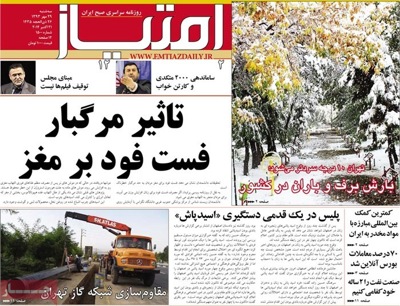
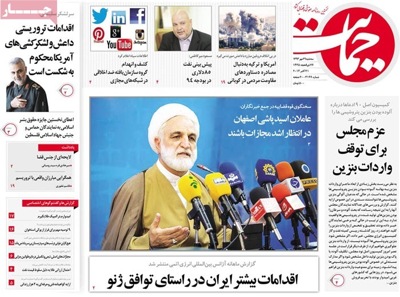
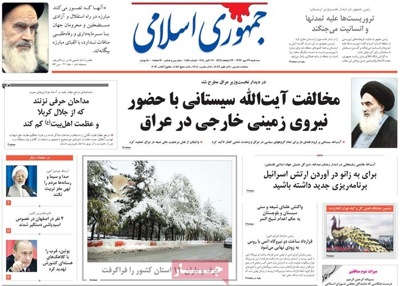
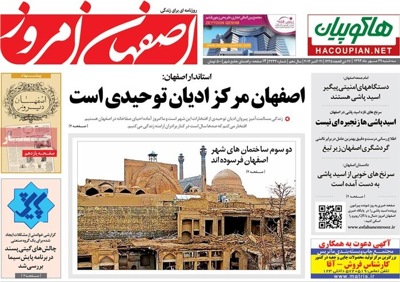
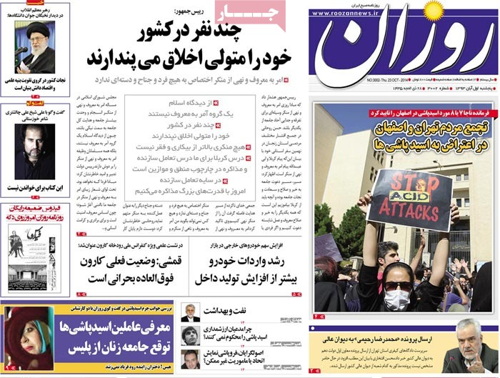
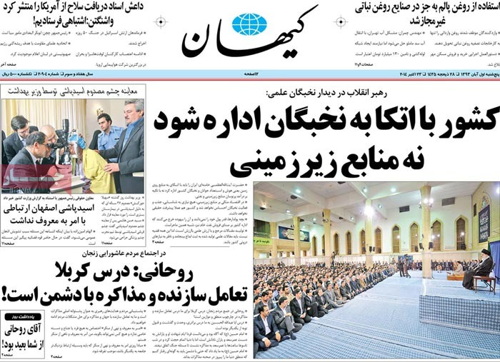
A look at Iranian newspaper front pages on September 25

Iranian Newspapers headlines
Iranian Newspapers Headlines

The comments of the Supreme Leader at a meeting with senior military and law enforcement officials dominated the front pages of Iranian newspapers on Thursday. “The experience of the Sacred Defense showed that we can defy the unrealistic expectations of global powers,” Ayatollah Khamenei said. The meetings of President Rouhani with world leaders, particularly British Prime Minister David Cameron, in New York also grabbed a lot of front-page attention.

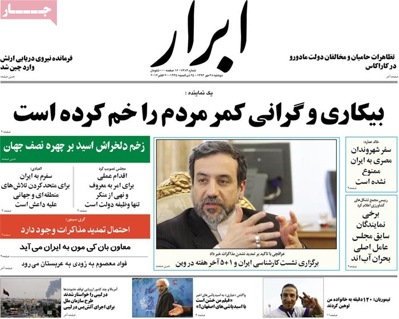
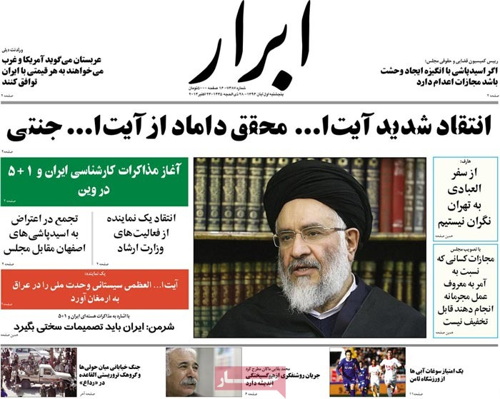
Abrar: “The reopening of the British embassy [in Tehran] does not need parliamentary approval,” a member of the Islamic Consultative Assembly said.

Abrar: “Iran can serve as a reliable energy hub for Europe,” President Rouhani tells his Austrian counterpart.


Abrar newspaper-09-25


Afarinesh: “If we believe in the logic of our revolution, why should we be afraid of holding talks with others in advance?” Ayatollah Hashemi Rafsanjani asked.

Afarinesh: “As long as our economy remains in the shadows of government policy, our problems won’t be solved,” said Parliament Speaker Ali Larijani.


Afarinesh newspaper-09-25


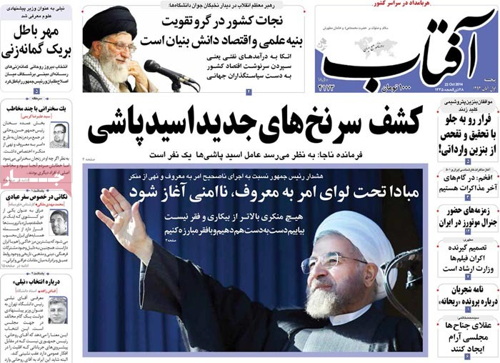
Aftab-e Yazd: “A historic turnaround in diplomacy; [President] Rouhani met with British Prime Minister David Cameron [in New York].”

Aftab-e Yazd: “Some are distorting the comments of [the late] Imam Khomeini,” said former Parliament Speaker Nateq Nouri. He further stated that if there were one person faithful to Imam and to the Supreme Leader to the end, that would be Hashemi Rafsanjani.


Aftabe Yazd newspaper-09-25


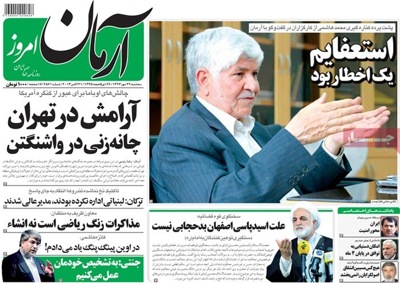
Arman-e Emrooz: “I had the government-issue car for only one and a half months,” said Mohammad Reza Mirtajeddini, the vice-president for parliamentary affairs under Ahmadinejad. His comment came in response to allegations by officials with President Rouhani’s government that their predecessor are not handing back the government items which are at their disposal.


arman newspaper-09-25


Asrar: “Confronting terrorism is a priority of Iran,” Foreign Minister Mohammad Javad Zarif said.

Asrar: “Our most important strategy is to win the [upcoming] legislative election,” said Mohammad Reza Aref [a prominent reformist figure who served as the deputy of President Mohammad Khatami].


Asrar newspaper-09-25


Ettela’at: “Iran’s presence in the fight against IS is necessary,” said the Iraqi president.

Ettela’at: “It is impossible to deprive the public of communications technology,” said the Iranian police chief.

Ettela’at: “Making threats against the Iranian nation is useless; tensions between Iran and the United States should ease,” President Rouhani said in New York on Wednesday.


Ettelaat newspaper-09-25


Hamshahri: “Iran is in 10th spot in a new world ranking released by FIVB [International Volleyball Federation].”

Hamshahri: The Islamic Consultative Assembly has rejected a bill that would have sent those convicted of tax fraud to jail.


Hamshahri newspaper-09-25


Hemayat: “Iranian athletes bag one gold, four silver medals and a bronze on day five [of the Asian Games in Incheon, South Korea].” In the overall standings Iran is now 8th.


hemayat newspaper-09-25


Kaenat: “Adherence to values is a red line in the talks,” said Judiciary Chief Ayatollah Sadegh Amoli Larijani.


Kaenat newspaper-09-25


Kar va Kargar: “Iran is on its way to becoming an economic heavyweight,” President Rouhani says.


kar va kargar newspaper-09-25kar va kargar newspaper-09-25


Kayhan: “Had it not been for Iranian assistance, Iraq would have been under the control of terrorists today,” President Rouhani told the UN chief.


Kayhan newspaper-09-25


Mardomsalari: “Inflation is expected to slip below 18 percent by yearend,” the Iranian government has forecast.


Mardom Salari newspaper-09-25


Rah-e Mardom: “Sending a letter by [Former President Mohammad] Khatami to the Leader was a positive move. He should have paid a visit to the leader, but some didn’t allow that to happen,” Ali Motahari, who represents Tehran in parliament, said.

I disagree with blocking social networks

Iran Police chief: Ahmadi Moghadam

Iran’s Police Chief Brigadier General Esmail Ahmadi Moghadam says the infrastructure Iran has set for social networking sites to operate in the country is not adequate.

Mehr News Agency quoted Brigadier General Ahmadi Moghadam as telling reporters in the northwestern city of Ardabil on Tuesday that providing and maintaining the security of such online services is imperative and that the whole world has underlined the necessity of such security.

He said the Supreme Cyberspace Council has made preparations for the operation of social networks, adding that security concerns should be addressed if we are to develop the cyberspace.

He further said that the police deal with the issue of internet content filtering as they take into account issues related to prevention of criminal acts.

“I do not agree with blocking such social websites, but we need to observe security rules,” said the general.

UK: Iran part of solution to fight ISIL in Syria

Cameron-Rouhani
Cameron-Rouhani

Addressing the 69th session of the UN General Assembly in New York on Thursday, Cameron said Iran “could be part of the solution” in defeating the terrorist group.

“Iran’s leaders could help in defeating the threat from ISIL,” Cameron said.

The British premier added that Iranian authorities “could help secure a more stable, inclusive Iraq, and a more stable, inclusive Syria,” and urged the international community to welcome actions on the part of Iran to combat the Takfiri militants.

Cameron noted that the international coalition against the threat imposed by ISIL must be inclusive. He also said he will hold a parliamentary debate Friday to discuss a possible British involvement in airstrikes against the ISIL positions in Iraq.

Cameron and Rouhani discussed ties and regional issues in a landmark meeting on Wednesday. It was the first bilateral talks between a UK prime minister and an Iranian president since Iran’s Islamic Revolution in 1979.

The ISIL terrorists are in control of some areas in Syria and have captured large swathes of land in neighboring Iraq. Tehran has on several occasions voiced support for the Iraqi government since it began fighting against the ISIL in June.

ISIL has committed heinous crimes and threatened all communities, including Shias, Sunnis, Kurds, Christians and Izadi Kurds, during their advances.

According to a CIA source, more than 15,000 foreign fighters from more than 80 countries have gone to Syria to join militant groups. 2,000 of those fighters are believed to be Westerners, including at least 500 British nationals.

Observers have said the rise of ISIL can be directly attributed to the policies of Western countries, including the UK, in the Middle East region as they have been supporting insurgent groups in their fight against the Syrian government.

A look at Iranian newspaper front pages on Sept. 24

Iranian Newspapers headlines
Iranian Newspapers Headlines

What dominated the front pages of dailies Wednesday centered on the comments of President Rouhani at a UN Climate Summit as well as at a meeting with senior editors of some American news outlets. Speculations by political experts about the outcome of ongoing nuclear talks in New York were among the big stories of the day.

Abrar: “Minster of Road and Urbanization is headed for impeachment.”

Abrar: “Ghalibaf’s opinion about the election of mayors [by popular vote]” is the headline of a report about a bill which suggests that towns with populations of over 200,000 people could directly elect their mayors. Tehran Mayor Mohammad Bagher Ghalibaf said, “Appointment or election of mayors is determined by law, but I think what needs to be done is the transformation of rules and the way cities are run.” Uniform Urban Management Services, a bill which, among other things, focuses on the election of mayors, is now under examination by the government and will be later handed to parliament for approval.

Abrar: “I won’t act arbitrarily at the [Media] Supervisory Board,” said Hassan Kamran after he was voted by MPs to take the seat vacated by Ali Motahari. He stressed that he would comply with the law.

Abrar: “Iran’s Naval Forces are capable of building vessels heavier than Jamaran [an Iranian-built frigate].”


Abrar newspaper-09-24


Abrar-e Eghtesadi: “France expressed readiness to invest in Iran’s Rajaei Port.”

Abrar-e Eghtesadi: “The first wide-body Airbus A380 is to touch down at Imam Khomeini Airport [on September 30].” The report in the daily says since the airport enjoys high technical capability, Emirates has applied for some of its A380 planes to land at and take off from the airport.


Abrar Eghtesadi newspaper-09-24


Afarinesh: “Iran has handed eight al-Qaeda members to Saudi Arabia.”

Afarinesh: “Iranian and British top diplomats held talks about the reopening of their embassies.”


Afarinesh newspaper-09-24


Afkar: “Saudi Arabia’s harsh stance” focuses on Riyadh’s reaction to developments in Yemen, accusing Tehran of meddling in the Yemeni affairs.


Afkar newspaper-09-24


Aftab-e Yazd: “A historic meeting in the Political Olympics” is the title of a piece in which the daily looks at the imminent meeting between President Rouhani and British Prime Minister David Cameron.

Aftab-e Yazd: “Terrific news is around the corner for [Iranian] women,” said Vice President for Women and Family Affairs Shahindokht Molaverdi. In an interview with the daily, she said negotiations about the presence of women in sporting venues are at a final stage and efforts are being made to hammer out a proper and viable way for their presence.


Aftabe Yazd newspaper-09-24


Arman-e Emrooz: “President Rouhani is likely to attend [nuclear] talks.”

Arman-e Emrooz: “An Accord seems to be highly likely,” said Chairman of the State Expediency Council Hashemi Rafsanjani. Wishing Iran’s negotiating team every success, he said, “Talks have come to a sensitive stage, and an accord seems to be highly likely.”

Arman-e Emrooz: “Culture cannot be fostered by morality police,” said Deputy Director of the Presidential Office Morteza Bank.


Arman newspaper-09-24


Asrar: “The International Monetary Fund hailed as a miracle Iran’s economic success,” said Economy Minister Ali Tayebnia.

Asrar: “Ahmadinejad’s violation of law has made his comeback to the political landscape impossible,” said Masoud Pezeshkian, a former MP and minister.

Asrar: “We will take Iranian musicians to European concert halls,” said Minister of Culture and Islamic Guidance Ali Jannati.


Asrar newspaper-09-24


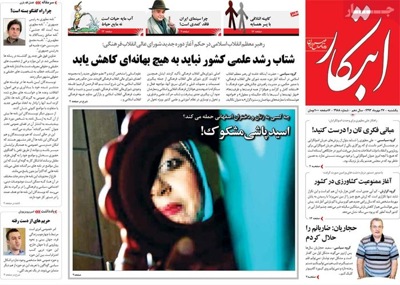
Ebtekar: “I do not approve of filtering the social networks,” said Iran’s Police Chief Brigadier General Esmail Ahmadi Moghadam.

Ebtekar: “Parliament turned its back on the Islamic Revolution Stability Front,” is a report which indicated that contrary to the belief of the front’s advocates, it does not wield as much clout as it was thought. In an in-house parliamentary vote held on September 23 to appoint members of a Media Supervisory Board and an IRIB (Islamic Republic of Iran Broadcasting) Supervisory Board, the front turned out to be unsuccessful. Following the major role that it played in the impeachment of the former science minister, many believed it would prove to be a major player in the vote.

Ebtekar: “A rise in the number of holy sites under the magnifying glass of parliament” is a report about the critical comments of an MP representing Rasht – a northern city – about the growing number of registered holy sites across the country. He accused the Endowments and Charitable Affairs Organization of land-grab. Under law, any place which is registered as a holy site along with an expanse of land in its vicinity will be run under the supervision of the organization.


Ebtekar newspaper-09-24


Eghtesad-e Pooya: “Sanctions will be lifted and a promising future awaits the country,” said Vice President for Planning and Strategic Supervision Mohammad Bagher Nobakht.

Eghtesad-e Pooya: “Non-oil exports registered 4-percent growth [between March 21 and August 23, 2014].”


Eghtesad Pouya newspaper-09-24


Etemad: “The first US-led attack on ISIL in Syria.”


Etemad newspaper-09-24


Ettela’at: “Iran’s proposals for the improvement of the global environment” refers to the speech that President Rouhani delivered at the United Nations Climate Summit on September 23.

Ettela’at: “A solution to Iran’s nuclear dossier will transform Tehran-Washington ties,” said President Rouhani in a meeting with senior editors of American news outlets.

Ettela’at: Under a new law approved by parliament,those who owe the government as much as 10 million tomans in taxes will face a travel ban.


Ettelaat newspaper-09-24


Haft-e Sobh: “A watered down bill which bans bearing bladed weapons finds its way to parliament floor.” The daily posted different opinions about the bill from the perspective of jurists and MPs.


Shahrvand newspaper-09-24


Hemayat: “Take US green-lights with a pinch of salt,” said Deputy Judiciary Chief Gholamhossien Mohseni Ejeie. Criticizing those who believe that an agreement with America can address all our issues, he said “I do not suggest war with America, yet we should not fall for its green-lights.”

Hemayat: “Hollywood-style adventurism is not real fight against terrorism,” said Deputy Foreign Minister for Arab and African affairs Hossein Amir-Abdollahian. He dismissed US-led airstrikes in Syria on the pretext of fighting ISIL as violation of Syria’s sovereignty and international law which paved the way for further meddling in the region.


Hemayat newspaper-09-24


Iran: “Commemoration of the International Day of Peace in Tehran.”


Iran newspaper-09-24


Kayhan: “Yemen is immersed in joy and light; the Yemeni people celebrate their victory.”


Kayhan newspaper-09-24


Jamejam: “US military operation in Syria is illegal,” said President Rouhani.


JameJam newspaper-09-24


Resalat: “Iran won’t bow to plans imposed by the US,” said Ali Akbar Velayati, an advisor to the Supreme Leader for international affairs.


Resalat newspaper-09-24


Roozan: “Heidar Moslehi and Seyyed Hassan Khomeini [grandson of the founder of the Islamic Republic] are vying to become the Friday prayer leader of Shemiranat [a small town on the northern edge of metropolitan Tehran].”


Rouzan newspaper-09-24


Shahrvand: “Last year’s prominent musicians were awarded.”

Shahrvand: “The government granted its main opposition rival [the Islamic Revolution Stability Front] a party permit.”


Shahrvand newspaper-09-24


Sharq: “Holding a concert in Iran is my dream,” Sami Yusuf, an Iranian-born British singer-songwriter said in an interview with the daily.


Shargh newspaper-09-24


Tafahom: “Ministry of Culture and Islamic Guidance throws its weight behind media which pitch the values of Sacred Defense.”


Tafahom newspaper-09-24


Iran said “No” to powers’ bullying in 8-year war

Supreme Leader-khamenei

Leader of the Islamic Revolution Ayatollah Seyyed Ali Khamenei says the eight years of defense against Iraq’s invasion was Iran’s “No” to bullying and excessive demands of global powers.

“The experience of the eight-year Sacred Defense [against Iraq’s invasion] proved that despite all limitations and pressures, lack of financial resources, and numerous problems, it is possible to stand up against bullying and excessive demands by global powers through firm determination and reliance on God,” the Leader said.

Ayatollah Khamenei made the remarks during a meeting with a number of high-ranking military and police commanders on Wednesday.

The Leader said that certain countries from the West and East along with their lackeys in the region formed a large military axis against the Islamic Republic during Iraq’s imposed war in the 1980s.

“This broad coalition sought to weaken, undermine and disgrace the Islamic establishment, put it in numerous troubles and ultimately lay the groundwork for the collapse of the Islamic Republic, but the Islamic establishment and the Iranian nation withstood this front and emerged victorious despite a lack of facilities and equipment and the existence of problems at that time,” he added.

Ayatollah Khamenei said Iran made “enormous” achievements although it sustained heavy costs in the war.

America is a hostile rival: Kayhan newspaper

Hossein Shariatmadari-Kayhan Newspaper

With nuclear talks between Iran and P5+1 in full swing in New York, the following might help you appreciate why the Iranian top negotiator recently said both sides need to make a “hard decision”.

Kayhan newspaper ran an opinion piece by Hossein Shariatmadari on September 22 under the title of “The rival’s new dream”. This brief title indicates a change in the tone used by the daily’s managing editor – his replacement of signature “enemy” with “rival”.

Shariatmadari, a theoretician and analysttrusted by part of the Principlist faction’s policymakers and politicians, politely, yet in critical tone, warns Iran’s nuclear negotiators and officials at the helm of the Islamic Republic’s diplomacy machine not to handle the ongoing New York talks in a fashion similar to last November when they inked the Geneva Interim Agreement – which produced no result – just three months after President Rouhani’s government came to office.

In a word, Kayhan assesses the Geneva deal as “a generous in-cash concession in exchange for on-credit promises”. It reminds the country’s negotiating team of the unreliability of the “rival”, citing an attempt by the US secretary of state at flexing American muscle.

The daily refers to remarks by John Kerry, hours after the conclusion of the Geneva Interim Agreement, who described “the suspension and shutdown of uranium enrichment” as commitment on the part of Iran and quite an achievement [for the West], something which – in Shariatmadari’s words – came across as shocking even to members of Iran’s negotiating team led by Mohammad Javad Zarif.

Kayhan underlines its concern about “making a non-nuclear decision” for which the nuclear challenge could be an excuse, citing an assessment on July 24, 2014 by Jofi Joseph, a former director in the non-proliferation section of the National Security Council at an Atlantic Council meeting.

This is how Shariatmadari explains the reason behind his concern, “… Whispers have been circulating in recent months among US politicians and policymakers, those who are under the illusion that any support for the Iranian government could bring Washington closer to its main objective, which has been defined outside the nuclear challenge.

“They are predicating their assumption on the presence of certain Western-inclined elements in the Iranian government and its close ties with members of the Sedition Camp [the Green Movement which emerged following the 2009 presidential elections in protest at the election results. The Sedition Camp is a metaphorical reference to reformists and the current affiliated to former President Seyyed Mohammad Khatami].

“They believe if the current government leaves the talks empty-handed, the reformist camp suffers a heavy blow in the court of public opinion.”

The columnist wants to warn the “rival” to stop harboring illusions that it can use the nuclear deal to secure non-nuclear goals. In other words, the talks do not provide an opportunity for the Islamic Republic of Iran to fall back under American domination, although, as Kayhan puts it, some members of the Sedition Camp have urged the United States not to miss out on the “golden opportunity that arose with the rise to power of moderates”.

Given the likelihood of misinterpretation of his comments by the readers, Shariatmadari then says, “No doubt, just like members of the Iranian negotiating team, Rouhani is part of the Islamic establishment and knows that in the talks ahead, he’s leading the people many of whom have made sacrifices and fallen martyr in quest of securing glory for their country.”

In the final paragraph, though, the columnist once again uses the term “enemy” instead of “rival” and says, “In the nuclear standoff the enemy is not simply dealing with the esteemed government; rather, it is dealing with a great nation that follows the instructions of its Imam [a reference to the Supreme Leader]. So the latest ploy of securing a nuclear deal for the sake of non-nuclear objectives will fail just like dozens of even more sophisticated ploys in the past.”

On the same day President Rouhani departed for New York, the daily had the following advice for the moderate president and his colleagues:

“At this point, in order to prevent the enemy from getting greedier, the political terminology the esteemed president and the Iranian nuclear negotiating team employ should be more compatible with our firm revolutionary principles. For instance, at a time when the US does not miss out on any opportunity to bring its grudge and hostility to bear against Iran and evade its commitments, our dear brother Dr. Zarif should not have said, ‘If President Obama makes a promise, we’ll trust him,’…”

It should be noted that the column ends in ellipsis dots which seem to suggest that more criticism will come along.

The newspaper opens another column by explaining why it has not aimed more criticism at the performance of the Iranian diplomacy machine. “We thought it would not be expedient to talk about what comes next. We believed and still believe that the Iranian negotiating team and Iranian officials are too smart to let the rival keep its new ploy under wraps.”

In another column by Mohammad Imani on Tuesday the daily’s new opinion piece adopts a more open tone and does nothing to hide the ongoing hostility between Iran and the United States.

He says, “No one can deny the fact that the US has been constantly hostile to the Iranian nation over the past six decades. Besides, no one can doubt the fact that the United States has either attacked or staged coups against 50 countries around the world. So everyone should regard the US as an irreconcilable enemy of nations, one which does not believe in fair deals, and one that cannot be trusted as a partner. Identification of the hegemonic, acquisitive and deal-breaking US administration as a normal government and a diplomatic partner is the first mistake.”

The piece later recalls the readers who are in favor of talks with the US of seven rounds of inconclusive talks between Iran and P5+1 which have seen trust hit the rock-bottom and says, “The Americans think about nothing but Iranian surrender.” It warns that any submission in foreign policy is bound to result in further audacity, acquisitiveness and aggressiveness on the other side.

The piece suggests the fact that Iran’s permanent seat at the UN has remained vacant over the past eight months thanks to American failure to grant a visa to Hamid Abutalebi, who according to a report by Fars News Agency on Sept. 22 seems to hold views similar to Javad Zarif, amounts to insistence on the part of the American administration to insult and humiliate Iran.

Mohammad Imani further says American insistence on continuing to insult and humiliate the Iranians is an attempt to prompt miscalculations among Iranian policymakers and decision-makers so that in dealing with America Iranian diplomats ignore the country’s local potential and speak from a position of weakness rather than strength. The author goes on to suggest that over the past three decades, Iran’s authority both at home and abroad has increased and at the same time the American influence has been on the wane.

The author then reminds the Iranian negotiators that they have a responsibility not to fall prey to the American strategy to downplay the Iranian power.

It says what is important is to maintain enrichment on an industrial scale, not have a collection of useless centrifuges that are good for nothing but display. In conclusion Imani expresses his concern by saying “What is alarming is that the Americans might assume that one year after rising to power and months after striking the Geneva deal, the Iranian government is ready to strike another agreement, just like that.”

“The rival’s new dream” and “what’s happening in New York?” were the original headlines of the editorials in Kayhan.

The New York Times misunderstood US stance on talks

NYTimes
NYTimes

Dismissing news by some Western media about a new US nuclear plan, an official close to Iran’s nuclear negotiating team told Entekhab [Choice] website that The New York Times had a misunderstanding of the US stance on the talks.

He went on to say that over the past few days, there has been a positive, constructive atmosphere prevailing in the talks, although disagreements over some key matters persist and the two sides are trying to winnow them down.

“Unfortunately, some media seek to poison the atmosphere of the talks,” the official added.

Referring to the recent article by The New York Times – U.S. Hopes Face-Saving Plan Offers a Path to a Nuclear Pact with Iran on September 19, 2014 – the official said the newspaper acknowledged that it had quoted some American sources about the centrifuges. However, such claims are false and are not a proper understanding of where America stands on the nuclear talks.

“Interestingly, overwhelmed by such a commotion of media, some Senate lawmakers wrote a letter to President Obama and lashed out at him. In fact, it’s crystal clear that there is no affinity between such reports and what is going on in the negotiations, and therefore they are nothing but media attempts to disturb the atmosphere of the talks,” he pointed out.

It’s worth noting that a few days ago, The New York Times and The Associated Press released a report on a new US plan which requires Iran to disconnect enriching machines from feeds of uranium. The unsubstantiated plan would let Iran have its centrifuges only if many of the pipes that connect the nuclear centrifuges are taken away.

Aftabe, an Iranian app downloaded 1.5 million times and counting

Iranian apps-Aftabe
Iranian apps-Aftabe

Iran-e Javan, an addendum of Iran, on Tuesday September 16 featured an interview with Iranian developers of a game app which has been downloaded more than 1.5 million times in less than six months. The following is the translation of the lead of the interview:


Aftabeh-app-programmers

The name of the app is bizarre [in Farsi Aftabe means ewer which has been widely used in the past and is still used in some places as a water container in toilets]. It strikes everyone as surprising that a group of app developers has named their app Aftabe.

Why have they given the app such a name? What is it good for? These are the questions that spring to your mind when you hear the name. If you are familiar with the guess game, you probably know why the app is named what it’s named.

Mohammad Amin Moradi, 19, who studies Mechanical Engineering at Imam Khomeini University, Seyyed Hamed Valizadeh, who is also 19 and studies Software Engineering at Sharif University of Technology, and Amir Ala Masoumi, who is 20 and is studying Architecture at Tehran University, have jointly developed the app.

They seem to enjoy plunging gamers into deep thought for hours. The game they have developed is simple and complicated at the same time. In this app an image appears on screen and the gamer must guess what word that image refers to in order to advance to the next round.

[During the interview the three young programmers told the interviewer that the Aftabe they had in mind in naming the app was the contracted form of Aftab Ast which means “It’s sunny.” in Farsi and not ewer.]

Nuclear talks have reached a critical point

rafsanjani -chairman of Iran's Expediency Council

Chairman of the Expediency Council Ayatollah Akbar Hashemi Rafsanjani has once again backed Iran’s nuclear team, wishing them success and saying the talks have reached a critical point.

In an interview with Entekhab news website on Tuesday, Rafsanjani said nuclear talks are at a critical stage and this has made the conclusion of a final deal [with P5+1] more likely than before.

The top councilor said at a time when some have pinned much hope on the conclusiveness of the talks and some others are totally pessimistic, one needs to wait and see what will unfold in the coming sessions.

“Iran has proved, both in words and in deeds, that it – like other nations – is after peaceful use of nuclear energy, the knowhow of which has been indigenized in Iran,” he said, adding that Tehran showed its resentment of the employment of weapons of mass destruction during the Iran-Iraq war [in the 1980s].

Rafsanjani went on to say with nuclear talks under way, what is done at home should not force Iranian negotiators to express views which could harm what they have achieved so far.

In conclusion, he expressed hope that the nuclear team could make big gains in the talks.