Saturday, December 27, 2025
Home Blog Page 5029

Iranian book among IYL’s top works

Farideh Khalatbari
Farideh Khalatbari

The Coach’, a book written by Iranian writer Farideh Khalatbari, has been registered as one of the five top books on the list of the International Youth Library (IYL).

“The IYL is the largest library for international children’s and youth literature in the world. For the first time, since its establishment in 1949, the library has selected an Iranian book among its five top works,” Khalatbari said.

The IYL was established in 1949, four years after the Second World War with the efforts of Jella Lepman, a German humanitarian.

Each year the IYL, in Munich, Germany, selects newly published books from across the world that it considers to be especially noteworthy. This list of books is compiled into the annual White Ravens Catalogue, which is introduced each year at the Bologna (Italy) Children’s Book Fair.

“Finally five top books are selected. This is the first time that a book from Iran has made its way to the top five works,” the writer noted.

The White Raven label is given to books that deserve worldwide attention because of their universal themes and/or their exceptional and often innovative artistic and literary style and design.

The Coach’ is written by Iranian writer Farideh Khalatbari and illustrated by Zila Hodaei.

Iranian libraries among ‘1001 libraries to see before one dies’

Bazar library tehran iran

Bazar library tehran iran-1Tehran’s Bazar and Mashhad’s Astan Quds Razavi libraries are among the ‘1001 Libraries to see before one dies’, a list provided by the International Federation of Library Associations and Institutions (IFLA).

At the beginning of summer, the IFLA Public Libraries Section asked all librarians from across the world to nominate ‘must see’ libraries in their respective countries, the Art and Cultural Organization of Tehran Municipality announced Sunday.

The libraries could be nominated for several reasons – the library building, location, innovative programs or community engagement.

The list holds two libraries from Iran including Bazar library, located in Tehran – Imam Khomeini Square, as well as the library of Astan Quds Razavi, which is located in Mashhad city.

The Bazar library was chosen for its historical building which belonged to a relative of Naseruddin Shah dating back to 150 years.


Bazar library tehran iran-2


Iran World Heritage Attractions in Photo

Soltaniyeh shares the title of the world’s highest dome with Santa Maria Gloriosa dei Frari Church in Venice, Italy and Hagia Sophia Cathedral in Istanbul, Turkey.


99999


Iran police arrest man over acid attack threat

Tehran-police-Sajedinia

The Iranian police have detained a man who threatened people with acid attacks in the capital, Tehran, amid national outrage over recent cases of acid throwing.

The arrest was made after a number of citizens in western Tehran contacted the police and reported that an unknown man had threatened them with acid attacks on the phone, Tehran Police Chief Brigadier General Hossein Sajedinia told reporters on Sunday.

Police identified and arrested the man in an urgent operation on Saturday night “when he was making a call from a public booth,” Sajedinia said.

The detainee admitted that he had been “influenced by foreign satellite channels,” added Sajedinia.

According to the police chief, some others have been also arrested and are under investigation for reporting fake acid attacks to the police.

“Police will deal with those trying to threaten the citizens’ security decisively, according to law. Therefore, those who intend to annoy others by spreading rumors…about acid attacks should know that they will be dealt with by the police,” he further noted.

Reports of a spate of recent acid attacks against women in the central city of Isfahan have triggered grave concerns among the Iranian public and led to widespread speculations in the press and social media.

Iranian authorities say security forces have arrested a number of suspects in connection with the attacks, but have not confirmed claims that the women were attacked because they were not dressed appropriately as required by the Islamic dress code.

Iranian President Hassan Rouhani instructed three ministries on Thursday to step up efforts to find culprits behind the attacks.

Rouhani tasked the ministries of the interior, intelligence, and justice with launching an investigation into the sensitive case.

On October 20, Iranian Judiciary spokesman, Gholam-Hossein Mohseni Eje’I, pledged serious and prompt action against the attacks.

Parliament speaker comments on morality laws, acid attacks and nuclear case

Ali Larijani-Iran Majlis speaker

Parliament Speaker Ali Larijani has thanked the Ministry of Science, Research and Technology for compiling a report on [illegal] scholarships [granted when the previous government was in office] and said, “At a time when both the executive and legislative branches of government are determined to pursue the case, some media act as if the legislature is against investigating the scholarships or that the impeachment of the former science minister had its roots in the fact that he wanted to pursue the case. Such characterization is wrong because the Supreme Audit Court, which is an affiliate of parliament, was probing the case [of unlawful scholarships].”

According to the Islamic Republic News Agency (IRNA), the following is part of what else the top MP had to tell his fellow deputies:

Speaking during an open session of the Islamic Consultative Assembly on Sunday, Larijani said issues such the political and cultural approaches of the former science minister and his appointments were behind the chamber’s decision to impeach him. “That some MPs criticized the former minister ahead the vote of no-confidence was because he had made the inquiry into the scholarships public through media, not because he followed the case. “Such characterization of the performance of the chamber is politically wrong. It is like accusing someone of doing something simply in order to sideline them.”

He went on to say that political parties should take account of the fact that over the years such attitudes have turned into a source of hostility and conflict. “Do they want to insist on the wrong approaches of the past and repeat them? We need to look at developments through the lens of national interests and security. Iran is a hub of calm and security in a region which is experiencing a lot of turbulence. At a time when Iran is subjected to sanctions because of the hostility major powers nurture against the country, the nation needs convergence to advance national development and sustainability.

Larijani further said, “Naturally, political rivalry should be judicious and fair. Efforts by some to seize every opportunity to hammer away at their opponents and deal them a blow in the court of public opinion will simply play into foreign hands.

The top MP criticized those who politicize the parliamentary motion to support those who promote virtue and prevent vice and said no one should ever think of enforcement of morality laws as a peripheral question and treat it in a politically motivated way.

He dismissed efforts to paint a gloomy picture of the motion in question and link it to some developments in the country. “Parliament has yet to finalize the motion, and if there are any problems associated with it, we will review them in line with rules and regulations.”

He denounced a recent spate of acid attacks in Isfahan as heinous and urged the parliament’s National Security and Foreign Policy Committee to follow the case and report its findings to the chamber. “Another mistake is that this ugly anti-social measure is being used for settling political scores. What is even worse is that some are linking the acid attacks to promotion of virtue and prevention of vice. Why should some muddy the political waters? Politicization of the attacks is sheer opportunism and politically unfair.

On nuclear talks between Iran and P5+1, he said Iran will not give in to illogical demands to curb its peaceful nuclear program. He also urged parties engaged in nuclear talks with Iran to avoid deception, citing the fact that Iran is well aware of their tactics.

Flowers line the walkway to take visitors by surprise

Chrysanthemums2

Banks of Chrysanths, also known as Chrysanthemums, are piled in a place to create a beautiful scene. Floral aroma is in the air in the city of Mashhad in northeast Iran where a festival is underway to showcase Chrysanthemums, which are native to Asia and northeastern Europe. The floral arrangements in the festival help visitors enjoy the scenic view of the eye-catching environment, artificial albeit. The following are images Tasnim News Agency filed of the festival on October 22:


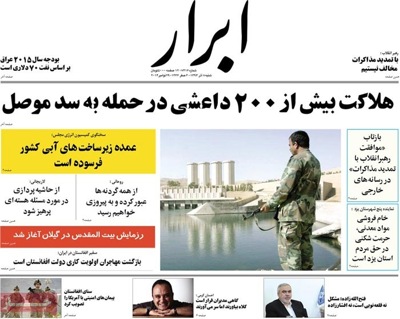
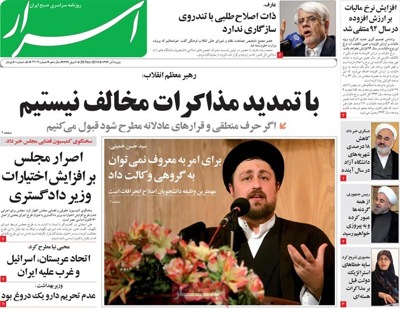
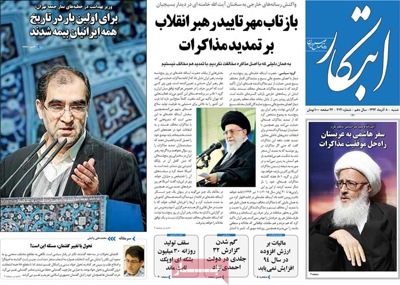
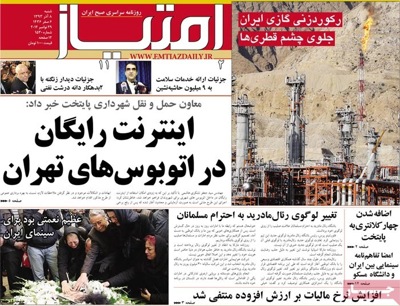
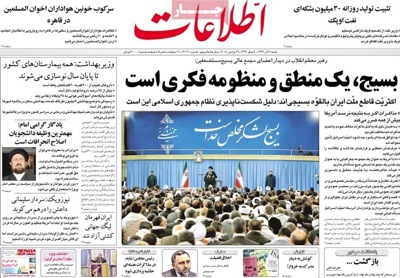
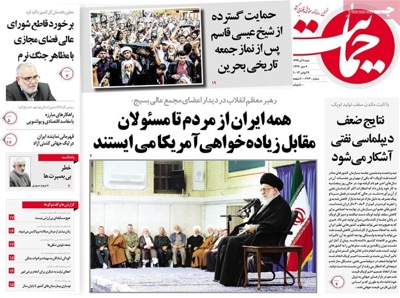
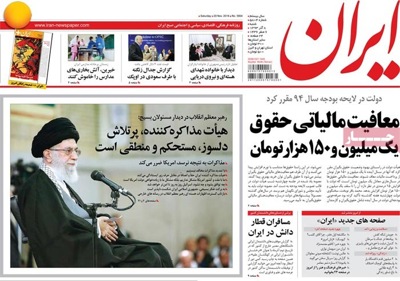
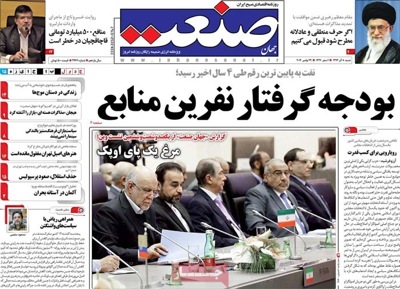
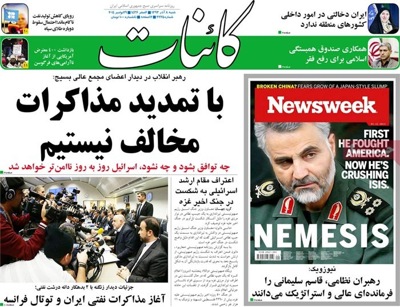
A look at Iranian newspaper front pages on Oct. 26

Iranian Newspapers Headlines

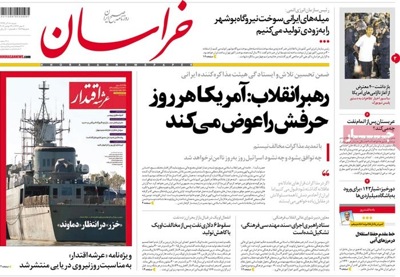
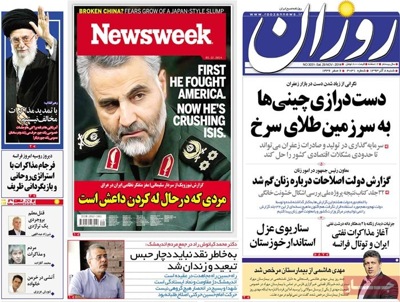
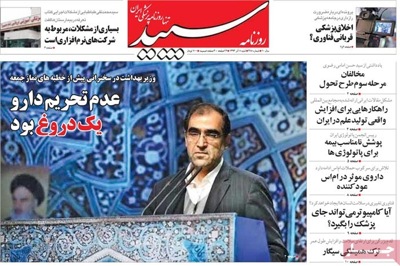
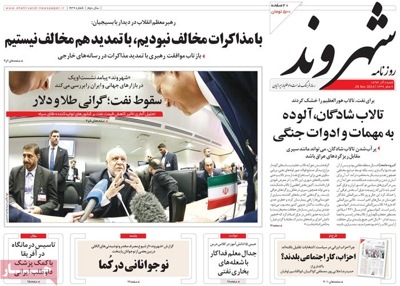
A memorial service for the late Ayatollah Mohammad Reza Mahdavi Kani attended by Islamic Revolution Leader Ayatollah Seyyed Ali Khamenei was placed by several newspapers on their front pages. Also in the news were remarks by senior nuclear negotiator Seyyed Abbas Araghchi that Iran won’t step back from its atomic rights as well as a message by Chairman of the Expediency Council Ayatollah Akbar Hashemi Rafsanjani to the Saudi King on the death sentence for top Shiite cleric Nimr al-Nimr. The ramifications of recent acid attacks in Isfahan and the Cabinet’s report on illegal scholarships granted by the science ministry of the previous administration also made headlines in a majority of newspapers on Sunday.

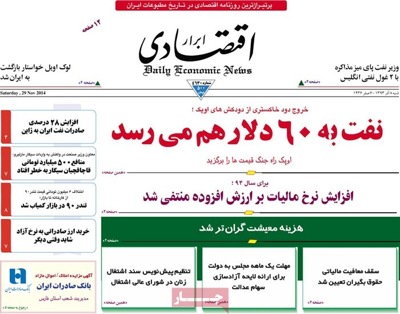
Abrar-e Eghtesadi:“Italy only buys crude oil from Iran,” is the banner headline of the daily quoting Italian authorities on trade with Iran.

Abrar-e Eghtesadi: “Housing market is lifting itself out of the depths of stagnation.”

Abrar-e Eghtesadi: “Utility prices are likely to be raised next year.” The energy minister has put forward a plan for the next Iranian calendar year (starting March 2015) to raise the fees Iranian households and businesses will have to pay for electricity and water.


Abrar eghtesadi newspaper_10_26


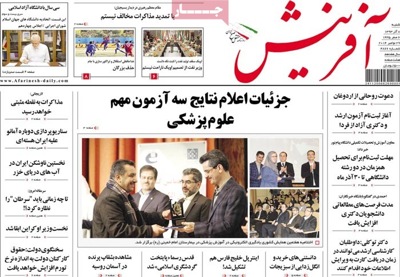
Afarinesh: “Those who have made Iran-140 passenger planes should be held accountable,” said Tehran’s Public and Revolutionary Courts Prosecutor.


Afarinesh newspaper_10_26


Afkar reports that around $8 billion in loans will be granted in two phases to small industries.

Afkar: “Iran will not retreat even one step from its nuclear rights,” said Iran’s Deputy Foreign Minister Seyyed Abbas Araghchi.


Afkar newspaper_10_26


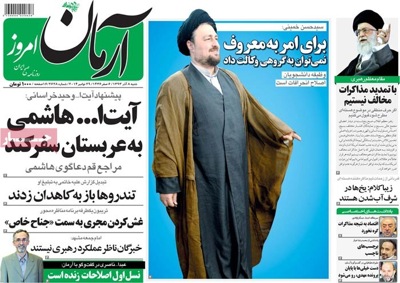
Arman-e Emrooz: “[Fatemeh] Fatemeh Motamed-Arya is on her way to Oscars,” writes the daily. The famous Iranian actress has a [leading] role in Nabat, directed by Azeri filmmaker Elchin Musaoglu which has been nominated for the Oscars.


Arman newspaper_10_26


Asia: “As many as 46 giant Italian firms are to return to Tehran shortly,” said the chairman of Iran-Italy Joint Chamber of Commerce.

Asia: “Iran will not accept sanctions to remain in place, not even one of them,” said Iran’s senior nuclear negotiator, Seyyed Abbas Araghchi.

Asia: “A train carrying American tourists is due to arrive in Iran.”

Asia quoted First Vice-President Eshagh Jahangiri as saying that the stage is being set in Iran to take in more and more foreign investment.


Asia newspaper_10_26


Asr-e Eghtesad: “Iran will not have a budget deficit in excess of nine percent this year,” said the chairman of the Planning and Budget Committee of Iran’s parliament about the current Iranian year which ends on March 20, 2015.


Asreeghtesad newspaper_10_26


Ebtekar: The Leader of the Islamic Revolution has praised the Iranian team for their superb performance and the colorful medals they have won in the 2014 Asian Para Games in Incheon, South Korea.

Ebtekar: “Do not pin much hope on disqualification of reformists,” said Mohammad Reza Aref, a vice-president in Mohammad Khatami’s Cabinet, in comments aimed at principlists. His comments came in response to rumors that the Guardian Council is likely to disapprove the bulk of reformists contesting legislative elections due to be held in March 2016.

Ebtekar: “Let the dividers [among Muslims] be overcome with despair by overturning the death sentence of top Shiite cleric Nimr al-Nimr,” read a message by Chairman of the Expediency Council Ayatollah Akbar Hashemi Rafsanjani to Saudi King Abdullah.


Ebtekar newspaper_10_26


Eghtesad-e Pooya: “[Greek pianist, keyboardist, composer, and music producer] Yanni [Yuzon] is to make a trip to Iran.”


Eghtesad poia newspaper_10_26


Esfahan Emrooz: “The [Golden Eagle Danube] Express carrying European tourists has arrived in Isfahan,” wrote the daily, adding that more than 60 passengers from nine countries are on board the first European train to visit Iran.


Isfahan eroz newspaper_10_26


Etemad:“[The release of] a report on the scholarships was courageous,” said Ahmad Tavakkoli, a Tehran MP and a vocal critic of former President Mahmoud Ahmadinejad.


Etemad newspaper_10_26


Ettela’at: “The collegiate community has welcomed the release [by the Iranian Cabinet] of a report on [illegal] scholarships.”

Ettela’at: “Iranian pensioners will not be charged for the healthcare services they receive as of mid-November.”


Ettelaat newspaper_10_26


Hambastegi: “Reformists will have a strong presence in the upcoming parliamentary elections,” said Mohammad Reza Aref, the chairman of the Omid Iranian Foundation.


Hambastegi newspaper_10_26


Hemayat: The Judiciary chief has tasked his deputy Gholamhossein Ejei to follow the case involving a spate of acid attacks in Isfahan.


Hemayat newspaper_10_26


Iran: “The water level at the Lake Urmia has risen by 23 cm following a recent rainfall in the region.”


iran newspaper_10_26


Jahan-e Sanat: “Indictments have been issued for three of those implicated in [Babak Zanjani’s] oil case,” said Tehran’s Public and Revolutionary Courts Prosecutor Abbas Jafari Dolatabadi.

Jahan-e Sanat: “Talks are held between FAO and Iran’s agriculture minister.” The UN Food and Agriculture Organization has plans to fight drought in Iran.


Jahan sanat newspaper_10_26


Jamejam: “If acid attacks are meant to terrorize the public, they amount to Moharebeh [waging war against God],” said Seyyed Ebrahim Raeisi, the prosecutor general.


Jame jam newspaper_10_26


Kayhan: “The decision to grant scholarships to students without requiring them to take tests was made by the science minister of the Reformist cabinet [of President Mohammad Khatami].” The daily is taking a jab at the government of President Rouhani for releasing the names of individuals who were granted the scholarships when President Ahmadinejad was in office.


Kayhan newspaper_10_26


Mardomsalari: “Iran will not be the party to leave the [nuclear] negotiating table,” said Ali Akbar Velayati, the foreign policy advisor to the Supreme Leader and a former Iranian foreign minister.


Mardom salari newspaper_10_26


Shahrvand: “As many as 30 oil tankers have rolled over in Lorestan province over the last seven months, discharging several thousand liters of oil into the province’s soil and water resources.

Shahrvand: “Iranians buy 400 tons of gold annually,” reads the daily’s headline, saying that Iran is one of the world’s top six gold consumption hubs.

Shahrvand: “Good nutrition and health have taken the place of a planned rise in subsidies,” said Vice President Eshagh Jahangiri, referring to the cash handouts the Iranian government pays each month to qualified families.

Shahrvand: “The Saheb Gharani-e Palace (in Niavaran Complex) has developed cracks.” Reports have come out in recent days that big cracks have run up the northern flank of the Mirror Pavilions of the palace.


Shahrvand newspaper_10_26


Sharq: “Untold stories about the assassination of a banker of Iranian origin in Malaysia,” is the daily’s banner headline, shedding light on the mystery death of Hossein Ahmadnejadi, a 75-year-old Iranian-Bahraini, who was shot dead in a parking lot on July 29, 2013 when he, accompanied by his wife, was departing a Chinese temple in Kuala Lumpur.

Sharq: “The first Iranian chess player who has bagged a silver inWorld Youth Championships” wrote the daily saying that Sara Sadat Khadem al-Sharieh, the Iranian master, finished second in the World Youth Chess Championship 2014 held in Pune, India (October 5-20).

Sharq: Young scholars from 46 countries are studying Islamic lessons at Al-Mustafa International University in Mashhad.


Shargh newspaper_10_26


Tehran Times: “US NGOs urge Congress not to sabotage Iran nuclear talks.”


Tehran times newspaper_10_26


Iran, Russia Plan to Use National Currencies in Bilateral Trade

Iran-russia
Iran-russia

A senior Iranian lawmaker announced that Tehran and Moscow have a plan to replace the US dollar with their national currencies in bilateral transactions.

“Replacing (the US) dollar with ruble in bilateral and multilateral transactions between Iran and Russia tops the agenda of the upcoming visit of an Iranian delegation to Russia,” member of Iran-Russia Parliamentary Friendship Group Hadi Qavami said on October 25.

Qavami pointed to an upcoming visit of Iran-Russia Parliamentary Friendship Group to Moscow, and said, “The Russia-Iran parliamentary friendship group has recently visited Iran and now the visit of the Iranian delegation will take place at the invitation of the Russian side.”

He noted that the Iranian delegation will discuss setting up banks along Iran-Oman border in a bid to facilitate changing Iran’s oil payments to ruble and rial and to reduce the pressure of sanctions.

In the last several years, Iran and Russia have had vast cooperation in different fields, especially in political and economic spheres.

The two states also enjoy special positions on the international scene and have long had constant and regular consultations on key regional and global issues.

Isfahan is a model of peaceful coexistence among followers of divine faiths

World Armenians Leader

The Spiritual Leader of the World Armenians Archbishop Jasliq Aram I says Isfahan is a textbook example of peaceful coexistence among followers of monotheistic faiths.

Khabar Online on October 20 covered a news story about a meeting between the Archbishop and Isfahan’s Governor General Rasoul Zargarpour during which the former focused, among other things, on good-neighborliness among people with different religious backgrounds. The following is the translation of the report:

The spiritual leader of the World Armenians said that Isfahan offers a typical example of how followers of monotheistic faiths can live peacefully alongside each other in Islamic countries.

He said that if Tehran is the political capital of Iran, Isfahan is Iran’s cultural and civilizational center, stressing that those who have not visited Isfahan can be said not to have seen Iran at all.

The governor general, for his part, said Isfahan is the focal point of monotheistic faiths, adding that the secretariat of the Monotheistic Religions is acting in full swing.

In light of the fact that Armenians and Muslims live closely together in Isfahan with mutual respect, he said peaceful coexistence between followers of monotheistic religions is a source of pride for this city, adding that we are ready to revive the Safa Khaneh Community [an old congregation hall located in a predominantly Christian neighborhood of Isfahan where followers of divine faiths used to gather for debate] in this historic city.

The governor general thanked the archbishop for his positive take on what is happening in Iran and for his support for Iran’s regional and international stances and said Iran’s realties are slanted in Western media, urging efforts to bring down the curtain on publicity campaigns against Iran.

Zargarpour then touched on the question of Islamic State of Iraq and the Levant (ISIL) and said that ISIL is the biggest headache for the Middle East.

He said efforts to take on and destroy the terrorist group will misfire in the absence of Iran, adding that it is good that Lebanon has firmly stood up to ISIL militants.

The remarks by the spiritual leader of the world Armenians are indicative of realism and idealism of Christianity, he said, adding that celebrations to mark the 350th anniversary of Vank Church in Isfahan also show that a deep bond exists between Armenians and Iranians.

The meeting comes ahead of a Sixth International Conference of Monotheistic Religions which is to be held in Isfahan in February 2015. Representatives from the Muslim community as well as religious minorities namely Armenians, Assyrians, and followers of Judaism, Zoroastrianism and the Sabians are to attend the interfaith gathering.

Sa’adi, Cervantes to be honored in Madrid

Sa’adi-Cervantes
Sa’adi-Cervantes

The Complutense University of Madrid (UCM) will host Sa’adi and Cervantes Conference on October 28-29 with Iranian and Spanish academicians attending.

Ali Asghar Mohammadkhani, the manager of Shahre Ketab (City of Book) International and Cultural Affairs elaborated on the upcoming conference and said, “Shahre Ketab hosted the ceremony to honor Sa’adi and Cervantes on April 21-22 on the occasion of Sa’adi National Day, and we planned a Madrid conference as well to be held in late October in Complutense University of Madrid (UCM). The conference is a concerted effort by Shahre Ketab International and Cultural center, the Center for Sa’adi Studies, Iran’s cultural attaché in Madrid, and UCM, where 11 literary historians and critics will deliver lectures on Sa’adi and Cervantes.”

“Iranian delegation will be in Cervantes’ birthplace in Alcala at the invitation of the University of Alcala, and will have meetings with Spain’s contemporary poets and literary figures. The delegation will also meet Persian literature professors in Madrid and Barcelona Universities,” he concluded.


A look at Iranian newspaper front pages on Oct. 26


Iranian-Newspaper-Headlines

Radicalism will return to the US and Europe (Part Two)

isis-control-map
isis-control-map

On October 12, Khabar Online posted an analysis of the current state of affairs in the Middle East followed by an interview with political science researcher Dr. Davood Feirahi which mainly revolves around the emergence of the Islamic State of Iraq and the Levant and the crisis which has swept the region. A few days ago we posted part one of the interview on our website. The following is PART TWO of the translation of the interview conducted by saeid jafari:

Basically, why hasn’t a kind of acquiescence to and tolerance of others surfaced in the Arab Middle East and among different religious groups? Having faced many challenges, Europe finally stepped into the right path, but the Shiites and Sunnis have yet to control their intragroup conflicts, despite the fact that they have had numerous experiences. Today we can see that such conflicts have grown [between the Shiites and Sunnis] and have heightened a sense of otherness instead.

Religious conduct is not viewed as sophisticated only because it is religious, something whichcan be seen in the Middle East. The military system, municipalities, education [agencies] and governments in the region are engulfed by tension and are not developed, neither is the religious conduct.

Islam has yet to display a behavior like what happened between various religious groups in Europe and America, and to engage in dialogs which are intended to identify conflictive aspects of the religion. The bone of contention between the Shiites and Sunnis is not stronger than the rift among Catholics, Protestants and Orthodox Christians. One reveres the Pope as a saint and the other disbelieves in his sanctity, whereas Muslim differences are not as stark as Christians’.

Nonetheless, they began to work on their common ground and managed to carry on their debates. Unity among religious denominations is an idea which has failed to grow into something beyond an ideal, and its executive mechanisms have yet to be hammered out.

Therefore, each year we see several theatrical meetings between Shiite and Sunni clerics which end inconclusively. In other words, we have been unable to take even one step toward patching up our differences and as a result we see the literature of negation come to the fore in a tense society.

A process of religious convergence is what is direly needed in such countries, a process which should get three things done simultaneously to help religious development occur. One is for convergence within religion. The second aims to strengthen common literature among religions, something which hasn’t been appreciably successful. The Shiites and Sunnis have failed to take a remarkable step in this regard. When convergence with Sunnism is missing, those who opt for particularism would take the most out of the small holes [created due to the absence of convergence]. And the third is convergence among global religions.

The stunning point is that we can tolerate different religions, but our tolerance does not apply to the denominations of Islam. We have yet to receive training to live peacefully alongside each other. Online videos released by ISIL show that one Arab was enslaved by the militants for having a turbah [or Mohr which is a stone for prayers] in his home.

That’s why it should be said that the Middle East needs development of religious conduct more than any other places and as long as such development is nonexistent, the development of other sciences and technologies would touch off still more divisions and massacre, and would fail to preserve order.

Development of religious conduct, I think, is the Achilles’ heel of democracy in the Middle East. Any solution to this crisis would be a nonstarter unless society becomes more or less democratic. This won’t take place unless the religious conduct is developed, a cycle which is still conspicuous by its absence in the Middle East.

Consequently, we are a long time away from the stage at which we can talk about a type of religious convergence; there are some groups and voices which heed such a point, but they don’t have the needed tools at their disposal. For instance, when the tools are democratic, the democratic interpretations could smooth the way more easily, but when violence serves as a tool and a certain government resorts to violence to attack its opponents, naturally the opposition takes up arms to counter the government. Thus, when the government tries to justify its acts legally, the other side too takes advantage of religious tenets.

What Iraq went through when [former Prime Minister Nouri] al-Maliki was in power showed that as the government overlookedthe Sahwa, [the Sunni] Awakening movement(s), and even disarmed them, Mosul fell easily. As we know, Mosul is the place forces affiliated with the Baath Party hail from, and news streaming from the flashpoint city revealed that Mosul did not come under attack from the outside, rather it imploded.

It is interesting to know that people in Mosul joined ISIL and swelled its ranks. This indicates that wherever a government resorts to such tools, the opposing groups display such behavior. These groups had previously joined battle against Al-Qaeda, and the 70,000-plus Sahwa fighters pushed back Al-Qaeda, whereas Maliki back then was much weaker than now. At the time, the Sahwa movement and the like managed to force Al-Qaeda to retreat to Raqqa.

So this brings us to the conclusion that we need democracy, something which could be established through nothing but religious development. This is the most complicated part of the DNAof developments in the Middle East. Religious development is a must. In case religious reforms are not introduced and religious convergence is not practiced, regional conflicts will use religious wording and, above all, a negative picture – say the blackest in history – will be painted of Islam among other civilizations.

If so, nobody would ever look at this region as a place which has an idea to put forward and talk about. It would be regarded as a region which should be suppressed in order to stay calm, something which would authorize them to be permanently present in the Middle East. And when they are asked to leave the region, they respond, “What happened when we last left the region? Has the situation changed for the better or for the worse?”


What should be done to have development in religious conduct materialized?

The matter in question should be weighed from an expert’s point of view and not from a political perspective. By the latter I mean a perspective in which our analysis relies on antagonistic behavior and conflict. If you go down this path, you will be caught in the trap the enemy has set for you, and there will be no remedy.

In this region, events unfold based on how conflicts are dealt with. For example, Iran says ISIL is what the West has produced and the group is a problem of the West’s own making. ISIL militants claim that Iran is working hand in glove with the US.

Topics as such would inflame the conflicts. For starters, this phenomenon should be recognized as an internal disease of the world of Islam and we need to analytically study the true origin of such a disease. In fact, we cannot solve the problem through expressing strong antagonism.

It is no secret that Western countries have, knowingly or unknowingly, left their mark on this crisis, knowingly on the part of those who have created these currents to eliminate their rivals from the political scene, and unknowingly by those who have feared something and now pour down their bombs on this region unmindful of the fact that such measures bear no fruit. Quite the reverse, these measures will scatter the seeds of radicalism at a micro level. It is more than hard to fully control micro-radicalism from a political angle.

We have to admit that Westerners have left negative impacts on this phenomenon, whether intentionally or unintentionally. I would prefer to crack down on ISIL if I were given a mandate today to call the shots. But the crackdown seems to have more consequences.

This holds true, especially because these groups are smart; they do not gather all in one place so that you can readily drop bombs on them. The large number of bombs that have rained down on ISIL militants inflicted light casualties on the so-called Islamic State (IS). This demonstrates that ISIL has evacuated any location it presumes to be a likely target.

ISIL may fill their trenches with humans; they may fan out in cities and houses. So the death of an ISIL fighter could cost a number of civilians their lives. There will be collateral damage. And more importantly, convincing people who have lost their loved ones in these attacks is not an easy job. We need to start to work for a solution to this problem and we’d better tackle the issue like a firefighter who tries to discover the source of the blaze first.

Where do you think this fire originates from?

I think the source of fire is inside the Muslim community. Some events have taken place in the Muslim community where certain orientations have been adopted and these incidents have ignited the flames of the fire. Therefore, it would be of no use if you kill people, no matter how many of them. [If one is taken out] Nothing happens except for the emergence of a second Caliph succeeding the current IS caliph [Abu Bakr al-Baghdadi]. The ideology would live on until it erupts into flames somewhere else.

The source of this fire should be spotted, and here the source is a lack of democracy, authority and the absence of a channel through which opposing voices could be heard loud and clear. The case in point is when voices are silenced in a society; the muzzled critical voices would make themselves heard through the barrels of guns instead of airwaves.

This is all because of the security atmosphere failed states have created in society. The critical voices get disappointed by the governments’ case-by-case, slow-paced, reforms, and take aim at thecore principles of governments.

A person who kills himself is said to suffer from insanity, but when suicide is committed in strength, there should be a reason behind it. This reason should be established. Now that people in big numbers stage suicidal operations, something must be done about it.

You said that the only solution lies in efforts to bring in religious development and help religious denominations digest [the viewpoints of] each other. In some places like Lebanon different faiths and denominations are living together and have good ties with each other, but their country is always hit by some sort of unrest. Well, if religion offers the answer, why hasn’t it done so in Lebanon?

As far as Lebanon is concerned, one can say that this country has no serious problem if the problems Israel creates die down. Often times the crises Palestinians go through and the operations Israel mounts drag Lebanon into the conflict. The same thing has now happened in northern Turkey, something which is bringing the country’s Kurdish-held areas closer to a highly explosive point.

Let’s assume that the Associative Democracy is fragile in Lebanon, but it is, in any manner, much better than disorder. The fragility in question has something to do with those interferences. The Lebanese government has begun to turn the Hezbollah [Movement] into a political current, trying to incorporate it into the cabinet and maintain its own integrity. However, this did not occur in Iraq where the integration of the Sunnis into the government did not come true. In default of integration, the Sunnis were marginalized and took up arms.

It is true that Hezbollah is seriously under the influence of certain regional countries, but its national identity has been further highlighted ever since it has been given more political weight. So the convergence that exists between followers of different faiths and denominations in Lebanon amounts to deterrence. Big pains are said to have simple cures. One should not necessarily go after complex methods to treat great pains.

In Lebanon when a Shiite holds a gathering in which a Sunni and a Christian take part, he cannot celebrate the killing of Umar [a Sunni Caliph who took over after the demise of the Prophet]. In other words, the organizer lets go of his radical positions. The same thing holds true for the Sunnis. This way a mutual tie is established [between the followers of different beliefs]. This is very simple. These dialogs have helped Lebanon maintain its integrity to some extent.

Another example is Tunisia which successfully restored order in the post-Ben Ali period despite riots which were raging in the country. In Egypt, however, extremist moves by the Muslim Brotherhood that was overjoyed [about its victory] disrupted the affairs.

You mentioned that the Middle East is the focal point of the crisis, whereas we’ve heard in the news that the European and US nationals who have joined ISIL account for the bulk of the group’s fighters. The question is whether this crisis is really confined to the Middle East or a war has been waged affecting areas beyond this region?

I said a phenomenon has emerged which is called migration. Those immigrants, even if they are the third generation, show sympathy for the region. The further you go away from the center of religion, the more serious your religious prejudices would become. This has been proved empirically. It means that radicalism is seen in immigrant youth more than in local people, because they only see a very idealistic picture of what is not satisfactory in their place of living.

In like manner, an Iranian paints an idealistic image of the West in his mind which does not match the reality. Therefore, these young men look at the ideals through realities of the region and feel that they should do something to create a hub in the region.

When religious enthusiasm and youthful energies go hand in hand with social crises, the result would be a lot of uproar. Those people who are away feel that they should return to the region. When they are back, they treat locals as strangers, and not insiders. They argue that they should have done something if they had been true Muslims. They head for this region and resort to violence.

Given the current trend, we should wait to see the birth of a new group, even more violent than ISIL, in the foreseeable future just like today that we have seen the emergence of the so-called Islamic State which is far more radical than al-Qaeda.

It seems that violence will reach its extremity, but I believe that violence cannot curb radicalism. Some believe that the Westerners have created an atmosphere and a proper place allowing terrorists from Europe and the US to come to the region in order to destroy them all. This is the belief of those who say the US is to blame for ISIL.

Well, this fails to uproot a dangerous ideology and only some agents are eliminated, but that dangerous belief would take root in societies.    

That’s right. According to the supporters of this theory, this trend would at least delay the re-concentration of forces. Conversely, others are of the opinion that these are some tools to justify the 2011 decision, referring to the time when the Americans failed to build a consensus for attacking Syria.

Now such a trend can disrupt regional governments or cause the infrastructure of these systems to be badly damaged, at the minimum. To some, these groups are linked with MI6, Mossad, and the US intelligence agencies. They say the group continues to perpetrate violence to a predefined level and then interventions stop this trend. But this sounds to be based on conspiracy-based theories.

Another viewpoint says that what is going on is linked to the crisis in Saudi Arabia. Some argue that the radical forces that had gone to Afghanistan came back to Saudi Arabia after a national unity government was formed there and started to provoke a crisis. So Saudi Arabia tried to create a vacant region for them to keep them occupied.

Personally I think all these views could be the reason, but the fact is that the region is set for such a phenomenon. We need to find out where it comes from and review its effects.