Saturday, December 27, 2025
Home Blog Page 5028

Ayatollah Khamenei stresses unity among Muslim states

Iran-Leader
Iran-Leader

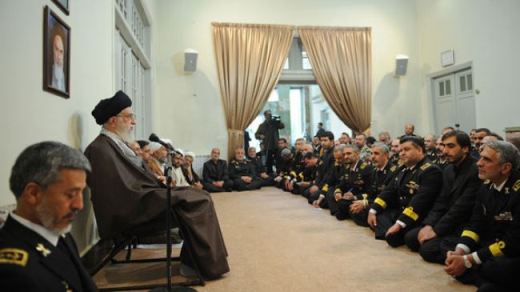
Leader of the Islamic Revolution Ayatollah Seyyed Ali Khamenei has underscored the need for unity among all Muslim countries amid enemy plots to create rift in the Islamic Ummah.

Addressing a group of Iranian Hajj officials in Tehran on Tuesday, Ayatollah Khamenei described Islamic unity as “the Islamic Republic’s fundamental slogan”, which means that Muslim states should set aside enmities and stand by each other in dealing with key global issues.

The Leader further described Hajj pilgrimage as an opportunity that must be seized in order to foil enemy plots, which are hatched to separate Iran from the rest of the Muslim world.

“Raising a barrier between the Islamic Republic [of Iran] and the rest of the Muslim world is one of the ploys [used by] the enemies of unity in the Islamic Ummah,” the Leader stated, adding that every Muslim is obligated to make efforts to help raze this “fake barrier.”

Ayatollah Khamenei also warned of false enemy propaganda aimed at spreading illusions about Iran and Shia Islam.

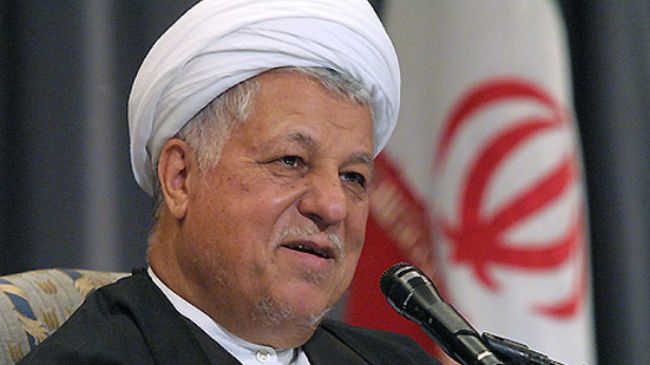
Rafsanjani denies reports he is unwilling to become chairman of Assembly of Experts

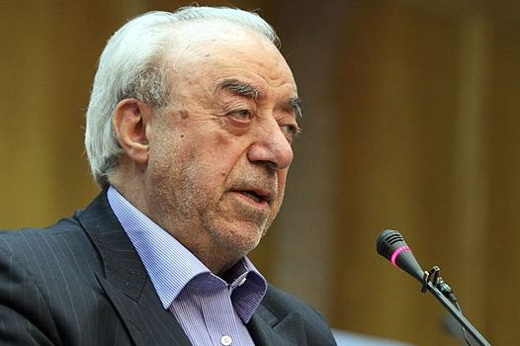
Hashemi Rafsanjani
Hashemi Rafsanjani

One day after Ayatollah Ahmad Khatami, an influential member of the Assembly of Experts, said Ayatollah Rafsanjani seems unwilling to take over as chairman of the assembly, Hashemi Rafsanjani, a former president who led the assembly until March 2011, said he would field his candidacy for the post if individuals he deem unfit for the top job threw their hats in the ring. The following is a brief announcement which appeared on the official website of Ayatollah Rafsanjani (hashemirafsanjani.ir):

A source close to Chairman of the Expediency Council Ayatollah Hashemi Rafsanjani has denied the statement of another member of the assembly [a reference to Principlist Ayatollah Ahmad Khatami] that Rafsanjani seems unwilling to run for chairman of the assembly.

“In response to a question as to whether he would run for the top job at the Assembly of Experts, Ayatollah Rafsanjani has simply said, ‘In case individuals I deem unfit make a run for the chairmanship of the assembly, I would field my candidacy too,'” the source said.

[The top job at the Assembly of Experts was vacated last week when Ayatollah Mohammad-Reza Mahdavi Kani passed away after slipping into a coma in early June.]

Two key capital owners whose biggest asset is the trust of a nation

Haft-e Sobh-Zarif-Soleimani

In an article on October 21, Haft-e Sobh, a Tehran-based daily, described Foreign Minister Mohammad Javad Zarif and Ghasem Soleimani, the commander of the Quds Force, a division ofthe Islamic Revolution Guard Corps, as the biggest capital owners of the country. The following is the translation of the article by the daily’s Kamal Bordbar:

These two individuals are the biggest capital owners in Iran. At an important juncture in the history of the region when all neighboring countries are grappling with war and unrest and Iran is subjected to all kinds of foreign threats, these two individuals who reflect the diplomatic potential and the military prowess of the nation are accumulating their capital by the day.

The representatives of these two important state institutions – the diplomacy machine and the military – did not have this much capital for years. The capital in question does not come in the form of dollars or oil. It is made of trust, unprecedented social trust which is building around these two representatives of our nation on the international stage at a time when the region is going through tough times.

One year ago when Mohammad Javad Zarif started running the nuclear marathon his optimistic assessments about the talks and the unraveling of sanctions drew pessimism from principlists and those who adhered to the faith more strictly. But the middle-class was expecting this mild-mannered, active man to pave the way for more acceptability of its ideas on the international stage.

On the other hand, principlists, radicals and more religious strata of society pessimistically sought traces of compromise in the way Zarif handled the talks. The telephone conversation between Presidents Rouhani and Obama and images of Zarif smiling next to [US Secretary of State] John Kerry deepened that pessimism.

With the Syrian war flaring up, the middle-class supporters of Zarif looked on, in a way that was anything but confident, as Iran helped keep Bashar al-Assad in power. Regional and Western media propaganda depicted the opponents of Assad as selfless freedom-fighters who were putting their lives on the line for the liberation of their country. They also alleged that for totalitarian reasons Iran was cooperating with Russia and China to help Assad hold on to power.

It came as the principlists and orthodox Muslims were eagerly following news about the resistance Lebanese Hezbollah put up and the role Iranian Quds Force advisers were playing in relieving key Syrian cities under siege. Back then the line of diplomacy which was led by a hardworking diplomat who smiled readily and the military line led by a mysterious general were diverse. It seemed that social gaps in Iranian society were nowhere near closing and new excavations had widened the gap between the two groups.

One year on, things have changed. The same regional developments which were supposed to weaken Iran have resulted in unbelievable convergence. ISIL’s invasion of Iraq and animosity between Iranian society and this stone-hearted group which was the most powerful of three aligned against Assad spelled an end to illusions.

The freedom-fighters of the past were now a bunch of brutal beasts that readily beheaded and maimed humans. They used different methods to show the grudge they held against Shiites and even Iranians. When ISIL captured Jalawla, Iraq and positioned itself 40 km from the Iranian border, the same pessimistic middle class began to appreciate the international arm of the Islamic Revolution Guard Corps and the pacifying role of the white-haired general: Ghasem Soleimani.

That even shed light on the fact that Hezbollah was different from other militant groups in the region. That was how Soleimani secured the trust of new sections of society. That trust was not simply placed in him, but in the troops he commanded. And praise for his role began to pour onto social networking sites and peaked.

On the other hand, the skipper of Iran’s diplomacy ship proved that at critical moments in negotiations he would not submit to blackmail. The tireless diplomat emerged from one meeting only to go into another and put on the same smile, but his words were now tinged with traces of doubt and pessimism. He was now trying to counter the diplomatic attacks and saber-rattling of the other side. Those doubts which centered on the intentions of the Western side stemmed from his knowledge about what the other party had in mind.

Zarif and his men developed an increasingly coherent approach and cleared themselves of accusations they were too lenient. That was how the more religious stratum of society set aside the pessimistic lens through which they had always looked at this cheerful diplomat and concluded that the top diplomat and his men had no intention of selling Iranian national interests short.

At the same time the middle-class that supported Zarif realized that Iran had done nothing to push the nuclear talks into a deadlock. Other factors played a role in this gradual convergence too. The decline in the grandeur of Turkey, which depicted itself as an example of modern Islamism for years and a duplicate of Iran’s Islamic society, helped expedite the convergence in the country.

Turkey’s policy to help ISIL and its hypocritical indifference to the massacre of the Kurdish minority in Iraq and Syria at the hands of ISIL, coupled with its deadly crackdown on Kurds which left 33 people dead, revealed the unseen angle of Turkey’s Islamic liberal democracy in the court of public opinion in Iran.

This gradual, mild convergence has not remained hidden to others. There are still some media outlets overseas that put the slightest display of divergence in an ideological light and play up differences.

There are some quick-tempered radicals who pay no heed to the convergence that has formed in the country and to the critical stage the region is going through. They insist, with their trademark inconsiderateness, on ideological differences and describe any civil action as a conspiracy. Their reaction to the likely reasons behind what happened in Isfahan [a recent spate of acid attacks on women in this central city] was one such example. It was similar to their reaction last year to what was probably a mistake on the part of a famous elegist.

Developments overseas and the competence of our representatives on various fronts should be credited for convergence in our society and the unprecedented accumulation of social capital at home. Still, some foreign media and some at home are resorting to differences to beat the drum of division.

Back to the protagonists of our story: At a time when the region is witnessing bloodletting and war, these two men enjoy unprecedented popular support. On diplomatic and military fronts, these two individuals are representing the dreams of millions of Iranians to make the world a better place.

Iranian police arrest 10 suspects over Isfahan acid attacks

Esfahan Provincial Governor Rasoul Zargarpour

Iranian security forces have apprehended 10 suspects in connection with a recent spate of acid attacks against women in the central city of Esfahan.

“So far, ten suspects have been identified in connection with acid attack in the province and are being interrogated by the police,” Isfahan Provincial Governor Rasoul Zargarpour was quoted as saying by IRNA on Monday.

The official noted that an operational committee has been set up at the police department in addition to a special headquarters at Isfahan Justice Department to identify the perpetrators and deal with legal aspects of the issue.

Zargarpour said four cases of acid attacks were reported in Isfahan from September 6 to October 15, noting that the incidents had nothing to do with women wearing improper hijab.

Reports of the acid attacks against women in Isfahan have triggered grave concerns among the public and led to widespread speculations in the press and social media.

Iranian President Hassan Rouhani instructed three ministries on Thursday to step up efforts to find those behind the attacks.

Rouhani tasked the ministries of the interior, intelligence, and justice with investigating the sensitive case.

On October 20, Iranian Judiciary Spokesman Gholamhossein Mohseni Ejei pledged serious and prompt action against the attacks.

Terrorism, extremism more dangerous than Ebola: Rouhani

Iran-Rouhani-Belgium

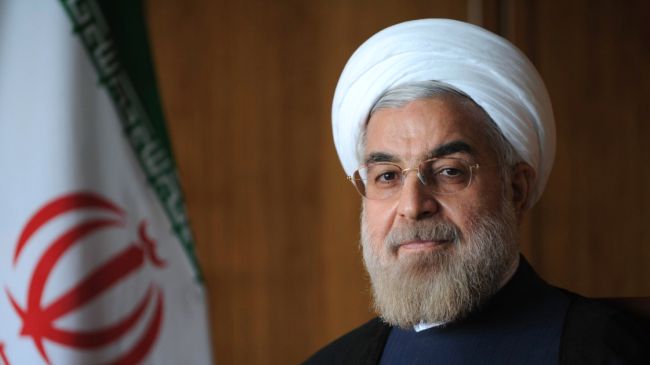
Iranian President Hassan Rouhani has described terrorism as a “disease” more dangerous than Ebola, expressing Tehran’s readiness to help contain the threatening phenomenon.

“The diseases of terrorism and extremism are much more dangerous that Ebola,” President Rouhani said at a meeting with the Belgian Ambassador to Iran Francois del Marmol on Monday.

Rouhani called the escalation of terrorism in the region a “menace,” and said that the only solution to the problem would be “consultation, coordination, and cooperation among countries.”

“The Islamic Republic of Iran is ready to consult with all influential countries in this regard.”

Rouhani also touched upon the ongoing nuclear talks between Iran and six world powers to reach a final deal on the Islamic Republic’s nuclear energy program, saying, “If there is a serious political will among the sides [involved] in the negotiations, a final comprehensive agreement can be reached within the remaining time.”

He further noted that the outcome of a comprehensive deal on Iran’s nuclear energy program will be a “win-win for all sides.”

Rouhani also underlined the peaceful nature of Iran’s nuclear activities, saying, the fatwa (religious decree) by Leader of the Islamic Revolution Ayatollah Seyyed Ali Khamenei against the use of nuclear weapons is “the most important guarantee that Iran’s nuclear program is peaceful.”

The Iranian President also pointed to age-old relations between the Tehran and Brussels, saying, baseless pretexts, which have been behind cruel sanctions against Iran, should not harm the countries that have had good relations with Iran in the past.

For his part, the Belgian ambassador, who met with the president to submit his credentials, said, “Iran is a big and powerful country in the region and we want the expansion of ties” with Tehran.

He further expressed hope that sanctions against Iran would be lifted sooner, saying, “I hope with the removal of obstacles, we can see Belgian businessmen in Iran.”
[…]

A lifeline to victims of acid attacks

Shahindokh Mollaverdi

Vice President for Women and Family Affairs Shahindokht Molaverdi said Monday government is taking measures to help the victims of recent acid attacks in Isfahan. What appears below is the partial translation of a report by the Islamic Republic News Agency (IRNA) on her comments about the harrowing incident that has generated heated debate in society:

“The government is working out a plan to allocate a special budget to the treatment of the victims of recent acid attacks,” said Vice President for Women and Family Affairs Shahindokht Molaverdi.

In her 7th meeting with female consultants to executive institutions on October 27, Molaverdi congratulated Iranian female athletes on their stellar performance in the 2014 Asian Games and Para Games in Incheon, South Korea and said, “These women have only showcased part of Iranian women’s capabilities. We hope to witness more success by Iranian women in the future.”

These heinous acid attacks have entangled our society of late, she said, adding “These unfortunate incidents have dealt a blow to the physical, mental and social security of society.”

She went on to say, “After the ministers of interior, justice and intelligence handed in reports to President Rouhani on the incidents, the president was swift to condemn the inhumane attacks and ordered the case to be solved as soon as possible.”

Recalling efforts by the government from the get-go to solve the case, she pointed out, “A bill designed to stiffen penalties for those behind acid attacks is being crafted and will soon be sent to parliament. We won’t stand down until the truth is out.”

She quoted President Rouhani as saying, “Security is the cornerstone of growth and development, and we do not let it take a hit for any reason.”

She concluded that the government is trying to cut a deal with Iran Bar Association to use its potential in representing the victims of these attacks.

Final nuclear deal possible in one month: Rouhani

Iran-Norway-Rouhani
Iran-Norway-Rouhani

Iranian President Hassan Rouhani says a final nuclear deal between Tehran and the P5+1 group is possible within the upcoming deadline for the talks between the two sides, if the six world powers show the necessary political resolve in this regard.

In a meeting with Norwegian Ambassador to Tehran Odyssey Norheim on Monday, President Rouhani said Iran has taken very positive step in the previous rounds of nuclear talks with the five permanent members of the UN Security Council plus Germany.

“If [Iran’s] negotiating partners also show the necessary political resolve, it will be possible to reach a comprehensive agreement within a month,” the Iranian president added, emphasizing that Iran’s nuclear activities are completely peaceful and will remain so in the future.

“Our activities are within the framework of the Non-Proliferation Treaty and are carried out under the supervision and in the presence of the International Atomic Energy Agency’s inspectors,” Rouhani pointed out.

He added that the Iranian nation has the right to use nuclear energy for peaceful purposes, noting that a final deal and a win-win strategy would lead to the expansion of Tehran’s ties with all member states of the European Union.

The Norwegian ambassador, who submitted her credentials to President Rouhani, said Oslo recognizes Iran’s right to peaceful nuclear energy and expressed hope the nuclear talks would lead to a comprehensive deal by the November 24 deadline.

She added that Norway is determined to hold close consultation with Iran to solve regional issues and establish stability in the region.

[…]

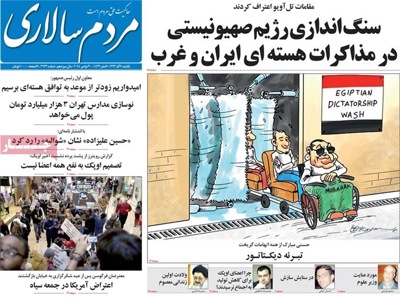
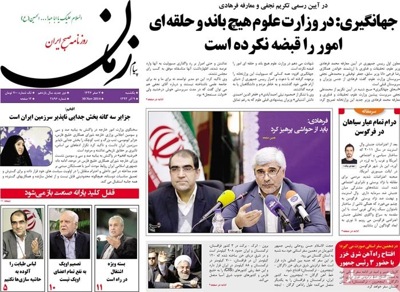
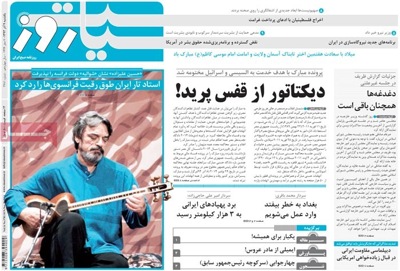
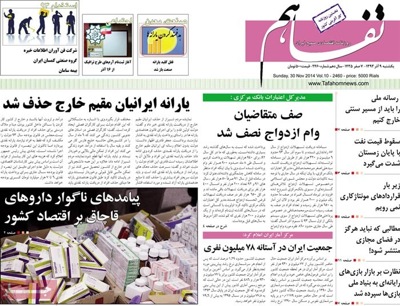
A look at Iranian newspaper front pages on Oct. 27

Iranian-Newspaper-Headlines

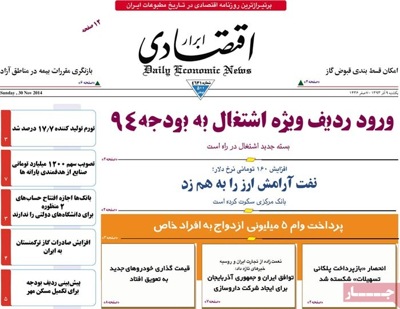
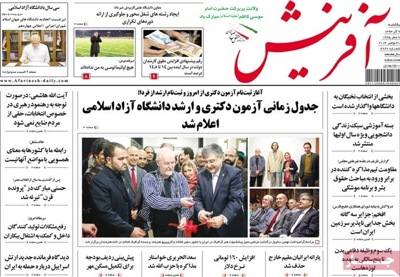
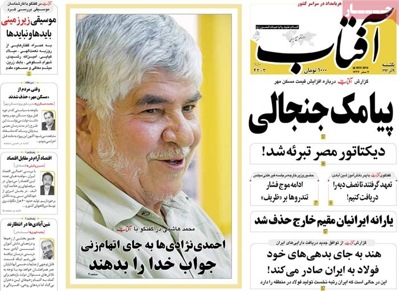
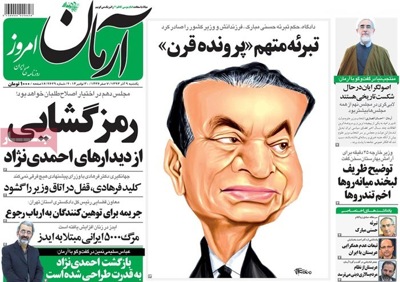
Comments by the heads of the three branches of government on a recent spate of acid attacks in Isfahan and remarks by the Supreme Leader in a meeting with the family of the late Habibollah Asgaroladi that “fatigue is not permissible when it comes to the struggle for the greater cause” dominated the front pages of a majority of Iranian newspapers on Monday. More controversy over illegal scholarships [granted to some students when former President Mahmoud Ahmadinejad was in office] was also in the news. The heavy defeats ISIL terrorists have suffered in Iraq and the likelihood of the impeachment of the minister of culture and Islamic guidance also made headlines in several newspapers.

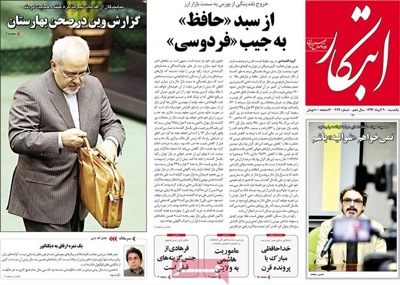
Abrar: “The viewpoints of the committee tasked with studying the effects of satellite jamming signals should be acted on,” urged Masoumeh Ebtekar, the director of the Environment Protection Organization.

Abrar: Peyman Moaadi – an Iranian actor, screenwriter, and director – has called for charitable screening of Camp X-Ray and dedication of its proceeds to the victims of the recent acid attacks. Moaadi has played Ali Amir in the 2014 American drama by Peter Sattler which opens with hiscapture and transportation to Guantanamo Bay.


Abrar newspaper 10 - 27


Arman-e Emrooz: “What should the Ministry of Science apologize for?” asked the acting minister. It came after Principlists urged the ministry to apologize for releasing the list of those involved in the illegal scholarships case. Words have spread that a complaint is to be lodged against the ministry.

Arman-e Emrooz: Representatives of President Rouhani paid bedside visits to Ayatollah Yousef Sanei, a former Guardian Council chairman. The Ayatollah is suffering from a gastric problem.

Arman-e Emrooz: “The public responsibility to promote virtue is limited to admonition,” said the parliament speaker.


Armane emruz newspaper 10 - 27


Asia: “Iran and the Netherlands are to establish a joint chamber of commerce.”


Asia newspaper 10 - 27


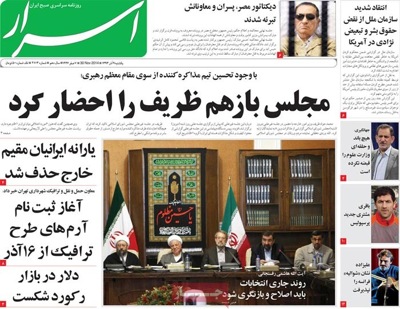
Asrar: “Iranian MPs are seeking to impeach the minister of culture and Islamic guidance.”

Asrar: “A hospital in Tehran will be equipped with equipment to [screen and contain] Ebola,” said Director of the Health Ministry’s Center for Management of Contagious Diseases Mohammad Mehdi Gouya.

Asrar: “We [reformists] will enter the parliamentary race with former President Mohammad Khatami playing a central role,” said Hossein Marashi, an Iranian reformist and a former vice-president.


Asrar newspaper 10 - 27


Eghtesad-e Pooya: “Efforts to lay down laws should not be politicized,” said Judiciary Chief Ayatollah Sadegh Amoli Larijani, expressing sorrow for certain local media outlets [which, as he put it, fan the flames of controversy over the acid attacks].


Eghtesade puya newspaper 10 - 27


Etemad: The Ministry of Science, Research and Technology has set a 100-day deadline for the repayment of fees received by those who have been granted illegal scholarships.

Etemad: “Yet another medal for Abbas Kiarostami,” reported the daily, saying that the Austrian president has given the Badge of the Austrian Decoration of Honour for Science and Art to the world-famous Iranian director.


Etemad newspaper 10 - 27


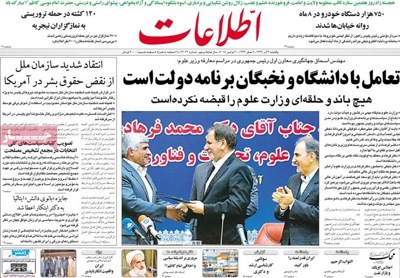
Ettela’at: “ISIL suffers heavy defeats in Iraq and Lebanon.” Abu Bakr al-Baghdadi, the [self-proclaimed] leader of ISIL, has ordered the terrorists to retreat from Lebanon and Kobani in Syria.

Ettela’at: “The case involving those implicated in granting scholarships to students [without requiring them to take tests] will be submitted to court”, said Mohammad Ali Najafi, the acting minister of science, research and technology.

Ettela’at: “The government will not rest easy until it arrests those behind the recent acid attacks in Isfahan. We will report to people any crime or question which may dent security in society,” said President Hassan Rouhani.

Ettela’at: “Select researchers have been awarded at a second Tahereh Saffarzadeh Scientific-Literary Award [in a ceremony in Tehran].”


Ettelaat newspaper 10 - 27


Farhikhtegan: “Mahmoud Nili Ahmadabadi will earn Iran international credit,” said a vice-chancellor of the Islamic Azad University about President Rouhani’s pick to lead the ministry of science.


Farhikhtegan newspaper 10 - 27


Haft-e Sobh: “The prime suspect in acid attacks in Isfahan is under interrogation,” wrote the daily, adding that deputy Judiciary chief Gholamhossein Mohseni Ejei has arrived in Isfahan to oversee the investigation into the tragic case.


Haftesobh newspaper 10 - 27


Hambastegi: “Iran will raise its oil production volume to 4.3 million barrels [per day],” announced the deputy oil minister.


Hambastegi newspaper 10 - 27


Hamshahri: “The imported camels are infected with coronavirus.”

Hamshahri: “The [hidden] threat plummeting oil prices pose to budget appropriation,” is the daily’s front-page headline which says that slumping crude prices have forced the Iranian government to review different scenarios to prevent a possible budget deficit before submitting to parliament the country’s spending package for next year (starting March 21, 2015).


Hamshahri newspaper 10 - 27


Hemayat: “Attempts to relate acid attacks to the question of virtue promotion are made by the Western and anti-revolution media to poison the atmosphere [in Iran],” stressed Ayatollah Sadegh Amoli Larijani, the Judiciary chief.


Hemayat newspaper 10 - 27


Iran: “It doesn’t matter if one is given a yellow card in their quest of [boosting] the culture,” said Minister of Culture and Islamic Guidance, Ali Jannati after being warned by MPs that he might be the next minister to be impeached.

Iran: “We should not be overcome by fatigue or exhaustion in the battlefield,” said Leader of the Islamic Revolution Ayatollah Seyyed Ali Khamenei in a meeting with the family of the late Habibollah Asgaroladi, a veteran Iranian politician.


Iran newspaper 10 - 27'


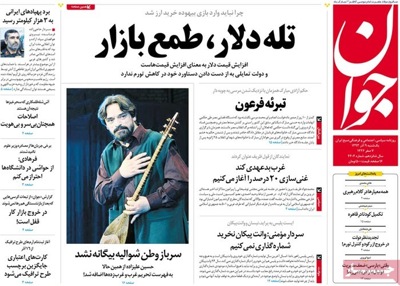
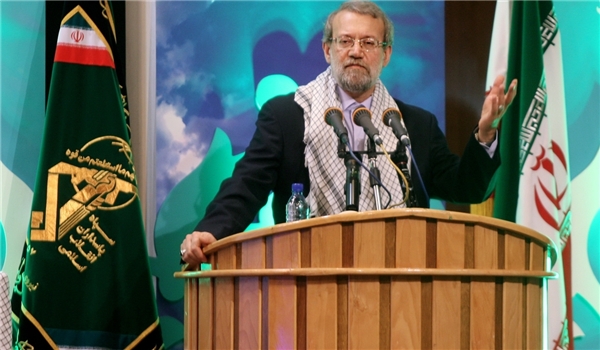
Javan: “Politicization of acid attacks is nothing but opportunism and political villainy,” said Parliament Speaker Ali Larijani.


Javan newspaper 10 - 27


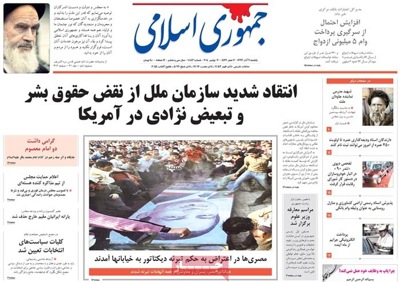
Jomhouri Islami: “Some 1,800 billion tomans (over $560 million) has been allocated to the coverage of medication used by patients with special diseases,” said a member of the board of directors of Iran Health Insurance Organization.

Jomhouri Islami: “The volume of trade with Iran will increase even if the existing sanctions remain in place,” said the president of the German Chamber of Commerce.


Jomhorie eslami newspaper 10 - 27


Kar va Kargar: “The public should rest assured that those involved in recent acid attacks will be dealt with seriously,” said the prosecutor general.


Karo kargar newspaper 10 - 27


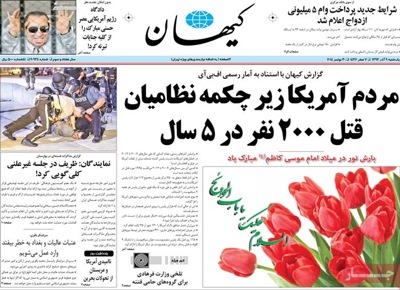
Kayhan: “Major General [Ghasem] Soleimani [the commander of the Quds Force] and the Ashura Operations he led demeaned the anti-ISIL alliance,”wrote the daily on the retaking of the city of Jurf Al Sakhar by Iraqi soldiers.

Kayhan: “Parliament will not endorse a minister who was not qualified to lead the University of Tehran,” wrote the daily, elaborating on the reaction by some MPs to the introduction of Mahmoud Nili Ahmadabadi by President Rouhani to take over the Ministry of Science, Research and Technology.


Kayhan newspaper 10 - 27


Roozan: “Ayatollah Hashemi [Rafsanjani] is the best choice to take the helm at the Assembly of Experts,” said Mohsen Gharavian, a member of the Society of Seminary Teachers of Qom.


Ruzan newspaper 10 - 27


Shahrvand: “A person threatening citizens with acid attacks has been taken to custody in the capital.”

Shahrvand: “The ministry of science could have dismissed as many as 840 students but showed tolerance,” said the acting minister of science, research and technology in reference to a number of students who were not qualified for scholarship but were granted anyway.


Shahrvand newspaper 10 - 27


Sharq: “Plans to introduce a single foreign currency exchange rate have been put on hold,” said Farhad Nili, the Director of the Monetary and Banking Research Institute (MBRI) at the Central Bank of Iran in an exclusive interview with the daily.


Shargh newspaper 10 - 27


Tafahom: “Iran will post record-breaking economic growth this year [ending March 20, 2015],” said Minister of Cooperatives, Labor and Social Welfare Ali Rabiei.


Tafahom newspaper 10 - 27


Acid attacks culprits to be dealt with harshly: Rouhani

Iran's President Rouhani

Iranian President Hassan Rouhani says his administration is pursuing the recent case of acid attacks on women with all its might, adding that the culprits will be harshly dealt with.

The Iranian president said in a cabinet session on October 26 that the three ministers, tasked with following up the case, had delivered their report to the cabinet earlier in the day.

Rouhani on Thursday tasked the ministries of the interior, intelligence, and justice with launching an investigation into the sensitive case after he was briefed about the attacks against young women in Isfahan.

President Rouhani also reassured the Iranian nation that his administration would leave no stone unturned in examining all aspects of the “inhumane” and “hideous” acts.

“The issue was an inhumane event, incompatible with any principles, and is the most heinous act that an evil person can commit in the society,” the president added.

Rouhani said the recent events in the central city of Isfahan were attempts to harm the country’s “national security and the administration will exert every effort for the establishment of security in the society.”

He added that his administration would do whatever it can to provide support for the victims of the attacks.

“No clemency” will be granted to the attacker or attackers and they will be given the maximum penalty, he further noted.

The president also warned against making “baseless accusations” against any particular person or group before the real culprits are arrested.

Reports of a spate of acid attacks against women in Isfahan have triggered grave concerns among the Iranian public and led to widespread speculations in the press and social media.

On October 20, Iranian Judiciary spokesman, Gholamhossein Ejei, pledged serious and prompt action against the attacks.

Iran Establishing Ebola Control Center

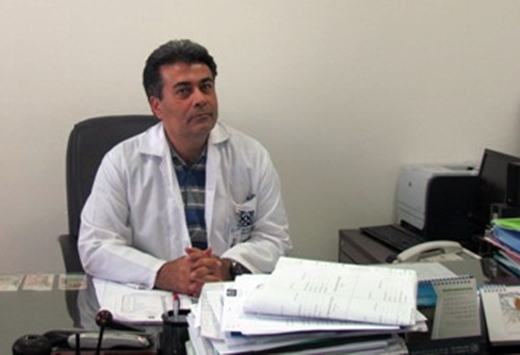
Mohammad Mehdi Gouya

Senior Iranian health officials declared on October 26 that they are working to equip a special hospital to fight any possible Ebola outbreak, adding that they are pleased to see no case of Coronavirus infection among the country’s Hajj pilgrims who have returned from Saudi Arabia.

“I can assure you that no case of Coronavirus has been reported among the Iranian pilgrims, but we have allocated a hospital for controlling Ebola disease”, if any case of infection is diagnosed, Head of the Health Ministry’s Center for Management of Contagious Diseases Mohammad Mehdi Gouya told reporters on October 26.

The official said although no Ebola case has been diagnosed in Iran, the ministry should develop a plan for setting up more potential Ebola control and quarantine centers.

On October 25, President of the Islamic Republic of Iran’s Medical Council (IRICM) Alireza Zali said that no case of Ebola virus contamination has been observed in Iran and no patient with such symptom of the diseases has been reported so far.

Zali said that medical system is fully ready to confront the epidemic.

“We are completely prepared to counter Ebola if any case is observed,” he said.

Earlier this month, Iranian Health Minister Seyed Hassan Qazizadeh Hashemi said that his ministry has done its best to immune the country’s Hajj pilgrims against epidemic diseases, including Ebola and Coronavirus.

“Although Ebola and Coronavirus diseases have been reported in Saudi Arabia, but there should be no worry about the Iranian Hajj pilgrims returning to the country,” Qazizadeh Hashemi said.

The health minister, meanwhile, reiterated that even if a case is observed the Health Ministry is fully prepared to do all necessary measures in a bid not to allow the disease spread.

The Hajj is an annual Islamic pilgrimage to Mecca, and a religious duty for Muslims which must be carried out at least once in lifetime by every adult Muslim who is physically and financially capable of undertaking the journey, and can support his family during his absence.

The World Health organization (WHO) in its latest report said that the number of cases in the Ebola outbreak has exceeded 10,000, with 4,922 deaths.

Only 27 of the cases have occurred outside the three worst-hit countries, Sierra Leone, Liberia and Guinea.

Those three countries account for all but 10 of the fatalities.

Mali became the latest nation to record a death, a two-year-old girl. More than 40 people known to have come into contact with her have been quarantined.