Wednesday, April 8, 2026
Home Blog Page 5027

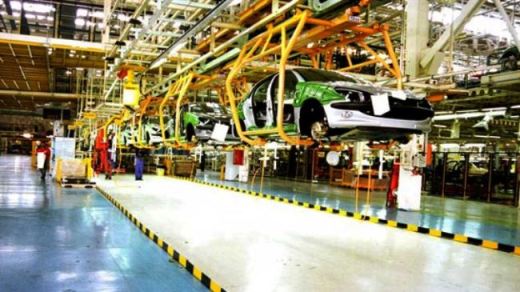
Iran hosts int’l auto parts exhibition

Iran-car-exhibition
Iran-car-exhibition

The 9th Auto Parts International Exhibition which kicked off on Tehran’s Permanent International Fairgrounds on Friday closed today, Press TV reports.

The exhibition is known as the largest international market of auto spare parts in the Middle East.

Nearly 800 Iranian and foreign companies have flocked to this year’s fair to share their latest achievements and capacities.

The foreign representatives include 400 companies from 20 countries such as Britain, Germany, Japan, India, South Korea, China and Sweden.

Mercedes Benz, Volkswagen, Renault, Peugeot, Kia and Toyota are among the participating companies.

The event also aims to promote investment opportunities in Iran’s light and heavy vehicles industry and identify new export markets.

Iran’s automotive industry is the second most active industry of the country after oil and gas, accounting for 10% of the country’s Gross Domestic Product (GDP).

The Islamic Republic of Iran currently ranks fifth in the world in terms of car production growth, standing after China, Taiwan, Romania and India.

The 9th Auto Parts International Exhibition kicked off on November 28 and will come to an end on December 1, 2014.

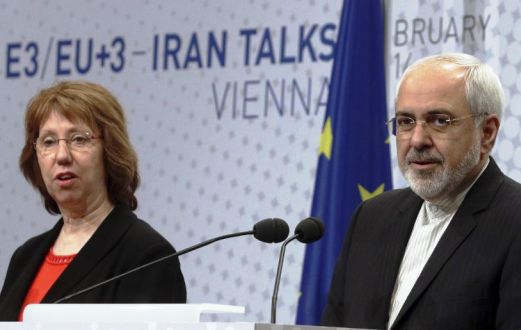
Poll shows majority of people supports extension of N-talks

Austria-Iran-Nuclear

According to a recent poll conducted by the Islamic Republic News Agency (IRNA), 81 percent of Tehran residents are in favor and 19 percent against the extension of Iran’s nuclear talks with P5+1.

The IRNA poll was carried out by random telephone calls made in all 22 neighborhoods of Tehran on November 25 and 26.

59.1 percent of the respondents were men. The youngest respondent was 19 years old while the oldest one was an 83-year-old man. The average age of the respondents was 40.5 years.

A Majority of the questioned believed that the latest agreement reached between the negotiating teams of Iran and the six world powers (US, Britain, France, Russia and China plus Germany) to continue nuclear talks for another seven months ‘would benefit Iran.’

Only 19 percent of those polled said the agreement ‘will not benefit’ the country.

79 percent of those asked said they believed prospects of the future nuclear talks were ‘positive’ while 21 percentbelieved otherwise.

33.6 percent said extension of nuclear talks would give both sides more opportunity to reach a win-win situation.

17.3 percent said they believed continuation of the talks will benefit Iran as the West needed Tehran’s economic and security cooperation.

8.2 percent said they supported extension of the talks because they believed Iran was moving in line with restoring its nuclear rights.

Among other positive views held by the respondents were as follows:

5.5 percent are in favor of gradual release of Iran’s blocked assets

5.5 percent are for economic stability in Iran

3.6 percent are for improving Iran’s international image

2.7 percent are for growing foreign investment.

Meanwhile, those who held a negative outlook about extension of the nuclear negotiations included:

10.9 percent for lack of West’s cooperation towardcomplete and lasting removal of sanctions which could block a final agreement.

6.3 percent considered the victory of the Republicans and pressures exerted by the Zionist lobby as main obstacles in the way of nuclear talks while 2.7 percent said holding nuclear talks was totally a mistake.

The respondents’ suggestions for the Iranian negotiating team included:

29.6 percent called on them to defend rights of the nation

25.9 percent asked them to continue their efforts

23.1 percent said they prayed for the success and health of the Iranian negotiating team

9.3 percent called on them to show more flexibility in talks to the extent that will not threaten national interests

2.8 percent reiterated Iranians will always support the negotiating team

1.9 percent asked them to halt the negotiations as they were useless and

0.9 percent urged the nuclear negotiating team to be independent and transparent


A look at Iranian newspaper front pages on Dec. 1

Iranian Newspapers Headlines

Remarks of the Supreme Leader in a meeting with a group of senior Navy officers in Tehran generated headlines in Iranian dailies on Monday. The hike in the value of dollar against rial was another top story of the day. Drawing as much attention was an acid attack on the administrator of the capital’s Ziaeian Hospital Dr. Siamand Anvari.

Abrar: “Iraqi President Fouad Masoum has lauded Iran for its role in helping the Iraqis [take on terrorists].”

Abrar: “They did not allow former President Ahmadinejad to become a second Amir Kabir! [a 19th century chief minister who is widely respected as Iran’s first real reformer],” said Kamran Daneshjoo, who served as the minister of science under Ahmadinejad.
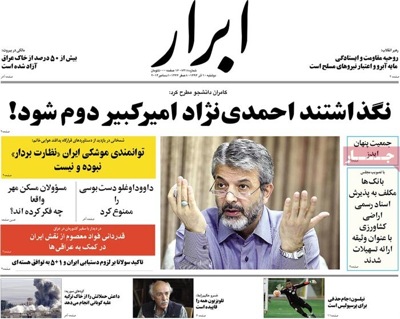
 

Abrar newspaper 12 - 1


Afarinesh: “Iran’s missile capabilities couldn’t and cannot be subjected to surveillance,” said Secretary of the Supreme National Security Council Rear Admiral Ali Shamkhani.

Afarinesh: “Banks should be prepared for the lifting of sanctions,” said the Central Bank of Iran.
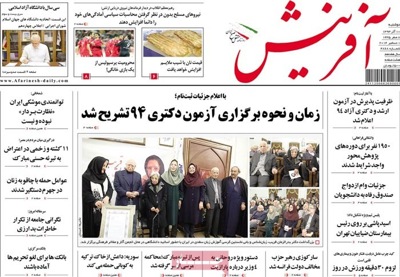
 

Afarinesh newspaper 12 - 1


Afkar: “Yesterday, Tehran Stock Exchange experienced one of its most dramatic falls this fall, shedding 1,000 points.”
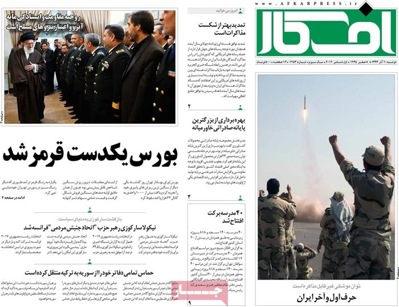
 

Afkar  newspaper 12 - 1


Aftab-e Yazd: “There is not much difference between Dr. Mostafa Moeen [the minister of culture and higher education under former President Rafsanjani] and [current Minister of Science, Research and Technology] Mohammad Farhadi,” said Chairman of the Expediency Council Hashemi Rafsanjani.

Aftab-e Yazd: “A special police team has been tasked with investigating the acid attack on Dr. Siamand Anvari in Tehran.”

Aftab-e Yazd: “To please a handful of hardliners, we should not back down,” said Rasoul Montajabnia, a reformist politician.

Aftab-e Yazd: “Important agreements have been reached in nuclear talks. As for Arak heavy water and the scope of enrichment we are close to a deal,” said Chairman of parliament’s National Security and Foreign Policy Committee Alaeddin Boroujerdi.
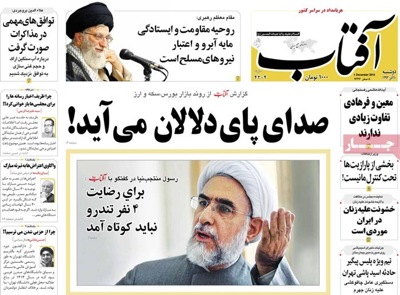
 

Aftabe yazd newspaper 12 - 1


Arman-e Emrooz: “With 133 votes for, 64 against, and 11 abstentions, MPs took the first step toward ratifying a bill that proposes that the geographical area of a province determine its constituency in parliament and thus each voter can choose a representative for all provincial seats in the chamber. The bill will introduce change to the make-up of parliament.”

Arman-e Emrooz: “We do not have control over part of satellite-jamming signals,” said the minister of communications and information.
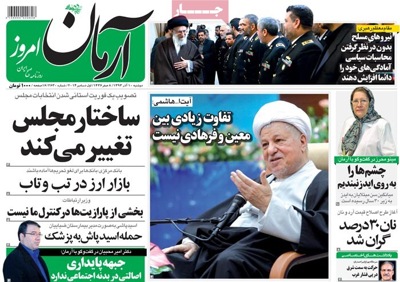
 

Armane emruz newspaper 12 - 1


Asrar: “Calm will make a comeback to the foreign currency market,” Governor of the Central Bank of Iran Valiollah Seif said.

Asrar: “The approval of the Supreme Leader for nuclear talks doesn’t leave any room for opposition [to the negotiating process],” said Ali Velayati, an advisor to the Supreme Leader.

Asrar: “Under any condition, 70 MPs are opposed to interaction with the government,” said Masoud Pezeshkian, a parliamentarian.

Asrar: “The water level of Lake Orumiyeh has gone up 35 cm.”
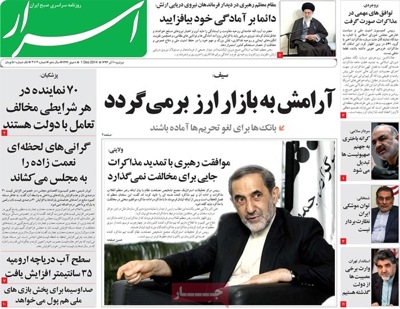
 

Asrar newspaper 12 - 1


Ebtekar: “Javier Solana, the former EU high representative for foreign and security policy, has advised the West not to miss a unique opportunity for a deal [with Iran].”

Ebtekar: “President Rouhani has tasked three ministers and his deputy with handing in a report to the government about satellite jamming.”
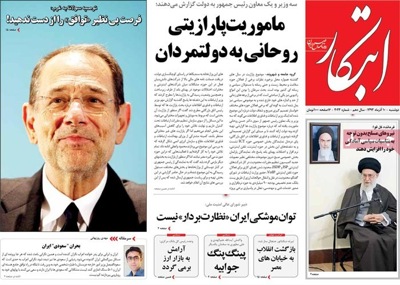
 

Ebtekar newspaper 12 - 1


Eghtesad-e Pooya: “Non-oil exports, natural gas condensates included, brought in $65 billion between March 21 and November 21, 2014.”
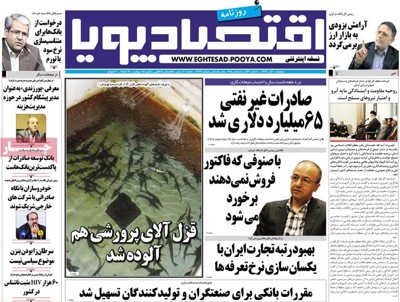
 

Eghtesade puya newspaper 12 - 1


Ettela’at: “American politicians and military officials have backed the continuation of nuclear talks with Iran.”

Ettela’at: “Iran’s Veteran Artists Institute has thrown birthday parties for 20 veteran artists.”
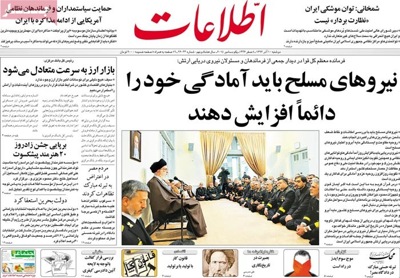
 

Ettelaat newspaper 12 - 1


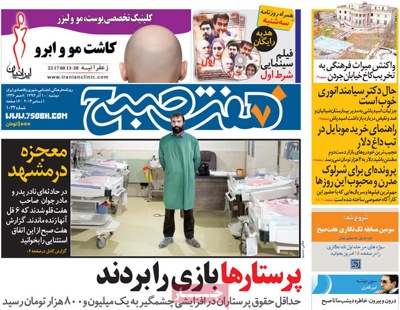
Haft-e Sobh: “In a rare incident, a young woman in Mashhad [a city in Khorasan Razavi Province]gave birth to septuplets of which six survived.”
 

Hafte sobh newspaper 12 - 1


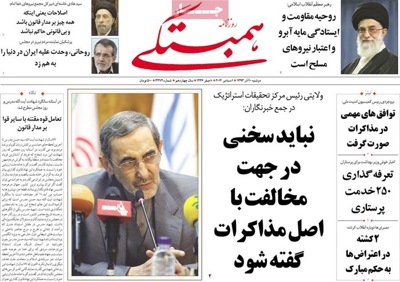
Hambastegi: “President Rouhani has shattered the global anti-Iran alliance,” said Masoud Pezeshkian, an MP representing Tabriz [the capital of East Azerbaijan Province].
 

Hambastegi newspaper 12 - 1


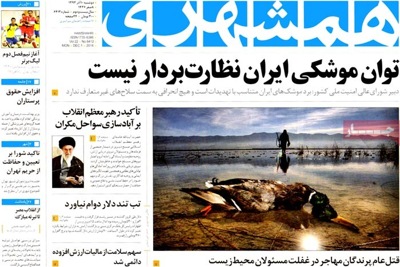
Hamshahri: “A mass killing of migratory birds as a result of the negligence of environment officials” is a headline that refers to the unbridled hunting of birds that have flown to Caspian provinces of Iran to spend the winter there.
 

Hamshahri newspaper 12 - 1


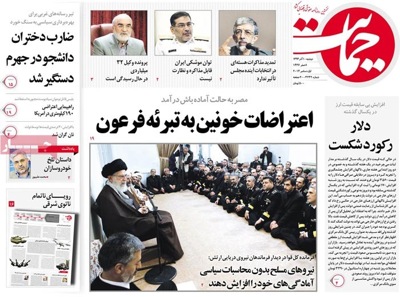
Hemayat: “An individual who attacked female university students in Jahrom, a city in Fars Province, has been arrested.”

Hemayat: “There have been bloody protests against Hosni Mubarak’s acquittal in Egypt.”
 

Hemayat newspaper 12 - 1


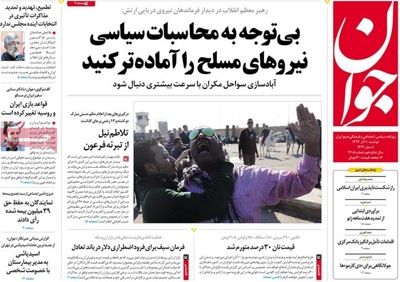
Javan: “In a meeting with Iran’s Navy commanders, the Supreme Leader advised them to enhance their preparedness regardless of political calculations.”
 

Javan newspaper 12 - 1


Resalat: “White marriage [illegal cohabitation] is shameful for our country,” said Supreme Leader’s Chief of Staff Ayatollah Mohammad Mohammadi Golpayegani.

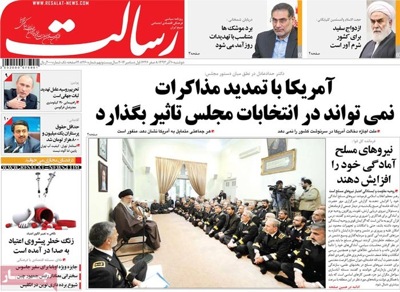
Resalat: “America cannot influence Iran’s upcoming parliamentary elections by extending the nuclear talks,” said Gholamali Haddad Adel, a Tehran MP and a former speaker of the Islamic Consultative Assembly.
 

Resalat newspaper 12 - 1


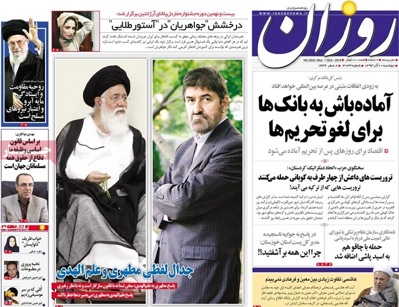
Roozan: “A war of words between Ali Motahari, a Tehran MP, and AyatollahAhmad Alamolhoda, the Friday prayer leader of the northeastern city of Mashhad and a member of the Assembly of Experts, over the duties of the assembly” is the headline that the daily put on its front page. After Motahari told Alamolhoda that his remarks that the Assembly of Experts does not supervise the performance of the leader are neither Constitutional nor in line with the opinions of the Supreme Leader, Alamolhoda argued back that those who lack wisdom are dangerous.
 

Ruzan newspaper 12 - 1


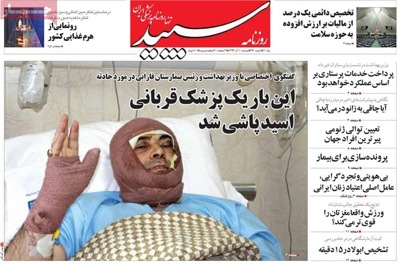
Sepid: “This time around, a doctor has fallen victim to an acid attack.”
 

Sepid newspaper 12 - 1


Velayati urges UN to identify countries backing terrorism

Ali Akbar Velayati
Ali Akbar Velayati

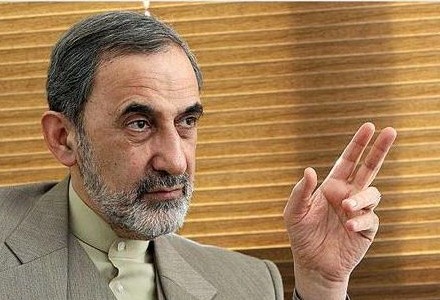
Head of the Strategic Research Center of Iran’s Expediency Council Ali Akbar Velayati called on the United Nations to name those countries that support terrorist groups in the region.

“Given its responsibility, the UN ought to identify the countries that support terrorists (such as) ISIL in the region because without foreign backing, ISIL would be defeated by Iraqi forces,” Velayati said Sunday in a meeting with UN Special Representative for Iraq Nickolay Mladenov.

The Iranian official stated that some Western countries in cooperation with certain regional states have helped terrorist groups emerge”.

He added that groups like the so-called Islamic State in Iraq and the Levant (ISIL) were created, trained, financed and armed by countries that claim to be fighting terrorism.

Velayati also voiced Iran’s readiness to cooperate internationally in the fight against ISIL.

The ISIL terrorists currently control swaths of territory across Syria and Iraq. They have been committing heinous crimes in the captured areas, including mass executions and beheading of local residents as well as foreign nationals.

The Western powers and their regional allies- especially Qatar, Saudi Arabia, and Turkey- are believed to have been supporting terrorist groups in the region.

Objections to nuclear talks despite Leader’s approval illogical

Ali Akbar Velayati

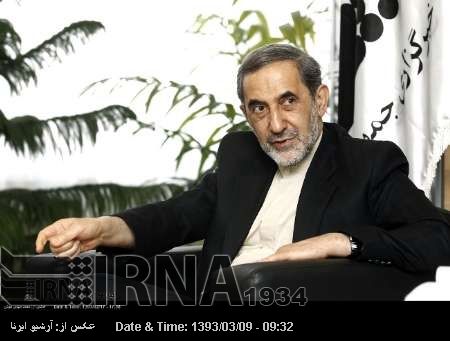
Supreme Leader’s Adviser in Int’l Affairs Ali Akbar Velayati said on Sunday when the Islamic Revolution Leader has approved of nuclear negotiations with world powers, opposite voices against those talks are illogical.

“His Eminence the Leader of the Revolution in his remarks supported the negotiations and their continuation, and we know that our nuclear negotiation team’s moves are in line within the Leader’s defined framework,” said Velayati after his talks with the UN Secretary General’s Special Envoy for Iraq, in response to a question on recent remarks by some stubborn critics of the government.

“Our country’s nuclear negotiation team has thus far observed all redlines drawn by the Leader of Revolution and they have spent tremendous efforts, which are worth appreciation,” added the head of the Strategic Research Center of the Expediency Council.

Velayati reiterated that some people might argue that the nuclear negotiations are quite useless, while some others believe they are pretty useful, but everyone should know that the Leader of Revolution has the final word on every issue.

“Therefore, when His Eminence said that we agree with the negotiations and with their continuation, arguments against the nuclear negotiations should not be made,” reiterated Velayati.

Iraq president calls for Iran’s help in anti-terror fight

Fouad Masoum - Iraq President

Iraqi President Fouad Masoum has called for the continuation of cooperation with Iran to eradicate terrorism.

In a Sunday meeting with Iran’s Ambassador to Baghdad Hassan Danaeifar, the Iraqi president commended the Islamic Republic’s support for Iraq in the battle against terrorism.

He further stressed the importance of improving Tehran-Baghdad relations in all fields and said the two sides’ officials should hold regular meetings and consultations to find appropriate solutions to regional problems.

The Iranian envoy, for his part, urged more support for the Iraqi government and nation to fight the ISIL Takfiri terrorists.

The Iraqi military, supported by volunteer fighters, on Saturday succeeded in flushing out ISIL militants from the Hamrin Mountains in the eastern province of Diyala and inflicting heavy losses on the Takfiri group in the area.

The Iraqi army has so far managed to make numerous gains in the fight against the ISIL militants, pledging to continue the battle against the extremist group.

The ISIL terrorists control some areas across northern and western Iraq as well as eastern Syria.

Iran’s top security official: Military attack no more among enemies’ options

Iran-shamkhani
Iran-shamkhani

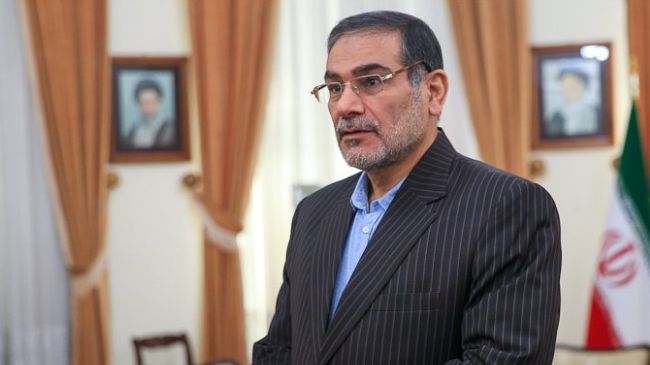
Secretary of Iran’s Supreme National Security Council (SNSC) Rear Admiral Ali Shamkhani underscored the country’s missile power, and said military attack against Iran is no longer among the enemies’ options.

“At present and in the near future, no military threat would be posed to Iran; this doesn’t mean that they (the enemies) don’t want (to threaten Iran) but (means that) they cannot as such a move would incur heavy costs on them and therefore, they have excluded it from their agenda,” Shamkhani said after visiting an exhibition of Iran’s air defense in Tehran on Sunday.

He underlined Iran’s high missile power, and said, “Iran’s missile tests and ranges are proportionate to threats, but Iran’s missile power has never diverted towards unconventional weapons and this issue cannot and will never go under foreign monitoring and inspection.”

Noting that the asymmetric enemies of Iran enjoy highly good air force power, Shamkhani said Iran has also made huge progress in the missile and air defense field to combat the same power.

He emphasized the country’s self-reliance and self-sufficiency in building different missiles, and said like the nuclear technology, Iran’s missile industry is in pursuit of peaceful purposes.

[…]

Iran to host confab on extremism: Zarif

Mohammad-Javad-Zarif

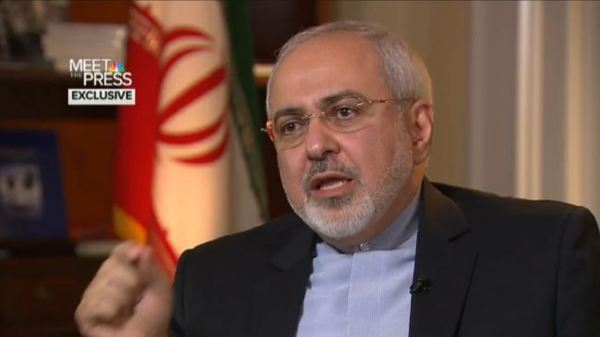
Iran plans to host an international conference on violence and extremism in the near future, Iranian Foreign Minister Mohammad Javad Zarif says.

He made the remarks in a meeting with Nickolay Mladenov, the special representative of UN Secretary General Ban Ki-moon to Iraq, in the Iranian capital Tehran on Sunday.

Zarif added that distinguished international and regional figures will attend the gathering entitled “World against Violence and Extremism,” yet he did not provide any details on the exact date and place of the conference.

He described relations between Tehran and Baghdad as strategic, stressing, “Iraq’s stability, security, development, and progress are among the priorities of the Islamic Republic of Iran and we will spare no effort in this regard.”

The UN should identify key elements that can play an instrumental role in the resolution of the crisis in Iraq and Syria, Zarif said, adding, ongoing consultation among regional countries is necessary to uproot the menace of extremism in Iraq.

“Any country that aims to help improve the situation in Iraq…should quit supporting Takfiri terrorist groups,” the top Iranian diplomat added.

The UN official, for his part, called the situation in Iraq hard and complicated, urging the participation and cooperation of all countries in the fight against terrorism.

Mladenov also appreciated Iran’s assistance for the Iraqi people and government, underscoring that the UN is prepared to play a more effective role to stem terrorism in the Arab country.

The ISIL terrorists launched an offensive in Iraq in June and took control of the country’s second largest city, Mosul, before sweeping through parts of the country’s Sunni Arab heartland.

The extremist group has threatened all communities, including Shias, Sunnis, Kurds and Christians, during its advances in the violence-torn Arab state.

Shakespeare my magic carpet to Iran

iran-shakespeare
iran-shakespeare

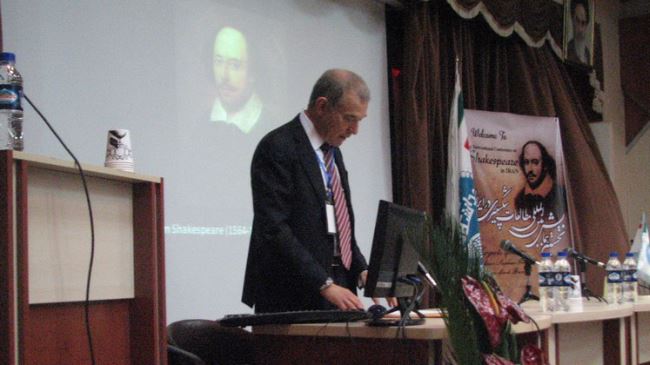
Pulitzer Prize-winning author Professor Stephen Greenblatt visited Iran during the First International Conference on Shakespeare Studies at the University of Tehran.
“I never thought that Shakespeare would become my magic carpet to the land of Persia, where I wished I could have seen someday,” said Harvard scholar Prof. Greenblatt when he expressed his enthusiasm for Iran and Persian cultural and historical heritage during the conference.
One of the world’s most celebrated Shakespearean scholars, Greenblatt took part in the conference and delivered a keynote speech on November 26.
He is best known for his biography of Shakespeare titled “Will in the World: How Shakespeare became Shakespeare,” which was on the New York Times Best Seller List for nine weeks.
He also won the Pulitzer Prize in 2012 for his groundbreaking book, The Swerve: How the World Became Modern.
Organized by the Faculty of Foreign Languages and Literatures, the University of Tehran, the conference was held on November 26-27, 2014.
The conference explored themes such as ‘Shakespeare and Political Discourse’, ‘Shakespeare under the Iranian Eye’, ‘Shakespeare and Adaptation’, ‘Radical Shakespeare’, ‘Shakespeare and Mysticism’ and ‘Shakespeare and Popular Culture’.
Prof. Mark Burnett from Queen’s University in Belfast, was another keynote speaker whose discussion focused on cinematic representations of Shakespeare in Iran.
He talked about an Iranian adaptation of Shakespeare’s Hamlet entitled Doubt (Tardid), a 2009 Iranian Crystal Simorgh-winning film directed by Varuzh Karim Masihi.
Iranian scholar, author and lecturer on literature, art and mysticism Hossein Elahi Ghomshei also spoke at the literary gala.
The event was organized by Dr. Ismail Salami and Dr. Maryam Soltan Beyad, professors at the University of Tehran.

Iran’s Beauties in Photos: Garden of Stones in Sirjan

Iran Stones gaudren
Iran Stones gaudren

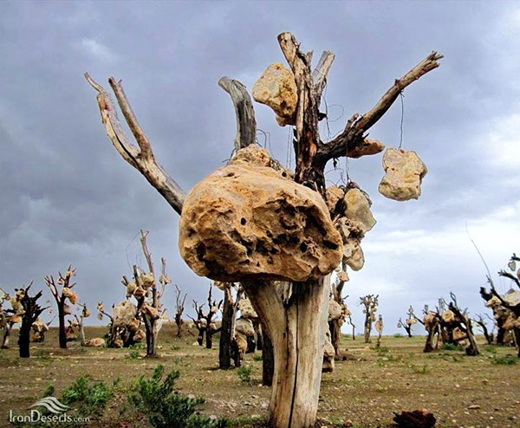
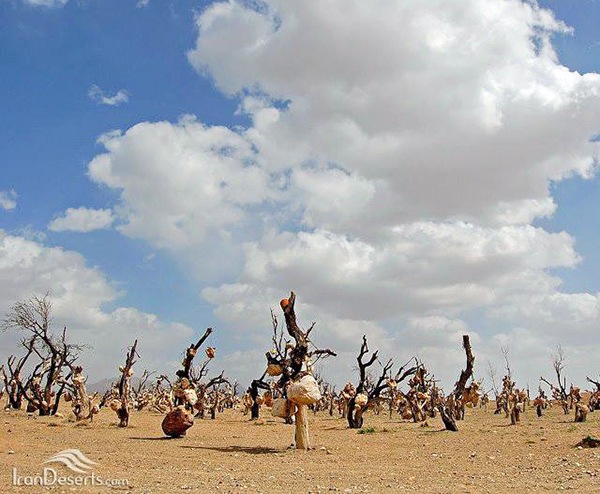
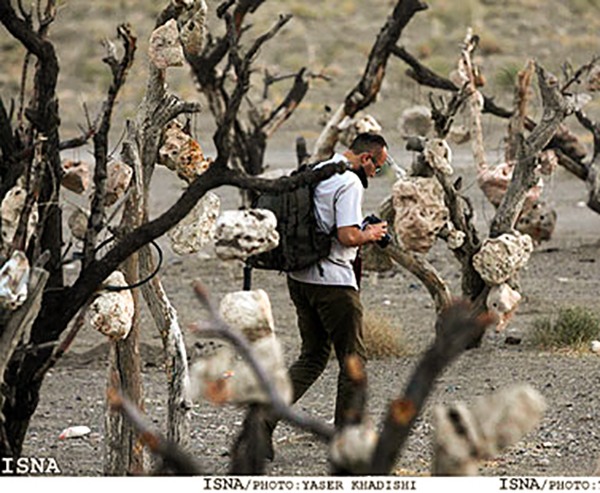
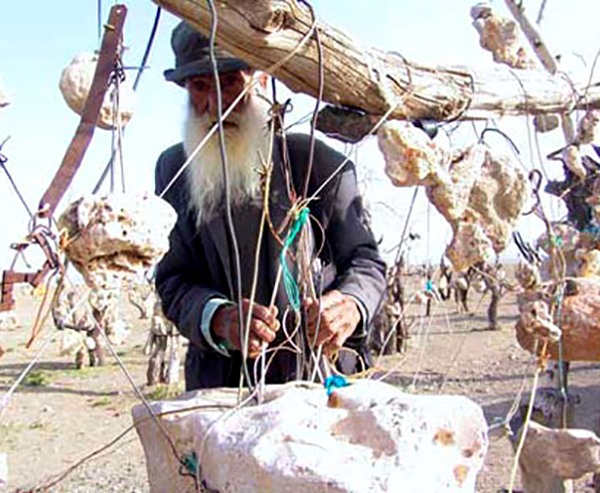
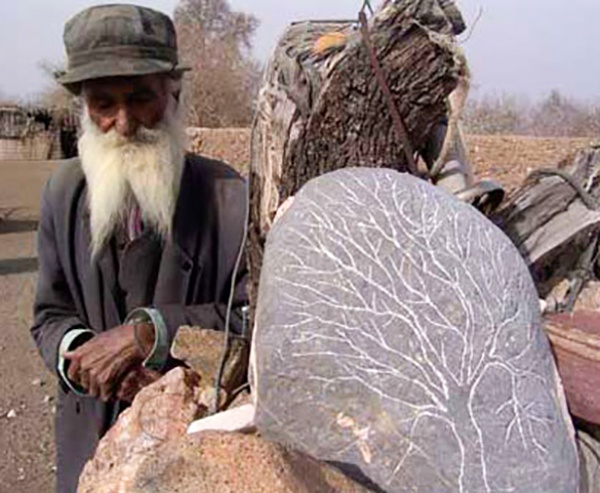
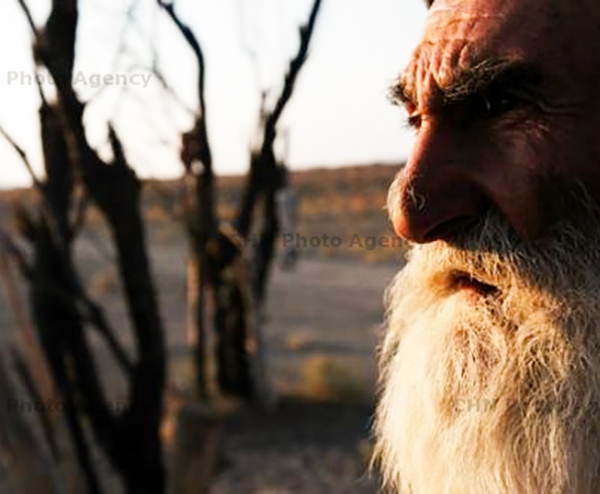
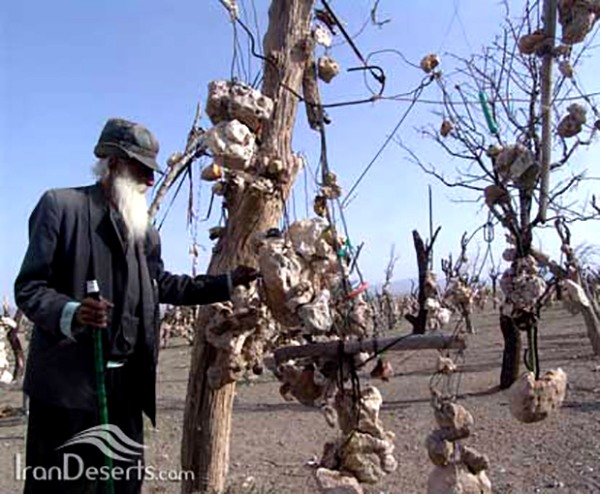
The Garden of Stones is located in the vicinity of Balvard Village, 45 km to the southeast of Sirjan, a town in the southeastern province of Kerman. Darvish Khan Gong Esfandiyarpour, who festooned his dried and dead trees with stones back in 1961 in protest at a series of planned land reforms introduced by Mohammad Reza Pahlavi, never thought that his garden would one day find a place on the list of tourist attractions in Kerman Province. Darvish Khan passed away in 2007 at the age of 90 and was buried in the same stone garden he had created.

Among other filmmakers, Parviz Kimiavi, a famous director and screenwriter, has made two films about Darvish Khan. His first film featuring Darvish Khan and his family was produced in 1971. The second was a documentary entitled The old man and his garden of stones which came out 23 years later.

The following is a photo gallery of the Garden of Stones that Irandesert.com has posted on its website: