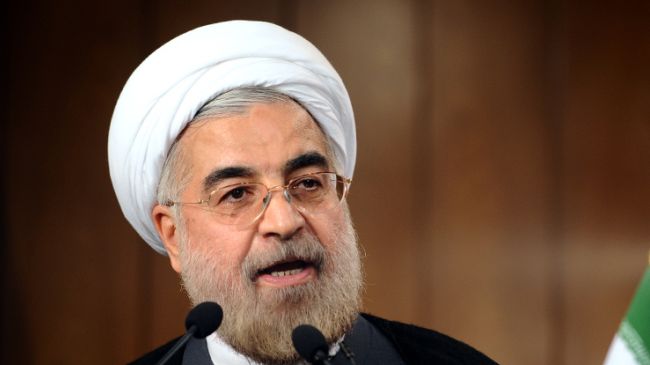
Iranian President Hassan Rouhani says that the West has no other choice but to lift the “cruel” sanctions against the Islamic Republic.
President Rouhani made the remarks on Monday, saying that the P5+1 group of world powers must remove anti-Iran sanctions through interaction with Tehran.
“They (the West) have no other way since all other ways are wrong; they have tried these ways before and if they want to retry them, they will lose more,” Rouhani said.
The Iranian chief executive further reiterated the peaceful nature of Tehran’s nuclear activities, saying the Islamic Republic is holding “logical and calculated” negotiations with the world.
In their last round of talks before a November 24 deadline for reaching a comprehensive nuclear deal, Iran and P5+1 — the United States, Russia, China, Germany, France and Britain — held nearly a week of intense negotiations in Vienna on how to tackle the remaining obstacles that exist in the way of clinching an agreement.
At the end of the talks, the two sides agreed to extend the Joint Plan of Action to July 1, 2015.
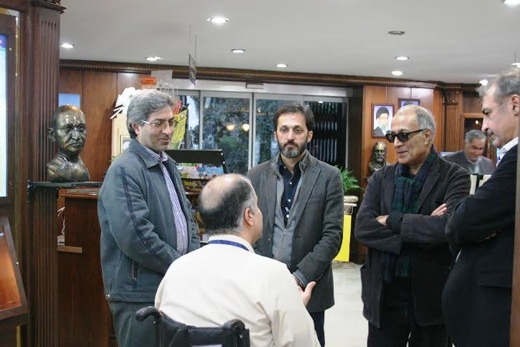
World-class Iranian filmmaker, Abbas Kiarostami paid a two-hour visit to the Tehran Peace Museum during which he was briefed on the devastating consequences of the Iran-Iraq war and the use of chemical weapons by Saddam’s army against Iranian civilians and soldiers back in the 1980s.
On December 14, Sharq, a newspaper, reported on the visit which came at the invitation of the chemical victims of the war, and on the remarks Kiarostami and disabled war veterans who were there to narrate what transpired on the battlefields of the Iran-Iraq war. The following is the translation of the daily’s report on what the renowned filmmaker saw from behind his signature glasses to be dramatically transformed:
Kiarostami is moved by what he sees
Kiarostami, who was deeply affected by the visit, said, “We are doubly indebted to the veterans who were wounded in action; once when you were defending the homeland and making sacrifices for all of us, and now that you have undertaken the responsibility to narrate your war memories in the Museum of Peace despite the harms you have suffered. It is extremely difficult to review those tragic yet epical moments, and I should admit from the bottom of my heart that nobody but you can handle this.”
He went on to say, “Ordinary people who are out there strolling and having fun in the Park-e Shahr (the City Park) will enter a whole new world after they step into this museum. Undoubtedly, they will feel a pang of conscience with two questions weighing on their minds: Why have we been so far so ignorant of the enormity of the war which is so close to us although we are somehow familiar with the question of war and defense?
“And more importantly, they compare their own responsibilities with yours wondering why you are tender-heartedly pushing hard to raise public awareness despite your physical problems? This can be a wake-up call for everyone, me included, to wholeheartedly do what it takes to help you and your cause.”
The veteran director further said, “That’s why I’m going to ask everybody to pay a visit to the museum. I also want to ask for efforts to build at least 50 other peace museums across the country where the disabled war veterans could narrate their stories so that others too can relish the pleasure of discovering [new information about the war]. I am sure people will give you a helping hand in this humanitarian measure.”
Kiarostami, who had previously come in for criticism [by Ebrahim Hatamikia, another famous Iranian movie director] for his lack of interest in the cinematic portrayal of the Sacred Defense, further said, “I entered this museum as a person with a normal mentality, but from now on I will be strongly involved in what I saw here, especially the sight of the tearful, transplanted eyes of Mr. Hassani Sa’di which is per se conclusive proof of all documentation in this museum.”
Hassan Hassani Sa’di, one of the veterans who is 70 percent disabled, shared memories [of the battlefield events] with Kiarostami and others at the start of the visit. Later the disabled veterans present in the museum thanked Abbas Kiarostami for making Two Solutions for One Problem [a 1975 Iranian short film directed by Kiarostami which involves two school kids breaking each other’s stuff and getting in a fight because they would not cooperate.] and said that they have screened his film many times to teach young visitors simple ways of seeking peace.
Peace does not approve of bowing to injustice
The disabled veterans narrated wartime events, among them: the use of chemical weapons during the Iran-Iraq war, the support Western governments lent to Saddam, concerted efforts by the UN Security Council not to name in its resolutions Iraq’s Baath party as a regime that used chemical weapons [against Iran] or the unjust bans on [life-saving] medical supplies.
Hassani Sa’di said what he is doing is the logical continuation of the Sacred Defense, “Fully supported by other governments, Saddam launched the war only to spark a bitter feud between the Iranian and Iraqi nations.
“Now that the war has come to an end thanks to the honorable resistance of the Iranian nation, we take pride in every single part of the unforgettable epic. We may make a huge miscalculation if we fail to distinguish between the Iraqi people and the performance of the Baath Party in political discussions and cinema advertising, thus keep the feud between the two neighbors alive. If so, we will help the enemies who backed Saddam achieve their once-failed objectives.
Kuniko Yamamura, the mother of Martyr Mohammad Babaei, retold her memories of the war and her son, saying as an Iranian of Japanese origin she is determined to help advance the museum’s plans for the Iranian and Japanese kids and women.
Later Mohammad Reza Taghipour, the museum’s manager who is also an Iran-Iraq war veteran said, “I lost my legs in the operation to liberate Khorramshahr, but I’ve always told myself and the museum visitors that I take pride in the fact that I’m in a wheelchair and nobody owes me a debt of gratitude for what I did.
“That I sit in a wheelchair has caused my nation to proudly stand up. Here I announce that we don’t define peace as bowing to injustice; rather, we are after peace which comes with sustainable justice, and not false peace which will be just a temporary ceasefire between the past and future wars due to failure to administer justice.”
He continued, “We lost Ahmad Zangiabadi the other day, a veteran who was one of the narrators [of the war]. He was in line for lung transplant. In spite of false propaganda which depicts the disabled veterans as bedridden, terminal patients, he came out, with his breathing mask on and his oxygen tank in tow, to narrate what has happened to this innocent nation.
Like his fellow disabled comrades, he sought to show that there is no end to the responsibility to raise awareness even in the toughest conditions and until the bitter end. Unfortunately he is not with us anymore to welcome the visitors. May God bless his soul!”
On the sidelines of the visit, a report on the Friendship Ship Celebrations featuring Iranian and Iraqi children was screened.
1. Tehran Peace Museum is a member of the International Network of Museums for Peace. Its main objective is to promote a culture of peace by raising awareness about the dire consequences of war, with a focus on the health and environmental impacts of chemical weapons.
2. Abbas Kiarostami is an Iranian film director, screenwriter, photographer and film producer. He has been involved in over forty films, including shorts and documentaries. Kiarostami attained critical acclaim for directing the Koker Trilogy, Close-Up, Taste of Cherry, and The Wind Will Carry Us. In his recent films, Certified Copy and Like Someone in Love, he filmed for the first time outside Iran, in Italy and Japan, respectively. He was awarded Palme d’Or at the 1997 Cannes Film Festival for Taste of Cherry.
Sharq newspaper on December 8 ran a detailed report by Marjan Saebi on Amanj Band, and on street music and its challenges and prospects. The following is a partial translation of the report:
The crowd was bigger than those groups of viewers who usually circle street musicians. It looked as if many knew that the group would perform close to Azadi (Freedom) Multiplex [a newly-built complex in the capital]. I thought those in the crowd were their friends and acquaintances, but people who were there were different, appearance-wise. An old man wearing a tie and laborers with shabby garment were in the crowd. They were not moviegoers, though. […]
They started to play something like a lead guitar an eastern rocker plays. The Setar player was making a strange melody. The somber theme of the Persian music had been mingled with the melody of rock. Their instrumental music [music with no lyrics] attracted a 200-plus group of people. After a while the music drowned out the noise of passing cars honking their horns and the buzz of voices on the street.
Half an hour later a guitar’s string was broken. Except for a few, others remained where they were. A happily sad sound seemed to have mesmerized them. Everybody was waiting for the guitarist to fix the broken string.
Twenty minutes later the attractive sound started to ring in the air. Then a five or six-year-old girl went to the players and put a 5,000-toman bill on the cover of one of their instruments. Following her lead, others who had gotten over their shyness stepped forward. There were no complaints about the high ticket prices; nor was there any sign of music mafia or hidden hands. Everything was candid. The magic of music had worked and everybody felt well….
On the street
They mostly played in Shahrak Gharb, somewhere close to Milad Noor Shopping Mall. Mohsen plays the Setar and Eiliya, his son, the Daf. They had long been looking for a guitarist. When they met Shahin, they liked his playing the guitar so much that they began to play together. Their band was unofficially formed right there. In Kurdish, Amanj means a mountain summit or a dream. It was there on the grass verge where they sat and shared their dreams. Shahin says, “What Mohsen played did not sound like the Setar. He was playing a sort of the Setar I’d not heard before. I told him if I could accompany him and he accepted. I played the minor scales on the guitar, Mohsen went solo and Eiliya played the Daf.
From where to where
It is not a common occurrence to see a person with an academic degree playing music out on the streets in Tehran. Shahin who holds a university degree is the composer of the Amanj Band. Mohsen has played music since childhood and Shahin first learnt about the rock music when he was a middle-school student. […]
Originality of music
The music Amanj Band plays comes from their feelings. They have intelligently mixed familiar melodies with western themes. The technicalities of their career have not barred them from mingling with people on the streets and their feelings. […]
That they stick to rhythm and emotionality of music could be the reason why a big crowd gathers around them. The originality of their works is another factor. How many bands can be found out there that compose what they play? Amanj is not after cover versions [cover song or version is a new performance or recording of a previously recorded, commercially released/unreleased song, by someone other than the original artist or composer]. They compose the pieces they play.
Street music and protest elements
Where does street music stand in society? Is it because of auditory pleasure that the artist resorts to criticism and protest, or it is a musical genre? Shahin says, “It is not protest. It’s a kind of change. It can be called protest music when it comes to the elements of protest, but our music is all emotion-filled.” […] Sometimes deconstruction could amount to protest, but Mohsen says, “We don’t consider it.”
Mohsen knows about the Persian classical music and listens to works of masters like Hossein Alizadeh. “[…] He lived with Turkmens for a year before he played Torkaman. I’ve raised an Iranian flag to say this music is the language of people all over the world, not simply that of Iranians. We have a general look at music in order to make our work appealing to everybody. […] If the music we play attracts people, it is because we have not drawn a line between Iranian and western music. For example this music is attractive to my religious dad who knows nothing about music, although to him it is what Motrebs do. Motreb [music performer] was added to the Persian language when music players started to perform in the streets. It has a derogatory meaning.
“Music shouldn’t be lasting like UHT milk which [has a shelf life of six to nine months and] does not go sour even out of the fridge. It should be made and expressed instantly. We do not claim that our music is something different from other kinds of music. Whatever we play has been adapted from the works of Iranian and foreign masters. In fact, we are gaining experience.”
One important point about Amanj Band is that they haven’t decided beforehand to produce fusion music. The togetherness of guitar, Setar and Daf has been accidental; it has been formed based on their experiences and the kick they get from music.
[…] Music should be produced and played in a way that is understandable to everybody. If we take into account a special group of people, our music turns specific, like ours which has a [special] background and philosophy. But we need western music to help our music meet people’s demands. I need to live among people to express their pains. To make the music attractive for passers-by who have their own problems, I need to learn about their pains.
Career or panhandling
Playing music out in the street and in the subway is an acceptable job in other countries where a musician rents part of a street for a month, but it is not so in Iran. At a time when the officially registered music is in a state of suspension, it seems all but impossible to establish street music as an acceptable career.
Shahin says, “[…] I had difficulty convincing my parents. My family had a cultural background. My mom was a school teacher and this helped her understand me better. But the Iranian families ask about the future of art and the occupation you will choose. When they saw me change my major out of interest, they helped me, although my dad’s view of music was a far cry from mine. […]”
[…]
Challenges of street music
It is hard to play music in authorized concert halls, let alone do it on the street. Rarely can you find a month in which a concert is not cancelled. But the music without lyrics the Amanj plays reduces the problems they may face.
They say they face three types of problems in the street. “First is the municipality. We talked with them and they said we are not street vendors to be dealt with. Second is the police and the third are people who file complaints about the noise. We try not to cause any trouble for anybody. […]”
Future of street music
They stress that demarcations between the western and eastern music should be removed. To do so, they say, street is the best place. They get the energy they need to play from people, and to hold concerts in big halls is not tantalizing for them. […]
Mohsen says, “We produce a sound which is heard with no analysis. It emits energy for us, something we take before giving it back to people. This exchange of energy is done through money which is just a symbol. We produce the sound, and the money people give to us is full of blessing. We live on street music and take money to earn our keep.
At times it seems streets are the place for them to be noticed. They wouldn’t have played there if they’d had a better place to go. But Shahin says, “No matter what, we will play in the street even for an hour. The pleasure associated with it can be found nowhere. […]
“We are thinking of releasing an album and holding a concert. But we want to play for people in the street once in a week, because it was the source of inspiration for us. We have risen [from the bottom] to the top thanks to playing in the streets. […]”
As the crowd grew bigger around the Amanj, a police officer pulled his bike to the curb and cast a policing look at them. Perhaps he was thinking about the unlawfulness of playing in the street, or maybe the music had aroused his interest too. But he tried to maintain a stiff face. Perhaps it was illegal, but he didn’t want to cut people’s emotional tie with music.
After a few seconds, he – as if he failed to make a convincing decision – turned around, got on his bike and disappeared down the street.
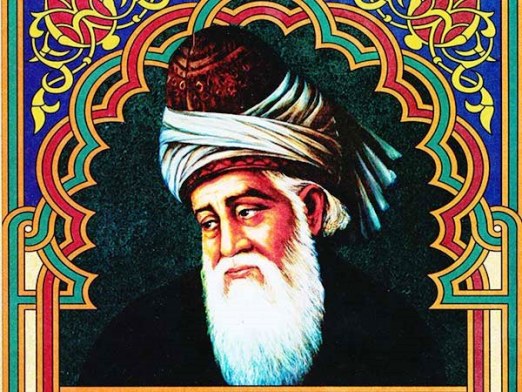
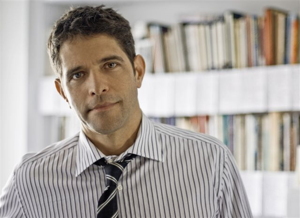
On December 6, Hamshahri-Javan, a weekly journal, carried an interview with Brad Gooch, an American author, about his latest project on Mawlana Jalaleddin Rumi. The interesting content of the interview by Salar Abdoh initially prompted IFP to have it translated. However, after contacting the journal, it kindly provided our website with the English version of the interview. IFP extends its deep gratitude to Hamshahri-Javan for helping it find the original text. IFP regrets to say that because of some constraints on the text size, it could not post the interview in its entirety. The following features only parts of the chat:
Brad Gooch
[…] When Brad Gooch, who was just then researching for his book, Godtalk: Travels in Spiritual America, asked if I could take him to a mosque with me. I ended up taking him to a mosque in the Tribeca district in lower Manhattan. I liked the imam there. He was a soft-spoken man and open to ideas, and the mosque itself was next door to one of my favorite bookstores at the time specializing on Sufi texts and Middle Eastern history.
[…]
But by that time, a few months before 9/11, Gooch had already written a definitive biography of the remarkable mid-century American and New York School poet Frank O’Hara. The new book that he had come with me to the mosque for, Godtalk, was exactly what its title suggested, a delving into the essence of spirituality and belief in its various forms across the United States; while the next biography he went on to write a few years later would cover the life and times of the major Southern writer, Flannery O’Connor.
No wonder then that when I heard about Gooch’s new mission, a comprehensive biography of Rumi, along with a separate translation project of his poetry, I was curious but not surprised. In retrospect, it seemed that Gooch always – from the very beginning, from the days when he was seriously considering becoming a monk, to his book about spirituality, his biographies of O’Hara and O’Connor, the special course that he teaches at William Paterson University in New Jersey on the writers of the Beat Generation […] had been moving, inevitably, towards Mawlana Jalaleddin. It was, in a way, destiny. And so, this was the first question I put to him:
Is it safe to say that your journey in the writing of biographies, your passionate interest in poetry, and also your dedication to writing about religion and spirituality seem to have, quite logically, brought you to Rumi, at last?
Well I do think that if you put Frank O’Hara and Flannery O’Connor together you would wind up with Rumi (though that personal equation rarely makes sense to anyone else.) Rumi shares with Frank O’Hara a spontaneous manner of writing poetry, often in public settings, and often writing occasional poems. Also their poetry in both cases reflected their friendships. O’Hara changes style according to his predominant friendships of the time. While ghazals poured out of Rumi following his separation from Shams, many of them turbulent to the point of surrealism. When he next became involved with Salahuddin as his friend, he wrote much calmer ghazals. At the request of his third main spiritual friendship with Hosamuddin, he wrote the more didactic, and wise, Masnavi. His poetry, like O’Hara’s, was finally quite personal.
[…]
What, if anything, do you think of how everyone wants to appropriate Rumi for themselves? What may be the impetus for that?
At its best I suppose it shows that his universalist message is indeed universal. He manages to be both religious and romantic, or romantic about the spiritual quest. […] When I was in Konya for the Whirling Dervish ceremony in honor of the anniversary of Rumi’s death, the [then] Turkish Prime Minister Erdogan arrived to give a half-hour address, and I kept running into heavily armed military guards around every corner of the auditorium. Tajiks claim Rumi; Afghanis as well; Iranians stress his Persian language and culture; Turks think of Rumi as Turkish; many American think Rumi is Indian; and so it goes.
Let’s talk a bit then about the travels you’ve had to do for this book – the places Rumi lived and your impressions of them.
I’m one of those biographers who unfortunately believe that you need to actually visit and eyeball and experience the locations where your subject lived. The map of Rumi’s life spreads over 4000 kilometers, from Tajikistan to Turkey, so that involved much traveling, but was certainly helpful in finally helping me to understand the importance of Central Asia, or the Greater Khorasan as the liveliest corner of Persian culture at the time, and its influence on Rumi’s views and language. He always spoke a dialect of Khorasani Persian (including using some Khorasani curses) that reflected his origins; the earliest manuscripts of his Divan-e Shams were verified by their use of the Khorasani spellings of Persian words rather than the Anatolian spellings (similar to the difference between English and American spellings.) […]
I’ve visited Iran twice while writing this book—traveling to Mashhad, Shiraz, Esfahan, Tehran, Qom, Tabriz. I did fall in love with the energy, color, vibrancy, youthfulness, busyness, and complexity of the country. Surprisingly in its wonderful cuisine, historical cities, and lively population I was reminded of Italy. I was also struck that seemingly everyone was avid for discussions about politics.
In your research, what are some of the aspects of Rumi that you find especially curious and interesting? What do you think of the scholarship that came before now?
Well, Rumi certainly qualifies as a genius, simply as an artist. Without any special training or even much apparent ambition in poetry, he wound up, mostly triggered by his intense friendship with and separation from Shams of Tabriz, to write thousands of ghazals and rubaiyat, and then a six-book epic Masnavi. His poems are not only seductive in their imagery and their messages, but, according to his great Iranian editor Foruzunfar, they are among the most technically varied in terms of meter of any Persian poet. Foruzunfar credited this eruption of virtuosity (most of the poems were written in the second half of his life) to his talent as a musician. For instance, he custom-made a rebek (a kind of kamanche) to get a timbre of the sound that he preferred.
I am also fascinated by his curious ability to have survived as both a sort of genius and a sort of saint at a very tumultuous time in history, while balancing great demands put upon him by his extended family and by the madrase that had been left in his care by his father Bahauddin. As Rumi evolved from a traditional preacher and jurist into a mystic absorbed in “sama,” or meditation using music, dance, and poetry, he was always skirting “fatwas” from medieval religious jurists, but he also seemed to be protected by his ties with the Seljuk ruling class of sultans and viziers. He struggled to maintain his distance from the world, yet he was always maneuvering through competing worldly responsibilities.
Where then would you put Rumi in context of the rest of Persian literature, and especially in relation to the other giants of Persian poetry?
Rumi sets up his own lineage. He claims that he is descendent of Sanai and Attar, and he quotes, and alludes to them often. These were poets who took the lyric and epic Persian poetry of Rudaki and Ferdowsi, which was mainly practiced in royal courts, and adapted the forms to religious and spiritual messages. Rumi differs from a poet like Hafez by not just going after beauty, but in trying to convey meanings. He is trying to be sermonic as well as suggestive.
[…]
Now then, besides this monumental biography you’ve undertaken, you’ve also set out to translate quite a large body of Rumi’s poetry. There have been a lot of translations of Rumi already. How doyou approach the translation of Rumi?
Interestingly, I’ve discovered that even sloppily free mistranslations, or stodgy precise academic translations, all seem to convey some essential feeling and tone that is quintessentially Rumi. I can’t begin to say why or how that magic works.
In very important ways, Rumi’s poetry lends itself to the modern American idiom: he purposely uses rather simple language; he relies heavily on imagism, which at least since the Surrealists and Rimbaud has been the essential motor of much European and American poetry; he has a kind of epic intimacy of tone that reminds me of Walt Whitman. The challenge is that he was using rhyme, and with rhyme and repeating “radif” was able to make music that is hard to reproduce. Also, even though his language is clear and simple, his ideas can be mind-bending, especially when he is working with some abstruse medieval Sufi concepts. […]
Yet regarding translation, I am still curious how you actually go about translating him. You mention that Rumi is quite translatable. […]
I hope I didn’t say that Rumi is easily translatable. Firstly, of course, I have Maryam Mortaz helping me with language and connotation and denotation. I think what I was trying to say is that Rumi actually uses simple understandable words, conversational, musical words, and repeating imagery: candle, sun, star, cloud, heart.
What is elusive is the music, which can only be approximated, and then only in obvious poems with radif and such. And in spite of the simple vocabulary, Rumi bends into subtleties of thought and spirituality and philosophy and religion and psychology that are often mystifying – I would think even in the original, and certainly at one remove in translation. And in some ghazals he is positively and bizarrely surreal.
[…]
[…] How you feel about Rumi now – what would you say?
Well your final question is a little more difficult only because I have yet to finish the biography. I’m one of those writers who doesn’t know what I think until I’ve written it. So I find summing up to still be out-of-reach. I suppose as his biographer some dimensions of Rumi’s life are now clearer to me, and I find a personal connection – insofar as you can feel “connected” to such a larger-than-life personality and force as Rumi. I am struck that he was going through a practically metaphysical version of a mid-life crisis. So I am interested how a middle-aged man, with many responsibilities to work and family, navigated such a radical rupture in his life and psyche, which was triggered by the entry of Shams of Tabriz into his life. I also feel that Rumi became almost more radical than Shams in the latter half of his life (which I’m just confronting now in my research). He pushed the envelope with his “religion of the heart,” his almost romantic spirituality, and his dance and music. Not every Sufi mystic of the period was given as much leeway as he: he was fortuitously protected by the Seljuk elite, and obviously had tremendous personal charm.
I’m interested in him, too, because when people nowadays are talking spirituality vis-à-vis religion, they are thinking often of Rumi; he is the poster saint, and he obviously struggled to find his own balance betwixt and between.
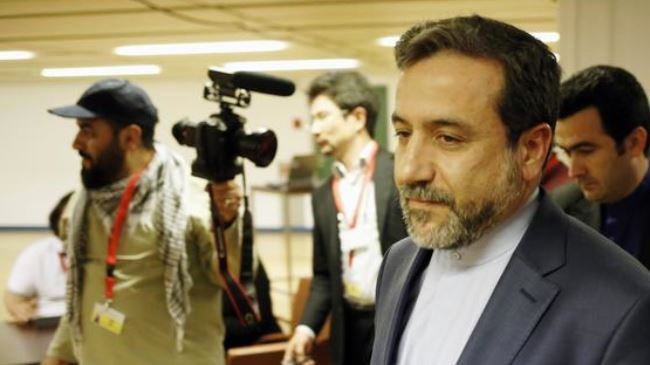
Senior Iranian nuclear negotiators are scheduled to head to Geneva for a fresh round of talks with the P5+1 group of world powers over Tehran’s nuclear energy program.
The Iranian delegation, which will be led by Deputy Foreign Ministers Abbas Araghchi and Majid Takht-e-Ravanchi, is slated to leave Tehran for the Swiss city of Geneva on Monday.
On Thursday, Araghchi said the next round of talks between Tehran and the P5+1 group — Russia, China, France, Britain, the US and Germany — will be held at the deputy level.
The Iranian official added that there will be bilateral negotiations between delegations from the Islamic Republic and its negotiating partners in Geneva two days prior to the start of the talks on December 17.
In their last round of talks, Iran and the P5+1 countries wrapped up a week of intense closed-door nuclear negotiations in the Austrian capital of Vienna on November 24. The negotiations aimed to tackle the remaining obstacles that exist in the way of reaching a final agreement, but despite some progress, the two sides failed to clinch a deal.
At the end of the talks, Iran and the six countries decided to extend their discussions for seven more months. They also agreed that the interim deal they had signed in Geneva last November remain in place during the remainder of the negotiations until June 30, 2015.
Among the thorny issues in the talks are the level of Iran’s uranium enrichment and the lifting of anti-Tehran sanctions.
Iran’s culture minister said that mending manuscripts, books and ancient journals is a precious and lasting act.
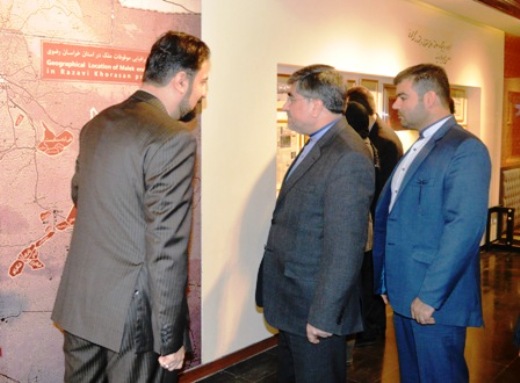
Ali Jannati made the statement during a visit to Tehran’s Malek Museum on Sunday.
“Experts in this field are great artists, who can receive orders for mending works from foreign countries as well,” Jannati added.
“Malek National Library and Museum Institution is home to historical works which are parts of our country’s history and civilization.”
The library is located in downtown Tehran at Mashq Square, which is home to several Qajar era monuments.
The building and almost all its artifacts were donated by the Qajar era tradesman Hussein Malek, to the guardianship of the shrine of Imam Reza (AS) to be converted into a museum and library.
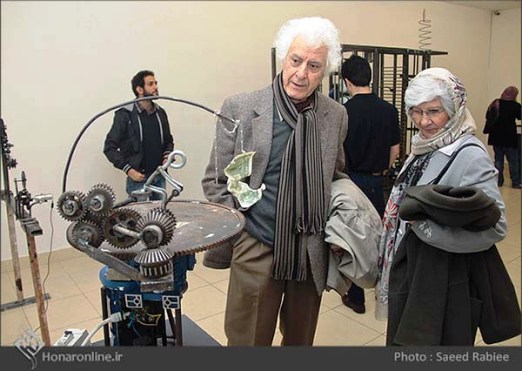
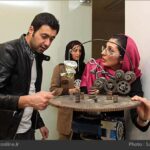
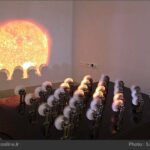
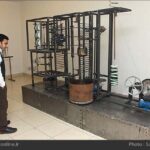
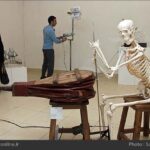
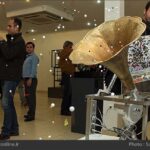
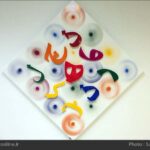
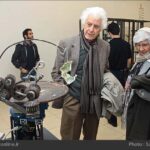
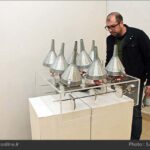
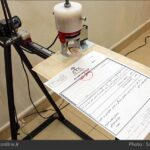
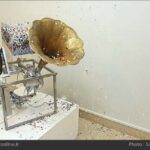
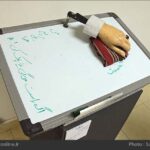
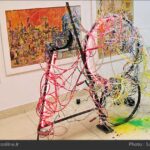
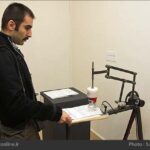
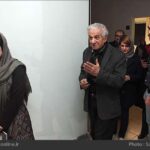
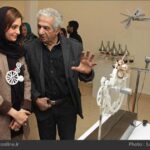
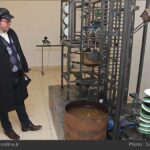
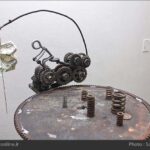
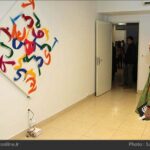
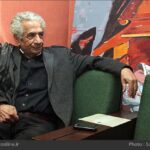
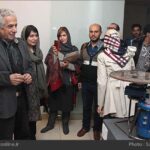
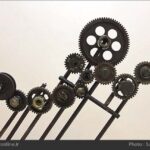
Honaronline.ir has filed a report about a Tehran exhibition entitled ‘Useless Machines’ which opened on December 12 in Mah-e Mehr Art Gallery with Parviz Tanavoli, a well-known sculptor and the instructor of ‘Useless Machines’ workshop, in attendance. The exhibition which showcases a collection of artworks by Mr. Tanavoli’s students is intended to define the concept of uselessness for visitors. The following is a partial translation of the report:
“The artworks made over this 2-month intensive educational course are a combination of art with either industry or machine. In modern life machines have a major role to play and can be a source of inspiration. It’s worth noting that we did not seek to find machines with useful functions. Far from that; we planned on creating useless machines,” Tanavoli said.
“I supervised the whole project and Ms. Mona Pad, a graduate in industrial design, was in charge of all technical matters and the implementation of the project. In fact, she helped artists with the choice of machine structure and power,” he added.
“Such artworks are new in Iran. However, for five decades, artists elsewhere in the world have adopted machines in their works and injected mobility into them. We have done this project to take the first step in this field, letting Iranian visitors get familiar with moving sculptures whose movement is aimless,” he stated.
As for the importance of uselessness in the contemporary art, he said, “Uselessness has become so common in art and many artists are after it. Time is gone when art was in pursuit of moral or educational aspects; now artists want to present works which portray the useless aspects of life. We come across pointless matters in life on a daily basis which we put up with and leave behind. Such questions have a great impact on artists and thus throughout the world they take the concept of uselessness very seriously and base part of their art on it.”
On humor in artworks he said, “There is a great deal of humor in such works. In general, Iranians take a humorous look at useless tasks. […] Humor is part of Iranian character and that’s the secret to their survival in the face of hardship, because such approach helps them put up with problems.”
Recalling his past experience with machines, he concluded, “I used machines 50 years ago to make moving sculptures and such artworks still exist, but since then I have never used machines in my works.”
[…]
Among artists contributing to the exhibition were Farish Alborzkouh, Kourosh Ameri, Leila Taheri and Amir Mousavizadeh.
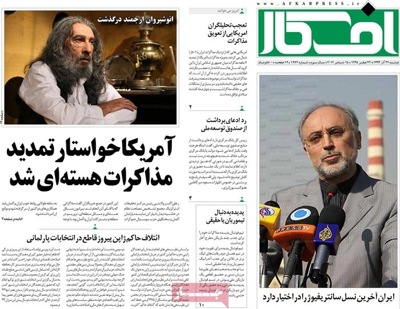
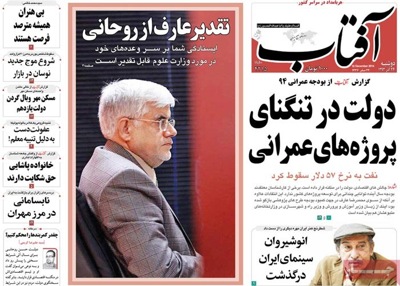
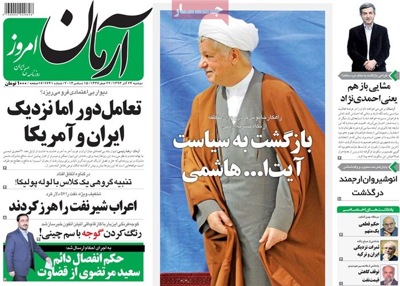
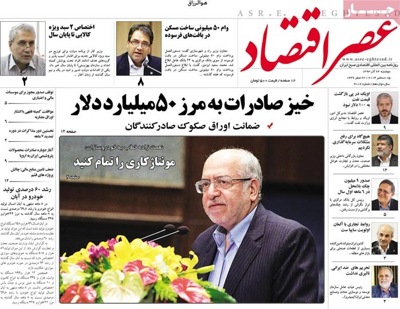
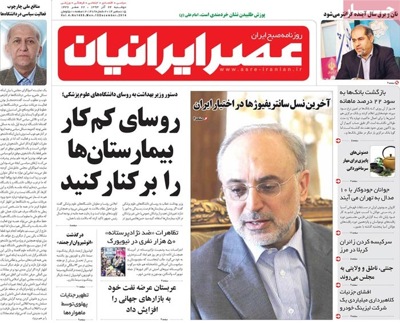
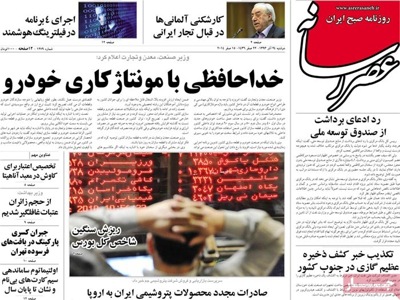
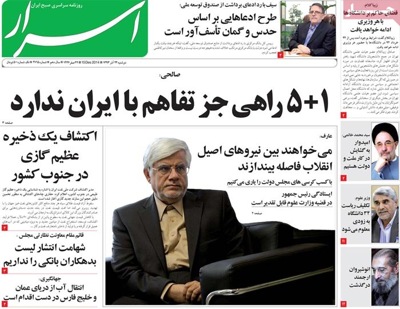
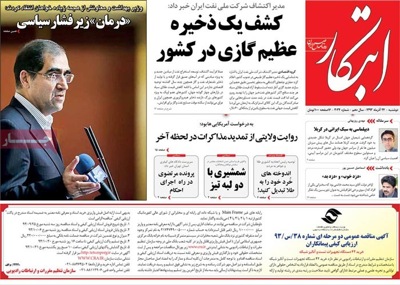
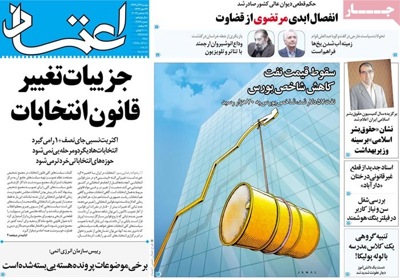
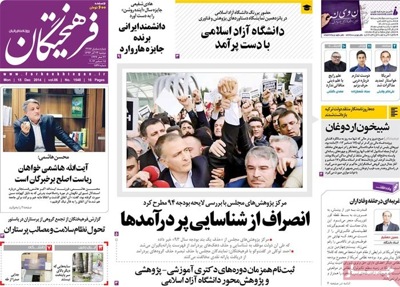
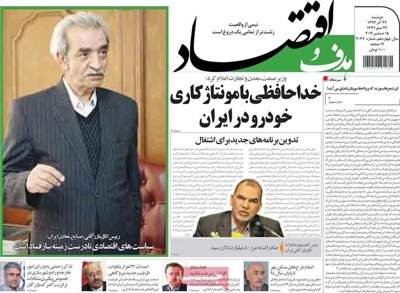
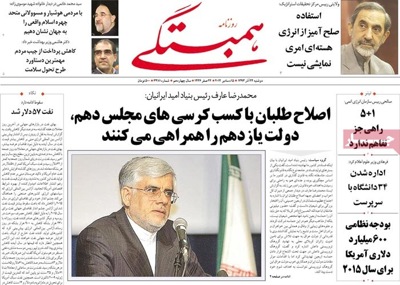
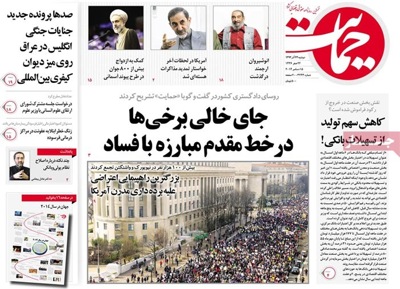
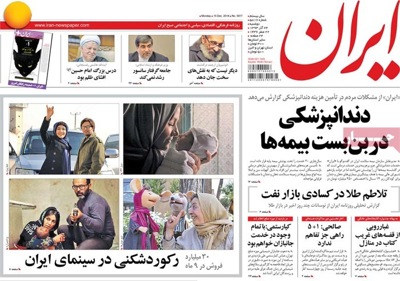
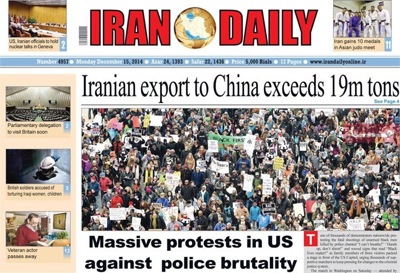
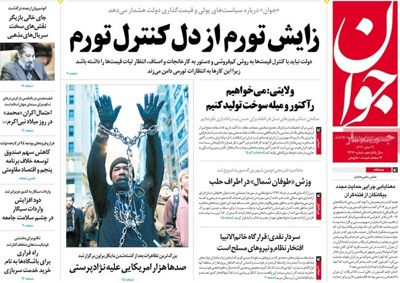
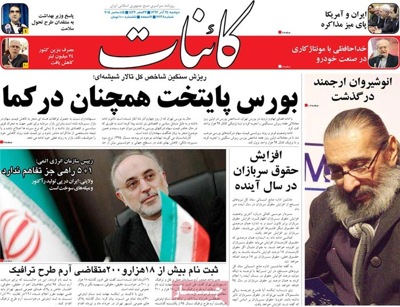
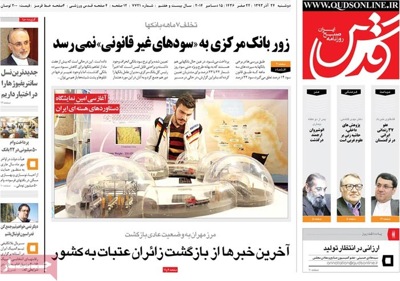
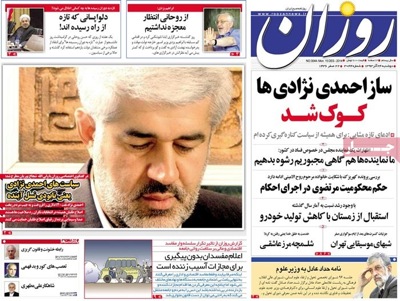
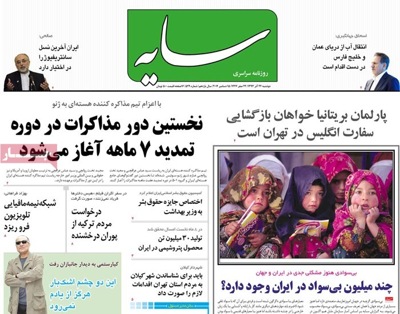
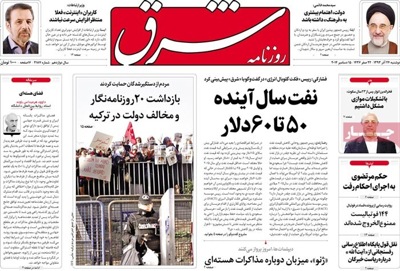
News about the passing of veteran Iranian actor Anushirvan Arjmand due to a heart condition was on the front pages of most Iranian dailies, reformist and principlist alike, on Monday. The continuous decline in oil prices and ongoing protests in the US against police brutality also made headlines.
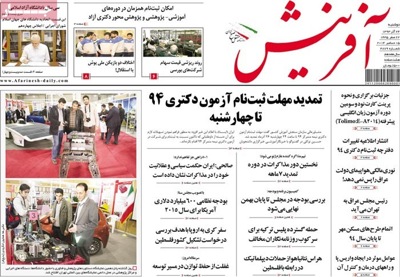
Afarinesh: The Iraqi parliament speaker is expected in Iran [Tuesday at the invitation of the speaker of the Islamic Consultative Assembly].
Afkar: “Iran has the latest generation of centrifuges,” said the director of the Atomic Energy Organization of Iran.
Aftab-e Yazd: With oil prices plunging to $57 a barrel, the government has problem with its development budget.
Aftab-e Yazd:[Former Vice-President Mohammad Reza] Aref has hailed President Rouhani, saying, “Your commitment to the promises you made about the Ministry of Science is praiseworthy.”
Arman-e Emrooz: [Former Tehran Prosecutor] Saeed Mortazavi has been disbarred for life.
Asr-e Eghtesad: Car production registered a 60 percent growth in the month to November 21 over the corresponding period last year.
Asr-e Iranian: The health minister has ordered deans of med schools to discharge hospital administrators who are not fully committed to their responsibilities.
Asr-e Rasaneh: The governor of the Central Bank of Iran has dismissed reports that the National Development Fund has been [illegally] tapped into.
Asrar: The minister of science has said that the presidents of 34 universities will be named soon.
Ebtekar: “A vast gas field has been discovered in the south,” said a senior manager at the National Iranian Oil Company.
Ebtekar: “Extension of nuclear talks came at the request of the Americans,” said Ali Akbar Velayati, an advisor to the supreme leader.
Etemad: The Iranian Human Rights Commission has granted Health Minister Hassan Hashemi the medal of Islamic Human Rights.
Etemad: With oil prices plunging, the Iranian stock exchange shed more points.
Farhikhtegan: Hadi Shafiee, an Iranian scientist, has won the Bright Futures Prize in the United States.
Hadaf va Eghtesad: The minister of industries, mines and trade has said the Iranian automotive industry should bid farewell to assembly of foreign-made cars.
Hambastegi: “By securing seats in the next parliament, reformists will help the 11th government [President Rouhani’s],” said Mohammad Reza Aref, President Khatami’s deputy.
Hemayat: Protest rallies against modern-day slavery have been held in New York and Washington DC.
Hemayat: The amount of loans banks provide to those involved in the manufacturing sector has shrunk.
Iran: “I’ll do my best to serve disabled war veterans,” said renowned Iranian filmmaker Abbas Kiarostami after paying a visit to Tehran’s Peace Museum.
Iran: “P5+1 have no choice but strike a deal [with Iran],” said the director of the Atomic Energy Organization of Iran.
Iran Daily: Iran gains 10 medals in Asian judo meet.
Javan: Pay-to-get-exemption is the best way for [football] clubs to keep [draft-dodging] players on the pitch.
Javan: “We want to build nuclear reactors and develop fuel rods,” said a onetime Foreign Minister Ali Akbar Velayati, who now serves as advisor to the Supreme Leader.
Kaenat: [Veteran actor] Anushirvan Arjmand has passed away.
Qods: A 30th exhibition on the country’s nuclear achievements has opened.
Roozan: “Sometimes MPs have to pay bribes too,” is part of the comments of a member of the Islamic Consultative Assembly about corruption in the country.
Sayeh: The British parliament wants the UK embassy in Tehran to reopen.
Sharq: “As many as 144 soccer players have been banned from leaving the country following a corruption scandal.”
Sharq: In Turkey 20 journalists and opposition members have been arrested.
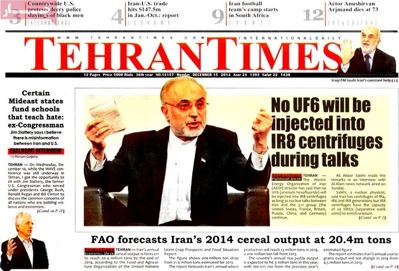
Tehran Times: “No UF6 will be injected into IR8 centrifuges during talks,” said the director of the Atomic Energy Organization of Iran.
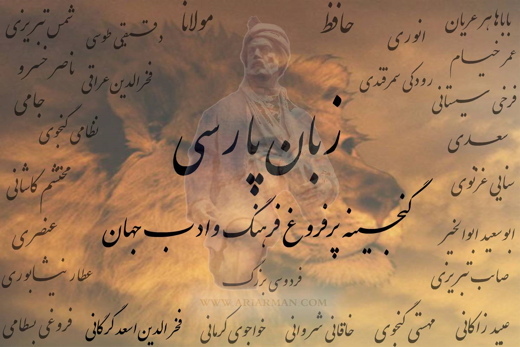
Iran’s cultural attaché office in Erzurum, Turkey, will host a workshop of Persian poetry and literature for the first time.
The workshop will be held in the office’s Persian language and literature education center. Rahim Koushesh, a visiting professor at Atatürk University and a scientific board member of Urmia University, will be the instructor of the program.
The educational workshop will be held with the aim of introducing Persian poetry and Iranian literary scholars, the Islamic Culture and Relations Organization reported.
During the weekly workshop, which will be attended by Persian-language M.A. students of Erzurum Atatürk University, poems of Rumi and Hafez will be studied.
Persian traditional music was presented at the Iranology exhibition of the Belarusian University. The expo was mounted by Iran’s cultural attaché office in Belarus and Minsk’s Muslim Students Association in Belarusian State Medical University.
Chordophone and Percussion instruments of Persian traditional music were displayed at the event while classical Iranian poets and five contemporary Iranian scholars were introduced at the event.
On the sidelines of the expo, booklets of modern Iran were distributed. The pavilions of Iranian tribes were the event’s most visited and attractive sections according to foreign visitors.
The event will host lovers of Iranian arts and works by December21.
A German lawmaker said that negotiations between Iran and world powers over Tehran nuclear program cannot continue endlessly.
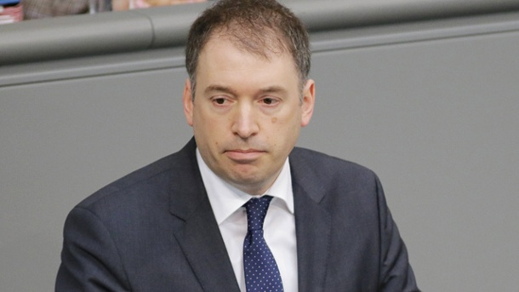
“We cannot continue the nuclear negotiations forever but should come to a conclusion at some point,” said Niels Annen, a member of the German Bundestag and the spokesman on foreign policy affairs for the Social Democrats (SPD).
He expressed hope for a deal between the two sides, adding that everything is ready for a “very good agreement.”
Iran and 5+1 (Russia, China, the US, Britain, France and Germany) have held several rounds of talks to hammer out a final deal to end a decade of impasse over Tehran’s civilian nuclear work.
They wrapped up seven days of intensive nuclear talks in Vienna on November 24 without securing a long-awaited comprehensive deal.
They decided to extend talks on Tehran’s civilian nuclear program for seven more months.
Tehran and P5+1 are scheduled to resume talks at the deputy level in Geneva, Switzerland, on Wednesday.
Annen, who is in Tehran, said clinching a nuclear deal could be very important for a stable, secure and peaceful Middle East and for the mutual interests of Iran and Germany.
Once a nuclear agreement is reached, the German lawmaker said, “We can significantly develop our mutual cooperation.”