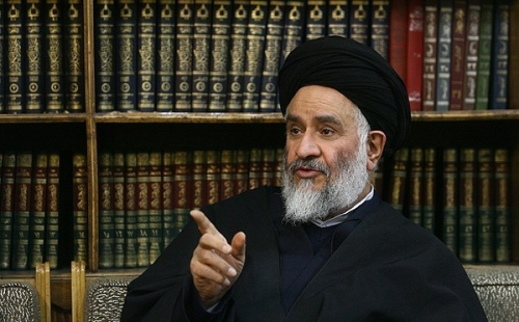
Decades separate the release of Distortions of Ashura by Martyr Morteza Motahari and The Disaster of Holy Ignorance by prominent scholar Mostafa Mohaghegh Damad. No doubt, things were different when these two books came out, but the two scholars seem to have tried to push the same point: When ignorance and superstition engulf the truth, scholars who are in quest of justice cannot remain silent. The following is the translation of an interview Ketab-e Hafte-ye Khabar (News Week Book) published in its December 13 issue with Ayatollah Mostafa Mohaghegh Damad on the so-called holy ignorance, its typical forms and the harms it causes:
The release of The Disaster of Holy Ignorance which is on its second reprint already is the reason why we’re conducting this interview. Would you tell us what you mean by holy ignorance?
I believe ignorance is the greatest anguish a person, or a society for that matter, can experience. No fire is more consuming than ignorance. “It is the fire of Allah, kindled, which leapeth up over the hearts [of men].” These Koranic verses [which are said of people who mistakenly assume that their wealth will save them] refer to the same thing.
The fact of the matter is that ignorance comes in different shapes and forms. What was mentioned already is only one form of ignorance. Ignorance can be good, too. That someone knows that they lack knowledge [in a certain area] is an example of such ignorance.
In fact, such ignorance can be quite positive. Many sciences have developed on the back of such ignorance. In the absence of such ignorance, great scientists such as Avicenna and Farabi, and schools of thoughts would not have emerged. It is such ignorance that pushes humans forward and lands them on the path to progress.
The tormenting ignorance I have likened to a consuming fire [in the book] is the kind of ignorance of which individuals are unaware. In fact they assume they know and view themselves as knowledgeable, whereas in reality they are ignorant. That is the kind of ignorance that consumes individuals and society and wreaks havoc.
Such ignorance becomes most devastating when it has an aura of holiness attached to it. According to Koranic verses, individuals the holy book and the Prophet dealt with were mostly suffering from this kind of ignorance.
In response to your question as to what I mean by holy ignorance, I have to say I believe such ignorance is built on what is viewed as value by some. But, I describe it as more of an idea than value. So the kind of ignorance that is based on ideology is holy ignorance.
Talking about ideology, the most common definition of ideology is a set of beliefs. Is that what you have in mind, or you have a different interpretation?
Well, the Arabic word for belief comes from a verb which means to close. When you close your mind, you develop a belief. For example, in daily life, when a travel agent tells you that a certain list is closed, s/he means that no more items can be added to it.
When someone closed their mind, they no longer admit new items. That is where ignorance takes shape. The upshot would be holy ignorance when those beliefs are placed in a theocratic context. Those who are suffering from such ignorance shut out new ideas.
For instance, if you replace ‘I firmly believe’ with ‘I assume’, you are set to hear opposing thoughts, get involved in dialogue and remain open to movement [change]. When an individual embarks on thinking, they become dynamic and might land on the path that leads to Him [God].
Such individuals view joining the Infinite Being [God] as the final destination, so they tap into their knowledge to take one step at a time toward God. But when you say you firmly believe, you are implying that you are above making mistakes.
Does that result in the individual’s refusal to get involved in dialogue and, as they say, ossification?
That is true. The holy Koran makes mention of such ossification too. […] It describes the hearts of such individuals as sick and made of stone. In another chapter of the holy book the word Zalim [literally oppressor] which originally comes from the Arabic word for darkness has been used. […]
The Koran also makes mention of believers. By believers the holy book means those who have no prior stance on an issue and are set to hear out different ideas and thoughts on it. When someone firmly believes what they have achieved is their ultimate goal, and views their achievement as a red line, the Koran can no longer convince them.
In the holy book, it is also said, “Thou canst make the dead to hear, nor canst thou make the deaf to hear the call….” The Koran uses terms such as sick heart, stone-hearted, blind, deaf, and sick in defining these individuals. To be able to be addressed by the Koran, they should not have ideas which are set in advance. […]
I believe, I may be wrong though, that in Koranic terms faith is based on knowledge. Faith is not a state, nor is it a level beyond which is unimaginable. It is an act. It might sound grammatically wrong, but one must [practice] faith forever.
The Koran makes mention of faith on many occasions. In fact, faith is a dynamic concept. “Those who believe and obscure not their belief by wrongdoing, ….”
In this Koranic verse, wrongdoing does not mean oppression, rather, it means narrow-mindedness.
We need to remain dynamic at all times to promote our faith which improves step by step. That happens when someone has assumptions rather than firm beliefs. Ironically, some Muslims have closed minds, and are sick at heart. The holy Koran describes them as dangerous.
“And We reveal of the Koran that which is a healing and mercy for believers though it increases the evil-doers in naught save ruin.”
The Koran places those who resort to the holy book in two categories. One group for whom the holy book serves as a healer, and the other who are chronically ill at heart. The second group does not benefit from the book. The Koran itself states that they suffer more. In other words, they would be better off if they stayed away from the holy book.
That is why the crimes committed following the dawn of the Islamic era are much worse than those of the pre-Islamic period. The book this interview centers on takes an analytical look at Ashura [the day Prophet Muhammad’s grandson was martyred], a disaster which was unprecedented during the Era of Ignorance [pre-Islamic era on the Arabian Peninsula].
During the Ignorance Era, they would not slaughter babies and they would not let horses trample on dead bodies. All those crimes were committed in the name of religion. Who were to blame for all this? A handful of them such as Amr ibn Sa’ad might have committed those crimes because they wanted power. For instance, Sa’ad wanted to become the ruler of Rey.
But Shemr did not commit the heinous crimes he committed in hopes of securing wealth or power. Shemr ibn Thul-Jawshan was a believer in the true sense of the word. He was a faithful individual who killed Hussein ibn Ali [the grandson of the Prophet] to secure God’s satisfaction.
On the eve of this past Ashura, speaking at Martyr Motahari School, Ayatollah Emami Kashani, who has spent a long time poring over Hadith [religious sayings], talked about an important question. When Shemr took the severed head of the Master of Martyrs [Imam Hussein] to Ubayd Allah ibn Ziyad, he was asked whether he had severed the head himself.
When Shemr said the answer was in the affirmative, Ibn Ziyad asked him about his last conversation with Hussein ibn Ali. In response Shemr said, “When I put the dagger to his throat I said, ‘I am going to kill you now. You will soon experience the torment of the Fire.’ In response Hussein ibn Ali said, ‘I will soon join my grandfather [Prophet Muhammad]. You are the harbinger of paradise.’”
As you see Shemr did not do what he did to climb the caliphate ladder. Evidence suggests he was not the kind of person who would report such a thing to get his hands on a higher position. He believed that the Islamic government of Yazid was legitimate and that the defection of Hussein ibn Ali was illegitimate and worthy of punishment.
He viewed Hussein ibn Ali’s refusal to pledge allegiance to a legitimate theocracy as a ticket to Hell. Hussein was unable to convince Yazid, because the latter had a closed mind and was suffering from what I call holy ignorance.
According to a story mentioned in Al Ghadir [a twenty-volume book written by Allameh Amini] after the uprising of Karbala [which led to the martyrdom of Imam Hussein] a person told Ibn Abbas that after circumambulating the Kaaba he found out that there was a blood stain on his abaya, apparently from a dead mosquito. He was wondering whether he had to repeat the ritual because of the blood stain.
‘Since you learned about the blood stain after circumambulating [the Kaaba] was over, you don’t have to repeat it,’ Ibn Abbas told the man before asking him to identify himself. The man identified himself as Shemr ibn Thul-Jawshan. In reaction, Ibn Abbas said, ‘Shame on you. You have severed the head of the grandson of the Prophet. Now you are worried about a blood stain on your clothes?’
In response to those comments Shemr said, ‘Ibn Abbas, I never expected you to say something like that. [In killing Hussein ibn Ali] I fulfilled my religious duty and acted in keeping with the orders of my leader Yazid ibn Muawiyah.
‘I did what I did to preserve a legitimate religious government. Hussein had defected. He was refusing to swear allegiance. He was stoking sedition and I stopped it.’
Those comments show that Shemr was far from repentant after what he did in Karbala. There are some ignorant people who change after a crime they commit. After the assassination of Morteza Motahari, who was my professor, I saw one of the individuals involved in his assassination at Evin Prison. I asked him why he killed my professor. With his head still bowed as he read verses from the holy Koran, he answered, ‘For the sake of God.”
I have doubts about Ibn Muljamal-Muradi [who killed Imam Ali, Prophet Muhammad’s son-in-law]. When he was taken to Imam Ali [who was in deathbed after being stabbed by Ibn Muljam], Ali asked him whether he had been a bad leader for him, whether he had failed to help him and whether he had harmed him? ‘Why did you do this to me?’ In response Ibn Muljam recited a Koranic verse. “…Canst thou rescue him in the Fire?”
By reciting that line, he seemed to have realized how sinister an act he had committed. He was fatalistic. By reciting what he recited, he implied that he was suffering from holy ignorance; that Ali was unable to rescue him from the Fire; and that Ali had been unable to influence him through his words. They confirm my suggestions that you cannot lead a person who is suffering from holy ignorance to the right path.
You could say they slam shut the door to dialogue and insist on their ossification.
You could never force Bin Laden to change. That holds true about Abu Bakar al-Baghdadi too. Upon returning from a pilgrimage visit to holy sites in Iraq, Ayatollah Emami Kashani said, ‘A young man was arrested in Iraq for trying to set off his suicide vest among a crowd of Shiites. In custody, the would-be suicide bomber was asked why he was crying.
The answer he produced is worth pondering. ‘I am not crying because of being arrested. By foiling this suicide mission, you prevented me from joining Prophet Muhammad. I was only five minutes away from him,’ he said.
As far as I understand, you are saying an orthodox interpretation of religion and failure by those in power, even if it is well-intentioned, to allow others to present their own interpretations are the root causes of holy ignorance?
Among other places the roots of holy ignorance should be sought in brainwashing. The holy Koran has described as weak those who have been brainwashed. “Lo! As for those whom the angels take (in death) while they wrong themselves, (the angels) will ask: In what were you engaged? They will say: We were oppressed in the land. (The angels) will say: Was not Allah’s earth spacious that ye could have migrated therein? As for such, their habitation will be Hell, an evil journey’s end.”
I believe religion is the best means for human progress. It brings humans and truth-seekers closer to God. The holy Koran describes religion as a double-edged sword. If a person develops a correct understanding of it, s/he approaches God. If their understanding of religion is incorrect, they land in the worst of places. Mowlana has written some lines in this regard.
Since many have been misled by [what they understand from] the holy Koran
The holy book is like a rope by which some are likely to go deep into the well
The rope is not to blame for your falling into the well, oh you the opposed!
You remain down there [in the well] for you do not ever dream of coming out.
What is the right mechanism to keep holy ignorance at bay?
In order to lift yourself up, first you need to find the source you want to join. Then as Hafiz puts it you need to seek advice from real truth-seekers.
O holy bird! (the perfect Murshid) thy blessing the guide of my path, make;
For, to our goal, long is the Path; new to journeying, am I.
For us, the Shiites, the infallible household of the Prophet are a boon. They provide us with the best of advice. What would Imam Hussein do if he were in our shoes now? What advice would he dispense? We need to get involved in hypothetical conversations with Imam Hussein.
I don’t buy arguments that Imam Hussein fought because he defected. He insisted on the right thing by refusing to swear allegiance to Yazid. He and his family made the ultimate sacrifice so that he would not support the illegitimate rule of Yazid.