Wednesday, December 31, 2025
Home Blog Page 4991

Sadegh Zibakalam: I really thank the Worriers

Sadegh Zibakalam

Arman-e Emrooz, a reformist daily, on December 22 ran an exclusive interview with Sadegh Zibakalam, a political analyst and university professor, on the Western-imposed sanctions on Tehran and their effects on the Iranian economy as well as the viewpoints of the so-called Worriers [former President Ahmadinejad’s supporters who proclaim to be worried and keep sounding alarms about the state of affairs in the country since the rise to power of the moderate government of Hassan Rouhani]. The following is the translation of the Q & A:


You have earlier said that a breakthrough in nuclear talks will open up an opportunity for Iran to make an economic leap and that such a possible breakthrough will bring considerable economic benefits to the country.

Despite the fact that sanctions have been said to have no economic impact and the country’s economic woes are blamed on mismanagement, I believe that it’s not true. I don’t want to deny the role of mismanagement. When the eleventh government took over last year, a deputy minister of industries, mines and trade said that half of the country’s production units had been closed down due to lack of raw material, spare parts and venturecapital – for which sanctions are to blame – and the other half are running below capacity.

Over $120 billion of Iran’s assets has been frozen in overseas banks, of which around $4 billion has been given back to Tehran under the Geneva Interim Deal. Iran is to get $700 million each month [under what was agreed in the November 24, 2014 nuclear talks]. If the knot of nuclear talks is untied, the effects of such openness will be first seen on the economic front.


You said in a letter to nuclear negotiators that efforts to circumvent sanctions have given rise to corruption. What do you mean exactly?

Under President Ahmadinejad officials said they had managed to bypass sanctions, but it has become clear today that, in President Rouhani’s words, the then government bypassed the [national] economy, not the sanctions. In other words, no matter what angle you look at the case from, there is ambiguity. When Iran is not allowed to sell more than 700,000-800,000 barrels of oil [per day] and the international financial system learns that the money [which is going to be transferred] belongs to Iran, it blocks the money. That’s why the country has to do its transactions covertly.


Direct talks between Iran and the US were the turning point of Iran-P5+1 nuclear negotiations in Geneva. What’s your take on mutual talks between representatives of Tehran and Washington and their overall impact on the negotiations?

Certainly it is a step forward. We should have opened bilateral talks with the US many years ago and asked ourselves why Iran harbors hostility toward the US. Now it will be very helpful if we review the areas of contention between the two countries and mull over which line each side has taken and what they are calling for.


Although the US foreign policy establishment has one single attitude, various political groups have taken different attitudes toward Iran’s nuclear case. How should Iran react to such groups and their approaches?

Political groups in the US, as a whole, were opposed to Iran. Things changed after June, 14, 2013 [when President Rouhani came to power] which was followed by efforts by Messrs. Zarif and Araghchi and others to have direct talks with the US secretary of state and other American negotiators. They did what they did to change the atmosphere. This [change] was missing before.

But now senior US officials have met with Dr. Rouhani’s Foreign Minister [Mohammad Javad] Zarif, sat around the negotiating table and exchanged handshakes. This has not been easy.

In the interim, conservative Republicans in the US believe that Secretary John Kerry and [President] Obama have made a mistake [by dealing with Iran]; that’s why you see Republicans and [Israeli Prime Minister Benyamin] Netanyahu are placing pressures on Obama, trying to make their case that trusting Iran is not the right thing to do.

Republicans are opposed to Iran. That’s true. In the new US Congress which is to meet in a few weeks those who are against Iran hold the majority. I think if we can go tougher on the anti-Iran elements in Washington in coming months, we can remain hopeful about positive results. If so, Republicans will fail in their efforts to impose a new set of sanctions on Iran, because they cannot easily withstand the pressure the public opinion brings to bear. Despite the fact that the Republican-majority Congress is deeply opposed to Iran, I am still hopeful that they cannot slap new sanctions on Iran in the months to come.


In remarks in the University of Tehran, you said that the country owes the opportunity it has been given to openly critique the nuclear policies to hardliners. Would you please elaborate on that?

I really thank the Worriers. They presented us with an opportunity to openly analyze [the upsides and downsides] of the nuclear policies, a first in a decade. After Iran and P5+1 inked the Geneva deal in November 2013, hardliners began to attack the so-called Joint Plan of Action.

Then the so-called Worriers staged [protest] gatherings outside the building which used to serve as the US embassy in Tehran and other places during which they publicly hit out at Geneva talks. Some of them went as far as denounce the Geneva deal as being worse than the Treaty of Turkmenchay [the name of an agreement Iran and the Russian Empire signed in 1828 in Torkamanchay, under which the former ceded to Russia control of several areas in the South Caucasus].

The break came when some criticized the nuclear policies the government of President Rouhani had adopted. After all, double standards were unacceptable. In other words, you cannot let others dispute Dr. Rouhani’s nuclear policies but say that nobody is allowed to challenge those of Mr. [Saeed] Jalili and Ahmadinejad.

When President Rouhani’s nuclear policies came in for criticism, naturally similar policies of Mr. Ahmadinejad and principlists were fair game. At least they were not as off limits as they used to be. This helped me join the ranks of other critics and talk in a roundtable in the University of Tehran. That is what the opponents of President Rouhani’s did in other universities in earlier weeks.

The point is this: you cannot say that opposition to Mr. Rouhani is ok, but you have no right to talk against or critically analyze the nuclear policies of Ahmadinejad, Jalili and their fellow principlists. Undoubtedly, we owe the [open] atmosphere we enjoy today to the Worriers. I really thank them [for what they did].


The very group, as you put it the Worriers, have in recent days strongly railed against what you said in your speech in Tehran University.

I sincerely thank them. Since December 17 when the three-hour meeting was held in Tehran University, attacks were launched in radio and TV programs, as well as a number of principlist newspapers and news agencies against what Dr. Ahmad Shirzad and Dr. Davoud Hermidas Bavand and I said in the gathering. I think it is a good thing, because people – out of curiosity – seek to learn what we said that IRIB and the principlist press keep talking about.

I have made a laundry list of those who have talked against my words in the last 24 hours. These critical views are good because they help society open up [to opposing views].

I really welcome the viewpoints of our friends and remain thankful to them. Basically, this is exactly what freedom, democracy and enlightenment of the public opinion call for. In other words, you can easily talk about different issues and there are other groups which can openly stake out their opposing views.

President Rouhani is to bring down the curtain on illegal wiretaps

wiretaps

In a report on December 22, Arman-e Emrooz, a daily, looked back at one campaign promise of President Rouhani and his emphasis on implementation of Article 25 of the Constitution which says: “It is forbidden to inspect letters and to confiscate them, to disclose telephone conversations, to disclose telegraphic and telex communications, to censor them and to stop their delivery. It is forbidden to wiretap conversations. All forms of inspection are forbidden except according to law.” The following is a partial translation of the report which looks at steps taken by the Rouhani administration to uphold that constitutional provision:

In order to guarantee the enforcement of Article 25 of the Constitution, President Rouhani has sent parliament a bill which introduces an amendment to Chapter 31 of the Fifth Book of the Islamic Penal Code.

If the bill were passed by the chamber, while tapping into the latest advanced technology not only would it streamline the telecommunications sector, but it would be an effective step in honoring civic rights by putting the brakes on illegal interference in public communications. It would also fulfill the vow President Rouhani has repeatedly made since he rose to power.

On December 13, President Rouhani handed to parliament a bill entitled “Use of Technical Equipment Mainly Intended for Intelligence Gathering”. The bill says that real or any legal entity that purposely and without permission from the Intelligence Ministry tries to produce, distribute or advertise any equipment used for data mining and intelligence gathering, including audio and video data, will be subjected to punishments enshrined in the Penal Code.

With the passage of the bill, legal and real entities as well as different institutions would not be able to use wiretaps or other equipment with similar purposes to pry into people’s lives unless they are granted permission by the Intelligence Ministry or its affiliates. If signed into law, aside from safeguarding civic rights, it would eliminate undue and unlawful interference by parallel and illegal structures which want to snoop into the private lives of people.

If approved, it would help those in the judicial system and its affiliates deal with violations and infringements with greater ease and stop unlawful interference in people’s lives by offenders who take advantage of legal loopholes when it comes to communications and exchange of information among members of the public.

Park rangers give an injured wild goat life-saving stitches

life-saving

On December 19, Khabaronline filed a report on saving by park rangers in a village near Shahrud, a city in Semnan Province, of a two-year-old wild goat which suffered severe wounds after being attacked by a wolf. What appears below is a partial translation of the report accompanied by a photo gallery:

“Right now, the wild goat is in good condition. The goat was wounded in the throat and immediately taken to Sharud for treatment,” said Mohammad Reza Ghasemi, the head of the Public Relations Office of the Environment Protection Department of Shahrud.

“The wild goat will be taken care of for about 10 days at the Environment Protection Department and then will be released in nature,” Ghasemi added.

The veterinarian in charge of treating the goat said, “If it weren’t for the swift action of people and environment officials, the animal would have definitely died from injuries.”

With rare wildlife species, Shahrud, the second largest protected area in Iran, is very rich in environmental resources.


Ex-IAEA chief warns on unverified intel to pressure Iran

Han Blix

In a critique of the handling of the Iran file by the International Atomic Energy Agency, former IAEA Director General Hans Blix has called for greater skepticism about the intelligence documents and reports alleging that Iran is in pursuit of nuclear weapons.

In an interview in his Stockholm apartment late last month with Gareth Porter, an investigative journalist and historian specializing in U.S., Blix, who headed the IAEA from 1981 to 1997, also criticized the language repeated by the IAEA under its current director general, Yukiya Amano, suggesting that Iran is still under suspicion of undeclared nuclear activity.

Blix, who clashed with US officials when he was the head of the United Nations Monitoring, Verification and Inspection Commission (UNMOVIC) on weapons of mass destruction in Iraq from 2000 to 2003, said he has long been skeptical of intelligence that has been used to accuse Iraq and Iran of having active nuclear-weapons programs.

“I’ve often said you have as much disinformation as information” on alleged weaponization efforts in those countries, he said.

Referring to the allegations of past Iranian nuclear weapons research that have been published in IAEA reports, Blix said, “Something that worries me is that these accusations that come from foreign intelligence agencies can be utilized by states to keep Iran under suspicion.”

Such allegations, Blix added, “can be employed as a tactic to keep the state in a suspect light — to keep Iran on the run.” The IAEA, he said, “should be cautious and not allow itself to be drawn into such a tactic.”

He warned that compromising the independence of the IAEA by pushing it to embrace unverified intelligence was not in the true interests of those providing the intelligence.

The IAEA member states providing the intelligence papers to the IAEA “have a long-term interest in an international service that seeks to be independent,” said Blix. “In the Security Council they can pursue their own interest, but the [IAEA] dossier has to be as objective as possible.”

In 2005, the George W. Bush administration gave the IAEA a large cache of documents purporting to derive from a covert Iranian nuclear weapons research and development program from 2001 to 2003. Israel provided a series of documents and intelligence reports on alleged Iranian nuclear weapons work in 2008 and 2009.

Blix’s successor as IAEA director general, Mohamed ElBaradei, recalled in his 2011 memoirs having doubts about the authenticity of both sets of intelligence documents. ElBaradei resisted pressure from the United States and its European allies in 2009 to publish an “annex” to a regular IAEA report based on those unverified documents.

But Amano agreed to do so, and the annex on “possible military dimensions” of the Iranian nuclear program was published in November 2011. During the current negotiations with Iran, P5+1 (US, UK, Russia, China, France plus Germany) has taken the position that Iran must explain the intelligence documents and reports described in the annex.

The provenance of the largest part of the intelligence documents — the so-called “laptop documents” — was an unresolved question for years after they were first reported in 2004 and 2005.

But former senior German foreign office official Karsten Voigt confirmed in 2013 that the terrorist Iranian exile opposition cult, the Mujahedeen e-Khalq (MEK), gave the original set of documents to the German intelligence service (BND) in 2004. The group has been reported by Seymour Hersh, Connie Bruck, and a popular history of the Mossad’s covert operations to have been a client of Israel’s foreign intelligence agency, the Mossad, serving to “launder” intelligence that Mossad did not want to have attributed to Israel.

Blix has been joined by two other former senior IAEA officials in criticizing the agency for its uncritical presentation of the intelligence documents cited in the November 2011 annex.

Robert Kelley, the head of the Iraq team under both Blix and ElBaradei, and Tariq Rauf, the former head of the Agency’s Verification and Security Policy Coordination Office, have written that the annex employed “exaggeration, innuendo and careful choice of words” in presenting intelligence information from an unidentified Member State of the IAEA on the alleged cylinder at the Parchin military facility.

Blix said he is “critical” of the IAEA for the boilerplate language used in its reports on Iran that the agency is “not in a position to provide credible assurances about the absence of undeclared nuclear material and activities….”

Blix added that it is “erroneous” to suggest that the IAEA would be able to provide such assurances if Iran or any other state were more cooperative.

As head of UNMOVIC, Blix recalled, “I was always clear that there could always be small things in a big geographical area that can be hidden, and you can never guarantee completely that there are no undeclared activities.”

“In Iraq we didn’t maintain there was nothing,” he said. “We said we had made 700 inspections at 500 sites and we had not seen anything.”

Blix emphasized that he was not questioning the importance of maximizing inspections, or of Iran’s ratification of the Additional Protocol. “I think the more inspections you can perform the smaller the residue of uncertainty,” he said.

Yemeni President Hails Iran’s Important Role in Region

Abd Rabuh Mansur

Yemeni President Abd Rabuh Mansur Hadi in a meeting with Iranian Ambassador to Sana’a Hassan Niknam underscored Tehran’s major and important role in settling different problems in the region.

“Iran is a great country in the region,” President Mansur Hadi said during the meeting in the Yemeni capital on Saturday.

He underlined that Yemen and Iran can increase their mutual cooperation in a bid to resolve the regional problems.

The Yemeni president reiterated that Iran can play important roles using its broad capacities and capabilities.

The Yemeni president, meantime, called on the Iranian companies to invest in Yemen’s development projects.

In similar remarks last week, Vice-Chairman of Britain-Iran Parliamentary Friendship Group Richard Bacon underscored Tehran’s capability to establish stability in the region, and called on the West to use Tehran’s power and capacity.

Bacon made the remarks in a meeting with Chairman of Iran-Europe Parliamentary Friendship Group Kazzem Jalali in Tehran.

He hailed the prevailing security in Iran, and said that travelling to Tehran and Iran in full security can rarely be experienced in (other parts of) the Middle East and Iran can play a vital role in regional stability if Western countries attach more significance to Iran’s role.

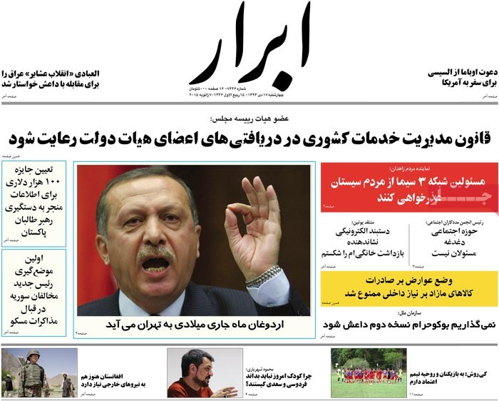
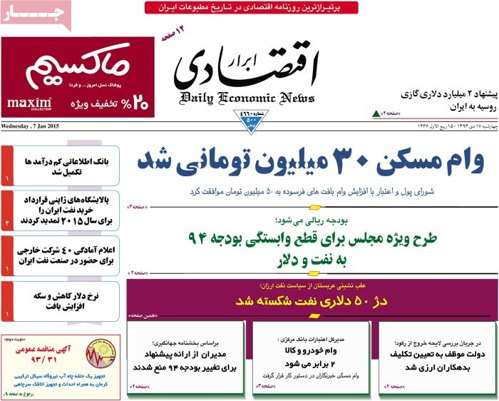
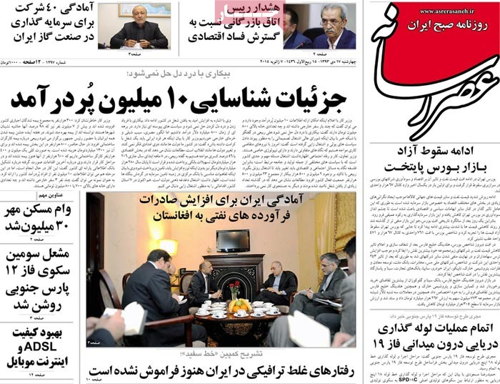
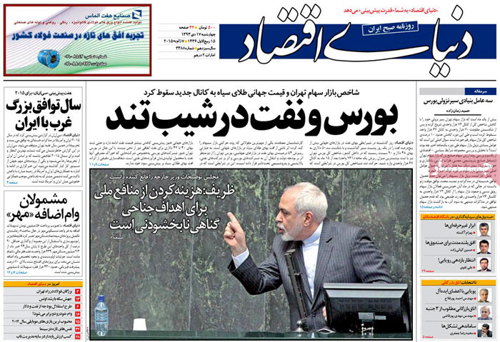
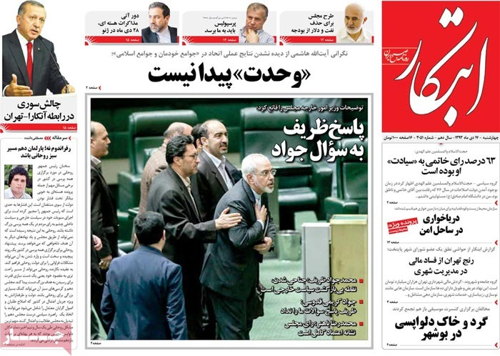
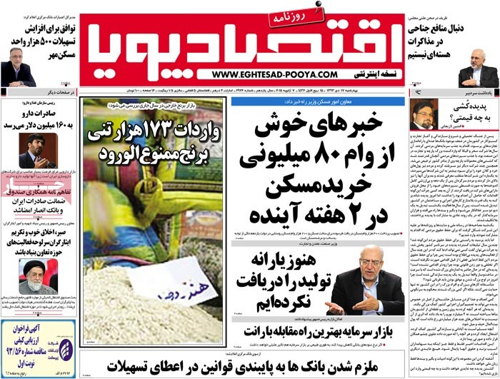
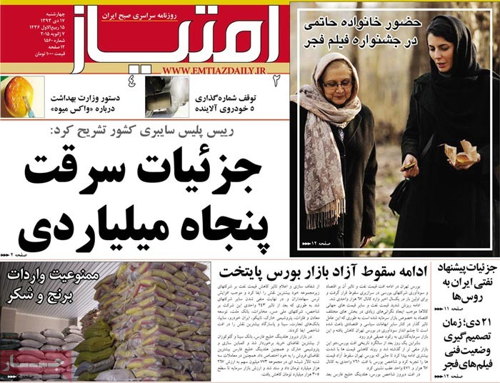
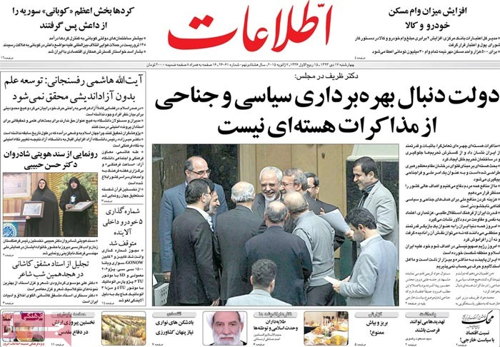
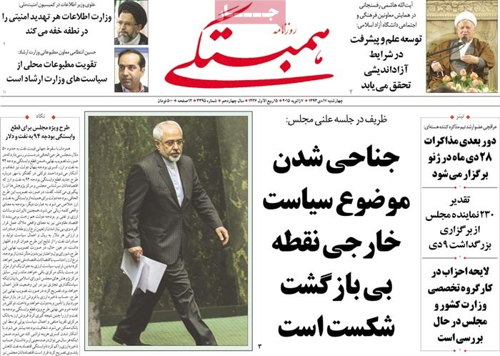
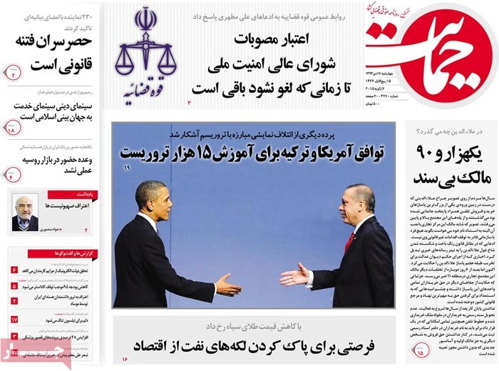
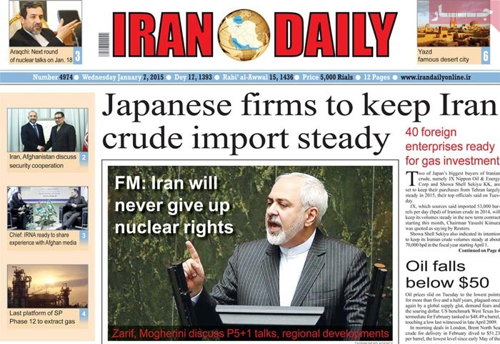
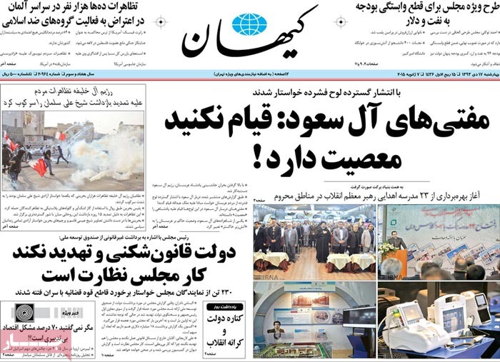
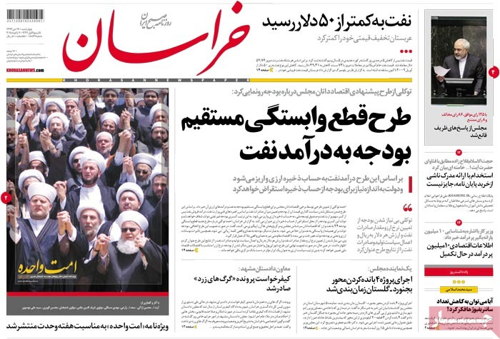
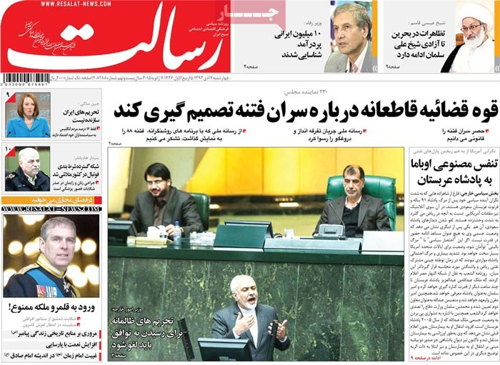
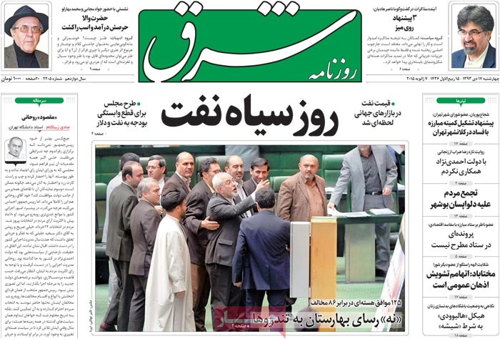
A look at Iranian newspaper front pages on Dec. 22

Iranian Newspapers Headlines

News about the passing of veteran actor Morteza Ahmadi appeared on the front pages of a small number of newspapers that appeared on newsstands on Monday. (In light of the fact that Sunday and Tuesday are public holidays in Iran, most dailies decided to skip Monday too.) Also in the headlines was a decision by the Central Bank to increase the amount of interest banks pay customers on 6- and 9-month accounts. And reformist dailies covered the comments of Imam Khomeini’s grandson on the fight against large-scale corruption.


Afarinesh: “Tehran supports a diplomatic solution to bloodshed by terrorists in Syria,” said the Iranian parliament speaker [on a visit to Syria].


Afarinesh newspaper 12 - 22


Aftab-e Yazd: Saudi Arabia is beating the drum of an oil war against Iran.


Aftabe yazd newspaper 12 - 22


Arman-e Emrooz: The government has taken a giant step toward upholding civic rights by ordering a halt to illegal eavesdropping.

Arman-e Emrooz: Another step toward improvement of ties between Iran and Britain; an Iranian parliamentary delegation [Iran-Britain Friendship Group] has flown to London.

Arman-e Emrooz: “There should be no hesitation in the fight against corruption,” said Seyyed Ali Khomeini, the grandson of the founding father of the Islamic Republic, in a speech in Qazvin.


Armane emruz newspaper 12 - 22


Haft-e Sobh: Up until a few days ago a drop in interest rates was on every economic official’s lips; suddenly the Central Bank of Iran has voted for a 2 percent hike in interest rates.


Hafte sobh newspaper 12 - 22


Hamshahri: Ten new ambassadors and consul generals are being sent abroad on mostly economic missions.


Hamshahri newspaper 12 - 22


Hemayat: “Syria owes a debt of gratitude to Iran for the support Tehran has lent Damascus in the fight against terrorists,” President Assad told Iran’s top MP.


Hemayat newspaper 12 - 22


Iran: Visiting Iranian Parliament Speaker Ali Larijani has met with the Syrian president in Damascus.

Iran: President Rouhani has vowed his government will press ahead with the Healthcare Transformation Plan next year.


Iran newspaper 12 - 22'


Iran Daily: Croatia eyeing investment in Iran.


Iran daily newspaper 12 - 22


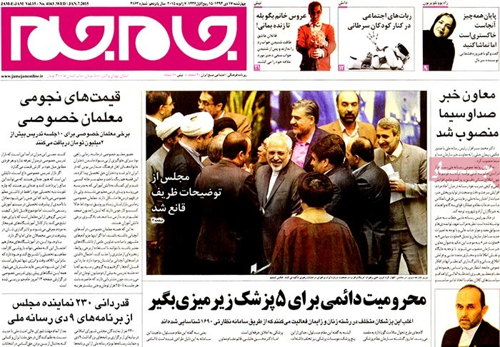
Jamejam: The government seems too afraid to cut the cash subsidies of high-income individuals next year.


Jame jam newspaper 12 - 22


Kayhan: IS terrorists are desperate following major operations by the Iraqi and Syrian armies. IS has executed 170 fighters from among its own ranks.


Kayhan newspaper 12 - 22


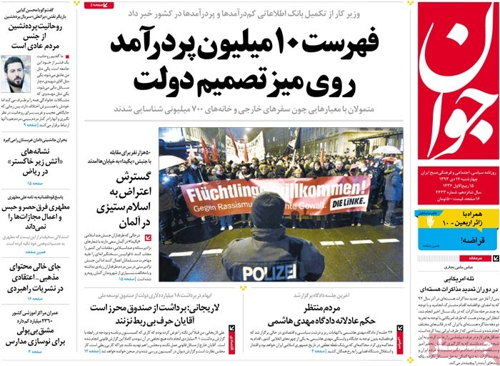
Roozan: What will be President Obama’s next move after Cuba? Just like their American peers, hardliners in Iran are opposed to any kind of diplomatic deal.


Ruzan newspaper 12 - 22


Sharq: [Veteran actor] Morteza Ahmadi, who was known as “The Voice of Tehroon [a colloquial pronunciation of Tehran]” has died at the age of 90.


Shargh newspaper 12 - 22


Tafahom: Imports of airplanes older than 15 years have been banned.


Tafahom newspaper 12 - 22


Iran MPs to visit UK to discuss embassy reopening

iran-uk-embassy

A delegation of Iranian parliamentarians is expected to head to the UK capital, London, in the near future for talks on full reopening of the British embassy in Tehran, a lawmaker says.

Head of the Iran-Britain Parliamentary Friendship Group Abbas Ali Mansouri Arani said Sunday that the delegation would pay a visit to London in the coming months upon both verbal and written invitations from the British side.

According to Arani, Richard Bacon, the vice chairman of the Britain-Iran Parliamentary Friendship Group, verbally invited Iranian lawmakers to visit London during his short stay in Tehran, where he attended a conference on fighting extremism earlier this month.

He further expressed hope that meetings between the Iranian and British sides would remove the existing obstacles, adding that reopening of the UK embassy in Tehran would facilitate obtaining visas for Iranians.

Arani added that during the visit, the Iranian delegation will also look into the problems facing Iranian nationals living in the UK.

In November 2011, Iranian lawmakers voted by a large majority to downgrade diplomatic ties with the UK in response to Britain’s decision to impose sanctions on the Central Bank of Iran over the allegation that Tehran is pursuing non-civilian objectives in its nuclear energy program.

Two days after the decision by the Iranian Majlis, hundreds of Iranian students staged a protest outside the British embassy in Tehran, pulling down the UK flag and demanding the expulsion of the British ambassador.

Following the incident, UK announced in November 2011 that it is withdrawing its diplomatic staff from Iran and that the Iranian embassy in London would be closed.

Nearly two years after their diplomatic ties were severed, Iran and Britain agreed in October 2013 to appoint non-resident chargés d’affaires as a first step toward reopening their respective embassies.

On February 20, Tehran and London officially resumed direct diplomatic relations.

Iran will keep supporting Syria’s anti-terror fight: Larijani

Iran-Syria-Assad

Iran’s Parliament (Majlis) Speaker Ali Larijani says Tehran will continue to fully support the Syrian government in its battle against terrorism and efforts aimed at helping the success of national dialog in the Arab country.

“The Iranian government and nation are standing by the Syrian people and are prepared to expand all-out cooperation with the Syrian government in order to establish regional stability and security,” Larijani said in a meeting with Syrian President Bashar al-Assad in Damascus on Sunday.

He added that the Syrian government’s efforts to safeguard the country’s territorial integrity and counter terrorists should be appreciated.

Since the outset of the crisis in Syria, Iran believed that the developments in Syria were aimed at spreading terrorism, violence and instability in the region, the Majlis speaker said.

Syria has been grappling with a deadly crisis since March 2011. The ISIL terrorists, who control parts of Syria and Iraq, are engaged in crimes against humanity in the areas under their control.

More than 200,000 people have been killed so far in the conflict in Syria, according to UN High Commissioner for Human Rights Zeid Ra’ad Zeid al-Hussein.

The Syrian president, for his part, said his government is keen on uprooting terrorism and extremist ideology while working on reaching national reconciliation at the same time.

Assad added that Iran and Syria have managed to resist many problems and succeeded in foiling plans of the enemies and terrorists.

He emphasized that Damascus is ready to boost cooperation with Tehran in an effort to fulfill the two sides’ interests and improve security across the Middle East.

Muslims marking demise anniversary of Muslim Prophet

Islam-prophet

The 28th day of the month of Safar (the second month in the lunar calendar) marks the demise of the Prophet Mohammed (PBUH). The day also marks the martyrdom of the holy prophet’s grandson Imam Hassan (PBUH), the second revered Shiite imam.

Nationwide mourning ceremonies are also being held to mark the tragic events on Sunday.

Prophet Mohammed (PBUH) was born in about 570 AD in the Saudi Arabian city of Mecca. He became the final prophet by God at the age of 40. He passed away at the age of 63 after disseminating the message of Islam for 23 years.

Imam Reza (PBUH), the eighth Imam of Shiites, who was martyred on the last day of the month of Safar, will be honored held in Iran on December 23.

Cuba resistance invalidated US sanctions, isolation policy: Iran

Iran Issues Statement on US Bid to Reinstate UN Sanctions

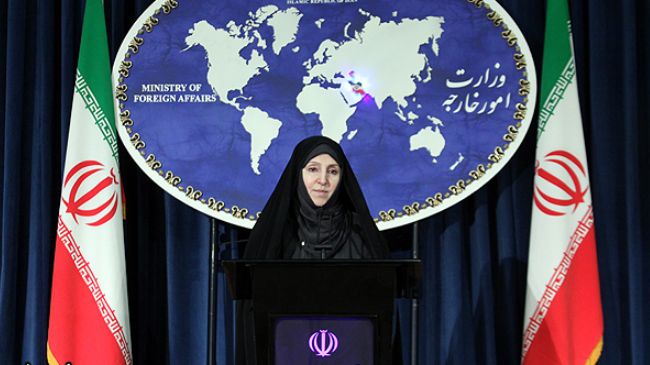
Iranian Foreign Ministry Spokeswoman Marzieh Afkham said Saturday that Cuba’s resistance over the past 54 years since the country’s revolution has “proved that the policy of isolation and sanctions pursued by domineering powers against the will and resistance of independent nations and governments is fruitless and ineffective.”

Pointing to the US acknowledgement that isolating Cuba had been ineffective, the Iranian official said the recent development surrounding Washington-Havana relations could be a step toward decreasing tensions in the region.

In a major policy shift, US President Barack Obama described US policy toward Cuba outdated and ineffective and announced that Washington and Havana will restore diplomatic relations more than 50 years after they were broken.

“I do not believe we can continue doing the same thing for over five decades and expect a different result,” Obama said during remarks at the White House on Wednesday, adding, “Isolation has not worked.”

Cuba and the United States have not had diplomatic relations since 1961.

The United States imposed a partial trade sanction on the Caribbean island nation in October 1960. The measure later evolved into a full trade embargo in February 1962.