Saturday, April 11, 2026
Home Blog Page 4990

We need to get closer to religions through rationality

Iran-Larijani PUIC Troika must urgently meet on Gaza
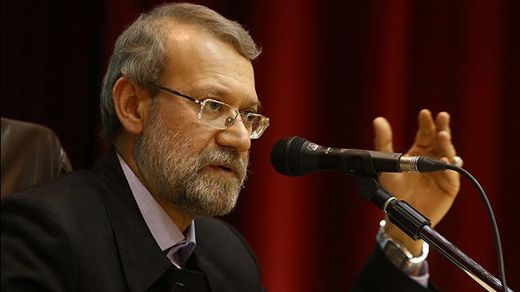
Iran’s Majlis Speaker Ali Larijani

The speaker of the Islamic Consultative Assembly said that the group known as the Islamic State of Iraq and the Levant (ISIL) has been formed based on warmongering attitudes. Ali Larijani went on to say that the ISIL warlords are likely to be led by others, but the group members have their own ideologies and this shows that something serious and practical must be done. The top MP also underscored efforts to keep interfaith dialogue alive and a focus on commonalities as what is direly needed for peaceful coexistence.

Larijani made the remarks in a ceremony celebrating the birthday of Prophet Muhammad (Peace Be upon Him) and the graduation of students of the University of Religions and Denominations on Thursday in the central city of Qom. The following is the translation of his comments as reported by Fars News Agency on January 8:

Formation of a university which could focus – along with the seminary schools – on [different] religions and denominations was of great significance. Today we see that such a university is flourishing in Qom.

It is a must to delve deeply into religions and denominations from different angles. In the past, controversies arose in the East and West for which biased people waged wars against each other. Today we witness that ignorant prejudice against and improper attitudes toward religion have brought disgrace [on nations].

A look at this condition reveals that research into religions and denominations is highly essential. The current situation in the region has caused the potential of several Islamic countries to be wasted; only the US and Israel take advantage of this situation.

The ISIL group has emerged drawing on a warlike mentality, and their warlords seem likely to have been led by others. They have ideologies of their own and this shows serious scientific studies should be carried out.

Conflicts have given rise to multiple problems in the world of Islam. These conflicts have even been taken to their TV channels.

Religions have been practiced by a large population throughout the world. They share many questions and this is the potential which should not be ignored.

Where people are to be guided to is the centerpiece of a religious way of thinking. Commonalities [among various religions] should be highlighted, and peaceful coexistence – not division and discord – should be the core of [religious] principles.

Proximity with religions should be accompanied through a rational view. It should be noted that all religions have mystic views and orientations. Positive results will be produced if we pay due attention to mystic questions on top of rational matters.

Dialogue among religions should be kept alive. Socially speaking, today’s world is in need of interfaith dialogue, and the existing voids should be filled in this regard.

Points which we missed on ‘referendum’ proposal

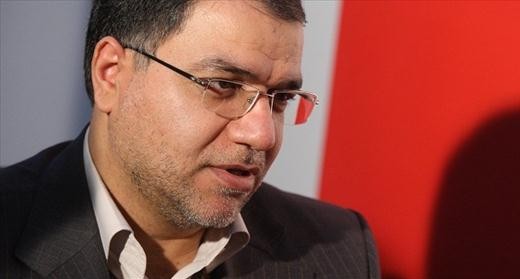
Mehdi Fazaeli
Mehdi Fazaeli

Some comments by the president, including his remarks in a conference on the Iranian economy [on Sunday], evoke memories of those who created red herrings for any speech; the outsiders would take advantage of such marginal issues which would also ruin opportunities, wrote Mehdi Fazaeli, a former managing director of Fars News Agency (FNA) in an opinion piece in Jamejam daily. The following is the translation of the piece as reported by Fars News Agency on January 6:

The president’s recent remarks can be a topic for discussion, but the time is tight for addressing all issues surrounding it. In one part of his remarks which was on foreign policy and [nuclear] talks, the president said, “Threats, opportunities and common interests are the base of foreign policy, and principles and ideals are not up for discussion in foreign policy.”

The president further reiterated, “All talks intend to build a bridge between what the other party seeks and what we require. Our ideal is not tied to centrifuges; rather, it is tied to our heart and willpower.”

Apart from false reasoning, there is one clear point in his remarks: “Principles and ideals are not up for discussion in foreign policy.”

In the same conference, Mr. Rouhani pointed to the role and responsibility of the president in implementing the Constitution and somehow expressed regret for non-implementation of “referendum”! Let’s not deny the fact that referendum is a license, not a must, for certain questions, and the difference between the two is clear for experts.

The Constitution’s Article 59 reads, “In considering vital economic, political, social, and cultural issues, it is possible that the legislative power be exercised through referendum or reference to direct public vote. The request to appeal to public votes must be approved by two-thirds of the entire representatives of the Islamic Consultative Assembly.”

Careful attention should be devoted to the phrase “it is possible”, not ‘it is a must’! Moreover, the process to ratify a referendum has been clarified. But in the foreign policy which has been given a separate chapter (Chapter Ten) in the Constitution due to its importance, it is not a matter of “it is possible”, “it can be” and the like; rather, the phrases are completely clear and imperative in order to remove any ambiguity and [possible] ifs and buts.

Read over three, out of four, articles on foreign policy. (The fourth article is on asylum seeking and is irrelevant here).

Article 152 reads, “The foreign policy of the Islamic Republic of Iran is based on the rejection of any kind of domination, both its exercise and submission to it; the preservation of the all-inclusive independence of the country and its territorial integrity; the defense of the rights of all Muslims; non-alignment in relation to the domineering powers; mutual peaceful relations with nonaggressive states.”

We read in Article 153, “Any form of agreement that would result in foreign domination over the natural and economic resources, foreign domination over culture, the army, and other affairs of the country, is forbidden.”

And finally Article 154, which has pointed to the “ideal” – in the foreign policy chapter – says, “The Islamic Republic of Iran considers human happiness throughout human society as its ideal. It considers independence, freedom, and the governance of justice and truth as the right of all the people of the world. Consequently, while it completely abstains from any kind of intervention in the internal affairs of other nations, it supports the struggles of the oppressed for their rights against the oppressors anywhere in the world.”

Now we want to put this question to the president: What do you think about ‘the rejection of any kind of domination, both its exercise and submission to it; the preservation of the all-inclusive independence of the country, non-alignment in relation to the domineering powers, and prevention of any form of agreement that would result in foreign domination, etc.’? Are they interests or ideals? We think they are ideals and believe that the interests of the Islamic Republic have been intertwined with these ideals, with the benefit of the hindsight.

Should attention to these issues be just in our mind and heart, or we should be careful about them at the negotiating table? When talks possibly result in submission to domination or [foreign] domination over the natural and economic resources, culture, the army, and other affairs of the country, is it possible to claim that the country’s interests have been maintained?

“Sometimes” in foreign policy we face “conditions” in which the smallest retreat, even when it is as small as [decommissioning] one single centrifuge, can be a perfect example of submission to domination, and at other times the shutdown of the entire enrichment [program] has no similar meaning. Whether “sometimes” applies to our status today or how the conditions are is a separate, overarching issue which I am not to get into here.

Today we take pride in the fact that not one single meter of the Islamic Republic of Iran’s soil remained under the enemy’s occupation during the Sacred Defense, and hundreds of soldiers fell to prevent such a thing from happening. Drawing on such logic, isn’t it possible not to sustain human losses and allow some areas remain under the enemy’s occupation and say that the country’s territorial integrity is not compromised with one border city?

The president has sworn to God Almighty before the Iranian nation to safeguard the Constitution, an oath he is obliged to make good on, an oath which comes with legal and religious duties once the president takes it.

Mr. Rouhani, you need to be watchful of your advisors!

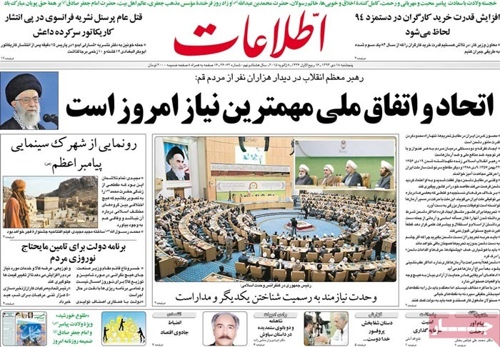
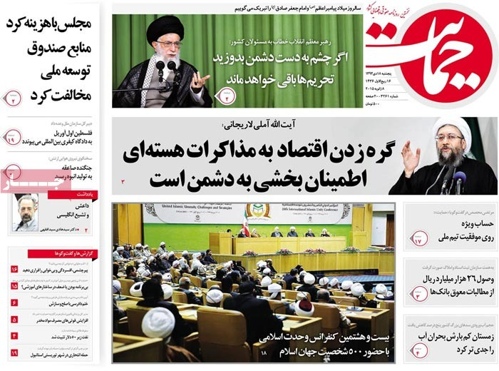
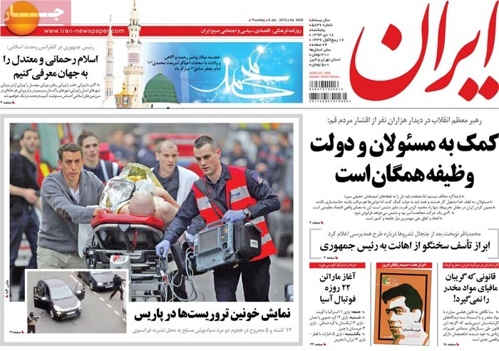
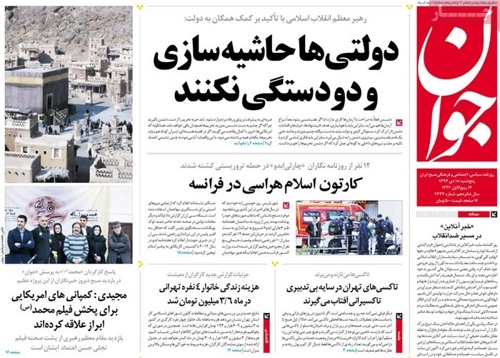
A look at Iranian newspaper front pages on Jan. 8

Iranian Newspapers Headlines

The comments of the Supreme Leader about important issues such as national unity and nuclear talks dominated the front pages of the Iranian dailies on Thursday. The president’s remarks at an Islamic Unity conference in Tehran also made front-page headlines. Last but not least, the deadly terrorist attack in Paris that claimed 12 lives appeared on the cover of almost every newspaper.


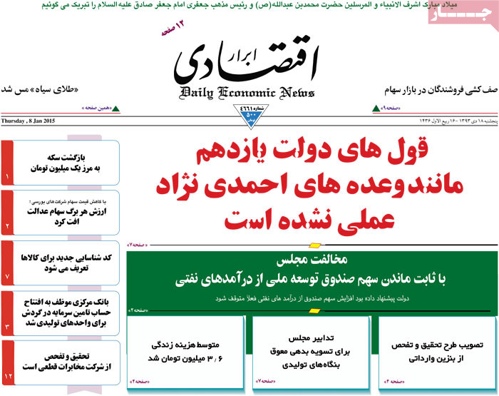
Abrar Eghtesadi: Parliament has rejected a government plan to keep unchanged the National Development Fund’s share of oil revenues.


Abrar eghtesadi newspaper 1- 8


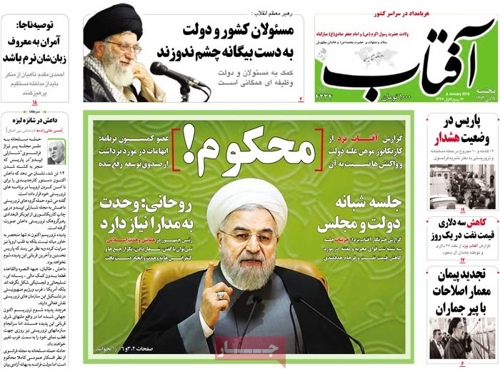
Aftab-e Yazd: The Law Enforcement Force has urged promoters of virtue to talk softly to the public.

Aftab-e Yazd: Oil prices dropped by as much as $3 in a single day.


Aftabe yazd newspaper 1- 8


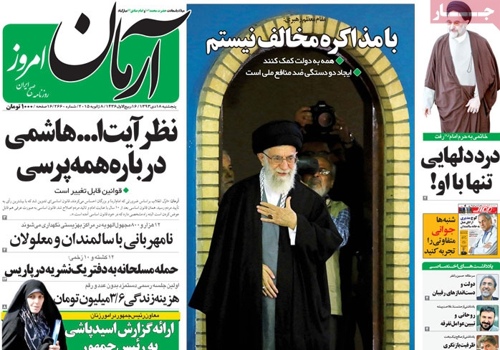
Arman-e Emrooz: “I am not against talks. Everyone should help the government. Creation of division is against our ideals and national interests,” said the Supreme Leader.

Arman-e Emrooz: “Laws can be changed,” is what Chairman of the Expediency Council Akbar Hashemi Rafsanjani thinks of referendum.


Armane emruz newspaper 1- 8


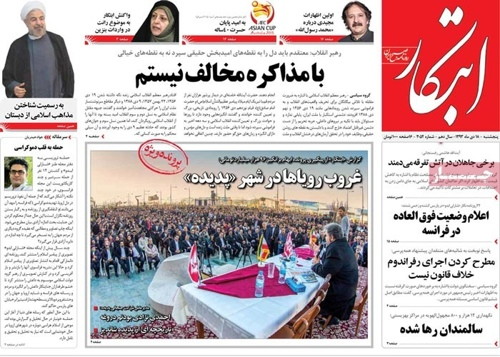
Ebtekar: “Floating the idea of holding a referendum is not illegal,” said the government spokesman.


Ebtekar newspaper1- 8


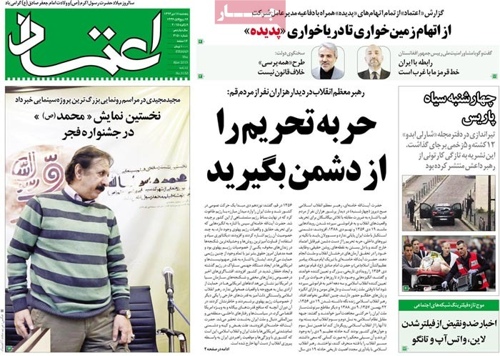
Etemad: There are conflicting reports about messaging and phone apps LINE, WhatsApp, and Tango being blocked.

Etemad: Black Wednesday in Paris. Gunmen stormed the offices of Charlie Hebdo satirical weekly in Paris, killing 12 people and wounding five others.


Etemad newspaper 1- 8


Ettela’at: “Recognition of each other and tolerance are the requirements of unity,” President Rouhani told an Islamic Unity Conference in Tehran.


Ettelaat newspaper 1- 8


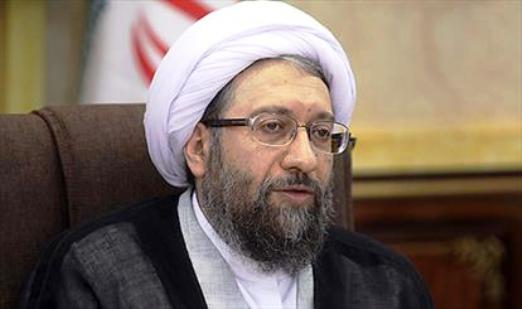
Hemayat: “Tying the country’s economy to nuclear talks is the same as reassuring the enemy,” said Judiciary Chief Ayatollah Sadegh Amoli Larijani.


Hemayat newspaper 1- 8


Iran: Terrorists staged a bloody show in Paris, killing 12 people.

Iran: The government spokesman has said it is shameful that some have insulted the president following his call for a referendum on major issues.


Iran newspaper 1- 8


Javan: “American companies have expressed readiness to screen Muhammad, the Messenger of Allah,” said Majid Majidi the director of the movie which will premiere at the 33rd Fajr International Film Festival later this year.


Javan newspaper 1- 8


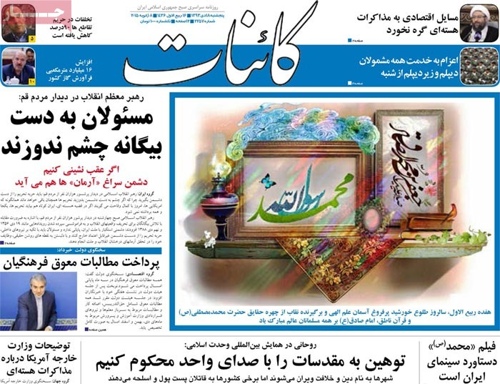
Kaenat: “We unanimously condemn insults being hurled at religious sanctities,” said President Rouhani.


Kaenaat newspaper 1- 8


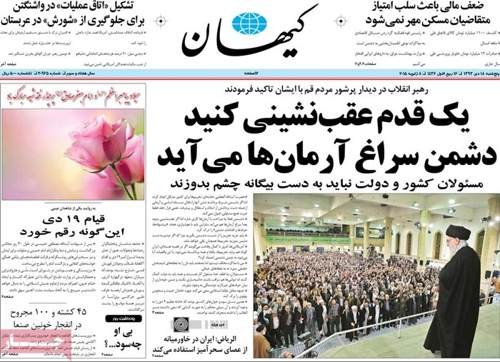
Kayhan: “If you take one step back, the enemy will target our ideals,” the Supreme Leader said in comments aimed at Iranian statesmen.


Kayhan newspaper 1- 8


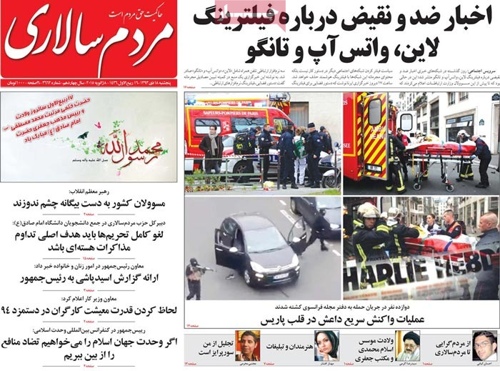
Mardomsalari: “A report on acid attacks has been handed to President Rouhani,” said the vice-president for women and family affairs.


Mardom salari newspaper 1- 8


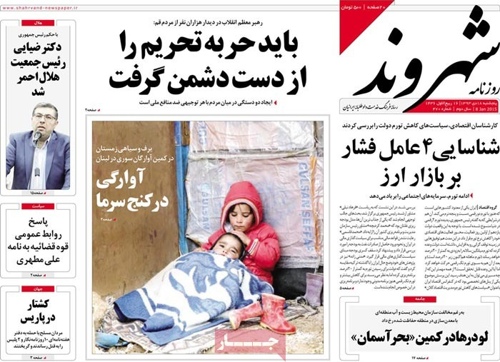
Shahrvand: President Rouhani has named Dr. Amir Mohsen Ziaei as the director of the Iranian Red Crescent Society.


Shahrvand newspaper 1- 8


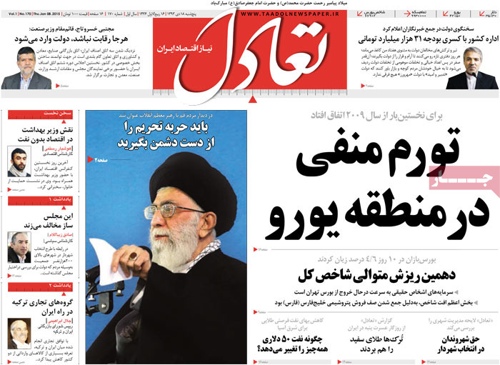
Taadol: “You should take the weapon of sanctions away from the enemy,” the Supreme Leader said in a statement aimed at statesmen.


Taadol newspaper 1- 8


Change in US Congress won’t affect Iran’s nuclear stance

ZArif

Iran’s foreign minister says that the recent changes in the US Congress will have no impact on Tehran’s stance in the nuclear talks with P5+1.

“The changes have no impact on us,” Mohammad Javad Zarif said in an interview with Iran’s parliament news service, ICANA.

Zarif added that he thinks it is possible to reach a final nuclear deal with P5+1 within a short period of time. However, he added that for this to happen, the other negotiating side should abandon its excuses and does not try to prolong talks over Iran’s nuclear program.

“I have always believed that the possibility exists for reaching the agreement in a short period [of time],” Zarif said in the interview, which was published on Wednesday, adding, “… if the other side does not seek excuses and does not prolong the job, there is the possibility of reaching an understanding.”

Zarif also denied a recent report by the Associated Press that Iran has allegedly accepted to transfer some of its enriched uranium outside of the country, describing the report as “rumors and fake news.”

He also said certain achievements have been made in the talks after the last round of negotiations with 5+1 in Vienna this past November. However, Zarif emphasized that those achievements cannot be made public before they are complete.

Tying economic issues to nuclear talks assures enemies

Amoli Larijani

Iran’s Judiciary Chief has said that the country’s economic problems and their solutions must not be tied to nuclear negotiations.

Judiciary Chief Ayatollah Sadegh Amoli Larijani made the remarks at a meeting with the Supreme Judicial Court officials, saying that the way out of economic issues was through ‘high self-esteem’ and relying on ‘resistance economy.’

He also stressed that nuclear negotiations must proceed within the framework of national interests and adherence to the Islamic Republic’s red lines, saying, “One must not tie economic issues to nuclear talks. Iran is a rich country with plentiful resources and hardworking intellectuals. By relying on our natural and human resources we have no reason to be afraid of sanctions and enemies’ economic plots.”

He noted that linking the nuclear talks to economic problems was a kind of ‘reassurance’ for the enemies, and warned the officials and the media not to encourage the enemies’ plots with their ‘despairing’ debates.

“Western countries must know that a country such as Iran with its massive natural and human resources will never back down and has no fear should the sanctions remain,” he said, stressing that Iranian nation’s resilience and determination was the country’s greatest asset.

In his remarks, Amoli Larijani strongly condemned the arrest of Bahraini top opposition figure Sheikh Ali Salman, and said that the Bahraini government backed by Western countries particularly the US and Britain was mistreating its own people.

Iran supports any Muslim fighting extremism

Rouhani-Islam

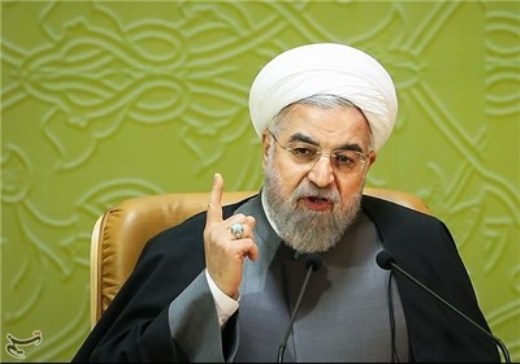
Iran’s President Hassan Rouhani gave an assurance on Wednesday that the Islamic Republic, as an “Islamic world’s big regional power”, will support any Muslim nation or entity in the fight against violence, extremism and terrorism.

“The Islamic Republic of Iran will stand beside and defend the Muslims who fight for the sake of freedom of their land against usurpers,” President Rouhani said, addressing the opening session of the 28th International Islamic Unity Conference in Tehran on Wednesday.

He underlined that Tehran’s support is not confined to a specific area, and Muslims that are battling with violence can enjoy Iran’s backing either in Gaza, Damascus, Mosul, Kurdistan, Afghanistan, Pakistan or elsewhere.

“Should we seek unity in the Islamic world, we must regard as a unified Ummah all around the Muslim world, the Sunnis in Gaza, Alawites in Damascus, Zaidis in Yemen or Kurds in northern Iraq,” he added.

Pointing to the gruesome atrocities committed by the ISIL terrorist group, Rouhani condemned a muted response to the devastation of towns and houses in the name of religion and caliphate.

The president also lashed out at certain countries for arming and funding ISIL terrorists, whom he described as “murderers meaner than wild animals.”

President Rouhani further touched on the procedures for unity in the Islamic world, saying, “When the whole Muslims and denominations have a share in the government in an Islamic society, the way for unity will be paved.”

He also urged consolidate efforts to ensure solidarity in the Islamic world, calling on Muslims to condemn with a “unified voice” the TV channels that confront other faiths in the name of defending Shiite or Sunni Muslims.

Titled “Unified Islamic Ummah: Challenges and Strategies”, the international conference has brought together some 1,200 Islamic scholars and intellectuals from around the globe.

Attendees at the event include educated Muslim figures, ministers of Islamic countries, clerics, scholars and representatives of scientific and cultural circles from Iran and across the world.

President Rouhani congratulates Muslim counterparts on Prophet’s birthday

Rouhani issues

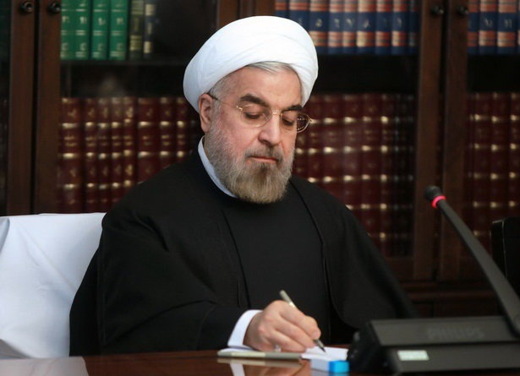
President Hassan Rouhani on Wednesday congratulated his counterparts in the Islamic world on the birthday of Prophet Muhammad (Peace Be upon Him).

In separate messages to the heads of the Islamic states, President Rouhani expressed hope that those “who care about the Muslim Ummah and lovers of the Holy Prophet of Islam would pay due attention, more than ever, to the necessity of the Islamic unity.”

Now that the world of Islam is burning in the fire of extremism, provocative acts intend to trigger tribal and religious prejudice, and enemies of Islam are painting a distorted image of the holy prophet and Islam – which is a religion of peace – the Islamic unity is a must, the president stressed.

President Rouhani also hoped that true lovers of Islam would “pave the way for the spread of peace, justice, progress and spirituality among Muslim nations by following the morals of Prophet Muhammad (PBUH) and his attitude which was based on tolerance.”

Muslims hold week-long celebrations worldwide – designated as the Islamic Unity Week – to mark the birthday of Prophet Muhammad (PBUH).

The Islamic Unity Week is marked between 12 and 17 of Rabi’ al-awwal, the third month in the Islamic calendar. The occasion in which Muslims ponder on the fundamental call of unity according to the Holy Koran was initiated by the late Imam Khomeini following the establishment of the Islamic Republic of Iran in 1979.

Each year Muslims in Iran and other countries around the world celebrate the Islamic Unity Week, which has played an important role in bringing the various Islamic schools of thought on a single platform.

Trans-regional actors sowing discord among Muslims

Rouhani-Cabinnet

Iranian President Hassan Rouhani warned that certain trans-regional countries are implementing plots to create rift among Muslims, and urged strengthening unity between Shiites and Sunnis.

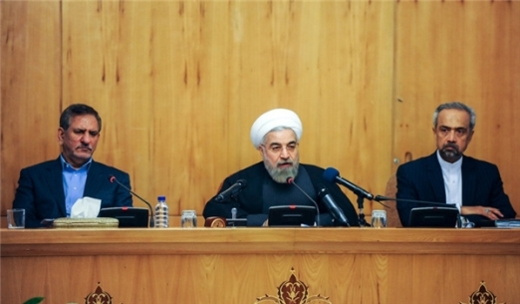
“Under the circumstances prevailing in the world today and with all the dangers threatening the Muslim world, the Shiite and Sunni Muslims are necessitated to side with each other and we should stand hand in hand to create unity in the Muslim world,” Rouhani said, addressing a cabinet meeting on Wednesday.

He cautioned that those outside the Muslim world are widening natural and theoretical differences among Muslims to stir religious and sectarian strife in a bid to block the region and the Muslim world’s development.

In relevant remarks in November 2013, Supreme Leader of the Islamic Revolution Ayatollah Seyyed Ali Khamenei urged the Muslim Ummah (community) to increase vigilance as enemies of Islam are hatching plots to stir sectarian strife among them.

“A major problem of the Muslim World today is the imposed, intentional and wicked problem of kindling differences among the Muslim Ummah and (Islam’s) religious sects,” Ayatollah Khamenei said addressing Hajj officials in Tehran.

[…]

“The confrontation (that the enemies are trying spark) among the religious sects will not be limited to the Shiite-Sunni confrontation and if the enemies of Islam can institutionalize these confrontations, they will put on their agenda sparking internal differences inside the different Shiite sects and Sunni sects,” Ayatollah Khamenei said.

Iran FM: Divisive schemes to backfire on plotters

zarif-Ahmad Badreddin Hassoun

Iranian Foreign Minister Mohammad Javad Zarif says that those countries seeking to sow the seeds of discord among Muslims will be haunted by their divisive scenarios.

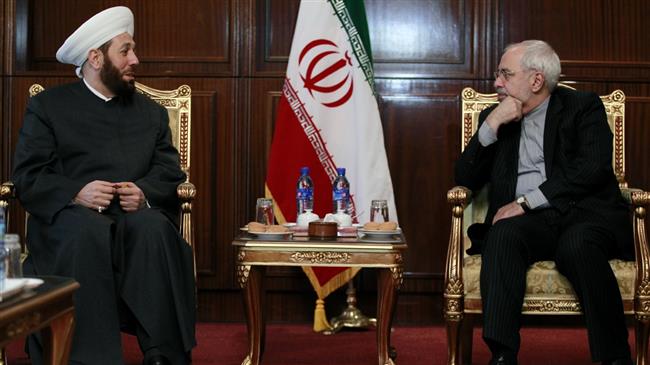
“Those inciting sedition should know that the aftermath of their acts will eventually come back to haunt them,” Zarif said in a meeting with Syrian Grand Mufti Sheikh Ahmad Badreddin Hassoun in Tehran on Wednesday.

The Iranian foreign minister warned that Muslims would not benefit from rifts and divisions, and said that common threats facing Muslim countries are imposed on them by those who do not seek Muslims’ interests.

Zarif also highlighted the invaluable role of scholars in putting an end to religious differences in the Islamic world and countering moves aimed at tarnishing the image of Islam.

Sheikh Hassoun, for his part, highlighted Iran’s role in fostering unity among Muslims and praised Tehran’s support for his country.

The meeting came on the sidelines of the 28th International Islamic Unity Conference which opened in Tehran on Wednesday.

Hundreds of Sunni and Shiite scholars and intellectuals from more than 60 countries are attending the conference titled Unified Islamic Ummah: Challenges and Strategies.

The participants are scheduled to discuss ways to promote unity and solidarity in the Muslim world and will focus on problems facing the Islamic world, such as the threat posed by Takfiri militants.

Crisis of succession brewing on the Red Sea

Malek Abdollah-Saudi

There are rumors about Saudi King Abdullah’s state of health. Some go as far as suggest that the monarch is already dead and some say he’s slipped into a coma. Riyadh is not the only capital worried about the monarch’s health and who succeeds him. Many countries in the region and around the world are closely following the news coming out of the kingdom.

The question of succession is not an easy one and the rise to power of whoever succeeds King Abdullah will have a deep impact on regional issues. On January 6, Ebtekar, a reformist daily, published an interview featuring the views of Hossein Rouyvaran, a Middle East expert. The following is the translation of the report:

Hossein Rouyvaran, an expert in Middle Eastern affairs, believes there are some factors that complicate the question of succession.

First, the ailing monarch has set up a council that names the king and the heir to the throne. So the succession won’t be automatic as is the case in other monarchies.

Second, the current crown prince Salman Al Saud is suffering from Alzheimer’s and eventually many won’t approve of his accession to the throne. Of course, one should not forget the fact that King Fahd was suffering from the same disease toward the end of his reign. Back then Crown Prince Abdullah ran the day-to-day administration of affairs. That the selection of Salman is bound to draw objections makes the question of succession more challenging.

Third, Prince Muqrin bin Abdulaziz, second in line to the throne, is another factor. Naming a second heir to the throne is unprecedented in Saudi history, but that is what King Abdullah has done. Prince Muqrin is not a member of the ruling elite.

Accession to power is dynastic in Saudi Arabia. So far all Saudi monarchs have written wills naming all their sons to rule one after another after their demise. Their sons have not necessarily been from the same mother. The first three kings, Faisal, Khalid and Fahd were mothered by the same woman. Abdullah’s mother came from Al Rashid family. But Muqrin’s mother used to be a slave and his inclusion in the club of elite has drawn objections.

Fourth, the grandsons of Faisal bin Abdulaziz Al Saud are demanding changes to the power structure. That has created serious challenges to the Saudi political establishment. A new generation of leaders needs to replace the old princes to settle the serious challenges the political system is faced with.

The sons of Sultan bin Abdulaziz, a former crown prince, led by Bandar, those of Prince Nayif led by Interior Minister Muhammad Nayif, and the sons of Faisal led by Foreign Minister Saud al-Faisal are going to great lengths to pave the way for the rise to power of a third generation.

Foreign factors are at play too. By keeping oil prices low Saudi Arabia has helped lift the West out of recession and put it on the path to growth. The West seeks to see a reliable individual rise to power in Riyadh.

So, in addition to domestic variables, foreign elements are exerting efforts to make sure someone who listens to the voice of the West rises to power. That has further complicated the selection of a new king.

Anyone who rises to power will need time to solidify his position. Buying time to cement his foothold will definitely be a pillar of the policies the next king adopts. So the next king will try to ease disagreements. Whoever takes that position won’t try to pursue the controversial policies of his predecessor as strictly and that amounts to an opportunity for Iran.

So, a change of guard in Saudi Arabia might result in solutions to some regional crises. If the ailing king dies, Iran will definitely adopt a logical stance and won’t celebrate his passing. Rather, it will send a delegation to attend the king’s funeral. Saudi Arabia is a key regional player and one cannot ignore the kingdom.

Iran is in favor of a Saudi kingdom that pursues Muslim unity. As long as Saudi Arabia acts in a sanctimonious way and follows divisive rather than uniting policies in the world of Islam, it will remain on a collision course with Iran. But if and when Riyadh quits this policy, Iran and Saudi Arabia can be the best of friends.