Saturday, December 27, 2025
Home Blog Page 4943

Interfaith dialogue; a call for action

Iran-Catechism of the Catholic Church

Proximity of religions and interfaith dialogue are among issues which are widely discussed in religious and scientific circles. Religious researchers and scholars put pen to paper to speak their mind about different denominations and religious approaches.

The Publishing House of the University of Religions and Denominations (URD) in Qom is a major player in this regard. A translation of The Catechism of the Catholic Church – a 1992 book written in French by Cardinal Joseph Ratzinger by order of Pope John Paul II – is one of the most recent books the university press has released. The book, which is the essence of the written heritage of church traditions, makes references to the Scriptures and many other sources.

As its name suggests The Catechism of the Catholic Church is the Catholic Church’s reference book on ideological questions and religious-ethical traditions. This book is the official text for church teachings and is based on Scripture, church traditions, [the views of] Church Fathers, and the church educational authority. It has been translated into Farsi by Ahmad Reza Meftah, Hossein Soleimani and Hassan Ghanbari.

On February 2, Ettela’at newspaper filed a report on a review session of the book in which the Vatican Ambassador to Tehran Leo Boccardi, Hojjat-ol-Islam Abolhassan Navvab, the head of the University of Religions and Islamic Denominations, and the book’s translators discussed different aspects of The Catechism of the Catholic Church. The following is a partial translation of who said what in the session:

Ali-Asghar Mohammadkhani, the deputy director for cultural affairs at Book City [a bookshop chain], said that the release of the book sets the stage for a dialogue between Islam and Christianity and added, “We’re happy that many researchers and thinkers in Iran and in Western countries seek interfaith dialogue, and to that end hold talks with each other in a scholarly and friendly atmosphere.

“At a time when some in the world go to extremes, either by resorting to extremism or by trying to eliminate religion, we have a responsibility to promote rationalism, peace and moderation as the true messages of religions.”


Books which eliminate ignorance

The Vatican Ambassador to Tehran Leo Boccardi said, “The Farsi version of The Catechism of the Catholic Church was unveiled on January 12 at the Pontifical Gregorian University in Rome with Iranian thinkers and scientists as well as the dean of the university and representatives from the Vatican in attendance.

“Prominent scholars have said what is there to say about the book; as the Vatican’s ambassador, what can I add to what was said? First, I would like to thank the translators for 12 years of constant, serious work on the book. The book’s new, accurate translation is a success, not only from a linguistic point of view but also for conveying the theme. I assure you that the translation of such a book is by no means an easy job.

“It is commonly said that no translation can exactly match the original text, but in this case I can firmly say that The Catechism of the Catholic Church has been translated carefully in terms of diction and meaning and does not need correction or re-editing. On a scale of one to 10, I proudly give ten to the book’s translators, editor and publisher for its precious print, fluency and reasonable price.”

Ambassador Boccardi further said, “Is this book merely for your library? The answer is No. Such a thing would be a serious blow to what has been done for the book which is a valuable source for reference, research, dialogue and understanding. It is necessary for those who are involved in interfaith dialogue [to read it].

“The other day Supreme Leader Ayatollah Khamenei called on the youth around the world to learn about Islam [firsthand]. Hereby, I invite the Iranian youth to study and do research on The Catechism of the Catholic Church.

“To know about the other party is a prelude to dialogue. We cannot have dialogue with those we do not know. This book provides a good opportunity for Muslim and Christian students, teachers and religious people to learn more about the Christian faith and common biases, and overcome the prejudices which insult human’s rationality, because such prejudices are superficial, baseless and untrue. The current translation can promote the quality of Islam-Catholicism ties to a large extent and help hold a more intimate dialogue between Iran and the Vatican.”
[…]

The Vatican envoy added, “Dialogue is not held just among religions; rather, it brings the faithful together. Ignorance is the biggest obstacle in the way of holding dialogue, developing mutual understanding and showing mutual respect. This book is helpful in removing the existing obstacles.”

[…]


Dialogue and human suffering

Hojjat-ol-Islam Navvab, for his part, elaborated on the prevailing viewpoints and approaches in the University of Religions and Denominations (URD) and said, “Dialogue, research and postgraduate studies are among the main focuses of the university. […]

“URD is a non-governmental, independent university because changes in different governments can render the university vulnerable; that’s why the university is trying to pursue its activities based on freedom, independence, liberty and freethinking. Our university focuses on dialogue when it comes to religions and attaches enormous significance to proximity as far as denominations go.”

[…] “The University of Religions and Denominations has gone to great lengths to promote [religious] tolerance by adopting different approaches such as translation of various religious books, and it has fared well in this regard.

“In light of the fact that Qom is a religious hub, we decided to base the university in Qom. The impacts of such a decision are evident today. The Society of Religions and Denominations has been set up in Qom, and all seminary schools have begun to offer courses on different religions. What we’ve done has been effective in many ways.

“We have opened dialogue on different fronts; as a result, leaders of different religions and denominations visit the university and talks have been held with many churches; […]”

“Religions must know about each other. This approach has been adopted without any prejudice. At the beginning, we compiled a book on Isma’ilism; leaders of this religious sect hailed it as the first academically-complied book by scholars at Qom Seminary School. The URD has always underscored scientific methods at all stages [of education], and there’s always room for dialogue.
“As many as 250 books on different religions and denominations have been translated so far, and this trend will be actively pursued. The university is also home to a research department which publishes several research journals. […] Six-hundred majors are studying at the doctoral level and 1,500 at the postgraduate level in the university.

“The university is running online courses too. We hope our efforts constitute a step toward removing hatred. We hope we can produce a wave of love and kindness and remain steadfast on this path in defiance of measures by ISIL to breed hatred.

“We hope the university’s small steps can help promote humanity, contribute to the cause of peace and human comfort, and bring religions closer together. We do not get engaged in dialogue just for the sake of dialogue. We enter into dialogue to improve the status of humans and ease their pains.”
[…]


Long road ahead

Soleimani, one of the three translators of the book, said, “We translated the book because we believe such measures can help rid the world of violence, cynicism and war. I hope Christians too take similar measures to introduce Islam [to their communities].”
[…]


Dialogue and science

Meftah, another translator, led off his speech by highlighting the need for helping dialogue among religions become a reality and said that today the atmosphere of dialogue between religions has domination over the dialectical approaches of the past.

“Undermining each other is not in the best interests of divine faiths; rather, dialogue and mutual understanding are the best option. […]

“[…] When concepts such as miracle, the origin [of the Creation], Akhirah [the afterlife or the Islamic Day of Judgment], the invisible world, etc. are analyzed in the review of the holy book in modern times, Muslim beliefs become subject to critique too. We should not take pleasure when Christian religiosity takes a hit in the Western world, because secularist attitudes and lack of attention to religion could also affect Muslim societies.

“Therefore, it’s better to stand by each other and help religiosity grow instead of fanning the flames of rivalry and hostile attitudes. The more the followers of a religion stick to their beliefs, the more they can help each other. I reiterate that we can help each other through scientific works.

“I hope the translated version of the book could be a reason for continuing dialogue between Christians and Muslims; we hope the book could generate motivation to seriously follow scientific topics.

“The dialogue might be challenging to some extent, but it can help us get closer in terms of theological issues. If we can understand each other better, we can hold more satisfactory dialogue.

“Those who compared this book [with its translation] stressed that its terminology should be totally Christian without being mixed with Islamic terms. We did not add our own viewpoints to the text; neither did we make alterations to it.

“It is the first time that the book has been translated in a non-Christian country. The readers may find the first part of the book – which deals with theological theories – boring, but the following parts are a better read.

Senior Commander: Iran’s Missile Capability Not Negotiable

General Massoud Jazzayeri

“Iran’s missile programs and defensive capabilities are not negotiable in any foreign circle, irrespective of their approach,” Jazzayeri said in reaction to the Monday remarks of US State Department Spokeswoman Jen Psaki who voiced concern about the launch of a new Iranian satellite and claimed that Tehran’s missile program is a part of the ongoing nuclear negotiations between Iran and six world powers.

“We don’t allow the US and others to meddle in Iran’s defensive affairs,” he added.

Stressing that Iran will use its defensive capability against the bullying powers whenever necessary, Jazzayeri said if the US embarks on any aggressive move, it would face Iranian missiles.

“The era of the US being a superpower has ended, but some have not realized it yet,” he underlined.

In relevant remarks on Tuesday, senior Iranian negotiator and Deputy Foreign Minister Seyed Abbas Araqchi stressed that the rocket carrier used to send Iran’s new satellite into orbit has been designed and used for completely scientific purposes, adding that the country would never allow its missile industry, which is used for defensive purposes, to become an agenda for Iran-powers talks.

“The ‘Safir (Messenger)’ rocket which carried the Fajr satellite into the orbit (on Monday) has been designed and built by the capable hands of experts at the defense ministry’s aerospace organization for space missions and in pursuit of fully peaceful goals,” Araqchi said.

“Iran’s missile program is fully defensive in nature and the Islamic Republic of Iran believes that its defensive issues are not negotiable at all and it will not discuss this issue with any foreign side,” Araqchi stressed.

“Hence, raising and negotiating the country’s defensive and missile capability in Iran’s nuclear talks with the Group 5+1 (the US, Russia, China, Britain and France plus Germany) has never been allowed in the past nor at present nor in future,” he added.

Iranian officials have on different occasions underscored that the country’s missile program is non-negotiable, stressing that the talks with the six world powers are limited to the nuclear standoff.

In relevant remarks in August, Iranian President Hassan Rouhani stressed that Iran’s military program was based on a defensive doctrine, but meantime said Tehran would never ask for anyone’s permission for defending itself and expanding its defense industries, implying that the nation would not discuss its missile program in talks with the world powers.

“Our military doctrine is based on defense and we don’t design any weapon for aggression; we don’t carry out any research on how to occupy the regional states. All our researches are based on this defense principle that how we can defend ourselves or how we can stop the enemy,” Rouhani said, addressing a ceremony to unveil two new home-made cruise missiles and two new drones in Tehran participated by Defense Minister Brigadier General Hossein Dehqan and other senior officials at the time.

He said Iran’s defense programs were based on a deterrence strategy to prevent the breaking out of war in the region, reiterating that “our military capability is at the service of regional security”.

He underscored Iran’s strategy of preventing war in the region, and said Tehran is not after an arms race and the Weapons of Mass Destruction (WMDs) “but it doesn’t ask for anyone’s permission to defend itself and to develop our defense industries to whatever degree” that we deem necessary.

The President once again reiterated the necessity for creation of a nuclear weapons-free Middle-East, saying that all WMDs in the Middle-East should be dismantled.

Rouhani also stressed Iran’s special geopolitical conditions, and asked, “Given Iran’s position in the region and the world, is it possible to speak about stability in the region and avoid mentioning Iran? Is it possible to speak of regional welfare and development without naming Iran?”

Foreign gain with Iranian pain

Export-Iran

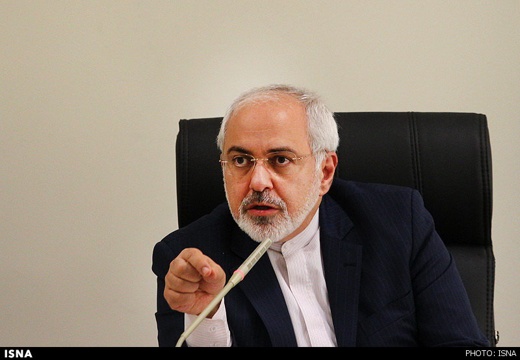
On January 3, Foreign Minister Mohammad Javad Zarif, who was on a tour of Africa told journalists, “Some individuals don’t want sanctions to be lifted.” His comment drew different reactions in Iran. Apparently upset by Zarif, a principlist daily said the top diplomat has called “those who are opposed to flexibility in the face of America and the West” as a bunch pursuing personal interests.

Fararu, a website filed a report about the problems that Iranian exporters are wrestling with which sheds light on another fact: Beyond Iran’s borders, there are many profiteers who capitalize on the murky conditions created by sanctions to buy Iranian products in bulk to wrest control of the market from Iranian producers. They seek to make Iranian businessmen (read Iran’s economy) stay dependent on middlemen to sell their products even after the sanctions are lifted.

In such conditions, bitterness toward world powers which slapped crippling sanctions on the Iranian nation would persist even after the removal of sanctions. Mandela has said that certain things might be forgivable, but they are not forgettable. The following is a partial translation of the report:

By opting for wrong trade methods, some Iranian businessmen have put the reputation of Iranian products on the line. The problem has lingered so long that the issue of bulk exports of low- quality products has drawn criticism from many.

In some countries, it’s said that the Iranians offer their products in worn-out sacks and torn boxes to their customers and this issue has tarnished the reputation of Iranian products on international markets.

The remarks of Iranian traders are interesting too. They contend bulk exports have never been their preference, but to avoid paying value added tax, foreign customers prefer them. Foreign countries have levied heavy tariffs on imports of packed products. Besides, foreign hypermarkets are not willing to directly buy Iranian packed goods because of the sanctions.

Aside from numerous production obstacles, Iranian producers have more challenges on global markets, as a result of which substantial profits are channeled into the pockets of foreign traders on sales of Iranian products.

Iran’s saffron is exported to Spain and packed beautifully there before being resold to other countries with eight- to ten-fold profits.

Iran’s high-quality dates end up in the UAE and are sold to other countries as Arabic brands. Apples grown in Damavand [northeast of Tehran] gardens are cherry-picked and sold not in kilos but in numbers on Turkey’s market.

Based on stats by the Food and Agriculture Organization, palm groves around the world cover about 950,000 hectares of land, of which 250,000 is in Iran.

The very report identifies Iran as the biggest producer of dates in the world: 1 million tons a year. One kilo of Iran’s high-quality dates in bulk fetches less than $1, whereas one kilo of packed dates from Saudi Arabia, Egypt and Algeria is sold $5. As a result, the UAE is one of the biggest buyers of Iran’s dates.

Ahmad Mirhashemi, a board member of Khuzestan’s Nuts Producers and Exporters Union, has told the Islamic Students News Agency that Iran’s dates which are exported in bulk to Dubai and Turkey are later packed by those countries and sold to markets in France and Britain.

Kish Island to host 1st intl. sculpture symposium

Kish-Art

Director of Kish Investment and Development Company has announced that the first international sculpture symposium is to be held in Kish Island.

Behboud Behizadeh stated that this event aims at developing contemporary art of sculpture on the island. “Making the urban space more beautiful and elegant through setting ground for Iranian and foreign artists to exchange experience and share their aesthetic viewpoints.”

He also added that the event is aimed at educating the island residents on how statues are created.

Behizadeh said that the 20-day symposium, which is going to be held on February 8, would be judged by sculpture and visual arts experts.

He also said that factors such as good facilities, pleasant climate, and the ease of transportation for foreign passengers without any visa requirement would boost the presence of international artists in the event.

Iran condemns savage murder of Jordanian pilot

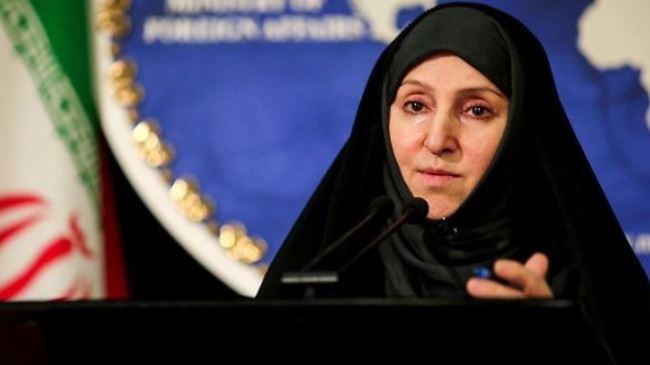
Iranian Foreign Ministry Spokeswoman Marziyeh Afkham

Foreign Ministry spokeswoman Marziyeh Afkham has vigorously condemned the savage murder of a captivated Jordanian pilot by the terrorist group, ISIL.

She termed the murder as an inhuman act which did not abide by any Islamic codes of conduct.

Afkham further expressed sympathy with the family of the murdered pilot as well as the Jordanian government and nation.

She then said all those countries which support the terror group are implicated in the heinous crime and advised against adopting selective measures in dealing with terrorism.

The spokesman also stressed the necessity of adopting measures to strongly confront all crimes committed by the terrorist groups.

The terrorist ISIL group released a video on Tuesday which contained images of the 26-year old Jordanian pilot Mouath al-Kasaesbeh who was burned alive.

Parliament supports nuclear negotiators: Larijani

Larijani-2

Parliament Speaker Ali Larijani said on Tuesday that the Iranian Majlis fully backs the efforts of Iranian diplomats involved in nuclear talks with P5+1.

Larijani made the remarks in a meeting with visiting Speaker of Malaysian House of Representatives Pandikar Amin Mulia.

Larijani said that the Western governments should not be worried about Iran’s peaceful nuclear program following the Fatwa (religious edict) issued by the Supreme Leader of the Islamic Revolution banning the proliferation and stockpiling of nuclear weapons.

He said that Iran and Malaysia have historical amity and cultural affinities and the two countries have taken major strides to bolster relations and cooperation.

The stage is set for expansion of political, economic, commercial, cultural and tourism cooperation between the two countries, he said.

On regional and international developments, Larijani said time is ripe for leaders of the Islamic states to depict the real image of Islam by developing unity and solidarity, Larijani said.

Speaker of the Malaysian House of Representatives, for his part said Malaysia attaches importance to expansion of political, parliamentary, economic, commercial and cultural cooperation between the two countries and is determined to deepen and broaden such ties.

Iranian people are the true friends for the Malaysian people, he said and called for expansion of relations and cooperation between the two nations.

There exists good potential in cultural fields as well as tourism industry in both countries which should be explored, he said.

Iran and Malaysia have the same stand on extremists and terrorist groups in the region mainly with IS, he said adding that Malaysia has taken required legal measures to deal with their ideology and the activities of extremist groups.

All Muslim states should seriously thwart extremism and violence, he said.

He expressed satisfaction with the Iranian significant achievements in nuclear talks with the Western governments and expressed hope that lifting economic sanctions will help expand economic cooperation.

Iran rejects US anti-terror call of help over Washington insincerity

Abdullahian-1

“The US asked Iran for help in the fight against terrorism. However, we believe the US lacks sincerity [in its anti-terror bid] as some of these terrorist groups are simultaneously supported by the US,” said Iran’s Deputy Foreign Minister for Arab and African Affairs Hossein Amir Abdollahian on Tuesday without mentioning the time of the request.

The presence of foreign military troops in the region over the recent years has shown that having a military approach toward undeveloped countries not only fails to solve the issues of terrorism and instability, but may even exacerbate the problems, he added.

The Iranian diplomat also slammed US policies with regard to the Syrian crisis, noting that the presence of terrorist groups in Syria is the result of the wrong policies of the US and its allies.

Amir Abdollahian is currently in the Ethiopian capital city of Addis Ababa to attend an African Union summit.

Since late September last year, the US and its allies have been conducting airstrikes against ISIL Takfiri terrorist group inside Syria without any authorization from Damascus or a UN mandate. The airstrikes are an extension of the US-led aerial campaign against ISIL positions in Iraq.

This is while Washington has been supporting the militants operating against the government in Syria since March 2011. Many ISIL terrorists have reportedly received training by the CIA in Jordan and Turkey. Saudi Arabia and Qatar have also been staunch supporters of militants fighting the Syrian government.

The ISIL militants have seized large swathes of land in Iraq and Syria, terrorizing all communities, including Shias, Sunnis, Kurds and Christians, in the areas they are controlling.

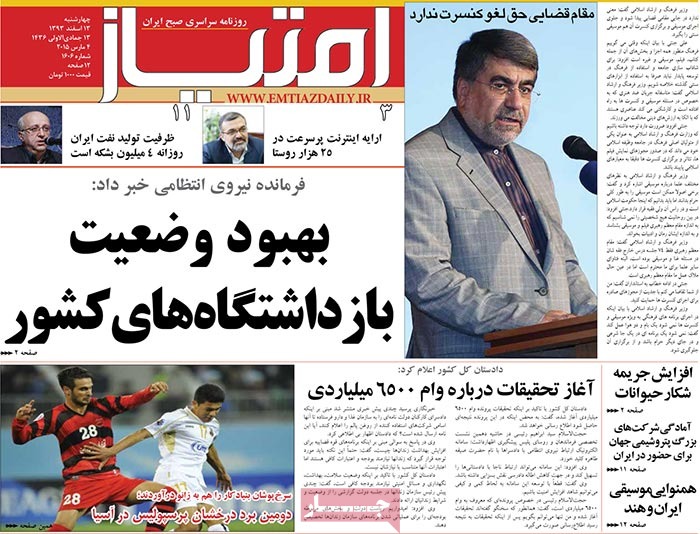
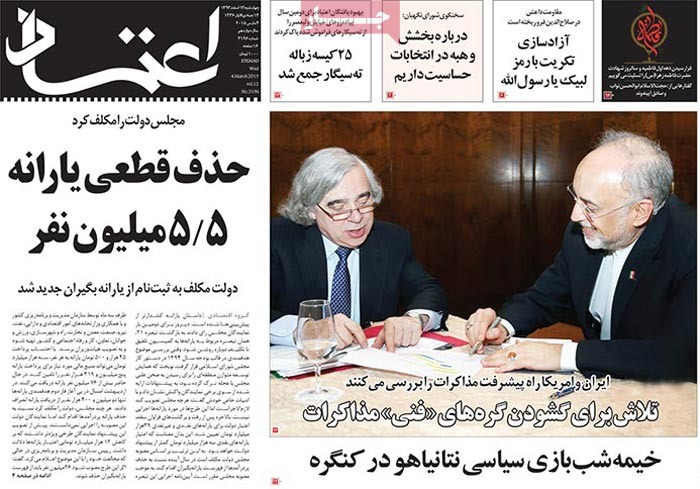
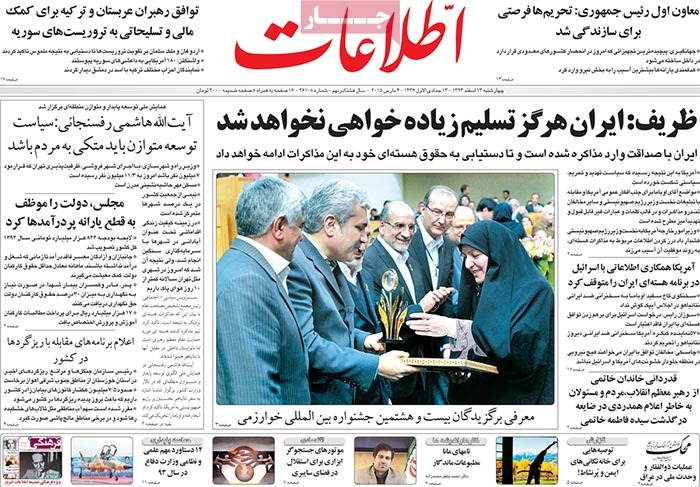
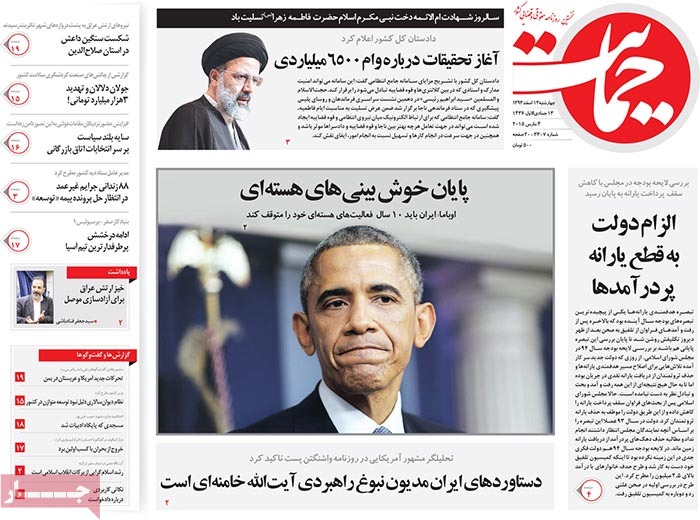
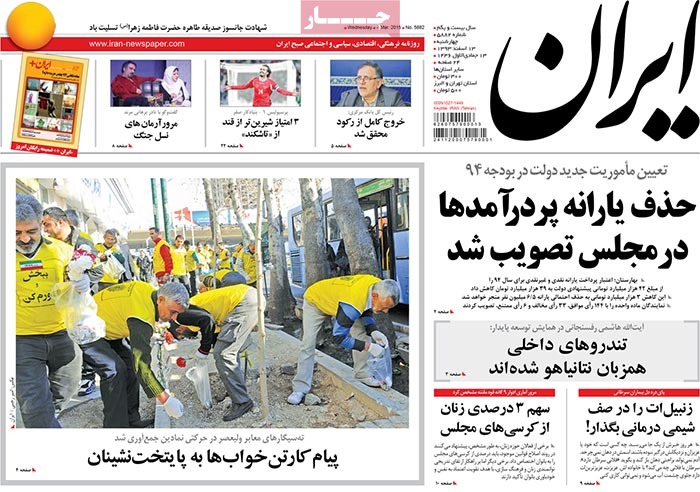
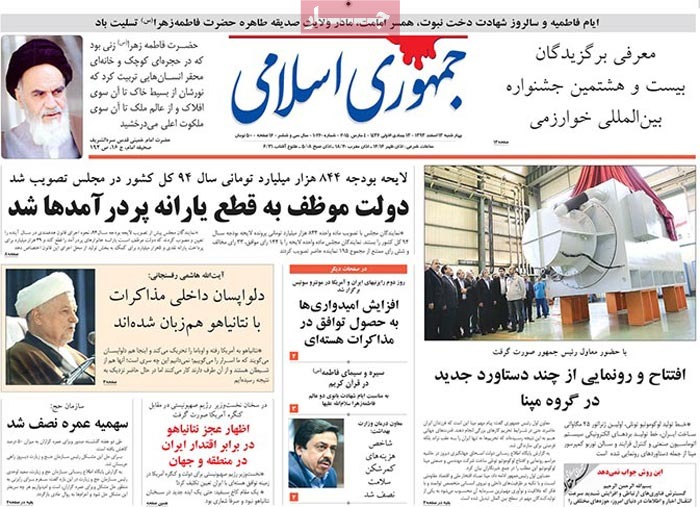
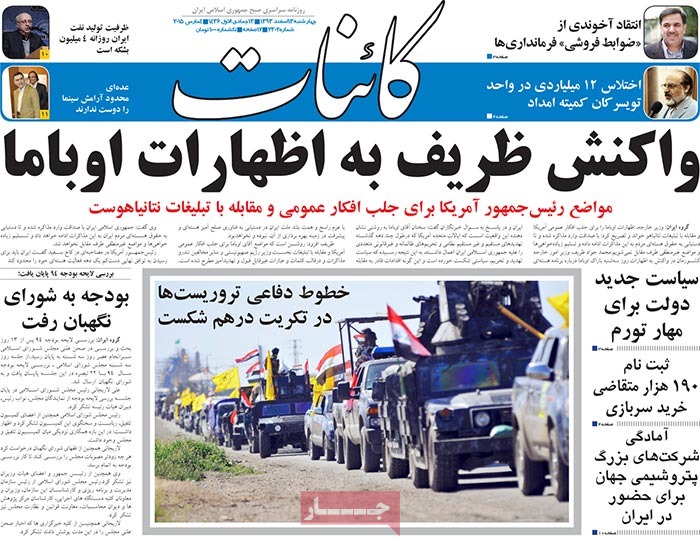
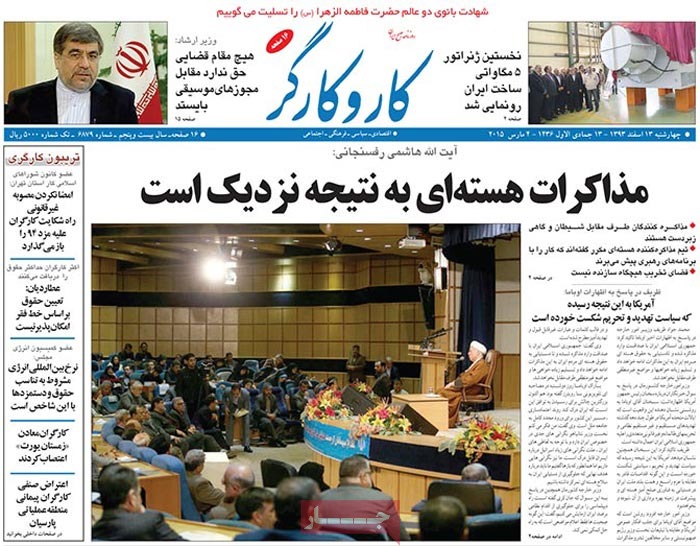
A look at Iranian newspaper front pages on Feb. 4

Iranian Newspapers Headlines

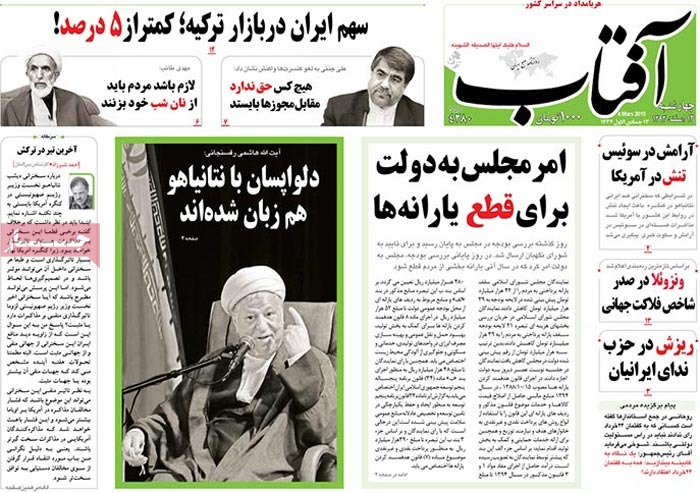
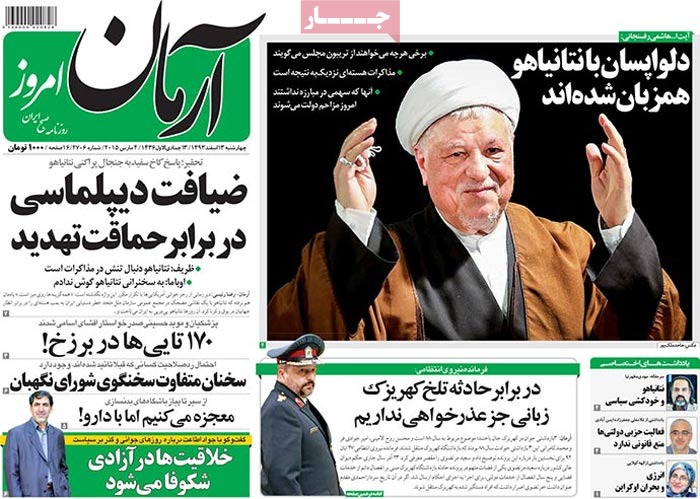
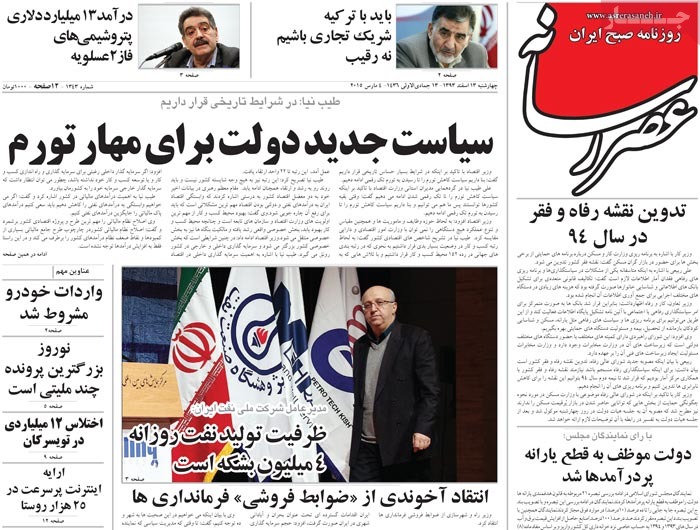
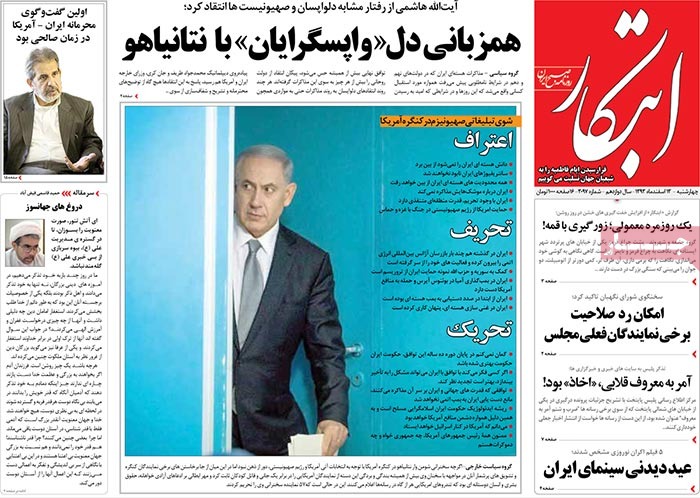
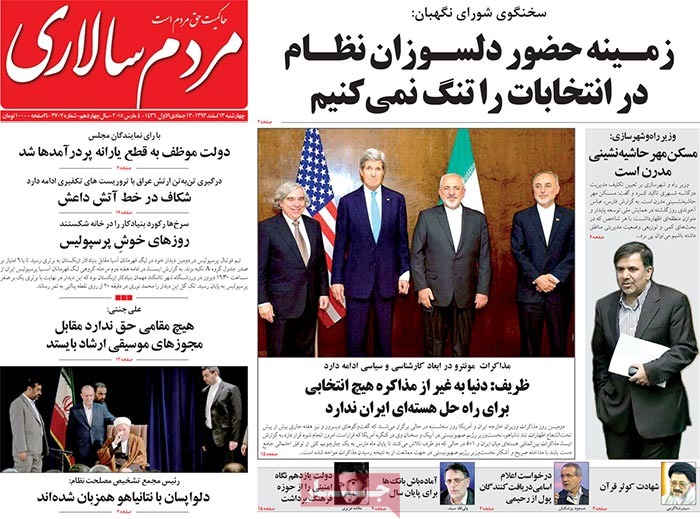
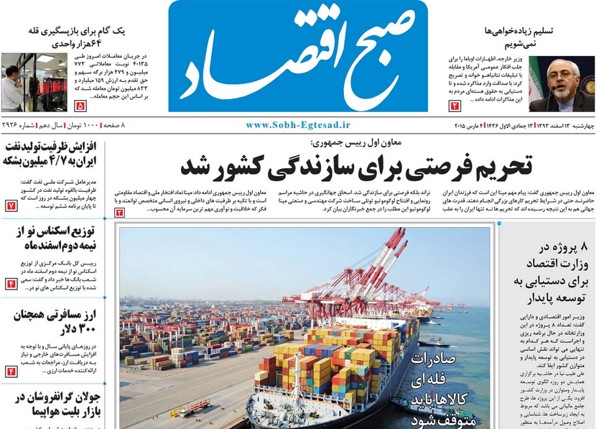
President Rouhani’s announcement that gaps have narrowed in nuclear talks between Iran and the West dominated the front pages of Iranian newspapers on Wednesday. Also on the covers of dailies were the comments of the economy minister during his appearance in parliament to answer the questions of MPs. Principlist dailies focused much of their front-page attention on the decision of parliament to require the government to scrap the Geneva deal in case any new sanctions are imposed on Iran.


Arman-e Emrooz: “Let the Europeans know that Iran seeks to interact with the whole world,” said the chairman of the Expediency Council at a meeting with visiting former Irish Prime Minister Bertie Ahern.

Arman-e Emrooz: Oman has said that a nuclear deal with Iran is certain to happen. President Rouhani said [after talks with the parliament speaker and the judiciary chief] that gaps between Iran and the West [on the nuclear issue] have narrowed.


Armane emruz newspaper 2 - 4 - 2015


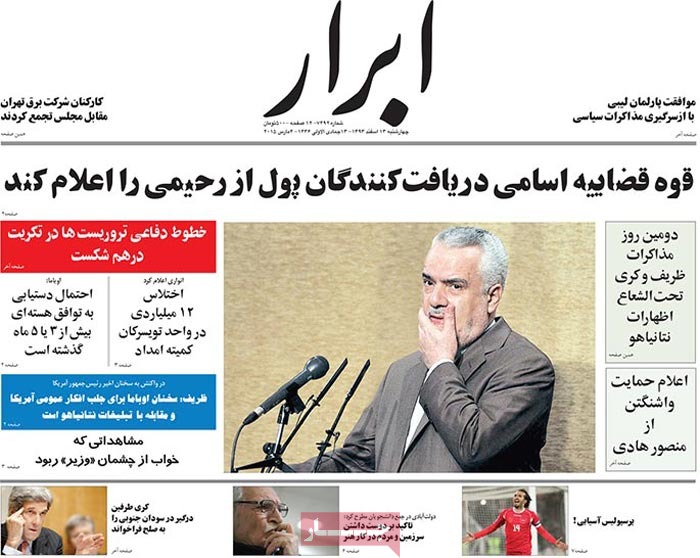
Asrar: “Withdrawal of $1.2 billion was normal and authorized,” said the governor of the Central Bank [in reaction to critics who accuse the government of taking unauthorized money from public funds.]


Asrar newspaper 2 - 4 - 2015


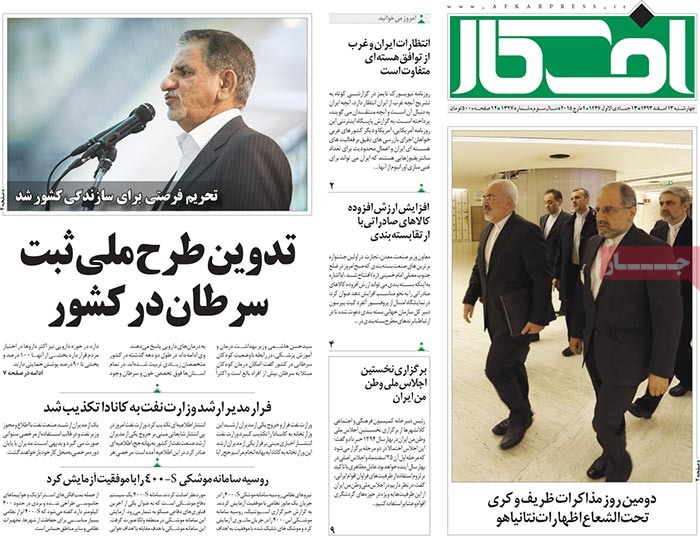
Ebtekar: The cash subsidies of some 9 million high-income individuals are likely to be cut as of next year [starts March 21, 2015].


Ebtekar newspaper 2 - 4 - 2015


Etemad: “When I attended a session of parliament’s Economic Committee, I was told that Messrs. Rouhani and Zarif are the target, not me,” said the economy minister after being yellow-carded by the chamber.


Etemad newspaper 2 - 4 - 2015


Ettela’at: More than 670 education and sports projects were inaugurated across the nation Tuesday on the third day of ceremonies marking the victory of the Islamic Revolution 36 years ago.

Ettela’at: “Some 220 cancer treatment centers will be set up across the country,” said the health minister.

Ettela’at: An official market where foreign currencies are traded will be set up.


Ettelaat newspaper 2 - 4 - 2015


Jomhouri Islami: “The Americans make mistakes and the Europeans follow their lead,” said Akbar Hashemi Rafsanjani at a meeting with visiting former Irish Prime Minister Bertie Ahern.


Jomhorie eslami newspaper 2 - 4 - 2015


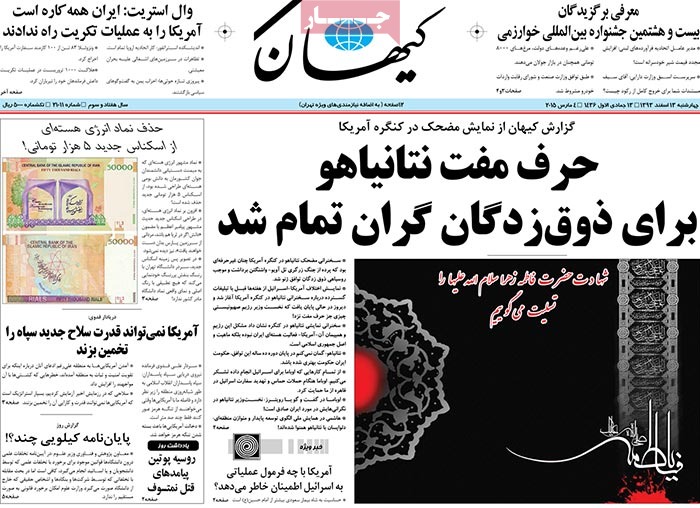
Kayhan: The Islamic Consultative Assembly has conditioned Iran’s acceptance of a comprehensive nuclear deal with P5+1 on removal of all sanctions.


Kayhan newspaper 2 - 4 - 2015


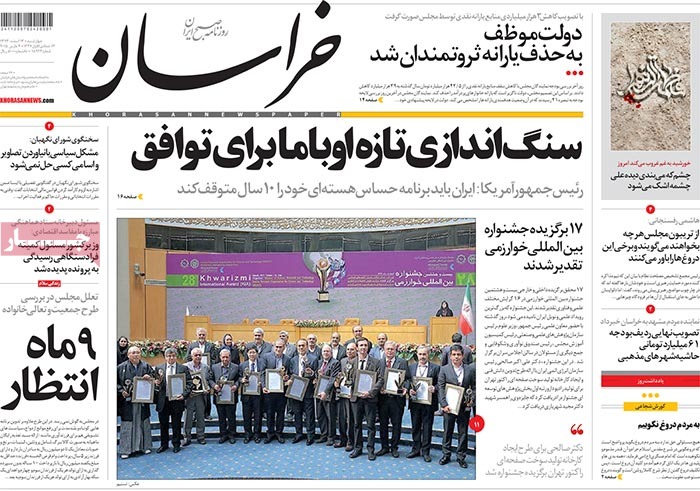
Khorasan: According to a decision by Iranian MPs, in case of new sanctions, the Geneva Deal would be scrapped and enrichment at any level Iran chooses would be resumed.


Khorasan newspaper 2 - 4 - 2015


Shahrvand: Iranian Health Minister Hassan Hashemi has warned that the number of cancer patients in the country will register a 70 percent rise within 15 years.


Shahrvand newspaper 2 - 4 - 2015


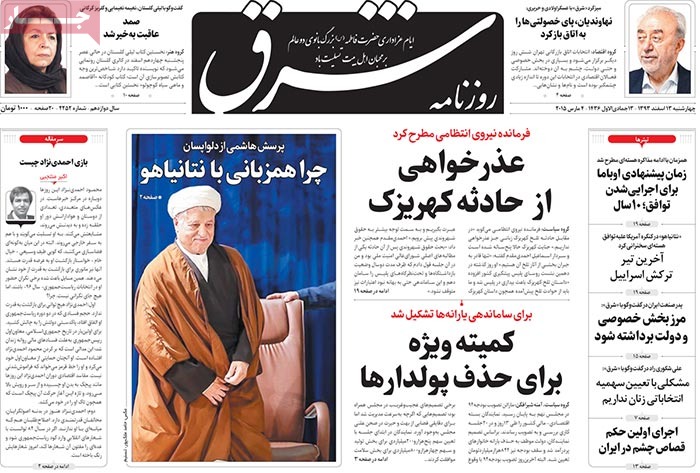
Sharq: The research center of the Guardian Council has said that appointment of Saeed Mortazavi as director of the Social Security Organization and the influence Mohammad Reza Rahimi wielded there were both against the law.


Shargh newspaper 2 - 4 - 2015


SMT: First Vice-President Eshagh Jahangiri has vowed that hurdles standing in the way of non-oil exports will be removed.


Samt newspaper 2 - 4 - 2015


Iran raps Europe for following US sanctions policies

Hashemi-Irland

“While economic problems have plagued many European countries, how can they justify their policy of following unsuccessful US programs?” said Ayatollah Akbar Hashemi Rafsanjani during his meeting with Ireland’s former prime minister, Bertie Ahern, in the Iranian capital city of Tehran on Tuesday.

He noted that the West’s sanctions against other countries have impacted detrimentally on the European economy, causing a massive economic slump.

Iran’s nuclear program

Ayatollah Hashemi also blamed the West for lacking a strong will to solve the issue of Iran’s nuclear program.

“Iran is serious in negotiations and defending its nuclear rights. However, it seems there are some problems in the US that even sap the European countries’ will [in the nuclear talks],” he said.

Iran and the six world powers are in talks to secure a final full-blown deal over Tehran’s nuclear program.

Since an interim deal was agreed in Geneva in November 2013, the negotiating sides have missed two deadlines to ink a final agreement.

The two sides now seek to reach a high-level political agreement by March 1 and to confirm the full technical details of the accord by July 1.

Rise of leftist parties in Europe

Ayatollah Hashemi also referred to the rising popularity of leftist parties in Europe which culminated in the victory of anti-austerity party Syriza in Greece’s parliamentary elections, saying the trend is the result of the European statesmen’s disregard of economic problems, especially the growing rate of unemployment.

“It is not far-fetched that Greece’s incident may permeate other countries as well,” he stated.

Syriza is a fierce opponent of Greece’s bailout deal with the International Monetary Fund and eurozone countries, and has vowed to reconsider the austerity measures that have caused mounting dissatisfaction in the country.

Gaps between Iran and P5+1 have narrowed: Rouhani

President Hassan Rouhani said the West feels that it needs to recognize the rights of the Iranian nation and the wide gaps that initially existed in nuclear talks have now narrowed.

After a meeting with the heads of the other two branches of government Tuesday, the president told reporters the nuclear case was one of the issues that came up for discussion at the meeting. “Fortunately, the nuclear case is progressing within the framework the Islamic establishment has set. The negotiating team has the backing of all senior state officials and the Supreme Leader has on occasion praised the members of the team.”

The president also said next year’s budget, banking and business issues, air pollution and investment in transportation as well as regional questions were also discussed at his meeting with the parliament speaker and judiciary chief.