Saturday, December 27, 2025
Home Blog Page 4941

Leader has given go-ahead for talks, not friendship: Principlist cleric

Alamolhoda

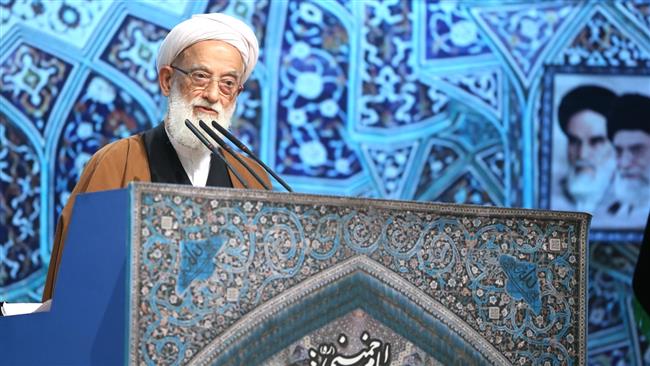
Ayatollah Ahmad Alam al-Hoda, the Friday prayer leader of Mashhad and a member of the Assembly of Experts, said on Wednesday that principlists are not jockeying for position in the country; rather they insist on advancement of Islamic principles remaining the top priority of the revolution which should remain on track to further progress. The following is a partial translation of his comments as reported by Entekhab news website on February 4:

[…] What we’re saying is that officials need to take account of the ideal outlook of the revolution and run the country based on such an ideal, rather than sticking to economic matters at the expanse of the revolutionary cause.

That is the way the Supreme Leader deals with all groups and factions. They [the moderates] sought permission to hold talks and the leader granted permission for talks, and not for friendship. That they [the president’s men] mock their opponents by saying that principlists find fault with everything, including the way the foreign minister dresses, is not correct. What we are saying is that at a time when the US supported a [French] publication which released 3 million copies insulting the Prophet, our foreign minister was out for a promenade with his American counterpart.

No one questioned the stroll itself. […] Are you supposed to hold talks or strike up a friendship? We are not supposed to befriend a country with which the [Islamic] establishment has been at war for 35 years, particularly at a time when global powers are going out of their way to bring down our establishment.

We trust the government and the foreign minister because they have the leader’s backing. Opposition to them would amount to opposition to the leader. But what we are asking is whether the government is taking account of the ideal outlook of the revolution or it is just looking a few yards ahead? What we are saying is that those who are appointed government ministers should see the ideal outlook of the revolution.


Officials should run the country with an eye to bolstering the revolution. Our foreign policy should be aimed at promoting such a mentality, rather than using politics to simply advance the country’s economic agenda.

Judiciary chief stresses wide public support for Islamic establishment

Iran’s Judiciary Chief Sadegh Amoli Larijani has underscored the failure of sanctions against Tehran, saying that the Iranian nation is firmly supporting the Islamic Republic ruling system.

“The Iranian nation is firmly determined to defend the Islamic Republic’s achievements,” Amoli Larijani said on Wednesday.

He called for massive public turnout in rallies that will be held on February 11 to celebrate the anniversary of the victory of the 1979 Islamic Revolution in Iran, and said, “By their large participation in the February 11 rallies, the Iranian nation will show to the world, especially the hegemonic powers, that plots and sanctions cannot influence these people and the Iranian people bear the hardships but never give up their divine goals.”

In relevant remarks in November, President Rouhani underlined that P5+1 (the US, Russia, China, Britain and France and Germany) had come to the conclusion that sanctions and pressures cannot halt Iran’s progress in various fields, including the nuclear technology.

“There is no doubt in the continued operation of Iran’s nuclear technology and installations and today, the negotiating sides are of this belief that pressures and sanctions against Iran don’t yield any fruit,” Rouhani said in an interview with the state-run TV.

The 10th round of negotiations between Iran and the six world powers was held in Vienna from November 18 to 24, where the seven nations decided to extend the talks until July after they failed to strike an agreement.

The latest round of the nuclear talks between the two sides was held at the level of deputy foreign ministers in Geneva, Switzerland, on January 18.

The two sides decided to continue their talk early in February.

Iran and P5 +1 have underlined that cutting a final deal before the July 10 deadline is possible.

A look at Iranian newspaper front pages on Feb. 5

Iranian Newspapers Headlines

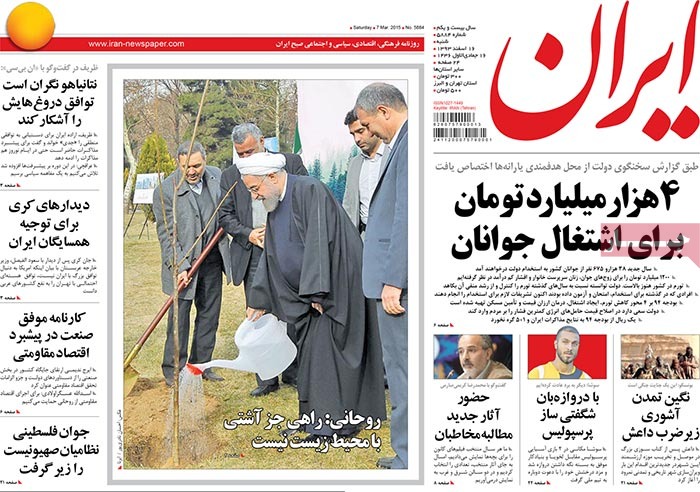
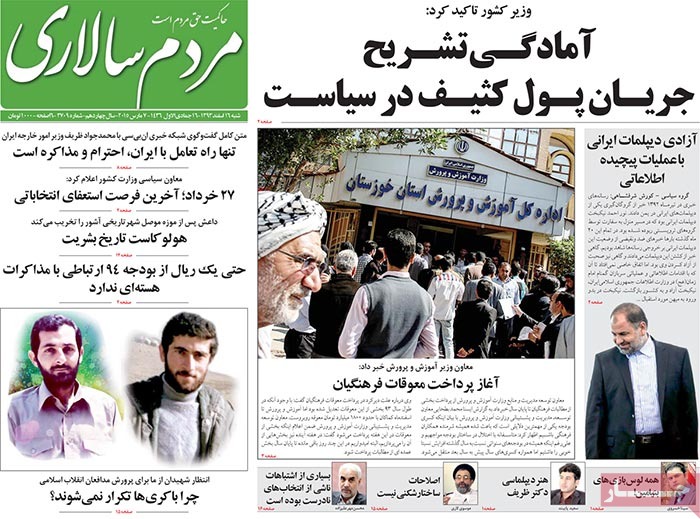
“We don’t need nukes, we have a great, selfless nation to rely on,” was part of the comments President Rouhani made in Isfahan which dominated the front pages of Iranian newspapers on Thursday. Also on the covers of dailies were the announcement by the government spokesman that civil servants will receive almost $200 in yearend annual bonuses and the amount of fines draft dodgers will have to pay to secure exemption from military service.


Aftab-e Yazd: “I have answers to provide, but time is not right,” said former President Mahmoud Ahmadinejad in response to corruption allegations leveled against his government.


Aftabe yazd newspaper 2 - 5 - 2015


Amin: “Iran’s exports to the US are down 25 percent,” said the government spokesman.


Amin newspaper 2 - 5 - 2015


Arman-e Emrooz: “We do not need nuclear weapons,” President Rouhani said in a speech in Isfahan.


Armane emruz newspaper 2 - 5 - 2015


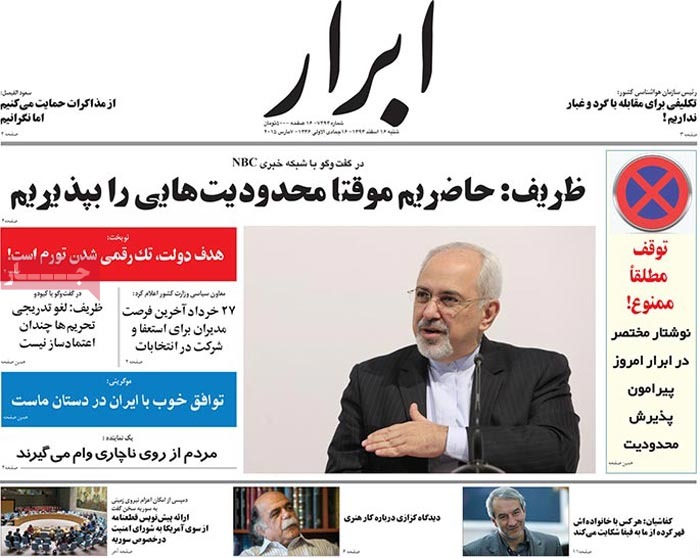
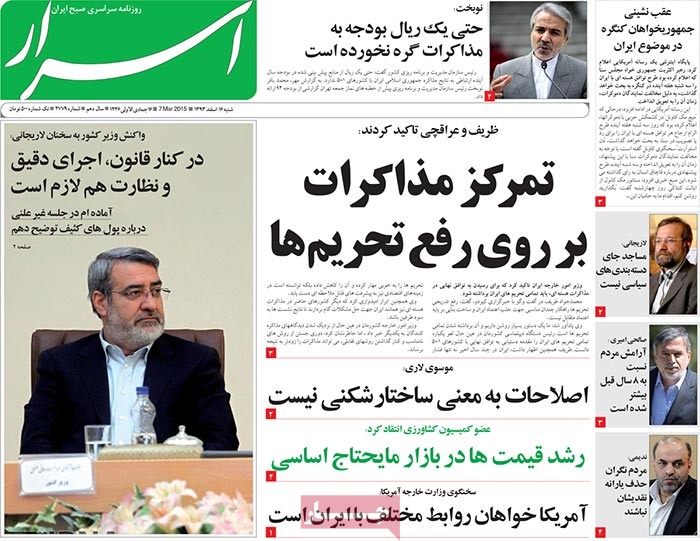
Asrar: “Ahmadinejad was a law-breaker,” said principlist MP Ahmad Tavakoli.


Asrar newspaper 2 - 5 - 2015


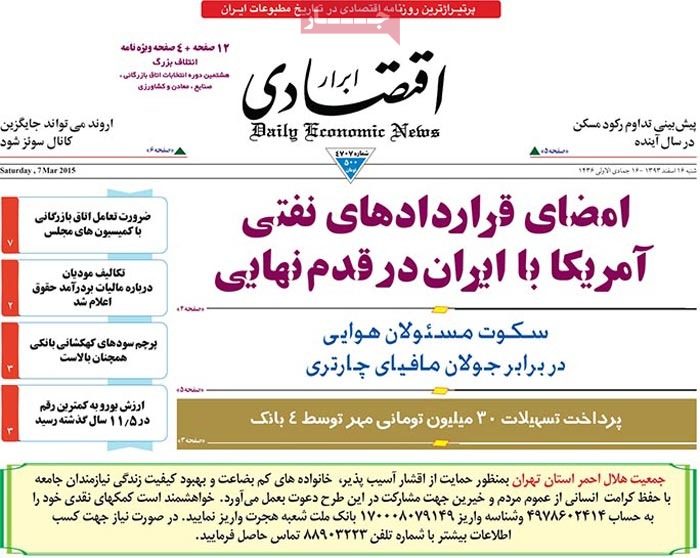
Eghtesad-e Pooya: “Iran’s world business ranking has improved 20 notches,” said the deputy economy minister.


Eghtesade puya newspaper 2 - 5 - 2015


Emtiaz: The country’s first trash-burning power plant will be inaugurated next week.


Emtiaz newspaper 2 - 5 - 2015


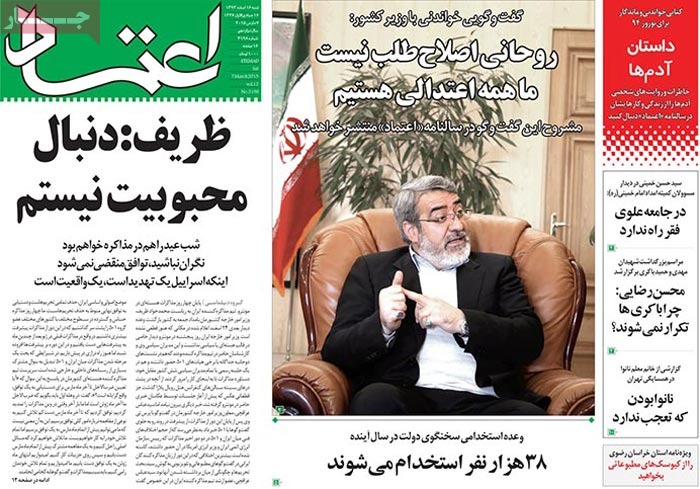
Etemad: In a report which has yet to be confirmed by negotiators from Iran and P5+1, The Associated Press said that the two sides have struck a deal over the operation of a large number of centrifuges.


Etemad newspaper 2 - 5 - 2015


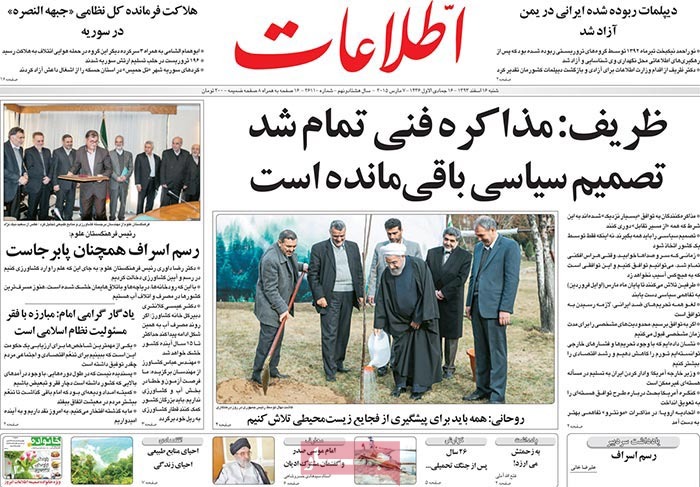
Ettela’at: “Threats and sanctions don’t frighten the Iranian nation which will remain steadfast on the path to progress,” the president told a large crowd in Isfahan.

Ettela’at: A rise in greenhouse gas levels is to blame for a lack of precipitation in the capital.


Ettelaat newspaper 2 - 5 - 2015


Hemayat: “The bond between politics and religiosity holds the key to the survival of the Islamic establishment,” said Judiciary Chief Ayatollah Sadegh Amoli Larijani.

Hemayat: A number of senior clerics have lashed out at the cultural performance of the government. “The Ministry of Culture and Islamic Guidance has no right to issue permission for events which are in contradiction with Sharia Law.”


Hemayat newspaper 2 - 5 - 2015


Iran: The barbaric killing of a Jordanian pilot has sparked global outrage at IS.


Iran newspaper 2 - 5 - 2015


Javan: “Iranian fate should be decided in Tehran, not in London or Washington,” said Gholamali Haddad Adel, [a senior principlist MP and a former parliament speaker].


Javan newspaper 2 - 5 - 2015


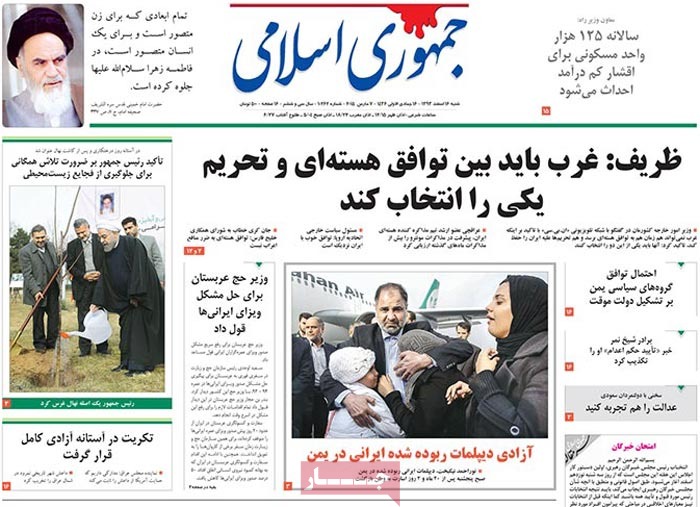
Jomhouri Islami: Iran has strongly condemned the heinous killing of a captive Jordanian pilot at the hands of IS.


Jomhorie eslami newspaper 2 - 5 - 2015


Kaenat: “We are keeping an eye on every move by Takfiri groups,” said the intelligence minister.


Kaenaat newspaper 2 - 5 - 2015


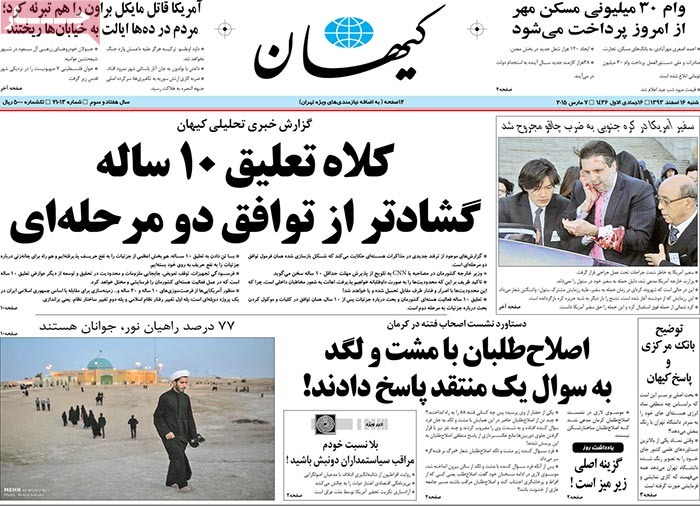
Kayhan: The go-ahead of the Ministry of Industries for imports of cigarettes has prompted MPs to summon the minister to parliament to answer some questions.


Kayhan newspaper 2 - 5 - 2015


Khorasan: Oil prices have jumped $9 in the recent week.


Khorasan newspaper 2 - 5 - 2015


Sharq: “Safe houses are to be set up to settle girls and women who are exposed to violence,” said the deputy director of the Welfare Organization of Iran.


Shargh newspaper 2 - 5 - 2015


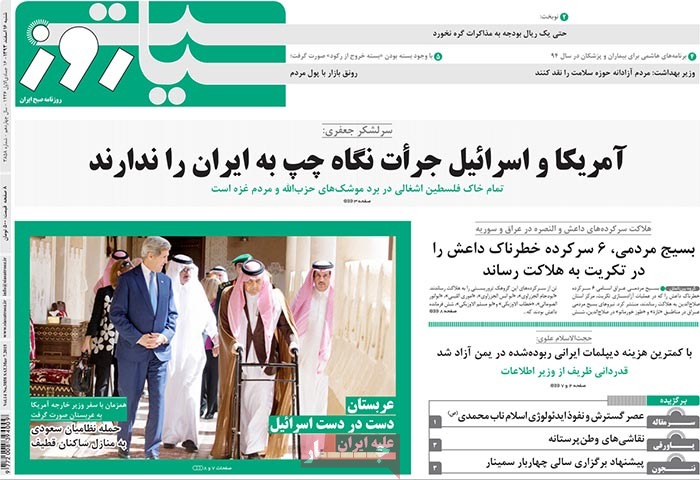
Siasat-e Rooz: “It’s now Saudi Arabia’s turn to show how honest it is,” said the Iranian ambassador to Riyadh.


Siasate ruz newspaper 2 - 5 - 2015


Rasht surrounded by a patch of fog (Photos)

Fog in Rasht-Iran7

A blanket of fog has shrouded the forested areas in Rasht, the capital city of Gilan province.

Dense fog in the dead of winter has added to the dazzling beauty of the northern city, internationally known as the “City of Silver Rains”.

The following are photos the Islamic Republic News Agency placed on its website on February 3:


Iran’s auto production up by over 60%

Iran Auto production

Iran’s auto industry has witnessed a sharp rise in the production of motor vehicles over the past 10 months.

Local media reports say Iranian carmakers have manufactured more than 930,000 vehicles in the first 10 months of the current Persian calendar year (which started March 21).

The figure shows a 61.6 percentage point rise, compared with the same period last year.

Iran is the second manufacturer of automobiles and automotive parts in the Middle East after Turkey, and the car industry is the second most active in the country after oil and gas.

Following the West’s sanctions against Iran over its nuclear energy program, the Iranian auto industry suffered a partial decline and major international automakers operating in Iran were forced to leave the country.

However, after the partial suspension of sanctions in the wake of Iran’s interim nuclear deal with the five permanent members of the UN Security Council – the United States, France, Britain, Russia and China – plus Germany in Geneva in November 2013, the industry witnessed a gradual growth, and giant foreign auto manufacturers, including Peugeot and Renault, expressed keenness to return to the Iranian market.

IMF calls Iran 2nd biggest economy in ME, N. Africa, Central Asia

IMF

The International Monetary Fund (IMF), in its latest report on the economic situation in the Middle East, North Africa, and Central Asia, announced that Iran has become the second biggest economy in these regions.

In the report, the IMF pointed to Iran’s $406 billion gross domestic product (GDP) in 2014, and said the country’s economy is now the second among 30 countries in the Middle East, North Africa, and Central Asia.

Saudi Arabia, with a GDP of $752 billion and the UAE with a total GDP of $401 billion rank first and third, respectively, among the countries.

The total GDP of these regions amounted to $3,459 billion in 2014, $2,579 billion of which belongs to the oil producing countries.

Given that oil prices have fallen by half over the past months, the IMP has predicted that the GDP of the oil producing countries will decrease by $303bln and stand at $2276bln.

According to analysts, the drops in oil prices are the result of a glut of supplies by certain oil producing countries such as Saudi Arabia.

Iranian officials have repeatedly said that the decline of crude oil price is not just an economic issue, but the result of a political plot hatched by certain states.

Iran seeks alternative ways to increase non-oil revenues

Rouhani-Iran

President Hassan Rouhani has highlighted the country’s need for alternative ways of boosting its non-oil revenues.

Rouhani said on Wednesday that Iran should invest more in new technologies and related areas to that end.

He also said his administration was set to develop Iran’s foreign policy in the next Persian calendar year (starting March 21) so that the country will witness better conditions.

His comments came at a gathering of business entrepreneurs in the central province of Isfahan, where he called for more investment in the local tourism industry.

The Iranian president further noted that his cabinet has managed to curb the country’s inflation rate and lower it from a 40 percent peak almost two years ago to around 16 percent.

Official figures confirm that the country’s economy has attained positive growth for the first time in two years.

Recent figures by the Central Bank of Iran show the economy expanded 4.6 percent in the first quarter of the current Iranian calendar year (started March 21, 2014).

Italian Anthropologist Hails Iran Leader’s ‘Historic Letter’

Tiziana Ciavardini

On January 21, Supreme Leader of the Islamic Revolution Ayatollah Seyed Ali Khamenei wrote a letter asking the European and North American youths not to judge Islam based on the recent terrorist attacks in Paris.

In his letter, Imam Khamenei urged Western youths to try to gain a direct and firsthand knowledge of the religion in reaction to the flood of prejudgments and disinformation campaigns.

In an e-mail interview with the Tasnim News Agency, Italian anthropologist Tiziana Ciavardini discussed the significance of the Supreme Leader’s letter.

Ciavardini is a cultural anthropologist, and the president of Italy’s Ancis Anthropology Forum.

Here is the full text of the interview.

Q – Regarding the recent letter by Iran’s Supreme Leader to the youth in Europe and North America, how could it be (more) effective in attracting those youths to real and authentic Islam?

A – What written in the letter is very true, we must learn from the real source. I hope that this letter could help the youth to study Islam as a religion, and lessen the bad propaganda against Islam. Ayatollah Khamenei said that there had been a flood of misinformation about Islam in the West. Unfortunately, in western countries people who declare themselves as ‘expert’ on Islam sometimes are confused about understanding the religion. Even the one who tries to tarnish the image of Islam, most of the time doesn’t know what he is talking about. This is one of the reasons behind the increase of Islamophobia in the West.

Q – How capable this message is in preventing the ongoing Islamophobia in the West?

Iran’s Supreme Leader understands better than anyone the importance of the new generation. He is talking to them because he knows the elder are already spoiled. He knows that we must push our youth to learn and study, since they are the future. If we encourage our youth to understand Islam from the (real) source, we can hope a better future with less people afraid of Islam. Islamophobia is just a fear of what we don’t know. We have also in Italy some cases of Islamophobia since people confuse Islam with terrorism. With our immigration policies, we have many Muslim people here in Italy who have escaped from war or difficulties in their countries to find a better life either in Italy or in Europe. Unfortunately these people may be stigmatized as people who may import terrorism to Italy. Especially at this moment that we are living in fear of terrorist attacks, in a state of maximum security alert.

Q – Do you think Western mainstream media are interested in widespread dissemination of Supreme Leader’s letter, or Western media empire is reluctant to publish it?

A – When the letter first appeared in English on the website I told myself: this will be a historic letter. As far as I know, this is the first time that Iran’s Supreme Leader talks to the western youth in this confidential way. The letter seems to me that he is saying much more than the words written on it. I was surprised as well to see that the letter was not on the first page of Italian Newspaper. The reasons could be varied. Even though Italy and Iran have great cooperation in many fields and we also see the new Italian government is ready to talk with and invest in Iran, still there are some media unenthusiastic to publish a letter from the Leader of Islam Republic of Iran. We can think of it as a sign of respect:  the important words from a religious Leader could not be shared just on a piece of paper, but still this reflects my theory about the prejudice on Iran. If something bad (in western eyes) happens in Iran, the news will be on first page, if it is good news it means no news. In this case, they make a mistake. We will see in the future the power of words of Supreme Leader.

Q – How do you evaluate the letter’s content?

A – The best of this letter is the way the Leader emphasizes the new generation’s education. He with all his experiences and culture knows that education is the way to succeed. Not only in school or university, education is the way to fight the war and bring peace on the earth. It is very important that he didn’t force the youth to convert to Islam and be Muslim, but just urged them to understand Islam and study from the source.

He did not refer to the violence directly, but on the intellectual conditions that allows ideologies of violence to exist.

Q – In your opinion, could this letter be a new chapter in paying attention to Islam by Europeans?

A – Yes this could be, if Western young generation spends more time on intellectual fields instead of material issues. Some Western countries are losing more values day by day and most of the youth do not have any hope for the future, not even dreams.  I am not a Muslim, but I have not seen in any other religion the devotion I see in Islam. I think Islam can help all of us understand better the world we live in. The territory of Islam has given birth to the most famous scientists and intellectuals. How can we believe that the same territory has given birth to people who spread death?

Q – Can this letter show the differences between authentic Islam and the one that the Islamic State in Iraq and the Levant (ISIL) and other terrorist groups have shown?

A – Whoever makes correspondence between Islam and terrorist groups certainly doesn’t know Islam. The Supreme Leader takes his distance from terrorist acts. It is unthinkable that someone who really believes in a religion may commit these acts.  How a religion of peace may suggest to the people to kill other people? Islam has nothing to do with this brutality. What people do not understand yet is that the primary victim of this cruelty is Islam itself. They operate in the name of Islam but the reasons are not religious but just political. These attacks and terrorist groups are damaging the peaceful vision of Islam. We must ask ourselves who will benefit or get power by showing Islam so hostile.

Q – What is the next step in order to enlighten the youth in West to introduce the real Islam to them?

A – We know that Islam is spreading in Europe. We have also seen an increase in the number of conversion to Islam in Italy. Islam is the second faith in Italy. I think the next steps must be taken by Western governments increasing the useful projects to let people understand Islam better. In Italy we have already schools with scholars from diverse nationalities and I hope in future we will be able to introduce lessons of ‘Religious Studies’ instead of studying one religion. Studying other religions does not mean converting to other religions, but learning more about something we don’t know. In the letter of Ayatollah Khamenei, he wrote about ‘other’. This term is exactly what we must understand. Other means knowing people who are different from us and we must consider diversities as great values to improve comprehending our nature.

Interfaith dialogue; a call for action

Iran-Catechism of the Catholic Church

Proximity of religions and interfaith dialogue are among issues which are widely discussed in religious and scientific circles. Religious researchers and scholars put pen to paper to speak their mind about different denominations and religious approaches.

The Publishing House of the University of Religions and Denominations (URD) in Qom is a major player in this regard. A translation of The Catechism of the Catholic Church – a 1992 book written in French by Cardinal Joseph Ratzinger by order of Pope John Paul II – is one of the most recent books the university press has released. The book, which is the essence of the written heritage of church traditions, makes references to the Scriptures and many other sources.

As its name suggests The Catechism of the Catholic Church is the Catholic Church’s reference book on ideological questions and religious-ethical traditions. This book is the official text for church teachings and is based on Scripture, church traditions, [the views of] Church Fathers, and the church educational authority. It has been translated into Farsi by Ahmad Reza Meftah, Hossein Soleimani and Hassan Ghanbari.

On February 2, Ettela’at newspaper filed a report on a review session of the book in which the Vatican Ambassador to Tehran Leo Boccardi, Hojjat-ol-Islam Abolhassan Navvab, the head of the University of Religions and Islamic Denominations, and the book’s translators discussed different aspects of The Catechism of the Catholic Church. The following is a partial translation of who said what in the session:

Ali-Asghar Mohammadkhani, the deputy director for cultural affairs at Book City [a bookshop chain], said that the release of the book sets the stage for a dialogue between Islam and Christianity and added, “We’re happy that many researchers and thinkers in Iran and in Western countries seek interfaith dialogue, and to that end hold talks with each other in a scholarly and friendly atmosphere.

“At a time when some in the world go to extremes, either by resorting to extremism or by trying to eliminate religion, we have a responsibility to promote rationalism, peace and moderation as the true messages of religions.”


Books which eliminate ignorance

The Vatican Ambassador to Tehran Leo Boccardi said, “The Farsi version of The Catechism of the Catholic Church was unveiled on January 12 at the Pontifical Gregorian University in Rome with Iranian thinkers and scientists as well as the dean of the university and representatives from the Vatican in attendance.

“Prominent scholars have said what is there to say about the book; as the Vatican’s ambassador, what can I add to what was said? First, I would like to thank the translators for 12 years of constant, serious work on the book. The book’s new, accurate translation is a success, not only from a linguistic point of view but also for conveying the theme. I assure you that the translation of such a book is by no means an easy job.

“It is commonly said that no translation can exactly match the original text, but in this case I can firmly say that The Catechism of the Catholic Church has been translated carefully in terms of diction and meaning and does not need correction or re-editing. On a scale of one to 10, I proudly give ten to the book’s translators, editor and publisher for its precious print, fluency and reasonable price.”

Ambassador Boccardi further said, “Is this book merely for your library? The answer is No. Such a thing would be a serious blow to what has been done for the book which is a valuable source for reference, research, dialogue and understanding. It is necessary for those who are involved in interfaith dialogue [to read it].

“The other day Supreme Leader Ayatollah Khamenei called on the youth around the world to learn about Islam [firsthand]. Hereby, I invite the Iranian youth to study and do research on The Catechism of the Catholic Church.

“To know about the other party is a prelude to dialogue. We cannot have dialogue with those we do not know. This book provides a good opportunity for Muslim and Christian students, teachers and religious people to learn more about the Christian faith and common biases, and overcome the prejudices which insult human’s rationality, because such prejudices are superficial, baseless and untrue. The current translation can promote the quality of Islam-Catholicism ties to a large extent and help hold a more intimate dialogue between Iran and the Vatican.”

[…]

The Vatican envoy added, “Dialogue is not held just among religions; rather, it brings the faithful together. Ignorance is the biggest obstacle in the way of holding dialogue, developing mutual understanding and showing mutual respect. This book is helpful in removing the existing obstacles.”

[…]


Dialogue and human suffering

Hojjat-ol-Islam Navvab, for his part, elaborated on the prevailing viewpoints and approaches in the University of Religions and Denominations (URD) and said, “Dialogue, research and postgraduate studies are among the main focuses of the university. […]

“URD is a non-governmental, independent university because changes in different governments can render the university vulnerable; that’s why the university is trying to pursue its activities based on freedom, independence, liberty and freethinking. Our university focuses on dialogue when it comes to religions and attaches enormous significance to proximity as far as denominations go.”

[…] “The University of Religions and Denominations has gone to great lengths to promote [religious] tolerance by adopting different approaches such as translation of various religious books, and it has fared well in this regard.

“In light of the fact that Qom is a religious hub, we decided to base the university in Qom. The impacts of such a decision are evident today. The Society of Religions and Denominations has been set up in Qom, and all seminary schools have begun to offer courses on different religions. What we’ve done has been effective in many ways.

“We have opened dialogue on different fronts; as a result, leaders of different religions and denominations visit the university and talks have been held with many churches; […]”

“Religions must know about each other. This approach has been adopted without any prejudice. At the beginning, we compiled a book on Isma’ilism; leaders of this religious sect hailed it as the first academically-complied book by scholars at Qom Seminary School. The URD has always underscored scientific methods at all stages [of education], and there’s always room for dialogue.

“As many as 250 books on different religions and denominations have been translated so far, and this trend will be actively pursued. The university is also home to a research department which publishes several research journals. […] Six-hundred majors are studying at the doctoral level and 1,500 at the postgraduate level in the university.

“The university is running online courses too. We hope our efforts constitute a step toward removing hatred. We hope we can produce a wave of love and kindness and remain steadfast on this path in defiance of measures by ISIL to breed hatred.

“We hope the university’s small steps can help promote humanity, contribute to the cause of peace and human comfort, and bring religions closer together. We do not get engaged in dialogue just for the sake of dialogue. We enter into dialogue to improve the status of humans and ease their pains.”

[…]


Long road ahead

Soleimani, one of the three translators of the book, said, “We translated the book because we believe such measures can help rid the world of violence, cynicism and war. I hope Christians too take similar measures to introduce Islam [to their communities].”

[…]


Dialogue and science

Meftah, another translator, led off his speech by highlighting the need for helping dialogue among religions become a reality and said that today the atmosphere of dialogue between religions has domination over the dialectical approaches of the past.

“Undermining each other is not in the best interests of divine faiths; rather, dialogue and mutual understanding are the best option. […]

“[…] When concepts such as miracle, the origin [of the Creation], Akhirah [the afterlife or the Islamic Day of Judgment], the invisible world, etc. are analyzed in the review of the holy book in modern times, Muslim beliefs become subject to critique too. We should not take pleasure when Christian religiosity takes a hit in the Western world, because secularist attitudes and lack of attention to religion could also affect Muslim societies.
“Therefore, it’s better to stand by each other and help religiosity grow instead of fanning the flames of rivalry and hostile attitudes. The more the followers of a religion stick to their beliefs, the more they can help each other. I reiterate that we can help each other through scientific works.
“I hope the translated version of the book could be a reason for continuing dialogue between Christians and Muslims; we hope the book could generate motivation to seriously follow scientific topics.
“The dialogue might be challenging to some extent, but it can help us get closer in terms of theological issues. If we can understand each other better, we can hold more satisfactory dialogue.

“Those who compared this book [with its translation] stressed that its terminology should be totally Christian without being mixed with Islamic terms. We did not add our own viewpoints to the text; neither did we make alterations to it.

“It is the first time that the book has been translated in a non-Christian country. The readers may find the first part of the book – which deals with theological theories – boring, but the following parts are a better read.

Senior Commander: Iran’s Missile Capability Not Negotiable

General Massoud Jazzayeri

“Iran’s missile programs and defensive capabilities are not negotiable in any foreign circle, irrespective of their approach,” Jazzayeri said in reaction to the Monday remarks of US State Department Spokeswoman Jen Psaki who voiced concern about the launch of a new Iranian satellite and claimed that Tehran’s missile program is a part of the ongoing nuclear negotiations between Iran and six world powers.

“We don’t allow the US and others to meddle in Iran’s defensive affairs,” he added.

Stressing that Iran will use its defensive capability against the bullying powers whenever necessary, Jazzayeri said if the US embarks on any aggressive move, it would face Iranian missiles.

“The era of the US being a superpower has ended, but some have not realized it yet,” he underlined.

In relevant remarks on Tuesday, senior Iranian negotiator and Deputy Foreign Minister Seyed Abbas Araqchi stressed that the rocket carrier used to send Iran’s new satellite into orbit has been designed and used for completely scientific purposes, adding that the country would never allow its missile industry, which is used for defensive purposes, to become an agenda for Iran-powers talks.

“The ‘Safir (Messenger)’ rocket which carried the Fajr satellite into the orbit (on Monday) has been designed and built by the capable hands of experts at the defense ministry’s aerospace organization for space missions and in pursuit of fully peaceful goals,” Araqchi said.

“Iran’s missile program is fully defensive in nature and the Islamic Republic of Iran believes that its defensive issues are not negotiable at all and it will not discuss this issue with any foreign side,” Araqchi stressed.

“Hence, raising and negotiating the country’s defensive and missile capability in Iran’s nuclear talks with the Group 5+1 (the US, Russia, China, Britain and France plus Germany) has never been allowed in the past nor at present nor in future,” he added.

Iranian officials have on different occasions underscored that the country’s missile program is non-negotiable, stressing that the talks with the six world powers are limited to the nuclear standoff.

In relevant remarks in August, Iranian President Hassan Rouhani stressed that Iran’s military program was based on a defensive doctrine, but meantime said Tehran would never ask for anyone’s permission for defending itself and expanding its defense industries, implying that the nation would not discuss its missile program in talks with the world powers.

“Our military doctrine is based on defense and we don’t design any weapon for aggression; we don’t carry out any research on how to occupy the regional states. All our researches are based on this defense principle that how we can defend ourselves or how we can stop the enemy,” Rouhani said, addressing a ceremony to unveil two new home-made cruise missiles and two new drones in Tehran participated by Defense Minister Brigadier General Hossein Dehqan and other senior officials at the time.

He said Iran’s defense programs were based on a deterrence strategy to prevent the breaking out of war in the region, reiterating that “our military capability is at the service of regional security”.

He underscored Iran’s strategy of preventing war in the region, and said Tehran is not after an arms race and the Weapons of Mass Destruction (WMDs) “but it doesn’t ask for anyone’s permission to defend itself and to develop our defense industries to whatever degree” that we deem necessary.

The President once again reiterated the necessity for creation of a nuclear weapons-free Middle-East, saying that all WMDs in the Middle-East should be dismantled.

Rouhani also stressed Iran’s special geopolitical conditions, and asked, “Given Iran’s position in the region and the world, is it possible to speak about stability in the region and avoid mentioning Iran? Is it possible to speak of regional welfare and development without naming Iran?”