Monday, January 19, 2026
Home Blog Page 4941

Iran won’t accept limits without deal: Foreign Minister Zarif

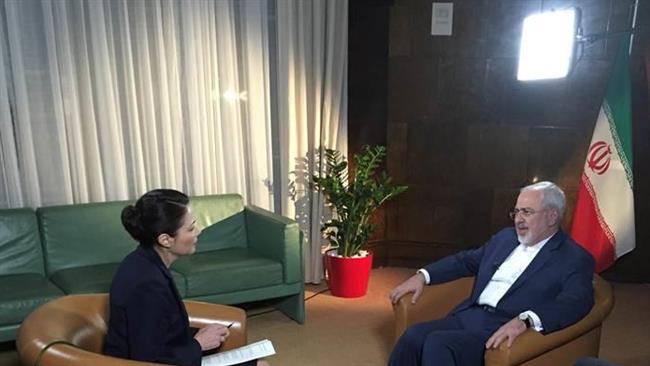
Zarif-NBC

Iran’s Foreign Minister Mohammad Javad Zarif says the Islamic Republic will not accept any limitations on its nuclear program if P5+1fails to reach a deal with the Islamic Republic.

“I don’t know why people do not want to have an agreement. Because if we don’t have an agreement, then we don’t accept anything. Then we go back to the posturing of more pressure on Iran and more centrifuges. We’re not going to develop nuclear weapons. But if they put more pressure on us, they won’t get more transparency,” Zarif said in a Wednesday interview with NBC News.

The top Iranian diplomat, however, said that Iran is “willing to accept limitations” on its nuclear activities “in order to reach an international agreement. We are willing to accept extra transparency measures in order to ease the concerns that we believe are misplaced. We believe these are the concerns that have been fanned by the hysteria that has been fanned by people like [Israeli Prime Minister Benjamin] Netanyahu and company.”

Referring to the Monday remarks made by US President Barack Obama that Iran should freeze sensitive nuclear activity for at least ten years if it wants a deal, Zarif said, “I’m not negotiating publicly. We are discussing various measures, both transparency measures, as well as limitations – voluntary limitations on our nuclear program… with 5+1, basically… primarily the United States, but other members of 5+1.”

“We believe these are not necessary. But we are prepared to take… to go the extra mile in order to convince the international community that our nuclear program is exclusively peaceful,” he said.

Highly technical discussions

“And we are engaged in very serious, high technical, discussions in which many nuclear physicists are involved, including the heads of… our atomic energy organization, and the US Secretary of Energy, both of them nuclear physicists, who are trying to make sure that Iran’s nuclear program will always remain peaceful. And we have no problem with that, because we want our nuclear program to be… we know that it’s peaceful.”

His remarks came as the representatives of Iran and P5+1 wrapped up deputy-level negotiations over the Islamic Republic’s nuclear program in the city of Montreux, Switzerland, on Thursday.

Iran and P5+1– Russia, China, Britain, France, and the United States plus Germany – are seeking to seal a comprehensive nuclear deal by July 1. The two sides have already missed two self-designated deadlines for inking a final agreement since they signed an interim one in the Swiss city of Geneva in November 2013.

Illegal sanctions

The Iranian foreign minister reiterated that the sanctions imposed on Iran by the US and its allies are illegal.

“Sanctions were there. I mean we considered them illegal. We considered them ill placed. But those who believed in sanctions believed they were there to reach an agreement. Now, if we have an agreement, which we don’t yet, we’re trying to, if we can [have] an agreement, then why you need sanctions?” Zarif said.

Israel aiding al-Qaeda

Zarif said the Israeli regime is supporting al-Qaeda-linked al-Nusra Front militants operating in Syria’s Golan Height.

He said that Israelis are “interesting bedfellows with Jabhat al-Nusra in the Golan. And if you look at Syria’s intelligence, you will see that. That is the problem that needs to be addressed.”

Israel is known to have been providing medical, intelligence and military support for the militants fighting to topple the Syrian government.

Late last year, a UN report confirmed contact between militants in Syria and the Israeli army across the Golan cease-fire line, especially during heavy clashes between the terrorists and the Syrian troops.

The report also confirmed that militants had been taking their wounded comrades into the Israeli-occupied part of the Golan Heights for treatment. The UN also confirmed the delivery of boxes with unknown content by the Israeli army to militants on the Syrian side of the ceasefire line.

A man who swims against the elements (Photos)

man swims-1

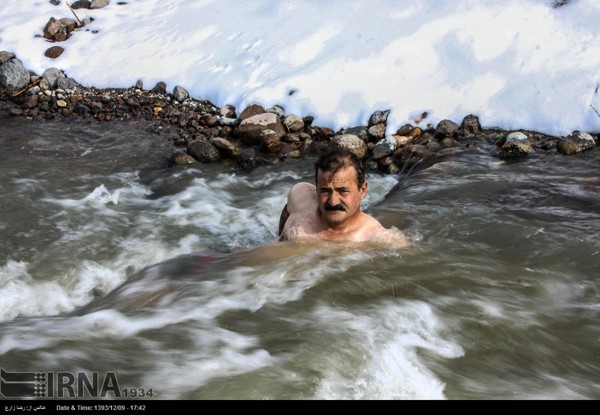
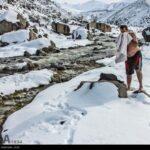
For many people trying to cool off in the searing heat of summer, swimming is the sport of choice, but in the dead of winter when snow and ice are everywhere swimming is out of the question for most of us.

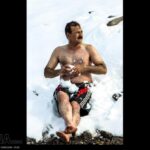
Untrue to type is Rasoul Soleimani, a 52-year-old man who is known as Ice Man in Meshginshahr, Ardebil Province. He goes swimming in winter when temperatures are minus 20º Celsius.

The Islamic Republic News Agency on February 28 posted online a collection of photos featuring the Iranian Ice Man swimming in a river whose banks are coated with snow. Take a look:


A look at Iranian newspaper front pages on March 7

Iranian Newspapers Headlines

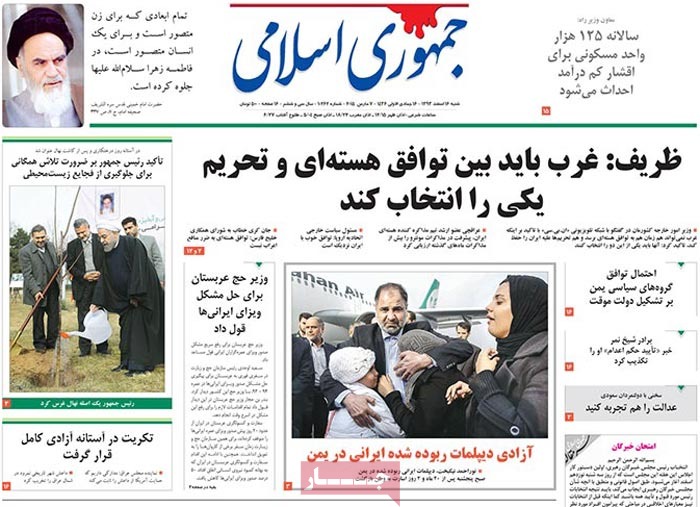
Comments by Foreign Minister Mohammad Javad Zarif upon return home from Switzerland where he led another round of nuclear talks with the US dominated the front pages of Iranian newspapers on Saturday. The release of an Iranian diplomat abducted in Yemen also appeared on the covers of the dailies.
 

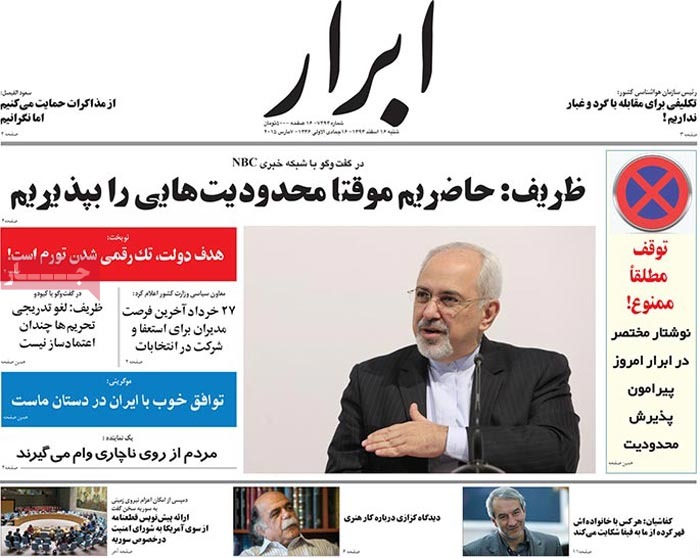
Abrar: State managers [who wish to run for parliament] have until June 17 to resign their current positions.

The announcement was made by the deputy interior minister for political affairs.


A look at Iranian newspaper front pages on March 7


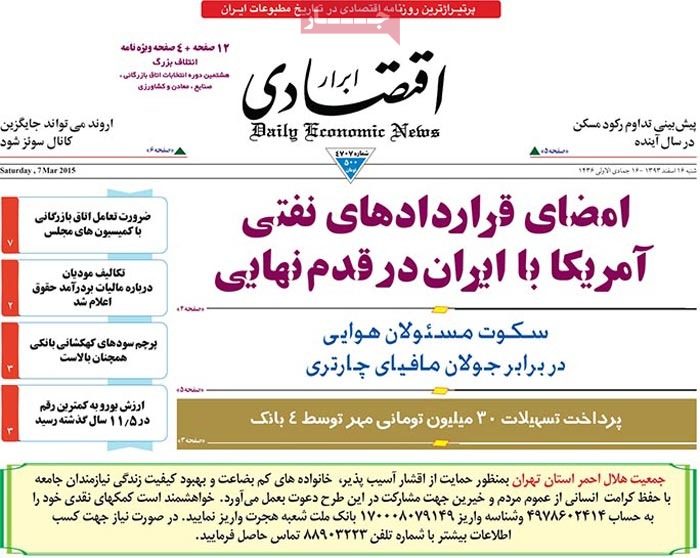
Abrar-e Eghtesadi: Conclusion of American oil deals with Iran is nearing its final stages.
 

A look at Iranian newspaper front pages on March 7


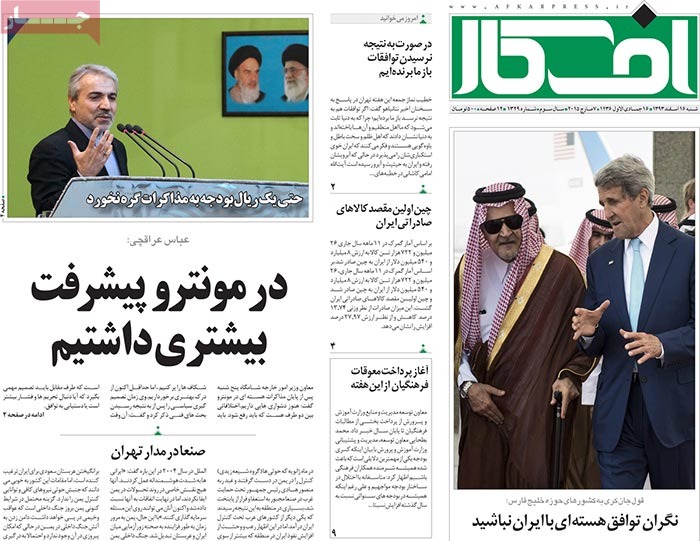
Afkar: “We made more progress in Montreux,” said Iranian Deputy Foreign Minister Seyyed Abbas Araghchi of nuclear talks with the US in the Swiss city.


A look at Iranian newspaper front pages on March 7


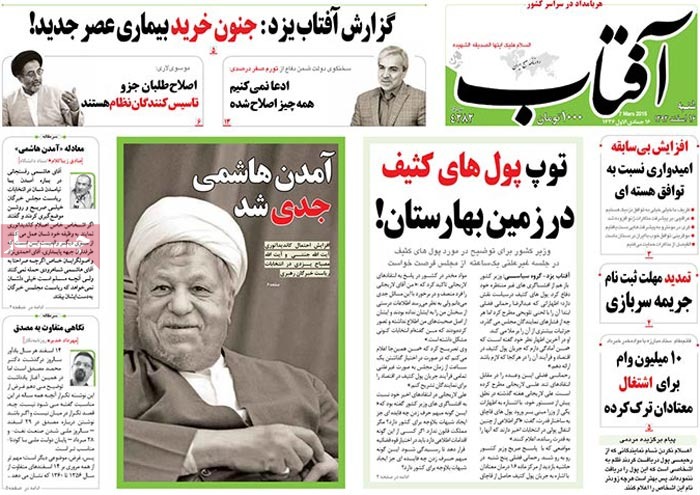
Aftab-e Yazd: Hashemi’s run for chairmanship [of the Assembly of Experts] has become more likely.

It came after the likelihood of Ayatollahs Jannati and Mesbah Yazdi’s candidacy for the top post increased.


A look at Iranian newspaper front pages on March 7


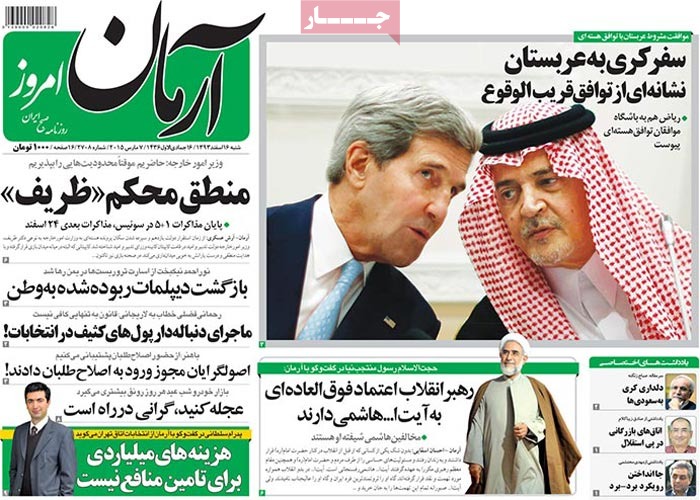
Arman-e Emrooz: Secretary Kerry’s Saudi Arabia visit shows that a deal is around the corner.

Riyadh has joined the club of nations who favor a nuclear agreement with Iran.


A look at Iranian newspaper front pages on March 7


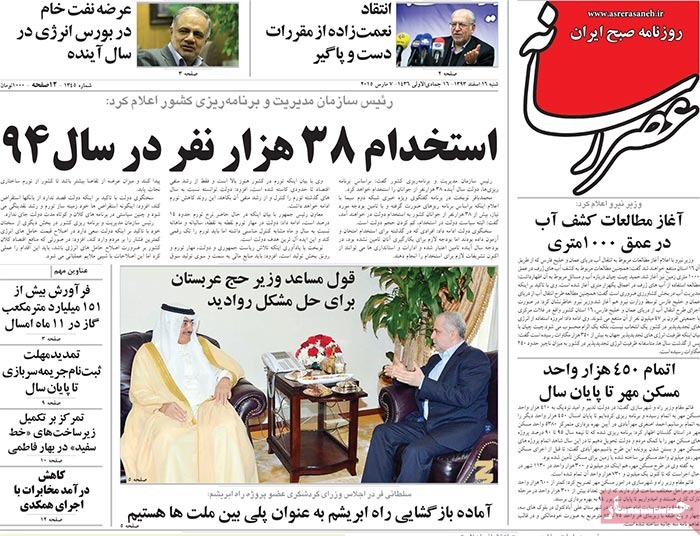
Asr-e Rasaneh: The Saudi Hajj minister has vowed to settle the visa-related problems of Iranian pilgrims.
The promise came at a meeting with the director of the Iranian Cultural Heritage Organization.
 

A look at Iranian newspaper front pages on March 7


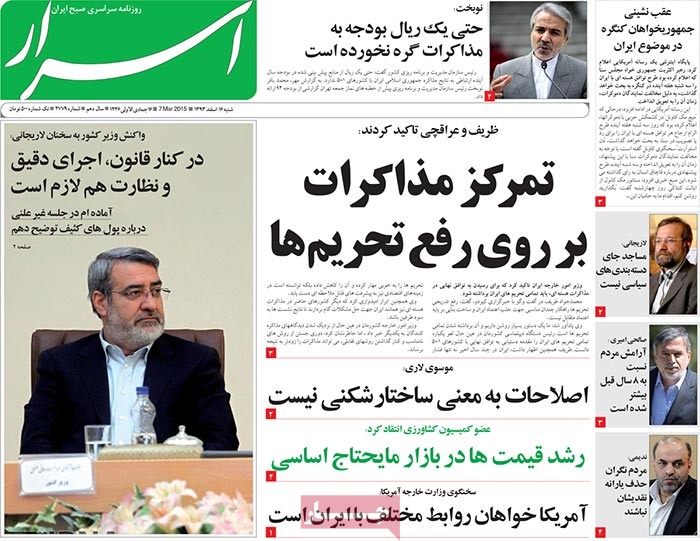
Asrar: “Not even a single rial of next year’s budget is tied to nuclear talks,” said the government spokesman.


A look at Iranian newspaper front pages on March 7


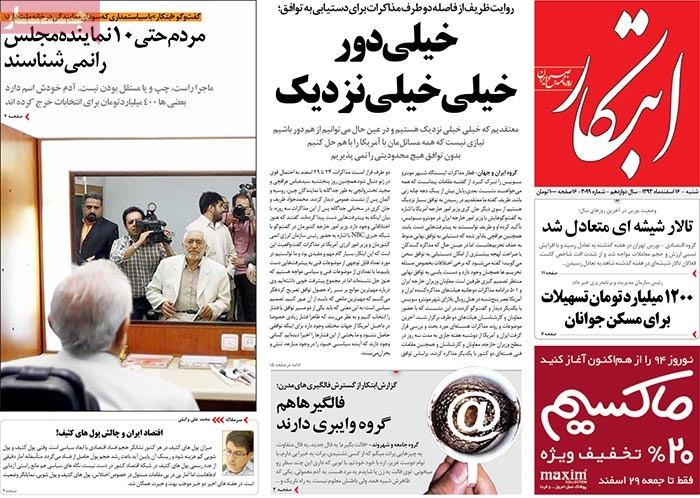
Ebtekar: Very far; very very close

Foreign Minister Zarif has said that we don’t need to settle every single problem we have with the US. Iran won’t accept any limits in the absence of a deal.


A look at Iranian newspaper front pages on March 7


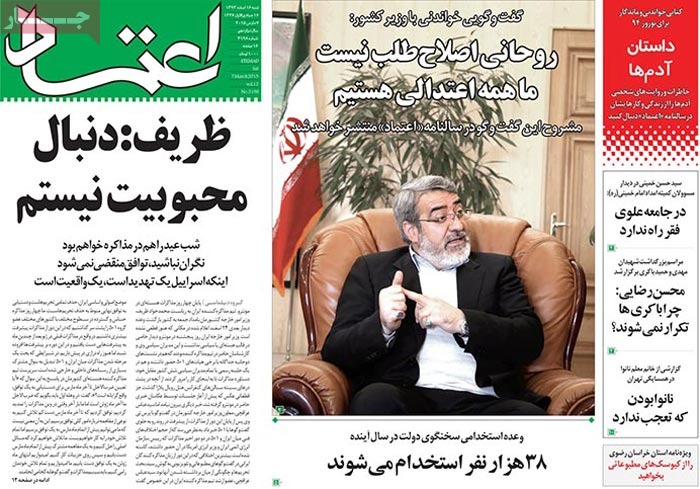
Etemad: “I don’t seek to win popularity.”

Foreign Minister Mohammad Javad Zarif made the comment upon return home following the end of another round of nuclear talks in Switzerland.

“I will spend the New Year eve in talks; that Israel poses a threat is a reality”.

Etemad: “President Rouhani is not a reformist; we’re all moderate,” said Interior Minister Rahmani Fazli.


A look at Iranian newspaper front pages on March 7


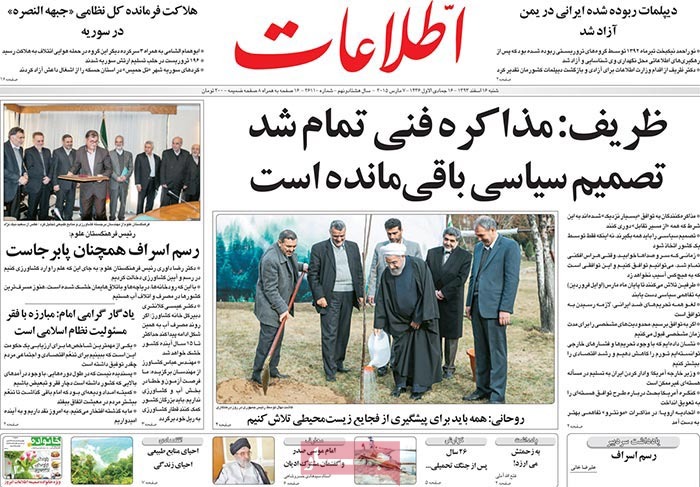
Ettela’at: “Technical talks are over; political decisions lie ahead,” said the Iranian foreign minister of negotiations with P5+1.

Ettela’at: “Everyone should make efforts to prevent environmental catastrophes,” said President Rouhani as he planted a tree to mark the Natural Resources Week.


A look at Iranian newspaper front pages on March 7


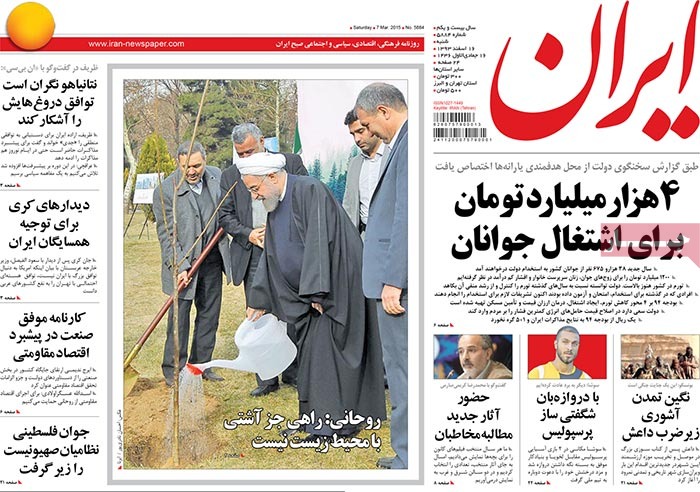
Iran: “Netanyahu is worried a deal with Iran might expose his fabrications,” said Zarif in an interview with NBC News.


A look at Iranian newspaper front pages on March 7


Jomhouri Islami: The Iraqi town of Tikrit is close to complete liberation.


A look at Iranian newspaper front pages on March 7


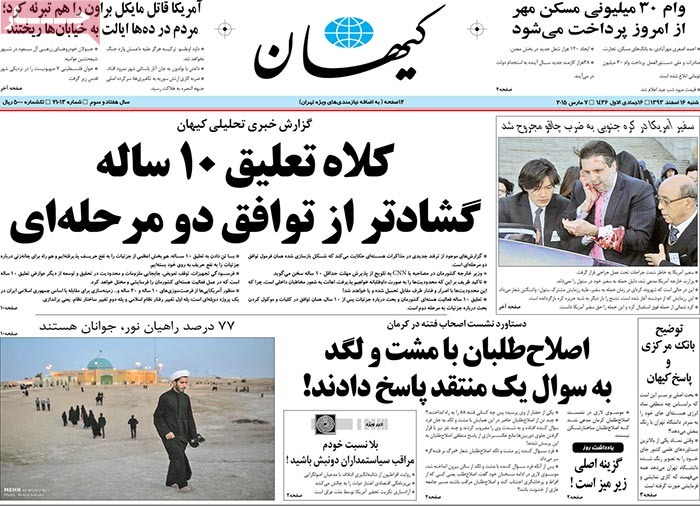
Kayhan: A ten-year suspension [of certain nuclear activities] is even more deceptive than a two-stage deal.


A look at Iranian newspaper front pages on March 7


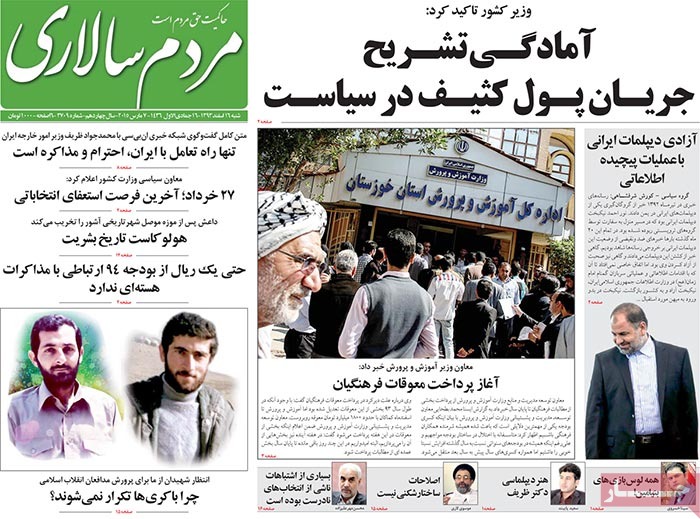
Mardomsalari: A human history Holocaust

After taking a hammer to ancient items in the Mosul Museum, IS terrorists have now bulldozed the historic city of Nimrud.


A look at Iranian newspaper front pages on March 7


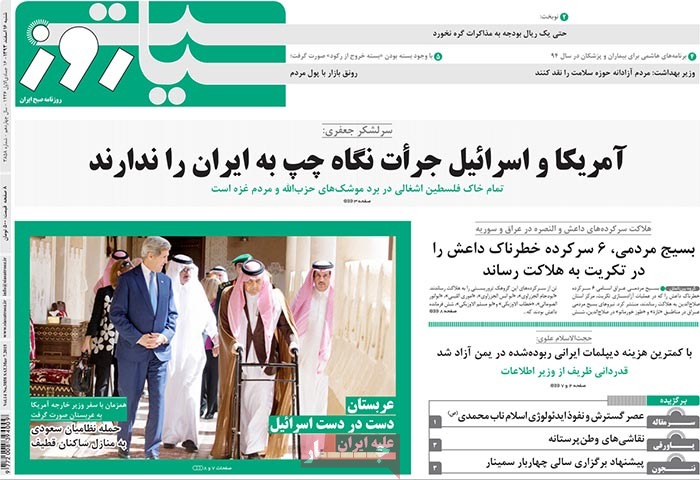
Siasat-e Rooz: “The US and Israel do not dare take action against Iran,” said the commander of the Islamic Revolution Guard Corps.


A look at Iranian newspaper front pages on March 7


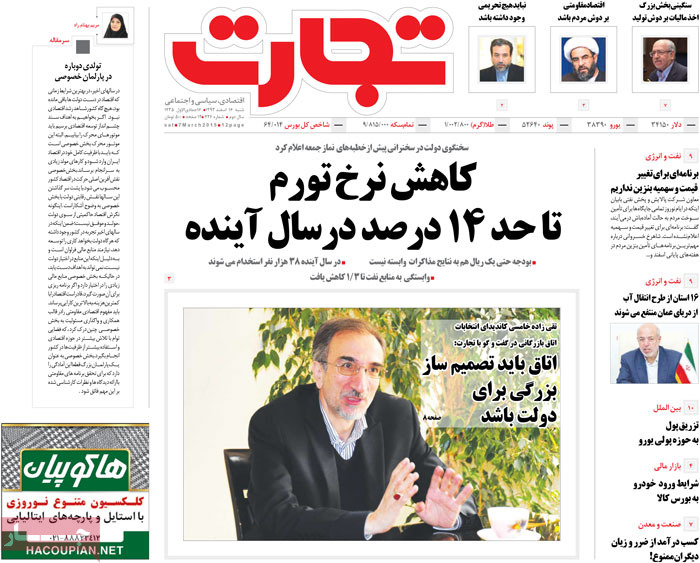
Tejarat: “Inflation will slip to around 14 percent next year,” said the government spokesman.


A look at Iranian newspaper front pages on March 7


A bird’s-eye view of Iran (Photos)

See Iran from skies

Iran from on high is the common theme of a series of aerial photos depicting different parts of the vast territories of Iran.

Mehr News Agency posted a collection of aerial photographs of Iran on March 3. Take a look:


Methods used in a small sheikhdom do not suit Iran

Nejatollah Ebrahimian-ISNA-1

Comments by the Judiciary spokesman that a ban on publication of news stories about former President Mohammad Khatami is still in effect continue to draw reaction. One official who reacted to Mohseni Ejei’s remarks was Nejatollah Ebrahimian, the spokesman of the Guardian Council who was interviewed by the Iranian Students News Agency on March 3. The following is the translation of his reaction and part of his comments about how the council goes about vetting potential candidates in upcoming elections:

Basically, in our society, measures taken by individuals and media are allowed unless they are prohibited by law and such prohibition requires a reason which is determined by ordinary rules. In other words, offenses and prohibited acts are defined by the law not according to individual tastes.

Under the Constitution, entities such as the Supreme National Security Council can make policies or coordination in matters of internal and external security.

We have a national security council whose responsibilities are envisaged in the Constitution. The responsibility of the Judiciary is to take on offenses as well as pre-emptive measures in line with the law.

Beyond these rules and legal channels, we cannot use any means to accomplish our ends. In fact, even the means to achieve legitimate ends like maintenance of national security must be legal.

Today, to address a political or anti-social issue, measures such as sidelining individuals through banning the publication of their photos won’t work. Public awareness about what is going on in society has increased. Besides, some of these methods are below the Islamic Republic.

Iran is the only democratic society in the region with a progressive Constitution. To tackle problems, the lofty position of the establishment and authorities, who are mostly religious scholars and scientists, must be appreciated. Methods suitable for a small sheikdom won’t suit a cultured and mighty country like Iran.

On qualification of candidates for elections

The labels attached by different groups to their rivals won’t be a criterion in our judgment; rather we pay attention to the conduct of candidates.

Groups should not scare each other by resorting to probable measures by the Guardian Council, because the council is simply committed to the provisions of law and won’t be affected by such labels.

Iran ranks 18th among world carmakers

OICA

The 2014 Production Statistics by the International Organization of Motor Vehicle Manufacturers (OICA) have revealed that Iran’s auto production increased by 46.7 percent in the 12-month period.

The latest figures indicate that Iranian automakers produced 1,090,846 cars and commercial vehicles last year, including 925,975 cars and 164,871 other vehicles.

Head of the commerce and sales office of Iranian carmaker Saipa Co. Mohammad Reza Abbasi said last month that the country had sold over a million vehicles in the current Iranian calendar year which ends on March 21, 2015.

The OICA report says that China topped the list with over 23 million motor vehicles and 7.3 percent rise over previous year.

The United States and Japan trailed behind with more than 11.66 and 9.77 million vehicles respectively, each registering smaller growths than China.

In total, the world produced 87,507,027 cars and other commercial vehicles in 2014, which shows a 2.6 percentage-point rise from 2013.

The OICA also predicted a global auto production increase of 3 percent to about 91 million vehicles in 2015.

German FM rules out extension of Iran nuclear talks

German FM

Germany’s foreign minister has ruled out a further extension of nuclear talks between Iran and P5+1 over Tehran’s nuclear program.

“Talks will not be extended. What cannot be reached in the upcoming three or three and half months cannot be achieved,” Frank-Walter Steinmeier told his country’s parliament (Bundestag) in a speech on Wednesday.

Steinmeier refused to talk about the state of the negotiations, saying only that no one wants a “bad deal.”

In February, Iranian Foreign Minister Mohammad Javad Zarif also echoed the stance about the extension of the talks.

“I do not think another extension is in the interest of anyone, as I do not believe this extension was either necessary or useful,” Zarif said.

Iran and P5+1 – Britain, France, China, the United States and Russia plus Germany – are seeking to seal a comprehensive nuclear deal by July 1. The two sides have already missed two self-imposed deadlines for inking a final agreement since they signed an interim one in the Swiss city of Geneva November 2013.

On Wednesday, Zarif and his American counterpart John Kerry wrapped up a third day of intense negotiations between Tehran and Washington in the Swiss city of Montreux.

Speaking to reporters, Kerry said tough challenges remained to seal a nuclear deal with Iran.

“We’ve made some progress from where we were and important choices need to be made,” Kerry told reporters after the talks, with a senior US State Department official saying that “tough challenges” had yet to be resolved.

Meanwhile, Zarif expressed optimism that “despite existing differences, a final deal is not too far off”, warning that the issue of sanctions against the Islamic Republic risked torpedoing a nuclear deal.

“The Western countries, and especially the United States, must decide whether they want a nuclear deal or to continue the sanctions,” he said.

Representatives of Iran and the United States had also held three rounds of intense negotiations in Geneva on February 22-23 to bridge their differences ahead of the July 1 deadline.

The next round of ministerial talks will be held from March 15 to 20. The venue is yet to be specified.

Deputy ministers from Iran and the three European countries of P5+1 wrapped up a day of nuclear negotiations in Montreux on Wednesday.

Iran’s top nuclear negotiators, Seyyed Abbas Araghchi and Majid Takht-e-Ravanchi, took part in the talks held in the lakeside city’s Plaza Hotel on Wednesday night.

Hans Dieter Lucas from Germany, Simon Gass from Britain and Nicolas de Riviere from France represented their respective countries at the deputy level talks, which will continue on Thursday.

A look at Iranian newspaper front pages on March 5

Iranian Newspapers Headlines

The reactions of the heads of the three branches of government to the theatrical speech of Netanyahu before a joint session of the US Congress dominated the front pages of Iranian newspapers on Thursday.


Abrar: Talks between Foreign Minister Zarif and Secretary Kerry have ended in Montreux, Switzerland.

A next round of negotiations is expected to open on March 15 and last through March 20.


A look at Iranian newspaper front pages on March 5


Abrar-e Eghtesadi: “The country is still in economic recession.”

The chairman of parliament’s Economic Committee has rejected assertions by the Central Bank governor that Iran is out of recession.


A look at Iranian newspaper front pages on March 5


Afkar: “It is not realistic or achievable to stop Iran from nuclear enrichment.”

US National Security Advisor Susan Rice said in a speech at the American Israeli Public Affairs Committee (AIPAC).


A look at Iranian newspaper front pages on March 5


Ebtekar: The white smoke signal

Bilateral talks have come to an end with chief negotiators Zarif and Kerry hopeful of a deal.


A look at Iranian newspaper front pages on March 5


Etemad: Tehran’s unanimous response

The heads of the three branches of government and political figures have all treated Netanyahu’s rhetoric with scorn.


A look at Iranian newspaper front pages on March 5


Ettela’at: “We have not tied the country’s future to the result of nuclear talks.”

Government Spokesman Mohammad Bagher Nobakht further said that the government has worked out contingency budgets for scenarios in which oil prices remain at 40 or 50 dollars a barrel.

Ettela’at: Funeral processions have been held in Tehran and a dozen other cities for a number of war martyrs whose remains recently returned home.


A look at Iranian newspaper front pages on March 5


Hamshahri: “Housing prices won’t increase next year,” said the minister of roads and urban development.


A look at Iranian newspaper front pages on March 5


Hemayat: “The Canadian Judiciary has been given information about the corruption case involving Mahmoud Reza Khavari.”

The chief of the Interpol Division of the Iranian police force said about the former banker wanted for embezzlement.


A look at Iranian newspaper front pages on March 5


Jahan-e Eghtesad: “We won’t back down in the fight against corruption,” said First Vice-President Eshagh Jahangiri.


Jahane Eghtesad Newspaper


Jomhouri Islami: Iranian diplomacy worked; the US and Europe paid no attention to the anti-Iranian rhetoric of Netanyahu.

Jomhouri Islami: An Iranian hybrid car has been unveiled with President Rouhani in attendance.

Jomhouri Islami: The Supreme Leader has donated some $17,000 dollars to a benevolence festival.


A look at Iranian newspaper front pages on March 5


Kaenat: Iran’s ambassador to the International Atomic Energy Agency has said that the UN nuclear watchdog and Iran will hold talks in Tehran on March 9.


A look at Iranian newspaper front pages on March 5


Kayhan: “It is too soon to pass judgment on the nuclear talks,” said Iranian negotiator Seyyed Abbas Araghchi.


A look at Iranian newspaper front pages on March 5


Qods: The interior minister has called on Pakistan to hand over Abdulsattar Rigi, [the ringleader of the Jaish al-Adl terrorist group].


A look at Iranian newspaper front pages on March 5


Sharq: Iran has a strong presence in an Iraqi army operation to wrest control of Tikrit [from IS terrorists].


A look at Iranian newspaper front pages on March 5


Siasat-e Rooz: A court in Saudi Arabia has upheld the death sentence handed down to senior Shiite cleric Nimr al-Nimr.

A look at Iranian newspaper front pages on March 5


Tejarat: A person accused of massive corruption has been arrested by the Islamic Revolution Guard Corps.


A look at Iranian newspaper front pages on March 5


Iranian diplomat abducted in Yemen released, returns home

Iranian Diplomate-Yemen

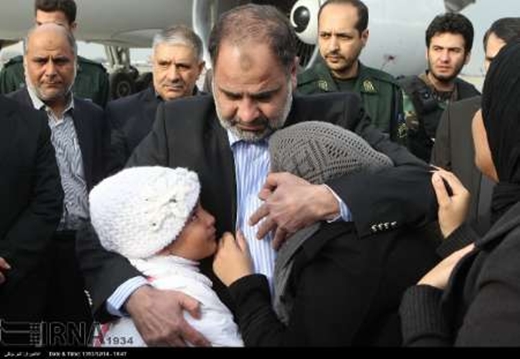
An Iranian diplomat kidnapped by gunmen in Yemeni capital, Sana’a, in 2013 has returned home after being released.

Iran says Nour Ahmad Nikbakht, whose plane landed in Tehran’s Mehrabad Airport on Thursday, was released following intelligence operation. A joint committee between Iran and Yemen at the security and political levels had been established to secure his freedom.

Nikbakht was kidnapped on July 21, 2013, on his way to work from his home in the diplomatic quarter of Sana’a, when unidentified gunmen blocked the road, forced him out of his vehicle and abducted him.

Does anybody know any secrets to threaten to reveal them?

Tasnim-Rafsanjani-Larijani-Zarif-1

Remarks by Ayatollah Hashemi Rafsanjani in a national conference on Sustainable and Balanced Regional Development earlier this week have drawn reactions inside Iran.

The chairman of the Expediency Council addressed the country’s top managers and governors general on Tuesday and criticized the domestic opponents of the Geneva deal (the Joint Plan of Action) and a host of principlists who are pessimistic about the settlement of nuclear dispute and the fruitfulness of efforts by President Rouhani’s moderate government.

Rafsanjani said in the conference, “There, Netanyahu threatens Obama, and here the Worriers [a reference to the supporters of former President Ahmadinejad] keep saying that they will reveal the secrets. We are yet to know what those secrets are.”

Principlist-leaning Tasnim News Agency filed a report in reaction, the translation of which comes below:

At a time when Iranian MPs know nothing about the content of nuclear talks – and this has always been one of their complaints about the Foreign Ministry and Mohammad Javad Zarif – what does Hashemi’s claim about threats by MPs to disclose secrets mean?

In reaction to insistence by Iranian deputies to be kept posted on the details of the talks, foreign minister has said, “I will not divulge the details even if I am impeached [by parliament].”

If details of the talks are to be disclosed, nobody other than the president’s inner circle and the negotiating team knows about them. Normally these details are expected to be revealed either by these people [who are involved in the talks] or beyond Iran’s borders by the US negotiating team.”

The top councilor himself has repeatedly taken advantage of this tactic – threatening to dig up dirt and uncover secrets – in response to his critics.

[Part of Hashemi’s remarks in which he has equated the stance of Zarif’s critics – who blame what they call the foreign minister’s optimistic attitude toward the West, the US in particular – with that of the Israeli prime minister, has drawn an implicit response from the Iranian parliament speaker.]

In an open session of parliament on Wednesday, Ali Larijani reacted to Netanyahu’s speeches at the American Israel Public Affairs Committee (AIPAC) and on Capitol Hill, describing his remarks as nothing but a political show and electioneering with no real value for Republicans or Likud.

Larijani then said, “If certain MPs raise concern about the nuclear program, it is because of the importance they attach to protecting the nuclear plan which is a national achievement.

“I do not have any concern about the limits which have been set for the talks, but comparing the concern of Iranian MPs and officials with the hostile attitude of the Zionist regime’s leader is false and unfair.”

IFP has chosen Hashemi Rafsanjani and Ali Larijani’s remarks from two separate reports Tasnim News Agency has released online. That Larijani’s remarks were aimed at Ayatollah Rafsanjani is just IFP’s interpretation, not the news agency’s.