Saturday, April 18, 2026
Home Blog Page 4934

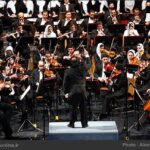
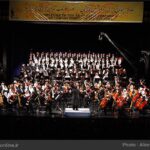
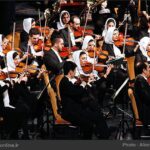
Tehran Symphony Orchestra back from hiatus

Tehran Symphony Orchestra

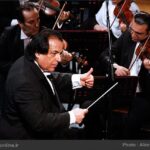
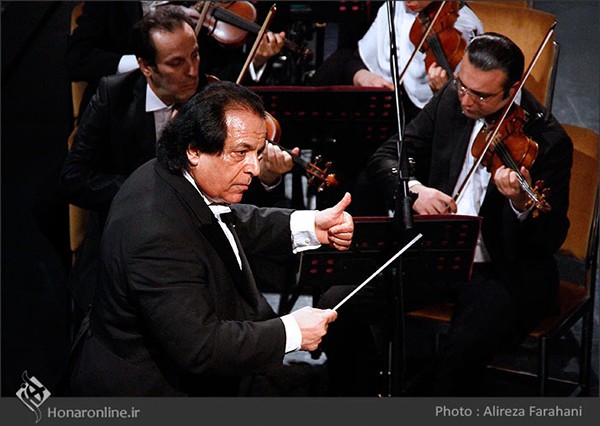
Tehran Symphony Orchestra is officially shaken out of a long hiatus under the management of Iranian maestro Ali Rahbari.

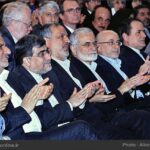
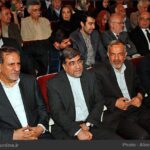
The orchestra returned to life after a 25-month break on Monday night with live performances conducted by Rahbari in the presence of various political figures and prominent artists in Tehran’s Vahdat Hall.

In a demonstration of his dexterous capabilities, Rahbari conducted Ludwig van Beethoven’s Symphony No. 9, a seminal piece in D minor, also known as “the Choral.”

Following the performance, Rahbari said, “Tonight is one of the best nights of my life, because I saw the Tehran Symphony Orchestra back on stage.”

He added, “This orchestra’s members are the country’s cultural and artistic assets,” and thanked all those who helped restore the ensemble.

“Tehran Symphonic Orchestra has nothing less than the world’s famous orchestras and with constant practice can live up to international standards,” he said.

The orchestra also preformed Iran’s national anthem during the ceremony.

Senior officials, including Culture Minister Ali Jannati, First Vice President Eshagh Jahangiri, and Deputy Culture Minister for Artistic Affairs Ali Moradkhani, were present among the audience.

Rahbari was invited from Austria to restructure the orchestra in 2004, but he quit the job in the following year due to a number of problems, including low salaries paid to the orchestra’s musicians.


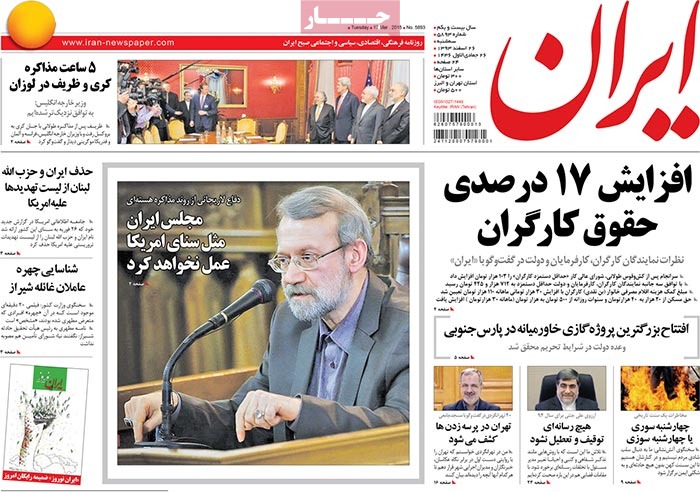
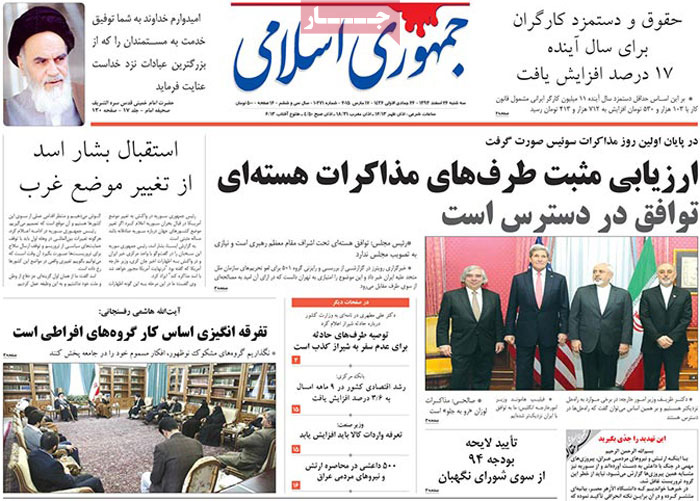
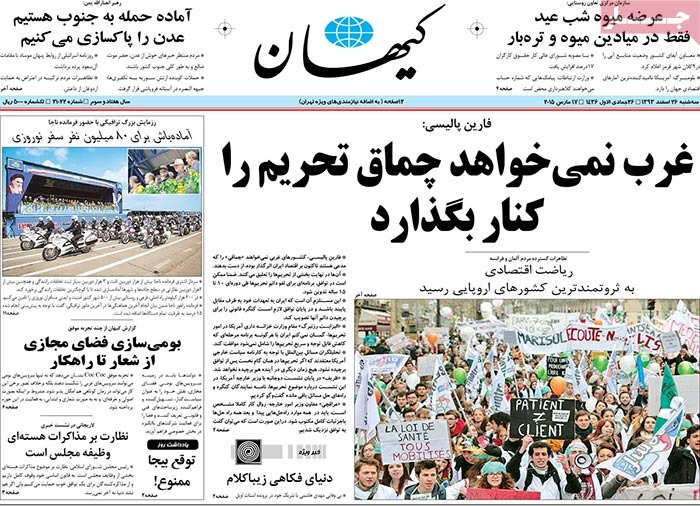
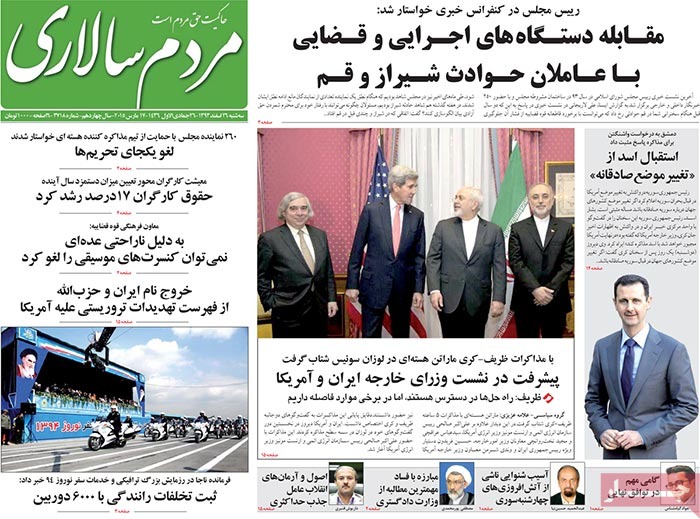
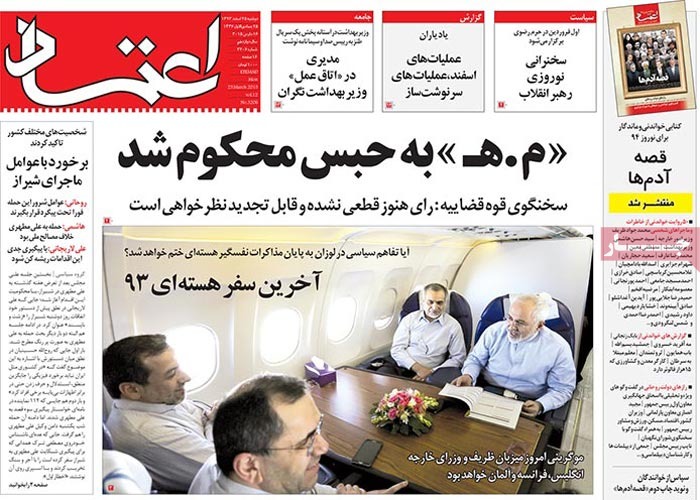
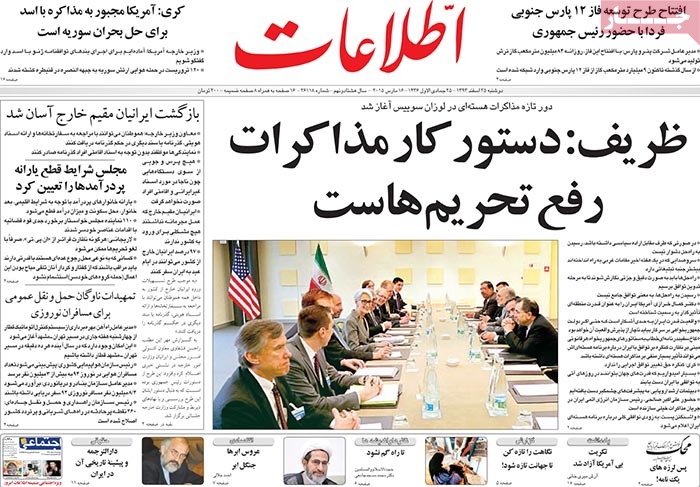
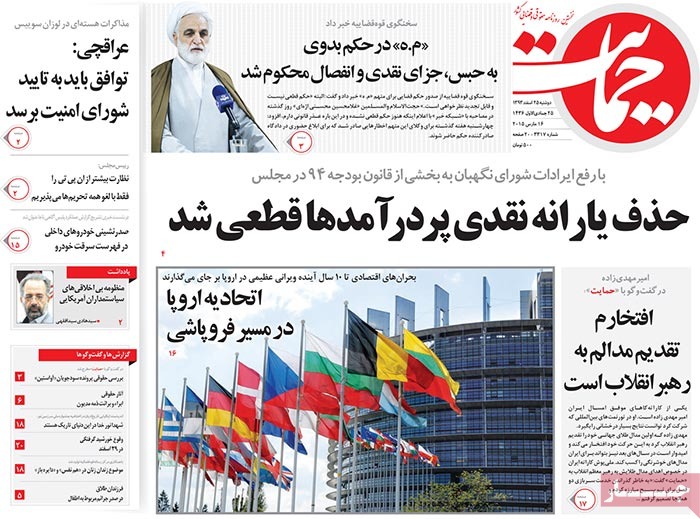
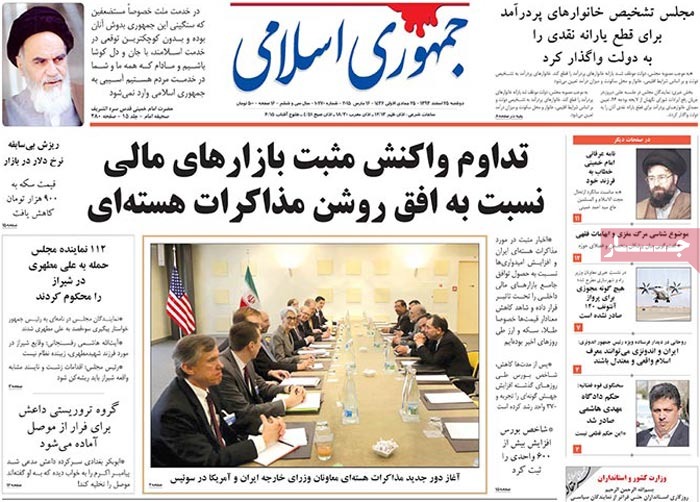
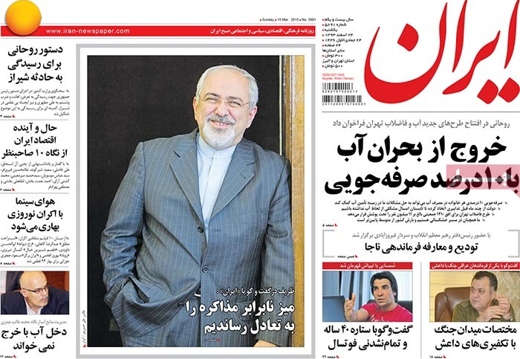
A look at Iranian newspaper front pages on March 17

Iranian Newspapers Headlines

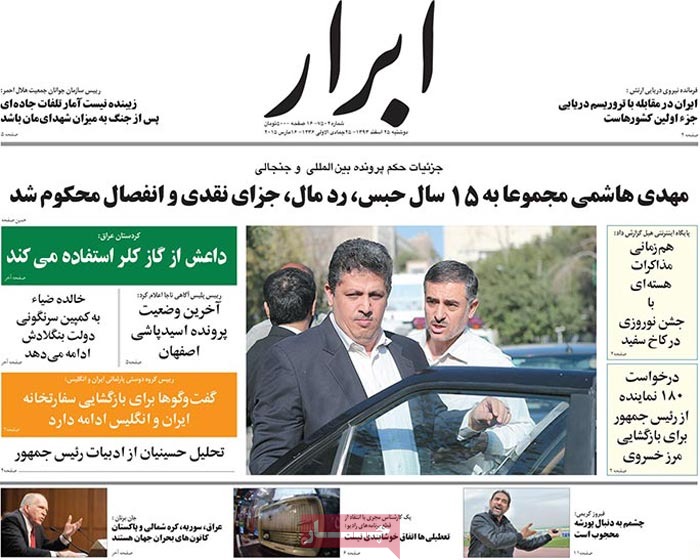
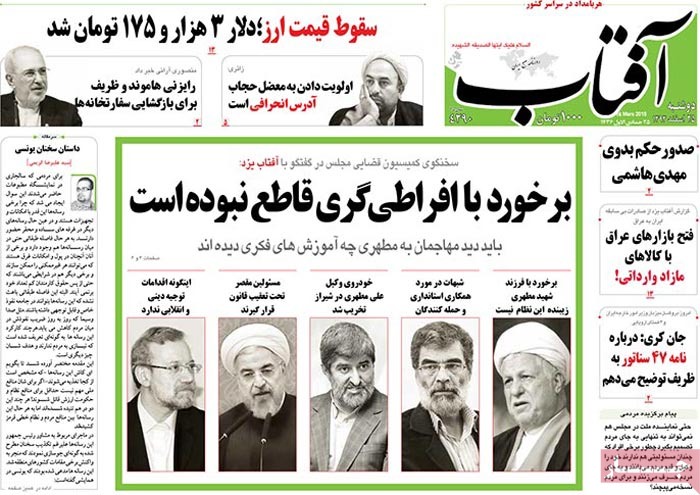
Another round of nuclear talks between Iran and members of P5+1 in Europe dominated the front pages of Iranian newspapers on Tuesday. The fallout of an attack on Tehran MP in Shiraz last week and the comments of the parliament speaker at a year-end press conference also appeared on the covers of dailies.


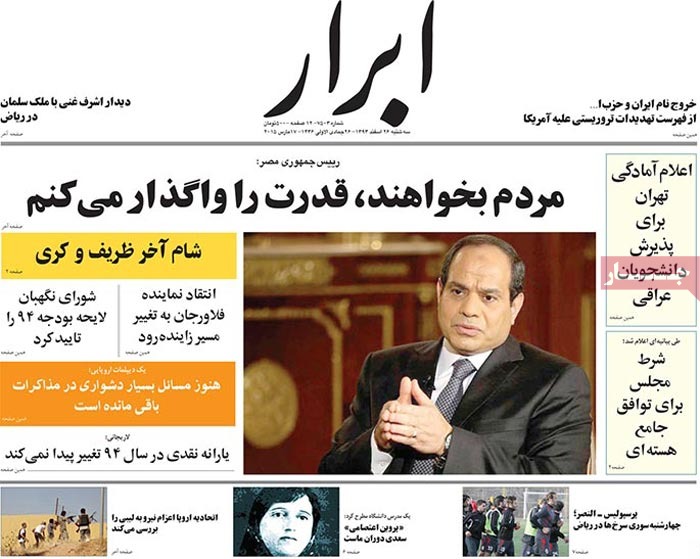
Abrar: The US [intelligence] has taken Iran and Hezbollah off the list of terrorist threats.

Abrar: Tehran has announced readiness to admit Iraqi students.


A look at Iranian newspaper front pages on March 17


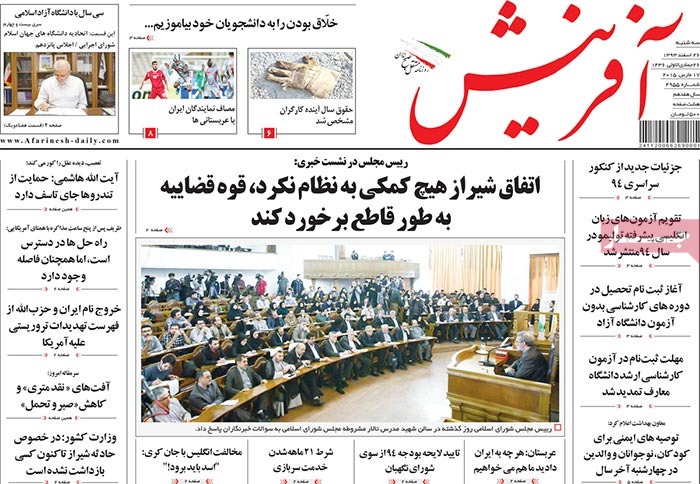
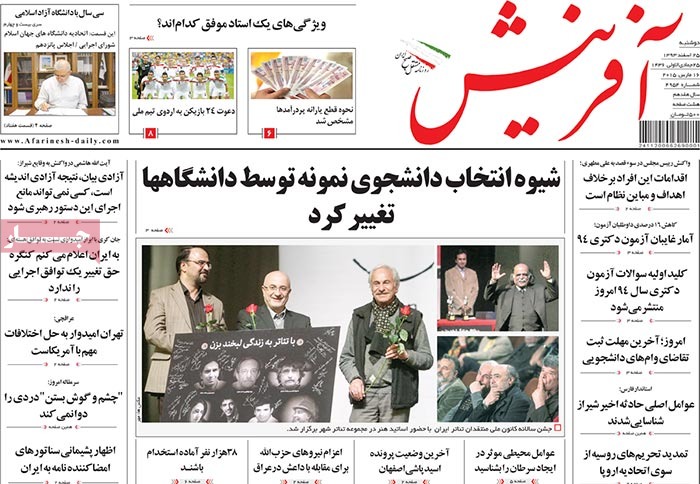
Afarinesh: The Interior Ministry said no one has been arrested so far in connection with the incident in Shiraz.

Afarinesh: The Guardian Council has approved next year’s budget bill passed by the Islamic Consultative Assembly.


A look at Iranian newspaper front pages on March 17


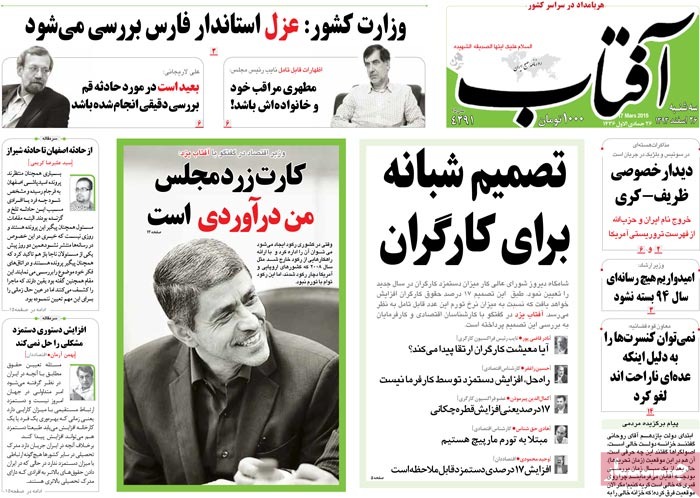
Aftab-e Yazd: The Interior Ministry is weighing the dismissal of Fars provincial governor.

It came after assailants on motorbikes attacked a Tehran MP who was in the provincial capital of Shiraz for a planned speech at a university.

Aftab-e Yazd: “We cannot call off concerts simply because some individuals do not like them,” said a deputy Judiciary chief.


A look at Iranian newspaper front pages on March 17


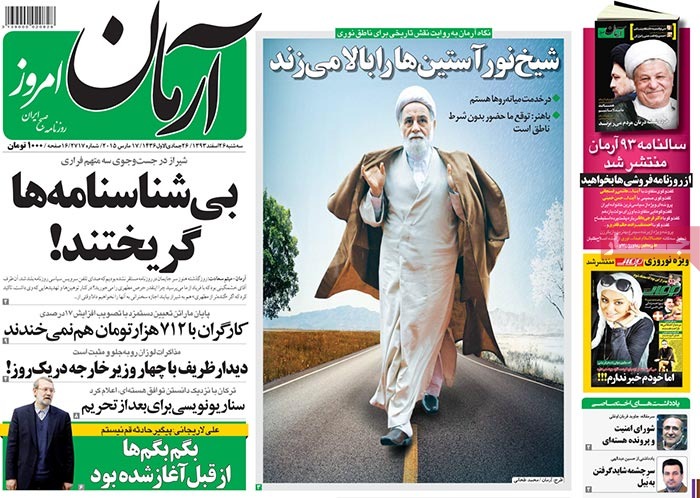
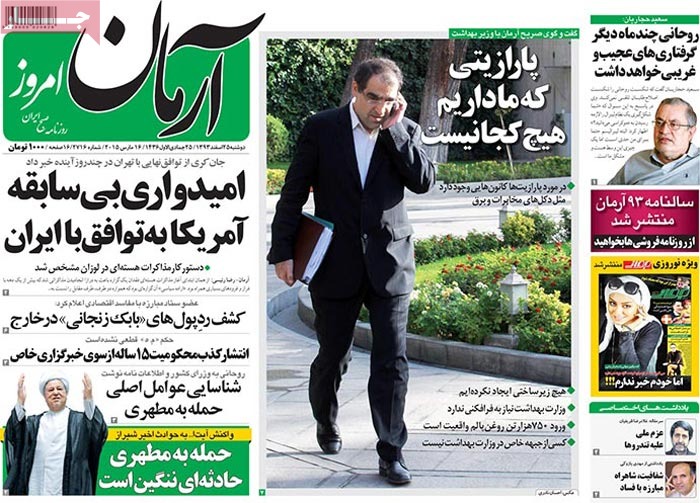
Arman-e Emrooz: The sheikh of Nour [a northern Iranian city] rolls up sleeves.

Ali Akbar Nategh Nouri [a former parliament speaker and presidential contender from the principlist camp] has said he is ready to work with moderates.

Arman-e Emrooz: Foreign Minister Mohammad Javad Zarif has held talks with four foreign counterparts in one day.

Arman-e Emrooz: The hunt is on for three suspects [in an attack last week on Tehran MP Ali Motahari] who are on the run.


A look at Iranian newspaper front pages on March 17


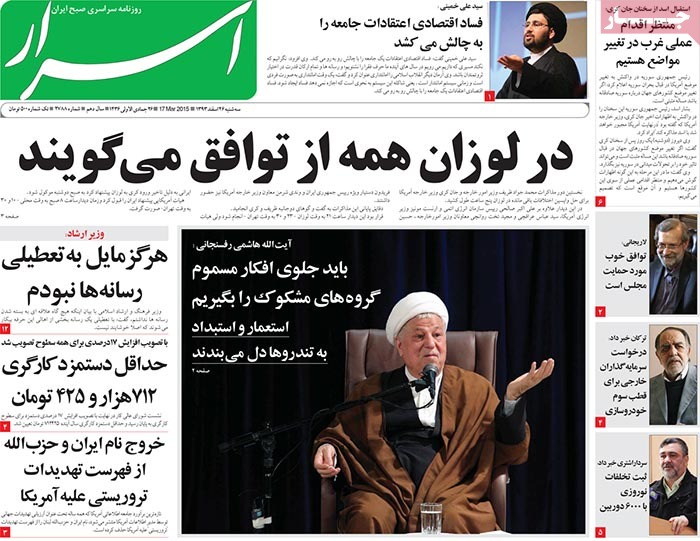
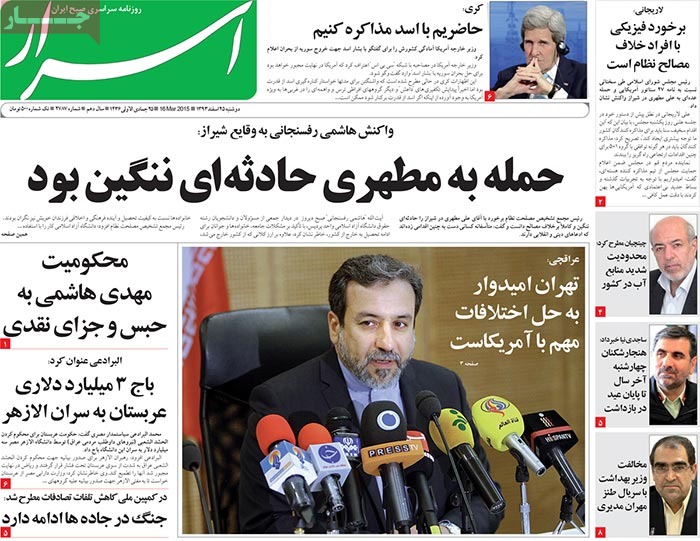
Asrar: “A good deal will be supported by the Islamic Consultative Assembly,” said Parliament Speaker Ali Larijani.


A look at Iranian newspaper front pages on March 17


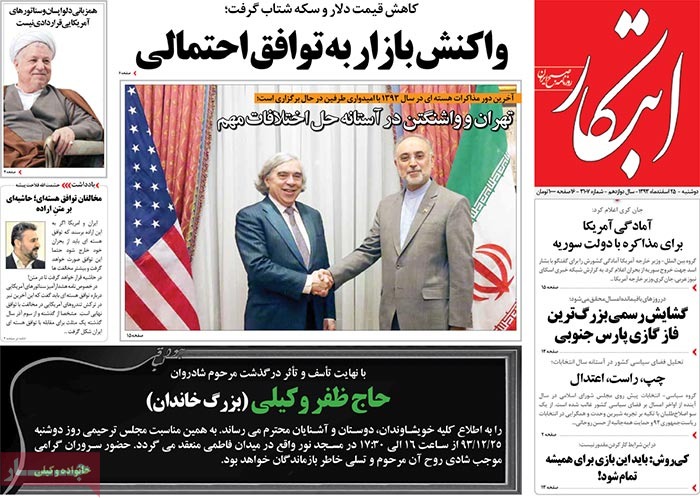
Ebtekar: The countdown is on for the grand [nuclear] deal [between Iran and P5+1].

Ebtekar: The Ayatollah warns hardliners

“Political and religious diversion poses a threat to Islamic countries,” said Ayatollah Hashemi Rafsanjani.


A look at Iranian newspaper front pages on March 17


Emtiaz: There are plans to raise oil exports by one million barrels a day.


A look at Iranian newspaper front pages on March 17


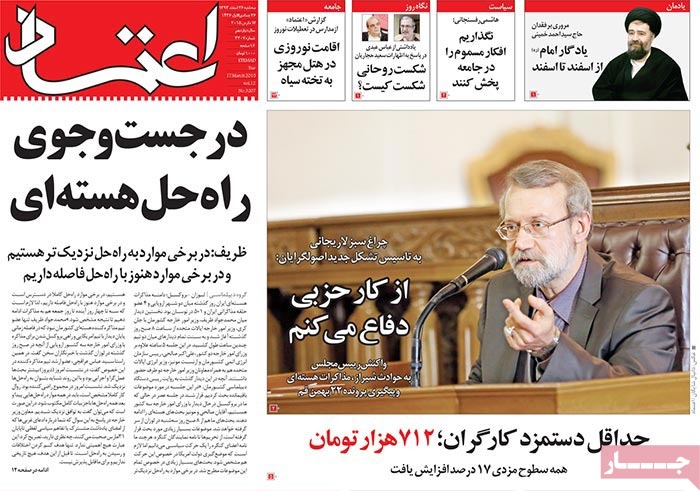
Etemad: “In certain areas we are closer to a deal; in some others differences still remain,” said the Iranian foreign minister of the stance of Iran and P5+1 on the nuclear issue.


A look at Iranian newspaper front pages on March 17


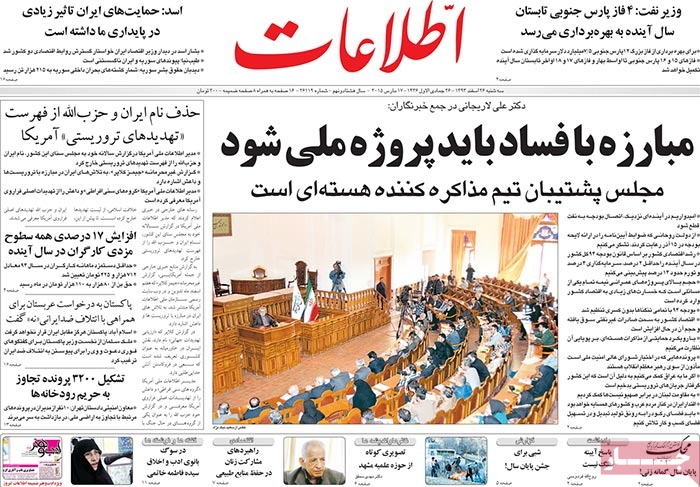
Ettela’at: “Four new phases of South Pars gas field will be inaugurated in the summer,” said the Iranian oil minister.

Ettela’at: Next year will see an across-the-board 17 percent wage hike for laborers.

Ettela’at: “Clampdown on corruption should turn into a national project,” said the Iranian parliament speaker.


A look at Iranian newspaper front pages on March 17


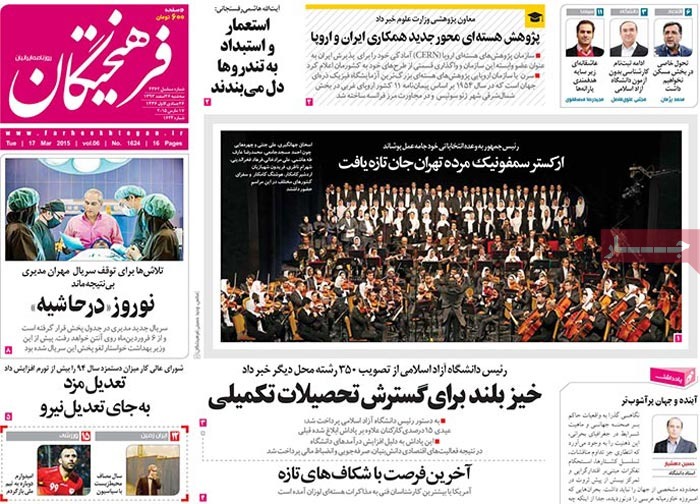
Farhikhtegan: The moribund Tehran Symphony Orchestra has been resuscitated.


A look at Iranian newspaper front pages on March 17


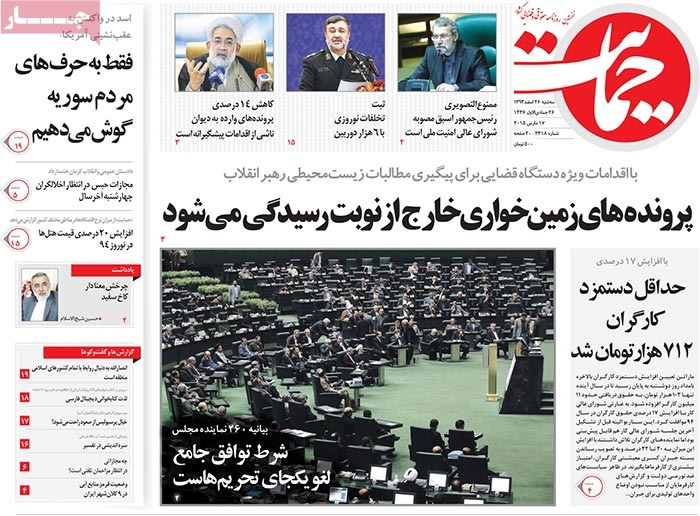
Hemayat: Following a call by the Supreme Leader on officials to protect the environment, the Judiciary is to fast-track land-grab cases.

Hemayat: “That images of the former president [Mohammad Khatami] should not be published in the press is in line with a decision of the Supreme National Security Council,” the parliament speaker told a news conference.


A look at Iranian newspaper front pages on March 17


Iran: “It is my hope that no publications will be shut down next year,” said the minister of culture and Islamic guidance.


A look at Iranian newspaper front pages on March 17


Jomhouri Islami: “Iran’s economic growth in the first three quarters [year ends on March 20, 2015] stood at 3.6 percent,” reported the Central Bank.

Jomhouri Islami: Parties to nuclear talks have had a positive view of the negotiations. A deal is within reach.


A look at Iranian newspaper front pages on March 17


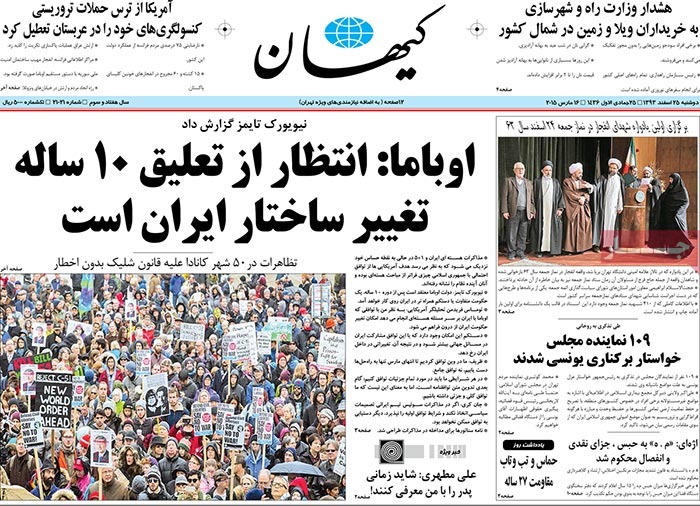
Kayhan: “Supervising the nuclear talks is part of parliament’s duty,” said parliament speaker.


A look at Iranian newspaper front pages on March 17


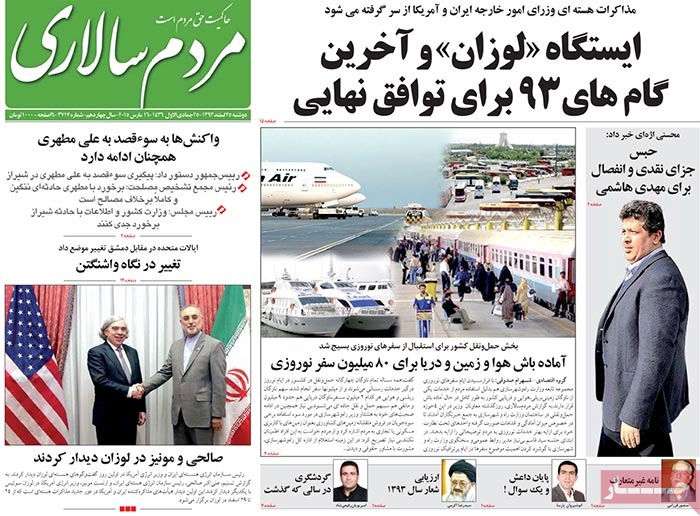
Mardomsalari: Some 6,000 traffic cameras keep an eye on the roads across the nation as people hit the road for the New Year holiday season.


A look at Iranian newspaper front pages on March 17


Iran slams Lahore’s church bombings

Marziyeh-Afkham
Marziyeh-Afkham

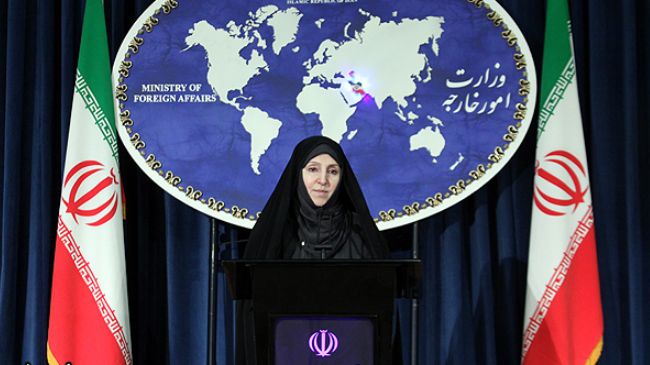
Iran’s Foreign Ministry Spokeswoman Marzieh Afkham has condemned the bombings targeting two churches in the eastern Pakistani city of Lahore by Pakistani militants that claimed 14 lives and left many injured.

Afkham said on Monday that Islam is a religion of kindness, peace and mercy and strongly opposes terrorism and violence.

“The Islamic Republic of Iran has always stressed peaceful coexistence among followers of divine religions and believes that the spread of violence and strengthening of radical groups will have an unfavorable impact on peace, stability and peaceful coexistence,” she said.

Afkham also expressed condolences to the Pakistani government, nation and relatives of the victims of the terrorist attacks.

At least 14 people were killed and nearly 70 others were injured on Sunday when the twin blasts hit an area near two churches in Youhanabad area, where over 100,000 Christians live.

Jamaat-ul-Ahrar, a Pakistani Taliban (TTP) splinter group, claimed responsibility for both the attacks.

Iranian MPs set conditions for comprehensive nuclear deal

Iran-Pariliament
Iran-Pariliament

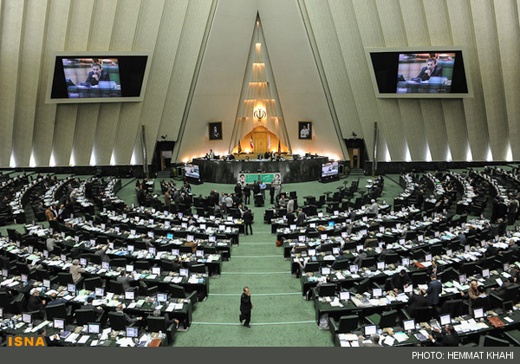
As many as 260 Iranian MPs released a statement Monday [March 16] which sets conditions for a comprehensive nuclear deal with P5+1 to take hold.

The following is a partial translation of the statement which was read out in the chamber by Zargham Sadeghi, a member of the Presiding Board of the Islamic Consultative Assembly, as reported by the Iranian Students News Agency:

[…]

While emphasizing the previous statements and decisions of the Islamic Consultative Assembly, especially the one that requires the government to stick to the nuclear achievements of the nation, we, members of this assembly, urge the nuclear negotiators to bravely and wholeheartedly shield the dignity of the Iranian nation – which has a very important position in regional and global equations – against American tricks and acquisitiveness.

The nuclear negotiators are expected to take account of the following as the absolute rights of the nation:

1. Removal of sanctions all at once and termination of Iran’s nuclear case at the UN Security Council should be a precondition for the implementation of a comprehensive nuclear deal.

2. Holding on to the nuclear achievements and fully restoring the nuclear rights of the nation under Article 4 of the NPT is what the Iranians unanimously want.

3. In case the other party fails to live up to any of its commitments, the deal should be scrapped and enrichment should be resumed at any level the country needs.

In light of the expression of concern by the Supreme Leader, confronting the US tricks which come in different shapes and forms undoubtedly requires more vigilance on the part of Iranian negotiators.

The world needs to know that extremism cannot be treated arbitrarily

Khorasan daily - Zarif

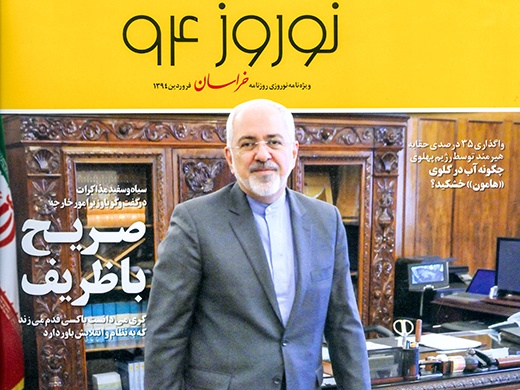
Foreign Minister Mohammad Javad Zarif has said that the world should wake up to the fact that extremism has to be seriously dealt with.

In its New Year supplement, Khorasan daily published an interview with the Iranian top diplomat on different issues, including talks with P5+1 and Iran’s ties with neighboring countries. The following is a partial translation of the highlights of Mr. Zarif’s remarks:

[…]

In the past the West assumed or acted as if Iran’s enrichment program was geared toward making a bomb. Although those allegations are still repeated, now experts with the International Atomic Energy Agency and Western political, technical and scientific circles acknowledge that there is a technical way to make sure enrichment does not lead to development of nuclear weapons. This is an achievement and now it is up to the other side to carry the ball and display political will.

In recent years, Iran has had the greatest cooperation with the IAEA. Perhaps nowhere else in the world – Japan excluded – has the IAEA been that much active; this comes as Iran has only 17 atomic sites and Japan is home to 170 nuclear facilities.

If you take a look at the agency’s 2013 report, you will learn that Iran’s reported negligence equals that of Japan which is below one percent. In the case of some countries that figure is as high as 20 or 30 percent. There are a couple of cases where the negligence figure is 100 percent. […]

I believe we can hold talks with the US and produce the [intended] results from such talks.

If we fail to arrive at an agreement, the US miscalculation would be to blame; the Americans [wrongly] thought that they could pursue their agenda though piling pressure [on Iran]. There is still one good opportunity to reach a deal, one which allows Iran to hold on to its rights and maintain its interests.

[…] I have repeatedly said that we do not hold talks only with the US. There are two reasons why negotiations with the US have been highlighted: First, it is the first time the Islamic Republic of Iran has entered official talks with the US; second and more importantly, the nuclear issue is the only subject about which we hold talks with the US.

[…]

If the talks result in a breakthrough, it won’t mean that all problems have been removed. From the start, I told my colleagues at the Foreign Ministry that conclusion of the Geneva deal marked the beginning of our job and that it would increase the problems and challenges down the road. In case talks break down, we have made other arrangements.

Mr. Obama said in a speech in [the Brookings Institution’s annual] Saban [Forum in December], ‘If I had an option, if we could create an option in which Iran eliminated every single nut and bolt of their nuclear program, and foreswore the possibility of ever having a nuclear program, and, for that matter, got rid of all its military capabilities, I would take it. But that particular option is not available.’

His remarks [back then] were viewed as an affront to Iran. They could have been viewed as inevitability, on the US part, to get along with the Iranian people. This is how I read Mr. Obama’s remarks, although I am not under any illusion that the US has changed course.

The Supreme Leader gets involved [in the nuclear issue] any time he deems it expedient. That the leader gets involved does not mean that the Foreign Ministry has failed to undertake its responsibility.

I’m sure that when [Secretary John] Kerry was taking a walk [in Geneva] with me, he felt that he was talking with a man who had strong belief in his country’s establishment and revolution. During the talks I repeatedly went to a corner in the negotiating room to say my prayers and later said [to the other parties to the talks] that I said my prayers to remember that there is one superior power in the world and other powers are not as mighty as Him.

I do not think that the American or other delegations could find any moment in the talks in which my colleagues or I have dropped our revolutionary principles and beliefs. In addition, the other side is convinced that Iran is after interaction, dialogue and logic to stick to its rights. Iran is not after war, conflict or tension, but we will stand up to bullying.

I hope the world will come to its senses next year [Iranian New Year that starts on March 21] to confront extremism and realize that acts of extremism cannot be treated selectively.

[…] I am certain that the West, including the US, has no option but arrive at a deal with Iran which is based on dialogue and mutual respect. They may make mistakes. Even in that case, I hope the Iranian people are not affected by their possible mistakes.

In an in-depth interview Rafsanjani talks politics, past and present (PART ONE)

Arman-Hashemi
Arman-Hashemi

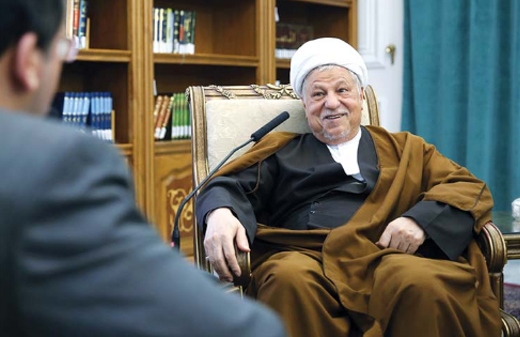
Chairman of the Expediency Council Ayatollah Akbar Hashemi Rafsanjani has said although President Rouhani’s administration is in conditions tougher than those of his own government that took office after the end of the Iran-Iraq war in the 1980s, the performance of the Rouhani administration is satisfactory.

The following is the translation of an exclusive interview Arman-e Emrooz daily’s Hossein Abdollahi conducted with the top councilor. The interview was published by the newspaper on March 15. IFP will release the translation of the interview in three parts.


How did the foreign policy of the Construction government [you led] differ from that of the Moderation government of Dr. Rouhani?

These two governments share one objective: prevent foreign issues from creating problems for the country and try to untie the knots, if any. I think Mr. Rouhani’s willingness in this regard is no less than mine. There are issues which are different, for instance, tough sanctions which have been imposed on the country.

When I was president, sanctions were haphazard, and we would not let issues be taken to international bodies. Several countries had acted on their own and boycotted Iran with no international resolutions. The Security Council, Congress and the like were not at play. Certain governments did not want to see Iran make progress, thus they would make political decisions which lacked international support. Our job back then was much easier than Mr. Rouhani’s.

As president, I would announce the basic principles saying that Iran is after interaction, not creating enemies, and it was enough. Thanks to my experience as parliament speaker and as the one in charge of handling the war, the world believed my stance, especially regional countries which realized that the Islamic establishment did not want to have issues with other nations and sought to solve problems.

When Iran accepted Resolution 598 [which brought the Iran-Iraq war to an end], the world learned that Iran is neither seeking war nor expecting much in return, and that we were simply seeking our legal rights. The country was determined not to quarrel with the world.

[…]

Back then we had no problem beyond our borders. We had issues with some regional countries because of war. They had supported Saddam’s Iraq through their forces, money, and other things. They were worried due to their past behavior. Building on our own special policy, we managed to convince those countries that we could work together as friends and neighbors.

What does stand in Mr. Rouhani’s way if his government wants to adopt a similar policy?

Mr. Rouhani cannot easily adopt such a policy. Back then there was no other issue than the past behavior of these countries. Mr. Rouhani is now facing the question of Syria of which many Arab nations can make an issue. They ask what Iran is doing in Lebanon. They are concerned about Iraq. Yemen and Bahrain have heightened their concerns.

These are the areas in foreign policy we need to act cautiously. Iran has no designs on other countries. If it helps a country it is only out of humanitarian concerns. Mr. Rouhani has to tackle these questions as well as sanctions. The same issues are raised when it comes to friendship with the Arabs. The problems Mr. Rouhani is facing for solving foreign issues outnumber those of the Construction government.

In all, are you satisfied with Mr. Rouhani’s foreign policy?

I think his decisions are sensible. One of the issues which had to be fundamentally solved was the question of sanctions. The nuclear case should be settled as well so that Iran can go after tapping into the country’s technical capability to exploit nuclear science.

The nuclear issue which is very important for Iran has become a bone of contention. I think Mr. Rouhani has taken the right path, picking a good foreign minister and a good plan.

Before we reach the point we are now, the Supreme Leader voiced his approval of talks with the US – once a red line. Talks with the US had already started in two meetings in Oman before the Rouhani administration took office. Mr. Salehi was then the foreign minister. The government was at ease, learning about the leader’s go-ahead. Discussing the [nuclear] issue was impossible with the US out of the talks.

The door opened and the government started to act. If the talks are moving ahead slowly it is not the government’s fault; the other party is to blame. I have repeatedly said that the dispute can be solved in one single day if good intentions are in place and the question is not politicized.

How come they are killing time?

They say they are concerned that Iran may use its nuclear capability for military purposes! That is not what we want to do. The Leader has released an edict banning [atomic] bombs. If they are killing time for this, it is no problem. We have repeatedly said, ‘Step forward and prove your claims’.

They are gradually getting the point. We accepted the Additional Protocol in the talks and the world is sure about it. They have to make an important decision and stop looking for excuses. […] They can be assured that Iran’s scientific power could be used for peaceful purposes.

They act based on their own criteria thinking that they can achieve better results through escalation of pressures; that’s why they resort to marginal issues and bring up the question of missiles which has nothing to do with the nuclear case.

Sanctions have been slapped [on Iran] because of the nuclear program. When marginal issues come to the fore, political motivations of the other side are revealed. As far as Iran is concerned, we have acted flawlessly.

The problems the government is grappling with at home are not few.      

Yes, I didn’t have the problems Mr. Rouhani is now facing inside the country. You see that they level unfounded charges and raise concerns after any trip the negotiating team makes. It is true that marginal issues should not be taken into account for the sake of the country’s interests, but at least they can avoid measures which sap the morale of the negotiating team if they cannot encourage, support or welcome the country’s negotiators.

Unfortunately, these rowdy people – who are in the minority – view themselves as revolutionaries. These are the problems the Rouhani administration is grappling with. Mine was less than this.

Another good point then was that we saw eye to eye on almost any issue with the Leader. For instance, when I wanted to form my cabinet, we talked about every proposed member of the cabinet. […] This way, the leader was quite sure about the government. Anything the cabinet wanted to do, the leader would give his approval.

You said the role the US plays in nuclear talks is important. How constructive is the American role in securing a likely deal at the talks the 11th government has been holding? Is it constructive at all?

Their role has been a bit tough and occasionally constructive. The reason: after so many years, talks have made progress. Weren’t there talks before Mr. Rouhani’s government took office? They [officials of the previous government] were holding talks too, but the gaps were widening by the day. Anytime there was a new statement, a new row would erupt.

That is not the case anymore. Things are progressing gradually. The Americans face problems too. Their problems are bigger, though. The Worriers [supporters of Ahmadinejad] are revolutionaries, but Congress and Israel officially interfere with things.

Many members of Congress are indebted to the Jews and the Zionist lobby which defies the Obama administration.

Arab countries whose concerns are quite unfounded are bankrolling efforts to sabotage the talks. The US has a balancing act to do. I am not saying the Obama administration has no choice but satisfy them all. If there were goodwill, the US would have acted swiftly.

If the problems were truly technical, they would sit at the table for marathon talks and settle all the problems in a few days and sign a deal. It is possible. They follow polices that prolong the talks. Still, we have made progress and many problems have been settled.

Do you think there will be a deal around the corner?  

I believe the Europeans, including those who talk to me off and on, cannot wait for a deal, because they know that transaction with Iran is of great importance.

Iranian gas and oil on the international market can settle some of their problems. For the great projects we are implementing, we have to get many things from them. Even if we implement these projects ourselves, we need to import certain things from Europe.

I believe that an inactive Iran won’t serve their interests. Our ties with Americans were cut at the beginning [of the revolution]. They lost everything in Iran and they are now remorseful. They are even jealous of other parties that do business with Iran.

The Europeans are all for a deal. Sometimes the French make complaints which are quite superficial. They have other reasons for their complaints.

The US is serious. It is the main party that sits across from us at the negotiating table. When they were imposing sanctions on us, Russia and China faced the American and NATO leverage. Talks with the three European countries are not a taboo, neither for us nor for them [the Worriers]. The US is the main question now.

Iran auto industry not to roll out red carpet for firms from hostile states: CEO

Yeke zare Iran Khodro

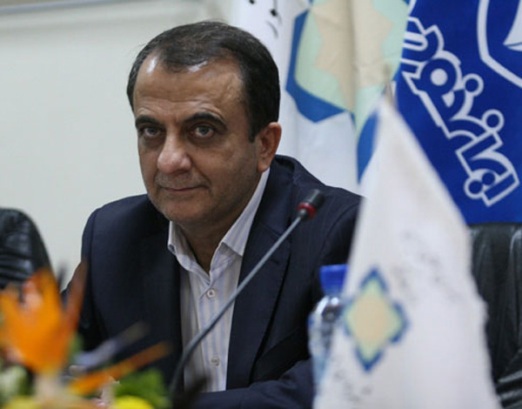
President of Iran’s largest carmaker, Iran Khodro Company, Hashem Yekke Zare, underlined the country’s capabilities in manufacturing modern cars, and said Tehran will not roll out a red carpet for the automakers of the states which have shown a hostile behavior towards Iran.
“Today, we are in a position that we talk with the world’s top automakers not from the position of a country in need, but from the position of a partner which owns technology,” Yekke Zare told reporters in Tehran on Saturday afternoon.

“We will never roll out a red carpet for the countries which have not had a friendly attitude, words and performance towards our country and have probably caused trouble for the Islamic Republic of Iran and no change is seen in their behavior,” he added.

“Iran’s market is highly attractive to the foreign automakers,” Yekke Zare said, and added that ensuring durable and long-term cooperation in designing and manufacturing modern products sets a priority for Iran Khodro Company (IKCO).

He also announced that Iran plans to choose a European partner, and said, “Several highly creditable companies want to launch cooperation with Iran Khodro, but IKCO never forgets the lessons it has learned from the past and it does not want to sign contracts which could be vulnerable to minor problems.”

[…]

A look at Iranian newspaper front pages on March 16

Iranian Newspapers Headlines

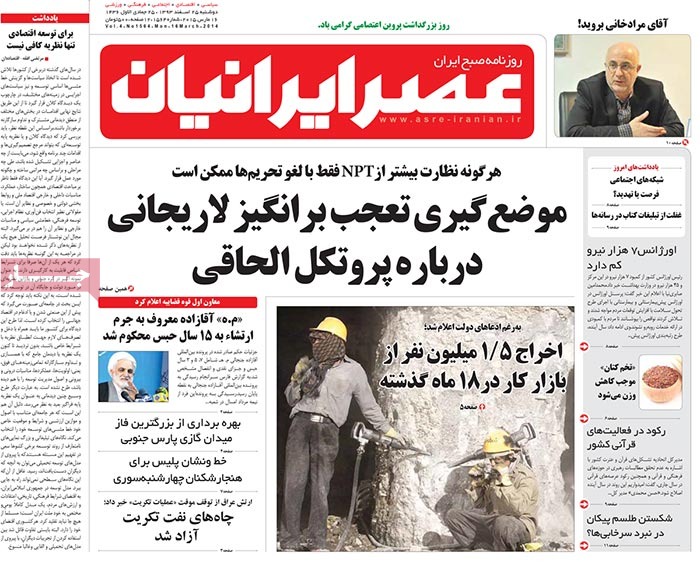
Reactions to an attack on Ali Motahari, a Tehran MP which forced him to call off a planned speech in the southern city of Shiraz, dominated the front pages of Iranian newspapers on Monday. The announcement by the Judiciary spokesman that a preliminary verdict has been handed down in the case of Mehdi Hashemi, the son of Ayatollah Akbar Hashemi Rafsanjani, and resumption of nuclear talks in Switzerland were also in the news.


Abrar: “Iran is among the leading countries in the world when it comes to clampdown on maritime terrorism,” said the commander of the Iranian Navy.

Abrar: Some 180 MPs have called on President Rouhani to order Khosravi Border Crossing reopened.


A look at Iranian newspaper front pages on March 16


Afarinesh: “Tehran hopes to settle major differences with the US,” said the Iranian Deputy Foreign Minister Seyyed Abbas Araghchi.


A look at Iranian newspaper front pages on March 16


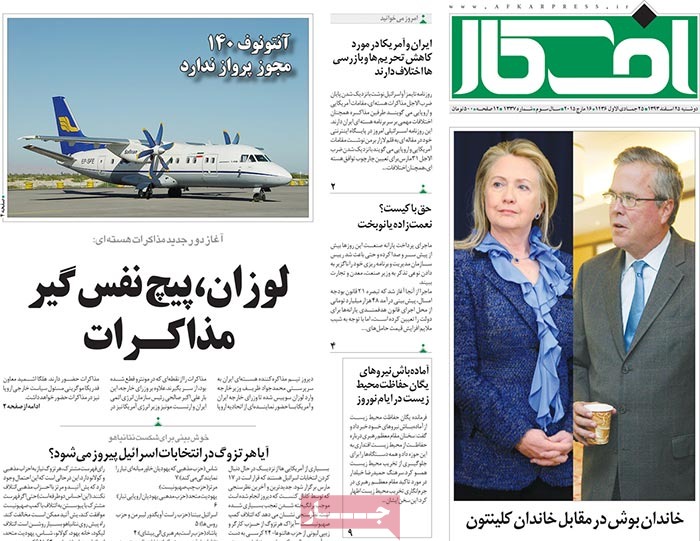
Afkar: Antonov 140 does not have permission to take off.


A look at Iranian newspaper front pages on March 16


Aftab-e Yazd: “Extremism has not been seriously dealt with,” said the chairman of parliament’s Judicial Committee in reaction to an attack on a Tehran MP in Shiraz.

“Treating the son of a martyr this way is below the dignity of the establishment,” Ayatollah Hashemi Rafsanjani said.

“Such measures cannot be justified in any religious or revolutionary way,” said Parliament Speaker Ali Larijani.

“There are suspicions that the governor’s office acted in cahoots with the attackers,” said Hamid Ansari, who leads the institute that publishes the works of the late Imam.

“Officials who are to blame should be prosecuted [for dereliction of duty],” said President Rouhani.

The comments came as the car of Ali Motahari’s attorney was vandalized in Shiraz.


A look at Iranian newspaper front pages on March 16


Arman-e Emrooz: “The attack on Motahari was outrageous,” said the chairman of the Expediency Council.

Ayatollah Hashemi Rafsanjani made the comment in reaction to the attack on Tehran principlist MP Ali Motahari in the southern city of Shiraz last week.


A look at Iranian newspaper front pages on March 16


Asr-e Iranian: The strange stance of the parliament speaker on the Additional Protocol

Any inspection beyond the provisions of the NPT will be possible only after sanctions are lifted.


A look at Iranian newspaper front pages on March 16


Asrar: Mehdi Hashemi has been fined and sentenced to jail term.

Asrar: Former Egyptian diplomat Mohamed ElBaradei has revealed that Saudi Arabia paid $3 billion in bribes to Al-Azhar to release a statement and condemn the presence of Shiite militiamen in the fight against IS terrorists.


A look at Iranian newspaper front pages on March 16


Ebtekar: The largest phase of South Pars gas field to be inaugurated.


A look at Iranian newspaper front pages on March 16


Etemad: “The verdict in Mehdi Hashemi’s case is not final and can be appealed,” said the Judiciary spokesman.


A look at Iranian newspaper front pages on March 16


Ettela’at: “Removal of sanctions is on the agenda of the talks,” said Iranian Foreign Minister Mohammad Javad Zarif.


A look at Iranian newspaper front pages on March 16


Hamkarie Melli: [Renowned actor] Parviz Parastooi is to auction off his prizes to help those who have no guardian to look after them.


A look at Iranian newspaper front pages on March 16


Hemayat: “Any deal should be approved by the UN Security Council,” said Iranian nuclear negotiator Abbas Araghchi of a possible agreement between Iran and P5+1.

Hemayat: Following the amendment of a budget bill clause by parliament, payment of cash subsidies to the rich will definitely stop next year.


A look at Iranian newspaper front pages on March 16


Jomhouri Islami: IS is preparing to retreat from Mosul.


A look at Iranian newspaper front pages on March 16


Kayhan: Some 109 MPs have called on President Rouhani to dismiss his adviser Ali Younesi for his controversial comments.


A look at Iranian newspaper front pages on March 16


Mardomsalari: The Iranian nuclear chief and the US energy secretary have met in Lausanne.


A look at Iranian newspaper front pages on March 16


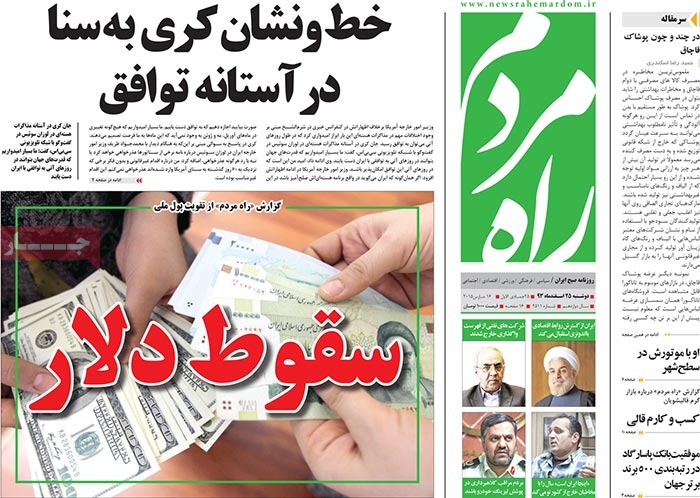
Rah-e Mardom: The value of the greenback has fallen against the Iranian rial.


A look at Iranian newspaper front pages on March 16


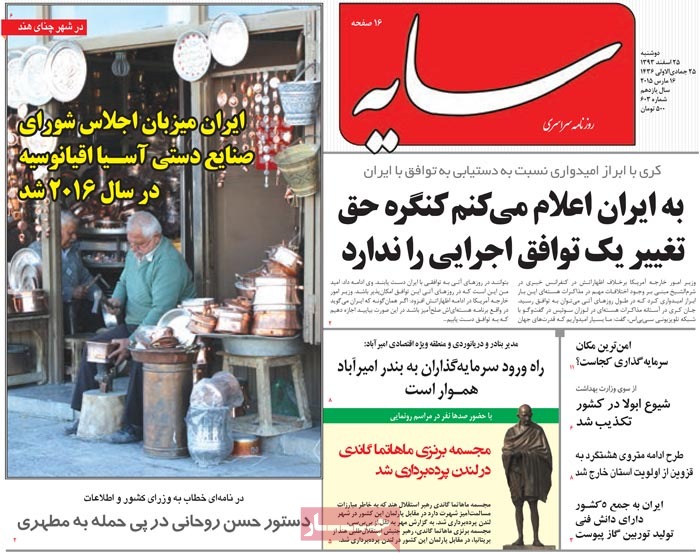
Sayeh: Iran to host a 2016 meeting of the World Crafts CouncilAsia Pacific Region.


A look at Iranian newspaper front pages on March 16


110 MPs express support for attacked lawmaker

Iran Parliamentarians: Syrian elections showing country’s power

Iraj Abdi told IRNA that in their letter, the lawmakers have called on the judiciary chief to strongly respond to such self-motivated moves.

Motahhari, a moderate member of parliament, was due to deliver a speech at Shiraz University in central Iran when his car was attacked by unknown motorcyclists.

He is member of parliament from Tehran and a vocal critic of the former president Mahmoud Ahmadinejad for bringing the enemies of the country together to inflict a major blow to the nation by orchestrating sanctions.

Restoring balance to a skewed negotiating table

Zarif-Iran_Newspaper

Foreign Minister Mohammad Javad Zarif has said although some of the things opponents of nuclear talks at home say do play into the hands of the other side, his primary concern is to prevent Iran’s national interests from being jeopardized.

On March 15, Iran published an in-depth interview with the top diplomat conducted earlier in the month by the daily’s Maryam Salari. The following is a partial translation of what the Iranian foreign policy chief said in the interview:


On how he and his performance will be judged

I knew about the difficulties associated with the job [leading the country’s nuclear negotiating team] before I accepted to take the helm. I knew that the talks were likely to face difficulty both at home and on the international stage. One reason why I knew about the stumbling blocks lying ahead was my previous position.

Before being named foreign minister, when the nuclear case was at a critical point – when it was taken to the UN Security Council and more sanctions were slapped on Iran – I was set aside for certain reasons. Actually, I was forced to retire.

For almost six years, I was looking at things from the vantage point of being away from the decision-making quarters. I knew well that the going was tough.

After the massive turnout for presidential elections in which Iranians voted for adoption of an approach based on interaction, logic and wisdom, I felt duty-bound to accept the foreign minister’s portfolio.

Although I was not interested in leading the Iranian negotiating team, I was entrusted with the job. That was quite a responsibility, and I felt I had to fulfill it to the best of my ability.

I have since focused my attention on trying my best to fulfill the duty of my office. I may have committed some mistakes along the way, but that is nothing unnatural.

I have gone out of my way to act in line with the decisions of the senior officials of the establishment. With such an attitude to my mission, I am not worried how future or present generations will judge me.

I focus all my attention on realities and try my best to fulfill my responsibility to serve our national interests. One cannot predict the outcome of the talks with certainty. Similarly, one cannot predict how history will be written in the future. That leaves no room for concern as to how history will judge me or my performance.


On nuclear talks   

Both sides to the talks over Iran’s nuclear program – which is a grand bargain in the contemporary international relations – have accumulated assets. Naturally, they don’t want to let go of their capital.

On one side of this bargain are the Iranian people who have put up resistance for years in the face of Western pressures. Not only have they not retreated, but have improved their scientific capabilities. They have proven that pressures won’t work in helping foreigners secure domination over them.

Over the years, the other side has turned sanctions into leverage to put pressure on the Iranian people. The Americans have used different occasions including the embassy takeover, Security Council Resolution 598 and the nuclear issue to get the Security Council to impose sanctions on Iran.

In other words, American moves to prompt the international community to put pressure on Iran date back to thirty-something years ago. With the nuclear dispute heating up, the US secured its goal after three decades of efforts. Naturally, they view the sanctions-related pressures as an asset.

However, their supposition that they will be able to pressure Iran through sanctions has not materialized. A case in point, in the early years of the nuclear dispute Iran had 200 centrifuges. After the imposition of sanctions the number has risen to 20,000.

If history is any indication, Iranians become more perseverant when they are exposed to more pressures. Five permanent members of the UN Security Council plus Germany – which has always sought to become a permanent member of the council itself – sit across the table from Iran in the talks.

What is interesting is that never in the history of the council have P5 been unanimous on a single issue. The only exception came when they put pressure on Iran to agree to an end to the imposed war and when Iran’s nuclear case came up for discussion.

The fact that these countries along with Germany have been acting in a concerted way against Iran for seven years has complicated the talks. Of course, they have come to the conclusion that the only way to solve Iran’s nuclear case goes through negotiations.


On why the West decided to stop imposing further sanctions

The ultimate goal of the sanctions was to drive a wedge between people and the government. They hoped with the creation of division, people would put pressure on the government to back down on its nuclear stance. But the elections proved that there existed no such a gap. […]

In other words, following Iran’s presidential elections, the West concluded that Iranian people supported the nuclear stance of their government. So the West came to the conclusion that its hopes of Iran’s nuclear surrender or regime change through more and more pressure on the public are irrational. […]

That was how the idea of holding talks with Iran gathered momentum in the West. At the talks, we tried to use rationality and the principle of talks not just for the sake of talks to drive that point home. That understanding now exists in the West; whether it will be reflected in the actions the West takes is difficult to predict.


On doubts in Iran about American intentions and conclusion of a deal

I don’t blame those who have serious doubts about American intentions. […] I share their stance on the necessity of holding on to Iran’s dignity and remaining committed to principles.

What divides us though is the approach to dealing with the United States. I believe the logical responsibility of the Iranian diplomatic apparatus is to deny American hardliners ammunition. That objective can be served through talks. Exposing the nature of unfounded allegations they level against us can drive them to the sidelines in the decision-making process in their own country.

Even if we assume that opposition to Iran is a bipartisan goal in the US, we should not forget the fact that the US does not necessarily secure its goals on the international stage. Did the US secure its goal in the Vietnam War? Was the deal it signed to end the war one which was ideal to Washington? Did the US withdraw its troops from Iraq and Afghanistan voluntarily? Why do we assume that the US is a superpower which gets whatever it wants?

[…]

I don’t buy the notion that no deal is signed unless it serves the interests of the US. I suggest these people review history to see how many agreements have exactly met each and every single demand of one signatory.


On America’s failure on the political front  

Cases of American failure are not limited to battlefields. There are several cases on the political front, too. For instance, in 1995, when the US was under the illusion that it was the only superpower in a unipolar world, Bush 41, raised the question of a New World Order at the UN General Assembly.

At the same time a number of countries launched a motion to establish an international criminal court. Although the US was bitterly opposed to the move, the court was eventually established. In other words, the US failed on a front which was of vital importance to it.

So one can say that the idea that the US is invincible is not correct. The most important thing neocons want to instill in the world is that all wars and negotiations end the way the US wants them to. But realities on the ground around the world do not confirm their idea.

I don’t buy the notion that it is impossible to pull off a political victory over the US. In keeping with its principle of independence, the Islamic Republic of Iran has secured remarkable victories on the international stage. […]

In the past, anytime Netanyahu visited the US, he would return to Tel Aviv with new American sanctions against Iran. Over the past two years, thanks to the changes in the atmosphere of the talks, he has been unable to convince American leaders to slap any new sanctions on us.

Things have changed. Obama recently told Congress that additional sanctions legislation would isolate the United States from its international coalition. Such comments show that Tehran’s new policy which is based on the unwavering support of the Iranian nation has restored balance to the skewed negotiating table. I hope the balance in question will help us secure success down the line.


On the stance and comments of local hardliners opposed to talks  

It is my hope that individuals or parties never stick to their factional and partisan interests at the expense of the country’s national interests or foreign policy.

The comments some local critics made in connection with the Geneva deal played into the hands of the other party. […] Critics need to be fair and think about the likely consequences of their comments.

[…]


On personal life

I launched my career at a very young age. After the revolution I got a job at the Iranian consulate in San Francisco at the age of 19. I landed the job because I knew English and I was a political science major.

Thanks to my busy schedule I have little time left for socializing. I got married at a young age, and that left me almost no time to spend time with friends or at social gatherings. That does not mean that I keep to myself. I have to divide my time between work and home.

Interaction and application of the language of logic has always been part of my job. As the leader has said we have to talk to the rest of the world with the language of logic. That advice has been reflected in Islamic instructions too. […]