Thursday, December 25, 2025
Home Blog Page 4919

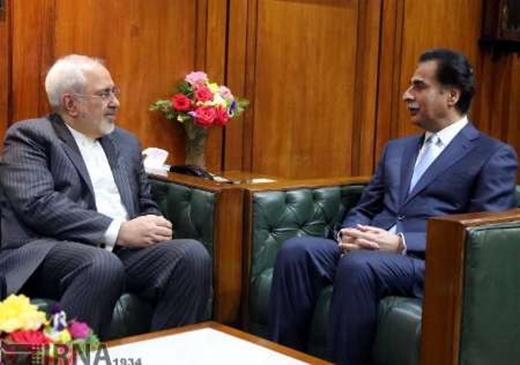
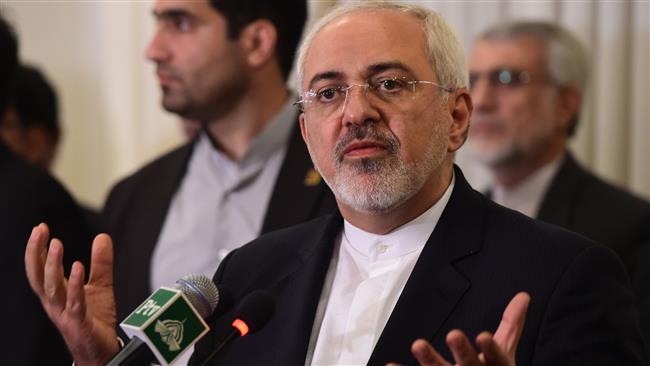
West must choose between N-deal or continued Iran sanctions: Zarif

Mohammad Javaz Zarif-Iran FM

In an exclusive interview with Press TV reporter in the Swiss city of Montreux on Wednesday, Zarif said if the West really seeks to reach an agreement with Iran over Tehran’s nuclear program, there is no need to continue with sanctions.

The Iranian top diplomat further noted that a serious problem on the way of an agreement is the great deal of pressure exerted by scaremongers, who are trying to create impediments on the way of negotiators.

Referring to the latest round of nuclear talks between Iran and the P5+1 countries – the US, the UK, France, Germany, China and Russia – Zarif said the negotiating sides have made serious headway in this round of talks.

Explaining about Iran’s red lines during negotiations, Zarif said, “Our red line is that we will not accept imposition. We will not accept trampling on the rights of our people. At the same time, we do not want anything more than what is legally ours and that is to move forward with a peaceful nuclear program and with the removal of international pressures against Iran.”

The Iranian foreign minister stated that although gaps still remain between negotiating sides by “We’re not far from [the final] deal.”

The latest round of the nuclear talks ended in Montreux, Switzerland, on Wednesday. The three-day negotiations were headed by Iranian Foreign Minister Mohammad Javad Zarif and US Secretary of State John Kerry.

Representatives of Iran and the United States had also held three rounds of intense negotiations in the Swiss city of Geneva on February 22-23 to bridge their differences ahead of a July 1 deadline for Iran and the P5+1 group – Russia, China, France, Britain, the United States and Germany – to reach a comprehensive nuclear deal.

The talks were attended by head of the Atomic Energy Organization of Iran, Ali Akbar Salehi, US Energy Secretary Ernest Moniz, Iranian Deputy Foreign Ministers Abbas Araqchi and Majid Takht-e Ravanchi, US Under Secretary of State for Political Affairs Wendy Sherman, and European Union deputy foreign policy chief, Helga Schmid in addition to Hossein Fereydoun, Iranian President Hassan Rouhani’s special aide.

An informed source close to Iran’s negotiating team told Press TV reporter that the next round of talks at ministerial level has been slated for March 15-20.

The fourth round was preceded by technical discussions between Salehi and Moniz.

Iran and the P5+1 have already missed two deadlines for inking a final agreement since they signed an interim one in the Swiss city of Geneva last November.


Today only one aggressive, terrorist regime finds the nuclear talks irritating: President

President Hassan Rouhani has said that if talks are designed to make things more transparent, Tehran will sit at the negotiating table, but that his government would not accept any deal meant to deprive the Iranian nation of their absolute right to scientific and technological progress.

Speaking in a meeting of his Cabinet Wednesday – in reaction to Israeli prime minister’s comments on Capitol Hill a day before – the president said we seek a deal that serves our national interests as well as those of the region and the wider world.

The world approves of progress in talks between Iran and P5+1 because such progress serves the commercial, economic and cultural interests of the region and the entire world as it helps settle the problems that have given rise to extremism around the globe, he said, adding, only one aggressive and occupying regime which sees its survival guaranteed in war and aggression is mad at the talks.

The president further said the Zionist regime has always been worried about the prospects of peace and stability in the region. “The al-Nusra Front, which is a terrorist grouping [operating in Syria] has the support of this regime. Those who want to see the region and the entire world become a better place should know that the path to regional development and progress goes through stability and security and that talks are the only way to settle the dispute over Iran’s nuclear program.”

President Rouhani stated, “People of the world and the United States are too smart to listen to the advice of a regime which has always fanned the flames of conflict; a regime that has always acted in defiance of international law and away from the eyes of international inspectors to build a huge nuclear arsenal; a regime that does not allow the IAEA to inspect its nuclear facilities; a regime that has time and again invaded its neighbors over the years; a regime that kills innocent people and children in the Gaza Strip.

“Such comments won’t leave an impact on the will of nations and governments; the basis of our interaction with the rest of the world is goodwill in return for goodwill, honesty in return for honesty, and trust in return for trust. We have always called for the emergence of a nuclear-free Middle East. My government has always been in quest of a win-win, balanced and sustainable deal and such a deal would certainly serve the interests of the Middle East and the world,” he said.

“P5+1 has two options to choose from. Either, it has to stick to the principles of logic and international law to reach a deal; the sooner that deal comes, the better it will be for everyone. Or it can opt to deny the realities and expect to see Iran’s peaceful nuclear program land on the fast track. They have once chosen the second option and found out that sanctions and pressures won’t work in dealing with Iran which has remained steadfast on its path,” the president concluded.

Zionist lobby won’t allow US-Israel ties to weaken: Expert

Pirooz Mojtahedzadeh

Mosalas, a weekly magazine, in its 255th issue published an interview with Pirooz Mojtahedzadeh, an expert in international affairs, about the state of relations between Washington and Tel-Aviv and whether recent developments and personal problems between President Obama and Prime Minister Netanyahu will affect ties between the US and Israel. The following is a partial translation of the interview:


What is the root cause of disagreements between Obama and Netanyahu?

Given the geopolitical conditions of Israel, from the very beginning, the existence of Israel has been heavily dependent on American support which has carried a huge price tag for Washington.

On multiple occasions, America has sacrificed its own national interests for Israel’s security. This unrequited feeling has persisted because the Zionist lobby in America, which acts in a very pro-Israeli fashion in dealing with the Middle East, puts pressure on the US administration to lend unwavering support to Tel Aviv, even if it does not approve of such support.

When Obama took office, Israel kept threatening that it was poised to impose a war on the region in order to have Iran’s nuclear program destroyed. Of course, it expected the US to pick up the tab.

[…]

Settlement of Iran’s nuclear dispute has never been welcome news to the Israelis. That’s why a biased and impudent Netanyahu has found himself at odds with the policies of a US Democratic president and has subsequently put up resistance.

[…]

In spite of all its bullying and invasions, Israel has never had a prime minister as impudent and vicious as Netanyahu. Now that the US seeks to settle Iran’s nuclear case peacefully, it faces an over-demanding and manipulative person like Netanyahu.

Bear in mind that Netanyahu is aggressive and is not an individual who complies with ethics in his social relations. This eccentric person has turned political disagreements between the Israeli and American governments into personal disputes between US leaders and himself.

[…]

If Obama manages to solve this historically grave problem, the settlement would be remembered as his crown achievement on the international stage. If not, it would mean that measures by Netanyahu over the past six or seven years to foil [Obama’s efforts] have borne fruit. That would harm Obama’s legacy.

So, in the time left, Obama will have to do his best to make good on his pledge to promote peace and security in the world. Because he knows well that if he cannot deliver on that promise, he will be remembered as a feeble president who performed poorly.

Given Obama’s plans to settle the issue of Palestine, don’t you think that such efforts will give rise to tensions between Israel and America?

It would be wishful thinking if we expected Arabs to demonstrate as much zeal as before and be at the forefront of the fight against Israel. Years ago Arab leaders surrendered themselves as well as their nations to the Israeli desires as far as Palestine is concerned.

When leaders like [President] Assad fail to join the ranks of Arab sellouts, their governments and countries are dragged into trouble.

If Palestine still breathes, with difficulty though, and if it is not completely vanquished, it’s because factions like Hamas and Hezbullah are not willing to sacrifice their dignity, identity and interests in the face of Israeli oppressors.

[…]

Where do the Arabs stand on this dispute?

Some Arab countries like Saudi Arabia and Jordan, which have always helped America, have entered an unholy alliance with Israel against Iran. Their contribution to a Zionist plan dubbed Shia Crescent has turned a 7-decade dispute between Arabs and Israel into a problem within Islamic countries.

What do you make of the decision by Britain’s House of Commons to recognize the Palestinian state?

The recognition of Palestine was the outcome of an international agreement. Although as usual, Israel failed to keep the deal, Britain and other European countries abided by it. It was the very deal that America and Israel breached.

[…]

The US was not in a position to be able to handle any move against Israel, because the Zionist lobby is way more influential to fall into disarray as a result of disagreements between Obama and Netanyahu.

Will [upcoming] American election play a role in bolstering or undermining Israel?

The power wielded by the Zionist lobby in America has hit a ceiling. For almost seven decades it has been unofficially in control of America. Everyone who seeks to be elected to the White House needs to cooperate with the Israeli lobby.

Keep in mind that the Republican Party is more inclined to Israel. Therefore, the Zionist lobby tries to invest more in the Democratic Party to bring it on board.

Some experts believe that the US approach to Israel is changing, because it has paid a hefty price for Israel. How realistic is this belief?

Never will such approach change, because it is not up to Washington to change the conditions. The personal problems between Obama and Netanyahu have prompted some to get the wrong impression that the US strategy has changed. But, these disputes are more of a personal nature.

Netanyahu disrespected Obama and effectively told him to mind his own business in a veiled but pointed response [to the US president’s purported belief that Mr. Netanyahu “does not know what Israel’s best interests are”].

This shows that it has turned into a personal matter and that’s why Obama reacts. Let me remind you that in a private conversation between Obama and Sarkozy at a G20 summit in Paris, which was originally said to be accidentally recorded, but turned out to be, as they say accidentally on purpose, Sarkozy said [in French], “I can’t stand him [Netanyahu] anymore, he’s a liar” and Obama replied, “You may be sick of him, but me, I have to deal with him every day”.

We should not jump to conclusion and view personal things between Obama and Netanyahu as a new development capable of introducing seismic change to decades-long political relations between Washington and Tel-Aviv. At least, we should not forget, not even for a moment, that the Zionist lobby won’t allow Israel to weaken.

Elections will be held in Israel in March. Do you think recent measures by Netanyahu have got something to do with the upcoming vote?

Probably, because he is in the worst of conditions at home and has lost much of his sway. That an Israeli president calls him as a renegade conveys a big message.

In fact, Israel’s national issues outweigh regional questions. It must not be forgotten that different Israeli governments have always adopted the same hardline policy, because, basically, Israel is an anomalous entity which always acts weirdly.

For Instance, Shimon Peres, who takes a swipe at the aggressive behaviors of Netanyahu these days, used to be criticized at home for his hardline approach when he was prime minister.

Therefore, Israel’s foreign policy remains almost the same under different governments. Under every government, the Palestinians have been attacked. There is little difference between this group and that in Israel.

Despite sanctions Iran is experiencing better conditions than wartime years

Hashemi Rafsanjani-Iran

Chairman of the Expediency Council Ayatollah Akbar Hashemi Rafsanjani told a National Conference on Sustainable and Balanced Regional Development – attended by provincial governors and senior state managers – Tuesday that Iran can overcome the existing problems and make more progress even under the burden of sanctions.

The following is a partial translation of his remarks as reported by Mehr News Agency on March 3 with “Construction is possible even under sanctions” as its headline:

After the war, Iran experienced long hours of power outages on a daily basis. Industries would operate on a rotating basis. The country’s budget deficit stood at 51 percent in 1988. Iran’s foreign exchange reserves fund held a little more than $1 billion. The country had to make $12 billion in debt payments for the basic items it had purchased years before. Refineries were sitting idle. The oil industry was in ruins and Iran was hit by sanctions.

Sanctions then were not as tough as today. Since the revolution, Iran has always been under sanctions. It’s true that sanctions bite, but despite that the government can push ahead with its reconstruction drive.

The Iranian nation was united when the post-war Government of Construction was in office, although partial disagreements existed. Unfortunately, the post-war esprit de corps has been recently dealt a blow and in the most important foreign mission of the government which is led by a team backed by the Supreme Leader, the Worriers [supporters of Ahmadinejad] are joining Netanyahu in causing disruption.

Obama is under threat by Netanyahu, and here the Worries are threatening to reveal [what they tout are] secrets. They say whatever they want on parliament floor and some believe these lies. The Worriers are supported by certain forces which are originally in charge of protecting the establishment.

This is not what we faced in the post-war era. There was criticism back then, but not obstructionist measures. Today we are under international pressures, and state managers have a difficult responsibility to handle the affairs.

To make sustainable and balanced development a reality, you [governors general] need to build on people’s capacity and identify the provinces’ potential and resources in order to help the country grow. You can even tap into what is at your disposal in less-developed areas.

Governors-general should be given more powers to be able to make use of resources in their provinces. People are entitled to sustainable development and there should be no gap between the lifestyles of people from different strata.

To tackle water shortages in the country, we should opt for hothouse agriculture, which earns the country more revenues, consumes less water and creates more jobs.

Governors-general should identify experimental scientific plans in the country, implement and commercialize them, something which could produce more money and jobs in the country.

Governors-general should have interaction with each other and help boost development, and this results in a society in which people do not feel discriminated against.

The establishment has to remove the administrative problems, among them the red tape and corruption. Guidelines on Article 44 of the Constitution were part of a policy the Supreme Leader had ordered to be implemented – because a state-owned economy would weaken the country and make government still bigger – expecting it to result in an economic revolution, but it did not come true.

The Justice Shares was the first bomb which went off and blocked the way of privatization, with its supporters saying the private sector should dedicate part of its shares to Justice Shares. But the fact is that the private sector should be free [and be allowed to act freely].

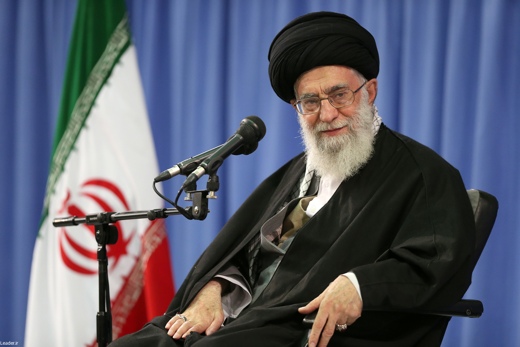
The Supreme Leader supports Article 44. State organizations should help it become a reality. To that end, we have to remove the obstacles standing in the way. Thanks to people’s strong will and close cooperation, the existing problems can become a thing of the past, and sustainable and balanced regional development can come true.

London should take essential stride to broaden cooperation with Tehran: Boroujerdi

Broujerdi

Chairman of parliament’s National Security and Foreign Policy Committee of Alaeddin Boroujerdi said on Tuesday that London should take concrete steps to promote cooperation with Tehran.

Boroujerdi made the remarks in a meeting with Director of Middle East at British Foreign Office Edward Oakden.

Referring to the performance of the British government about Iran in the past, he said London should spare no efforts to clear the negative image about the British government in the mind of Iranian people.

The current stands adopted by London and the economic sanctions orchestrated by the British government over the Iranian nuclear program do not help create a new chapter in relations, he said.

He expressed hope that London would take new strides in order to broaden scope of cooperation between the two countries.

The West has adopted double-standard policy in dealing with global issues as democracy, free elections and the fight against terrorism, he said.

Their negligence of the demand of public opinion in Bahrain and conduct of free election based on international norms and their inattention to the fight against terrorism will leave negative impacts on security and tranquility of the region and the world, Boroujerdi said.

Terrorism posed a potential threat to the security and development of all nations and adopting wrong policies will lead to the escalation of terrorism in the region, he said.

On Syrian developments, he said that refusal to take heed of the Syrian national sovereignty along with support for terrorist groups has created an unbearable situation in Syria which hurts humanity.

Edward Oakden, for his part, called for bolstering mutual relations as well as for a new chapter in Tehran-London ties.

“We are willing to open a new chapter on expansion of mutual relations,” he said.

He expressed hope that nuclear talks between Iran and P5+1 would bear fruit, saying that London will do its best to meet mutual interests.

He further added that London is quite serious in the fight against the IS terrorist group.

Old locks have literally seen better days in Iran (Photos)

Old Lock-21

Iranians were among the world’s top lock makers in the past, producing locks in the form of animals to fill the void created by the absence of sculpture in the country.

Since half a century ago, the lock making craft has been overpowered by the emergence of industrial padlocks.

What comes below is a collection of photos the Islamic Republic News Agency released on March 2 of old locks produced in Kerman, southeastern Iran:

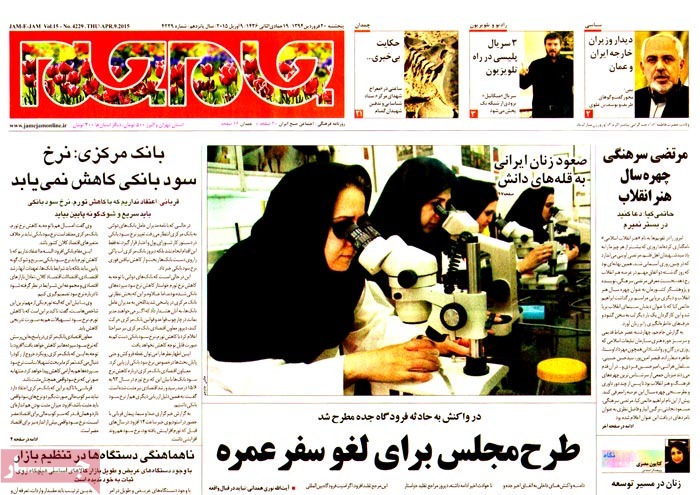
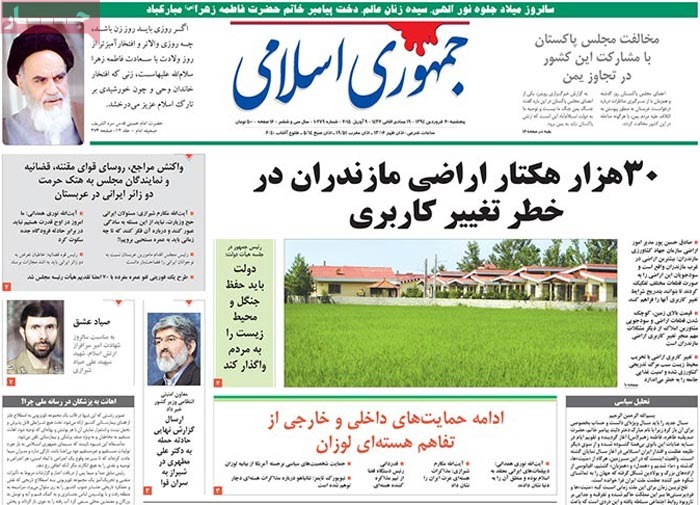
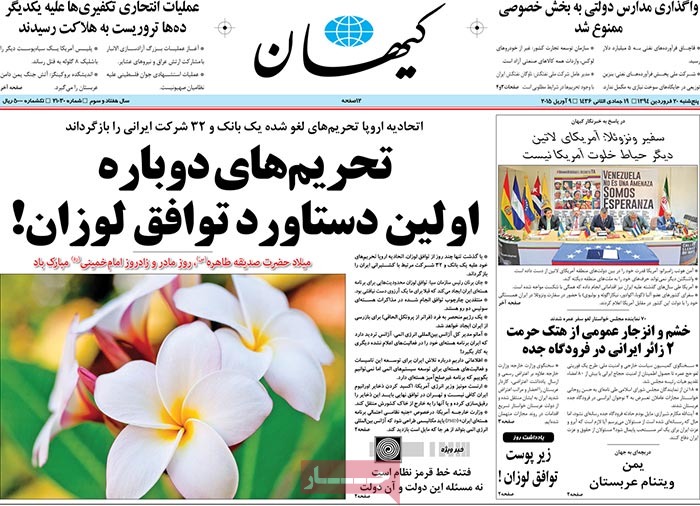
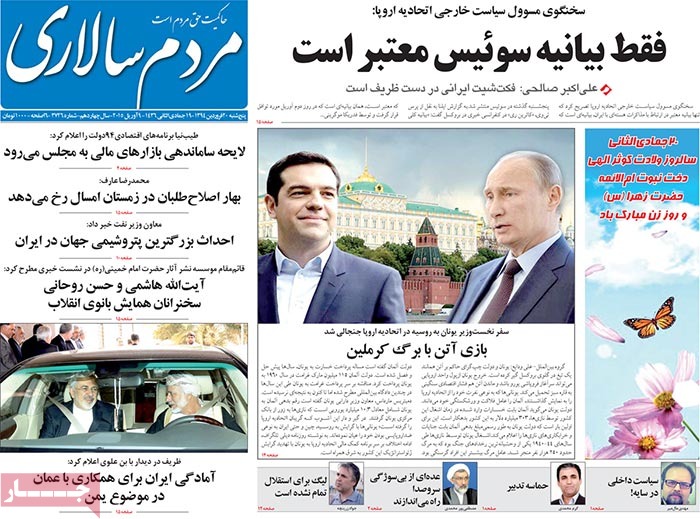
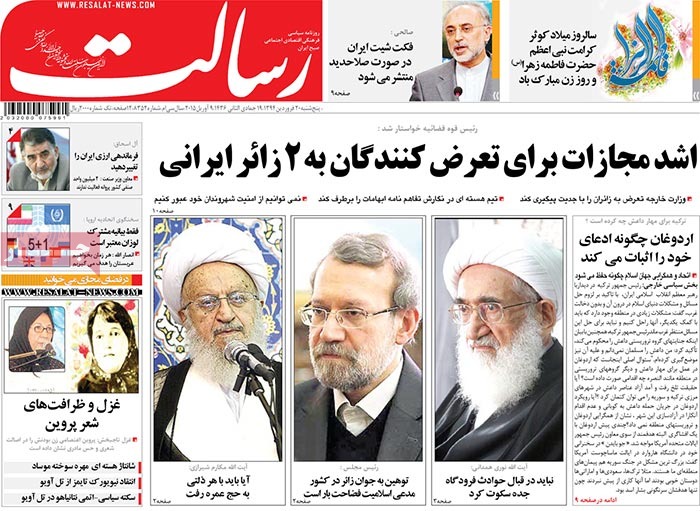
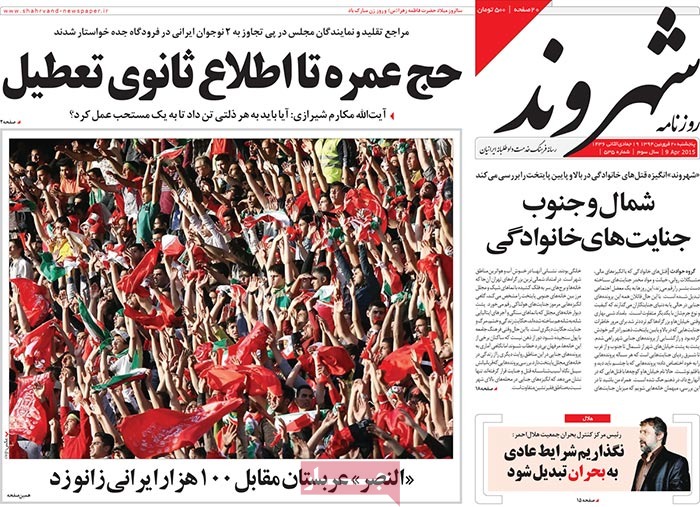
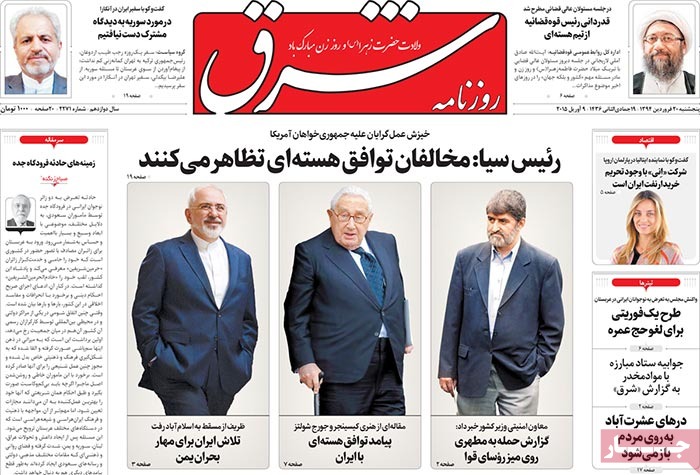
A look at Iranian newspaper front pages on March 4

Iranian Newspapers Headlines

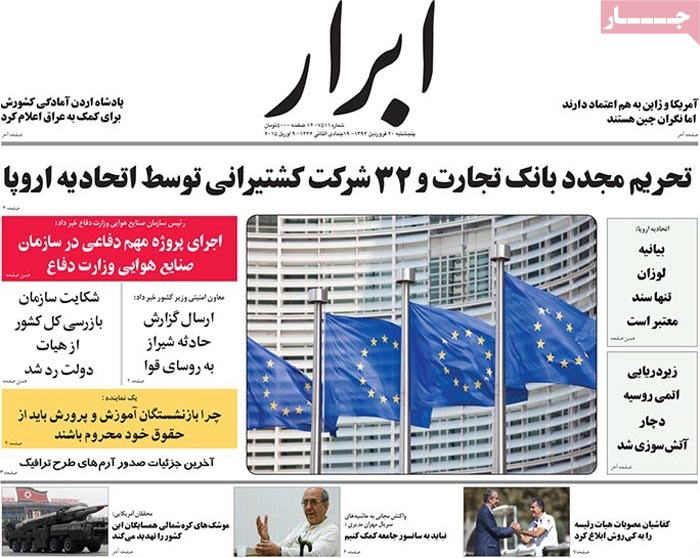
Reaction to the deceptive remarks of Israeli Prime Minister Benjamin Netanyahu in the US Congress where he warned American officials of what he claimed to be a bad deal with Iran dominated the front pages of most Iranian newspapers on Wednesday. Day two of the talks between Iranian and US delegations was also in the headlines. And, reformist-leaning newspapers quoted Chairman of the Expediency Council Ayatollah Hashemi Rafsanjani as criticizing the hardliners at home for their opposition to anything President Rouhani’s administration does.


Abrar: Terrorist defense lines have been shattered in Tikrit, Iraq.


A look at Iranian newspaper front pages on March 4


Afkar: Reports that a senior Oil Ministry official has fled to Canada have been denied.


A look at Iranian newspaper front pages on March 4


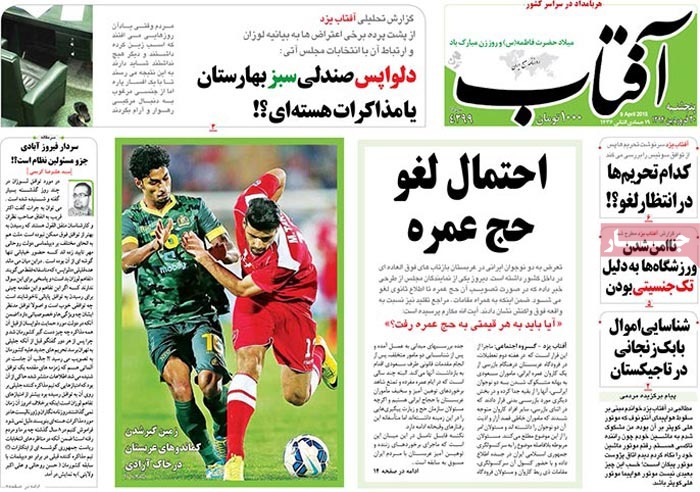
Aftab-e Yazd: Iran’s share of the Turkish market is less than five percent.


A look at Iranian newspaper front pages on March 4


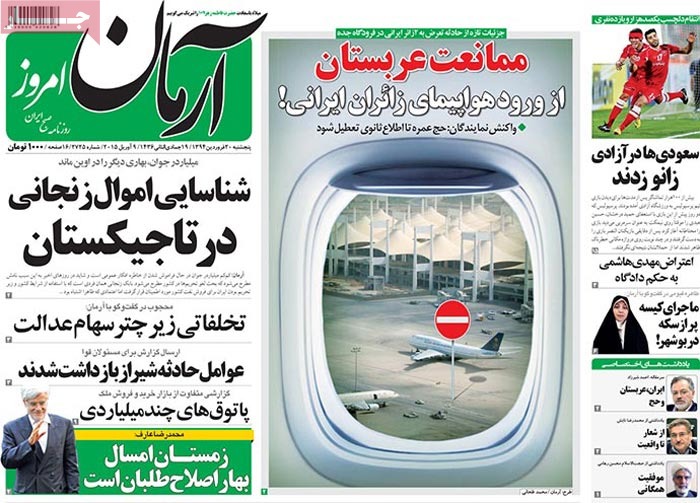
Arman-e Emrooz: Different comments by the spokesman of the Guardian Council

It is possible for candidates who have been qualified before to be disqualified [in upcoming elections].

Arman-e Emrooz: “As for the saddening incident of Kahrizak, we have nothing to say but apologize,” said the police chief.


A look at Iranian newspaper front pages on March 4


Asr-e Rasaneh: “Iran’s daily oil production capacity stands at four million barrels,” said the managing director of the National Iranian Oil Company.


A look at Iranian newspaper front pages on March 4


Ebtekar: “The first round of secret talks between Iran and the US took place when Salehi was in office [at the helm of the Foreign Ministry],” said Hamid Reza Asefi, [a former FM spokesman].


A look at Iranian newspaper front pages on March 4


Emtiaz: The attorney general has said that an investigation is underway into a $2.2 billion loan.

Emtiaz: The amount of fines poachers will have to pay has increased.


A look at Iranian newspaper front pages on March 4


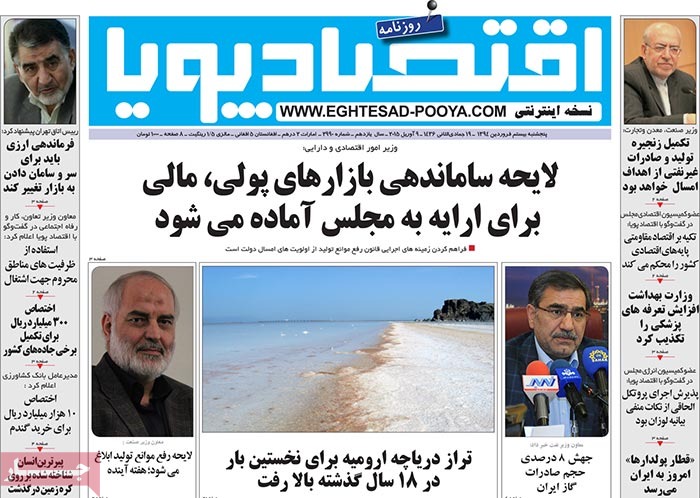
Etemad: Parliament has required the government to cut the cash subsidies of 5.5 million high-income individuals.

The government also has to register any new recipient of subsidies in cash.

Etemad: Efforts are underway to untie the technical knots of [nuclear] talks.

Iran and the US explore ways of pushing the talks forward.


A look at Iranian newspaper front pages on March 4


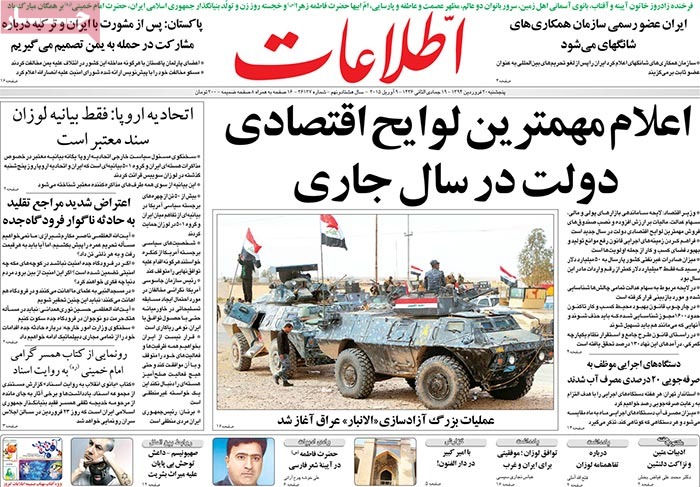
Ettela’at: The US has stopped intelligence cooperation with Israel over Iran’s nuclear program.

Ettela’at: Plans have been made public to stop particulates affecting people’s lives and health across the country.


A look at Iranian newspaper front pages on March 4


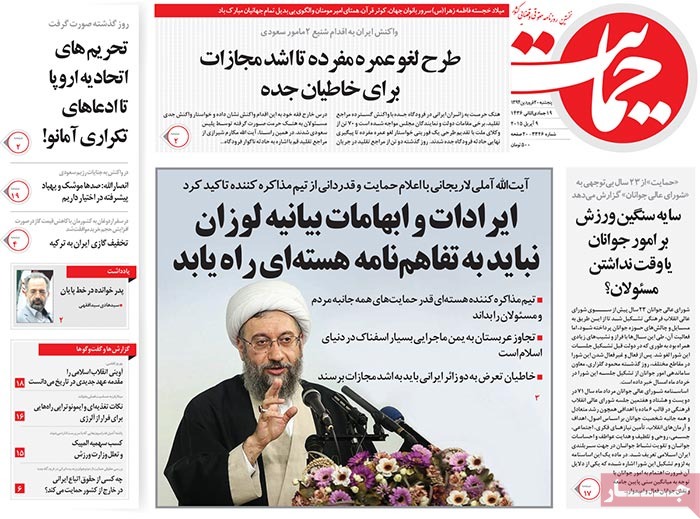
Hemayat: A famous US analyst has said that Iran owes its achievements to “the Genius of its Supreme Leader”.


A look at Iranian newspaper front pages on March 4


Iran: Women have a three percent share of parliament seats.


A look at Iranian newspaper front pages on March 4


Jomhouri Islami: After a second day of talks between Iranian and US delegates, hopes of clinching a nuclear deal have increased.

Jomhouri Islami: Netanyahu has expressed frustration with Iran’s regional and global authority.


A look at Iranian newspaper front pages on March 4


Kaenat: Parliament has wrapped up its review of the budget bill which has now been sent to the Guardian Council for final approval.

Kaenat: World petrochemical giants are poised to work in Iran.


A look at Iranian newspaper front pages on March 4


Kar va Kargar: “Judicial officials have no right to override the permissions issued for music concerts,” said the minister of culture and Islamic guidance.


A look at Iranian newspaper front pages on March 4


Kayhan: The nonsense of a speech Netanyahu delivered [in the US Congress] cost those who were overexcited [about the Geneva deal] a lot.


A look at Iranian newspaper front pages on March 4


Khorasan: Winners of the 28th Kharazmi International Festival have been named.


A look at Iranian newspaper front pages on March 4


Mardomsalari: “Worriers [Ahmadinejad supporters] have joined the Netanyahu chorus,” said the chairman of the Expediency Council.


A look at Iranian newspaper front pages on March 4


Sharq: A committee has been formed to cross out the rich from the list of individuals eligible for cash subsidies.


A look at Iranian newspaper front pages on March 4


Sobh-e Eghtesad: “Sanctions offered an opportunity to rebuild the country,” said the first vice-president.


sohbe eghtesad newspaper


Kharazmi International Award announces winners

Khwarizmi

Director of the Atomic Energy Organization of Iran Ali Akbar Salehi and Prof. Fu-Tong Liu from Taiwan were among winners of a 28th edition of Kharazmi International Award named on March 3.

During the closing ceremony of the Kharazmi International Award which took place on Tuesday, the jury selected seven accomplished foreign researchers as winners of the prestigious award. The winners were awarded by President Hassan Rouhani.

Prof. Fu-Tong Liu for his research on the role of galectins in health and disease; Prof. Claudio Hetz from Chile for targeting protein homeostasis to treat neurodegenerative diseases; and Prof. Andreas Manz from Switzerland for lab on a chip technology for use in analytical chemistry and applied biosciences were the foreign winners.

In the national section, the winners included Dr. Homayoun Kanouni for his studies on cold tolerance on chickpea and nuclear chief Ali Akbar Salehi for his endeavors to launch a nuclear plant to produce radiopharmaceuticals.

In 1987, the leading Iranian Research Organization for Science and Technology (IROST) decided to launch an award to acknowledge the outstanding achievements in the field of science and technology.

IROST proposed the creation of the Kharazmi International Award in memory of Abu Jafar Mohammad Ibn Mousa Kharazmi, the great Iranian Mathematician and Astronomer (770-840 C.E).

During a fifth edition of the festival a foreign section was also launched.

Afkham slams Netanyahu anti-Iran speech at US Congress

Iran-Afkham
Iran-Afkham

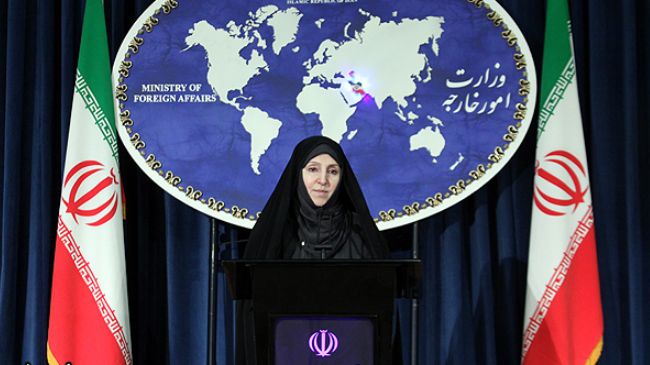
Spokeswoman of the Foreign Ministry Marziyeh Afkham made the remarks while commenting on the anti-Iran address of Benjamin Netanyahu to the US lawmakers which was made coincidentally with the ongoing nuclear talks between officials of Iran and the Gtoup 5+1 in Switzerland.

It was a completely “deceitful show and a part of electoral campaign made by radicals in Tel Aviv,” Afkham said.

She added that Netanyahu’s speech has “indicated his weakness and extreme isolation of the radical groups even among their supporters.

“This is also an effort to impose their radical and irrational agenda on international policy.”

“There is no doubt that the world public opinion gives no value or status to a child-killer regime,” Afkham stressed.

She said ‘constant lying of Netanyahu about goals and purposes of Iran’s peaceful nuclear program is very much boring and not new.’

The policy of Iranophobia has faced serious problems following the continuation of the nuclear talks and due to Iran’s firm intention to resolve the fabricated nuclear crisis. It also led the creators of those crises and propaganda to resort to desperate efforts.

In his address to the US Congress today, the Zionist leader warned them of what he claimed to be making a bad deal with Iran.

However, the White House described his controversial statements as unhelpful.

Shortly after the Israeli prime minister ranted against the ongoing Iran nuclear talks, President Barack Obama told reports that Netanyahu ‘did not offer any viable alternative.”

The US President said there was ‘nothing new’ in Netanyahu’s speech.

Netanyahu trying to have disruptive effect on nuclear talks: Zarif

Zarif-Iran FM

Iran’s foreign minister says the Israeli prime minister is trying to have a disruptive effect on the Islamic Republic’s nuclear negotiations with world powers.

“He’s trying to,” Mohammad Javad Zarif said on Tuesday, asked by the CNN if Benjamin Netanyahu was trying to have such effect on the talks.

“But I don’t think trying to create tension and conflict helps anybody,” the Iranian top diplomat noted.

Also on Tuesday, Netanyahu addressed the US Congress, calling on the United States not to negotiate “a very bad deal” with Iran over its nuclear energy program. He said, “We’ve been told for over a year that no deal is better than a bad deal. Well this is a bad deal, a very bad deal. We’re better off without it.”

Iran and P5+1 – Russia, China, France, Britain, the US and Germany – are negotiating to narrow their differences over the Islamic Republic’s nuclear energy program ahead of a July 1 deadline.

Netanyahu said that it is not true that “the only alternative to this deal is war.”

“The alternative to this deal is a much better deal. A better deal that doesn’t leave Iran with a vast nuclear infrastructure and such a short breakout point,” he added.

He said that the ongoing nuclear negotiations would provide Iran “with a short breakout time for a bomb.”

“According to the deal not a single nuclear facility would be demolished,” he said.

“So this deal won’t change Iran for the better, it will only change the Middle East for the worst,” he noted.

US President Barack Obama said there was “nothing new” in the speech.

He told reporters that Netanyahu “did not offer any viable alternative.”

Speaking to reporters in the Swiss city of Geneva on Tuesday, EU foreign policy chief Federica Mogherini warned against “spreading fears” about a final nuclear deal that is being negotiated by representatives from Iran and the six states.

“Spreading fears is not helpful at this stage,” Mogherini told reporters, adding, “We are getting closer” to a comprehensive accord aimed at ending the longstanding dispute on Tehran’s nuclear dossier.

Reflecting on the talks, Zarif also said “we’re starting to move forward, but it’s a lot of work.”