Tuesday, December 23, 2025
Home Blog Page 4904

Afkham: Recent vote not to change Israel aggressive policy

Ms. Marzieh Afkham

Iran says it expects no change in Israel’s policies following the recent general elections since all the regime’s parties follow the same aggressive approach.

Speaking at her weekly press conference on Wednesday, Foreign Ministry Spokeswoman Marzieh Afkham said that the Israeli parties all have an “aggressive nature.”

“The Israeli parties are the same and they are all accomplices in crimes against the Palestinians and in the acts of aggression,” she added.

Israeli Prime Minister Benjamin Netanyahu’s Likud party has claimed victory in Tuesday general elections.

With nearly all the votes counted, the Likud party has now secured 30 seats in the 120-member parliament.

Afkham described the latest round of talks on Iran’s nuclear program as “very intensive, sensitive and complicated” and noted the Iranian negotiating team is seeking to bridge differences in the negotiations.

“We have also made good progress on the technical aspect and as the head of the Atomic Energy Organization of Iran (AEOI) said in an interview, a great number of technical issues have been settled and the talks are still going on over political issues as well as sanctions,” Afkham said.

The latest round of talks on Tehran’s nuclear program kicked off in Lausanne on Sunday. The negotiations are led by Iran’s Foreign Minister Mohammad Javad Zarif and US Secretary of State John Kerry.

On Wednesday, Ali Akbar Salehi, the head of the AEOI, and US Energy Secretary Ernest Moniz resumed their talks on technical issues in Lausanne.

Iranian Deputy Foreign Ministers Abbas Araghchi and Majid Takht-e Ravanchi were also scheduled to sit down with US Under-Secretary of State for Political Affairs Wendy Sherman later in the day.

On Tuesday, Salehi said that Tehran and Washington have resolved their differences over 90 percent of the issues in the talks.

“We have reached mutual understanding on 90 percent of technical issues,” Salehi told IRIB news, adding that “there remains only a single sticking point, which is very important.”

Iran and P5+1 – the United States, Britain, France, China, and Russia plus Germany – are seeking to seal a comprehensive nuclear deal by July 1.The two sides have already missed two self-imposed deadlines for inking a final agreement since they signed an interim one in the Swiss city of Geneva in November 2013.

Foreign Minister Zarif named Iran’s man of the year

Mohammad Javad Zarif

Foreign Minister Mohammad Javad Zarif has been named Iran’s man of the year [starting March 21, 2014], a poll showed.

In an online poll conducted by Tabnak, a news website, Foreign Minister Zarif garnered more than 50 percent of the votes. He was followed by commander of the IRGC Quds Force Major General Ghasem Soleimani, who secured over 28 percent of the votes.

Tehran MP Ali Motahari and Health Minister Hassan Ghazizadeh Hashemi came in third and fourth respectively.

The online survey also suggested that those polled believed that interaction with the rest of the world and struggle for the sake of Iran – when necessary – are the country’s top priorities.

President Hassan Rouhani, Chairman of the Expediency Council Ayatollah Akbar Hashemi Rafsanjani, a former science minister Reza Farajidana and Iranian mathematician Maryam Mirzakhani finished fifth through eighth in the online polling.

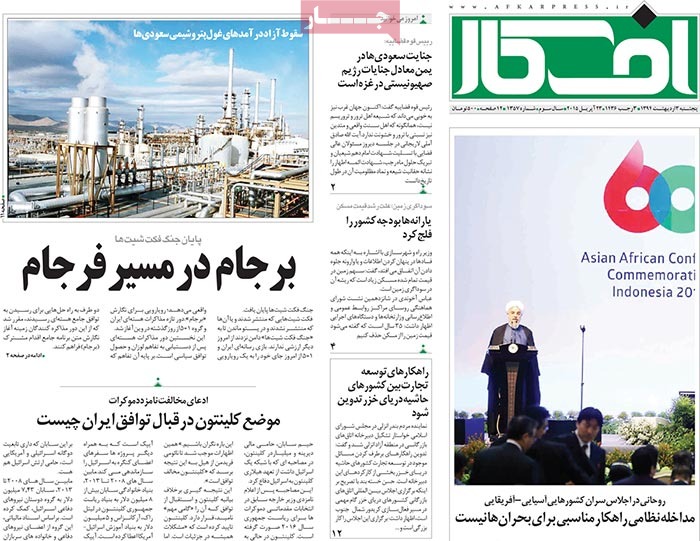
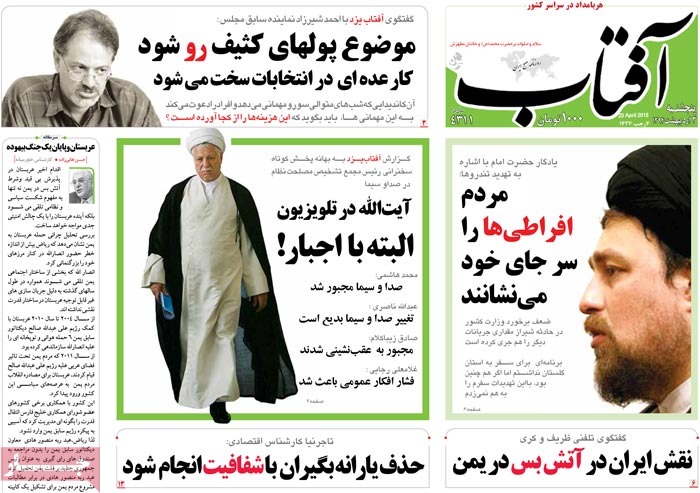
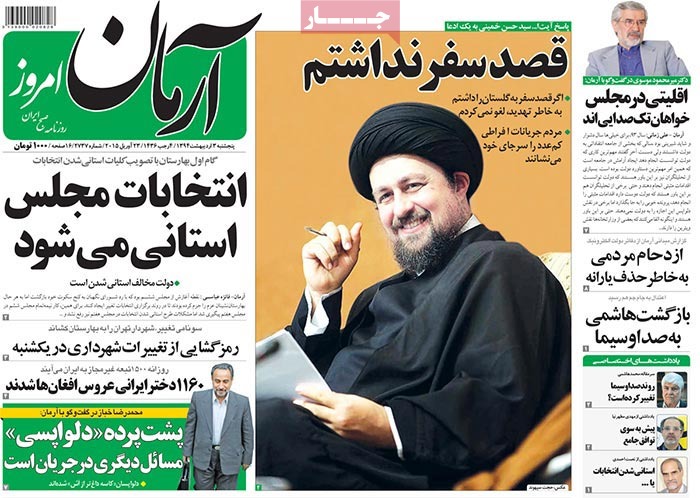
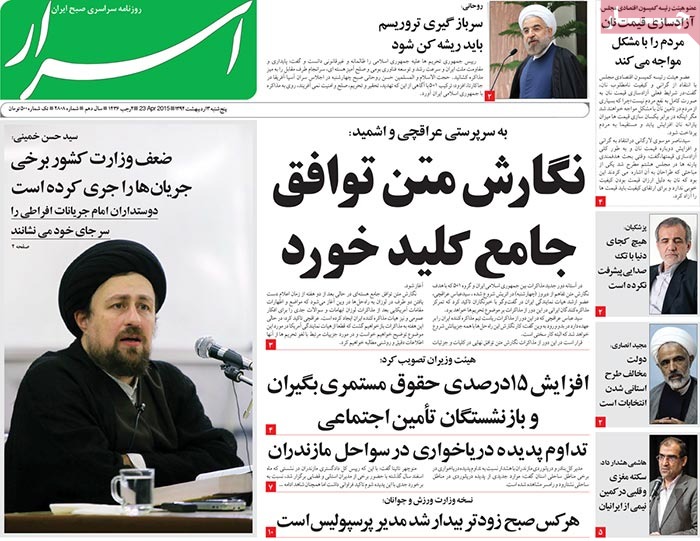
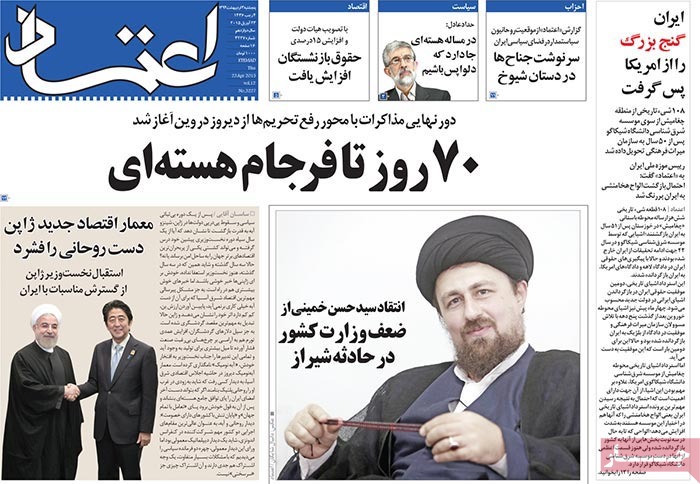
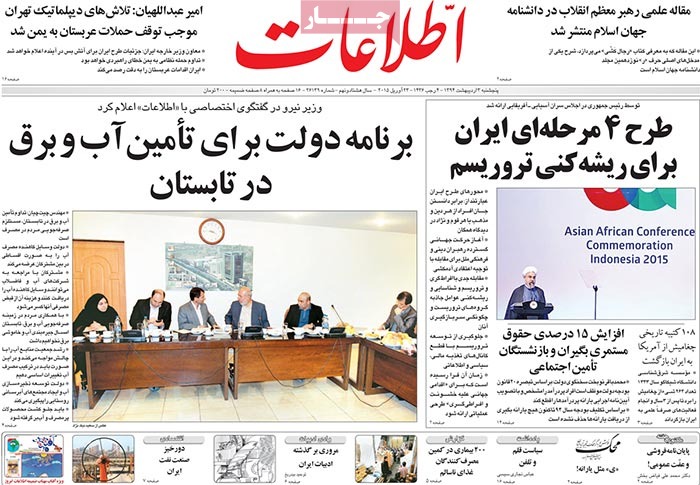
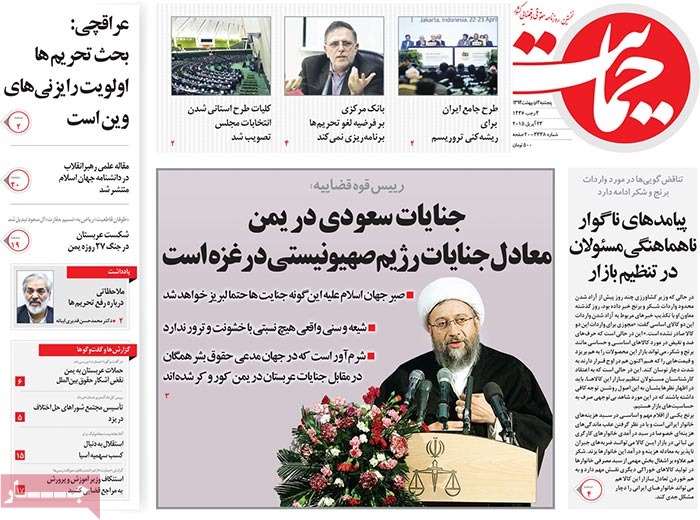
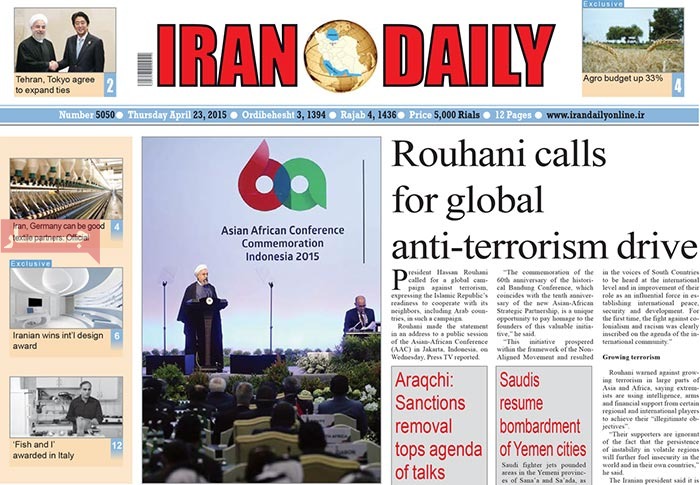
A look at Iranian newspaper front pages on March 19

Iranian Newspapers Headlines

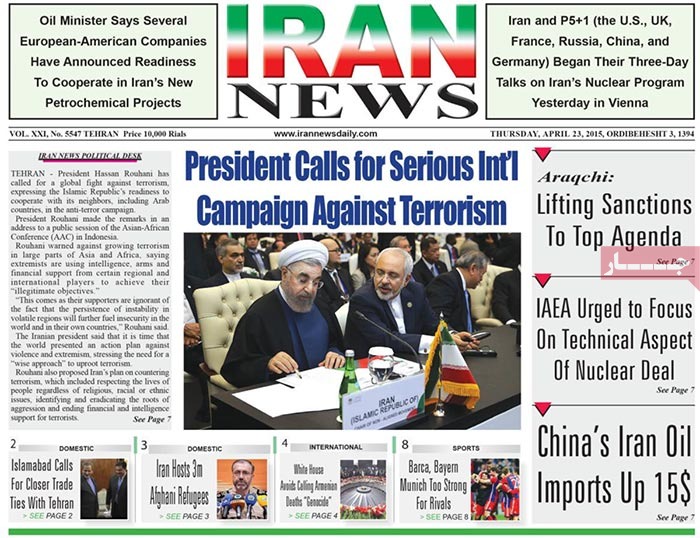
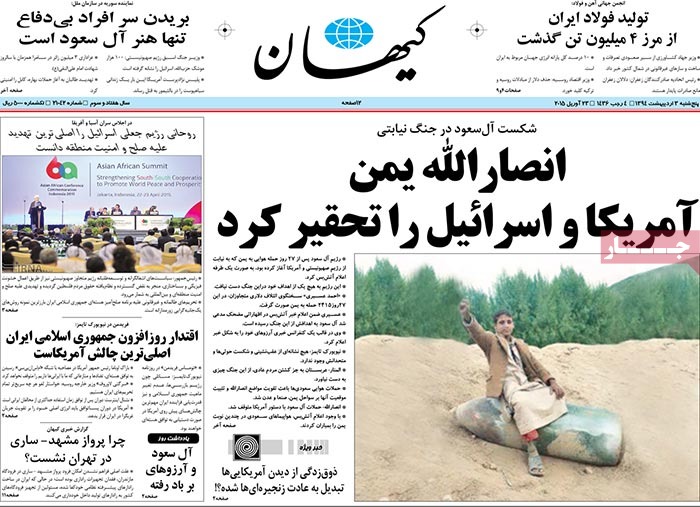
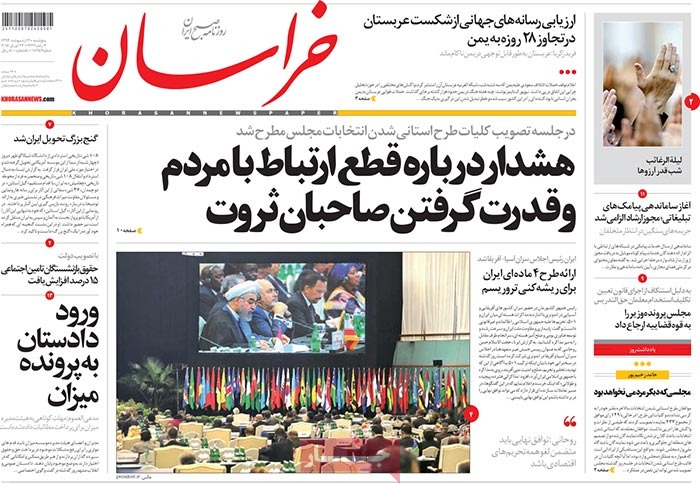
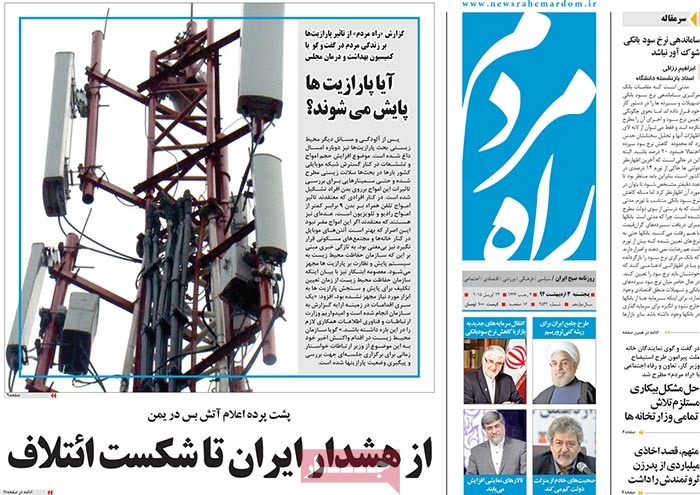
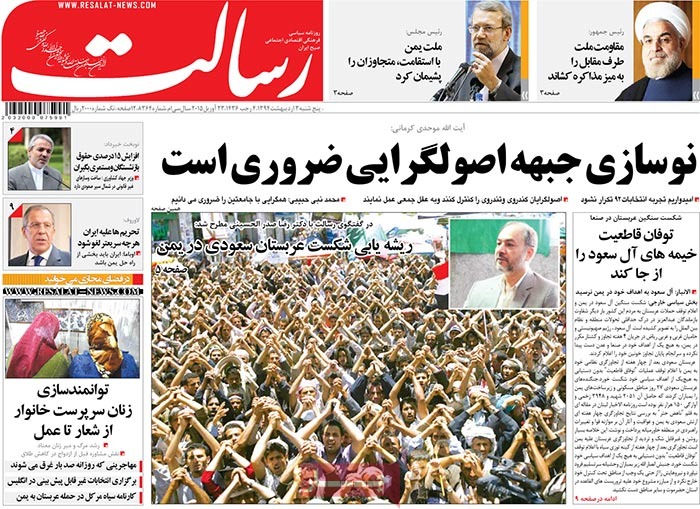
President Rouhani’s review of the performance of his government over the last 12 months and his promise of a better year ahead dominated the front pages of Iranian newspapers on Thursday. Continued nuclear talks and comments by Foreign Minister Zarif about them also appeared on the cover of dailies.


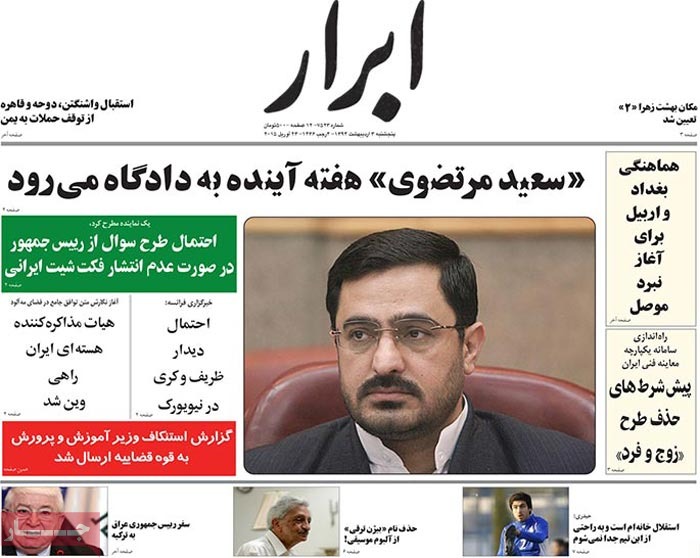
Abrar: The Foreign Ministry says it hopes [Saudi Arabia] will resume issuing visas for Iranian Hajj pilgrims.

Abrar: “Foreign ministers of P5+1 are unlikely to get together [for this round of talks],” said Iranian Foreign Minister Mohammad Javad Zarif.

A look at Iranian newspaper front pages on March 19


Afarinesh: The intelligence minister has said that rendering economic and cultural stability sustainable will be one of the priorities of his ministry next year.

A look at Iranian newspaper front pages on March 19


Aftab-e Yazd: A note by Hashemi Rafsanjani for the people

“Anytime we acted on the demands of the majority, we got closer to moderation and better advanced the cause of our revolution,” said the chairmen of the Expediency Council in the note.

A look at Iranian newspaper front pages on March 19


Arman-e Emrooz: Eventual agreement

The president’s prudence in talks with P5+1 will finally bear fruit.

Arman-e Emrooz: Thirty-eight political figures weigh in on the performance of the Rouhani administration

A look at Iranian newspaper front pages on March 19


Asrar: The minister of industries has said that Iran managed to push up non-oil exports by 22 percent even if the Islamic Republic was under sanctions.

Asrar: “Interaction with the rest of the world is a national and Islamic necessity,” said the chairman of the Expediency Council.

A look at Iranian newspaper front pages on March 19


Etemad: “Non-oil exports brought in some $50 billion in revenues this year,” said President Hassan Rouhani.

A look at Iranian newspaper front pages on March 19


Ettela’at: “Iran’s oil production won’t be less than its share of OPEC output,” said Iranian Oil Minister Bijan Namdar Zanganeh.

Ettela’at: Value added tax will stand at 9 percent next year.

A look at Iranian newspaper front pages on March 19


Hemayat: Ali Younesi [an adviser to President Rouhani] has been arraigned at the Special Court for the Clerics.

A look at Iranian newspaper front pages on March 19


Jomhouri Islami: President Rouhani has talked about the achievements of his government this year and promised a better year ahead.

A look at Iranian newspaper front pages on March 19


Mardomsalari: The secretary of the Supreme National Security Council has warned of factional approaches undermining the public in the future elections.

Mardomsalari: Anti-austerity protests at the opening of a new ECB (European Central Bank) headquarters have turned violent.

A look at Iranian newspaper front pages on March 19


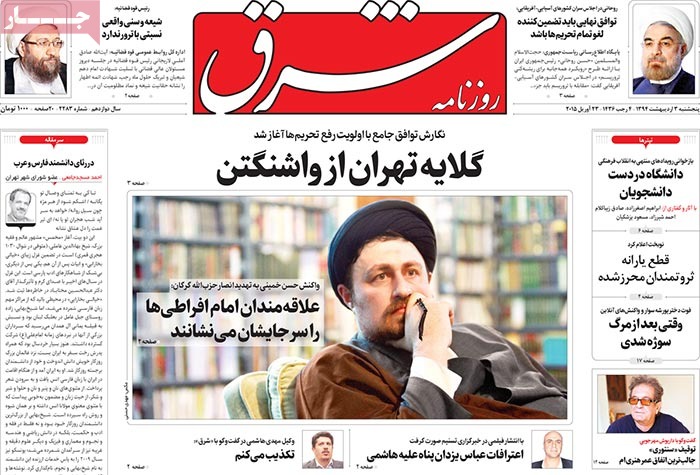
Sharq: “An agreement is unlikely to happen within a couple of days,” said Foreign Minister Mohammad Javad Zarif.

A look at Iranian newspaper front pages on March 19


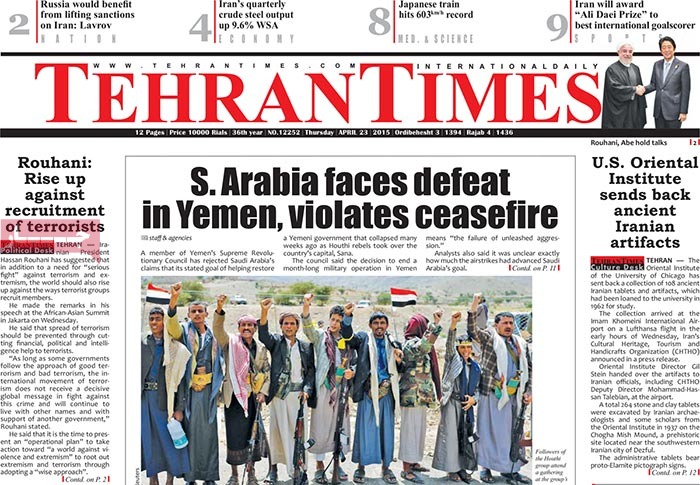
Tehran Times: Artists from 12 countries team up to celebrate Nowruz in Berlin.

A look at Iranian newspaper front pages on March 19


Zarif: Nothing resolved for nuclear deal till everything resolved

Zarif

Iranian Foreign Minister Mohammad Javad Zarif says to secure a comprehensive agreement on Iran’s nuclear program all issues pertaining to the program should be resolved.

“[…] We have said that nothing is resolved until everything is resolved,” Zarif told reporters in the Swiss city of Lausanne on Wednesday ahead of his announced talks with US Secretary of State John Kerry.

The remarks by the Iranian minister came as representatives of Iran and the US are currently holding talks on Tehran’s nuclear program in the Swiss city.

“We have made more progress on some of the issues and we have made less progress on others,” Zarif said, adding, “I think the most important element required is the political will to reach an agreement.”

“If that (the political will) is there, we can reach an agreement,” he added.

We have come to very detailed issues in the nuclear talks, Zarif noted, adding that there remain “important differences” on Iran’s nuclear program and the aim of the talks is to remove the sticking points.

“[The two sides are] close to mutual understanding on certain issues, but not as close to mutual understanding on some other issues. Anyway, as we have said from day one, nothing will be agreed upon until everything is agreed upon,” Zarif stressed.

Referring to the participation of the foreign ministers of P5+1 in the current round of the talks, Zarif said, “They might come”, but at the current level of the talks their participation is not necessary.

Zarif, Head of the Atomic Energy Organization of Iran (AEOI) Ali Akbar Salehi, Zarif’s deputies Abbas Araghchi and Majid Takht-e Ravanchi, special assistant to Iran’s president Hossein Fereidoun, US Secretary of State John Kerry, US Energy Secretary Ernest Moniz, and US Under Secretary of State for Political Affairs Wendy Sherman as well as European Union deputy foreign policy chief Helga Schmid were present in the second round of the talks between Iran and the US on Tuesday afternoon.

The latest round of negotiations about the Iranian nuclear program kicked off in the Swiss city on Sunday with Salehi and Moniz holding high-level technical talks. Experts from Iran and the US as well as AEOI spokesman Behrouz Kamalvandi also participated in the meeting.

Speaking after his five-hour meeting with Kerry on Monday, Zarif said solutions to outstanding nuclear issues with P5+1 are at hand although differences still remain between the two sides.

“We are closer to a solution in some cases and it can therefore be said that solutions are at hand, but in some cases solutions are still elusive,” the chief Iranian negotiator said.

Iran and P5+1– the United States, Britain, France, China, and Russia plus Germany – are seeking to seal a comprehensive nuclear deal by July 1.

In an in-depth interview Rafsanjani talks politics, past and present (PART TWO)

Hashemi Rafsanjani

Chairman of the Expediency Council Ayatollah Akbar Hashemi Rafsanjani has said although President Rouhani’s administration is in conditions tougher than those of his own government that took office after the end of the Iran-Iraq war in the 1980s, the performance of the Rouhani administration is satisfactory.

The following is part two of the translation of an exclusive interview Arman-e Emrooz daily’s Hossein Abdollahi conducted with the top councilor. The interview was published by the newspaper on March 15.

In the past you leveled criticisms at Iran’s Syria policy. Are those criticisms still in place or they are gone thanks to recent developments?

They date back to the time when terrorism was not an issue. People would pour onto the streets after Friday prayers to voice their demands. I said the government shouldn’t overreact. I think people have the final say. I know about that region. I knew that Israel and the US, which were not satisfied with the Syrian stance, would not sit idly by. The Syrian government should have gotten along with people from the start.

Then terrorists found their way to Syria and resorted to violent acts; up to 300,000 people were killed, millions were displaced, the Syrian economy was left in tatters and parts of Syria were captured by ISIL. Conditions now are different from back then.

In Libya, a military man who had staged a coup was running the country. He was a dictator but his people had welfare. When he was toppled, everything was sent tumbling down. What did happen to Libya? Terrorists splintered the country.

People in Egypt – a country with an ancient, advanced civilization – launched a revolution, but terrorists made people regret what they did. […] Now things have changed because of terrorists. I was suggesting back then that Mr. Assad meet people’s demands such as political freedom.

Arab Awakening did not end as expected.

Awakening is a fact. It is a fact that thanks to information superhighway people can learn about what happens elsewhere in the world. The youth, especially in Islamic nations, have woken up; unlike the old, young people are not content.

In Tunisia, a street vendor acted as a catalyst for a big revolution which toppled the government, and then the same process spilled over [into other countries]. The domino started to fall afterward. People were all ready and what followed was the result of [their] awareness.

What they call Arab Spring is described as “Islamic Awakening” here. The difference in terms is not important; what matters is the fact that Muslim people, especially the youth, were unhappy with their governments. Arab nationalism, which was also evident in their measures, was on the fast-track. Right there some people dropped their middle-of-the-road approach and went too far, and this set the stage for terrorists. In fact extremism was quite uncalled for.

Terrorists fished in troubled waters, taking up arms and sabotaging things. Like what happened in Iran following the victory of the revolution; members of several armed groups that were serving time in prison, such as MKO and Fadaian [caused trouble in the country]. They wreaked havoc for two years and Iran paid a heavy price.

If we had not acted properly, some places such as Kurdistan, Turkmen Sahra, Baluchestan and even Khuzestan would have seceded from Iran. In those tough two years we had the Imam who would put out a fire with a single sentence.

Other countries in which [Arab Spring] revolutions took place, did not have a leader like the late Imam to take charge of the affairs. Of course, before the establishment of a new system, disorder is the order of the day after every revolution. There are people within a revolution who have acquisitive demands. […] The country’s production decreases following every revolution; so do foreign arrivals, like what happened in Egypt. Foreigners, the Americans included, instigated [disorder] because they didn’t want to see the collapse of a despot.

Despotism and colonialism always work together. The former cannot live on without the support of the latter. Colonialism cannot stay in a country without the help of despotic elements. People cannot remain indifferent to foreign forces which plunder their wealth. […] A despot was toppled and the US saw the overfunded Palestinian peace plan slip through its fingers.

Things lasted a few days, revolutionaries were imprisoned and the military men returned [to power]. Trials were held, [former dictator Hosni] Mubarak was freed and President Mohamed Morsi of the Muslim Brotherhood was put in jail together with thousands of people.

This is the problem the Islamic Awakening is faced with. This is a real problem. Despotism, colonialism and terrorism – three lines of a triangle – pose the gravest threat to revolutions. This is a lesson the youth should be taught. They should know they shouldn’t turn full circle.

Over the past 35 years, you got a name for yourself supporting friendly ties with Saudi Arabia. Riyadh has always tried to create problems for Iran. In the past, it armed Saddam against Iran; now it is interfering with the nuclear case, and supports regional hostility toward Iran and killing Shiites in Iraq, Syria, Yemen, Lebanon, Afghanistan, Pakistan and other places. What’s your plan for changing the Saudi enmity to cooperation in the region, something which could be acceptable to the critics of Iran-Saudi ties?

Before the revolution, most of the Arab countries in the Persian Gulf were Iran’s protégés. They would act the way the Iranian government and royal court wanted them to. The Islamic Revolution put an end to this. In the early days of the revolution, different people made stern comments which frightened the Arab countries. They tried to take revenge and the result was the [Iran-Iraq] war. Although Saddam waged the war, they funded his war machine which was too costly for Iraq to sustain.

[Before the revolution] Iran was a paradise and a safe haven for colonial governments. Government officials and their families would come to Iran and do whatever they wished. […] They would buy Iran’s oil, deposit the money in an account and then sell arms to Iran. Part of that money is still overdue.

After the revolution, we learned that Iran had inked key arms and non-arms deals with Germany, France, Britain and Russia. These countries were opposed to the Islamic nature and slogans of Iran and didn’t want to let Iran become independent, let alone become a rival for them in science and technology.

They [colonial states] had a hostile attitude [toward Iran] and the Arabs did not want Iran to worry them. They waged the war, thinking that even if they fail to crush the revolution, they can at least take Khuzestan and that would not allow Iran to breathe easily.

When we launched Operation Karbala-5 in Faw, they were all concerned that Iran could defeat Iraq. It was a great job to cross Arvand Rud. […] During the operation, Iranian forces managed to break the Iraqi defense lines and capture the island. They realized that Iran’s ground power is much stronger than Iraq’s. Then they broadened their support [for Iraq].

Gradually the conditions on the battlefield and behind the frontlines led Iran to accept Resolution 598. Iran’s acceptance of the resolution was not out of weakness. Iraq thought it showed Iran’s weakness, so it re-launched attacks on Iran. MKO [terrorists] targeted Iran from the north and the Iraqis from the south. The MKO had designs on Tehran, and Iraqis were mounting attacks on Khuzestan.

The defense the Iranians put up defeated them all. They realized that military power is not the only thing that mattered. If Iran senses a danger, all Iranians will turn up [for defense]. As for the resolution, we all behaved in a way that was a sign of political wisdom. When the resolution took effect, Iran’s international might was put on display. Iran didn’t have many supporters at the UN. What happened that they [the UN] identified Iraq as the aggressor? They were supporting Iraq in the war, but Iran was the winner from political and military angles. […]

After the resolution, the Arabs were afraid.  

Arab countries thought Iran would take revenge. Iran was put to the test in the Kuwaiti war, something which took the Arabs by surprise. How much did the Kuwaitis help Saddam? When Saddam attacked Kuwait, they saw Saddam’s true colors! What did we do? Iran opened its borders to the Kuwaitis who were escaping the war. Around 10,000 cars full of Kuwaitis came to Iran and were treated kindly. This proved Iran was not about to take revenge.

There were people in parliament who said that Iran had to fight alongside the Iraqis against the US. This was the result of the war-related grudges they held. […] Thanks to the situation created after the formation of the postwar government, Iran overcame the hurdles and they turned into our friends.

How is the situation now? The Arabs saw Iran’s good intentions and started to have interaction with Iran. The interaction, which was initiated in part by your government, continued later. Now Saudi Arabia is interfering with Iran’s efforts in some cases. Is there an integrated view in the establishment to help solve the issue Iran has with Saudi Arabia? Or the worries are still in place?

In Ahmadinejad’s government, certain issues made them [Saudis] concerned. At that time, I had a trip to Saudi Arabia to take part in an Islamic conference which opened with my speech. Before my departure, people representing the Supreme National Security Council came to me and asked me to solve the issues Iran had with Riyadh. They [the government] felt that it was necessary.

During my meetings there, including lengthy talks with King Abdullah and several people of his inner circle, such as Prince Muqrin, who is now the crown prince, and Saud bin Faisal, I – accompanied by Mr. Nouri Shahroudi who was a one-time ambassador to Riyadh – worked out a good solution.

We decided to set up seven committees for domestic issues as well as ideological questions over which we had differences. I told them, ‘You are under the pressure of Wahhabism and hardliners, and we have problems of our own. The Shiites too have issues to raise. Let us form a committee of clerics – those who hold sway among people – to solve these issues’. We decided to form committees for areas we had differences over, for example, one for Syria, one for Lebanon, one for Iraq, one for Afghanistan; there were seven joint committees.

We wanted to settle the existing issues. They welcomed it and the differences were solved despite marginal issues. I brought those proposals and agreements to Tehran, but the government was the first one which started to show opposition.

Mr. Mottaki, who was foreign minister then, made a trip to Saudi Arabia after me and told reporters, ‘Mr. Reyshahri, the Leader’s representative, has been mistreated at the airport’. I heard his words on the radio on my way to the office. I was shocked.

I asked Mr. Reyshahri about the incident and he said that he had been treated very respectfully [in Saudi Arabia]. I asked him to deny the report and he did so. Part of his denial was broadcast by IRIB. This showed that they [government officials] didn’t want to see Iran and Saudi Arabia have good ties.

King Abdullah had said, ‘Do not make me deal with that man (Mr. Ahmadinejad). Let me deal with the leader. Our foreign ministers can implement it [what we have decided] and we will become personally involved, if necessary.’
The Supreme Leader did not accept it. He said that it was the job of the government and that he would not bypass the government. The Leader was right, but they [the Saudis] knew about the then Iranian government. Following my trip, Saud bin Faisal came to Iran and held meetings with Mr. Velayati, but political obstructionism stood in the way.

Did you tell the Supreme Leader about those committees? If yes, did he accept the formation of those committees?

No the leader had not told me anything on that before. The Supreme National Security Council had asked me to do that and I reported to it. The council said that it could be implemented, but it is up to the government to take care of it. The council did not want to meddle in the areas the government was responsible.

Now the eleventh government is trying to pursue the committees. Haven’t you stepped forward to do something in this regard?

They [the Saudis] have no problem with the Rouhani administration. Mr. Rouhani had a trip to Saudi Arabia where he held hours-long talks with [Prince] Nayef and inked an agreement. The Iranian president has been treated well. He was respectfully treated during the trips he accompanied me to Saudi Arabia.

This time around, it seems, the Iranian government has taken a step and they [the Saudis] have rejected the offer. For instance, Mr. Rouhani was to write a letter, but they said the letter should be submitted by the Iranian forging minister to his Saudi counterpart, not to the king. They thought that Iran was likely to be under pressure. Anyway, the Iranian government sought to take a step forward and put forth some proposals, but they did not welcome it.

Economic woes have yet to go away: President Rouhani

Rouhani-Government

“The public is still wrestling with problems, but statistics show that substantial achievements have been made mainly as a result of efforts by the public,” President Hassan Rouhani was quoted by Mehr News Agency as telling reporters on March 18.

As for the volume of exports, he said non-oil exports brought in some $50 billion over the last 12 months.

The president added, “In terms of development projects, we did not initially think we could allocate $10 billion to such projects in the year-ago period, but we did and that was noticeably higher than previous years.”

On efforts by the Health Ministry, the president said some eight million people were offered medical insurance in the past 12 months.

The president hailed measures taken to protect the environment and said, “In the year-ago period Tehran had 44 more clean days than last year.”

The president hoped the Iranians will have safe holiday trips and asked the public to comply with traffic rules and protect the environment.

A look at Iranian newspaper front pages on March 18

Iranian Newspapers Headlines

Inauguration of Phase 12 of South Pars gas field and President Rouhani’s comments at the opening ceremony that his administration has delivered on its promises and that sanctions do not work in eroding the hope and prudence of the nation dominated the front pages of Iranian newspapers on Wednesday. Also in the news were comments by Foreign Minister Zarif and nuclear chief Ali Akbar Salehi about progress in talks with P5+1 on the nuclear issue.


Abrar: Ali Younesi [an adviser to President Rouhani] has been summoned to the Special Court for Clerics [for making controversial comments].


A look at Iranian newspaper front pages on March 18


Aftab-e Yazd: Arrest warrants have been issued for assailants who attacked Tehran MP Ali Motahari in Shiraz last week.

Aftab-e Yazd: Nine people have been arrested in connection with the distribution of fake Avastin [a drug injected into the eye to slow vision loss].

Aftab-e Yazd: Iran’s gross domestic product is expected to go up by $53 billion.


A look at Iranian newspaper front pages on March 18


Arman-e Emrooz: “We will eventually reach a deal,” said Iranian Foreign Minister Mohammad Javad Zarif of nuclear talks between Iran and P5+1.

That comment came as Iranian nuclear chief Ali Akbar Salehi said 90 percent of technical differences has been settled.

Arman-e Emrooz: “IS terrorists had plans to invade [western Iranian cities of] Ghasr-e Shirin, Soomar and Naft Shahr,” said the commander of the ground troops of the Iranian Army.


A look at Iranian newspaper front pages on March 18


Asrar: “The results of government measures [on the economic front] will come to surface next year [starts on Saturday March 21]” said the minister of economy and financial affairs.


A look at Iranian newspaper front pages on March 18


Ebtekar: Well-known political commentator Sadegh Zibakalam has said a nuclear deal [between Iran and P5+1] will definitely be clinched in Farvardin [Iranian month that ends on April 20].


A look at Iranian newspaper front pages on March 18


Emtiaz: The governor of the Central Bank says efforts will be made to push inflation down into single digits.


A look at Iranian newspaper front pages on March 18


Etemad: A political deal is one step away.

On day three of talks solutions came within reach.


A look at Iranian newspaper front pages on March 18


Ettela’at: Wi-Fi is to become available in public places.

Ettela’at: “The international community welcomes understanding and interaction with Iran,” said the president’s chief of staff.

Ettela’at: “Talks have been satisfactory,” said Foreign Minister Zarif after negotiations with his counterparts from P5+1.


A look at Iranian newspaper front pages on March 18


Hambastegi: “Times are gone when pressures could be brought to bear through sanctions,” said President Hassan Rouhani at the inaugural of Phase 12 of South Pars gas field.


A look at Iranian newspaper front pages on March 18


Hemayat: The stock exchange lost 3,500 points in the final Tuesday of the year.


A look at Iranian newspaper front pages on March 18


Jomhouri Islami: President of the Iraqi Kurdistan Region Masoud Barzani has said that Iran plays a positive role in Iraq.


A look at Iranian newspaper front pages on March 18


Kayhan International: Biggest South Pars project comes on stream


A look at Iranian newspaper front pages on March 18


Tejarat: The mining sector posted 10.7 percent growth in the last 12 months


A look at Iranian newspaper front pages on March 18


Sanctions do not erode hope and prudence: President

The Iranian nation is walking down the path of self-reliance, economic independence and knowledge-based progress which are the building blocks of the resistance-based economy, President Hassan Rouhani told reporters Tuesday after the inauguration of Phase 12 of South Pars gas field.

The following is a partial translation of the president’s comments as reported by the website of the presidential office:

In comments aimed at P5+1, the president said inauguration of a megaproject like Phase 12 of South Pars shows that sanctions were not the reason why Iran decided to sit at the negotiating table. [If sanctions had been effective] Such great projects would not have come on stream. We managed to complete these great projects when we were subjected to sanctions.

The president admitted sanctions created some problems for the country, but said they were unable to interfere with its overall progress. “The reason why we agreed to hold talks was to serve everyone’s interest. Conclusiveness of the talks would serve the interests of the region, P5+1 and the entire world.”

President Rouhani further said, “Inauguration of this project proves to the world that gone are the times when sanctions and pressures were effective on the international stage.”

Later at a gathering of oil and gas industry officials, the president said his government pins hope on no one other than God and members of the public and that sanctions do nothing to erode hope and prudence.

He said local experts have implemented the better part of the project on their own and that when foreign contractors stopped honoring their end of the bargain, Iranian experts pitched in and picked up the work where it was left off by foreigners.

President Rouhani said he has told leaders of five countries engaged in talks with Iran over the nuclear issue that sanctions are illegal and against human rights principles.

In conclusion, he said nuclear talks will produce results sooner or later.

Fatemeh Motamed-Arya joins campaign to help the homeless

Fatemeh Motamed Arya

Iranian artistsFatemeh Motamed-Arya, a well-known Iranian stage and screen actress, has offered the “most prestigious award” she has won for her part in Gilaneh from the International Resistance Film Festival to a campaign to build shelters for the homeless.

Khabaronline, a news website, reported on Tuesday that Motamed-Arya is the third Iranian artist who has joined the campaign launched by Rakhshan Bani-Etemad, an internationally and critically acclaimed director and screenwriter, and Reza Kianian, an well-known actor, after they put up their awards for sale, so that the proceeds could go to a charity to build accommodations for the homeless.

The campaign is dubbed “Sarpanah, an 8th S:” in reference to an Iranian New Year tradition called “Haft Seen”[According to this tradition, Iranian families put seven items starting with the letter “S” in Farsi either on a table or on a piece of cloth spread on the floor. Each of the items represents an important concept reminding people of their significance at the turn of the year. The proposed campaign whose name starts with the letter of “S” – Sarpanah, meaning shelter – is meant to remind people of helping the homeless at the beginning of the New Year.]

Describing the move as one to promote peace and humanitarian causes, Motamed-Arya said, “I will offer my prize to this campaign, because I think it has humanitarian roots and can bring people with different beliefs and various financial backgrounds together to rally behind a lofty social cause. Amid wars, violence and conflicts over power, there are still some people with kind hearts across the world who launch campaigns to promote humanity in return for nothing.”

She added, “Building accommodations for the homeless cannot be done solely by the public or by the authorities alone; rather, cooperation between the two is necessary to make it happen.”

Energy cooperation with China ‘strategic’: Zanganeh

Zangeneh-Oil Minister

Iran’s Minister of Petroleum Bijan Namdar Zanganeh has described energy cooperation with China as “a strategic decision,” reiterating that Tehran is ready to expand ties with Chinese companies after anti-Iran sanctions are lifted.

Zanganeh described China and Russia as Iran’s “strategic partners” saying that “countries which cooperated with us under sanctions will be given priority in post-sanctions era.”

He also pointed to the cooperation with China National Petroleum Corporation (CNPC) in developing phase 11 of massive offshore South Pars gas field and said the contract was terminated due to sanctions imposed on Iran over its nuclear program.

The Iranian minister also said completion of all phases of South Pars gas field needs $20 billion in investment which is to be financed through domestic resources.

“If the finances are provided, South Pars gas field will be completed within three years,” Zanganeh was quoted as saying.

South Pars covers an area of 9,700 square kilometers, 3,700 square kilometers of which is in Iran’s territorial waters in the Persian Gulf. The remaining 6,000 square kilometers is situated in Qatar’s territorial waters.

The gas field is estimated to contain a significant amount of natural gas, accounting for about eight percent of the world’s reserves, and approximately 18 billion barrels of condensate.


Boost in gas exports

Zanganeh also announced that Iran wants to boost gas exports to regional countries including Turkey, Iraq, Azerbaijan, Afghanistan, Pakistan as well as Persian Gulf Arab states.

He pointed to the issue of gas exports from Iran to Pakistan and said Iran has already completed its share of the pipeline under the agreement and will use it to supply gas to southeastern parts of the country.

“Pakistan has announced that it cannot build the gas pipe line due to sanctions… The issue of fines and other articles of the contract still hold and any change in this regard should be discussed,” Zanganeh noted.

Iran and Pakistan signed an agreement for the construction of the gas pipeline in 1995. Later, Iran made a proposal to extend the pipeline from Pakistan into India. In February 1999, an accord between Iran and India was signed.

But due to US pressures, India withdrew from the project in 2009.

Iran has already built its 900-kilometer share of the pipeline on its own soil and is waiting for the 700-kilometer Pakistani side of the pipeline to be built.

The Iran-Pakistan pipeline aims to help Pakistan overcome its growing energy needs at a time when the country of over 180 million people is grappling with serious energy shortages.

The United States has long been threatening Islamabad with economic sanctions if it goes ahead with the plan.