Wednesday, January 14, 2026
Home Blog Page 4900

With Clinton in the White House, America’s Iran policy will not change

JOSEPH NYE

Seda-magazine-32Joseph Nye, a Harvard University professor and a former advisor to John Kerry during his 2004 presidential campaign, says that the US policy on Iran will not be subject to change if Hillary Clinton follows in the footsteps of her husband to the White House.

“The Most Ambitious Woman in the World” is the cover story of the 32nd issue of Seda (Voice) Weekly. The seven-page story takes a closer look at the past and future of Hillary Rodham Clinton, the most outstanding hopeful in the 2016 race.

The weekly’s Arash Najmeddin had asked Nye for a phone interview about the [foreign policy] challenges the US faces; the American political scientist accepted to be interviewed only after Arash read Is the American Century Over? – his latest book which came out earlier in 2015. The following is a partial translation of the interview preceded by Najmeddin’s introduction:

It would be no exaggeration to claim that nobody is above Joseph Nye when it comes to international relations. He has lectured at Harvard since 1964 and has served as the dean of the John F. Kennedy School of Government at Harvard University along the way. He is closer to Democrats and served as Assistant Secretary of Defense for International Security Affairs in the Clinton Administration [from 1994 to 1995]. Nye was widely considered to be the preferred choice for National Security Advisor in the 2004 presidential campaign of John Kerry.


Some have said that the Obama presidency has been an exception as far as the US foreign policy goes and that his successor – whether a Democrat or a Republican – will opt for change. What’s your take on that?

With Clinton in the White House, there wouldn’t be much change, because she once served as secretary of state under Obama. But if a Republican wins the White House, the situation will be different. The extent of the change in question will depend on who that Republican is. If Jeb Bush becomes the next president, change can be small or big, but the change will be remarkable if Rand Paul or Ted Cruz succeeds Obama. A President Paul would internalize foreign policy and a President Cruz would make it more aggressive. […]


When it comes to Iran, do you think Hillary’s policies will differ [from Obama’s]? If yes, how much?

I think Clinton will be a bit radical, but the change won’t be remarkable. What set the stage for talks on Iran’s nuclear program came when Clinton was secretary of state. Her staff started to make preparations for the [launch] of the talks. That’s why I think there will be no sea change.


What about the culture at the State Department? Would the makeup of the State Department or the topics it highlights undergo big change in the Clinton administration?  

I don’t think big change is in the cards. […] I do not see any big change. We need to look back at the past when she was the US top diplomat. The State Department in the Clinton administration would be probably similar to the time when she was the boss at the State Department.


Some say the US had better focus its attention on regions other than the Middle East. Which president do you think can better follow a policy in which Asia, for example, is given more attention?

[…] Asia is the dynamic part of the global economy. Any US government after the Obama administration has to concentrate its attention on Asia; on the other hand, the Middle East is the breeding ground for the current problems the world is grappling with, thus the US cannot turn its back on the Mideast.


The US is said to be unable to leave the Middle East since it has been entangled in this area? What’s your take?

[…] Observers maintain that the US will soon be energy independent and that it no longer will have to import energy from the Middle East, but it still has different reasons to be interested in the region, including striking a military balance, stemming the proliferation of nuclear weapons, and human rights. It is impossible for the US to completely turn its back on the Middle East.


Where do you stand on the nuclear talks, including the Lausanne statement and the path of the talks? Do you think they serve the US interests?

As far as we understand the agreement (clearly we do not have full understanding of that), I support it.


It is said that a Republican president will damage or diminish the US soft power in the world. Do you agree?

That is not necessarily the case. In the past, under Republican presidents such as Bush (41), Reagan and Eisenhower the US wielded soft power. I think it is not simply a matter of parties.


Don’t you think that a nuclear bomb can give a government enormous power?

The common knowledge that nuclear weaponry can transform a government’s power is nowhere near correct. […] In a region such as the Middle East, a nuclear bomb can simply undermine the security of all countries. The bigger the number of such weapons, the more likely it becomes for a regional government to use one, and this is dangerous for all regional countries.


In your book Is the American Century Over, you have talked about the integration of China into the international community. Which one of the candidates [for the 2016 race] do you think can better pursue a China policy as such?

The US has pursued a China balance of power policy since the 1990s when the Clinton administration was in talks with Beijing. President Clinton supported China’s entry into the World Trade Organization on the one hand, and cemented US security ties with Japan on the other. Presidents Bush (43) and Obama pursued that same policy. This will remain part of the US foreign policy in the next government.

At the Height of Tehran’s Tallest Flagpole

Tehran from its tallest flagpole

Tehran’s tallest flagpole has a height of 150 meters. It is indeed the third tallest flagpole in the world.

Snapshots of the capital from the highest point of Tehran’s flagpole released online by Tasnim News Agency:


History Show Focusing on Seljuq Dynasty in Isfahan

Isfahan History Show 35

Actors in Isfahan have contributed to a historical festival designed to take people on a trip down history lane to the time of the Seljuq Dynasty. The festival to mark Isfahan Week is aimed at getting people familiar with Isfahan’s history.

Photos of the history show posted online by IRNA:

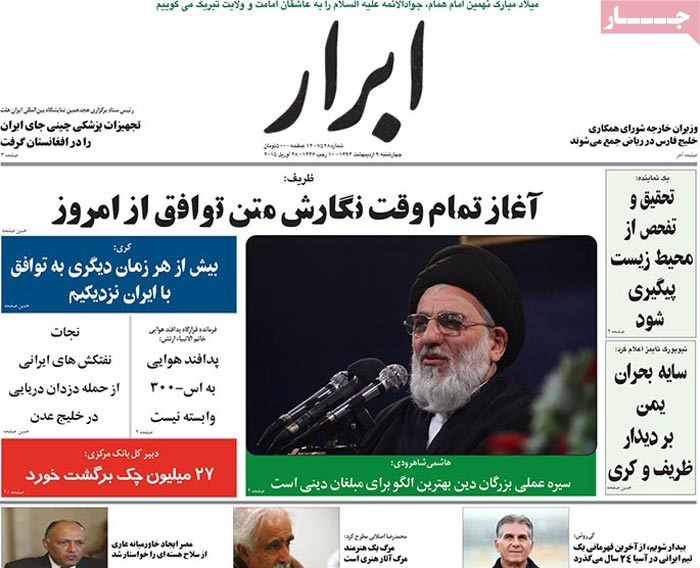
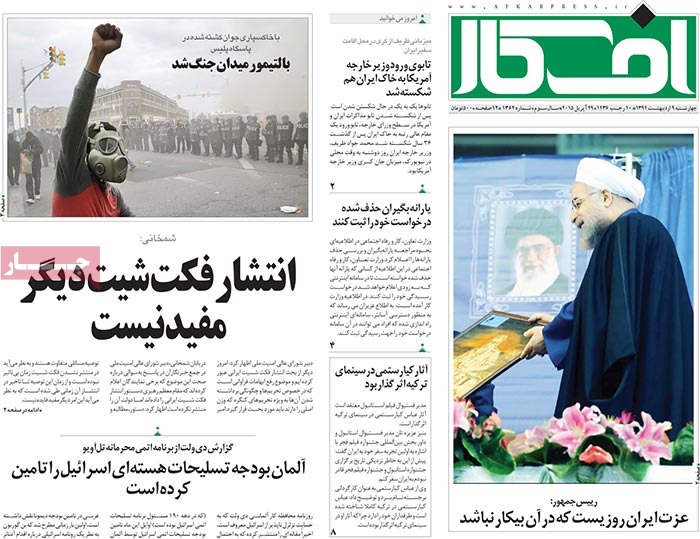
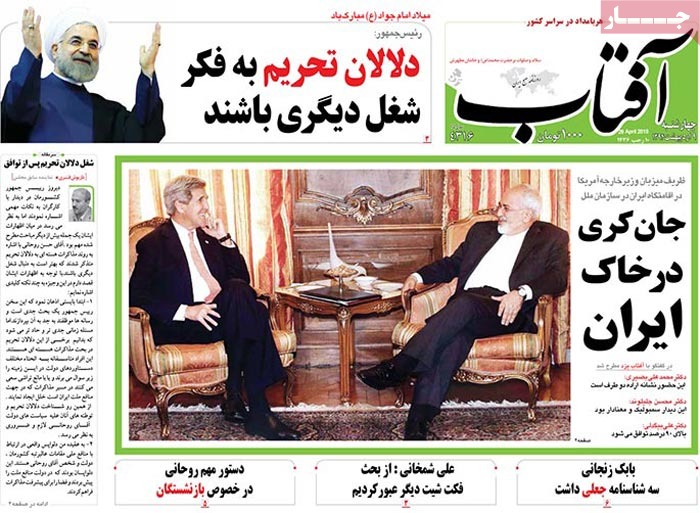
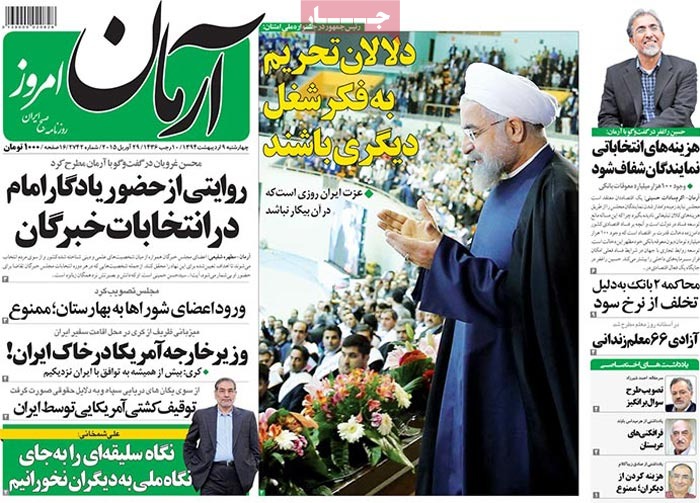
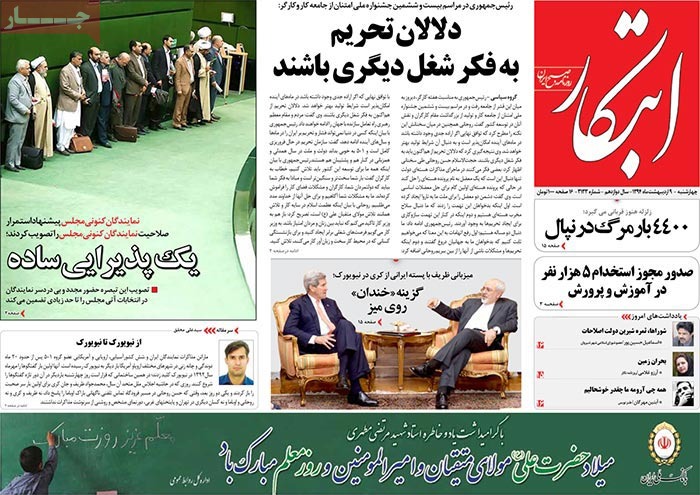
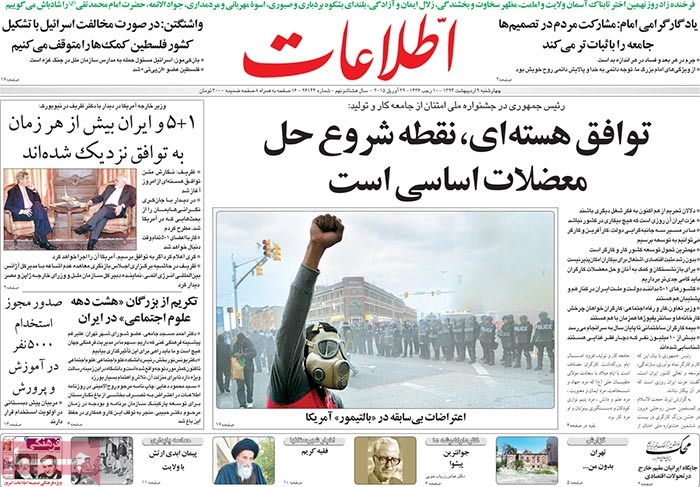
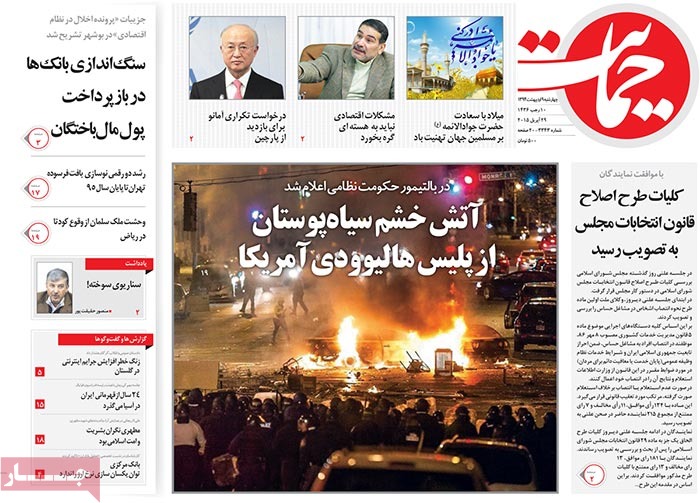
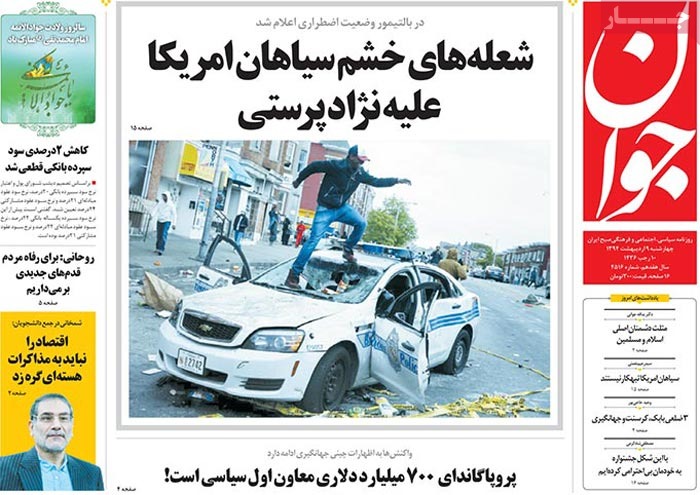
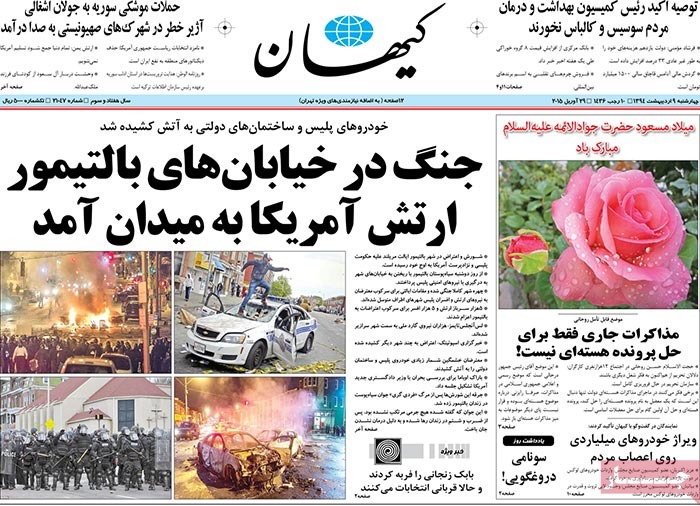
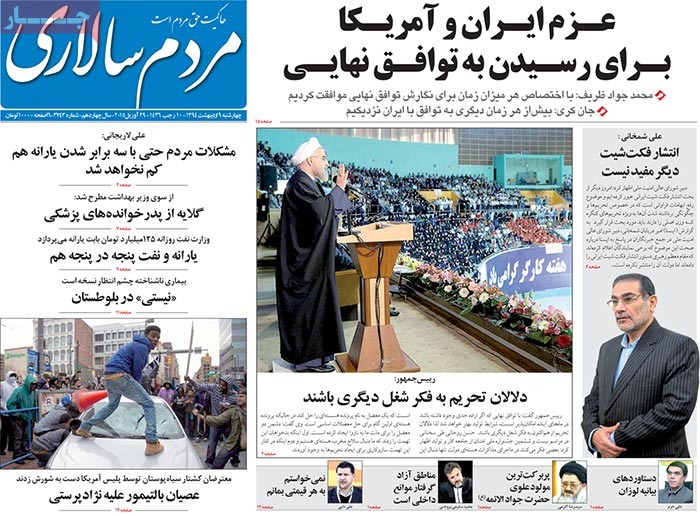
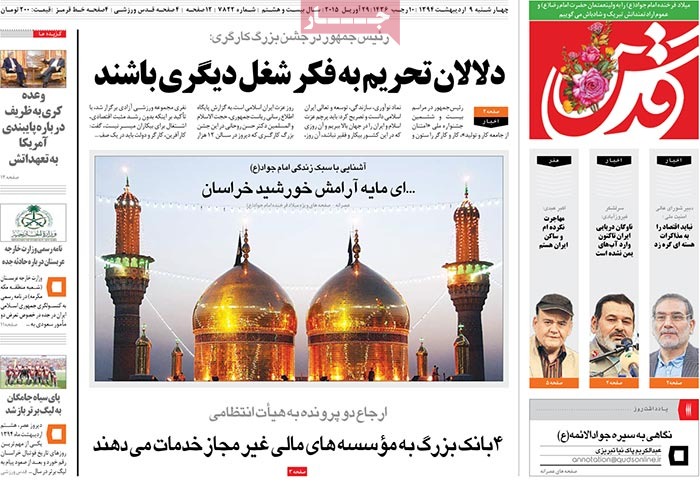
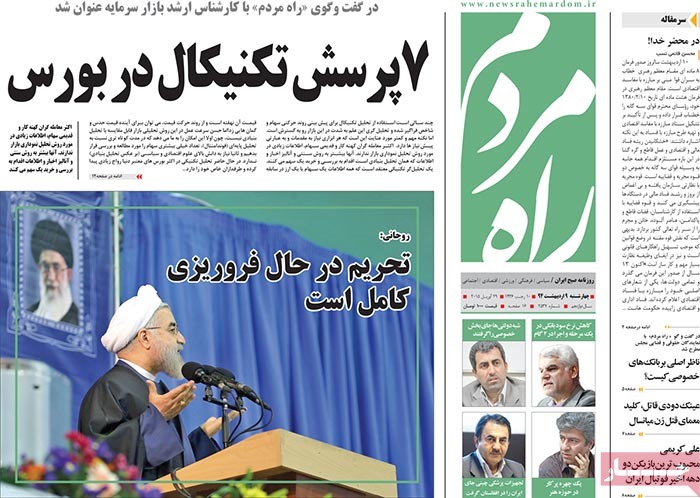
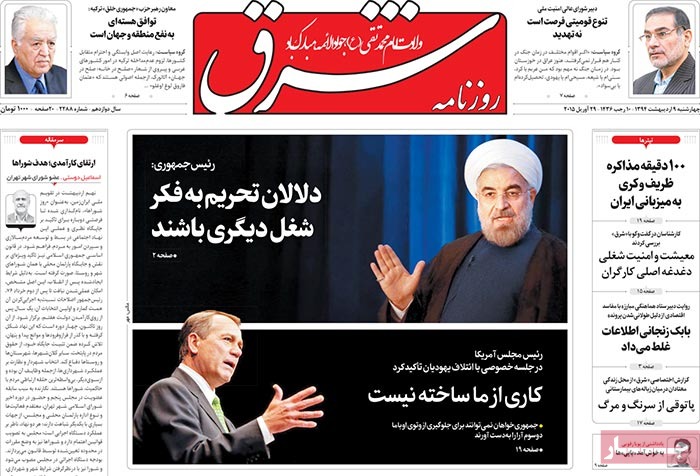
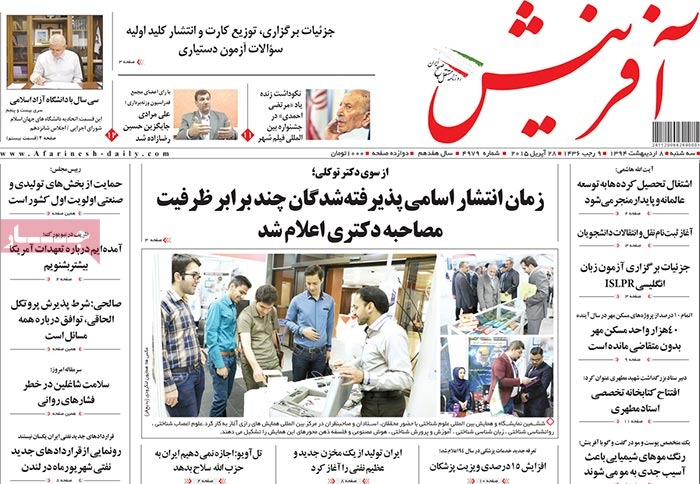
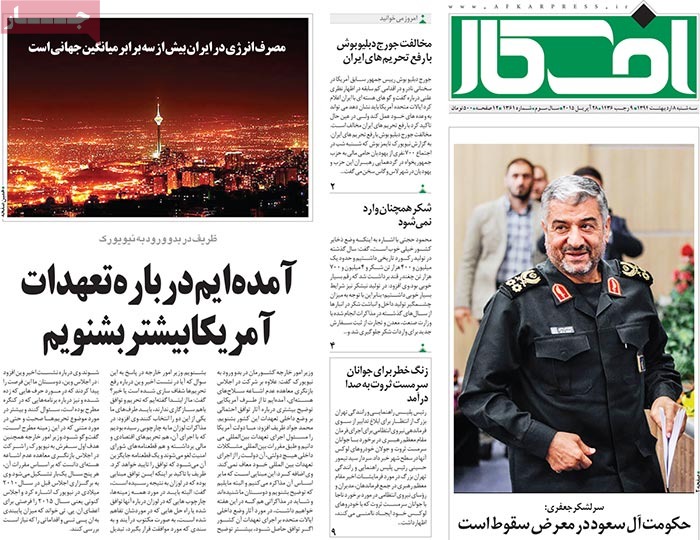
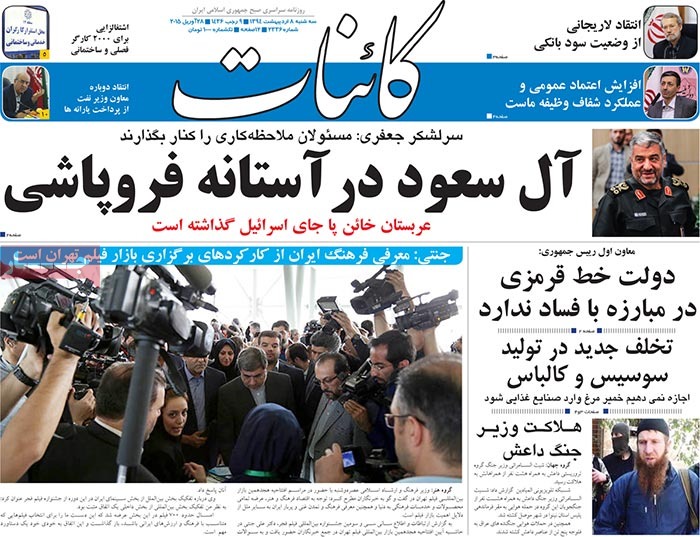
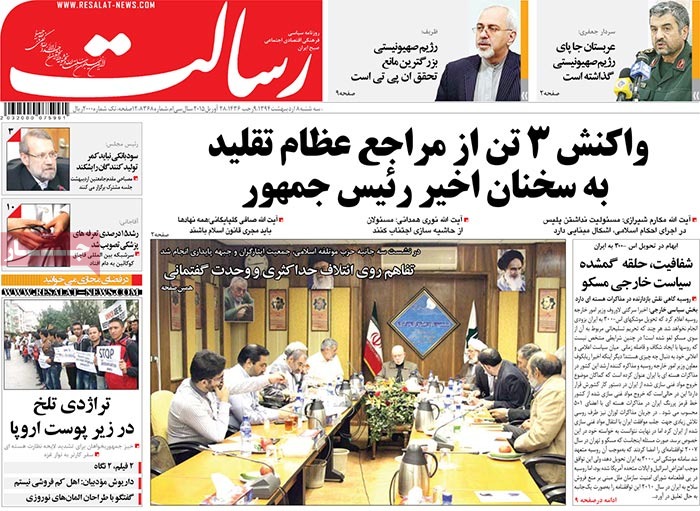
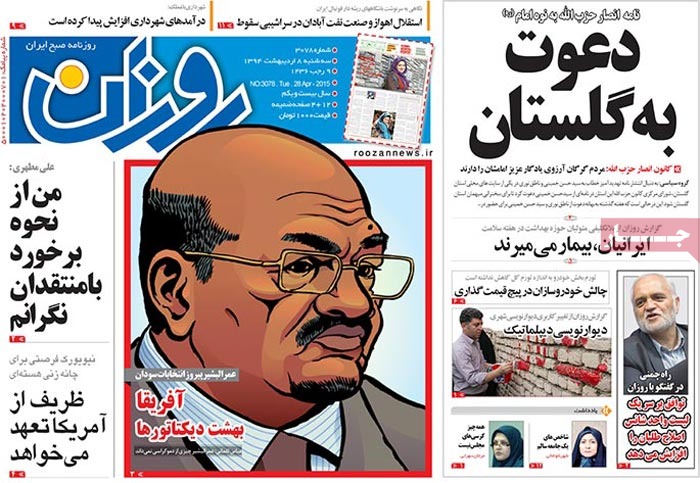
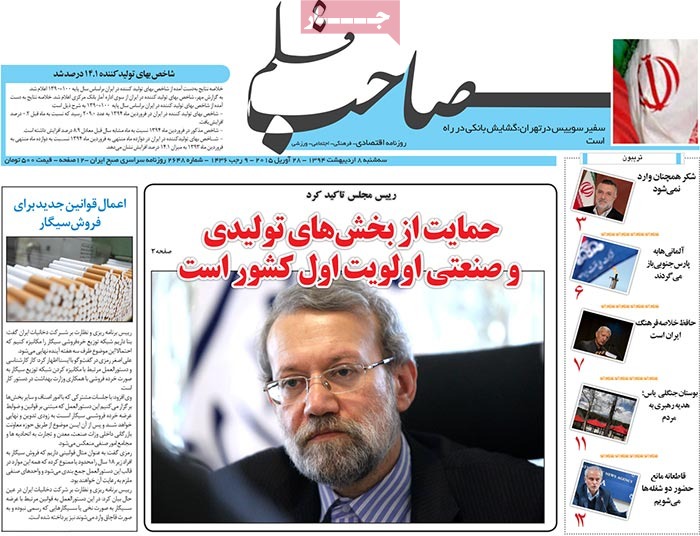
A look at Iranian newspaper front pages on April 27

Iranian Newspapers Headlines

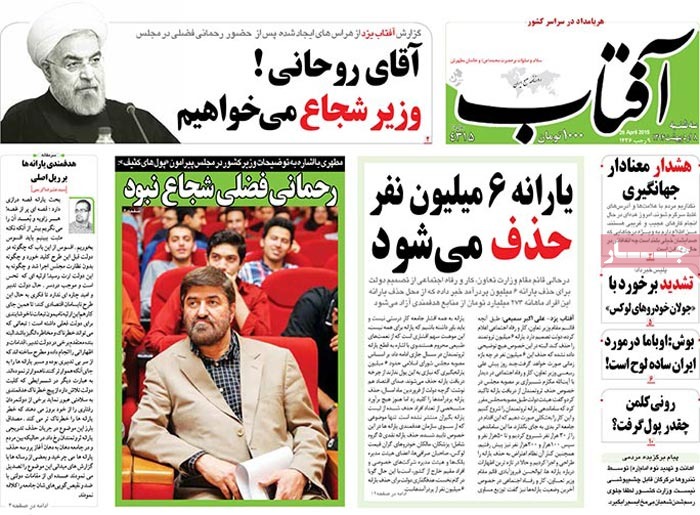
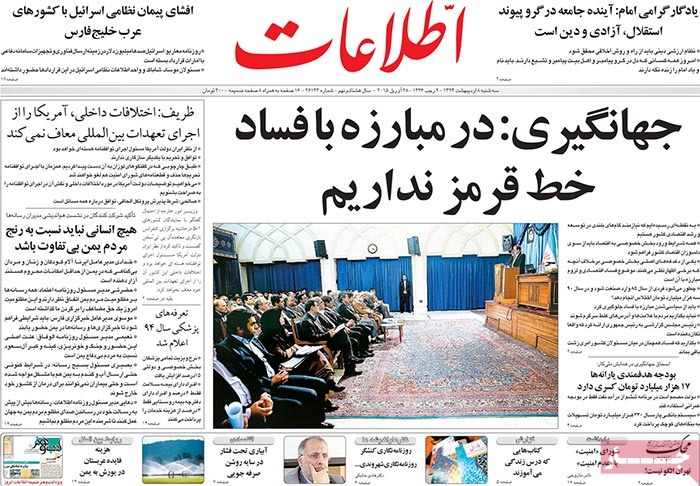
The Supreme Leader’s comments at a meeting with high-ranking Law Enforcement commanders urging police to pay closer attention to the psychological security of citizens dominated the front pages of Iranian newspapers on Monday. Different interpretations of comments made by the interior minister on dirty money in parliament also appeared on the cover of dailies.


Afarinesh: “A secure Iran helps sustain stability in the region,” said Chairman of the Expediency Council Ayatollah Akbar Hashemi Rafsanjani, at a meeting with laborers.

Afarinesh: “Saudi failure to allow Iranian aircraft [to land in Yemen to deliver humanitarian aid] won’t go unanswered,” said Hossein Amir-Abdollahian, a deputy foreign minister.


A look at Iranian newspaper front pages on April 27


Aftab-e Yazd: “President Rouhani’s performance has helped calm return to the country,” said Ali Akbar Nategh Nouri, a former parliament speaker.

Aftab-e Yazd: Director of the Environment Protection Organization Masoumeh Ebtekar has said that she has no ambition to become president.

Aftab-e Yazd: Hossein Rezazadeh was overwhelmed by law.

Rezazadeh, a former Olympic gold medalist weightlifter, is a member of Tehran City Council and was an incumbent at the Weightlifting Federation elections.

He has now decided to quit his run for the top job at the Weightlifting Federation.

Aftab-e Yazd: The list of parliament deputies who have received money from [former First Vice-President Mohammad Reza] Rahimi will be released soon.

[Rahimi is doing a five-year-plus prison term for fraud and corruption].


A look at Iranian newspaper front pages on April 27


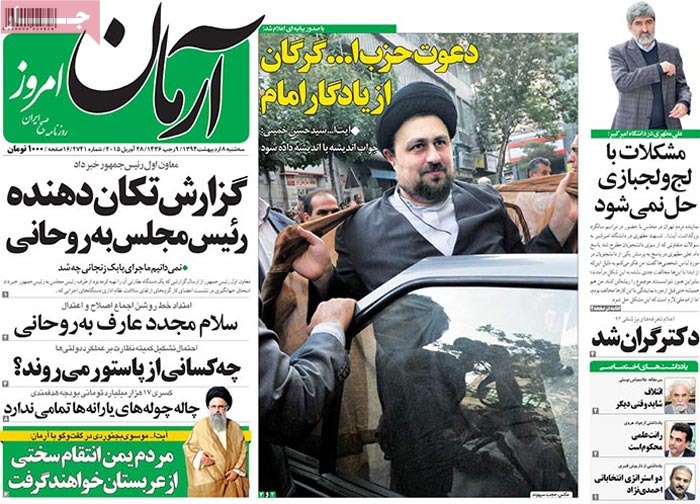
Arman-e Emrooz: “I don’t feel religiously required to field my candidacy [for upcoming elections],” said Ali Akbar Nategh Nouri [a former parliament speaker].

Nategh Nouri, who once represented principlists in a failed presidential bid, further said, “The youth should be given an opportunity to make their presence felt.”

Arman-e Emrooz: The top judge at the Administrative Justice Court has said that the court is looking into illegal decisions of city and town councils.


A look at Iranian newspaper front pages on April 27


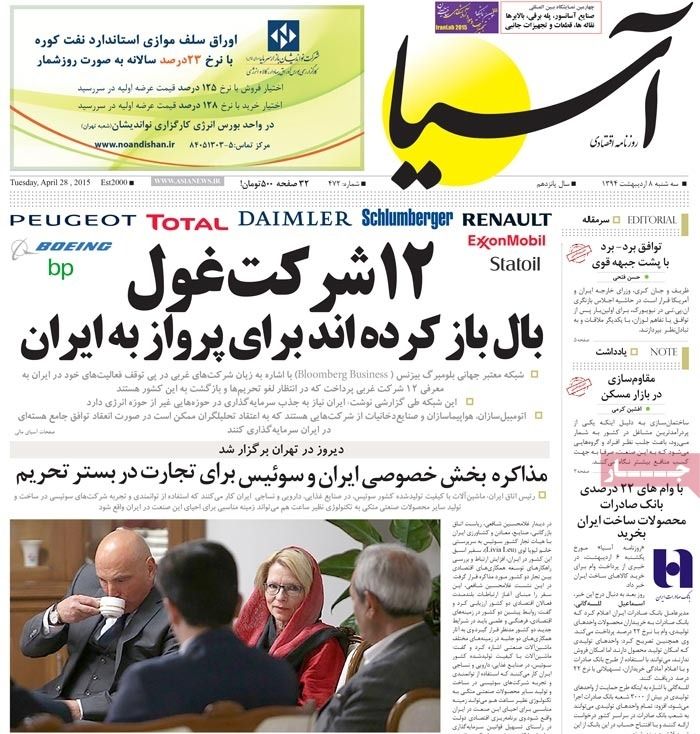
Asr-e Rasaneh: Some 1 billion euros is to be invested in petrochemical development projects.


A look at Iranian newspaper front pages on April 27


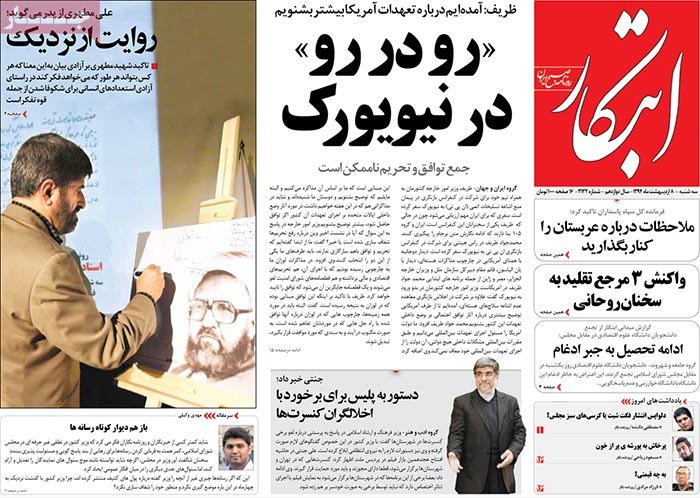
Ebtekar: The Worriers [supporters of former President Mahmoud Ahmadinejad] are playing the “questioning” card.

They have threatened to question the president [for the failure of his administration] to release an Iranian fact sheet on the Lausanne statement.

Ahmadinejad is the only Iranian president so far to have been questioned by parliament.

Ebtekar: “Arak Heavy Water facility and Fordow guarantee Iran’s right to uranium enrichment,” said the director of the Atomic Energy Organization.
A look at Iranian newspaper front pages on April 27


Etemad: The chairman of the Expediency Council told a host of workers that a nuclear deal between Iran and P5+1 is within reach.

Etemad: In a speech in parliament, the interior minister presented an implicit account on the so-called dirty money.

“I wanted this session to be held behind closed doors; tax evasion has robbed the state of some $200 billion in revenues; the Presiding Board of the assembly has urged me to apologize to the MPs; the money channeled to electoral campaigns should be traced,” Abdolreza Rahmani Fazli said.

Later the head of the Interior Ministry’s Information Center said that in his speech in parliament, the interior minister did not retract his previous comments on dirty money.

Etemad: Iranian MPs have reciprocated American senators.

The MPs have refloated the idea of reviewing and approving any nuclear deal with P5+1 before it takes effect.


A look at Iranian newspaper front pages on April 27


Ettela’at: “P5+1 has accepted to lift the sanctions in one fell swoop,” said Director of the Atomic Energy Organization Ali Akbar Salehi.

He further said that Iran has mastered all nuclear technologies which are out there.

Ettela’at: Government’s economic plans for the post-sanctions era

Economy Minister Ali Tayyebnia said that after sanctions have been lifted the state oil-based economy will be reassessed.

He added Iran will have short-, medium-, and long-term plans for the post-sanctions era.


A look at Iranian newspaper front pages on April 27


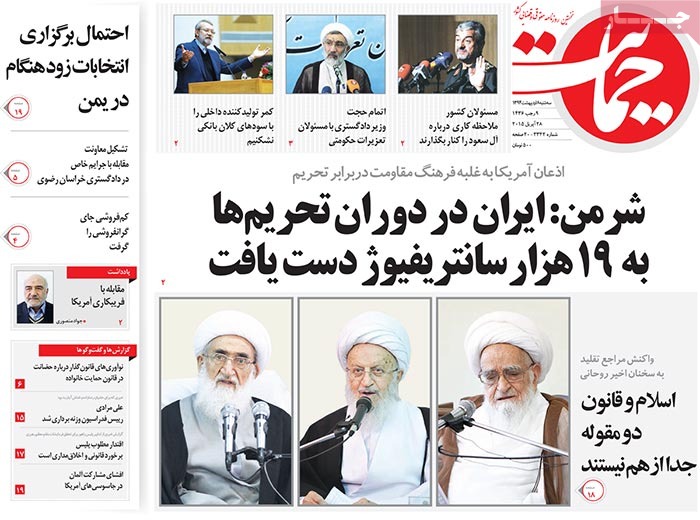
Hemayat: “Banks are owed more than 30 billion dollars in arrears,” said the inspector general.


A look at Iranian newspaper front pages on April 27


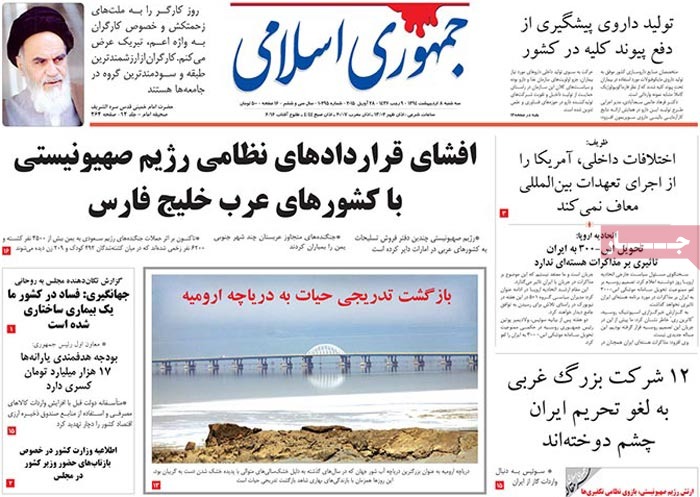
Jomhouri Islami: The interior minister has backtracked in parliament.

Rahmani Fazli said that his comments on injection of dirty money into electoral campaigns had been distorted by media!


A look at Iranian newspaper front pages on April 27


Kaenat: “The kingpin of an international drug gang has been arrested,” said an Iranian Intelligence Ministry official.


A look at Iranian newspaper front pages on April 27


Kayhan: The leader of IS terrorists is said to be brain dead. Al-Baghdadi has been moved to Israel.

Kayhan: “Police are expected to be resolute and at the same time just and compassionate,” said the Supreme Leader at a meeting with senior police commanders.


A look at Iranian newspaper front pages on April 27


Mardomsalari: Iran and Europe have launched talks [on exports of natural gas from Iran to Europe] in Bulgaria.


A look at Iranian newspaper front pages on April 27


Resalat: “If the US fails to keep its commitments, we will resume our nuclear activities,” warned the director of the Atomic Energy Organization.


A look at Iranian newspaper front pages on April 27


Shahrvand: “Some 90 percent of the Healthcare Transformation Plan is complete,” said the first vice-president.

Shahrvand: A Health Ministry official has said that unsafe sex is to blame for 35 percent of all HIV transmissions in the country.


A look at Iranian newspaper front pages on April 27


Ayatollah Rafsanjani: Iran is not a troublemaker in the region

Hashemi Rafsanjani

The chairman of the Expediency Council has said that [a final] nuclear deal with P5+1 is within reach and that Westerners should pay closer attention to the [nuclear] stance of the Supreme Leader whose remarks offer absolute proof of where Iran’s nuclear program is heading.

Ayatollah Akbar Hashemi Rafsanjani made the remarks Sunday in a meeting with a host of workers to mark Labor Week. Entekhab, a news website, covered Rafsanjani’s remarks on April 26. The following is a partial translation of what else the top councilor said:

[…]

Recalling the various stages of talks the government has held with P5+1, Rafsanjani said Iran is willing to have interaction with the world and develop cooperation with other countries.

He then disputed the vengeful stance of the Zionist regime and the illogical demands of Israeli officials from P5+1 and said that Iran is not a thorn in the side of [regional] countries; rather, it ensures, beefs up and maintains security in the region.

The chairman of the Expediency Council further said that a nuclear deal between [Iran and world powers] is achievable.

He also recalled Iran’s Islamic and revolutionary policies and the Supreme Leader’s decree banning nuclear weapons and said orders of a source of emulation who is the leader of a civilized society are convincing proof for all of us, urging Westerners to take heed of Iranian officials’ comments which are full of human concerns instead of acting upon the evil-spirited stance of the Zionists.

The Expediency Council chairman also condemned continued Saudi airstrikes against Yemen and said that the new Saudi government has started to walk down the wrong path and has hurt the feelings of Muslims. “The Saudis are sowing the seeds of hostility and feud in the hearts of the Yemeni people.”

Ayatollah Rafsanjani expressed sorrow over the killer quake in Nepal which also wreaked havoc in neighboring India and Pakistan and said that Iran is ready to offer humanitarian aid to the stricken people.

[…]

Iranian researchers produce anti-cancer nano-drug

cancer

Iranian researchers have produced a nano-drug which has proven effective in battling the treatment resistant cancers.

The Cancer Research Center of Tehran University of Medical Sciences produced the polymer-based nanocarrier for the targeted release of the anti-cancer drug curcumin.

“This nanocarrier was made without the use of poisonous catalysts and has proven successful in clinical trials on a number of cancer patients,” said Ali Mohammad Alizadeh from the Iran Nanotechnology Initiative Council.

Research has proven that curcumin, which is found in turmeric, has anti-cancer and cancer preventing properties apart from its anti-oxidant and anti-inflammatory properties, he added.

When curcumin is prescribed in its edible form, it has a low effect on the targeted tissues because of its low absorption rate and fast metabolism which causes it to be flushed from the body, he noted.

However, by capsuling curcumin in nano-emulsions (nano curcumin) its medical properties increase, Alizadeh noted.

Even if prescribed in high dosages, the drug is proven not poisonous during first-stage clinical trials and is currently near the end of stage two clinical trials on drug-resistant breast and digestive tract cancers.

Alizadeh added that because all the basic materials required to manufacture nano-curcumin are available in the country it can be domestically mass-produced as an anti-cancer drug.

Domestic friction does not exempt US from honoring int’l commitments

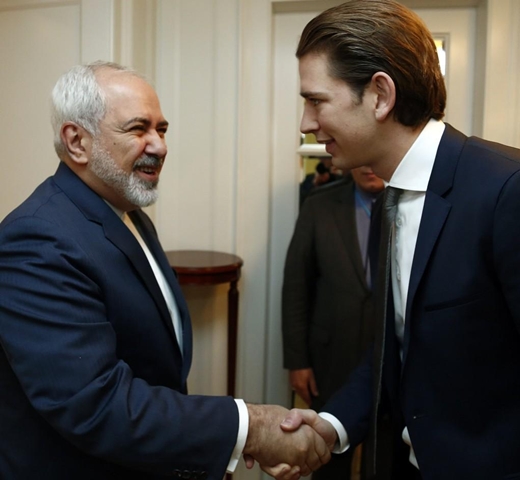
Mohammad Javad Zarif

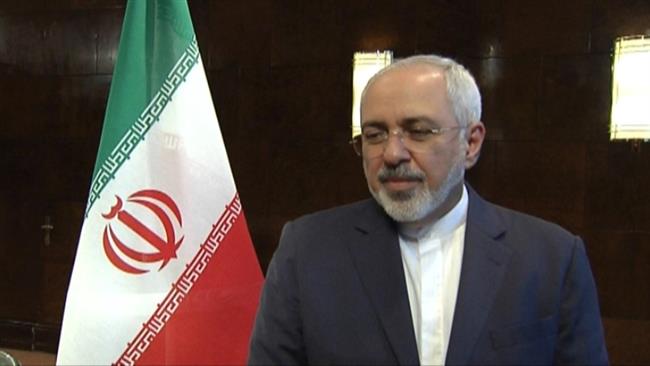
Foreign Minister Mohammad Javad Zarif has said that political bickering in the US has nothing to do with Iran and that the American administration – not Congress – is responsible for enforcement of the nuclear agreement.

Zarif made the comment in New York, where he is to attend the 2015 Review Conference of the Parties to the Treaty on the Non-Proliferation of Nuclear Weapons (NPT) due to be held at the UN Headquarters from April 27 to May 22.

The following is a partial translation of what else the Islamic Republic News Agency (IRNA) quoted him as saying on the Lausanne agreement:

[…]

“We have said from the very beginning that [conclusion of an] agreement does not conform to sanctions. We have also stressed the fact that under the agreement we arrived at Lausanne, [anti-Iran] sanctions will be lifted and the UN Security Council will release a new resolution to nullify the previous resolutions [against Iran] as we implement the [Lausanne] agreement,” said the Iranian top diplomat.

He went on to say that what we agreed on during the Lausanne talks should turn – at this final stage [of the talks] – into a legally binding document to be implemented down the road.

As for the ballyhoo in the US Congress and bipartisan disputes over the nuclear agreement, Zarif said, “We have already said that the US government is responsible for implementation of the agreement and the problems and disputes inside the US have nothing to do with Iran and the implementation of the deal. Under international regulations, countries are not exempt from honoring their commitments due to their internal problems. This is a basic framework that is of high importance to us”.

He further said that we expect US officials to provide explanations on this [their interpretation of the Lausanne agreement], adding that we want to hear transparent and frank explanations [from Washington] on their in-house bickering and its possible impact on the implementation of the Lausanne agreement.

No internal rift over nuclear talks: Velayati

Ali Akbar Velayati

Head of the Strategic Research Center of Iran’s Expediency Council Ali Akbar Velayati rejected the notion that a plan to require the parliament’s approval of a likely nuclear deal between Tehran and world powers would translates to polarization of views in the country.

Speaking to reporters in Tehran on Sunday, Velayati underscored that the Iranian nation remains united when it comes to the country’s major political issues, adding that it is an illusion that discord might emerge between the Iranian people and the three branches of power.

He made the comments in response to speculations about the emergence of polarity and division in the country after Iranian lawmakers prepared a plan that would require a possible final nuclear deal to win the endorsement of parliament.

The plan stipulates that, according to Iran’s Constitution, any possible nuclear accord between Iran and 5+1 (Russia, China, the US, Britain, France and Germany) will have no credibility without authorization of the legislature, an MP told Tasnim on Sunday.

Velayati made it clear that the Iranian diplomats are vigorously doing their job in the nuclear negotiations and that there is no need to worry that their morale might be undermined by the parliament’s move.

“They (negotiators) are doing their job and parliament is also doing its own,” he explained.

On April 2, Iran and 5+1 reached a framework nuclear agreement in Lausanne, Switzerland, with both sides committed to push for a final deal until the end of June.

They also held a three-day round of talks in Vienna on April 22-24 and started drafting the text of the long-awaited agreement.

Iran, Russia ditch dollar, trade in ruble

7

Bank officials in Tehran said on Sunday that a mechanism to transfer money to the country’s banks from Russia is now on stream.

Gholam-Reza Panahi, the deputy governor for currency affairs of Bank Melli of Iran (BMI), said the mechanism enables Iranian exporters to transfer payments in rubles from their Russian clients to Iran through the Moscow-based Mir Business Bank.

Panahi said BMI is ready to support Iranian exporters to receive the ruble payments of their Russian clients through Mir Business Bank.

He said Iranian exporters can even choose the same bank for opening letters of credit.

Both countries are subject to a series of draconian US-engineered sanctions. They had already announced plans to ditch the US dollar and trade in their own currencies.

The US and the European Union have imposed an array of embargoes on Russian individuals and businesses over the crisis in Ukraine. They accuse Moscow of supporting anti-Kiev protesters in eastern and southern Ukraine. Russia denies the allegation.

The US and its European allies have also imposed sanctions against Iran over Tehran’s civilian nuclear activities.

Iran decries Saudi obstacle to delivery of emergency supplies

Hossein Amir-Abdollahian

Deputy Foreign Minister for Arab-African Affairs Hossein Amir-Abdollahian on Sunday expressed outrage at the obstacles created by the Saudi government to the delivery of emergency supplies to Yemen.

He said that Iran reviews all options for assisting people in Yemen such as the immediate shipment of relief supplies and transfer of injured civilians.

The Saudi government does not have the right to dictate its policies on others in the region, he said, adding that their military intervention in Bahrain left hundreds of casualties.

He said that the Saudi government is not honoring its obligations under the international law and the Charter of the United Nations which prohibits intervention in the internal affairs of other states.

The Saudi aggression on Yemen has led to the escalation of violence and bloodshed in the country and the entire region, he said, adding that the Saudi government is expected to help promote peace and security in the region, but they have put regional security at risk.

Amir-Abdollahian said that the Saudi government is responsible to play a constructive role and not to disrupt peace and security in the region.

He underlined that Tehran always backs diplomatic talks with the Saudi government.