Monday, December 29, 2025
Home Blog Page 4889

Iran’s missile capabilities not negotiable at all: Velayati

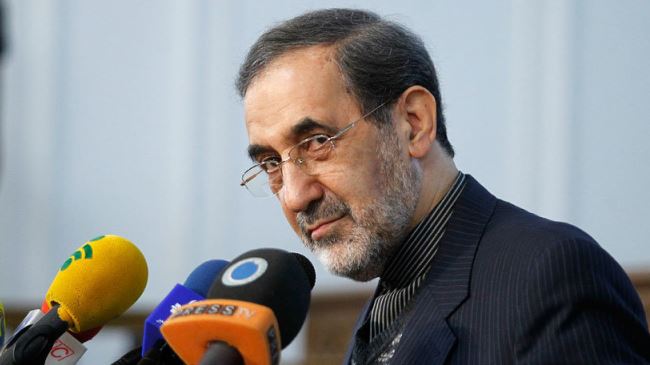
Ali-Akbar-Velayati

A senior advisor to Leader of the Islamic Revolution Ayatollah Seyyed Ali Khamenei has ruled out any negotiations whatsoever over the Islamic Republic’s defensive missile capabilities.

“Iran’s missile issue is not up for any type of negotiation,” Ali Akbar Velayati told reporters on Monday.

The senior Iranian official added that the issue of the country’s missile program would not be part of the upcoming nuclear talks with the P5+1 group of countries in the Swiss city of Geneva.

Some Western officials, particularly in the US, have called for Iran’s missile program to be included in the country’s nuclear talks with the P5+1 – Russia, China, France, Britain, the US and Germany.

“Iran will do whatever is necessary for its defensive purposes,” Velayati, who also serves as Head of Iran’s Strategic Research Center, pointed out.

He emphasized that Iran’s missile program is solely designed for peaceful defensive objectives.

“Deterrence is the most important feature of [Iran’s] missiles,” Velayati said, adding, “In order to strengthen its defense [capability], Iran does not need to obtain permission from anybody.”

His remarks came as senior officials from Iran and the P5+1 are scheduled to resume a new round of talks in Geneva on December 17.

Iran, Russia must be engaged to defeat ISIL: EU

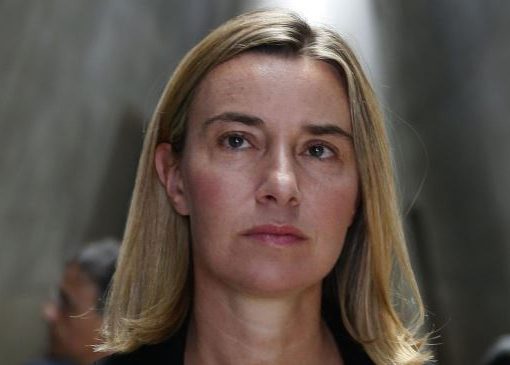
Federica-Mogherini

The European Union’s foreign policy chief says the 28-Nation bloc must engage Iran and Russia to defeat the ISIL Takfiri terrorists and end the conflict in Syria, Press TV reports.

Federica Mogherini made the comments on Monday, following a meeting by EU foreign ministers.

“Iran is not only the country with which we have nuclear talks, it is also a regional important player and this practically means that we will have to engage with Iran also on its neighborhood,” said Mogherini during a news conference.

Over the recent months, EU member states have been debating the union’s approach to Syria.

“The European Union is ready to engage with all regional and international actors with influence over the Syrian parties,” Mogherini added.

She added that the EU backs efforts by the United Nations to arrange a ceasefire between government troops and foreign-backed militants in Syria’s northwestern city of Aleppo.

The aim of the ceasefire is to help ease the desperate plight of people in Syria’s second-largest city.

Syria has been grappling with a deadly conflict since March 2011. Western powers and their regional allies – especially Qatar, Saudi Arabia, and Turkey – are the main supporters of the ISIL militants operating inside Syria.

More than 200,000 people have so far died in the conflict, according to the UN.

Iranian doctors successfully conduct thyroplasty surgery

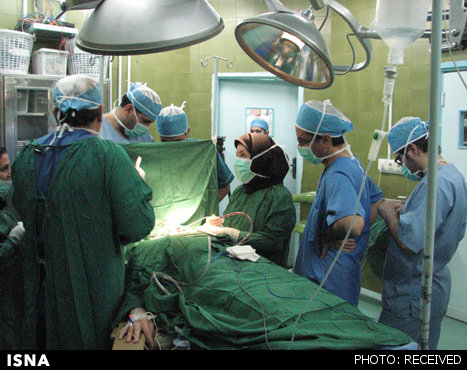
surgery

Iranian surgeons successfully conducted thyroplasty type III surgery to change a patient’s female voice to a male one at a hospital in Mashhad City, northeastern Iran.

Dr. Ehsan Khadivi, an Otolaryngology Associate Professor at Mashhad medical Sciences University said the operation was conducted on a 21-year old patient from Mashhad.

The surgery is conducted on people who have signs of maturity but their voice is still a female type.

He said speech-language pathology is prescribed for these kinds of patients before the surgery, but operation is offered in case it fails.

According to Khadivi, the surgery can be conducted for people who have gone through sex reassignment surgery. Female voice frequency stands at 180-200 for women and reaches 100-120 for men.

The patient has gone through the surgery one year after speech-language pathology, he said, adding the operation took half an hour and under Local anesthesia during which frequency of the patient’s voice was investigated.

Iran voices satisfaction with US talks

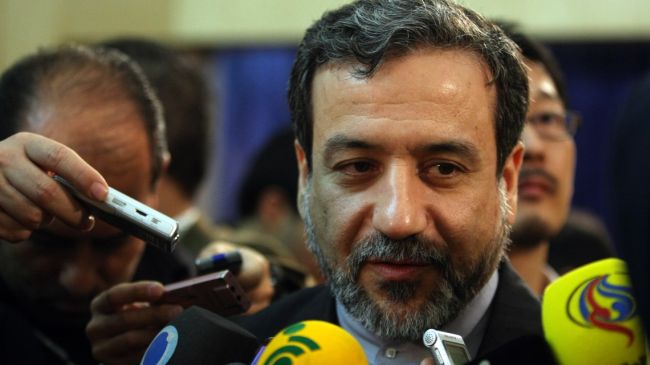
Abbas-Araqchi

A top Iranian nuclear negotiator has expressed satisfaction with the general atmosphere of the ongoing negotiations between representatives of the Islamic Republic and the United States over Iran’s nuclear program.

Seyyed Abbas Araghchi, who is also Iran’s deputy foreign minister for legal and international affairs, made the remarks after the two sides ended their first day of the new round of talks in Geneva on Monday.

The Iranian negotiating team is headed by Araghchi and Deputy Foreign Minister for European and American Affairs Majid Takht-e Ravanchi, while Acting Deputy Secretary of State Wendy Sherman leads the US team.

The Iranian official said that the two sides had detailed discussions, including on the US-led sanctions against Iran, during the expert-level meeting.

Iran will hold another round of talks with the US negotiating team on Tuesday morning.

Araghchi said Iran would also hold one-on-one talks with the other members of P5+1 later on Tuesday.

Iran and P5+1 – Russia, China, France, Britain, the US and Germany – will begin their new rounds of nuclear talks on Wednesday. The two sides failed to reach a final agreement by a previously-set November 24 deadline. Given the progress that had been made, however, Iran and P5+1 agreed to extend their discussions for seven more months until July 1, 2015. They also agreed for the interim deal they had signed in Geneva in November 2013 to remain in place during the negotiations.

A look at Iranian newspaper front pages on Dec. 16

Iranian Newspapers Headlines

Monday’s deadly hostage taking in a café in Sydney, Australia appeared on the front pages of most Iranian dailies on Tuesday. Also on the front pages were the comments of President Rouhani that sanctions will be lifted and those of Ali Akbar Velayati, the Supreme Leader’s advisor, that Tehran’s missile capability is not negotiable as well as the call by one-time parliament Speaker Ali Akbar Nategh Nouri for the formation of political parties to smooth the day-to-day administration of affairs in the country.


Abrar: “Members of parliament cannot question the judiciary,” said a deputy judiciary chief.

Abrar: The minister of science, research and technology has explained why some speeches planned for University Student Day were called off. “Some of the speeches had not been given the go-ahead in the first place.”
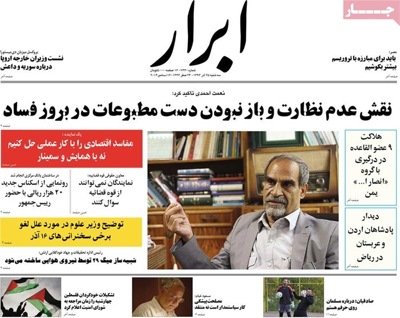
 

Abrar newspaper 12 - 16


Abrar-e Eghtesadi: The price of the standard gold coin in Iran has hit the 10 million rial [around $300] mark.
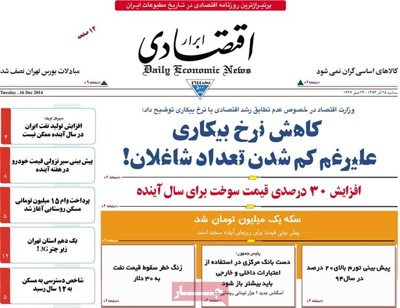
 

Abrare eghtesadi newspaper 12 - 16


Afkar: “We have full trust in our nuclear negotiators,” said President Hassan Rouhani.

Afkar: Talks between [Iranian deputy foreign ministers] Araghchi and Takht Ravanchi and American Under-Secretary of State for Political Affairs Wendy Sherman opened in Geneva, Switzerland.
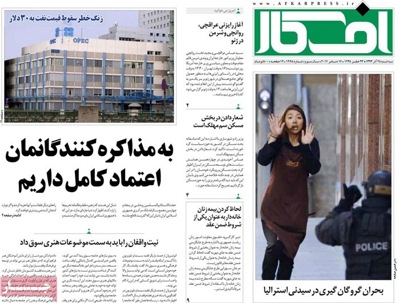
 

Afkar newspaper 12 - 16


Aftab-e Yazd: “The previous government printed forty-something percent of the entire bills the country has printed ever,” said President Rouhani.

Aftab-e Yazd: Some 11 million young men and women across Iran are of marriage age.
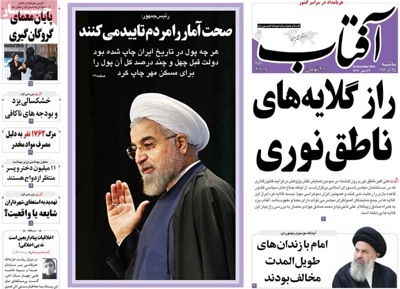
 

Aftabe yazd newspaper 12 - 16


Arman-e Emrooz: “Some urge us to conclude a deal fast; others want us to quit the talks altogether,” the president has said of efforts to prevent nuclear talks to produce results.
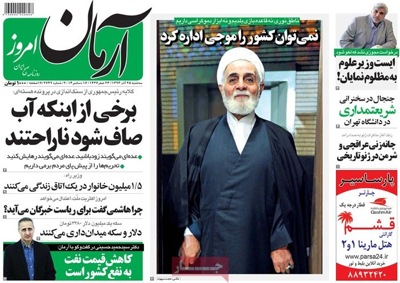
 

Armane rmruz newspaper 12 - 16


Asrar: “Wisdom requires us to thrive politically as we interact with the rest of the world,” said Chairman of the Expediency Council Akbar Hashemi Rafsanjani.

Asrar: Hostage taking in Sydney Australia comes to a bloody end.
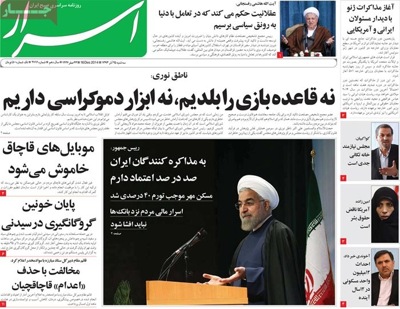
 

Asrar newspaper 12 - 16


Eghtesad-e Pooya: The president has blamed the 40 percent inflation rate [his government inherited from the previous government] on Mehr Housing Project his predecessor launched.

Eghtesad-e Pooya: A new 20,000 rial bill [roughly 60 cents in value] has been unveiled.
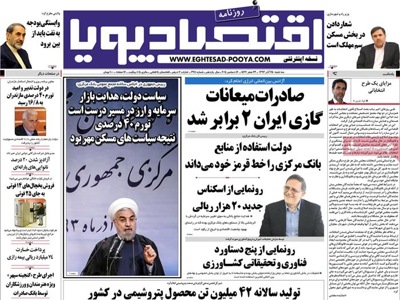
 

Eghtesade puya newspaper 12 - 16


Emtiaz: “As many as 220 thousand illegal abortions are conducted [across the country] annually,” said a deputy health minister.

Emtiaz: “Prices of energy forms are likely to rise by 30 percent next year,” said a member of parliament’s Budget Committee.
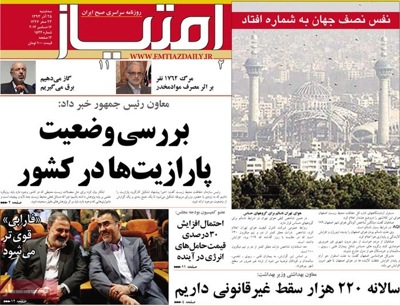
 

Emtiaz newspaper 12 - 16


Etemad: “We will bring down the sanctions [barrier],” President Rouhani told a host of banking managers as he urged banks to roll up their sleeves to enter the investment market.

Etemad: “Reformism will never take on the role of the opposition,” vowed Mohammad Reza Aref, President Khatami’s deputy.
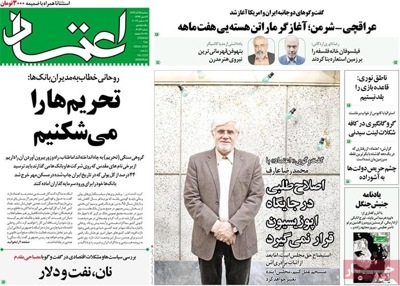
 

Etemad newspaper 12 - 16


Ettela’at: “Present laws prevent liquidity to be channeled to the manufacturing sector,” said Parliament Speaker Ali Larijani.
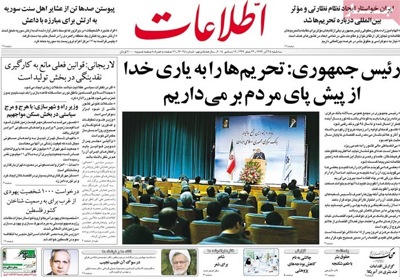
 

Ettelaat newspaper 12 - 16


Hambastegi: “Less reliance on oil in the budget bill is imperative,” said Ali Akbar Velayati, an advisor for international affairs to the Supreme Leader.

Hambastegi: “We do not know the rules of the game, nor do we have the tools of democracy at our disposal,” Ali Akbar Nategh Nouri told a national conference on the role of research in lawmaking.
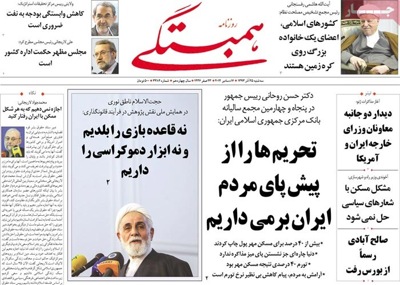
 

Hambastegi newspaper 12 - 16


Hemayat: “Western sanctions against Iran are against [principles of] human rights and amount to international crimes,” said the secretary of the Iranian Judiciary’s Human Rights Commission.
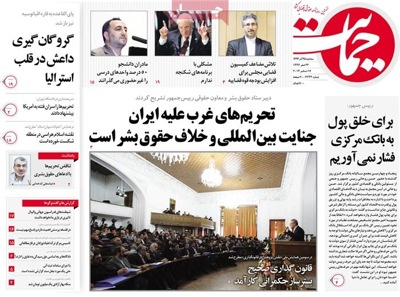
 

Hemayat newspaper 12 - 16'


Iran: In the first eight months of the year 1,762 people have died of addiction to illicit drugs [across Iran].
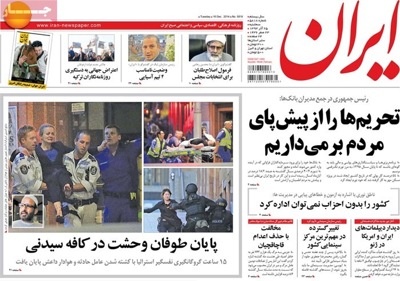
 

Iran newspaper 12 - 16


Iran Daily: South Korea’s Iran oil imports up 6.5 percent.

Iran Daily: Italy set to build steel plant in northern Iran.
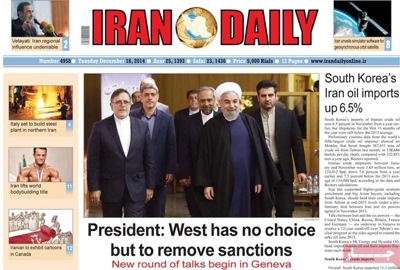
 

Iran daily newspaper 12 - 16


Javan: Parliament’s Research Center has announced that next year’s budget would entail more than $10 billion in deficit if it is based on oil prices of $70 a barrel.
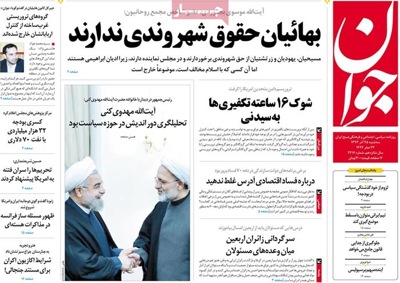
 

Javan newspaper 12 - 16


Kaenat: “Inflation rate should land in single-digit territory,” the president told a number of banking managers.
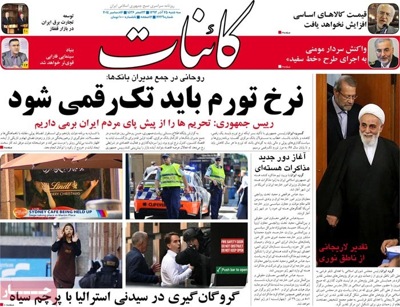
 

Kaenat newspaper 12 - 16


Kar va Kargar: “Iran’s missile capability is off limits in talks,” said Ali Akbar Velayati, a onetime foreign minister.

Kasb va Kar: “Those who fish in the troubled waters of sanctions are worried about the prospects of their termination,” President Rouhani said.
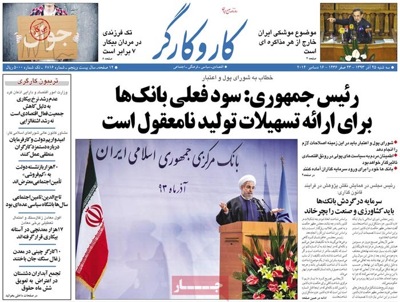
 

Karo kargar newspaper 12 - 16


Kayhan: “Economic sanctions were what top seditionists [those who disputed the results of the 2009 presidential elections and sparked unrest] asked the US for,” said Managing Editor of Kayhan Hossein Shariatmadri in a speech at the University of Tehran.
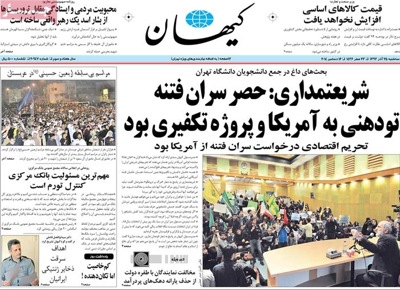
 

Kayhan newspaper 12 - 16


Mardomsalari: The Iranian Drug Commission has said it is opposed to abolition of the death penalty in cases involving drug traffickers.
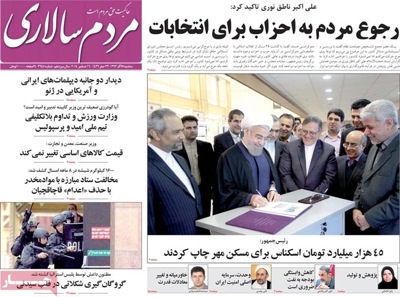
 

Mardom salari newspaper 12 - 16


Roozan: “Reports that Iran made concessions to have the talks extended are false,” said Ali Akbar Velayati, an advisor to the Supreme Leader.

Roozan: A staunch supporter of the Mashaei-Ahmadinejad camp has denied that the former president’s chief of staff has distanced himself from his boss. [It came after Mashaei was reported as saying that he was distancing himself from Ahmadinejad so that he could win back the support of his advocates.]
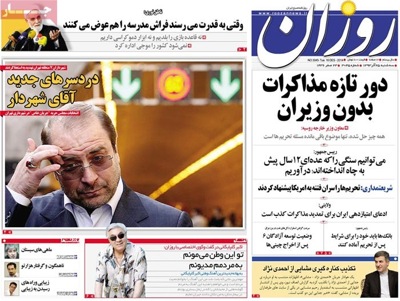
 

Ruzan newspaper 12 - 16


Sepid: “Doctors used to receive as much as $3 billion in unreported [illegal] fees from patients annually,” said the Iranian health minister.
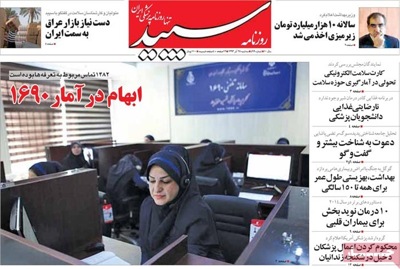
 

Sepid newspaper 12 - 16


Shahrvand: The head office of South Pars Company [in Asaluyeh] was engulfed in flames.

Shahrvand: The life of Iranian asylum-seekers at detention camps on Manus Island [in northern Papua New Guinea] is hellacious.
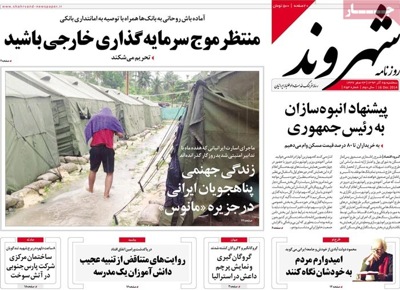
 

Shahrvand newspaper 12 - 16


Sharq: “We don’t have the tools of democracy at our disposal,” said Ali Akbar Nategh-Nouri, a former parliament speaker as he supported the formation of parties.
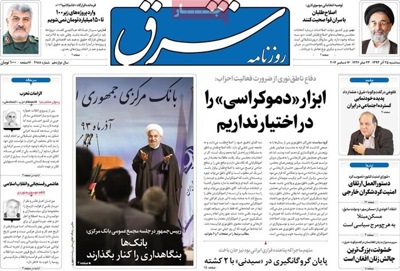
 

Shargh newspaper 12 - 16


SMT: “Under the proposed budget some 50 percent of the costs of research conducted by the private sector would be reimbursed,” said the minister of industries, mines and trade.
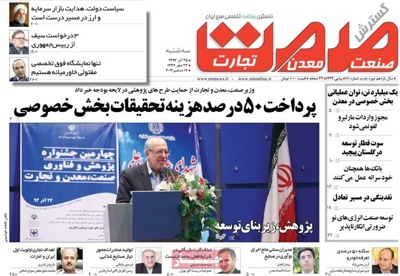
 

Samt newspaper 12 - 16


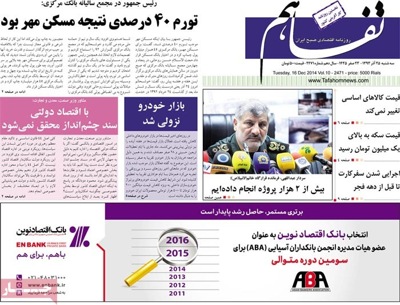
Tafahom: “Khatam al-Anbia Base [the development arm of the Islamic Revolution Guard Corps] has completed more than 2,000 projects so far,” said the commander of the base Brigadier General Abdollahi.
Tafahom newspaper 12 - 16


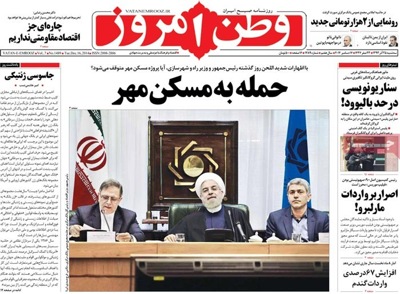
Vatan-e Emrooz: The chairman of parliament’s Article 90 Committee has said American tobacco company Philip Morris International is owned by the Zionists. Still, there is insistence [on the part of government] on importing Marlboro cigarettes.

 

Vatane emruz newspaper 12 - 16


Iran becomes champion of world bodybuilding contest for second year

FIBB
FIBB

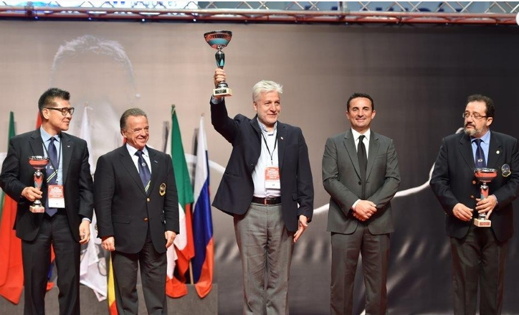
Iranian athletes won one gold, one silver and a bronze medal in the IFBB World Classic Bodybuilding Championships 2014 in La Nucia, Spain on Monday to be crowned champions for a second straight year.
The host, Spain, received one gold and another silver medal to finish second.
South Korea clinched a gold and a bronze medal to land in the third spot.
One hundred forty athletes from 36 countries took part in the 4-day competitions.
Iran had five representatives in the final stage, more than all the participating countries.

Iran strongly condemns hostage taking in Australia

Australia-hostage

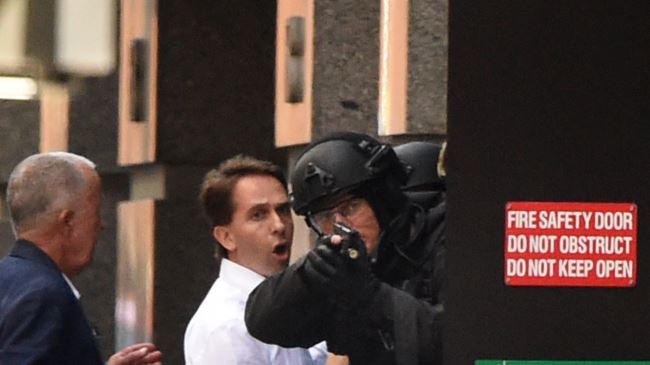
Iran has vehemently condemned hostage taking at a café in Australia’s most populous city Sydney.

“Resorting to inhumane methods and creating terror and panic in the name of the divine religion of Islam is not justifiable under any circumstances,” Foreign Ministry Spokeswoman Marzieh Afkham said on Monday.

She noted that the Australian police have been totally abreast of psychological conditions of the hostage taker, who had immigrated to Australia about two decades ago.

The hostage taker has been identified by local media as an Iranian, who had moved to Australia 18 years ago.

Some blame the incident on those who support terrorism, including the United States, Israel, and certain regimes in the Middle East region that support such Takfiri groups as al-Nusra Front and ISIL.

On December 1, in a message posted on his Tweeter account, the hostage taker had described Iran and the supporters of the Syrian President Bashar al-Assad as terrorists.

Australian security forces raided the Lindt Café in Sydney’s central business district on Monday, ending the siege that lasted for more than 16 hours.

According to police sources, the gunman and two hostages were killed during the operation.

In recent months, Australia has been on high alert after the Canberra government raised concerns over the return of the citizens who have joined the Takfiri terrorists operating in Syria and Iraq.

Earlier this month, Canberra said at least 20 Australian nationals fighting for terrorist groups, including ISIL, had been killed in the two neighboring Arab states. Over 90 Australians have joined ISIL Takfiri militants there.

West has no choice but to remove sanctions: Iranian President

Iran-president

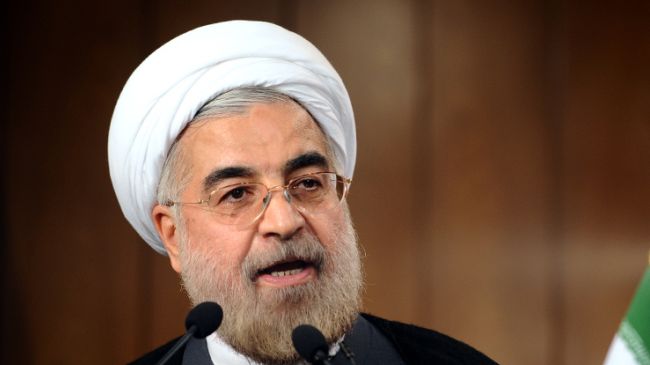
Iranian President Hassan Rouhani says that the West has no other choice but to lift the “cruel” sanctions against the Islamic Republic.

President Rouhani made the remarks on Monday, saying that the P5+1 group of world powers must remove anti-Iran sanctions through interaction with Tehran.

“They (the West) have no other way since all other ways are wrong; they have tried these ways before and if they want to retry them, they will lose more,” Rouhani said.

The Iranian chief executive further reiterated the peaceful nature of Tehran’s nuclear activities, saying the Islamic Republic is holding “logical and calculated” negotiations with the world.

In their last round of talks before a November 24 deadline for reaching a comprehensive nuclear deal, Iran and P5+1 — the United States, Russia, China, Germany, France and Britain — held nearly a week of intense negotiations in Vienna on how to tackle the remaining obstacles that exist in the way of clinching an agreement.

At the end of the talks, the two sides agreed to extend the Joint Plan of Action to July 1, 2015.

The world needs justice-based peace, not temporary ceasefire

Abbas Kiarostami

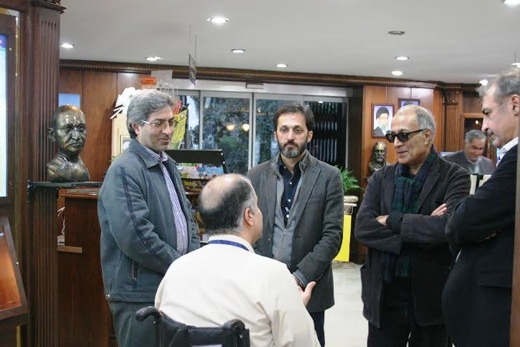
World-class Iranian filmmaker, Abbas Kiarostami paid a two-hour visit to the Tehran Peace Museum during which he was briefed on the devastating consequences of the Iran-Iraq war and the use of chemical weapons by Saddam’s army against Iranian civilians and soldiers back in the 1980s.

On December 14, Sharq, a newspaper, reported on the visit which came at the invitation of the chemical victims of the war, and on the remarks Kiarostami and disabled war veterans who were there to narrate what transpired on the battlefields of the Iran-Iraq war. The following is the translation of the daily’s report on what the renowned filmmaker saw from behind his signature glasses to be dramatically transformed:


Kiarostami is moved by what he sees

Kiarostami, who was deeply affected by the visit, said, “We are doubly indebted to the veterans who were wounded in action; once when you were defending the homeland and making sacrifices for all of us, and now that you have undertaken the responsibility to narrate your war memories in the Museum of Peace despite the harms you have suffered. It is extremely difficult to review those tragic yet epical moments, and I should admit from the bottom of my heart that nobody but you can handle this.”

He went on to say, “Ordinary people who are out there strolling and having fun in the Park-e Shahr (the City Park) will enter a whole new world after they step into this museum. Undoubtedly, they will feel a pang of conscience with two questions weighing on their minds: Why have we been so far so ignorant of the enormity of the war which is so close to us although we are somehow familiar with the question of war and defense?

“And more importantly, they compare their own responsibilities with yours wondering why you are tender-heartedly pushing hard to raise public awareness despite your physical problems? This can be a wake-up call for everyone, me included, to wholeheartedly do what it takes to help you and your cause.”

The veteran director further said, “That’s why I’m going to ask everybody to pay a visit to the museum. I also want to ask for efforts to build at least 50 other peace museums across the country where the disabled war veterans could narrate their stories so that others too can relish the pleasure of discovering [new information about the war]. I am sure people will give you a helping hand in this humanitarian measure.”

Kiarostami, who had previously come in for criticism [by Ebrahim Hatamikia, another famous Iranian movie director] for his lack of interest in the cinematic portrayal of the Sacred Defense, further said, “I entered this museum as a person with a normal mentality, but from now on I will be strongly involved in what I saw here, especially the sight of the tearful, transplanted eyes of Mr. Hassani Sa’di which is per se conclusive proof of all documentation in this museum.”

Hassan Hassani Sa’di, one of the veterans who is 70 percent disabled, shared memories [of the battlefield events] with Kiarostami and others at the start of the visit. Later the disabled veterans present in the museum thanked Abbas Kiarostami for making Two Solutions for One Problem [a 1975 Iranian short film directed by Kiarostami which involves two school kids breaking each other’s stuff and getting in a fight because they would not cooperate.] and said that they have screened his film many times to teach young visitors simple ways of seeking peace.


Peace does not approve of bowing to injustice

The disabled veterans narrated wartime events, among them: the use of chemical weapons during the Iran-Iraq war, the support Western governments lent to Saddam, concerted efforts by the UN Security Council not to name in its resolutions Iraq’s Baath party as a regime that used chemical weapons [against Iran] or the unjust bans on [life-saving] medical supplies.

Hassani Sa’di said what he is doing is the logical continuation of the Sacred Defense, “Fully supported by other governments, Saddam launched the war only to spark a bitter feud between the Iranian and Iraqi nations.

“Now that the war has come to an end thanks to the honorable resistance of the Iranian nation, we take pride in every single part of the unforgettable epic. We may make a huge miscalculation if we fail to distinguish between the Iraqi people and the performance of the Baath Party in political discussions and cinema advertising, thus keep the feud between the two neighbors alive. If so, we will help the enemies who backed Saddam achieve their once-failed objectives.

Kuniko Yamamura, the mother of Martyr Mohammad Babaei, retold her memories of the war and her son, saying as an Iranian of Japanese origin she is determined to help advance the museum’s plans for the Iranian and Japanese kids and women.

Later Mohammad Reza Taghipour, the museum’s manager who is also an Iran-Iraq war veteran said, “I lost my legs in the operation to liberate Khorramshahr, but I’ve always told myself and the museum visitors that I take pride in the fact that I’m in a wheelchair and nobody owes me a debt of gratitude for what I did.

“That I sit in a wheelchair has caused my nation to proudly stand up. Here I announce that we don’t define peace as bowing to injustice; rather, we are after peace which comes with sustainable justice, and not false peace which will be just a temporary ceasefire between the past and future wars due to failure to administer justice.”

He continued, “We lost Ahmad Zangiabadi the other day, a veteran who was one of the narrators [of the war]. He was in line for lung transplant. In spite of false propaganda which depicts the disabled veterans as bedridden, terminal patients, he came out, with his breathing mask on and his oxygen tank in tow, to narrate what has happened to this innocent nation.

Like his fellow disabled comrades, he sought to show that there is no end to the responsibility to raise awareness even in the toughest conditions and until the bitter end. Unfortunately he is not with us anymore to welcome the visitors. May God bless his soul!”

On the sidelines of the visit, a report on the Friendship Ship Celebrations featuring Iranian and Iraqi children was screened.


1. Tehran Peace Museum is a member of the International Network of Museums for Peace. Its main objective is to promote a culture of peace by raising awareness about the dire consequences of war, with a focus on the health and environmental impacts of chemical weapons.

2. Abbas Kiarostami is an Iranian film director, screenwriter, photographer and film producer. He has been involved in over forty films, including shorts and documentaries. Kiarostami attained critical acclaim for directing the Koker Trilogy, Close-Up, Taste of Cherry, and The Wind Will Carry Us. In his recent films, Certified Copy and Like Someone in Love, he filmed for the first time outside Iran, in Italy and Japan, respectively. He was awarded Palme d’Or at the 1997 Cannes Film Festival for Taste of Cherry.

A small music band bent on bringing down the West-East barriers

Music on the street-shargh daily

Sharq newspaper on December 8 ran a detailed report by Marjan Saebi on Amanj Band, and on street music and its challenges and prospects. The following is a partial translation of the report:

The crowd was bigger than those groups of viewers who usually circle street musicians. It looked as if many knew that the group would perform close to Azadi (Freedom) Multiplex [a newly-built complex in the capital]. I thought those in the crowd were their friends and acquaintances, but people who were there were different, appearance-wise. An old man wearing a tie and laborers with shabby garment were in the crowd. They were not moviegoers, though. […]

They started to play something like a lead guitar an eastern rocker plays. The Setar player was making a strange melody. The somber theme of the Persian music had been mingled with the melody of rock. Their instrumental music [music with no lyrics] attracted a 200-plus group of people. After a while the music drowned out the noise of passing cars honking their horns and the buzz of voices on the street.

Half an hour later a guitar’s string was broken. Except for a few, others remained where they were. A happily sad sound seemed to have mesmerized them. Everybody was waiting for the guitarist to fix the broken string.

Twenty minutes later the attractive sound started to ring in the air. Then a five or six-year-old girl went to the players and put a 5,000-toman bill on the cover of one of their instruments. Following her lead, others who had gotten over their shyness stepped forward. There were no complaints about the high ticket prices; nor was there any sign of music mafia or hidden hands. Everything was candid. The magic of music had worked and everybody felt well….

On the street  

They mostly played in Shahrak Gharb, somewhere close to Milad Noor Shopping Mall. Mohsen plays the Setar and Eiliya, his son, the Daf. They had long been looking for a guitarist. When they met Shahin, they liked his playing the guitar so much that they began to play together. Their band was unofficially formed right there. In Kurdish, Amanj means a mountain summit or a dream. It was there on the grass verge where they sat and shared their dreams. Shahin says, “What Mohsen played did not sound like the Setar. He was playing a sort of the Setar I’d not heard before. I told him if I could accompany him and he accepted. I played the minor scales on the guitar, Mohsen went solo and Eiliya played the Daf.

From where to where

It is not a common occurrence to see a person with an academic degree playing music out on the streets in Tehran. Shahin who holds a university degree is the composer of the Amanj Band. Mohsen has played music since childhood and Shahin first learnt about the rock music when he was a middle-school student. […]

Originality of music

The music Amanj Band plays comes from their feelings. They have intelligently mixed familiar melodies with western themes. The technicalities of their career have not barred them from mingling with people on the streets and their feelings. […]

That they stick to rhythm and emotionality of music could be the reason why a big crowd gathers around them. The originality of their works is another factor. How many bands can be found out there that compose what they play? Amanj is not after cover versions [cover song or version is a new performance or recording of a previously recorded, commercially released/unreleased song, by someone other than the original artist or composer]. They compose the pieces they play.

Street music and protest elements

Where does street music stand in society? Is it because of auditory pleasure that the artist resorts to criticism and protest, or it is a musical genre? Shahin says, “It is not protest. It’s a kind of change. It can be called protest music when it comes to the elements of protest, but our music is all emotion-filled.” […] Sometimes deconstruction could amount to protest, but Mohsen says, “We don’t consider it.”

Mohsen knows about the Persian classical music and listens to works of masters like Hossein Alizadeh. “[…] He lived with Turkmens for a year before he played Torkaman. I’ve raised an Iranian flag to say this music is the language of people all over the world, not simply that of Iranians. We have a general look at music in order to make our work appealing to everybody. […] If the music we play attracts people, it is because we have not drawn a line between Iranian and western music. For example this music is attractive to my religious dad who knows nothing about music, although to him it is what Motrebs do. Motreb [music performer] was added to the Persian language when music players started to perform in the streets. It has a derogatory meaning.

“Music shouldn’t be lasting like UHT milk which [has a shelf life of six to nine months and] does not go sour even out of the fridge. It should be made and expressed instantly. We do not claim that our music is something different from other kinds of music. Whatever we play has been adapted from the works of Iranian and foreign masters. In fact, we are gaining experience.”

One important point about Amanj Band is that they haven’t decided beforehand to produce fusion music. The togetherness of guitar, Setar and Daf has been accidental; it has been formed based on their experiences and the kick they get from music.

[…] Music should be produced and played in a way that is understandable to everybody. If we take into account a special group of people, our music turns specific, like ours which has a [special] background and philosophy. But we need western music to help our music meet people’s demands. I need to live among people to express their pains. To make the music attractive for passers-by who have their own problems, I need to learn about their pains.

Career or panhandling

Playing music out in the street and in the subway is an acceptable job in other countries where a musician rents part of a street for a month, but it is not so in Iran. At a time when the officially registered music is in a state of suspension, it seems all but impossible to establish street music as an acceptable career.

Shahin says, “[…] I had difficulty convincing my parents. My family had a cultural background. My mom was a school teacher and this helped her understand me better. But the Iranian families ask about the future of art and the occupation you will choose. When they saw me change my major out of interest, they helped me, although my dad’s view of music was a far cry from mine. […]”

[…]

Challenges of street music

It is hard to play music in authorized concert halls, let alone do it on the street. Rarely can you find a month in which a concert is not cancelled. But the music without lyrics the Amanj plays reduces the problems they may face.

They say they face three types of problems in the street. “First is the municipality. We talked with them and they said we are not street vendors to be dealt with. Second is the police and the third are people who file complaints about the noise. We try not to cause any trouble for anybody. […]”

Future of street music

They stress that demarcations between the western and eastern music should be removed. To do so, they say, street is the best place. They get the energy they need to play from people, and to hold concerts in big halls is not tantalizing for them. […]

Mohsen says, “We produce a sound which is heard with no analysis. It emits energy for us, something we take before giving it back to people. This exchange of energy is done through money which is just a symbol. We produce the sound, and the money people give to us is full of blessing. We live on street music and take money to earn our keep.

At times it seems streets are the place for them to be noticed. They wouldn’t have played there if they’d had a better place to go. But Shahin says, “No matter what, we will play in the street even for an hour. The pleasure associated with it can be found nowhere. […]

“We are thinking of releasing an album and holding a concert. But we want to play for people in the street once in a week, because it was the source of inspiration for us. We have risen [from the bottom] to the top thanks to playing in the streets. […]”

As the crowd grew bigger around the Amanj, a police officer pulled his bike to the curb and cast a policing look at them. Perhaps he was thinking about the unlawfulness of playing in the street, or maybe the music had aroused his interest too. But he tried to maintain a stiff face. Perhaps it was illegal, but he didn’t want to cut people’s emotional tie with music.

After a few seconds, he – as if he failed to make a convincing decision – turned around, got on his bike and disappeared down the street.