Monday, December 29, 2025
Home Blog Page 4888

Iran builds resistant nano-composite for railroads

railroad

Iranian researchers have designed a nano-composite with desirable mechanical and resistance properties which can be used for different purposes, including construction of insulated parts in railroads.

Mostafa Isaei, a Sharif Poly Technique University graduate and one of the authors of the study, said, “The project investigated phenolic nanocomposites and fiberglass properties to be used for construction of insulated rail joints. It has also examined presence of clay nanoparticles in the two modified and non-modified forms.”

He added the study aims to replace common samples used in the existing railroad parts. The parts usually expose to different air conditions and should be highly resistant.

The researcher went on to say that the product can be used as an insulated composite in railroad and also in missiles and spacecraft which need high resistance in harsh weather conditions. Phenolic resin can highly resist pressure and temperature.

The results of the study have been published in Composites Part A: Applied Science and Manufacturing.

Iran Strongly Condemns Peshawar Terrorist Attack

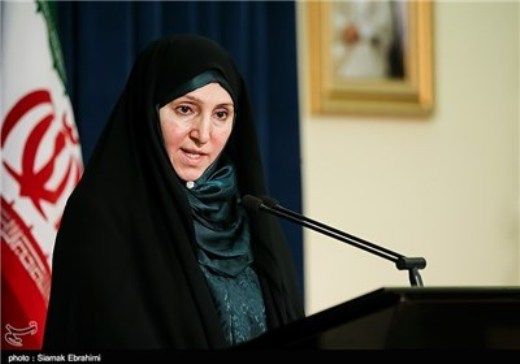
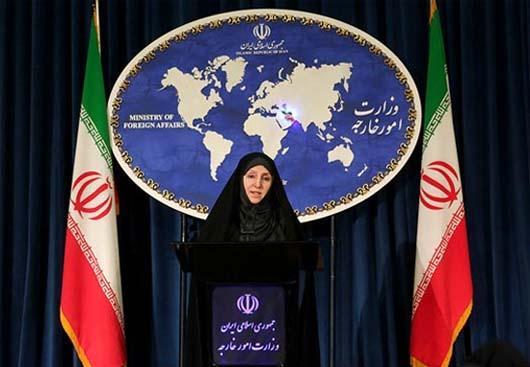
Marzieh Afkham

Iran’s Foreign Ministry spokeswoman on Tuesday condemned in the strongest terms the terrorist attack on a school in the Pakistani city of Peshawar.

“This is a totally un-Islamic and inhumane action,” Marziyeh Afkham said, adding that terrorism, extremism and putting innocent people’s lives at risk in any form and with any purpose are reprehensible.

She also expressed sympathy with the government and nation of Pakistan, especially the bereaved families of victims.

Afkham further said cooperation among the regional countries and the world community is necessary in order to fight terrorism and extremism.

At least 130 people, most of them students as young as 12, were killed and at least 122 others injured on Tuesday in a Taliban seizure of a military-run school in Peshawar.

The numbers of dead and injured may still rise as the casualties of the assault are counted.

Some 500 students and teachers were in the Army Public School on Warsak Road at the time of the attack. Pakistan’s military said most of the civilians escaped, but some had been taken hostage by the assailants.

Several militants dressed in Pakistani military uniforms entered the school compound on Tuesday at around noon. They torched a car at the site and proceeded with a raid on the facility.

The Pakistani Army responded to the emergency, dispatching security forces to cordon off the area and sending military helicopters for surveillance. A commando force arrived at the site.

In the ensuing battle with Pakistani security forces, all six militants were killed, according to the military. One of them is said to have detonated a suicide vest he was wearing, according tolocal media.

A look at Iranian newspaper front pages on Dec. 17

Iranian Newspapers Headlines

The massacre of schoolchildren at the hands of the Pakistani Taliban was the dominant front-page story in Iranian newspapers on Wednesday. “A bloody day in Peshawar,” one headline read. “Ruthless massacre of children,” said another. Also on the front pages of the dailies were the comments of the commander of the Islamic Revolution Guard Corps on relations between the corps and the government of President Rouhani. Major General Mohammad Ali Jafari was quoted as saying that the president was not alluding to his men when he told an anti-corruption conference in Tehran last week if what they have at their disposal is given to anyone, they would become corrupt. Dailies also ran front-page reports on the Iranian-born Haron Monis who took hostages at a café in Sydney, Australia and was killed in a shootout with police after a 16-hour-long drama.

Abrar: “We are still away from reaching a settlement [in nuclear talks],” said Iranian negotiator Seyyed Abbas Araghchi.

Abrar: The chairman of the Expediency Council has said that if religious extremism is not harnessed, another IS will be created.
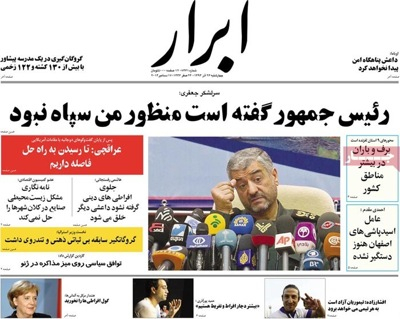
 

Abrar newspaper 12 - 17


Afarinesh: “The government cannot report to the public the depth of the problems it has inherited [from its predecessor],” said Chairman of the Expediency Council Ayatollah Akbar Hashemi Rafsanjani.

Afarinesh: “Ties between the Islamic Revolution Guard Corps (IRGC) and the president are based on mutual respect,” said IRGC Commander Major General Mohammad Ali Jafari.
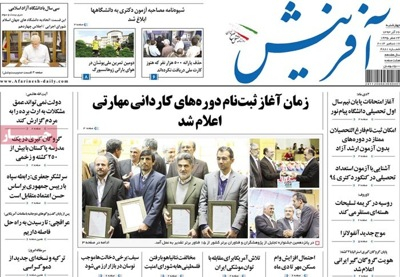
 

Afarinesh newspaper 12 - 17


Afkar: The Stock Exchange has finally landed in positive territory.
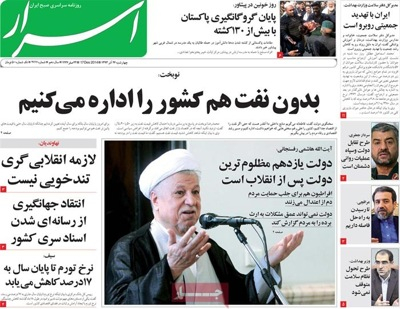
 

Asrar newspaper 12 - 17


Arman-e Emrooz: Massive changes in the Islamic Republic of Iran Broadcasting (IRIB) following Mohammad Sarafraz’s takeover of the national broadcaster.
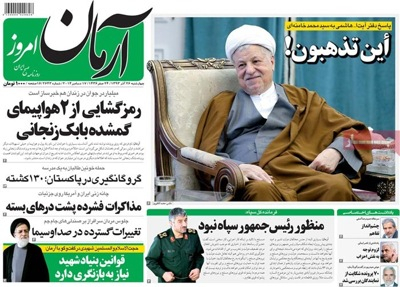
 

Armane emruz newspaper 12 - 17


Asr-e Rasaneh: A ship full of foreign tourists is on its way to Iran.
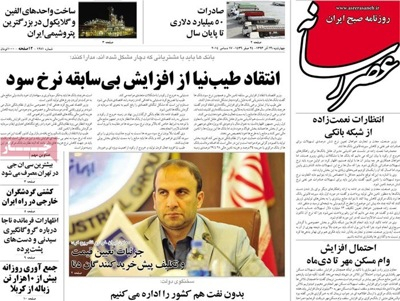
 

Asre resaneh newspaper 12 - 17


Asrar: “We can run the country even without oil [revenues],” said Government Spokesman Mohammad Baqer Nobakht.


Asrar newspaper 12 - 17


Ebtekar: Up to 130 people were killed in a Taliban attack on a school in Peshawar, Pakistan.
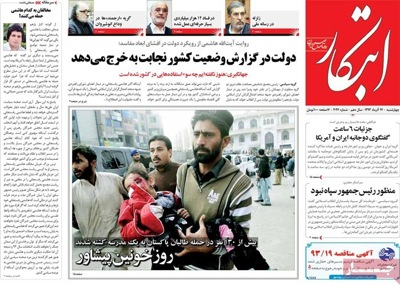
 

Ebtekar newspaper 12 - 17


Etemad: First Vice-President Eshaq Jahangiri has slammed the release by the media of the confidential [government] decisions.
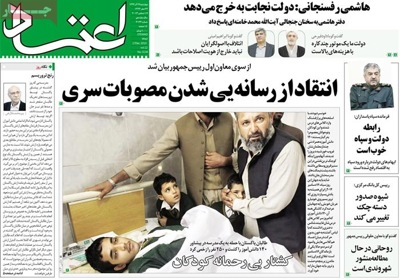
 

Etemad newspaper 12 - 17


Ettela’at: Iran’s top researchers and technologists have been rewarded in a ceremony [in Tehran].

Ettela’at: The European Union has said that it will cooperate with Iran and Russia to defuse the Syrian crisis.
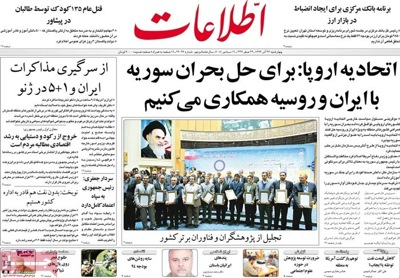
 

Ettelaat newspaper 12 - 17


Hemayat: “Reports on tortures in America are a reflection of the breakdown in morality,” said Judiciary Chief Sadegh Amoli Larijani

Hemayat: “The Sydney hostage taker was wanted by Iranian authorities for fraud,” said Police Chief Esmail Ahmadi Moghaddam.
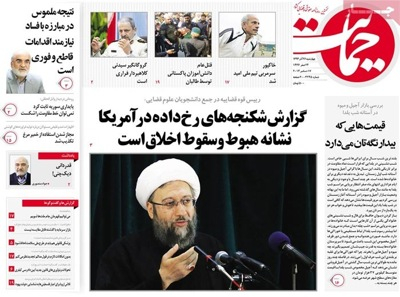
 

Hemayat newspaper 12 - 17


Javan: “Three economists in parliament have warned President Rouhani that the fluctuations of foreign currency and gold markets as well as a volatile stock exchange could retrigger recession and inflation.”
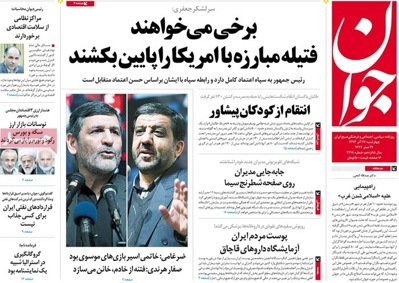
 

Javan newspaper 12 - 17


Jomhouri Islami: “The Iranian government and nation stand by their rightful demands with tenacity,” said Foreign Minister Mohammad Javad Zarif.

Jomhouri Islami:“The Islamic Revolution Guard Corps (IRGC) is not involved in trade, exports and imports,” said IRGC Commander Major General Mohammad Ali Jafari.
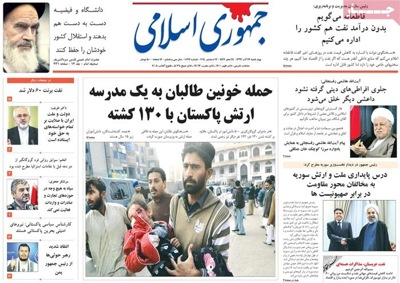
 

Jomhorie eslami newspaper 12 - 17


Kaenat: Iranians paid their final respects to veteran actor Anushirvan Arjmand on a rainy day.
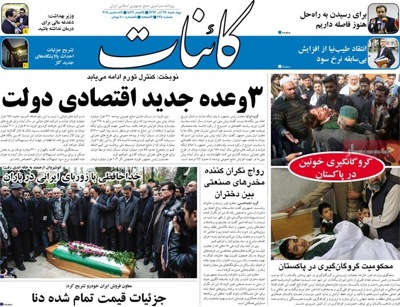
 

Kaenaat newspaper 12 - 17


Kayhan: “Some are trying to weaken Iranian opposition to the United States,” said the commander of the Islamic Revolution Guard Corps.
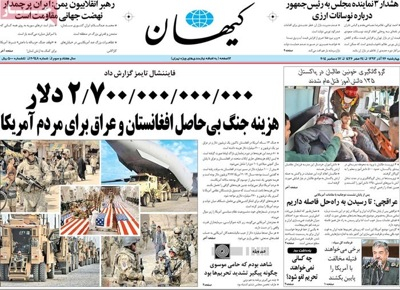
 

Kayhan newspaper 12 - 17


Mardomsalari: “The law on free access to information could be revolutionizing,” said Deputy Minister of Culture and Islamic Guidance Hossein Entezami.

Mardomsalari: “The agency that makes decisions on the house arrest [of those who disputed the results of the 2009 presidential elections and thus caused chaos] is the Supreme National Security Council,” said Justice Minister Mostafa Pourmohammadi.
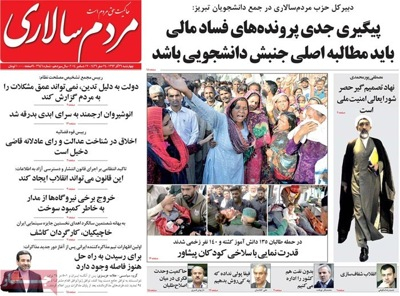
 

Mardom salari newspaper 12 - 17


Qods: Parliament has taken the first step toward turning up the heat on corruption. It has drafted a bill that would oversee the creation of an organization to lead the fight against corruption. The organization will answer to the Supreme Leader.
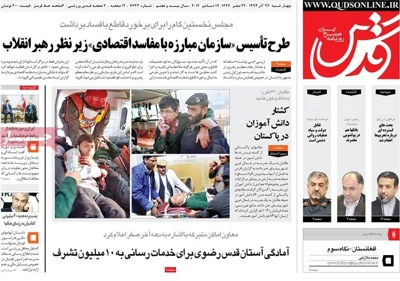
 

Ghods newspaper 12 - 17


Shahrvand: “Managers who were successful in the radio and TV organization have made a comeback to the national broadcaster.”
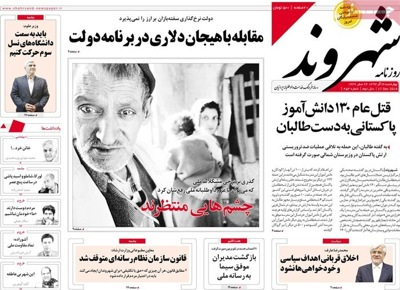
 

Shahrvand newspaper 12 - 17


Sharq: “A reformist-majority parliament won’t be a terrifying project,” said Ali Motahari, a Tehran MP.

Sharq: “It is impossible to streamline the housing sector over a short period of time,” said the minister of roads and urban development.
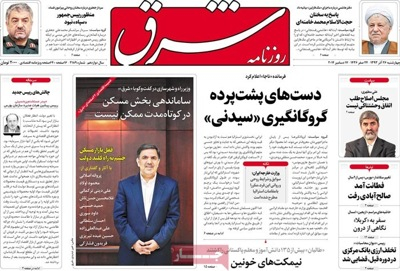
 

Shargh newspaper 12 - 17


SMT: Exports of Iran’s hand-woven carpets have registered a 25 percent hike.
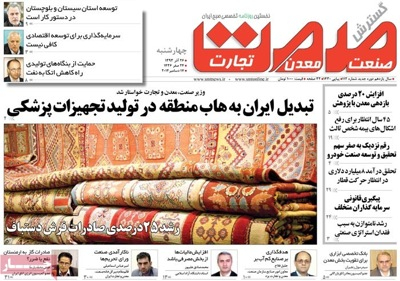
 

Samt newspaper 12 - 17


President Rouhani: World has realized Syria fighting terrorism

Iran-Syria-Rouhani

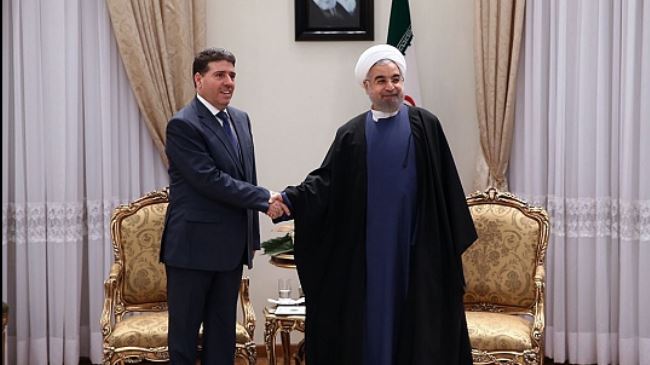
President Hassan Rouhani says that the world has now realized the fact that Syria is involved in a battle against terrorism.

“Today, the world’s public opinion has realized the fact that the Syrian army and people are fighting against terrorist groups and foreign conspiracies,” Rouhani said during a meeting with Syrian Prime Minister Wael Nader al-Halqi in Tehran on Tuesday.

The crimes committed by terrorist groups in Iraq have exposed the true nature of terrorists and the conspiracy devised by enemies against the region and Islam, he added.

Rouhani stressed that the Syrian conflict can only be resolved through “domestic political negotiations.”

The Syrian premier thanked Iran for its support for the Arab country, saying Damascus is ready to consider any appropriate initiative to resolve the country’s crisis.

“The Syrian government and people appreciate the Iranian government and people for their support during the four-year cruel war against Syria,” Halqi said

The Syrian government will consider any initiative that does not infringe upon Syria’s national sovereignty and contributes to the country’s unity, he added.

Syria has been grappling with a deadly conflict since March 2011. The Western powers and their regional allies – especially Qatar, Saudi Arabia, and Turkey – are the main supporters of the militants operating inside Syria.

Over the past months, Syrian soldiers have made numerous gains in the battle against the foreign-sponsored militants, inflicting heavy losses on them in several areas.

More than 200,000 people have so far died in the conflict.

Iran FM blasts ME countries on falling oil prices

zarif-jabouri

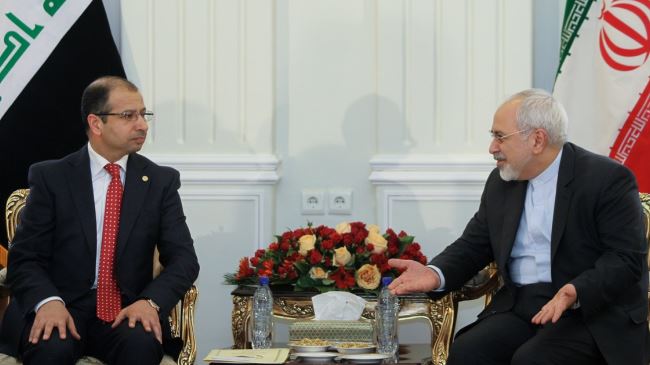
Iranian Foreign Minister Mohammad Javad Zarif has criticized the oil-producing countries of the Middle East for failing to control plummeting crude prices.

“It is regrettable that regional [oil-producing] countries are not cooperating on the falling oil prices and its negative implications,” Zarif said in a meeting with Iraqi Parliament Speaker Salim al-Jabouri in Tehran on Tuesday.

Oil prices have been falling throughout 2014, getting nearly halved since June as a result of declining demand and increased supplies.

On Tuesday, the price of Brent crude oil tumbled below USD 59 a barrel for the first time since May 2009.

The five-year low was exacerbated following a refusal by some major oil producers, including Saudi Arabia, to cut their crude output.

Zarif also expressed Tehran’s readiness to promote all-out ties with its western neighbor, especially in political, economic and parliamentary fields, saying Iraq’s progress and security is intertwined with that of Iran.

“The Islamic Republic of Iran is ready, like before, to cooperate and consult with all regional countries on Iraq, and Iran is prepared to take effective measures in that regard,” Zarif added.

Jabouri, for his part, said that all Iraqi ethnic and religious groups were united in the fight against terrorist groups, including ISIL.

He also underlined the need for unity and solidarity among regional countries to contribute to stability and security, saying all regional nations, including Iran and Iraq, benefited from security in the Middle East.

Iraqi army soldiers, backed by volunteer forces, have been fighting ISIL for several months now.

The ISIL militants, who have seized swathes of land in Iraq and neighboring Syria, have been carrying out horrific acts of violence against all communities such as Shiites, Sunnis, Kurds and Christians, in both Arab states.

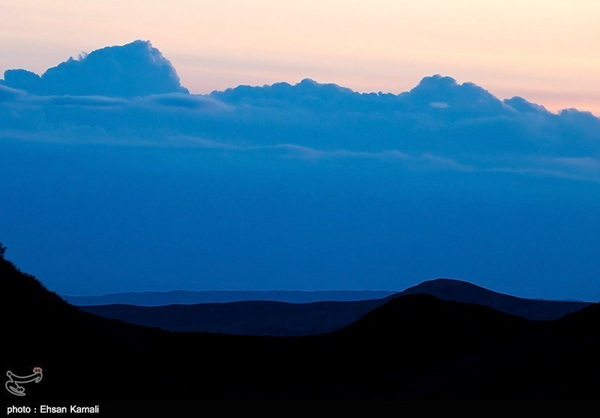
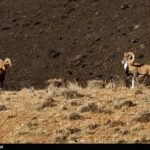
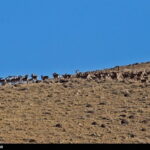
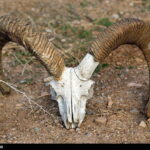
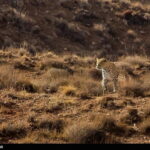
Wildlife in Iran’s North Khorasan Province

Iran-Wildlife North Khorasan

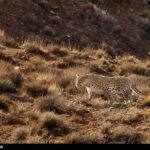
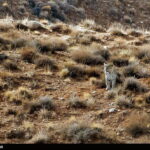
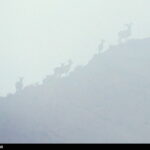
North Khorasan Province, located in northeast of Iran, is a habitat to different species of wildlife like leopards, rams, hawks and wild boars.

The following are photos Tasnim News Agency released on December 8 on wildlife in northeast of Iran:


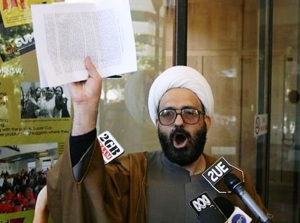
Sheikh Haron Monis: I am no longer Rafezi!

sheikh-haron

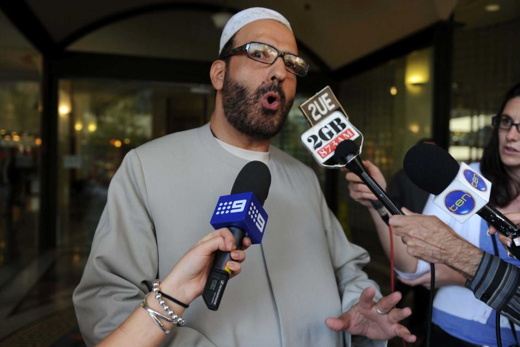
Following the deadly hostage taking by a man of Iranian origin in Sydney, Australia on Monday, Fararu, an Iranian news website, released additional information on the hostage taker on Tuesday. The following is the translation of what the website reported:

An investigation by a Fararu reporter indicates that the hostage taker the Australian police have identified as Sheikh Haron Monis was known as Mohammad Hossein Manteghi Borujerdi in Iran. He once attended Imam Sadegh University in Tehran.

He was admitted to Imam Sadegh University in 1982, the same year the university, run by the late Ayatollah Mahdavi Kani, was founded. Manteghi completed his master’s program at the same university.

Toward the end of his university years, he married the daughter of a then university official, but after a while walked out on her and moved to Australia in 1996.

Having been implicated in a corruption case, he fled the country and deceived the Australian government into granting him political asylum. The fact that he had left his wife behind in Iran prompted the family of his wife to successfully apply for divorce in absentia.

After a while, he donned a clerical robe in Australia and set out on a mission to attract attention. After a few years, thanks to mental problems and greed, he developed an interest in Wahhabism.

sheykh haronMost recently on his website, which has been blocked by the Australian police, he identified himself as no longer being a Rafezi (a derogatory term Wahhabis use to refer to Shiites), saying he had converted to Islam. He then changed his name to Sheikh Haron Monis.
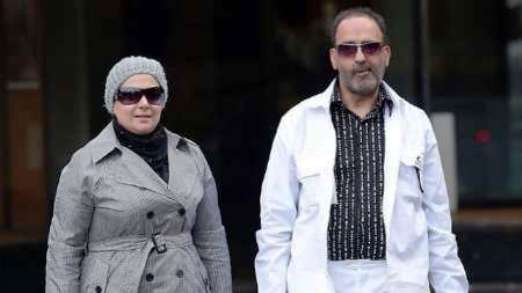
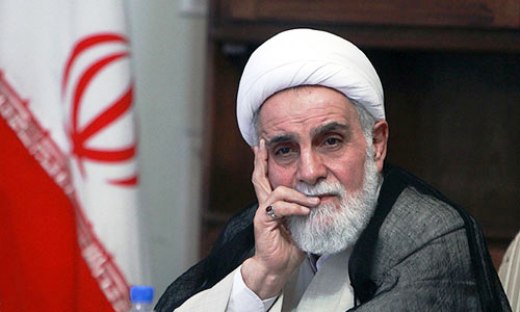
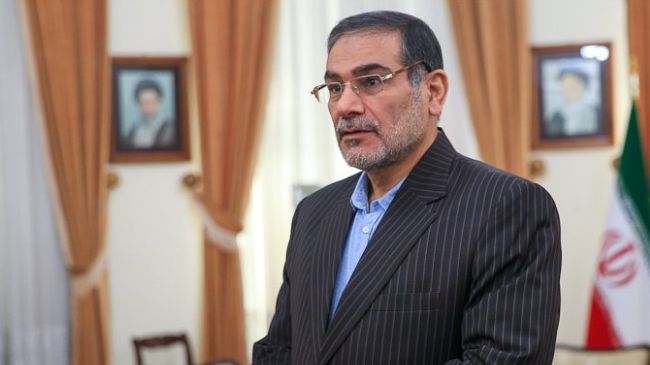
During the hostage crisis, he ordered hostages to post flags similar to those of IS [terrorists] behind the glass of the store where the drama was being played out. He also ordered them to contact Australian media and tell them that the hostage taking was the work of IS.


Australia supported the Iranian-fugitive-turned-Sydney-hostage taker; Western media hype the Islamophobia scenario

Manteghi

We do not know the rules of the game: Former parliament speaker

Ali Akbar Nategh Nuri

On December 16, Iran, a daily, filed the remarks of Ali Akbar Nategh Nouri, a member of the Expediency Council and a former parliament speaker, on the role of political parties in promoting democracy in the country. What comes below is the translation of what he had to say at the 3rd National Seminar on the role of Research in the Legislative Process on Monday:

Highlighting the need for democratic tools in the country, Nategh Nouri said, “Unfortunately, we do not know the rules of the game and the country cannot be run in the absence of political parties.”

Hailing parties as the tools of democracy, he added, “A democratic country should have parties and without them, administration of affairs in the country becomes difficult.”

Recalling verses from the holy Koran he stated, “If ordinary people want to vote for a real expert to represent them in the Assembly of Experts, presidential office or parliament, they do not know [well] about the individuals [candidates] who can best represent their province, city or region, so they cannot opt for the right candidate.”

“In the absence of experts, we run the risk of getting entangled in conflicts between ethnic and tribal groups or making impulsive decisions. Unfortunately, studies suggest people act on a whim in national affairs. A country cannot be run on a whim, with different factions coming and going.”

Expressing regret about the absence of democratic tools and the lack of knowledge about the rules of the game, he said, “When Party A takes office [and replaces Party B], it is entitled to replace top-level ministers, advisors and deputies, but employees who hold lower positions, working under advisors and deputies should not be affected. But what we see here is that as soon as Party A rises to power, the scale of employee shakeup stretches into the lowest positions. Accordingly when Party B succeeds Party A, it follows suit, citing the fact that its predecessor has done the same thing.”

“Thirty five years have passed since the revolution. We are no longer inexperienced, and we cannot claim that we are going through trial and error. After 35 years, such [wrong] measures cannot be sold to anyone,” he added.

“We do not know the rules of the game, nor do we have the tools, therefore the need for parties should be institutionalized in the country so that parties can introduce candidates and experts so that people can vote for them. This is one of the necessities of the country,” Nategh Nouri said.

“Irregularity has caused substantial damage to our country and we have incurred a lot of losses. From now on, we need to pay closer attention to such matters to suffer fewer losses,” he stated.

“The Islamic Republic of Iran considers parliament one of the pillars of the establishment and under the Constitution, the Islamic Consultative Assembly is one of the most powerful bodies not only among Iran’s institutions but also among world parliaments,” he said.

“As the Constitution was being drafted, one of the individuals fundamentally opposed to inclusion of a term which would allow the dissolution of parliament was the Supreme Leader Ayatollah Khamenei who was of the opinion that parliament cannot be dissolved and its bills cannot be signed into law as long as they are not approved by the Guardian Council.

“However when those acts get the go-ahead no official in the country can veto them. Of course, under the very Constitution, aside from lawmaking, parliament can oversee the performance of the government as well as other branches,” he concluded.

Organization of Arba’een ceremonies shows Iraqis do not need foreign security assistance

Iran-shamkhani
Iran-shamkhani

Secretary of the Supreme National Security Council Ali Shamkhani has sent a message to Iraqi Prime Minister Haider al-Abadi to congratulate him on the victory Iraqi armed forces and volunteers pulled out in ensuring the security of the largest human congregation across the world. The following is a translation of part of the message Javan daily released on December 16:

In the message, Shamkhani said although Takfiri terrorists were bent on disrupting the event, Iraqi security and intelligence forces did an excellent job in ensuring the security of the congregation. “That Iraqi government tapped into the enormous potential of volunteers to provide security for the ceremonies displayed the matchless power of popular determination in countering terrorists.”

The message further said, “The glorious organization of the event which, thanks to the presence of different groups such as Shiites, Sunnis, and Kurds turned into manifestation of Iraqi national unity, proved that the Iraqis are capable of maintaining their security without reliance on foreigners.

“No doubt, determined Iraqis can build on the support of religious scholars to beat the remainder of terrorists and restore peace, welfare and security to their nation.”

In conclusion, Shamkhani thanked the Iraqis for hosting more than 1.5 million Iranians and thousands of others from 60 different countries during the ceremonies.

[…]

Iran thanks Iraq for “glorious” organization of Arba’een

Iranian Foreign Ministry Spokeswoman Marziyeh Afkham

Iranian Foreign Ministry Spokeswoman Marzieh Afkham has thanked the Iraqi people, government and senior Shiite clerics for setting the stage for glorious organization of ceremonies to mark Arba’een [a Shiite observance marking 40 days after Ashura, which is the day when Imam Hussein, the grandson of Prophet Muhammad fell a martyr in an uprising centuries ago].

According to Mehr News Agency, Afkham hailed this year’s ceremony as manifestation of spirituality and unity inspired by the epic uprising the grandson of the Prophet led against tyrannical rulers of his time.