Monday, December 22, 2025
Home Blog Page 4866

A horse farm in northeastern Iran (PHOTOS)

Turkmen horses

Dr. Abdoljalil Ghiadi is a physician who lives in a village in the northeastern province of North Khorasan. Aside from practicing medicine, he is so interested in horse breeding that he has bred over 50 Turkmen thoroughbreds so far.

Snapshots of the doctor with his horses put online by Tasnim News Agency:

First Iran-P5+1 draft to contain blank sections: Araghchi

araghchi

A senior Iranian negotiator says the first draft of a deal between Iran and P5+1 on Tehran’s nuclear program will contain gaps requiring further decisions.

Iran’s Deputy Foreign Minister for Legal and International Affairs Abbas Araghchi made the comment in an interview with IRIB on the sidelines of the 2015 Review Conference of the Parties to the Treaty on the Non-Proliferation of Nuclear Weapons (NPT) in New York.

Araghchi said Iran and P5+1, represented by EU political director Helga Schmid, have officially started drawing up the draft of a final nuclear agreement.

He expressed hope that within the next days the sides would be able to write the first draft of the overarching deal “which includes all points.”

“It will be a tough task. This first draft will be full of disputed issues and will include parentheses and brackets, and decisions should be made about them in the future,” Araghchi said.

Experts from Iran and the six global powers are examining the details, he said, noting that a two-month period has been envisaged for writing the draft.

Iran and P5+1 seek to reach a draft agreement in New York no matter how many days it will take, the official said, adding the next round of talks would continue in Europe.

Araghchi noted that the main agenda of the Iranian negotiating team in New York focused on the NPT review conference.

The Iranian negotiators, however, have held nuclear talks with European Union foreign policy chief Federica Mogherini, Director-General of the International Atomic Energy Agency Yukiya Amano and US Secretary of State John Kerry on the sidelines of the New York event, Araghchi said.

Iran and P5+1– the United States, France, Britain, Russia and China plus Germany – reached a mutual understanding on Tehran’s nuclear program in the Swiss city of Lausanne on April 2.

The two sides held expert-level talks in Vienna, Austria, on April 24. The three-day talks were held in a bid to draft the text of a final agreement based on the mutual understanding reached in Lausanne.

Iran and the six-party group have agreed to finalize a comprehensive deal on Tehran’s nuclear program by the end of June.

Yemen’s Ansarullah vows decisive response to Saudi invasion

Ansarullah

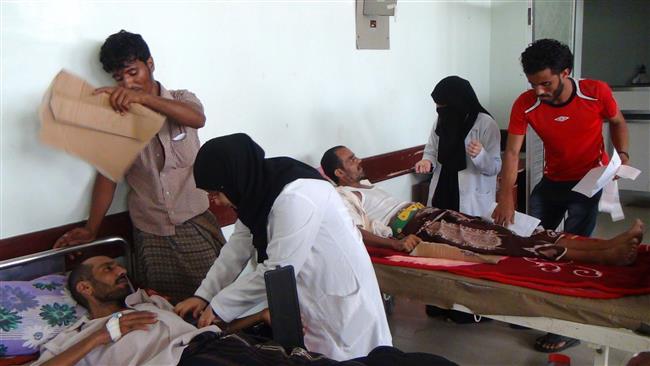
Yemenis will definitely respond to the Saudi-led attacks, an official with the Ansarullah movement underlined, saying the appropriate place and time for such reaction is left to the discretion of the Yemeni army and voluntary forces.

Speaking to the Tasnim News Agency, Mohammed al-Bukhaiti, a member of Ansarullah’s political council, warned of the serious consequences that invading Saudis will have to face in response to their military campaign against Yemen.

Ansarullah has not so far responded to the Saudi-led strikes to give the aggressors the time to think twice, he added.

“The response will be certain,” Bukhaiti reiterated, noting that the decision for the time and place of reaction comes within the purview of the Yemeni army and voluntary committees, with “all options” on the table.

He also called for the return of Yemenis to the negotiating table to settle the conflicts in the Arab country, stressing that any political decision needs to be made through Yemeni-Yemeni dialogue and consensus among all parties.

On March 26, Saudi Arabia and some of its Arab allies began to launch deadly air strikes against the Houthi Ansarullah movement in an attempt to restore power to the fugitive former President Abd Rabbuh Mansour Hadi, a close ally of Riyadh.

According to the spokesman of the Yemeni Army, the Saudi-led war on the Arab country has killed more than 2,000 people, most of them civilians.

On Thursday, UN Secretary-General Ban Ki-moon warned about the consequences of the continued blockade on Yemen, saying that dire fuel shortages in the Arab country were threatening to bring all relief operations to a halt “within days”.

The UN chief called for an “immediate resumption of fuel imports to avoid making the already catastrophic humanitarian situation in Yemen even worse.”

Zarif raps Egyptian daily for distorting remarks on Israel

Mohamad Javad Zarif

Iranian Foreign Minister Mohammad Javad Zarif lashed out at an Egyptian news website for distorting his comments on Israel.

On his Facebook page on Friday, Zarif said that the Egyptian website has falsely distorted his answer to a question by an American reporter on talks with the Zionist regime.

He said that the Egyptian website has falsely interpreted his clear and one-word (no) response to a question on possibility of holding talks with Israel as Iran’s readiness to negotiate with the regime.

Also on Thursday, Iran’s Interest Section in Cairo strongly blasted the Egyptian news website for misquoting Zarif’s remarks.

Iran’s Interest section in Cairo said in a statement that the Egyptian al-Youm al-Sabe’ daily had raised baseless claims on relations between Iran and Israel.

“All claims and allegations raised in this report, especially the remarks attributed to the Islamic Republic of Iran’s foreign minister quoted by certain Zionist media are sheer lies and fully baseless,” a statement by Iran’s Interest Section in Cairo said.

It added that all the Muslim world and Arab public opinion is aware of the Islamic Republic of Iran’s principled and clear policy on the illegitimate nature of the Zionist regime and Tehran’s support for the Palestinian nation’s holy cause and the holy Quds.

No place for adventurism in region: Iran’s deputy FM

Hossein Amir-Abdollahian

Iran’s Deputy Foreign Minister Hossein Amir Abdollahian slammed Saudi-led military offensive against Yemen as an adventurous act, saying Tehran will not allow such measures to jeopardize its joint security interests with Yemen.

In an interview with IRIB on Saturday, Amir Abdollahian said Iran will not allow others to imperil the security of Yemen, which he said is analogous with security of the region and Iran.

“The era of such adventurous moves has ended, and all sides should think about the region’s security and playing a constructive role,” the Iranian diplomat noted.

He also explained that Saudi Arabia’s focus on the military attacks against Yemen has just “emboldened the Zionist regime (of Israel) and the terrorist groups.”

Amir Abdollahian once again voiced Tehran’s support for the “Yemeni-Yemeni dialogue” and rejected any foreign meddling in the Arab country’s internal affairs.

He also deplored the muted response by certain countries on the continued Saudi-led airstrikes against Yemen and the blockade of the war-torn nation.

On March 26, Saudi Arabia and some of its Arab allies began to launch deadly air strikes against the Houthi Ansarullah movement in an attempt to restore power to the fugitive former President Abd Rabbuh Mansour Hadi, a close ally of Riyadh.

According to the spokesman of the Yemeni Army, the Saudi-led war on the Arab country has killed more than 2,000 people, most of them civilians.

On Thursday, UN Secretary-General Ban Ki-moon warned about the consequences of the continued blockade on Yemen, saying that dire fuel shortages in the Arab country were threatening to bring all relief operations to a halt “within days”.

The UN chief called for an “immediate resumption of fuel imports to avoid making the already catastrophic humanitarian situation in Yemen even worse.”

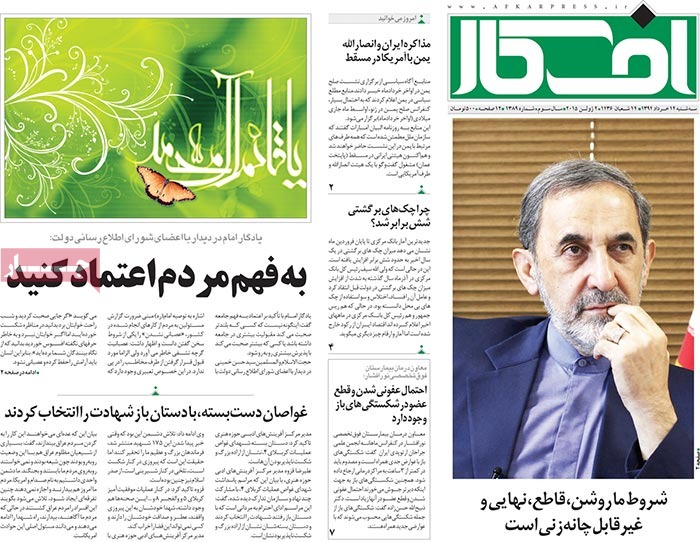
Iran under President Rouhani, a boon or a bane

197987_647

Dr. Rouhani’s foreign policy is mainly focused on more interaction with the international community, regional countries in particular, and on what he has repeatedly announced as a win-win approach.

Abdolali Ghavam, a faculty member at Shahid Beheshti University, in an opinion piece published by Etemad newspaper on April 19, elaborated on nuclear talks with P5+1 and President Rouhani’s foreign policy achievements. The following is a partial translation of the piece:

Rouhani’s foreign policy

In game theory, a zero-sum game is [a mathematical representation of] a situation in which a gain for one side entails a corresponding loss for the other side. […]

I think Dr. Rouhani is favoring a win-win game. The question that arises here is how much the Iranian foreign policy can show flexibility, structurally, to shift from a zero-sum game onto a win-win game.

Other theories

[…]

There is one point in game theory: although you have information about the other side in terms of politics, military and technological issues, etc., you cannot fully assess that information [which has turned into part of your mindset].

[…]

It can be said that you face limited communication [with the other side]. Although you have collected, among other things, the necessary ammunition on the other side’s economic and military capabilities, you still don’t know if the decision the other side makes has anything to do with those capabilities and whether its proposals and threats are real or just a bluff.

[…]

For any move you make, you need to weigh the costs you have to pay and the benefits you may reap. The costs and benefits may differ from one player to another. For instance, you may think that a policy you adopt will cause the other side to pay dear economic prices. Thus you may conclude that it is its Achilles’ heel on which you can pile more pressure. Maybe, unlike normative, ideological and idealistic questions, financial and economic issues are of little importance to that government.

Thus, the costs and benefits are not necessarily economic. If we just assess the financial and economic pluses and minuses, we are likely to miscalculate and this will cause huge damage.

In game theory, “brinkmanship” [the practice of seeking advantage by creating the impression that one is willing and able to push a highly dangerous situation to the limit rather than concede] happens when you take the other side to the edge of a cliff, but you are not sure if you want to push it down or keep it up there.

The game theory also entails deterrence. “Minimax” [a decision rule used in game theory for minimizing the possible loss for a worst case (maximum loss) scenario] and Maximin [the procedure of choosing the strategy that most benefits the least advantaged member of a group] are also part of the game theory. They are the games which help you maximize your benefits. They are the games in which you think a minimum is enough for you.
In Minimax, you choose the lesser of two evils. You may get involved in a situation in which you don’t have an ideal alternative, but you accept the least benefit. This way you choose the best of the worst to sustain fewer losses. This is the general framework of the game theory. […]

Win-win game

[…]

You get involved in interaction and cooperation when you see the game as a win-win situation. As one of the parties, if you expect to be the eventual winner of the talks and the other party the real loser, such talks do not take place. Even if they do, they will end inconclusively. […]

The other party [the US here] too seeks to win something out of the talks. For example, Mr. Obama wants to and should sell the result he achieves in the agreement to Congress. He should be able to pitch that result to his rival party, especially the radical and far-right Republicans. That he raises the issue in a certain way not to draw opposition from the Republicans comes with the territory t. […]

Obama does not think only about his term in office. He is thinking of a situation in which a Democrat president is at the White House. So any agreement [with Iran] can be a positive achievement under his belt. That’s why you cannot be a [comfortable] winner on all fronts in the talks.


P5+1 profits

First of all, economic profits do matter to members of P5+1, especially the Europeans as well as Russia and China. A number of European companies and industries admitted that they couldn’t believe the consequences [that they could not do very simple business with Iran] when they [first] learned about the sanctions imposed against Iran in recent years.

In light of the fact that Europe has been hit by a [money] crisis and Russia is currently facing a crisis [it is under sanctions over its role in Ukraine], P5+1 countries are seeking economic profits – their number one priority. Even in the recent round of nuclear talks in Lausanne, the topics which were raised showed that European countries together with China and Russia thought that the US was seeking to reap the largest benefits out of the agreement.

This was evident in their behavior. For instance, the top diplomat of one of those countries left the Swiss city and his deputies attended the talks. This shows that there is an economic rivalry among them too.

Economic profits are important to the US too, but what is more significant to the US are strategic interests, political and security issues, and how successful it is in turning Iran from a problem into a solution. That Western countries, the US in particular, see Iran as a problem has imposed huge security, economic and political costs on them.

If this [Lausanne] agreement is inked, it will be a paradigm shift and change Iran’s issue, which was believed to be a problem, into a solution.

When turned into a solution, Iran will be dealt with as a partner. Under such circumstances, the US and its fellow P5+1 members can benefit from an Iran which has turned into a solution. Instead of an Iran which is involved in Lebanon, Palestine, Iraq, Yemen and other hotspots, they can be helped by an Iran which is part of the solution. A U-turn surfaces here; naturally cooperation can be replaced by confrontation and conflict if Iran is regarded as a problem.

Conditions of talks and agreement

Before setting the stage for holding talks which could result in an agreement, there should be common ground between countries. The parties to the talks should accept the legitimacy of the other side. Either side should think its rival enjoys potential and it can take advantage of such potential. In other words, one party enjoys legitimacy or power that the other party can count on. If a country [one side] can encourage the other side [another country] to establish cooperation, the former can largely meet its own demands.

The second factor which pushes the governments – especially those that were at odds – toward agreement and cooperation is the growing rise in the costs the two sides should pay for confrontation. It means the higher the costs of confrontation between the governments, the more willingness on their side to reach agreement and have cooperation.

[A case in point is what Iran has done so far.] So long as the price Iran has to pay for lack of cooperation with P5+1 has not gone beyond a certain limit, Iran prefers not to be engaged in talks because the country does not lose much. Or as long as the US thought it was only Iran which was paying the price [for no engagement] it showed not much interest in engaging Iran. But when the economic, political, military and cultural costs the two sides have to pay rise on different fronts, the stage is set for reaching an agreement. […]

Rouhani diplomacy and international theories

If we want to study Iran’s foreign policy, we realize that it is based on several theories of international relations. It covers mainstream theories such as realism, liberalism and their different versions as well as Constructivism and critical theories.

What happens when you are engaged in a win-win game and international cooperation is definable according to liberalism? The security concerns can be studied within the principles of realism. When you challenge the existing regional order, you are critical of international law, human rights and the like, and you are following the critical theories. […]

Global changes and nuclear talks

[…]

The US under Obama has based its foreign policy on the world policy. The US look at global policies has been boosted after Democrats, led by Obama, assumed power. Unlike Gorge W. Bush and his fellow Republicans who put war above peace, Obama favors peace. What Obama is pursuing is peacemaking – or creating peace – not peacekeeping alone. This mindset focuses on efforts to create peace and try to maintain it.

Obama has taken into account a liberal principle which says that war is too costly compared with diplomacy and that relative stability and security is achievable through diplomatic means. [As for the nuclear agreement with Iran] I think the view of the US leaders has played a key role. The upshot of the agreement could serve the interests of P5+1, one way or another.

In addition, several regional countries – among them Israel, Saudi Arabia and Turkey – are upset by the current situation [a reference to the agreement] because they have been the leading players in the region in the absence of Iran, and now they think Iran is emerging as a serious rival. What has been the order of the day so far was ideal for them because they were given more room to maneuver. […]

Role of talks in global diplomacy

The policy President Obama is pursuing – that issues can be solved through diplomacy not confrontation and that diplomacy is less costly – has greatly paid off. World nations, especially regional countries, can learn a good lesson from it: that they can solve their issues through talks providing that the outlines of national interests and objectives as well as the priorities of those objectives are clear for the governments.

The upside of Iran diplomacy

[…]

That Iran announced it favored a win-win strategy marked the beginning of cooperation and talks. What parted the parties to the talks in the past was the win-lose strategy. Another plus for Iran is the employment of professional diplomats and well-experienced advisors – who were fully familiar with diplomatic techniques and knew how to get engaged in talks. […]

Main achievement of a possible final deal

[…]

In case of a final nuclear deal, the international community will have a different look at Iran. This will set the stage for other governments and nations to have more interaction with Iran, something which would help Iran meet their demands easily.

Under such circumstances, Iran can enjoy a better position and a more powerful base in the region to serve its national interests. It will also ease the concerns of P5+1 and other countries which regarded Iran as a threat. In other words, factors which threaten [regional] security will be replaced by those which beef up security.

Failure to ink a final deal

Even if no deal is clinched, Iran has walked down a long path to reach an agreement, has voiced its desires and demands, and has – honestly and powerfully – talked about its issues. In case of failure, one can say that Iran has chosen diplomacy because it favors talks, but that the other governments have gone for other options since they were not willing to reach an agreement.

[…]

A dramatic turnaround beyond a nuclear deal (PART TWO)

Lausanne deal

“Nothing has happened yet” is apparently the only similarity between the official stance of high-ranking Iranian and US leaders following the release of a joint statement by Iran and P5+1 in Lausanne [in early April]. The shared stance of the two sides is a requirement of diplomatic shrewdness to keep the doors to bargaining open in the months ahead and avoid triggering backlash at home.

Donya-e Eqtesad daily on April 15 published an opinion piece by Dr. Mohammad-Mahdi Mojahedi, a professor of Comparative Political Philosophy in Germany, about the tentative nuclear agreement between Iran and P5+1 and its consequences. The following is Part Two of the translation of the piece:

A dramatic turn in regional policies of the US and Western governments is a scenario which would answer: 1) Why did the US president start to have secret correspondence with senior Iranian leaders and why did secret [US-Iran] talks open in Oman one year before the 2013 presidential elections [in Iran]? 2) Why is the US willing to pay a heavy price – irking Israel and [its] regional allies – for advancing talks with Iran? 3) Why is the US administration ready to pay a dear price for its confrontation with Congress? 4) And why are senior officials of the Islamic Republic ready to show strategic far-sightedness and accept nuclear restrictions in case the US proves – during the talks – its resolve to take a dramatic turn?

This dramatic turn has two basic parts: One is the preparedness of the US and other world powers to gradually turn their backs on trouble-making Arab partners which are believed to be taken hostage by their own political structure and to be caught in domestic and regional crises as part of a self-destructive and irreversible trend. The signs of such abandonment have started to surface.

Another is the preparedness [of the US and other world powers] to gradually acknowledge and recognize the political status and strategic position of the Islamic Republic of Iran as the anchor of regional stability.

De-escalation of ties between Iran and world powers is the very first prerequisite to make this dramatic turn become a reality. Such détente – after almost four decades of tenuous ties with post-Islamic Revolution Iran and the accumulated distrust since the 1953 Iranian coup [also known as the 28 Mordad coup, which overthrew the democratically elected Prime Minister Mohammad Mosaddegh] – is not only a tough thing to do, but it is costly too, a price all beneficiaries are expected to pay their own share of.

The internal coordination and integrity among Iran’s senior political leaders has been in place for long – even before the nuclear dispute – to break the mental and objective deadlocks which are associated with strategic cooperation with world powers; Iran’s cooperation with the US-led coalition in Afghanistan against the Taliban is just an example.

Another proof for such dogged determination and integrated resolution is the absolute trust and full authority the Iranian nuclear negotiating team has earned to settle the nuclear dispute during talks with big powers.

It is neither cost-effective nor necessary to possess the full nuclear fuel cycle, not only for Iran but also for most of the countries which have used nuclear energy for decades. That’s why almost 20, out of 30, countries which employ nuclear energy have no full nuclear fuel cycle and import the nuclear energy, citing environmental and economic concerns. Besides, countries such as Denmark, Italy, Austria, Germany, Japan and Australia have for long begun to phase out nuclear energy from their energy regimes. This comes as other countries are gradually following the lead of these nations.

Investment in renewable energies (they are still costly though) will be more economical and safer for many countries in the long run. As far as the strategic values and deterrence go, a nuclear program finds no room – actual or potential – in the defensive doctrine of the Islamic Republic of Iran, and it is far from reasonable to be given a place in that doctrine. What is certain is the incontestability of the scientific and research-related value of a nuclear program, a value which will remain intact according to the framework envisioned in the Swiss statement.

Slowing down the full nuclear fuel cycle is a highly reasonable and low price for a country like Iran to pay in exchange for the big achievement it has gained in [its] regional and global relations: being upgraded from a threat to a partner in cooperation.

This is a stable and firmly-established position in which security threats are eliminated to a large extent and the Islamic Republic is recognized as the undisputable strategic partner of big powers in the region whose prospect for the coming three decades is gloomy because of widespread political uncertainty, organized violence, as well as shortages of water, energy and food resources.

“Nothing has happened yet”, but “the consequences” of what has happened between the Islamic Republic and the US over the past three years have been so big in the framework of strategic developments that veteran US strategists like 93-year-old Henry Kissinger and George [Pratt] Shultz, 95, sit down for a debate against [Zbigniew] Brzezinski, 88, to discuss the consequences of an agreement with Iran. They were not discussing the nuclear agreement but the long-term prospect of the US foreign policy and the future roadmap of the Middle East.

This is an example of heated debates that erupt these days in places where the Middle East is top on the agenda. The fact that these debates widely occur [in different places] substantiates an assessment, by Obama. “It is a once in a lifetime opportunity”.

Obama’s doctrine – which says we should not resort to tough means for what can be done in simple ways – seems to be a diplomatic expression of what the Islamic Republic of Iran and P5+1 jointly expect: that these talks should be held to seize the opportunity which is not to be repeated. This opportunity could pave the way for a dramatic turn in the [US] Middle East policy.

Mohammad-Mahdi Mojahedi is the Royal Netherlands Academy of Arts and Sciences (KNAW) Visiting Professor of Comparative Political Theories, with a focus on Iranian and Islamic studies, human rights and methodology at Leiden University and a Visiting Professor of Political Science at Freie Universitat Berlin.


Consequences of the Saudi formation of a war cabinet at home and abroad

hadi mohammadi

A royal decree, which came out Wednesday, announced changes in the higher-tiers of the Saudi government, culminating what has transpired over the past few months, especially the last six weeks: Saudi Arabia waging a war on the Yemeni people.

Formation of a war cabinet to make up for the failures in Yemen and fresh efforts to attract the attention of international players, especially world powers, are part of the policies adopted by the new Saudi king.

Tasnim News Agency published an expert analysis on April 29 following the unprecedented cabinet reshuffle in Saudi Arabia. The following is the full translation of Hadi Mohammadi’s piece:

A look at the reshuffle from another angle reveals the consequences associated with the new lineup of the [Saudi] power structure.

What is certain is that members of the Saudi political system did not see eye to eye when it came to meddling in the Yemeni affairs and igniting the flames of war there. Depending on the performance of each member of the establishment inside the kingdom and their relations with foreign players, they created a distinct impression of themselves and displayed a different showing.

Not only was the Saudi political system fraught with internal rivalries for getting promotions in the pyramid of power, it was also the place where members of the ruling polity had developed different insight, set different priorities on chances and challenges as well as ties with foreign powers, and adopted opposing views on issues of vital essence.

[Ousted foreign minister] Saud al-Faisal, who acts in line with US policies, is desperately trying to conform to the US stance; the new king, however, thinks the other way and prefers to see US policies promote the interests of Saudi Arabia and the Al Saud family. This means the Al Saud is in need of a [proxy] war in which the US and other players square up against Iran in Yemen in defense of Saudi Arabia and the Al Saud family.

New foreign minister’s ties with power centers

The US – which thinks a managed conflict [in Saudi Arabia] can be in its best interests – is unready to pay a higher price than what can advance its priorities; thus, Adel al-Jubeir [a US-educated connoisseur of Washington’s diplomatic scene and longtime adviser to the kingdom’s rulers] who is trained by the US and Prince Bandar bin Sultan [a former US ambassador (1983-2005)] and is linked to power centers and lobby groups, especially the radicals, is a boon for the new monarch who seeks to make Washington help him carry out his radical policies.

Salman’s secret plan for removing Muqrin from the power pyramid 

On similar ground, Muqrin and Mutaib – who opt for more moderate views in Saudi Arabia’s regional policies and are [closely] linked with multiple tribes and nomadic groups inside the kingdom – are headaches for King Salman because they do not approve of warlike policies and the massacre of people in Yemen and keep their distance from the king’s policies.

Although the removal of Muqrin from the power structure and the position of crown prince was part of a secret plan devised by Salman’s sons, the fact that the king and Muqrin [his former crown prince] were at odds over the developments in Yemen and – to some extent – over Iran provided the king with a good excuse to put aside his heir to the throne.

What stands out in the new cabinet lineup is a smart [political] cleanup which seeks to homogenize the radical elements and pursue hardline, bellicose policies.

First result, formation of a war cabinet

The first upshot of the new power composition in Saudi Arabia is the formation of a war cabinet to compensate the [military] defeats in Yemen together with redoubled efforts to win over  international players, especially world powers, when it comes to the new king’s policies.

The [king’s] pick of a hawkish cabinet is more in line with the strategies of the Zionist regime, than those of the US which are bound to leave an impact on ties between Riyadh and Washington, though.

The curve of military attacks on Yemen does not slope downward

The radical nature of the new cabinet lineup will leave [possible] impacts on the region as well. One cannot expect to see the curve of [Saudi] airstrikes in Yemen descend rapidly or flatten out suddenly. By the same token, we will witness more coordination between the Al Saud and the Zionist regime in Syria, especially in the south, that is to say in Quneitra and Qalamoun.

Dangerous tone of regional policy

The tone Saudi Arabia’s new government has set for its regional policy – especially when it comes to Iran and Shiism – will get more dangerous and reckless. These radical policies on Egypt, Turkey, Pakistan, Sudan and other Arab-Islamic countries will come as a shock because these countries are unable to join Saudi Arabia [in beating the drums of war], or they will be unable to openly follow in the footsteps of Saudi Arabia, to say the least.

Unsatisfactory state of the war cabinet

Irrespective of the ramifications of a war on the Yemeni people, the effect of Saudi Arabia’s regional policies will – by itself – push the kingdom toward isolation and vulnerability. Add to it the US interests and priorities, and you’ll see that satisfactory conditions are not in store for the war cabinet.

Certainly the consequences of the outrage and revenge the radical war cabinet of Al Saud will show in Yemen, Iraq, Syria and probably in Lebanon should not be ignored. The consequences will be more destruction, massacre and genocide; the new cabinet needs to take speedy, prudent measures to counteract such consequences.

Crisis will continue to plague the Al Saud family

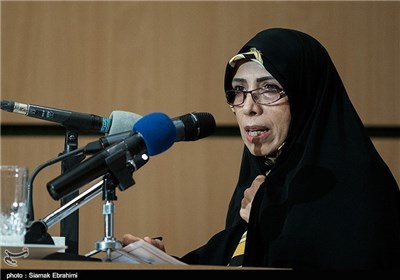
Sabah Zangeneh
Sabah Zangeneh

Saudi King Salman carried out major reshuffles in the line of succession and his cabinet on Wednesday (April 29). Saudi watchers believe that the sudden, dramatic changes in the top tiers of the Saudi system reveal huge cracks inside the Al Saud family.

A crisis fuelled by infighting and the ensuing rise of the neophytes to power will challenge Saudi Arabia’s policies on the international stage more than ever before.

Sabah Zanganeh, a former Iranian diplomat who is widely known for his familiarity with the developments in the Arab world, has – in an interview with Khabaronline on April 30 – looked at the shifts and rifts in Saudi Arabia.

The following is a partial translation of the highlights of Zanganeh’s remarks in the interview:

Zanganeh holds that the Saudi aggression against Yemen has been the driving force behind the escalation of the political crisis in the kingdom, saying certain members of the Al Saud family who are the movers and shakers of the political structure – including Muqrin [bin Abdulaziz who briefly served as crown prince and] whose mother is of Yemeni descent – have been unable to live with the fact that Saudi Arabia has waged a war against Yemen.

He further says the sons of King Salman – more than anybody else – have played a key role in causing these seismic shifts.

He goes on to say, “If we take a closer look at the dismissals and appointments [changes in the cabinet makeup], we can find defects and shortcomings – as far as the Arabic language are concerned – in the [wording] of the royal orders which announced the changes [cabinet reshuffle].

“They [shortcomings] reveal the hasty decisions [by the Saudis] to escape the problems which should be addressed thoroughly. At a time when a number of direct descendants of Abdulaziz are still alive, the rise of third-generation princes to power would fuel infighting in the Al Saud family”.

Zanganeh also says dismissal of Prince Mutaib bin Abdullah and refusal to name Abdulaziz bin Abdullah, the deputy foreign minister, as replacement for his boss [Saud al-Faisal] will create shockwaves down the line.

As for the effects of the royal reshuffle on Riyadh’s ties with Tehran, he says the newcomers – who are inexperienced – hold negative views compared with their predecessors, thus Saudi Arabia will face still more challenges on the world stage.

A woman who wants to turn her hometown into world’s capital of hand-woven carpets

ghali3

Fariba Nirumand is a 50-year-old retired teacher who set up a carpet workshop in western Iran two years ago to offer courses on carpet-weaving and embroidery by hand and machine.

Forsat-e Emrooz, a daily, ran a report on the hand-woven carpet entrepreneur who is based in Kurdistan Province. The following is a partial translation of what she told the daily earlier in April:

Carpet-weaving is an art which well suits women. Plus, its versatile nature allows anyone to make money anywhere he/she wants by just rigging up a loom. Since I opened my workshop, there have been some university students who have expressed interest in working for me. Over the past two years, I have hired 10 men too.

A culture that promotes carpet-weaving must be fostered, though, because the art is fading into oblivion. The youth consider it below their dignity to sit behind a loom.

The reluctance comes despite the fact that weaving a carpet is entirely different from other jobs. Carpet is like a living creature whose designs can talk; in fact, they communicate with the carpet-weaver, injecting energy into him/her.

If women want to secure self-belief to make their presence felt in society, they should land a job. The money women who work in my workshop earn has a positive impact on their lives. It also contributes to promotion of their mental stamina for presence in society.

As part of efforts to cultivate a friendly and relaxed atmosphere, people in my workshop make carpets while listening to music. There are also women on my payroll who weave carpets at home. In fact, carpets act like a savior and the job is flexible in nature so it can be done at home.

I avoid repeated designs. In order to introduce innovation into our carpets, I take snapshots of natural scenery. Then I hand the images to a designer. In fact, such innovative designs give us a competitive edge over our rivals.

As for export markets, our framed carpets are popular with Turkish importers who prefer carpets with a toranj motif and a single color. Silk carpets sell like hot cakes, too.

We make carpets our customers place order for; that is a fundamental business principle of today’s market.

Carpet-making is both an art and an industry. Its production is not confined to weaving; rather, it encompasses provision of raw materials, dyeing and carpet repair which complete the production cycle.

My ultimate ambition is to establish a centralized village where hand-woven carpets are made. I also seek to fulfill another aspiration of mine which is to turn my hometown, Qorveh, into the world’s capital of hand-woven carpets.

kashmir-carpet