Monday, December 22, 2025
Home Blog Page 4857

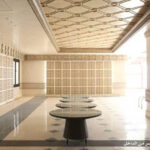
Iran’s strong presence in Expo Milano 2015

expo2015-0

“Feeding the Planet, Energy for Life” is the motto of Expo Milano 2015 and Iranian architect Kamran Safamanesh has built on that motto to put together a pavilion dubbed “Global tablecloth, Iranian Culture”.
His pavilion has earned the best design title at the Iranian section of the event.

The Iranian pavilion was mainly designed with a focus on nature, climatic diversity, colorful Iranian cuisine and its ancient culture and traditions in line with the expo’s motto.

In the structure of the pavilion, living elements were used. Inspired by ancient Iranian wind catchers, the design focuses on optimal use of climatic elements like wind and humidity.

Snapshots of the Iranian presence at the event released online by different news websites:

Photo exhibition in Tehran to help save an endangered species (PHOTOS)

Cheetah

Tehran is hosting a photo exhibition of Asiatic Cheetah, an endangered species whose ranks are dwindling across the continent – only 70 remain in the wild.

The proceeds will go to a project to help save the fleet-footed species from extinction.

The Islamic Republic News Agency has put online the following photos on display at the exhibition:

Iranian negotiator hopeful a deal is clinched before July 1 deadline

Seyyed Abbas Araghchi

There is hope that Iran and world powers reach a final deal over Iran’s nuclear program before a July 1 deadline, Iran’s top negotiator was quoted by Mehr News Agency as saying upon his arrival in Vienna, Austria Tuesday.

Araghchi went on to say, “We succeeded in producing a first draft in New York and from now on we will continue to work on it.”

He added, “The draft is based on the terms and solutions hammered out in Lausanne. We need to stay committed to what was concluded in the Swiss city and will only negotiate within that framework to put the final deal on paper.”

When asked about how far they have gone in addressing the outstanding questions, Araghchi said, “As for some paragraphs there is disagreement over one phrase, whereas in some others we disagree over one sentence or the whole passage. However, a great deal of job has been done so far.”

The negotiator said, “We will have a bilateral meeting with the Americans on Thursday. We will also hold talks with the Chinese delegation on the same day.”

We will definitely have a meeting with the Russian delegation, Araghchi said, adding, “We will hold talks with Europeans either as part of a single session or separately.”

Where has THAT money come from?

Turkan

President Rouhani’s chief advisor has said those who run for public office should declare the source of their campaign finances, urging legislators to make it mandatory for office holders to watch the money they use before and after coming to office.

Ali Akbar Torkan made the remark in a speech at a conference dubbed Missing Zeros on money and corruption in Iran over the past decades.

In his speech, he addressed the root causes of corruption and blamed it on adoption of laws which result in measures reeking of rent-seeking, and said rent-seeking and rent-seekers are the cause and effect of legal loopholes in the country.

“What I say in this conference is my own point of view, not those of a presidential advisor,” he said, reiterating that his views do not necessarily reflect those of the [eleventh] government’s.

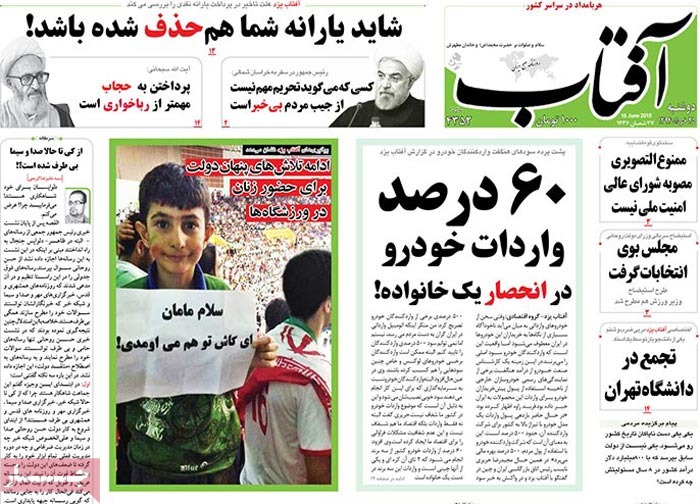
Aftab-e Yazd daily on May 11 covered the advisor’s speech at the conference held in a Tehran University faculty. The following is the translation of excerpts from Torkan’s remarks:

[…]

The senior advisor said, “In the Western industrialized countries, office workers are not picked based on merit and virtue, but in Iran merit is the yardstick in selecting jobholders. We try to pick the best of all, but how come these best picks slip up at times?”

[…]

He further said the best individuals should be selected; even that does not guarantee everything will be done without a hitch. “Inherently, an individual has all forces within themselves, and no one is totally immune to the [temptations of] Satan”.

[…]

“Some say import of one item is illegal, unless it is given a permit. This has caused the pen an office worker uses [to grant such a permit] to be worth billions [of rials]. There are few who do not slip under such a circumstance.

“When rent-seeking is pursued in a place, we cannot blame rent-seekers. Normally, people are pursuing their own benefits. The ones who have helped create rent-seeking are at fault,” Torkan said.

Dirty money does not exclusively change hands in Iran, he said, adding, “Other countries have enforced laws and regulations to bring the flow of such money under control. In Germany and the UK, for instance, there are laws on dirty money which say money will be protected by law if it meets three conditions: 1) It is collected from legal transactions, 2) It is legally registered, and 3) The tax levied on the money has been paid. Money is viewed as dirty in these countries if it fails to meet these three conditions”.

[…]

The official went on to say that Iran’s money laundering legislation is partially enforced, adding the origin and destination of money should become known [to the public]. To that end, he said, the Western countries’ laws on dirty money can serve as a good model for Iran to follow.

“In Iran, some office holders are elected through popular vote. Those running for office have to spend money on the campaign trail. This has been the trend since the [Islamic] revolution. In the early years of the revolution, certain people would spend money simply to advance their beliefs, but it [campaign contribution] has now turned into a business [for some people],” he said.

[…]

“In industrialized nations, anybody – real and legal entities – who enters politics has to offer their balance sheet which lists their revenues and expenses. Any given party which enters a race for certain office should be accountable to the officials for the money it has spent on the elections. In case they fail to do so, they will face legal action. We need to learn from them,” he added.

One way to avoid mistakes is to introduce legally binding measures, Torkan said, adding, “All political players who stand for office have to declare their funding transparently. We call on lawmakers to make it mandatory for contenders – for the offices from the president on down – to report their campaign finances [to officials and the public].

[…]

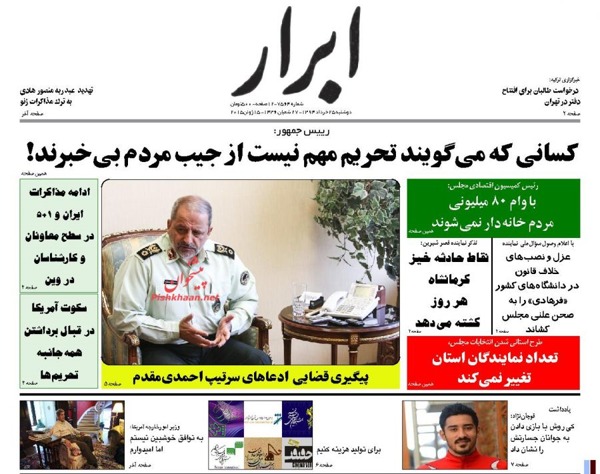
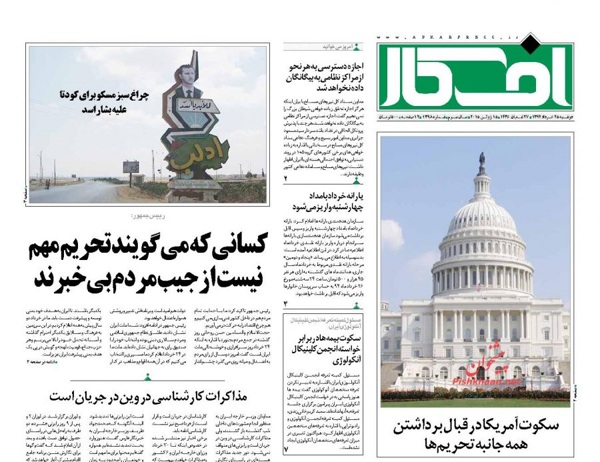
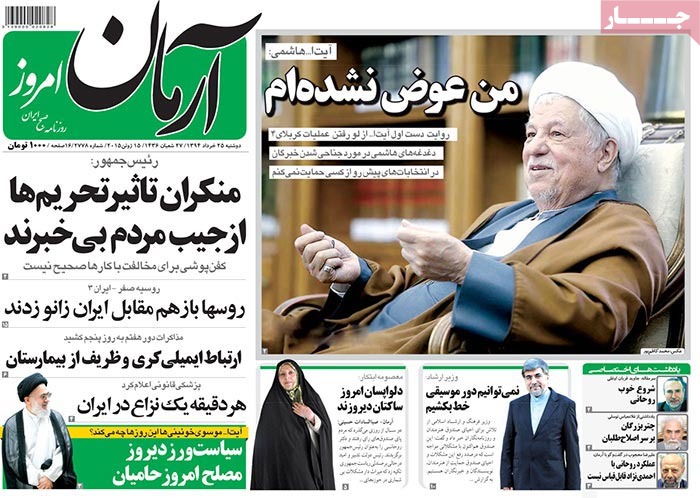
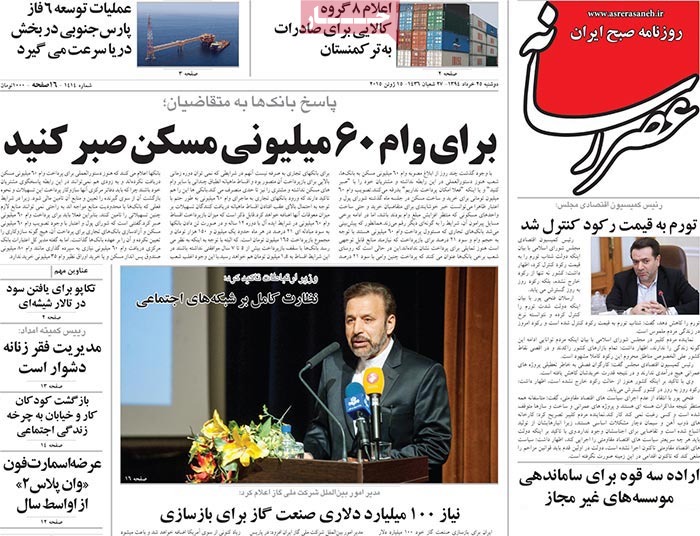
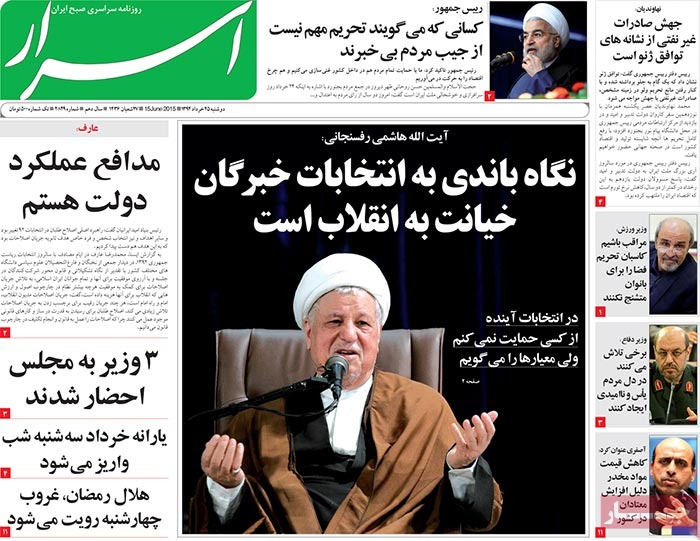
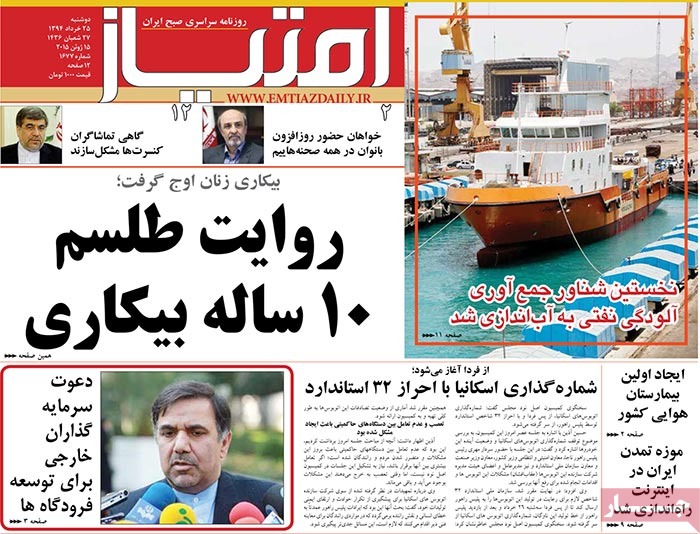
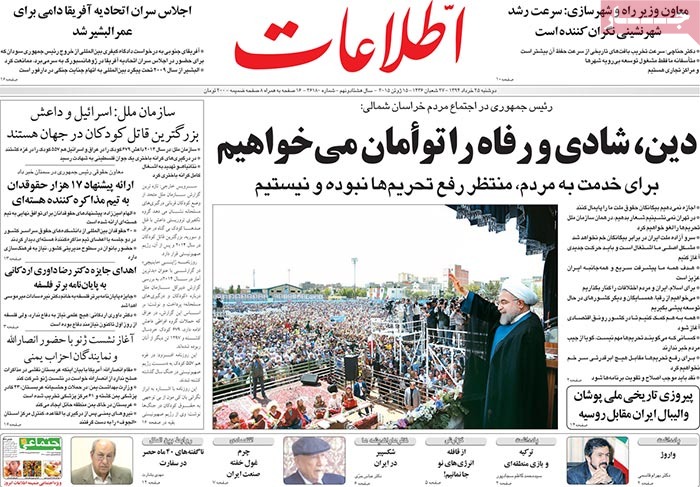
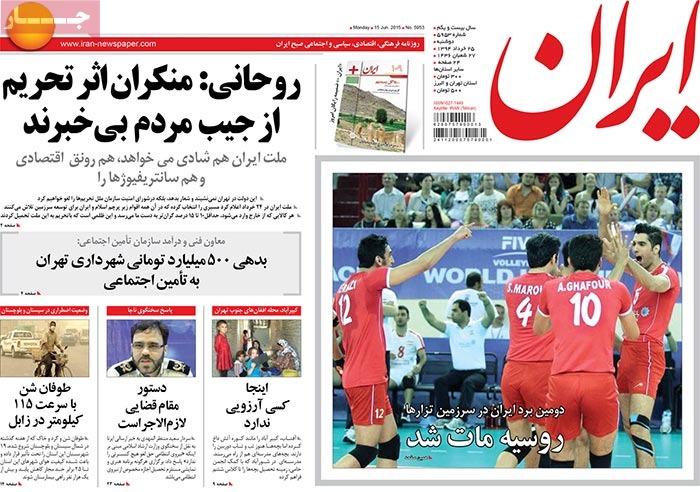
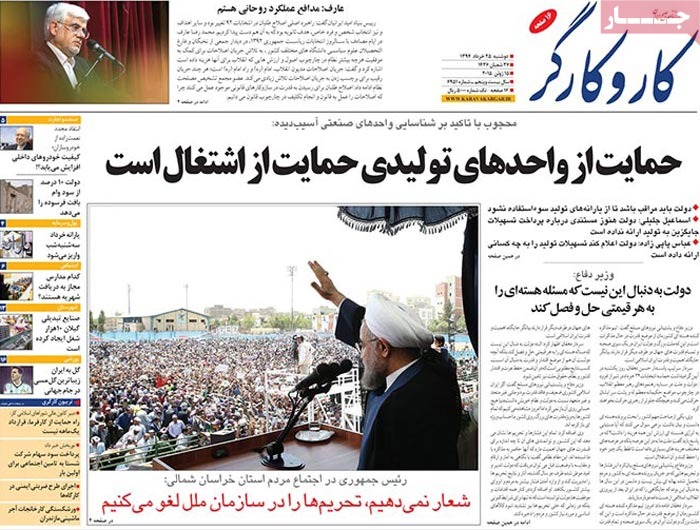
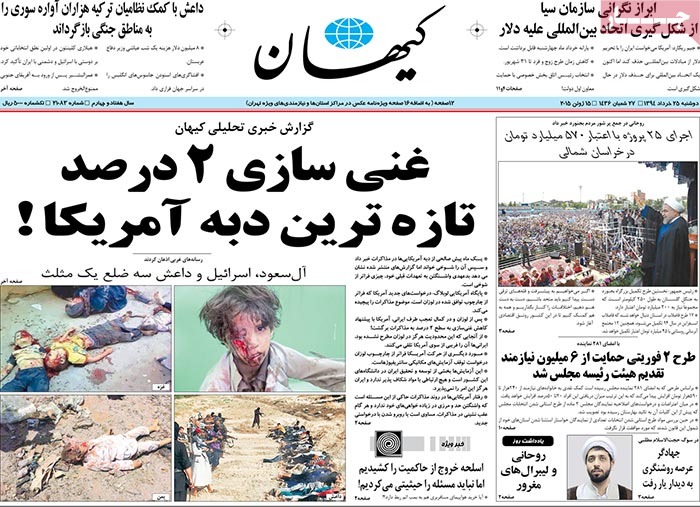
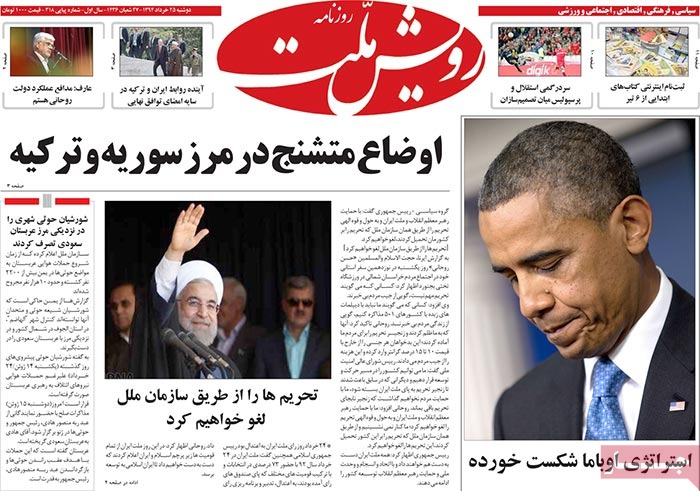
A look at Iranian newspaper front pages on May 12

Iranian Newspapers Headlines

Comments by President Rouhani on the fight against violence and terrorism and those of Foreign Minister Zarif on the impact of a recent US congressional bill on nuclear talks between Tehran and P5+1 dominated the front pages of Iranian newspapers. Also in the news was a statement by the Tehran mayor that part of Evin Prison is to be converted to a park.


Aftab-e Yazd: Three board members of Mizan Financial and Credit Institute have been arrested.

[It came after the institute said it needed time to be able to pay back the money of depositors.]


A look at Iranian newspaper front pages on May 12


Arman-e Emrooz: “Charges against me of being an accessory to murder have been thrown out five times,” said Saeed Mortazavi, a former prosecutor who is now on trial for corruption.

He said the charges which stemmed from alleged failure to supervise Kahrizak Detention Camp have been dismissed by both the provincial criminal court and the Supreme Court.


A look at Iranian newspaper front pages on May 12


Asr-e Iranian: Fear of a coup at home has prompted the Saudi King to stay away from a Camp David summit.


A look at Iranian newspaper front pages on May 12


Etemad: Iraqi President Fuad Masum is due in Iran on Tuesday.

The Iraqi official is expected to meet with the Supreme Leader, President Rouhani, Parliament Speaker Ali Larijani, and Chairman of the Expediency Council Ali Akbar Hashemi Rafsanjani during his stay in Iran.

Etemad: An ally of Larijani is expected to square off against Bahonar.

The likelihood of change in the lineup of the Presiding Board of the Islamic Consultative Assembly has increased.


A look at Iranian newspaper front pages on May 12


Ettela’at: “The virus of terrorism is spreading around the world; we need to join hands in the face of the virulent virus of violence and terrorism,” President Rouhani said.

The president made the comment at a meeting with the South African minister of international relations and cooperation. “Military invasion offers no solution to domestic problems of nations.”

Ettela’at: “Iran won’t bow to excessive demands [of P5+1],” said Foreign Minister Mohammad Javad Zarif.

The top diplomat’s comments came as his deputy, Abbas Araghchi, praised parliament’s opposition to a motion to halt nuclear talks with world powers.


A look at Iranian newspaper front pages on May 12


Hemayat: Part of Evin Prison in northern Tehran will turn into a park.

Tehran Mayor Mohammad Bagher Ghalibaf made the comment at the inaugural of an international flower and plant exhibition in the capital.


A look at Iranian newspaper front pages on May 12


Jomhouri Islami: A new round of nuclear talks between Iran and world powers gets underway in Vienna, Austria Tuesday.

It comes as the spokesman of parliament’s Presiding Board threw his weight behind continued nuclear talks despite an earlier motion by some MPs calling for a halt to the talks.


A look at Iranian newspaper front pages on May 12


Mardomsalari: Worried Arab leader have snubbed the US.

Leaders of the Persian Gulf Cooperation Council have decided to stay away from a Camp David summit.


A look at Iranian newspaper front pages on May 12


Roozan: I opted for a self-imposed ban on filmmaking over the past eight years,” said renowned director Rakhshan Banietemad.

In an exclusive interview with the daily, she said she is 100 percent in favor of reforms.


A look at Iranian newspaper front pages on May 12


Sharq: Individuals and institutions that played a role in an attack on Tehran MP Ali Motahari [in Shiraz in March] have identified.

The announcement was made by Interior Minister Abdolreza Rahmani Fazli.


A look at Iranian newspaper front pages on May 12


UN must act to stop Saudi killing in Yemen: Iran official

Abdullahian-UN

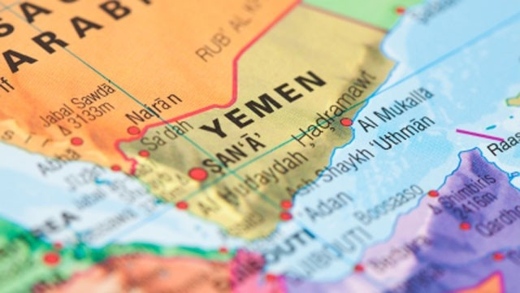
A senior Iranian official has called on the United Nations to take effective measures to put an end to Saudi Arabia’s airstrikes against Yemen and its killing of people in the impoverished Arab state.

“The United Nations is expected to take effective, clear and deterrent action regarding Saudi Arabia’s aggression and the blatant killing of the defenseless Yemeni people, which are in violation of international regulations,” Iran’s Deputy Foreign Minister for Arab and African Affairs Hossein Amir Abdollahian said in a Monday telephone conversation with Ismail Ould Cheikh Ahmed, the UN secretary general’s new envoy to Yemen.

The Iranian official urged the UN and international aid organizations to launch their campaign as soon as possible in a bid to end the ongoing crisis in Yemen.

“The Islamic Republic of Iran is ready to carry out any necessary measures in order to send humanitarian aid to the oppressed and defenseless Yemeni people,” Amir Abdollahian said.

The Iranian official’s remarks came as an Iranian cargo ship carrying humanitarian aid to the people in Yemen has set sail for the impoverished Arab country.

Saudi Arabia started its military aggression against Yemen on March 26 – without a UN mandate – in a bid to undermine the Houthi Ansarullah movement and to restore power to the fugitive former president, Abd Rabbuh Mansour Hadi, who is a staunch ally of Riyadh.

According to the latest UN figures, the Saudi military campaign has so far claimed the lives of over 1,400 people and injured close to 6,000, roughly half of whom have been civilians.

Cheikh Ahmed, for his part, said Iran plays an important role in regional developments and added that the UN is trying to hold consultations with Tehran to find solutions to regional woes.

The envoy added that the UN has concentrated its efforts on the establishment of a lasting ceasefire in Yemen, national dialog in the country and the dispatch of relief aid to the Yemenis.

Asia refiners renew Iran crude purchase deal

Oil refinery in India

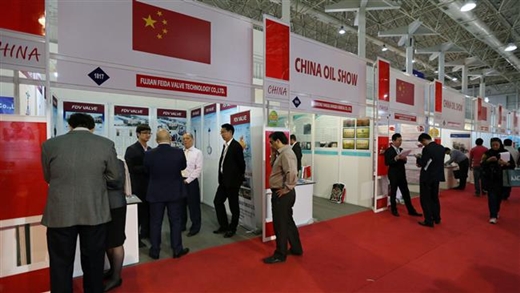
Asian refiners buying Iran’s crude oil have renewed their contracts for the purchase of oil from the Islamic Republic, a top official says.

Mohsen Ghamsari, director for international affairs at National Iranian Oil Company (NIOC), said Chinese, Indian, South Korean, Japanese and Turkish refiners have all extended their oil purchase contracts with Iran.

Ghamsari was reacting to media reports that Japanese oil refiner Idemitsu Kosan Co has not renewed its annual crude purchase contract with Iran for the fiscal year that started in April.

Major refineries in China, India, South Korea, Japan and Turkey are currently buying a total of 1 mb/d of crude oil from Iran.

China is the largest buyer of Iran’s crude oil, importing 400,000 b/d from Iran. India comes second.

Oil buyers in Asia are preparing to purchase more crude oil from Iran amid hopes of a long-awaited nuclear deal to ease sanctions against the Islamic Republic.

Mangalore Refinery and Petrochemicals Ltd. in India and Cosmo Oil Co. in Japan are among the refiners hoping for Iran sanctions relief.

Iran is currently exporting around 1 mb/d of oil, due to US-imposed restrictions, while it has potential to supply up to 4 mb/d.

Iran and P5+1 of global powers – the United States, Britain, France, Russia, China and Germany – reached mutual understanding on the parameters of a comprehensive agreement over the Islamic Republic’s nuclear program in Lausanne, Switzerland, on April 2. The two sides have agreed to finalize a comprehensive deal on the nuclear program by the end of June.

A final nuclear deal would result in the lifting of sanctions imposed on the Islamic Republic.

At the beginning of 2012, the US and European Union (EU) imposed sanctions on Iran’s oil and financial sectors with the goal of preventing other countries from purchasing Iranian oil and conducting transactions with the Central Bank of Iran.

On October 15, 2012, the EU foreign ministers reached an agreement on another round of sanctions against Iran.

Iran’s nuclear chief undergoes successful surgery, in stable condition

Ali Akbar Salehi

Director of Atomic Energy Organization of Iran (AEOI) Ali Akbar Salehi has undergone successful surgery on Monday.

“Mr. Salehi’s physicians said that he is now in stable conditions and he will be moved to the recovery unit any time,” AEOI Spokesman Behrouz Kamalvandi said early Tuesday.

AEOI chief was hospitalized after he complained of digestion problems and he had to undergo intestine surgery.

Iran, South Africa keen for closer economic ties

Rouhani-South Africa

Iranian President Hassan Rouhani and South African Minister of International Relations and Cooperation Maite Nkoana-Mashabane explored avenues for the promotion of Tehran- Pretoria ties in diverse areas, economy in particular.

During the meeting in Tehran on Monday, Rouhani said there is good ground for boosting cooperation between the two countries at bilateral and multilateral levels.

“The Islamic Republic of Iran is ready to further increase consultations and mutual cooperation,” the Iranian president said.

Tehran is willing to expand economic relations with Pretoria, he stated, adding that the ties should develop with a good momentum.

The South African minister, for her part, emphasized that the two countries should use the “good political relations” for boosting economic ties.

“Today, we are conveying the message of goodwill, solidarity, partnership and extensive cooperation between South Africa and the Islamic Republic of Iran,” she said.

Expansion of relations with African nations in all political, economic and cultural fields is top on the agenda of Iran’s foreign policy.

Iranian President Hassan Rouhani, who took office in August 2013, has repeatedly stressed his government’s interest in boosting relations with the African states.

Iran rejects UN human rights report on executions

Ms. Marzieh Afkham

Iran’s Foreign Ministry rejected as “downright lie” a recent report prepared by the UN special rapporteur on the situation of human rights in Iran, Ahmed Shaheed, and Christof Heyns, the UN rapporteur on extrajudicial, summary or arbitrary executions.

The report on the alleged unreported executions in Iran or the execution of political prisoners is a downright lie, Foreign Ministry Spokeswoman Marzieh Afkham said on Sunday, stressing that such untrue claims run counter to the professional responsibilities of Shaheed and Heyns.

Her comments came after the two UN staffers in a May 8 report condemned what they called a sharp increase in executions in recent weeks in Iran, alleging that many executions have gone unreported by official sources, and the names of prisoners have not been published.

Maldivian Shaheed and South African Heyns have also alleged that 98 prisoners “are reported to have been executed” in Iran between April 9 and 26, including at least six political prisoners and seven women.

In reaction, Afkham underscored that the allegation of a rise in the death penalty and “reliance on the estimated figures without any source or sources that are not authentic” nullify such a report.

“It’s a great pity that the trend of the (UN) special rapporteur’s (Shaheed’s) activities suggest that he does not seek credible evidence, and despite the reports and documents issued by Iran, such claims are continuously repeated with quite political purposes,” she noted.

The spokeswoman explained that Iran’s law hands out capital punishment only for “the most serious crimes, including narcotics trafficking”.

“The Islamic Republic of Iran calls on the special rapporteur not to include traffickers, murderers and those who have committed terrorist crimes in the list of the political prisoners,” she pointed out.