Monday, December 22, 2025
Home Blog Page 4858

What happened in Mahabad was a personal issue: Interior minister

Rahmani Fazli

Replacing some executive officials is a matter that every government might deal with, but the Interior Ministry has not had and does not have any plan at present to do so, Interior Minister Abdolreza Rahmani Fazli was quoted by Entekhab, a news website, as telling reporters on Monday.

Speaking on the sidelines of a gathering which brought together provincial governors from across the country, the interior chief also said his ministry and the president might decide to change some state executives in the weeks and months ahead.

On the suspicious death of a young woman in Mahabad in West Azerbaijan Province, he said, “What happened in Mahabad was a personal issue. In fact the deceased had an affair with the suspect, who was her suitor. Fearing that her family might learn about their relationship, she tried to leave the hotel with the help of a colleague. Unfortunately, however, she fell to the ground from the third floor and lost her life.”

He added, “Opportunist media tried to turn the personal issue into a political question by resorting to fabrications, claiming that a member of security forces tried to sexually assault her and that the woman jumped off the hotel window to her death to escape rape.”

The interior chief said the suspect is not a member of security forces, rather he is a specialist that often visited the hotel to help its personnel.

Rahmani Fazli went on to say, “The incident turned into a social problem thanks to the media which incited the public, particularly the youth in Mahabad. As a result, a large crowd thronged outside the hotel, shattered its windows and torched part of the facility.”

The interior minister further said, “Unfortunately, 21 police forces suffered injuries when protesters threw stones at them. Police invited demonstrators to stay calm and I extend my gratitude to police [for their restraint].”

Earlier, Seyyed Ebrahim Raeisi, the prosecutor general, said that those behind the unrest in the city would be punished.

Tehran flower exhibition (PHOTOS)

Tehran flower exhibition1

The 13th International Exhibition of Flowers and Plants opened in Tehran on May 11 with the Tehran mayor and chairman of Tehran City Council in attendance.

Snapshots of the expo released online by different news websites:

International festival of creativity in Islamic arts opens in Iran

T2852848-4310571

The second International Festival of Creativity and Innovation in Islamic Arts and Handicrafts opened in Tabriz on May 9.

The weeklong festival brings together 35 Islamic countries, said Secretary General of the festival Mehdi Mohammadzadeh, adding out of the 80 artists who have taken part in the event, 18 are Iranians.

Miniature, illuminated manuscripts, calligraphy, pottery, carpet-weaving, drawing, textile printing and glassmaking, wooden, and metal handicrafts are among the arts over which the participants are competing with each other at the event.


Dolls, the victims’ best friends in a Tehran rehab center (PHOTOS)

Ehsan House

Victims of the social ills are kept in Ehsan House, a charitable institute for protecting social victims. Like other rehab centers, the sufferers there receive treatment and rehabilitation services, but – unlike other places –dolls are also on the menu to ease the loneliness of those institutionalized.

The Islamic Republic News Agency has released the following pictures of the rehab center in Tehran:

A short stop by Lake Orumiyeh (PHOTOS)

Lake Orumiyeh

Lake Orumiyeh in northwestern Iran is a famous salt lake whose shrinkage in recent years has put it under the spotlight.

Efforts to revive the lake have gathered momentum in recent months and have been fairly successful.

The photographer of the Islamic Students’ News Agency has stopped by the famous lake to take the following photos:

Alignment, not crackdown, can help better direct public opinion

Ali Jannati

The minister of culture and Islamic guidance has said that the government needs to align with people if it seeks to better control and shape public opinion.

Ali Jannati made the remark in a gathering of police officials Sunday and added that media cannot be controlled and the flow of information cannot be blocked.

Ettela’at newspaper on May 11 published the minister’s remarks on public opinion and the ways to handle it in society. The following is the translation of excerpts of Jannati’s remarks:


Uncontrollability of information sharing

[…]

The minister said technically speaking, media cannot be brought under control, nor do geographical boundaries and legal requirements allow for such control.

He added nothing can staunch the [free] flow of information and news.

[…]

Jannati further said certain pieces of information are exchanged through Viber and WhatsApp, either mutually or within groups, adding we cannot control or interrupt these exchanges.


What should be done?

The culture chief went on to say that production of [decent Internet] content is of immense significance when it comes to dissemination of information and molding public opinion.

“We need to [rush to the scene] and take over and produce materials. The more we produce information in cyberspace, the more we can affect public opinion [in society]”, he stressed.

[…]

To counter the [inaccurate and misleading] information which is relayed via the web, the minister said, we have to tap into the potential satellite channels and the virtual world. He said we need to put these tools to good use. “Why shouldn’t we upload videos on [video-sharing website such as] YouTube?” he wondered.

If we align ourselves with people, we can better control public opinion, Jannati said, adding we can get nothing through opposing [people’s individual views, attitudes and beliefs which form] public opinion.

At the current situation, we need to develop appropriate software for cell phone systems in order not to let others sway public opinion, Jannati said, adding we need to take measures to address public opinion, both at home and abroad.

Iran’s revolution has a cultural nature, he said, adding we want to export our way of thinking and culture [to other nations].

The minister also said that we should exploit all potential to spread public diplomacy the world over. If so, we can influence public opinion in other nations too, he concluded.

[…]

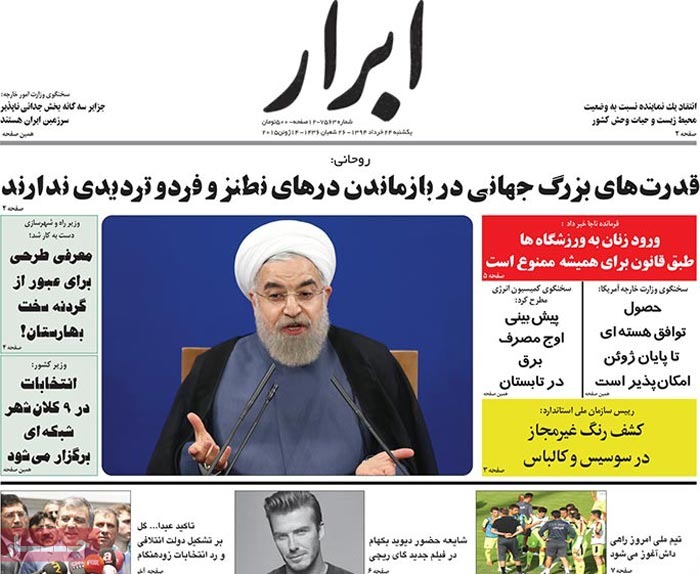
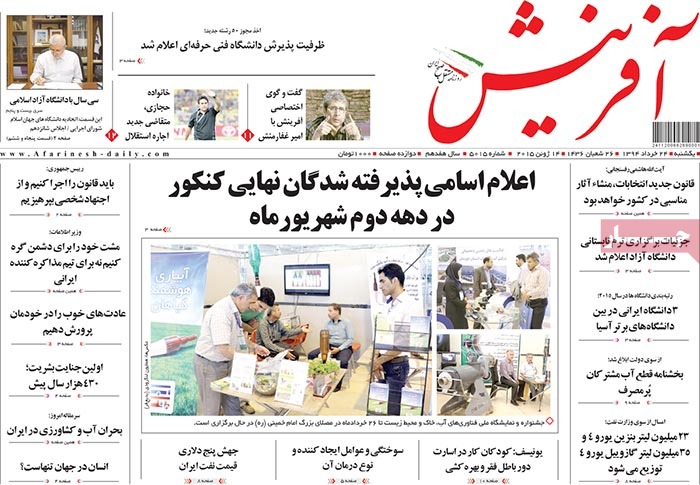
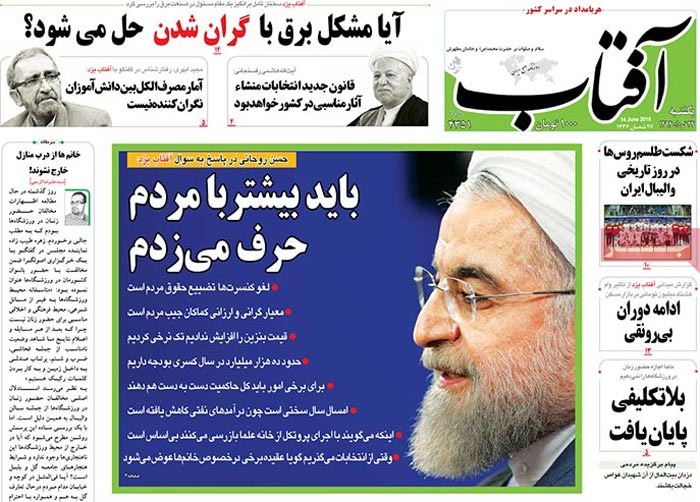
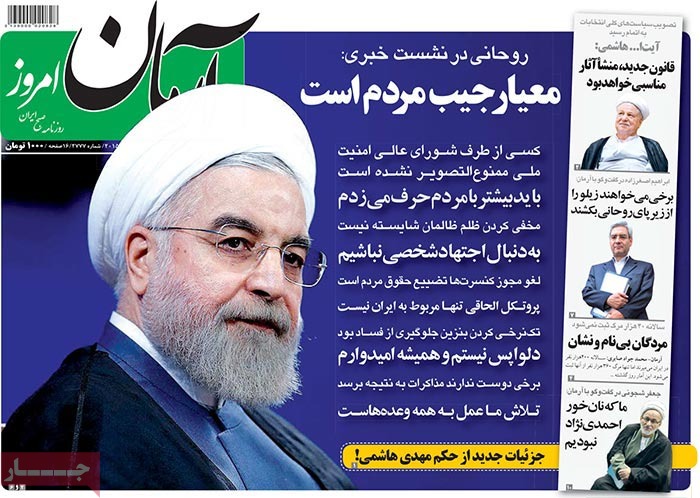
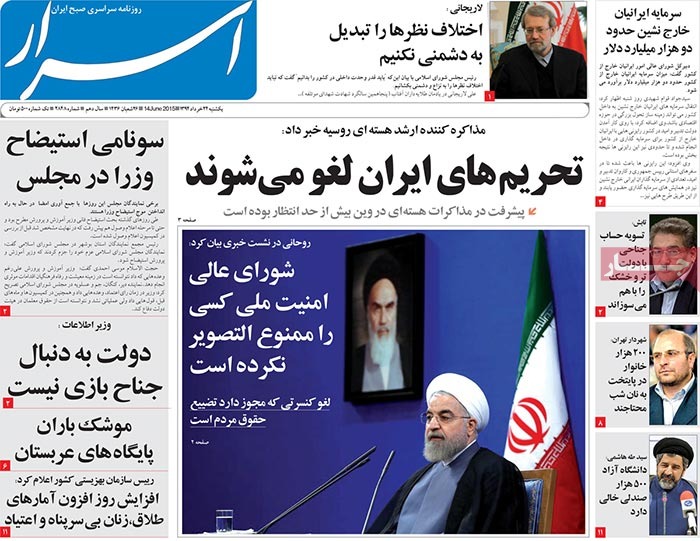
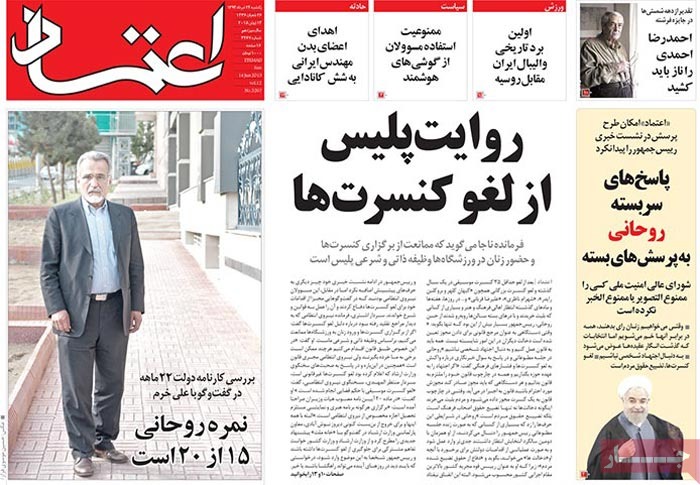
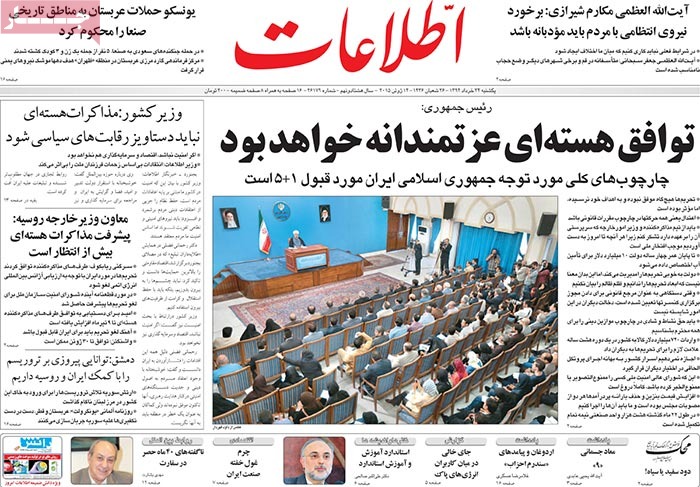
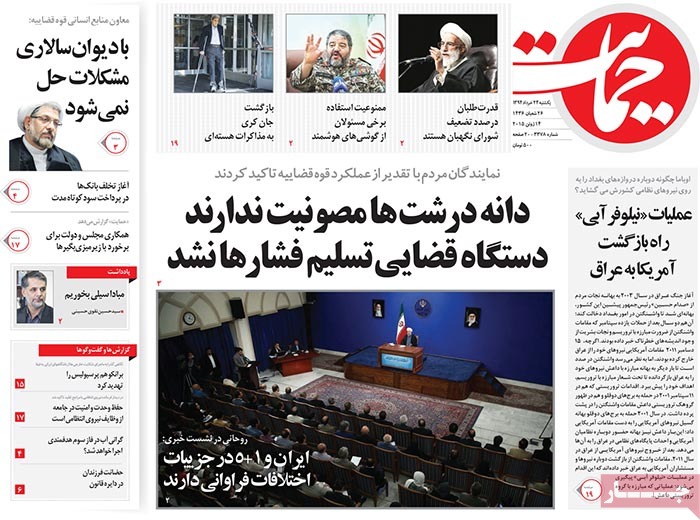
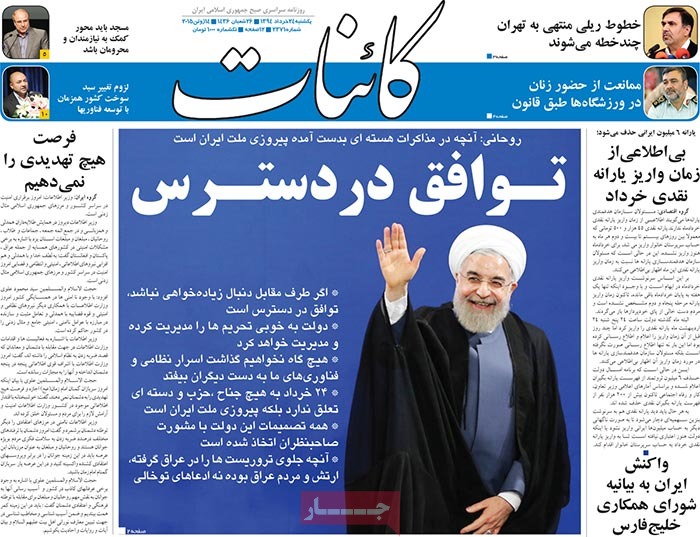
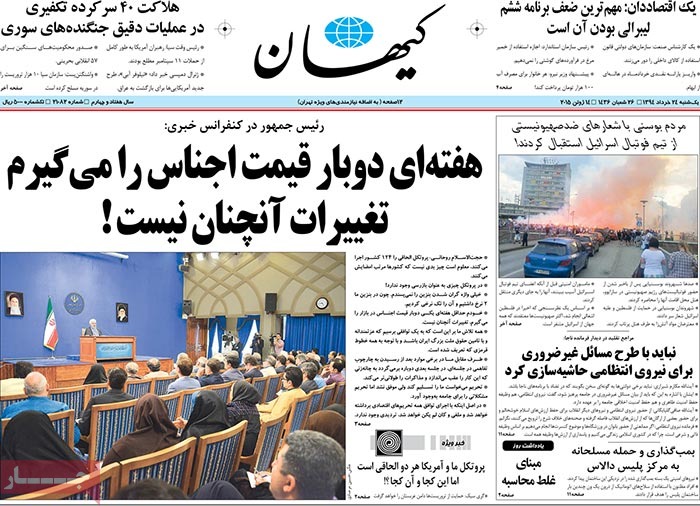
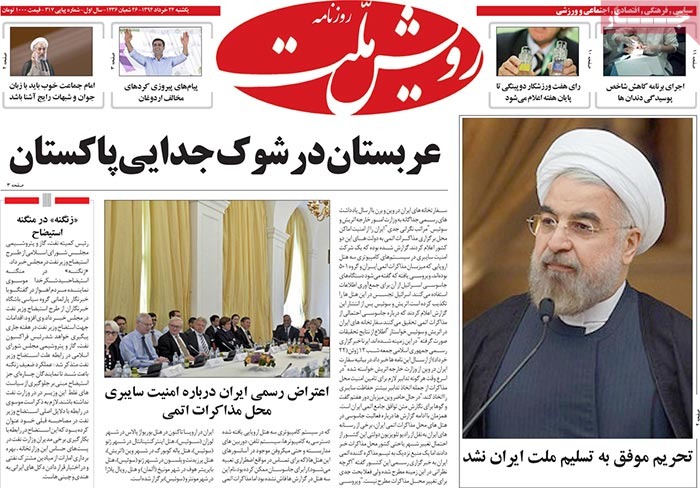
A look at Iranian newspaper front pages on May 11

Iranian Newspapers Headlines

The vehement opposition of the parliament speaker to a motion filed by fellow principlist MPs calling for a halt to negotiations with P5+1 dominated the front pages of Iranian newspapers Monday. Comments of the minister of culture and Islamic guidance about the freedom of press were also in the news.


Afarinesh: Parliament speaker has voiced opposition to [a motion that called for] a halt to nuclear negotiations [with P5+1].


A look at Iranian newspaper front pages on May 11


Afkar: “Iran stands ready to help with Afghan reconstruction,” said former foreign minister Ali Akbar Velayati, who now serves as an advisor to the Supreme Leader.


A look at Iranian newspaper front pages on May 11


Aftab-e Yazd: “Removal of satellite dishes from rooftops has failed to produce the intended result,” said the minister of culture and Islamic guidance.

Aftab-e Yazd: At a meeting with her Iranian counterpart in Tehran, the South African foreign minister said sanctions against Iran have been illogical.

Aftab-e Yazd: Residents will have to pay for calling 118 [the nationwide telephone directory service].


A look at Iranian newspaper front pages on May 11


Ebtekar: As many as 700 university professors have signed a letter to the heads of the three branches of government calling for authorities to counter extremism.


A look at Iranian newspaper front pages on May 11


Emtiaz: In a rare phenomenon, a coat of snow has blanketed Tochal Heights [to the north of Tehran] with the capital experiencing 30º C temperatures.

Emtiaz: More than 1.3 tons of pornography and smuggled DVDs have been destroyed in the capital.


A look at Iranian newspaper front pages on May 11


Ettela’at: “Family attorney” and “Legal representation insurance” initiative will be implemented in the country.

Ettela’at: “Alignment not confrontation is the best way to control public opinion,” said Minister of Culture and Islamic Guidance Ali Jannati.


A look at Iranian newspaper front pages on May 11


Hambastegi: “Even those who are more powerful than the Saudis cannot harm Iran’s interests,” said Ali Akbar Velayati, the chairman of the Center for Strategic Studies.


A look at Iranian newspaper front pages on May 11


Iran: Iran’s Greco-Roman wrestling team has been crowned Asian champion.

Iran: The minister of culture and Islamic guidance has explicitly supported freedom of press.


A look at Iranian newspaper front pages on May 11


Kayhan: An Iranian ship carrying humanitarian aid for the stricken people of Yemen has set sail.


A look at Iranian newspaper front pages on May 11


Resalat: The Iraqi president has said that Iran’s assistance in the fight against IS does not amount to interference [in Iraq’s internal affairs].


A look at Iranian newspaper front pages on May 11


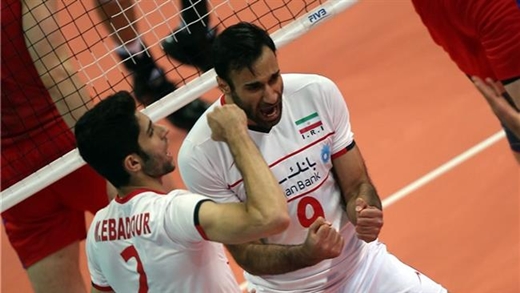
Roozan: “Iranian sport officials do not have respect for me,” complained Slobodan Kovac, the Serbian head coach of Iran’s national volleyball team.


A look at Iranian newspaper front pages on May 11


Sharq: Iran’s tourism balance is $6.5 billion in the red.


A look at Iranian newspaper front pages on May 11


Academics appeal to officials to launch anti-extremism campaign

tehran university

In an open letter to the heads of the three branches of the Islamic Republic, over 700 Iranian academics have called for efforts to ensure the privacy of universities.

What appears next is the translation of an excerpt of the letter that Ettela’at daily ran on May 11:

Knowledge is key to our country’s power and progress, and universities play an instrumental role in generating modern knowledge and in raising social awareness.

To play an effective role in cementing the scientific foundation of the country, universities need to enjoy sufficient independence in decision making, have enough security to think freely and be given a chance to contribute on the policymaking front.

The exertion of pressure coupled with interferences in the internal affairs of universities, either apparently legal or at times beyond the bounds of law, is in stark contrast with the principles and weighty responsibilities assigned to universities.

Among seemingly legal pressures exerted on universities toward the end of last year [ended on March 20] were two unpleasant incidents which irked a large number of people at universities.

One such incident was the unprecedented role of an organization in preventing a cultural event from being held at Ferdowsi University in Mashhad, it had been granted legal permission though.

The other controversial incident took place when another organization wouldn’t allow an MP to deliver a speech at Shiraz University. Likewise, a legal permission for the speech had been issued.

To add insult to injury, organized pressures beyond the law by some individuals and influential factions are constantly brought to bear on universities.

Such pressures interfere with the fulfillment of responsibilities of universities and make academics feel frustrated and insecure.

We expect the esteemed heads of the three branches of the government, who have the greatest responsibility by law and are known as educated and respectful figures by academics and university students, to use all their powers, particularly their authority in the Supreme Council of Cultural Revolution – which is responsible for laying down rules and regulations for universities – to safeguard the privacy of universities.

Also we want them to make sure unwarranted interference and pressures beyond the law by some organizations on universities become a thing of the past.

Iran trade team on rare US visit

San Francisco

A 15-member delegation comprising Iranian traders, entrepreneurs and artists is reportedly in the United States on a rare visit.

The visit – which officials say started two weeks ago and is expected to end next week – has been arranged by a US-based non-governmental institution called Learning.

Hamid Hosseini, a veteran Iranian merchant and a member of Tehran Chamber of Commerce, has told Mehr News Agency that the purpose of the visit is “to hold talks with American cultural institutes, universities and trade sectors and present Iran’s cultural and economic capacities and potential.”

“The delegation intends to present a vivid and real picture of Iran which has been malignantly distorted in recent decades,” Hosseini said, adding that a series of meetings have been planned in Washington and San Francisco.

“Iranian and American traders are interested in cooperating with each other,” said Hosseini, who is also a board member of the Union of Iranian Oil Products Exporters. “This is while the Americans cannot trade with Iran due to the sanctions,” he added.

The visit by the Iranian delegation to the US comes at a time that global businesses are awaiting an expected removal of sanctions against Iran in light of an emerging final deal over the country’s nuclear energy program.

Iran and P5+1 are presently working on the text of the final deal which – if concluded – envisages the removal of some economic sanctions against Iran in return for some restrictions in Iran’s nuclear energy activities.

The prospects for the lifting of sanctions have already encouraged trade delegations from several European and Asian countries to visit Iran over the past weeks.

In April, reports said a 22-member American trade delegation was visiting Iran to explore the avenues for post-sanctions investments. The visit had reportedly been arranged by Learning.

South Africa opposed to attacks in Yemen: Minister

bac453db-2b02-4d8d-8d03-306bee79c795

The South African minister of international relations and cooperation has rejected a military approach to the current crisis in Yemen, saying that using force against the impoverished Arab country could further destabilize the Middle East and instigate more chaos and insecurity in the world.

Maite Nkoana-Mashabane said on Sunday that the crisis in Yemen has no other solution than a diplomatic one, saying that Pretoria has initiated efforts aimed at mediating the conflict in Yemen.

The South African minister made the remarks in a meeting with Iranian Parliament (Majlis) Speaker Ali Larijani during his one-day visit to the Iranian capital Tehran.

South Africa has started communicating with the Arab League to find a political solution to the crisis in Yemen, Nkoana-Mashabane said, adding that the adoption of the military approach in dealing with the crisis could bring about “unwanted and harmful” outcomes including the spread of insecurity and terrorism in the region and the world.

The Iranian parliament speaker, for his part, described as “robust and growing” the relations between Tehran and Pretoria, saying that the two countries have enjoyed friendly relations since the fall of the apartheid regime in South Africa.

Larijani also called for the removal of the existing obstacles in the way of expanding bilateral relations, especially those related to the nuclear sanctions imposed on Iran’s banking and financial system.

He added that cooperation could have positive outcomes for sustainable peace and security in the region and the world.

Iran, South Africa should up cooperation

Earlier in the day, Iranian Foreign Minister Mohammad Javad Zarif also met with Nkoana-Mashabane, calling for more economic and business cooperation.

During the meeting Zarif said that Iran is interested to raise the current level of ties in various economic and business fields.

Despite the existing bans imposed on Tehran over its nuclear program, Iran and South Africa could cooperate in major fields such as oil and gas as well as financial and banking activities, Zarif said.

The Iranian foreign minister also said what matters to Iran most is the “mechanisms for implementing agreements” with South Africa.

The South African foreign minister, for her part, described as important the expansion of political and economic relations, saying the main objective of her trip to Tehran is to trigger a sensible and achievable growth in the bilateral ties.