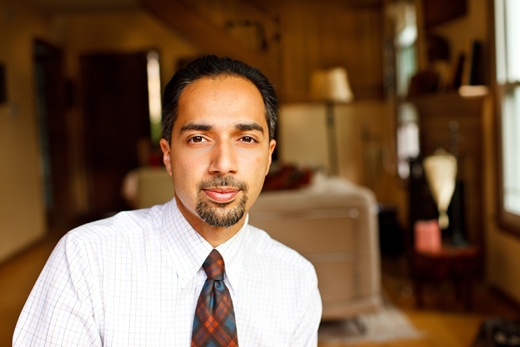
The president of the National Iranian American Council says that the stage is set for Iran and P5+1 to clinch a final deal.
The following is the translation of an excerpt of an interview Khabaronline.ir’s Saeed Jafari Pouya conducted with Trita Parsi in Vienna and posted online on June 30:
On extension of the talks
I don’t think anyone took the end-of-June deadline seriously enough. Everyone knew that the negotiations would continue past June 30. If the talks are drawn out more than a week, a new problem would emerge. I mean, if the talks do not produce results by July 9 or 10, the congressional review would last 82 days instead of 52. That in turn would give opponents of the talks in the US a better opportunity to pull the rug from under President Obama.
On Fabius’ red lines and how serious the French foreign minister should be taken
Personally I don’t take what Laurent Fabius says seriously. If Secretary Kerry had made the same comments, that would have spelled real trouble. Foreign Minister Fabius talks a lot and likes to be at the center of attention by making comments the media find controversial.
His comments do not carry much weight; they can complicate things for President Obama, though. They would provide American hardliners opposed to President Obama with an excuse to lambast him for lagging behind France in worrying about the deal. That would pose a challenge to Obama, but its impact on the talks is indirect.
President Obama is expected to report to Congress by July 10. The Congress will have one month to deliberate and make a decision. Then President Obama will have 10 days to veto their decision.
On American mechanisms
For now, President Obama has the one third of the votes he needs to veto the Senate decision, but no one knows what will happen in the next 30 to 50 days. For now, opponents of the deal can’t do anything.
There is another problem, let’s assume President Obama builds on the favorable view of 34 or 35 senators to hold on to his veto power. That would send the wrong signal to opponents who are bent on turning the tables on a deal.
Just like Obamacare which was approved a few years ago, but every now and then there is a new attempt to repeal it. President Obama needs a powerful number of senators on his side to push his agenda so that the Senate abandons the idea of challenging it. A deal which is challenged by US Senators every few months, would be a tenuous deal.
The Republicans will definitely try to repeal the deal no matter what. They have resorted to different lines of reasoning, but it has not worked so far. The American people are in favor of an agreement, but its opponents are radicals bent on sabotaging it. Those opponents call their congressmen and senators, but proponents do nothing. Over the course of the next week the president should encourage supporters of the deal to be more active and make their presence felt.
The endgame
If opponents of the deal get a two-thirds majority to bypass President Obama’s veto, the deal would fall through. In that case, the US would be the main problem because the Europeans are in favor of a nuclear agreement and have signaled in case Senate sabotaged the deal, they would part ways.
Of course, this would not be the best option for the Europeans. That would be a difficult choice for Europe. On the other hand, the Europeans don’t want a deal they have worked on for ten years to be sabotaged by the Senate. The Europeans have repeatedly said during the course of the talks that the nuclear deal is not a two-way contract between Iran and the US. They argue that they are part of this agreement.
Prediction on what happens eventually
I am optimistic. There is no reason not to be. If the talks do not produce results by July 10, things will be complicated. Personally, however, I am optimistic about a nuclear deal being clinched before July 10.
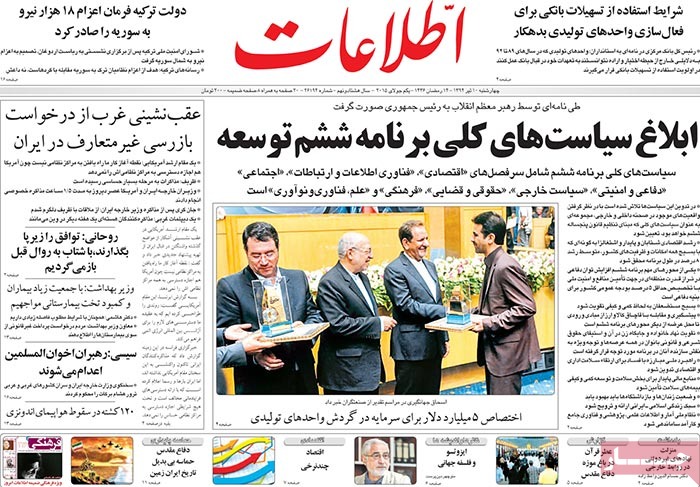
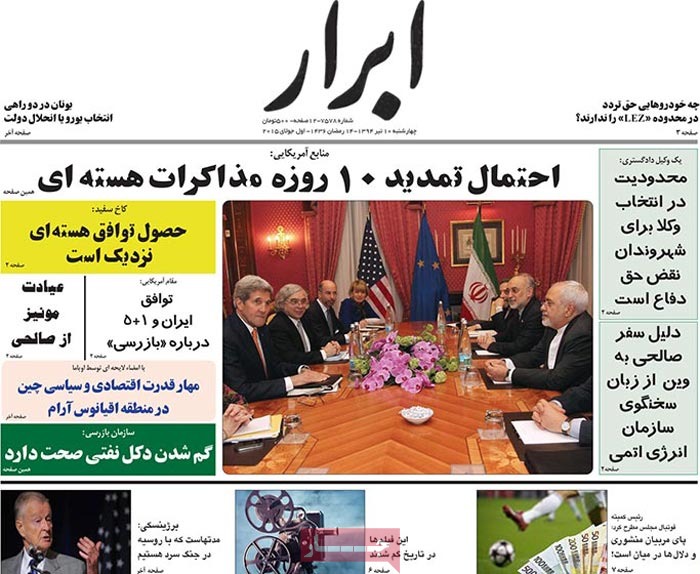
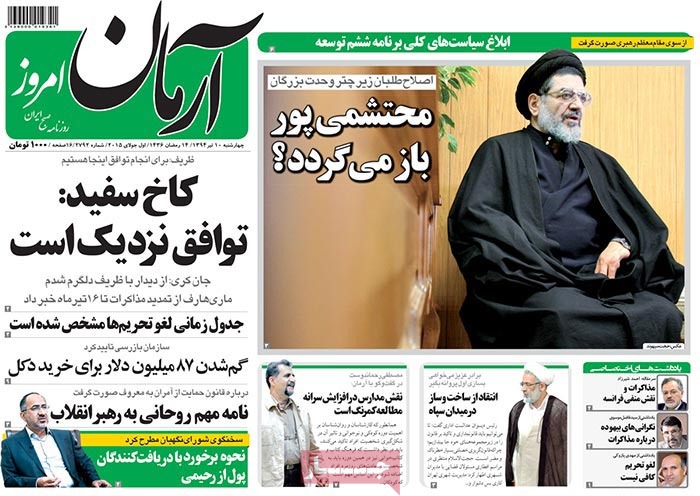
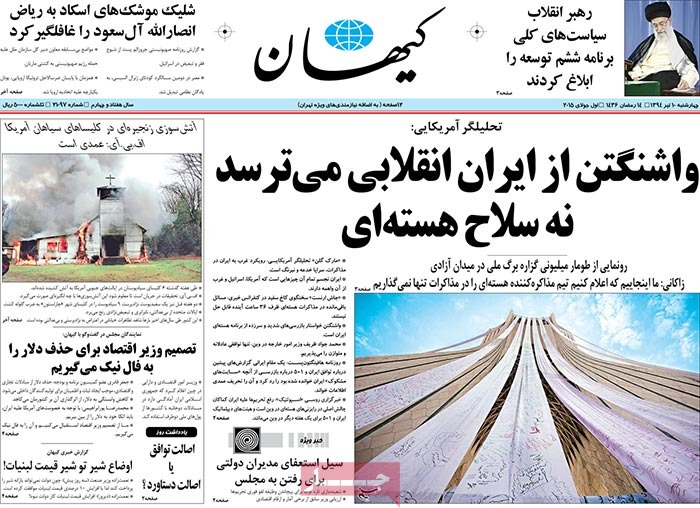
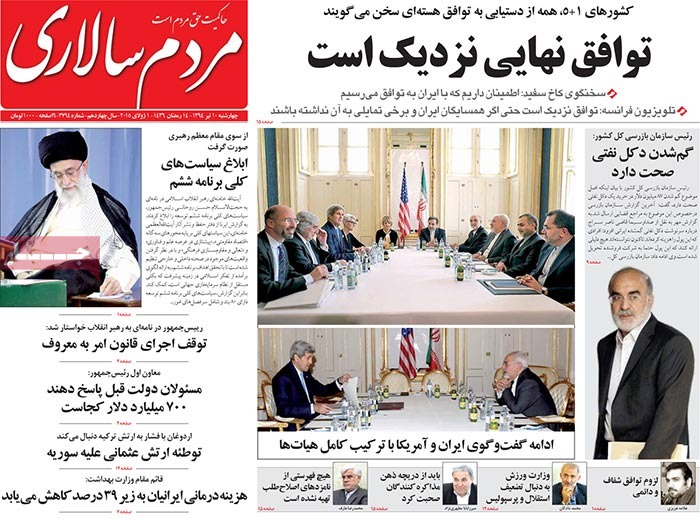
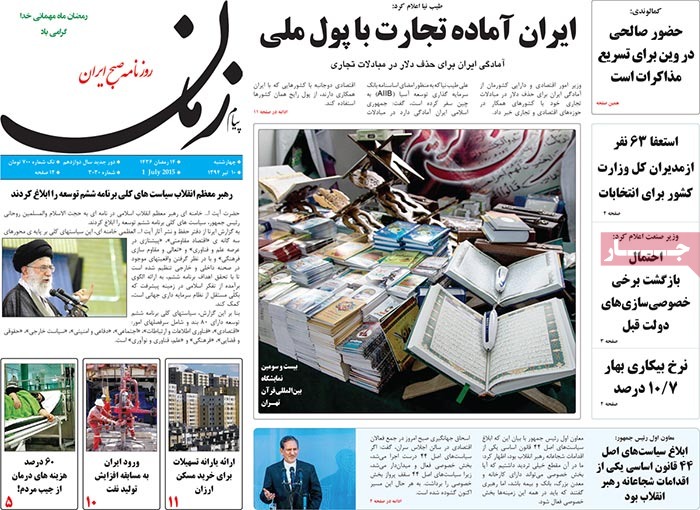
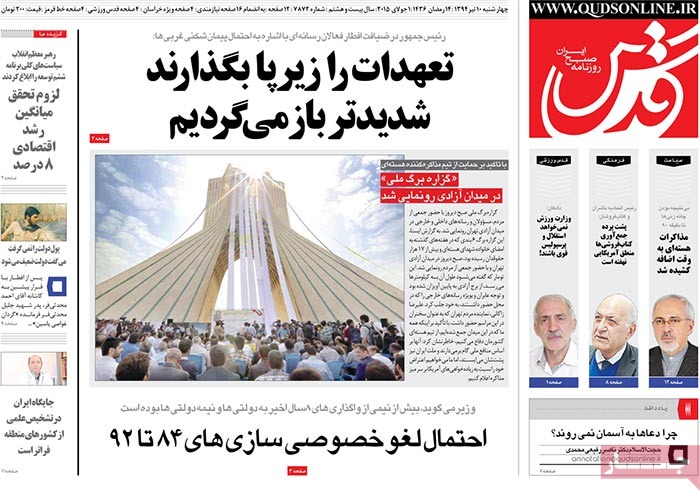
Extension of nuclear talks between Iran and P5+1 and communication of the macro-policies of the Sixth Development Plan by the Supreme Leader to the president dominated the front pages of Iranian newspapers on Wednesday.
Ettela’at: The Supreme Leader has communicated the macro-policies of the Sixth Development Plan to the president.
These polices fall into the following categories: Economy, Information Technology and Communications, Social, Defense and Security, Legal and Judicial, Cultural, Science, Technology and Innovation.
Abrar: “Denying citizens the right to choose whoever they wish as their attorney amounts to violation of their right to representation,” said an attorney at law.
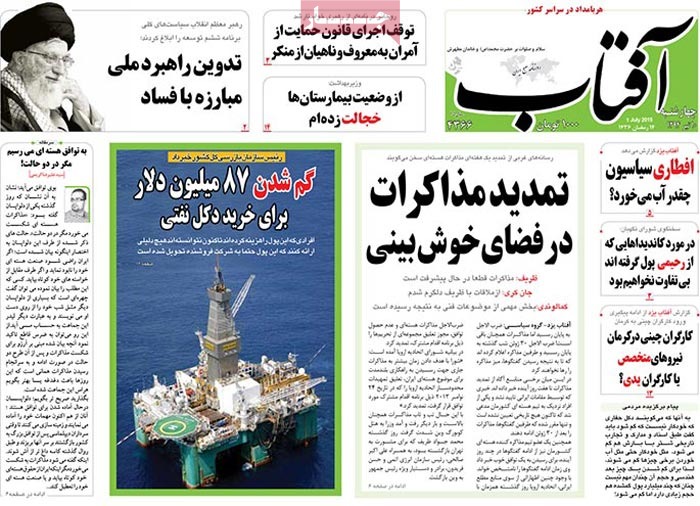
Aftab-e Yazd: The spokesman of the Guardian Council has said that the council won’t be indifferent to the conduct of those candidates who received money from [former First Vice-President Mohammad Reza] Rahimi [who is serving time for corruption].
Arman-e Emrooz: The inspector general has confirmed reports that $87 million dedicated to purchasing an oil derrick has gone missing [when the previous government was in office].
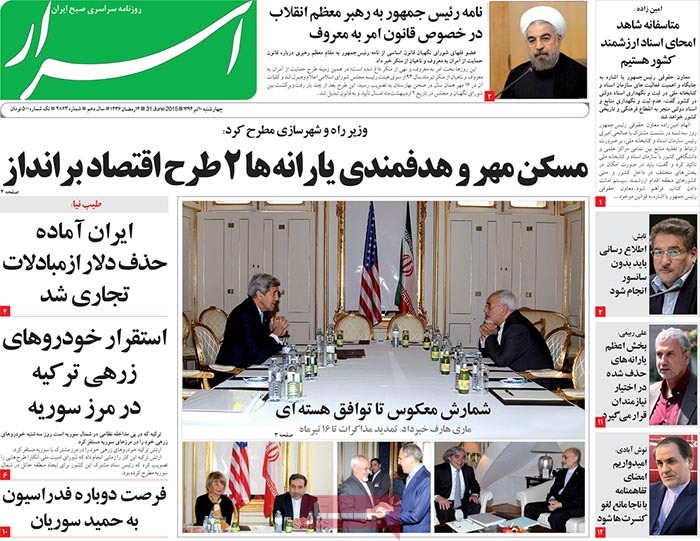
Asrar: “Iran stands ready to eliminate the US dollar from its international transactions,” announced the minister of economy and financial affairs.
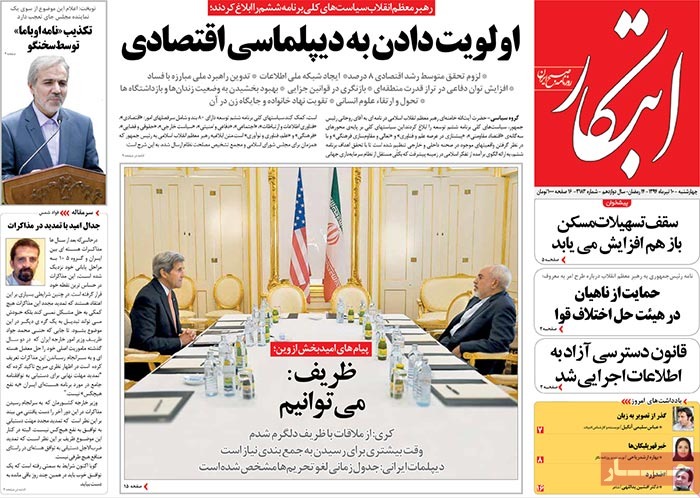
Ebtekar: The macro-policies of the Sixth Development Plan issued by the Supreme Leader prioritize economic diplomacy.
Among other things, these policies call for an average eight percent economic growth, creation of a national information network and formulation of a national strategy to turn up the heat on corruption, measures to boost the country’s defense capabilities, promotion of the humanities, and efforts to prop up the family institution and promote women’s status in society.
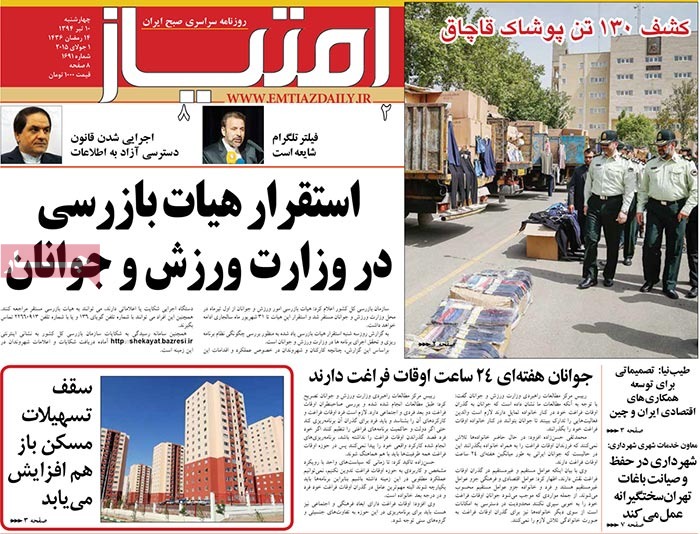
Emtiaz: Police have seized more than 130 tons of smuggled clothing.
Emtiaz: The minister of communications has denied reports that Telegram [a messaging app] has been blocked.
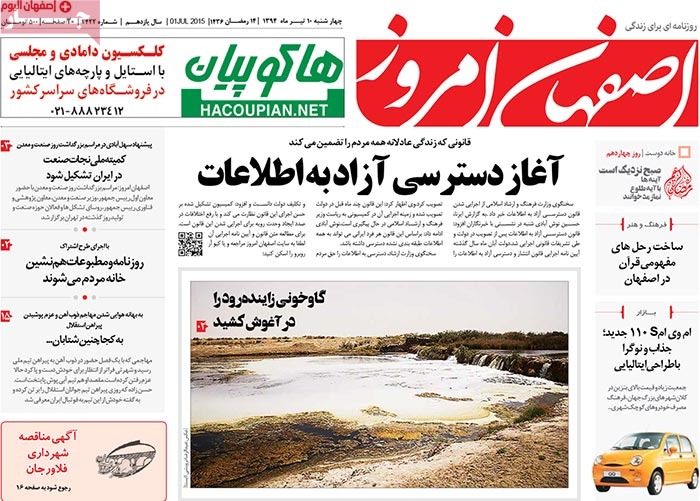
Esfahan Emrooz: The law that allows citizens free access to information has taken effect.
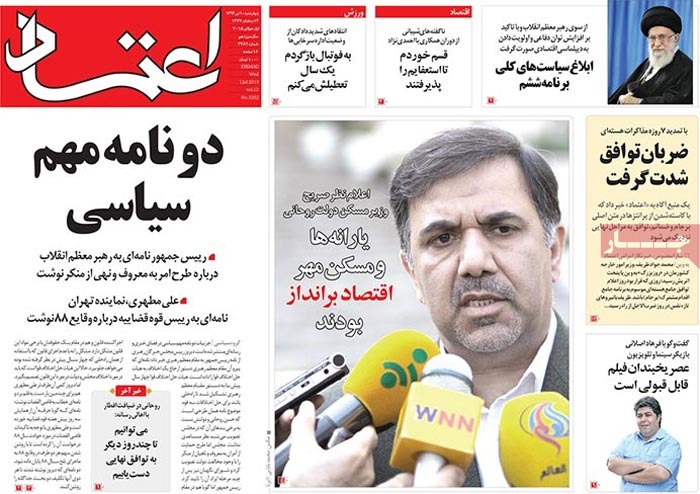
Etemad: “The cash subsidies and the Mehr Housing Project [both initiated by former President Ahmadinejad] took the ax to the economy,” said the minister of roads and urban development.
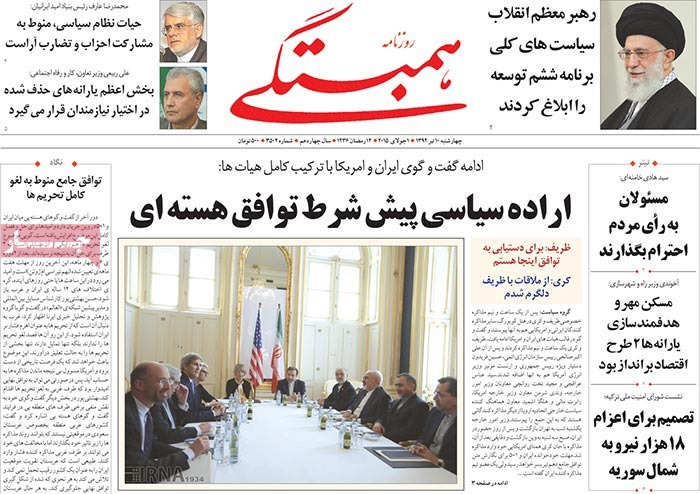
Hambastegi: “Government is to spend the cash it earns from the elimination of subsidies [to high-income individuals] on the needy,” said the minister of cooperatives, labor and social welfare.
Kayhan: A large number of state managers have resigned to run for parliament.
Mardomsalari: The first vice-president has asked the officials of the previous government to answer his question: “What happened to the $700 billion Iran earned in hard currency?”
Payam-e Zaman: “The presence of the director of the Atomic Energy Organization of Iran (AEOI) in Vienna is designed to speed up the nuclear talks,” said the spokesman of the AEOI.
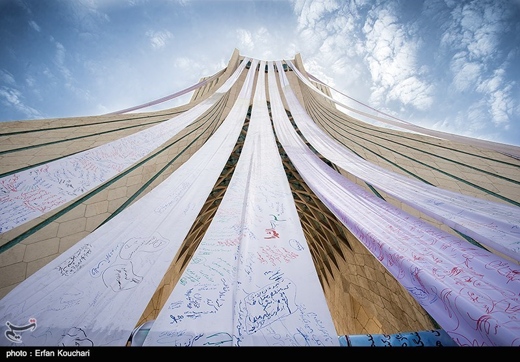
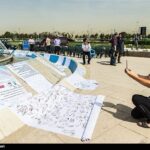
Qods: A national nuclear fact sheet has been unveiled at Tehran’s Azadi [Freedom] Square.
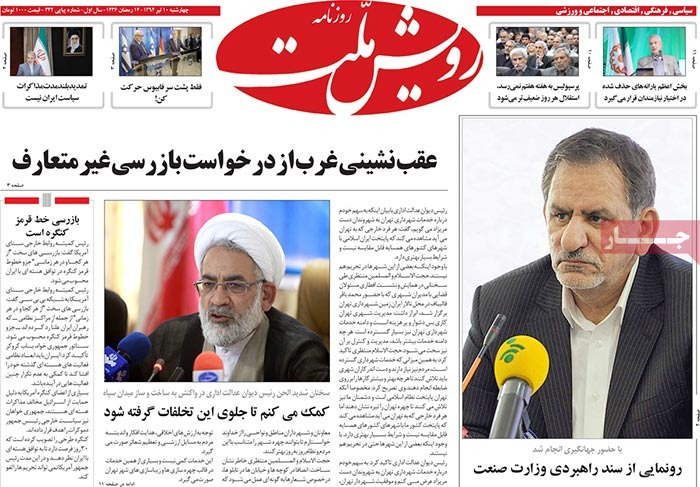
Rooyesh-e Mellat: The head of the Supreme Administrative Justice Court has said that he will help stop the illegal development project at a historical site in Tehran’s Sepah Square.
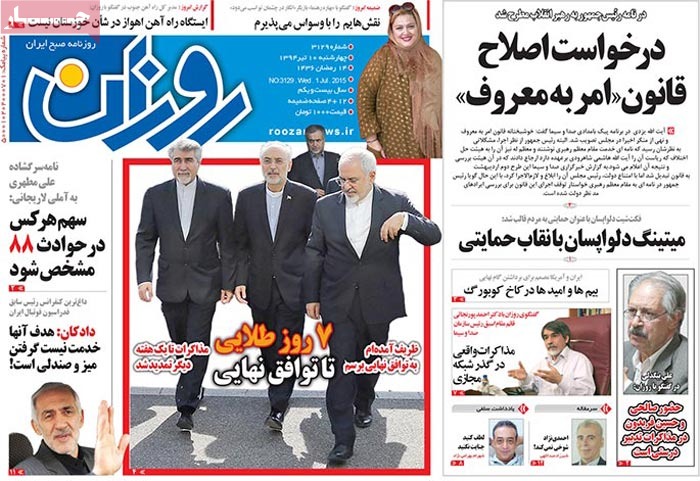
Roozan: Nuclear talks have been extended by one week.
♦ The Supreme Leader has communicated the macro-policies of the Sixth Development Plan to the president.
These polices fall into the following categories: Economy, Information Technology and Communications, Social, Defense and Security, Legal and Judicial, Cultural, Science, Technology and Innovation.
♦ Production units are to receive some $5 billion for their working capital.
First Vice-President Eshagh Jahangiri made the announcement at a ceremony to praise the services of industrialists.
♦ Banking loans up for grabs to reactivate production units in the red
The governor of the Central Bank of Iran has sent letters to provincial governors telling them that those units which have been unable to pay back their debts between 2010 and 2013 for reasons beyond their control should be given priority in getting loans.
♦ The Turkish government has ordered 18,000 troops deployed to Syria.
The troops are to take on Kurdish fighters, not IS, Turkish media have reported.
♦ The West has withdrawn its unconventional demand for access to military sites.
The foreign ministers of Iran and the US had a one-on-one meeting which lasted 90 minutes in Vienna on Tuesday.
♦ “If they [world powers] fail to keep their end of the bargain, we would rush back to the previous path,” said President Rouhani.
♦ “We are facing a shortage of hospital beds and a large patient population to deal with,” said Health Minister Hassan Hashemi.
The health chief further said that the healthcare system is far away from ideal conditions.
♦ Egyptian President Abdel Fattah el-Sisi has said that Muslim Brotherhood leaders will be executed.
His comments came as the Iranian Foreign Ministry spokeswoman and leaders of Western and Arab countries condemned the assassination of Egypt’s top public prosecutor in a bomb attack in Cairo.
♦ Up to 120 people were killed when an Indonesian [military transport] plane went down.
An Iranian economist says that from 2005 onward Iran’s economy has grown more dependent on imports thanks to the organized, systematic and intentional measures [the governments have adopted].
Saeed Laylaz, who is also a journalist, a university professor and a former advisor to President Mohammad Khatami, made the comment in an interview with Khabaronline.ir and added although the removal of sanctions is necessary for the country, it will not work miracles.
The following is a brief translation of PART TWO of his remarks in the interview preceded by an introduction by Saeed Jafari Pouya, the interviewer:
Saeed Laylaz is among a handful of economists who know history and can analyze international politics. Economists are usually versed in their own territory and perhaps have no interest in taking a broader look at political and international developments.
Laylaz, however, is blessed with these characteristics, something which renders him an outstanding analyst in international economics and politics. More than sanctions, he says, the sometimes deliberate mismanagements of the previous government have created such a [problematic economic] situation in the country.
Oil and future of Iran’s post-sanctions economy
A look at the experience of the past 70 years reveals that whenever oil is given a major role to play in Iran’s economy, inflation, corruption and political infighting become inevitable and the money it brings in goes to waste.
I have no reason to believe that this time would be an exception. This is a last chance to grab….
We have a $110 billion enemy
The United States has $110 billion in reserve for Iran. The reserve in question is our worst enemy. It would be the worst present one can get. Had it not been for the sanctions, that $110 billion would have been used up already. This is one final opportunity for our economy to seize.
Immediately after that money returns to the country, challenges such as social crises, corruption and special interest projects will emerge.
The social crisis would be driven by the lower strata who would expect [the arrival back home of the money] to bring them welfare and push prices down. Failure to meet such expectations might turn into a serious challenge.
Corrupt elements whose tentacles are felt in the country’s economic and financial sectors would go into overdrive immediately after the money is unfrozen. This corrupt structure remains intact and problems in this area have yet to be taken on.
The third challenge has to do with a potential rise in security spending. Expansion of security threats in neighboring countries thanks to the presence of IS and other Takfiri groups would haunt the government.
Obama-Rouhani telephone conversation lifted psychological burden from the back of Iranian economy
I believe when President Rouhani came to office in 2013, Iran’s economy had already been pushed over the edge. When it came to foodstuff, inflation stood at more than 60 percent in August 2013. Certain social strata were experiencing triple-digit inflation.
As a result of that famous telephone conversation between Presidents Rouhani and Obama, the psychological pressure of expectations regarding inflation was eased. That trend has worked for 22 months. The reason: that conversation eased the pressures.
Economic achievement of Rouhani administration: Stability, predictability and calm
President Rouhani has taken a number of important steps for Iran’s economy. His biggest service to our economy is qualitative and non-statistical. His presidency, which came after four years of around-the-clock fluctuations, has lent three main features to the country’s economy.
Stability, predictability and calm are the three qualities in question. Our society is not pessimistic about the future. There are bright signs in our economy. They are the results of President Rouhani’s emphasis on interaction with the world and the effect of his foreign policy on our economy.
Termination of sanctions is inevitable
I believe coming to terms with world powers is inevitable. Sometimes you say you can live with adverse conditions and sometimes you say you want to make progress and leap forward. So an agreement can be likened to walking down a steep slope which eventually turns up and leads to a peak which is inevitable. If we seek to solve our problems, we can’t help but start from international conflicts.
A decision on going nuclear, Japan or Pakistan-style?
In 2005, if we had followed in the footsteps of the Khatami administration, we would have been more successful on the nuclear front by now. Given the approach of the reformist government [of President Khatami], there would have been no consensus against us on the international stage. Khatami would smile and convince the world.
The path Khatami chose to develop peaceful nuclear capabilities was the same Japan had chosen. But Ahmadinejad showed that he preferred to go down the Pakistan path.
When you are poor but have the nuclear bomb, your nuclear arsenal is largely for domestic consumption: to have a powerful tool in dealing with your local opponents and denying the international community the opportunity to stop you.
Today, no one dares object to Pakistan, although everyone knows that it plays an important role in promoting terrorism internationally. At the same time it is a poor country.
In 2002, for every percentage point of economic growth, we had $2.5 billion in imports. In 2011, when sanctions had yet to be imposed, for every percentage point of growth we imported $25 billion in foreign items. That is a 10-fold growth. Given the performance of the previous government, how did you expect to go nuclear?
Exports of crude gas neither possible nor economical
In the 1960s, we concluded that our country was in a geopolitical deadlock when it came to exports of natural gas. That deadlock, both technical and geopolitical, meant we could not export natural gas to any country. Russia stood in the way of exports to the West, while ethnic conflicts prevented exports to the East. As for Japan, technical issues were to blame.
In the 1960s, the Shah decided at the Economy Council that natural gas needed to be [indirectly] converted to products such as steel, aluminum, etc. before being exported. He brought the direct revival technology to Mobarakeh Steel Company. Iran was expected to become a regional hub for steel and aluminum production. He said he wanted to build so many natural gas-powered plants in the South that thanks to the plentiful electricity generated in those plants Iranian shorelines could be seen from across the Persian Gulf.
I believe the president should take account of this geopolitical deadlock. Basically, the 24 phases of South Pars Gas Field are a manifestation of such strategy. We need to openly announce that we don’t sell crude natural gas.
Sanctions on petrochemicals kicked in much later. The reason why rial’s value to the dollar does not rise is that Iran is exporting more petrochemicals by the day. The hard currency that exports of petrochemicals earn is controlling the market. So, we need to pay close attention to this issue.
Prospects of Iran’s economy are promising
If we had acted before the economy plunged into this crisis, if we had stopped mismanagement, and if we had stopped appointing profiteering and non-expert individuals to high positions, sanctions would definitely have failed to create trouble for our country.
What has sunk us in this crisis is the sometime witting mismanagement that prevailed in the country between 2005 and 2013. In order to create promising prospects for the country, the Rouhani administration has no choice but break the shackles of sanctions and inject effective management into economy. I believe that is quite likely.
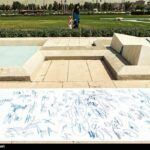
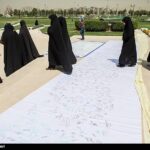
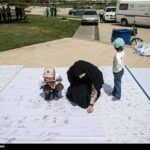
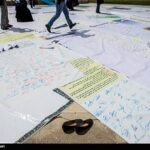
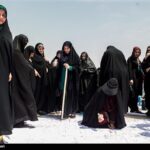
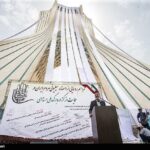
A “national fact sheet” with millions of signatures that outlines the essential requirements for a possible final nuclear deal between Tehran and six world powers was unveiled in Tehran’s Azadi square on Tuesday.
The following are pictures Tasnim News Agency released of the fact sheet on June 30:
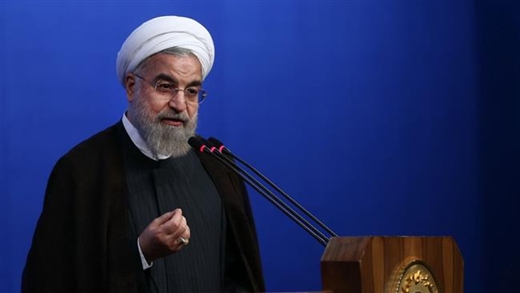
President Hassan Rouhani says the country will return to the previous level of its nuclear activities, if P5+1 violate the terms of a potential nuclear deal with the Islamic Republic.
“If a [final] nuclear agreement is reached, we will be committed to implementing it. However, it is clear that the opposite side should also remain committed to its obligations,” Rouhani said in a meeting with Iranian press corps on Tuesday.
In case of the six countries’ violation of a final nuclear deal, he said, his administration “will be fully ready to immediately return to the previous path even more vigorously than they could imagine.”
He said the ongoing talks between Iran and P5+1 in Vienna, Austria, can lead to a win-win result if the six countries show political will.
“Nuclear talks between Iran and P5+1 can bear fruit within the next couple of days past the [June 30] deadline,” Rouhani pointed out.
He noted that Iran and the six countries have managed to settle the “major part of the issues” and the remaining differences can be solved through initiatives worked out by both sides.
The president also said his administration has managed over the past two years, since taking office, to disprove unfounded allegations against Iran of meddling and belligerence as well as attempts to develop nuclear weapons.
Iran, however, made efforts to prove to the world that it seeks international dialog and interaction, and aims to settle problems at the negotiating table, he said.
“If they claim that they want to prevent the development of nuclear weapons in Iran, they should know that Iran has never sought to build nuclear weapons,” Rouhani said.
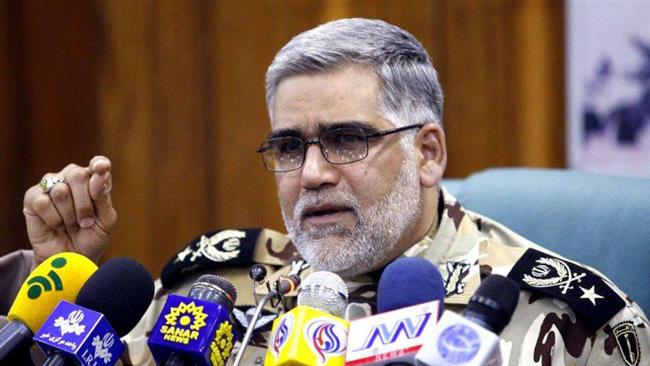
A senior Iranian Army commander says the Islamic Republic will counter any threat posed by its enemies on the country’s borders, stressing the resolve of the Armed Forces of the Islamic Republic to defend Iran against any foreign threats.
“Rocket-launching units of the Iranian Army Ground Forces possess very good capability and capacity,” Commander of the Iranian Army’s Ground Forces Brigadier General Ahmad Reza Pourdastan told reporters on Tuesday night.
“Our missiles have been reinforced and upgraded both in their range and destructive power,” Pourdastan added.
He went on to say that the Iranian Army’s missiles have passed testing stages in recent war games dubbed Beit ul-Muqaddas 27 held by the Army’s Ground Forces in May.
The Iranian commander also said that the country’s troops are “soldiers of Islam” and will not violate the integrity of any country.
In recent years, Iran has made major breakthroughs in its defense sector and attained self-sufficiency in producing important military equipment and systems.
The Islamic Republic maintains that its military might poses no threat to other countries, stating that its defense doctrine is merely based on deterrence.
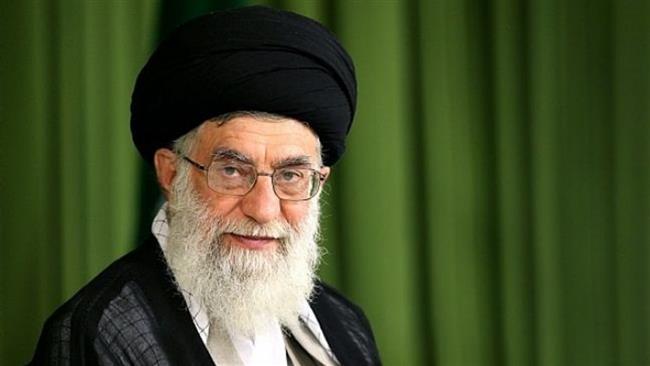
Supreme Leader of the Islamic Revolution Ayatollah Seyyed Ali Khamenei has instructed the Iranian president to boost the country’s defense and deterrence capabilities.
The directives were part of the Leader’s letter to President Hassan Rouhani in which Ayatollah Khamenei announced the general policies of the Sixth National Development Plan.
In the letter, the Leader underlined the need to upgrade Iran’s deterrence power by developing the nation’s missile capability and defense technologies as well as boosting the capacity to produce weaponry and major defense equipment to help counter “different types of threats.”
Ayatollah Khamenei also stressed the need to develop civil defense programs in critical and sensitive locations in the country.
Among other points highlighted by the Leader was the necessity of boosting soft power and cyber-defense capabilities as well as providing air defense and cyber-security for the country’s infrastructure.
Ayatollah Khamenei noted that at least five percent of the country’s budget should be set aside to boost the nation’s defense capability at the regional level to secure national security and interests.
President’s Chief of Staff Mohammad Nahavandian voiced optimism about the ongoing nuclear negotiations between Iran and P5+1 (the US, China, Russia, France and Britain plus Germany).
Nahavandian made the remarks in a meeting of Iran-Italy joint chamber of commerce in Tehran on Tuesday night.
“Although the nuclear negotiations have not ended, it is sufficient reason that we should be optimistic about the future of talks because the negotiating sides have resorted to logic and joint objectives instead of imposing their one-sided stances,” the president’s chief of staff said.
He called on the other side of negotiations to limit its efforts to make sure Iran’s nuclear program is not to seek weaponry objectives instead of using the nuclear issue as a pretext to confront Iran.
Iran has announced many times before that it had not sought military objectives in its nuclear program and it will not do so, he said, adding the other side’s confirmation that Iran has the right to advance its nuclear plan like other fields will pave the way for striking an agreement in a serious manner.
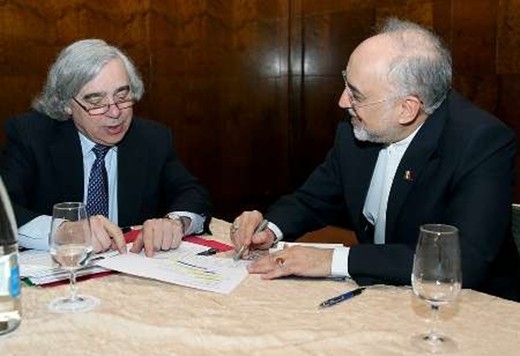
Head of the Atomic Energy Organization of Iran (AEOI) Ali-Akbar Salehi and US Secretary of Energy Ernest Moniz met and discussed technical aspects of a comprehensive deal over the Iranian nuclear program at Coburg hotel on Tuesday.
This is the first technical negotiations between senior atomic energy managers of Iran and the US after the Lausanne talks in March.
Salehi arrived in Vienna along with Foreign Minister Mohammad Javad Zarif earlier in the day and joined the talks for drafting a comprehensive nuclear deal.
Meanwhile, Yukiya Amano, the director general of the International Atomic Energy Agency also arrived in the Austrian capital on Tuesday evening and held talks with Zarif on cooperation between Iran and the IAEA.
Amano was also in Vienna two days earlier when he met with US Secretary of State John Kerry.
Deputy foreign ministers of Iran and the six world powers and Deputy EU Foreign Policy chief Helga Schmid began the eighth round of nuclear talks in Vienna since last Wednesday.