Thursday, December 25, 2025
Home Blog Page 4826

A look at Iranian newspaper front pages on June 22

Iranian Newspapers Headlines

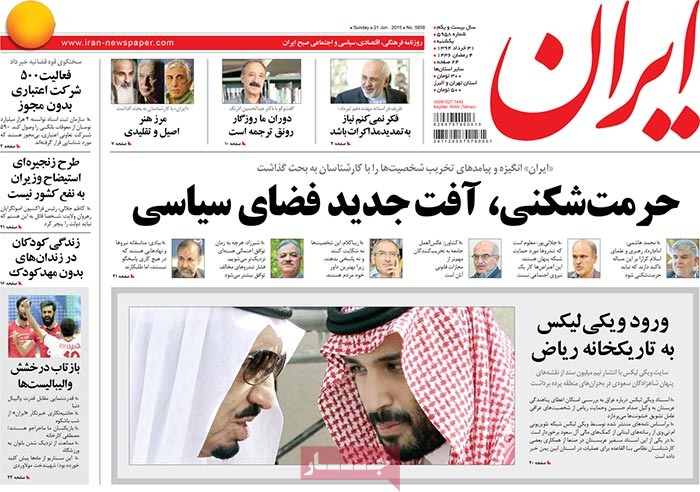
Approval by parliament of the general outlines of a bill that urged the government to safeguard the nuclear achievements of the nation dominated the front pages of Iranian newspapers on Monday. Reformist-leaning dailies also put the comments of Ayatollah Akbar Hashemi Rafsanjani in condemnation of what the previous government did on their covers.


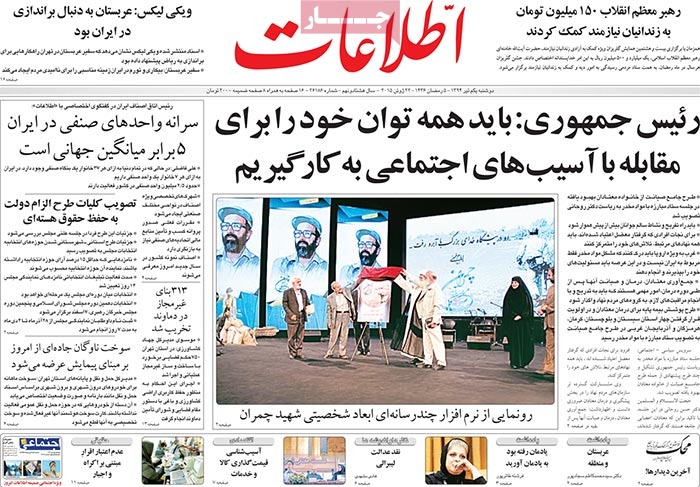
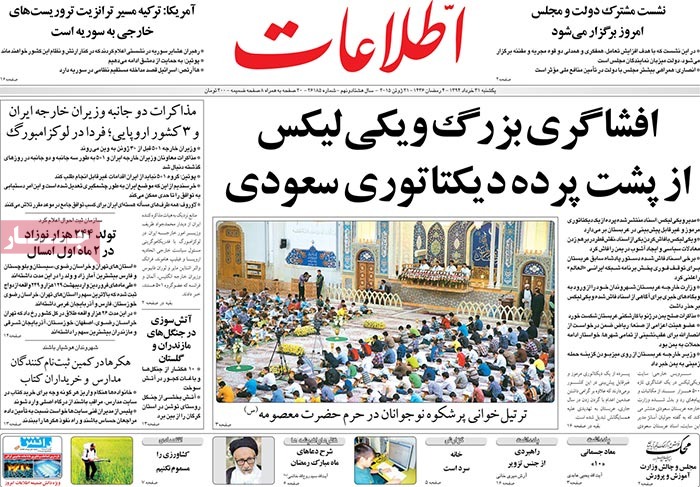
Ettela’at: “We need to fully tap into our potential to counter social harms,” said President Rouhani.

A session of the Anti-Drugs Headquarters presided over by the president voted for a plan that protects the families of the addicts who go into rehab.

“The West, Europe in particular, should understand that the scourge of drugs is not only for Iran to deal with. They too should share the burden,” President Rouhani added.

Ettela’at: The Supreme Leader has donated some $30,000 to help inmates who are in prison because of their inability to pay back their debts.

Ettela’at: The multimedia software depicting the characteristic traits of Martyr Chamran has been unveiled.

Ettela’at: [Newly released] WikiLeaks documents suggest that Saudi Arabia wanted a regime change in Iran.

In one of those documents the Saudi ambassador [in Tehran] has said that unemployment and inflation offer perfect ground for creation of despair among the Iranians.

Ettela’at: Parliament has approved the general outlines of a bill that requires the government to safeguard the nuclear achievements of the country.

An open session of the chamber will look into the details of the plan on Tuesday.

Ettela’at: The per capita number of businesses in Iran is five times the world average.

Ettela’at: More than 300 unauthorized buildings have been demolished in Damavand.


A look at Iranian newspaper front pages on June 22


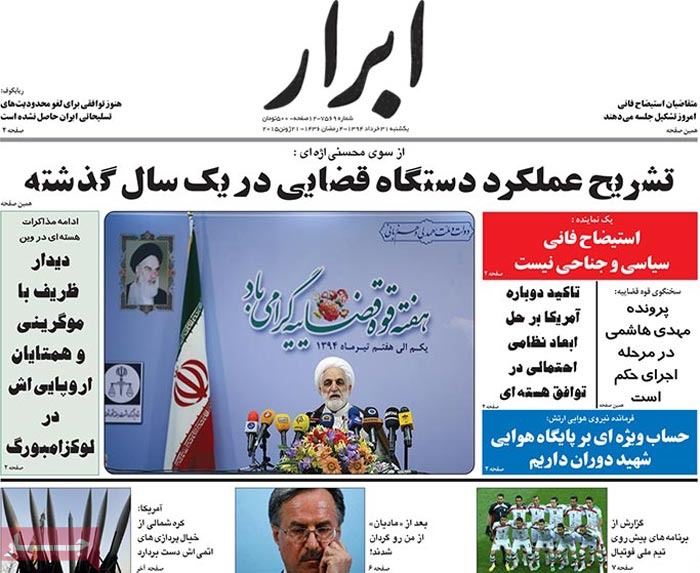
Abrar: [Iranian negotiators] Araghchi and Takht-e Ravanchi have continued the nuclear talks with [Wendy] Sherman and Helga Schmid.

It came as French Foreign Minister Laurent Fabius said that his country wants a firm deal to be struck with Iran.

Abrar: There are speculations that an operation to liberate Mosul is around the corner.

The Iraqi city has been under the control of IS terrorists for over a year.


A look at Iranian newspaper front pages on June 22


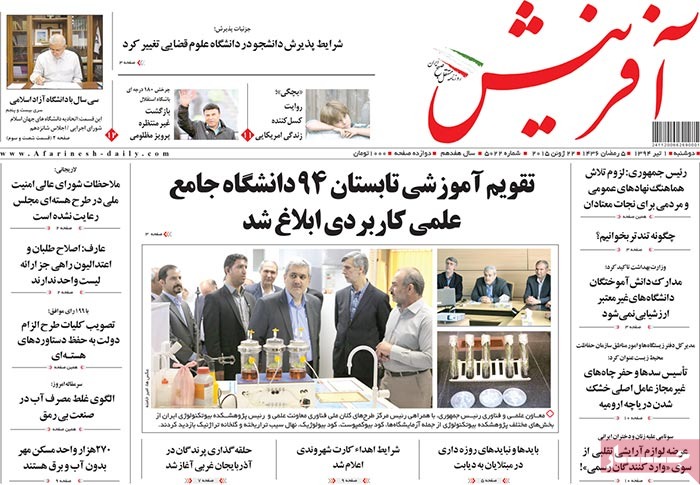
Afarinesh: Parviz Mazloumi has made an unexpected return to Esteghlal Football Club.

Mazloumi has signed a contract with the club to take over as head coach of the capital’s heavyweight club.


A look at Iranian newspaper front pages on June 22


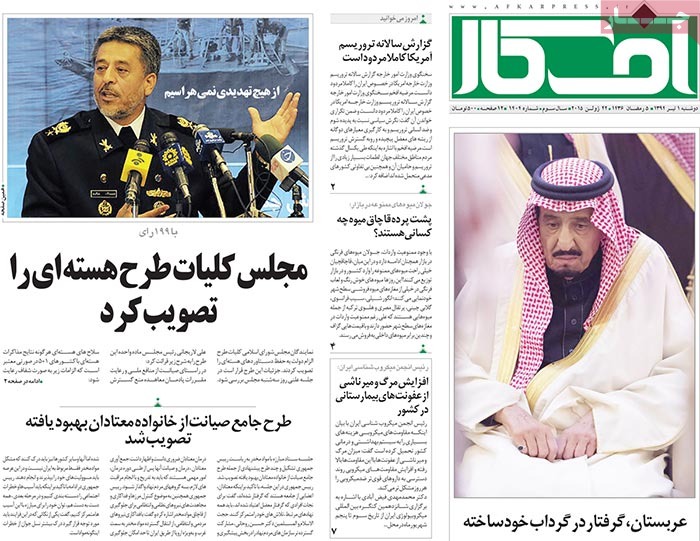
Afkar: There has been a hike in the number of deaths caused by hospital infections in the country.


A look at Iranian newspaper front pages on June 22


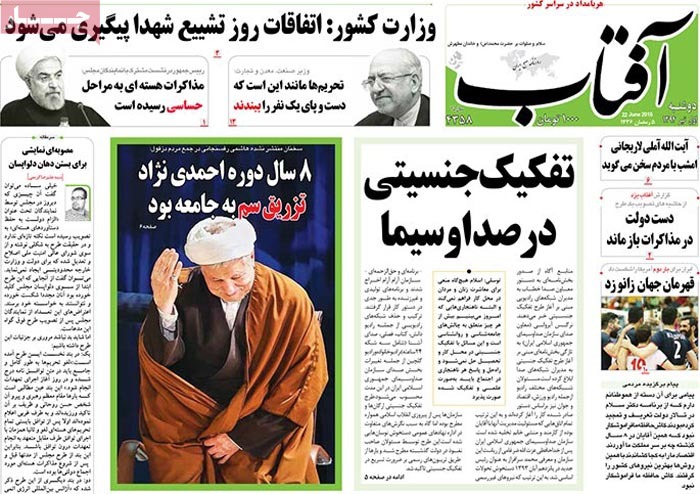
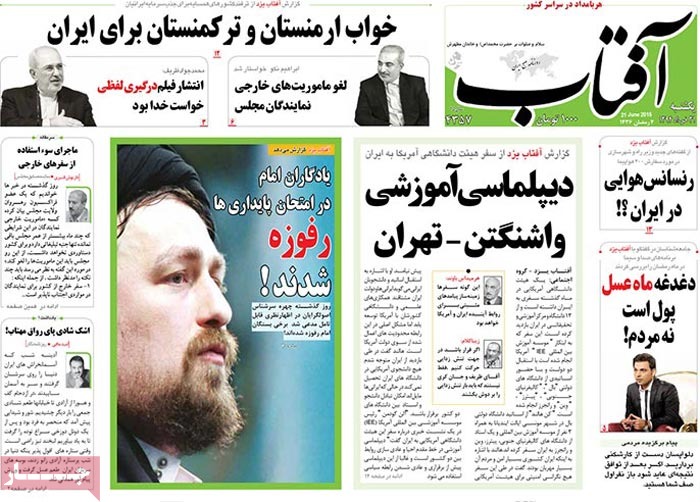
Aftab-e Yazd: Iran brought the world champions to their knees.

Iran has defeated the United States 3-0 in the FIVB World League for a second time.


A look at Iranian newspaper front pages on June 22


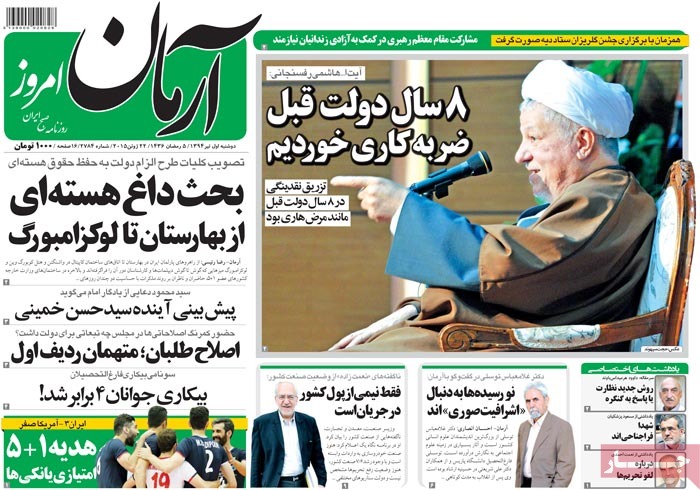
Arman-e Emrooz: “During the eight years the previous government was in power, we were dealt a heavy blow,” said Chairman of the Expediency Council Ayatollah Akbar Hashemi Rafsanjani.

He further said that injection of liquidity during the eight-year period was like “rabies”.


A look at Iranian newspaper front pages on June 22


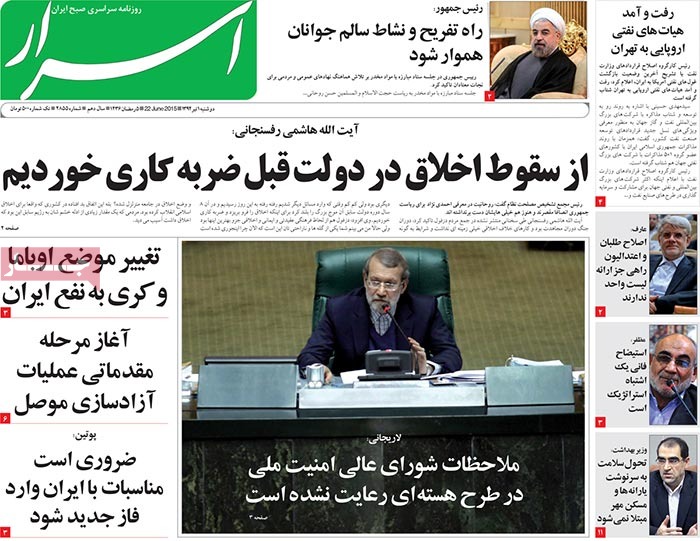
Asrar: “The Health Transformation Plan won’t suffer the same fate as the [cash] Subsidies Plan and Mehr Housing Plan [introduced by the previous government],” said Health Minister Hassan Hashemi.


A look at Iranian newspaper front pages on June 22


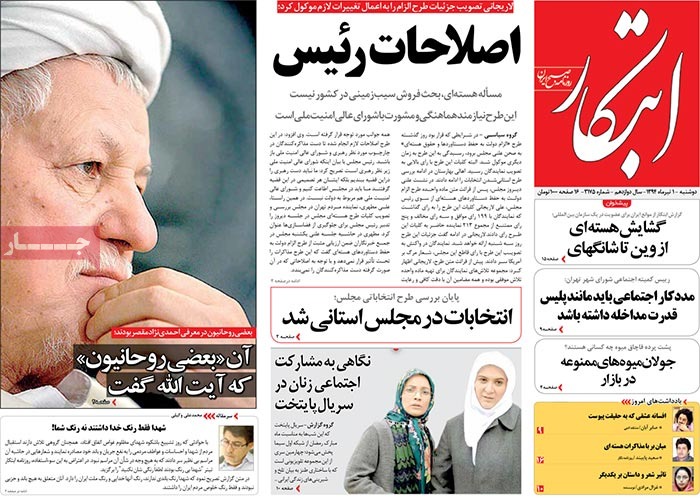
Ebtekar: Revisions of the Speaker

“The nuclear case should not be soft-pedaled to the level of potato sales, it needs coordination and consultations with the Supreme National Security Council,” said Parliament Speaker Ali Larijani.


A look at Iranian newspaper front pages on June 22


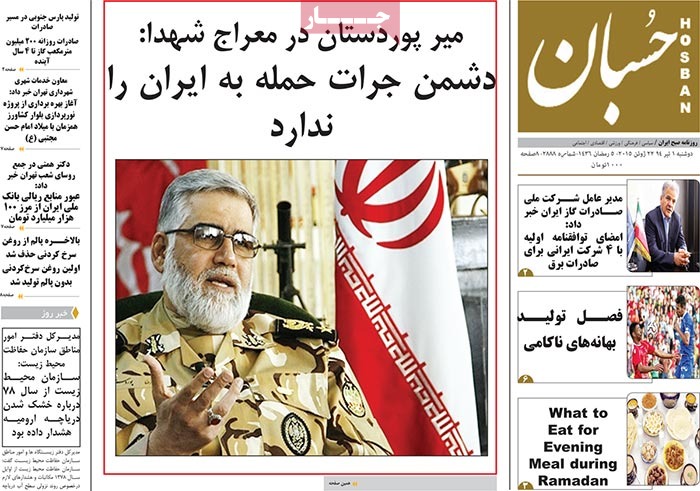
Hosban: “The enemy does not dare attack Iran,” said the commander of the ground forces of the Iranian Army.


A look at Iranian newspaper front pages on June 22


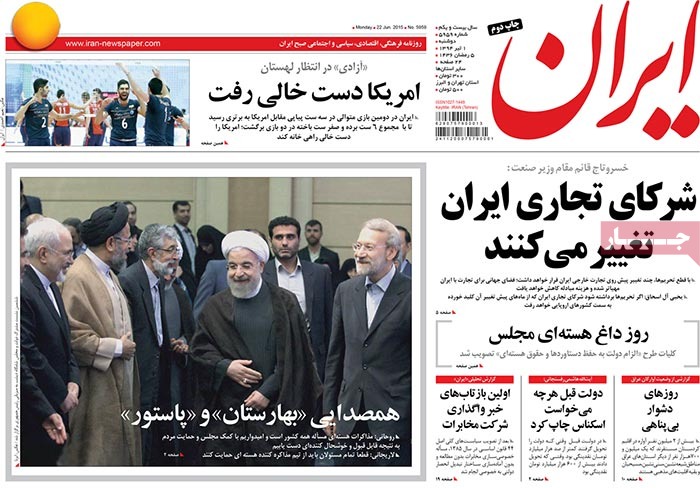
Iran: Baharestan [A Tehran street where parliament building is located] and Pasteur [Another street of the capital where the Presidential Office is located] are in tune.

President Rouhani: “Nuclear talks are an issue for the entire nation. With parliament’s contribution and public support, we hope to be able to reach an acceptable and satisfying result.”

Parliament Speaker Ali Larijani: “Definitely all officials should support the nuclear negotiating team.”


A look at Iranian newspaper front pages on June 22


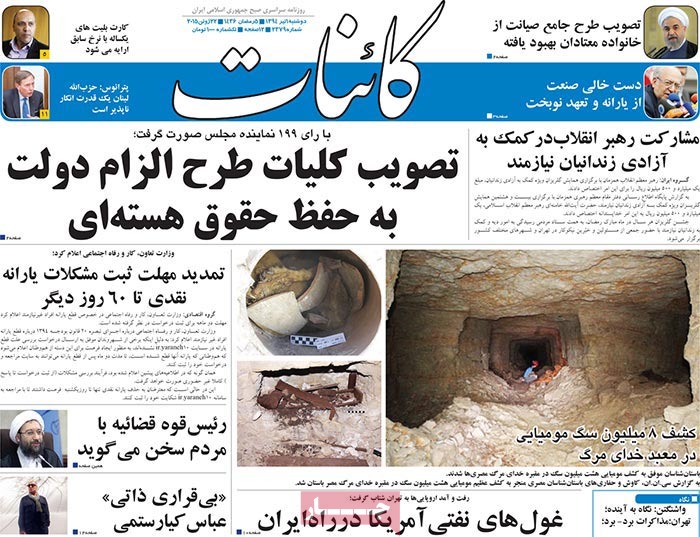
Kaenat: The judiciary chief is to present a televised report to the public on Monday.


A look at Iranian newspaper front pages on June 22


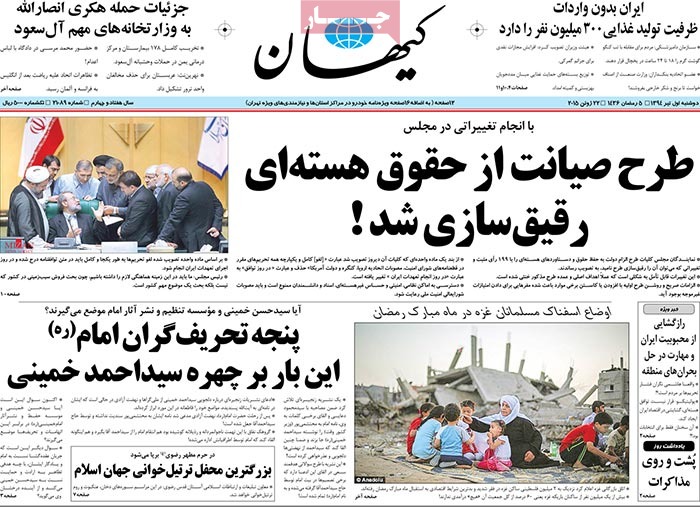
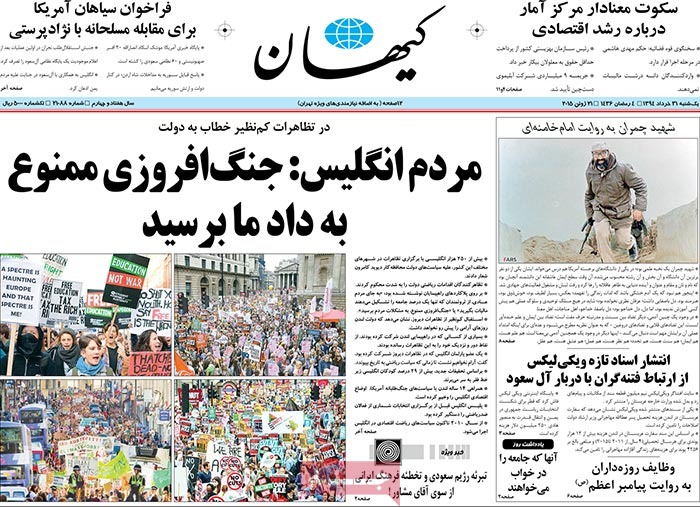
Kayhan: The plan to safeguard the nuclear rights of the country was watered down in parliament!


A look at Iranian newspaper front pages on June 22


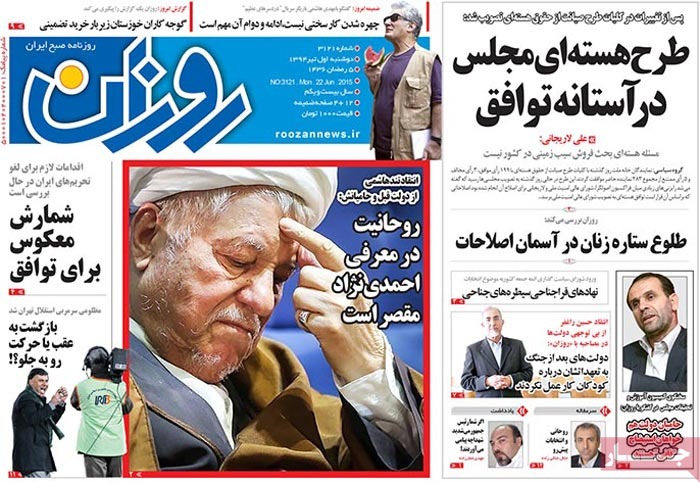
Roozan: “Some clergymen are to blame for introducing Ahmadinejad [to the public],” said Ayatollah Akbar Hashemi Rafsanjani.

The chairman of the Expediency Council has taken a swipe at the previous government and its supporters.


A look at Iranian newspaper front pages on June 22


Maritime terrorism fearful of Iran’s power: Navy chief

sayyari

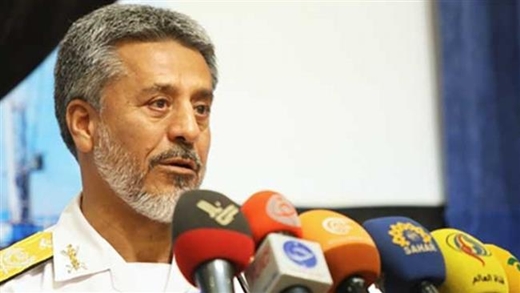
Iran’s Navy Commander Rear Admiral Habibollah Sayyari says pirates and maritime terrorists are fearful of the power of the Islamic Republic’s naval forces.

Sayyari said on Sunday that the Iranian naval forces are strongly present in the Middle East region and in high seas.

He added that Iranian naval forces have managed to safeguard the Islamic Republic’s resources and interests in high seas through their power and capabilities.

In recent years, Iran’s Navy has increased its presence in international waters to protect naval routes and provide security for merchant vessels and tankers.

In line with international efforts against piracy, the Iranian Navy has been also conducting patrols in the Gulf of Aden since November 2008 in order to safeguard merchant containers and oil tankers owned or leased by Iran or other countries.

Iran’s Navy has managed to foil several pirate attacks on both Iranian and foreign tankers during its missions in international waters.

Sayyari further said that the Iranian naval forces’ success to build equipment, destroyers and missile boats has proved that the country can rely on domestic capabilities.

[…]

New Movie Mocks Anti-Iran Films

139403311036185675541293

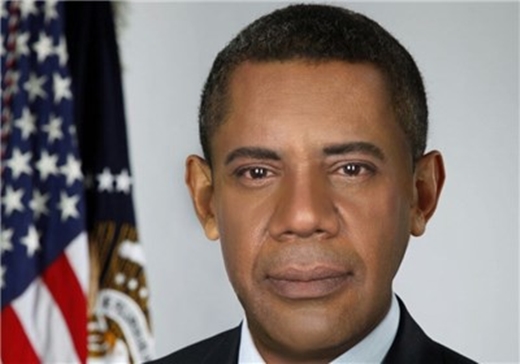
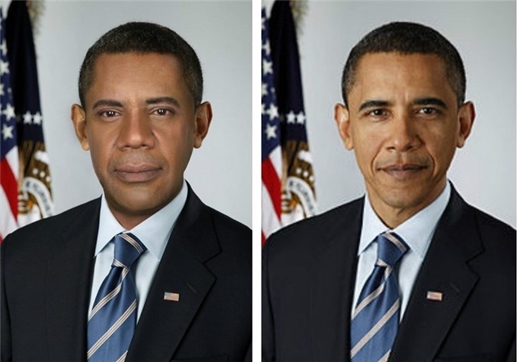
An Iranian film titled Stupid Philosophers, which depicts several political figures including US President Barack Obama, is to serve as a response to anti-Iran films produced in the US and some European countries.

According to filmmakers, Stupid Philosophers, directed by Saeed Chari and produced by Hadi Meshkat, mocks anti-Iran and anti-Islam motion pictures.

“This film is Iran’s first official response to satellite channels and anti-Iran films produced in Hollywood, and mocks such films as Argo, 300, Rosewater, Robocop, and the anti-Islamic movie Innocence of Muslims,” the producers said.

The movie will also relate the events that happened on September 11, 2001, in the US.

“After the 9/11 events, George W. Bush invades Afghanistan and then Iraq, and is considering an attack on Iran as well. However, since he knows Iranians would not tolerate any invasion of their territory, the fear of defeat in a man-to-man conflict with Iran makes him give up the plan,” the summary of film’s story reads.

“Instead (of a military attack), the US resorts to soft war and targets Iran’s culture and family ties by producing anti-Iran films like Argo, 300, Rosewater, and the like, and launching anti-Iran satellite channels,” the summary reads.

Several other infamous individuals including Benjamin Netanyahu (Israeli prime minister), Ariel Sharon (former Israeli premier), Terry Jones (anti-Islam American pastor), Osama bin Laden (founder of Al-Qaeda terrorist group), Sam Bacile (producer of Innocence of Muslims) are also depicted in the film.

Sirous Kahurinejad will play the role of US President Obama, and comedian Hamid Lolaee will play Netanyahu. Reza Rooygari, Touraj Nasr, Seyed Javad Hashemi, and Sharareh Rokham are also among other cast members appearing in this movie.

139403311218433785542274

Iran parliament approves general outlines of nuclear bill

Parliament-Iran

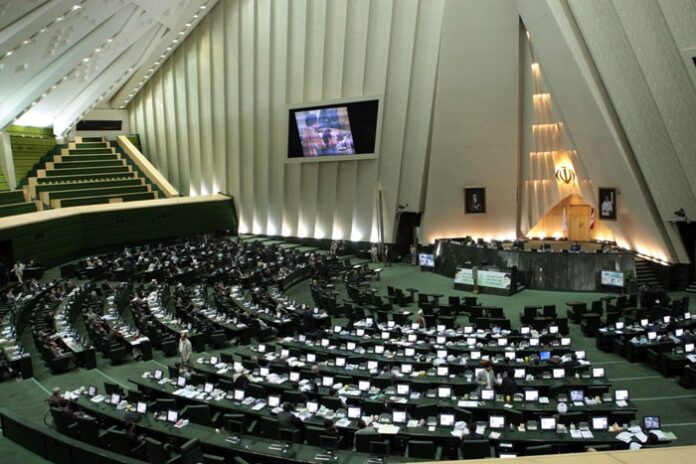
The Iranian MPs on Sunday adopted the general outlines of a motion which obliges government to safeguard the country’s nuclear achievements. The chamber will go into session on Tuesday to review the details of the motion.

Fararu on June 21 published a report on the parliamentary motion and its articles read out by Speaker Ali Larijani in an open session as well as Larijani’s remarks and the reactions they drew from fellow MPs. The following is the translation of the report:

Larijani said to protect national interests and comply with the Safeguards [Agreement] of the NPT, the results of nuclear talks with P5+1 would be reliable if they transparently meet the following requirements:

One: The removal of sanctions should be fully and comprehensively included in the text of the [final] agreement. Termination of sanctions should be carried out the day Iran starts to fulfill its commitments.

Two: The International Atomic Energy Agency (IAEA) is allowed to run conventional inspections of [Iran’s] nuclear sites within the framework of the Safeguards Agreement. The agency is not allowed to have access to sensitive non-nuclear, security and military sites as well as [the country’s] documents and scientists. The decisions of the Supreme National Security Council should be implemented.

Three: No restriction is accepted when it comes to acquisition of peaceful nuclear technology and knowhow as well as research and development, and the decisions of the Supreme National Security Council should be implemented.

Note One: Under Articles 77 and 125 of the Constitution, the results of the talks should be presented to the Islamic Consultative Assembly.

Note Two: The foreign minister is required to present a report to the Islamic Consultative Assembly on the implementation of the agreement every six months.

Parliament’s National Security [and Foreign Policy] Committee will submit a progress report of the agreement to the MPs every six months.

After Larijani read out the articles of the legislative motion on safeguarding nuclear achievements, the MPs voted on its general outlines. The motion was adopted 199-3. There were five abstentions out of a total of 213 votes cast.

Prior to reading out the general outlines of the motion, the top MP said that efforts made by the deputies to piece together this motion have proved successful, adding the motion has taken everything into account.

When Larijani was reading out the motion, a number of MPs protested by asking why the Supreme National Security Council [should be involved]?

The speaker of the Islamic Consultative Assembly replied, “The Supreme National Security Council is supervised by the Supreme Leader and we should not tie the Leader’s hands. We have to obey what the Supreme Leader decides on this.”

Larijani went on to stress that the Supreme National Security Council is not linked to the executive and that it is supervised by the Supreme Leader.

Ahrar al-Najran Movement calls for independence from Saudi Arabia

Najran-saudi

Tribal political activists in Saudi Arabia’s Najran region, which borders Yemen, have formed a grouping called Ahrar al-Najran Movement, calling for independence from Saudi Arabia.

The Islamic Republic News Agency (IRNA) quoted the website of Nabaa TV as reporting that the newly-formed group has called on Yemeni popular forces to offer its members military training.

The following is the translation of a report IRNA filed on June 21on the movement and its demands:

Abu Bakr Abi Ahmed al-Salami, a leader of Ahrar al-Najran, says the movement which brings together different tribal groups is set to launch its first battle in parts of south Najran occupied by the Saudi army.

Areas of Najran where members of the movement hail from were originally part of Yemen’s territory which was occupied by the Saudis in 1934.

There are four main reasons why the movement wants to declare independence from Saudi Arabia:

1. General dissatisfaction in Saudi Arabia with the way officials in Riyadh handle day-to-day administration of affairs,

2. Riyadh’s policy to keep the south impoverished,

3. Aggression against Yemen and the massacre of defenseless people there by the Saudi regime,

4. Failure of the Saudi government to view the residents of the south as first-class citizens, thus violation of their legitimate rights.

A look at Iranian newspaper front pages on June 21

Iranian Newspapers Headlines

The WikiLeaks documents on Saudi Arabia’s behind-the-scenes measures and the comments of the judiciary spokesman about a number of high-profile cases dominated the front pages of Iranian newspapers on Sunday.


Ettela’at: Major WikiLeaks revelations about the behind-the-scenes of Saudi dictatorship

Some of the newly released documents show that the former Saudi King had ordered Iran’s Arabic-Language TV Channel Al-Alam be jammed immediately.

Ettela’at: The legislative and executive branches of government will have a joint meeting later today.

The meeting to be hosted by the Executive is designed to promote interaction and consultations between the two branches.

Ettela’at: Iranian Foreign Minister Mohammad Javad Zarif will hold bilateral meetings with three European counterparts in Luxembourg Monday.

The foreign ministers of P5+1 will fly to Vienna before June 30.

Ettela’at: Some 244,000 babies were born across Iran in the first two months of the year [started March 21, 2015].

During the same period more than 26,000 divorces were registered across the country.

Ettela’at: Bushfires in the forests of the northern provinces of Golestan and Mazandaran

The fire blackened more than 10 hectares of forests and orchards in Kojur. It also partially destroyed a village in Golestan Province.

Ettela’at: Youngsters have recited the holy Koran in the holy shrine of Masoumeh in Qom.

Ettela’at: Police have sounded alarm bells: Hackers lie in wait to pounce on those who shop textbooks online.


A look at Iranian newspaper front pages on June 21


Abrar: “The impeachment of the education minister is not politically-motivated,” said a parliament representative.


A look at Iranian newspaper front pages on June 21


Afkar: An Iranian official has denied reports that Iran and Australia have struck a deal on forced repatriation of Iranian asylum-seekers.


A look at Iranian newspaper front pages on June 21


Aftab-e Yazd: The Tehran-Washington education diplomacy

A delegation of American academics has visited Iran, inspecting a dozen higher education facilities.


A look at Iranian newspaper front pages on June 21


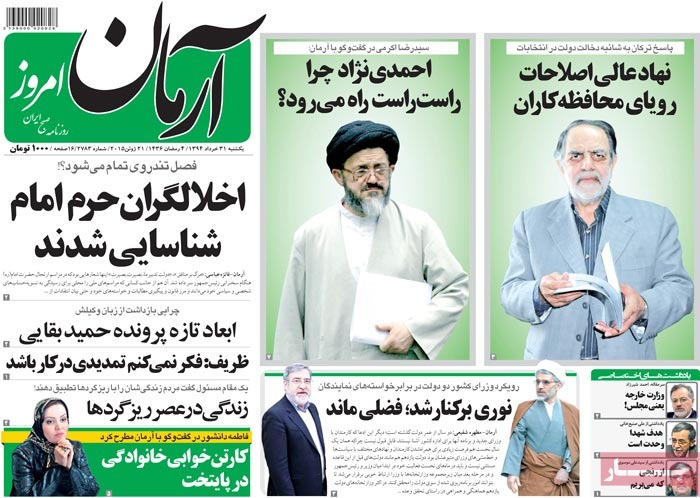
Arman-e Emrooz: Those who disrupted the speech of senior officials in Imam Khomeini Mausoleum have been identified.

Will this bring a chapter on extremism to a close?


A look at Iranian newspaper front pages on June 21


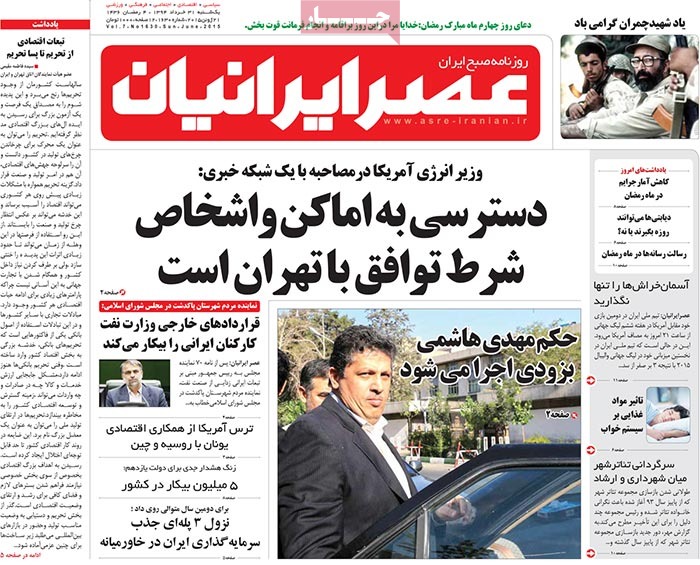
Asr-e Iranian: Up to 5 million Iranians are unemployed.


A look at Iranian newspaper front pages on June 21


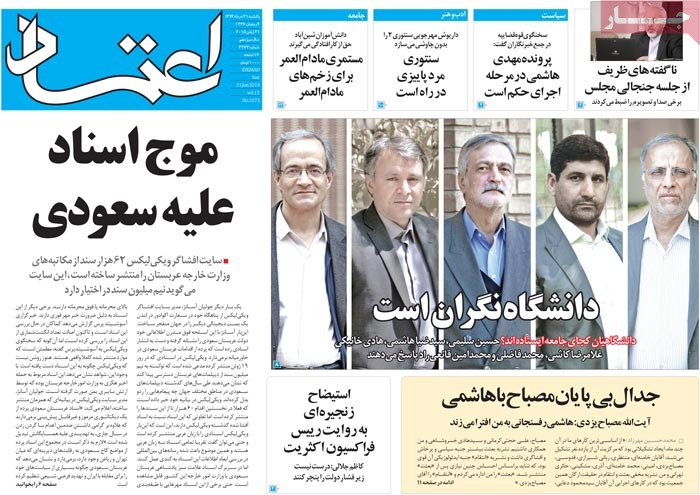
Etemad: “The case of Mehdi Hashemi has been sent to the division that implements the verdicts,” the judiciary spokesman told a news conference.


A look at Iranian newspaper front pages on June 21


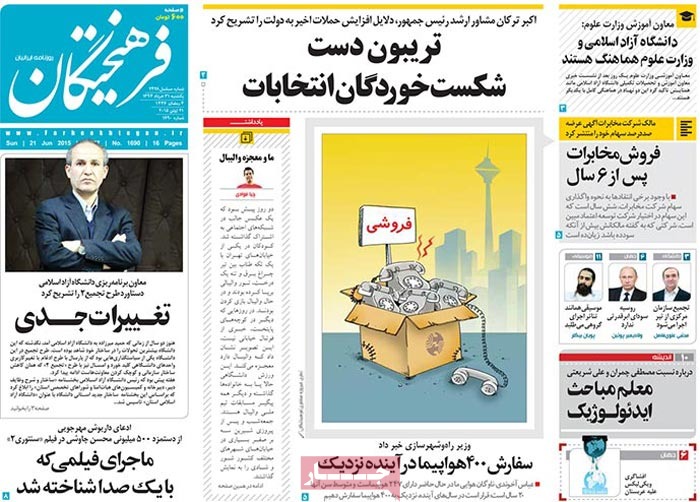
Farhikhtegan: “Iran will place orders for 400 aircraft in the near future,” said the minister of roads and urban development.


A look at Iranian newspaper front pages on June 21


Iran: “I don’t think an extension of nuclear talks will be needed,” said Iranian Foreign Minister Mohammad Javad Zarif.

Iran: “Serial impeachment of the Cabinet ministers won’t serve the interests of the nation,” said a principlist MP.


A look at Iranian newspaper front pages on June 21


Kayhan: Newly released WikiLeaks documents show that the Seditionists [a reference to those who disputed the results of the 2009 presidential elections and thus sparked widespread unrest] were in contact with the Saudi Royal Court.


A look at Iranian newspaper front pages on June 21


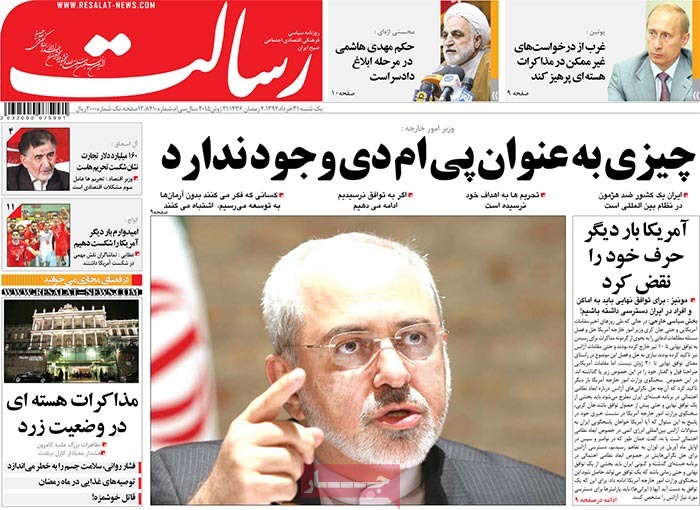
Resalat: “There is no such thing as PMD (Possible Military Dimensions) in Iran’s nuclear program,” said FM Zarif.

The top diplomat further said that sanctions have failed to produce their intended results.

Resalat: The head coach of the Iranian volleyball team has expressed hope his team will pull off a second win against the US.

Iran is to line up against the US on Sunday. In the first FIVB World League game on home soil, Iran defeated the US in straight sets on Friday.


A look at Iranian newspaper front pages on June 21


Iran censures US double standards on terrorism

Afkham

Tehran has rejected the anti-Iran accusations in the annual global terrorism report by the US Department of State, censuring Washington for adopting a double-standard approach in dealing with the issue of terrorism.

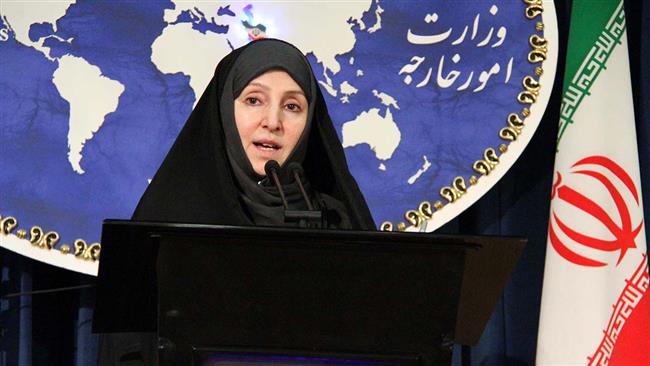
Iranian Foreign Ministry Spokeswoman Marzieh Afkham on Saturday described the content of the US report as repetitive and said a politically-motivated stance on terrorism further complicates the issue.

“The growing and complicated scourge of terrorism is rooted in applying double standards and a political approach toward this evil and inhumane phenomenon,” Afkham said.

In its annual global terrorism report released on Friday, the State Department accused Iran of supporting terrorist groups and conducting terror-related activities.

The Iranian official also described Iran as the “biggest victim of terrorism” over the past three decades, adding that leveling accusations against a country which spearheads international cooperation in the fight against terrorism, extremism and violence is part of a “blame game” played against the Islamic Republic.

The Iranian official took a swipe at the real supporters of terrorist groups as well as the so-called advocates of human rights for the surge in terror threats in the world.

Afkham questioned the US claim of fighting terrorism, saying the presence and unhindered operations of terrorists in the US, Washington’s failure to take a serious and firm action against terrorist and extremist groups as well as its indifference to Israel’s crimes against the Palestinian people discredit such so-called terrorism reports.

Shanghai filmfest awards ‘13’ by Iran’s Houman Seyyedi

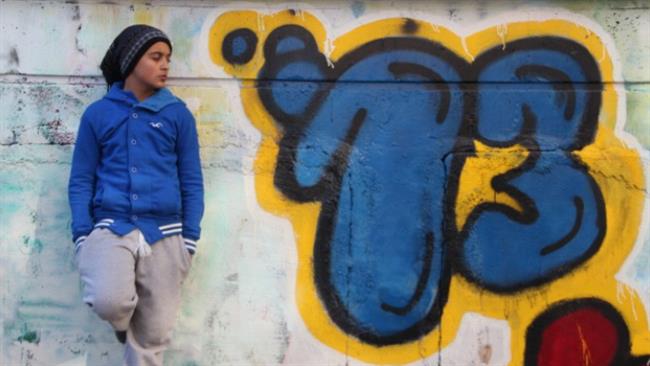
A scene from ‘13’ by Iranian filmmaker Houman Seyyedi

The 2015 edition of Shangahi International Film Festival has awarded 13 by Iranian filmmaker Houman Seyyedi.

Seyyedi’s drama received the Best Cinematography and Best Film awards of the prestigious event’s Asian New Talent category, which aims to introduce Asian youths in the film industry, and facilitating the production of Asian films.

The movie, which chronicles the story of a young reticent boy and the problems he faces after his parents’ divorce, competed with films from China, Indonesia, South Korea, India, Japan and Taiwan.

Seyyedi’s movie has participated in several international film festivals and won the New Current Award at the 2014 Busan International Film Festival and the Netpac Award for Best Asian Film at the 2014 Warsaw International Film Festival.

The international jury of the 2015 Shanghai International Film Festival was comprised of Russian director Andrey Zvyagintsev, Chinese director Cai Shangjun, Chinese actress Hao Lei, Korean screenwriter Hee Jai Kim, French filmmaker Philippe Muyl, Chinese producer Shi Nansun and US producer Ron Yerxa.

Founded in 1993, Shanghai International Film Festival is the only Chinese competitive film festival approved by the International Federation of Film Producers Associations.

The week-long festival aims to build an international platform and promote cooperation between Chinese and foreign film industries.

The 18th edition of the Shanghai International Film Festival kicked off on June 13.

The imperative of a comprehensive strategy to fight violent extremism

Zarif-Photo- (1)

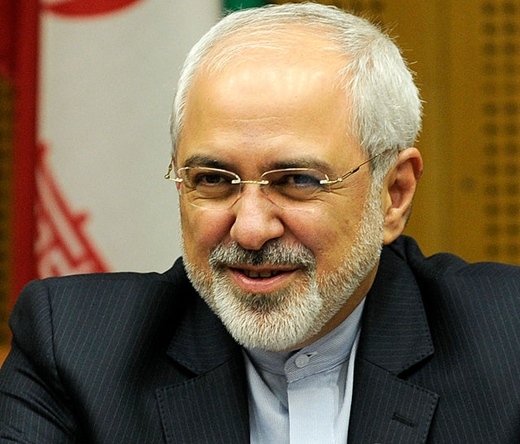
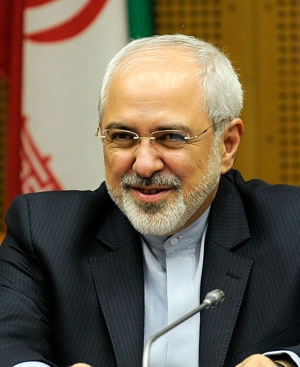
Harvard International Review has published an opinion piece by Iranian Foreign Minister Mohammad Javad Zarif on the need for a comprehensive global strategy to take on violent extremism.

The Farsi version of the piece appeared in Ettela’at daily on June 20. The following is the English version of the piece which appeared on the website of the Review and the Iranian Foreign Ministry:

Violent extremism is probably the most critical challenge that is not only menacing our region, but in fact the entire world, where threats recognize no borders. It is a grave threat that has already ravaged Iraq and Syria and cast gloom over the region’s horizons. Its global reach and stated worldwide ambitions make it clear that it has major implications for the geopolitical and security environment, not only in our immediate neighborhood, but also in many other parts of the world.

Atrocities committed by violent extremists and their brutal efforts towards religious and ethnic cleansing in Syria and Iraq have shocked the world. The attack in Europe by various Al-Qaeda affiliates, the 2015 Baga massacre by Boko Haram, the terrorist attack on Tunisia’s national museum, the deadly suicide bombing against civilians in Jalalabad, Afghanistan, the beheading of 21 Coptic Christians in Libya, the shocking massacre of 147 college students in Kenya in recent months highlight the widening scope of the threat posed by the rise of violent extremism. This phenomenon gained global attention several decades ago after the Soviet invasion of Afghanistan which led to the creation of Al-Qaeda and the Taliban, followed by the US invasion of Iraq, which produced various Al-Qaeda affiliates in Iraq which later grew into Daesh, often referred to as the Islamic State.
ZarifSerious crimes, including executions, rapes, forced conversions, torture and enslavement shamefully advertised by Daesh—Arabic acronym for the Islamic State of Iraq and the Levant—on social media exposes the extent of the threat they pose. Their recruitment from over 90 countries around the world, including many Western industrialized “democracies,” is an alarming indication of many social and structural malfunctions, which have hitherto been conveniently neglected. The terrorist group’s Takfiri (excommunicative) approach, has allowed it to justify, and even glorify, the targeting of an ever expanding list of those they despise, subjecting them to slavery and death. Hence, their wrath has spread well beyond their original professed targets, and no longer even spares members of other Takfiri groups. Many instances of beheadings of Al-Nusrah followers by Daesh in Syria—and vice versa—illustrate this tendency. In one case in March 2014, vicious infighting among the terrorist groups in northern Syria left more than a thousand dead.

Systematic destruction and desecration of sacred mosques, holy shrines, churches, ancient graves and temples, as well as ancient archeological treasures representing the rich cultural heritage of the region, illustrate the long-term objectives of violent extremism for the region. The atrocities committed against the Yazidi people reflect their intentions and behavior towards minorities. The use of social media to glorify the horrific massacre of 1700 Iraqi air force cadets in Tikrit in June 2014 portends what may lie ahead for Iraqis, if they fail to defeat violent extremists. These acts should be regarded as nothing less than an assault on the historic social fabric of the region and its rich, diverse, and proud heritage.


Where Does the Root of Violent Extremism Lie?

Such human values as compassion, empathy, patience, tolerance and forgiveness have always been the basic message that all religious traditions, particularly Islam, have espoused and carried throughout history. Meanwhile, in the past two centuries, a small group of demagogues with dubious background began to present a distorted image of Islam, under the guise of purifying the religion. They twisted the message of Islam, and distorted the religious teachings in a way to suit their narrow political interest and agenda. They tried to extract compassion and mercy from the religion, and their followers in the process, grew intolerant of those who did not share this interpretation and dubbed them “not true believers.”

Based on this misrepresentation, they set out to totally reject all other rival religious narratives and excommunicate those they deemed different only based on what they believe, where they come from, and what population group they belong to. They claim that they have arrived at the exclusively accurate understanding of Islam and own the entire truth. This is the essence of Takfirism, and its forefathers, which in my view are at the very core of the predicament that we now face with violent extremism.

As long as this interpretation was and is limited to their community of believers, their proponents were and are entitled to their opinion. The problem emerged when those with wealth and power undertook to diffuse this mode of thinking in the larger Muslim community and around the globe and force it upon peoples and communities near and far, not for the sake of religious puritanism but for shortsighted political and strategic calculations and objectives. Individuals or groups prone to radical ideologies were seduced to embrace this interpretation. While a majority of those believing in this interpretation have always avoided the use of force to implement the precepts of their ideology, some have not, and, at times, even turned against their mentors. This is precisely when violent extremism was born and where its roots lie.


Vicious Circle of Intervention, Radicalization, and Regional Destabilization

While we need to highlight the roots of Daesh and its affiliates in the historic development of a twisted interpretation of Islam, we must also be mindful of the strong impact of the bloody recent history of Iraq on the formation and growth of current violent extremist groups. Political and military interventions in the Islamic world, especially in the 2000s, exacerbated the situation and created an enormously fertile breeding ground for extremist demagogues and helped the most radical among them to outgrow less radicals and create larger violent extremist entities.

Daesh is not a new phenomenon. There is consensus that violent extremists benefited from the chaos created in post-2003 Iraq. Daesh, a group that feeds on collapse and chaos, grew out of instabilities created following the invasion of Iraq and during the years of occupation. With the Syrian crisis and the support the extremists received from some wealthy individuals, quarters and states within and outside the region, they found a new breeding space, fabricated a new false cause and turned into monsters that are now even threatening their creators and benefactors. Their international appeal to disenfranchised youth, in the Arab world following the generally failed “Arab Spring” and in the West, has allowed their rank and file to grow apace.

Military interventions, coupled with attempts at ill-conceived and ill-executed social engineering of Middle Eastern societies, reflect the depth of the delusions inherent in the policies of the United States and a few other Western powers towards the region. The so-called “Greater Middle East Initiative,” which originated in the United States neoconservative circles and aimed to politically and socially engineer Middle Eastern societies and export “democracy” created the theoretical framework for military intervention. The initiative triggered regional resistance and only created greater instability. The proponents of this scheme utterly failed to recognize that democracy cannot be imposed upon a people by military means and developed under the watch of an occupying army. The damage done in the course of implementing this fantasy has been so severe that efforts in following years to mitigate the damage have only managed to achieve meager results.

These policies grew out of sheer oblivion towards the region’s inner dynamics and led to feckless and clumsy attempts to stamp an alien model onto societies that are of completely different traditions, cultures and lifestyles. The consequent lingering instabilities in a number of societies in the region empowered violent extremists and created a vicious cycle in which foreign occupation and extremism reinforced each other, allowing the latter to feed off ensuing social and cultural fissures. This was not too difficult to predict. In a statement to the Security Council on 17 February 2003, I pointed out:

The extent of destabilization in the region and uncertainty in Iraq in the case of a war may go far beyond our imagination today. Given the state of the Iraqi society and the whole region, there are so many wild cards and no party could fit them beforehand into its calculations with any degree of certainty. But one outcome is almost certain: extremism stands to benefit enormously from an uncalculated adventure in Iraq.

Today, no one can deny that extremists and terrorists are much stronger and operating in more places in the Middle East than their demagogic leaders could ever imagine or wish in 2001.


What Daesh Is Not and What It Is

Daesh is not an Islamic group: its existence and objectives have nothing to do with Islam as laid out by the Holy Qur’an, the Prophet, and his disciples. Daesh uses Islam as a tool for recruiting and fundraising purposes. Islam is a religion of compassion and rationality: a religion of tolerance and mercy. All practicing Muslims begin their day with the verse from the Holy Qur’an, “In the Name of God, the Compassionate, the Merciful;” a verse they repeat many times in their daily prayers, to be reminded of the most important qualities of their Creator, which they must emulate in their quest for an ethical life and ultimate salvation. Daesh’s brutal treatment of and criminal acts against religious minorities in Iraq and Syria run counter to the Quranic teaching of “No compulsion is there in religion” (2:256). The Holy Qur’an further reiterates that “whoso slays a soul not to retaliate for a soul slain, nor for corruption done in the land, shall be as if he had slain mankind altogether; and whoso gives life to a soul, shall be as if he had given life to mankind altogether” (5:32). Against this backdrop, the overwhelming majority of Muslims have found the acts by Daesh and its affiliates to be anti-Islamic and morally repugnant, representing in no way Islamic thought and the practice of billions of Muslims throughout history.

Muslims and adherents of other faiths have lived in our region side by side for centuries. Religious shrines and precious antiquities across the Middle East belonging to various Islamic and non-Islamic sects and religions from the early days of Islam and even the pre-Islamic era bear testimony to the peaceful coexistence of the different peoples of faith in this region. And yet the destruction of these precious relics of the past by the extremists shows how alien they are to the mainstream Muslims of the region.

Those who violate the fundamental tenets of Islam predicated on compassion and empathy, repeatedly stated in the Qur’an and prophetic tradition, only distort Islam to use it towards their own perverse narrative and self-serving agenda. It is disingenuous, to say the least, to blame Islam for what these extremists have done. It is instructive to note that many of those who now blame Islam for the work of extremists are the very advocates of the invasion of Iraq under the previous US administration. In so doing, they try to absolve their own role in creating these monsters and blaming Islam for the mess that they created in our region and beyond.

Daesh is simply a destructive cult. In general, extremist entities, no matter what they claim to believe in, may become destructive cults at some point in the course of their development; Daesh is no exception. It started as a destructive cult with an authoritarian, totalitarian, domineering, and self-appointing power structure. It resorts to coercive mind control techniques to influence its fighters to commit atrocities and recruit in various ways, including through social media. It controls the territory under its rule mostly through brutality and intimidation.


Factors Contributing to the Rise of Daesh
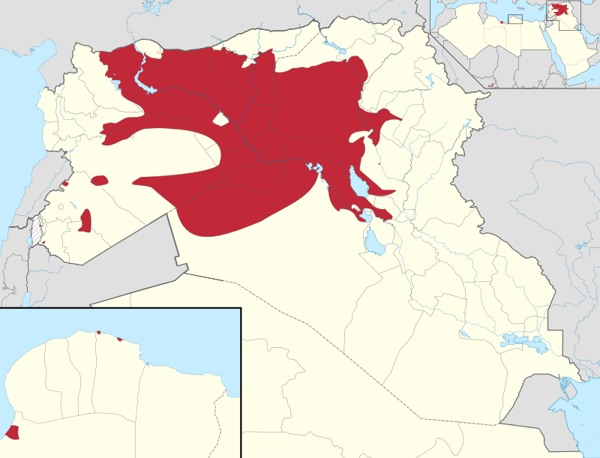
Areas-Controlled-by-ISISThere has been some debate over the reasons behind the success of Daesh in seizing control over swaths of territory in Syria and Iraq. This success is often attributed to a number of factors, including the weakness or collapse of central government authority, initial financial and military support from certain regional governments, which continue coming from within the region from wealthy officials and Takfiri millionaires, lax border control that allows cross border movement of recruits—deliberate or unplanned—access to huge weapons depots in Syria and Iraq, experienced and battle-hardened during their fight with the United States in Iraq for many years, and being well-supported with revenues from petroleum, oil and human smuggling.

While the above have been all important in boosting the position of Daesh, there is another important factor enabling Daesh to grab land, which also reveals the nature of this group: the major role the former members of the Iraqi Ba’ath Party and officers of Saddam Hussein’s army played in command and control of Daesh and its affiliates in Iraq and Syria. The primary reason for success of Daesh in the battlefield as well as in transforming from a simple suicidal terrorist group to a terrorist-cum-insurgent model with control over land lies in its alliance with a network of loyalists to Saddam Hussein.

This alliance of convenience could enhance Daesh’s terrorist techniques with classic military organization and skill. Beyond providing Daesh with military expertise, the Ba’athists also brought the smuggling networks developed to circumvent sanctions in the 1990s. Ba’athists assist Daesh in the hope of restoring, in essence, the former political system in Iraq where the Shiites, Kurds and other population groups, including even the majority of the Sunnis, were dominated and repressed by a small ruling clique. Thus, it is not surprising that what Daesh does is reminiscent of the raw cruelty of Saddam’s Ba’athist regime. However, given the power balance and the nature of Daesh, the Ba’athists will only be used for a specific duration, before being tossed aside as well.


The Imperative of a Comprehensive Strategy to Fight Violent Extremism

There is a broad international consensus that Daesh is a criminal entity that should be defeated and its operatives should be brought to justice. This consensus indicates that the entire international community has a common interest in defeating Daesh and similar groups, including those who fan sectarian violence. While this broad consensus is an asset, translating it into a targeted and effective set of actions has proven elusive. The international community continues to suffer from the lack of a comprehensive, consistent and coherent strategy to confront violent extremism. Such a strategy must address the problem in its entirety and have the following components:

First, it should be serious, global, rule-based, non-discriminatory, inclusive, and avoid selective applications based on defunct patterns of alliance and bilateral relations. In so doing, all actors must avoid the temptation to prioritize political considerations above this goal. It should also provide for a paradigm shift in which all actors avoid employing the fight against violent extremism as an instrument of alliance policy, and abandon selectivity and double standard in conducting this fight. Violent extremism cannot become a new label with which to attack and demonize adversaries and others. Violent extremism is also far too dangerous and far too serious to be confined to a particular state or region. A serious global campaign against Daesh and similar Takfiri extremists require an adjustment in mindsets and a paradigm shift.

Second, it should be based upon and in full compliance with the norms and principles of international law and the provisions of the UN Charter, in particular the principle of refraining from the threat or use of force against other states. We cannot uproot a menace by solidifying its foundations and widening its recruitment opportunities.

Third, it should stipulate that any war against violent extremism must be fought first and foremost on a cultural and ideological front. Thus, a winning strategy should mobilize religious and community leaders, media outlets, universities, social media and similar outlets to reject twisted, violence-oriented interpretation of religions and denounce hateful and violent philosophy, which essentially runs counter to the basic teachings of all religions. Religious leaders from around the world should be at the forefront of efforts to denounce the false precepts of violent extremism and unequivocally reject sectarianism and attacks against religious and ethnic minorities. In this context, the recent message of Ayatollah Khamenei to European and North American Youth is a serious endeavor to initiate such enlightened cultural and ideological discourse.

Fourth, it should also address the contributing factors that help create space for and sustain extremism, including dictatorship, poverty, corruption and discrimination. Economic, political, and cultural disenfranchisement of the youth in the West as well as discriminatory measures that marginalize people of foreign descent should be addressed. The continued occupation of Palestine and the plight of the Palestinian people and their tragic predicament have been another effective recruitment tool for extremist groups like Daesh, which require attention and action.

Fifth, it should contain measures to counter Islamophobia, which conflates violent extremists and true Muslims, thus playing right into the hands of Daesh and similar Takfiri groups and directly lending credence to the extremists’ messaging. While we should rightly condemn racism and anti-Semitism, and we indeed do, we should at the same time condemn and criminalize Islamophobia and blatant disregard for the values, beliefs and sanctities of Muslims. Islamophobia must be recognized as a form of extremism that, one way or another, incites and leads to violence. Thus, in the interest of consistency, all forms of violent extremism should be condemned and rejected.

Sixth, it should engage all regional states and international actors to deny extremists access to funds, recruits and other resources that they use to spread terror across the region and beyond. That should include resolute measures with a view to putting an end to moral, material, logistical and financial support for extremists coming from private or public entities or individuals within or beyond the region. Denying extremists free movement, including through enforcing effective and coordinated border control, will be critical to the success of this campaign; as will be the disruption of financial and logistical support networks and the sharing of critical relevant information and intelligence. It should encourage the international community, including the West—if they are really interested in ending extremism and defeating Daesh—to make external military and political support to all actors in the region conditional on their genuinely fighting Daesh and other violent and extremist groups and currents.

Seventh, it should provide for extending support to those countries that are directly engaged in fighting violent extremists. They should be assisted in their efforts towards strengthening their national unity and territorial integrity. This approach requires discouraging centrifugal forces and non-interference with the ethnic and sectarian mosaic of nations. Any approach that undermines these authorities while differentiating between segments of population in terms of protection will be a recipe for defeat.

Eighth, it should provide for a renewed focus on the imperative to fight Daesh and its affiliates and prevent nations, particularly in the Middle East, from undermining the unified front against extremism in all its forms. Military campaign against Yemen is a case in point, in that it has emboldened and provided space for al-Qaeda in the Arabian Peninsula. We need to unite against Daesh instead of bombing one another’s cities and airports. An understanding between countries and factions opposed to Daesh and its affiliates would provide a more conducive environment for a more effective fight against extremism. Trying to undermine those who have proven their resolve and dedication to fight Daesh while embracing those who have been tepid in this regards, would undercut the efforts towards containing, let alone uprooting extremism.

Iranians of all ages and affiliation, particularly the youth, have been consistent in rejecting and fighting violent extremism from the Taliban and Al-Qaeda in Afghanistan to AQAP, Daesh and others similar forces in Yemen, Iraq and Syria. Iran takes pride in being instrumental in preventing extremists from consolidating their rule in Afghanistan in the late 1990’s by providing support to the forces resisting the Taliban. Iran has shown unqualified determination to help the Iraqi government and coordinate with it to assist all those threatened by Daesh. When, during the first blitz by this group in June and July 2014, all others were taken aback and stunned or were hallucinating about possible tactical gains, we rose to the challenge and helped save Baghdad, Erbil, and Amerli from Daesh, with our advisers and military supplies being there before any other help arrived on the scene. Provision of advice and training proved instrumental in the recent months in dislodging Daesh from some of their strongholds in western Iraq.

We also rose to the challenge on the cultural and ideological front. When some were pushing for destructive war and social engineering in our region in 2001, Iran proposed, “A Global Agenda for Dialogue among Civilizations,” adopted by the UN General Assembly in 2001. More recently, and long before the battlefield successes of the extremists alerted the whole world to this new scourge, President Rouhani introduced a comprehensive agenda for “A World against Violent Extremism,” that was adopted by the General Assembly in 2013. This agenda provides a path to combat violent extremism and, if thoroughly pursued and implemented, would help empower peoples around the world to effectively address this serious challenge that we all face.

On the basis of the experience that Iran has so far gained and the success it has achieved in its efforts towards containing and defeating the scourge of violent extremism, we are prepared to contribute to all genuine and comprehensive efforts at the bilateral, regional, and global levels. Cooperation at all these levels is imperative for defeating Daesh, al-Qaeda, Jabhat al-Nusra and their affiliates, because they represent a global threat that jeopardizes not only local communities but also those located far from the centers of these crises. We hope that regional and global stakeholders will sooner rather than later recognize this imperative and engage in this collective endeavor.


When diplomacy serves the cause of development (PART ONE)

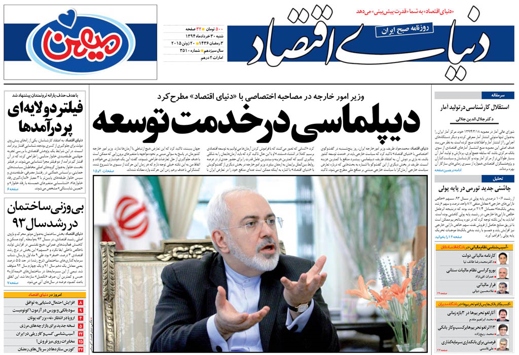
Donyaye Eghtesad daily-06-20

Iran’s foreign minister says nuclear talks are very much likely to continue past the end-of-June deadline. Mohammad Javad Zarif made the comment in an interview with Donyay-e Eghtesad’s Ehsan Abtahi and Hadi Khosro-Shahin on June 18.

In the interview the top diplomat said an ideals-based foreign policy does not run counter to a foreign policy of which national interests are the cornerstone. He added what makes a country successful on the international stage is its ability to render their ideals into international norms.

“Diplomacy is the art of advancing a country’s interests at the lowest cost. Foreign policy should serve the cause of development, rather than being a burden on a country’s development drive,” he said. The following is PART ONE of the translation of the interview:


The president said in a first conference on Iran’s economy that the economy has provided the politics with subsidies to date and today we should do something to direct the subsidies from politics to economy. You said in your confirmation hearing in parliament that foreign policy should be in line with [the country’s] economic interests. Given that you are the very first extremely professional person to have taken over the Foreign Ministry, how much do you think the eleventh government’s foreign policy can serve such a purpose and how much it can be effective when it comes to politics helping the economy? Concerning the talks, how much is it likely for Iran to lead a foreign policy that contributes to its economy?    

An important thing that should be taken into account is that basically there is no one-dimensional issue in human relations. Everything stems from a series of actions and reactions which should all be taken into consideration from a broad perspective. That’s why I do not believe that politics should be either Eastern-leaning or Western-leaning. I think this comes from misunderstanding the politics.

To answer that question, one needs to define diplomacy first. Diplomacy is the advancement of interests on as little cost as possible. It is not an art to spend too much. In other words, spending a lot and reaping benefits would not be remarkable.

The Supreme Leader said in a gathering of [Iran’s] ambassadors and chargé d’ affaires last year, “There may be very powerful governments which push their agenda through diplomacy, not through military means” because the tools of diplomacy are less costly with less pressure exerted on people.

Given these two points, we come to the conclusion that foreign policy should serve a country’s development and should not be a burden on the shoulders of [that] country’s development. The foreign policy machine should try to pursue the same objectives and ideals so that the stage can be set for development and nothing stands in the way of development. There may be some who say the revolution’s objectives should be put aside simply because of economic development.

But if that happens, I think we cannot be an identity to set our goals and then try to achieve them. If that happens, we will turn into a good-for-nothing and ineffective entity on the world stage and will lose our levers of power.

Those who think we can have economic development by ignoring the ideals are in the wrong. But the pursuit of those ideals – in a way that is less costly and provides us with the more power to wield more influence and have a stronger presence [in the international community] – translates into a comprehensive foreign policy which is at the service of development as it helps us not to forget our objectives and ideals.


Iran is viewed as an anti-hegemonic country in international relations. That Iran is an anti-hegemonic player imposes huge costs on the country. Over the past decades, especially during the eight years of Mr. Ahmadinejad’s presidency, Iran’s anti-hegemonic stature was highlighted. China once decided to include economy as a strategic – no tactical – topic in its foreign policy. The question that arises here is: when is economy supposed to be included in Iran’s foreign policy as a strategic issue?   

During the revolution era, we were always an anti-hegemonic player, but it is not good reason for the country’s economy to sustain costs. You are a player in an equation in the international community, I mean in an atmosphere which you have to turn into a balanced situation. If you go and put all your eggs in one basket – like what [Boris] Yeltsin did in the Russian Federation – you will gain nothing.

You will lead nowhere if you lose your identity or turn into a player that is in full compliance with the existing system and order. China, too, is following a detailed planning and it has not discarded its stance, objectives and ideals.

Unfortunately, the Islamic Republic left behind eight years during which the declared, not real policies were carried out in a way that threw obstacles in the way of development and caused the country to pay a price.

This should not make us think that by living up to the ideals, or maintaining ideal priorities and revolutionary tendencies, we cannot secure development. I think we can reach development. Standing on our own two feet is the only way which can help us reach sustainable and reliable development, a sort of development which does not make us collapse from the peak of power to the precipice of debasement once we encounter a small change in the world. Of course, to stand on our own two feet does not mean we should sever ties with the rest of the world; however, it means we should establish ties with the world based on our own identity.

The Supreme Leader has repeatedly said that a country which seeks to stand on its own two feet in the international system should pay a dear price. I believe you can stay longer on the world stage if you stand on your own two feet and stick to your principles and values.

It is also the case when it comes to a resistance-based economy. Such an economy will help the country sustain slighter loss at an international level. We should not use the eight years of the previous government – during which we witnessed several developments unfolding [in the country] – as a model. I do not want to paint a black picture of the time in which I had no role to play and was the target of the government’s compassion [a sarcastic reference to Ahmadinejad’s administration which described itself as a compassionate administration but sidelined everyone who was a bit critical of its policies].


Back to the eight-year presidency of Ahmadinejad; ever since the Islamic Revolution thanks to our country’s anti-hegemonic stance, rejection of some international norms has been one of the hallmarks of our foreign policy. Are the nuclear talks expected to produce a change in our foreign policy? Will economy replace opposition to hegemony as the number-one priority of our foreign policy?

Efforts to set priorities in a way that pits national interests and ideals against each other have their roots in an erroneous foundation. Such misconception is based on the mindset of former US Secretary of State Henry Kissinger who has said Tehran can be a reliable player only if it chooses between an idealist Iran and a nationalist Iran.

In light of the fact that I was personally involved in a debate with Kissinger on this, one of his students posed the very same question to me. I give you the same answer I gave him. ‘Whenever the US can draw a distinction between an idealist US and a nationalist US, it can expect others to do the same thing.’

In the absence of ideals, no country can have a powerful presence on the international stage. At best, they can have a say in issues which are not very important. Such countries cannot be major regional and international players.

As far as the nuclear question is concerned, if our presence is in line with our national interests and ideals in a way that deprives ill-wishers of the opportunity to paint a picture of the revolution that poses a security threat, we will be able to stick to our identity and serve our economic interests at the same time.

Willingness to let go of our identity might help us secure some short-term economic interests. But these interests will be anything but sustainable and won’t help us create a special position for the country to advance in the long run.

Some build on certain Cold War frameworks to suggest that economic development takes precedent over political development; others suggest that economy is more important than idealism in foreign policy. The developments of the Cold War all came against a different historical and theoretical backdrop that cannot be generalized.

In other words, we need to take a serious look at international relations, economy, as well as national and regional status to be able to be a serious actor whose foreign policy serves the cause of development.