Thursday, December 25, 2025
Home Blog Page 4803

Nuclear agreement’s best aspect is Zionist regime’s wrath

Movaheddi Kermani

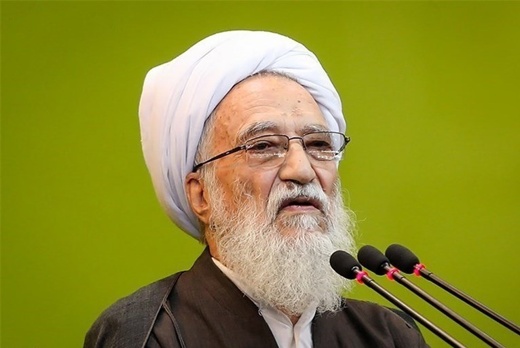
Appreciating Supreme Leader’s support, President’s efforts and the Iranian nuclear negotiation team’s tireless endeavors, the Friday prayer leader of Tehran said the best aspect of the nuclear agreement between Iran and P5+1 was the Zionist regime’s anger.

Addressing thousands of worshipers, Ayatollah Mohammad Ali Movahhedi Kermani said that the best proof for the true value of this agreement is the Zionist regime’s wrath.

People’s resistance in the face of the unjust sanctions and the economic pressures discouraged the Americans from further intensifying the sanctions and showed sanctions are not effective in bringing the brave Iranian nation to its knees, said Ayatollah Movahhedi Kermani.

He said that the Americans believed President Hassan Rouhani’s advice that the language of respect and not the language of threats, sanctions, and pressure should be used in speaking with the Iranians.

The Zionist regime and its supporters, especially the Saudis, are highly displeased with this agreement and we should repeat Martyr Beheshti’s comment aimed at the Americans when he said: ‘Be angry with the Iranian nation, and die of that anger!’

Nuclear conclusion to serve Iran-Turkey ties: Rouhani

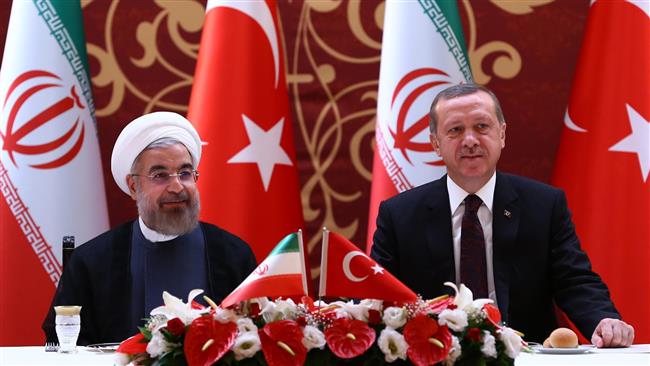
Rouhani-Erdogan

“This agreement will have an effect on Iran’s relations with its neighbors, especially Turkey,” Rouhani said in a telephone conversation with his Turkish counterpart Recep Tayyip Erdogan on Thursday night.

Rouhani said Iran managed to shed “cruel sanctions” imposed on the Islamic Republic and reach “acceptable solutions” in talks over the country’s nuclear program.

On July 14Iran and the P5+1 group — the United States, Britain, France, China, Russia and Germany — reached a conclusion on the Joint Comprehensive Plan of Action (JCPOA) in the Austrian capital city of Vienna following 18 days of talks over Tehran’s nuclear program.

Based on the nuclear conclusion, limits will be put on Iran’s nuclear activities in exchange for the removal of sanctions, including all economic and financial bans, against the Islamic Republic.

The UN Security Council is now expected to vote on the conclusion on Monday, according to diplomats.

Rouhani also said that Iran-Turkey cooperation could result in “win-win solutions” to ongoing conflicts in the Middle East region.

He also underlined the need for Iran-Turkey cooperation to uproot terrorism which is threatening the stability of the regional countries.

Erdogan, for his part, hailed the conclusion of Iran’s nuclear talks and expressed his country’s readiness to cooperate with Iran on regional issues.

He also called for further promotion of ties between Iran and Turkey.

Russia negotiating supply of ‘Sukhoi Superjet’ to Iran

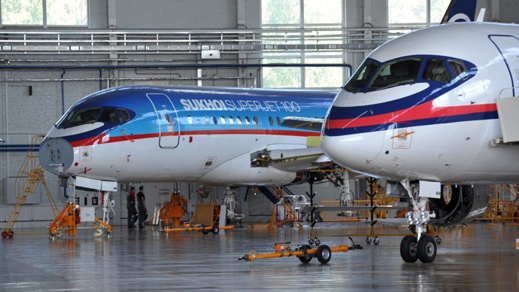
Sukhoi Superjet

Transport Minister of the Russian Federation Maxim Sokolov said that Russia and Iran are negotiating the supply of Russian passenger planes Sukhoi Superjet 100 to Iran.

“Such negotiations, as far as I know are taking place,” Sokolov said, answering a question about whether it is possible to deliver the SSJ100 to Iran.

“It is profitable to offer not just the Superjets but also other vehicles and machinery, as it raises certain interest in our Iranian colleagues,” RIA Novosti quoted the Russian minister as saying.

He further said that last year within the framework of the summit of transport ministers of the Caspian region, Russia actively discussed the possibility of cooperation with Iran and the Iranian delegation even visited the port of Olya in the Astrakhan region.

“The Iranian colleagues examined the infrastructure with great interest, including the ‘Sviyazhsk’ multimodal complex which will now be operational and be used to pull cargo into the country,” Sokolov said.

Transportation between Iran and Russia may be possible through the Caspian Sea as well as other transport modes on land.

Vienna deal brings new diplomacy to world: Omani FM

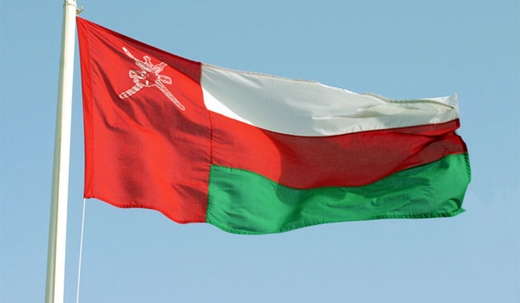
Oman Flags

Omani Foreign Minister Yusuf bin Alawi said the nuclear deal in Vienna brought a new culture of diplomacy to the world.

Talking to the Omani press, Yusuf bin Alawi said that the Vienna deal was the result of soft diplomacy and commitment to constructive talks based on mutual interests.

In today’s world, there is no chance for making mistakes, said the Omani diplomat stressing that respect for the two sides’ interests is needed to have global convergence.

Referring to Oman’s role as a mediator in negotiations between Iran and the six world powers, he said Muscat could make efforts to resume talks between the two parties to the talks thanks to its special relations with both sides.

Oman played an important role in the first round of the recent talks in order to build confidence between the two sides, he said.

He further said the Vienna deal can be used as an example for finding solutions to regional crises.

He also hoped the crises in Iraq, Syria, Yemen and Palestine would be solved through talks among all parties involved and also through the establishment of mutual confidence.

After over a decade, Iran and the six world powers reached a landmark agreement on Iran’s nuclear dispute with the West on Tuesday.

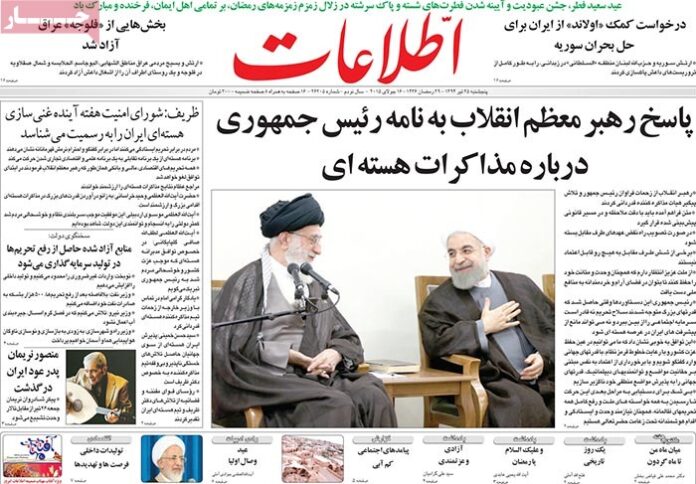
Highlights of Ettela’at newspaper on July 16

Ettelaat16

 The Supreme Leader has responded to a letter by President Rouhani on nuclear talks.

“The text of the deal should be carefully studied and go through the envisaged legal channels,” said Ayatollah Khamenei in the letter.

“If approved, it should close the door to the other party violating its commitments. Some members of the other party [a reference to P5+1] are not trustworthy at all,” the Leader said.

 French President Francois Hollande has appealed to Iran to help end the Syrian crisis.

It came as the Syrian Army and Lebanese Hezbollah mopped up pockets of IS terrorists in Zabadani.

 Parts of the Iraqi city of Fallujah have been liberated.

[The liberation came after the Iraqi Army and popular forces launched a massive operation to rid Al-Anbar of IS terrorists.]

 “The UN Security Council will recognize Iran’s uranium enrichment next week,” said Foreign Minister Mohammad Javad Zarif.

His comments came as sources of emulation hailed the nuclear talks Iran held with P5+1 as valuable.

 “The assets unfrozen as a result of termination of sanctions will be invested in the manufacturing sector,” said the government spokesman.

Mohammad Bagher Nobakht also said that the government is determined to limit unnecessary imports and increase local production.

 Mansour Nariman, the father of the oud [a pear-shaped stringed instrument] has passed away.

A funeral procession will be held for the late musician in Tehran on July 17.

Former President Ahmadinejad reacts to Iran nuclear deal

Ahmadinejad

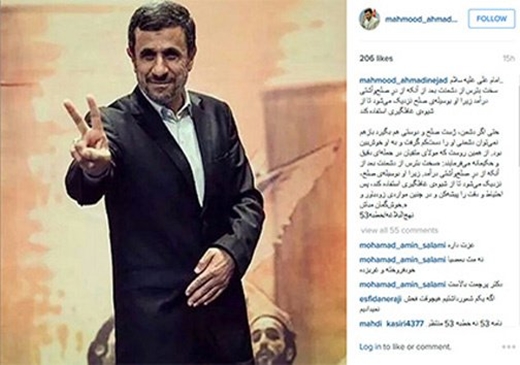
Mahmoud Ahmadinejad, the former Iranian president, has shown a guarded reaction to the historic deal Iran and six world powers clinched on July 14.

Ahmadinejad was widely known for his blistering comments against the West and fierce opposition to the demands of the Western countries in nuclear talks. Under Ahmadinejad, Iran’s nuclear dispute with the West failed to produce a breakthrough, with the president who was the head of the Supreme National Security Council downplaying the economic sanctions imposed against Iran as “worthless paper”.

Alef.ir on July 15 released a report on the former president’s online reaction to the landmark deal and the implicit note of caution he has sounded in his first reaction to the Iran Nuclear Deal. An Instagram message he posted following the historic deal can be an expression of “worriedness” about Iran’s nuclear deal with world powers. The following is the translation of report:

In his Instagram page, Ahmadinejad has posted a hadith from Hazrat Ali, the first Shiite Imam (Peace Be Upon Him), which reads, “Be deeply afraid of your enemy when s/he reaches out to you in peace and compromise, because your enemy approaches you under the cover of peace to catch you off guard”.

Even if the enemy takes on a gesture of peace and friendship, his or her animosity should not be underestimated and you should not be optimistic about him or her. That’s why the Master of the Pious Faithful [a title for Imam Ali] has said in a wise and shrewd comment, “Be deeply afraid of your enemy when s/he reaches out to you in peace and compromise, because your enemy approaches you under the cover of peace to catch you off guard. So exercise vigilance and care, and do not be credulous and optimistic in such circumstances”.

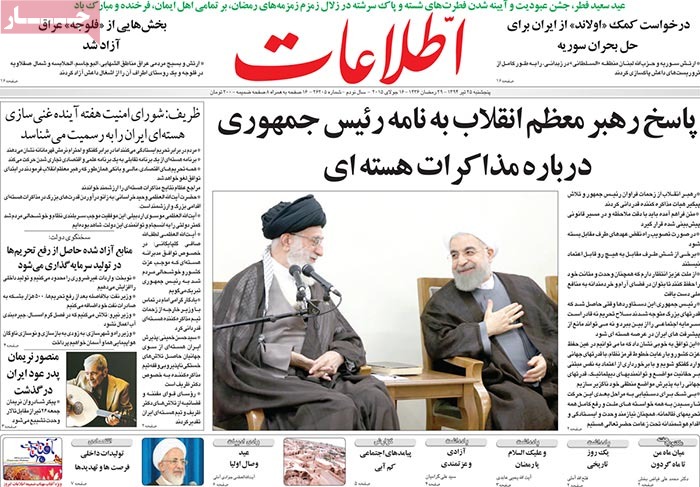
A look at Iranian newspaper front pages on July 16

Iranian Newspapers Headlines

The nuclear deal Iran and six world powers struck in Vienna continued to dominate the front pages of Iranian newspapers on Thursday.


Ettela’at: The Supreme Leader has responded to a letter by President Rouhani on nuclear talks.

“The text of the deal should be carefully studied and go through the envisaged legal channels,” said Ayatollah Khamenei in the letter.

“If approved, it should close the door to the other party violating its commitments. Some members of the other party [a reference to P5+1] are not trustworthy at all,” the Leader said.


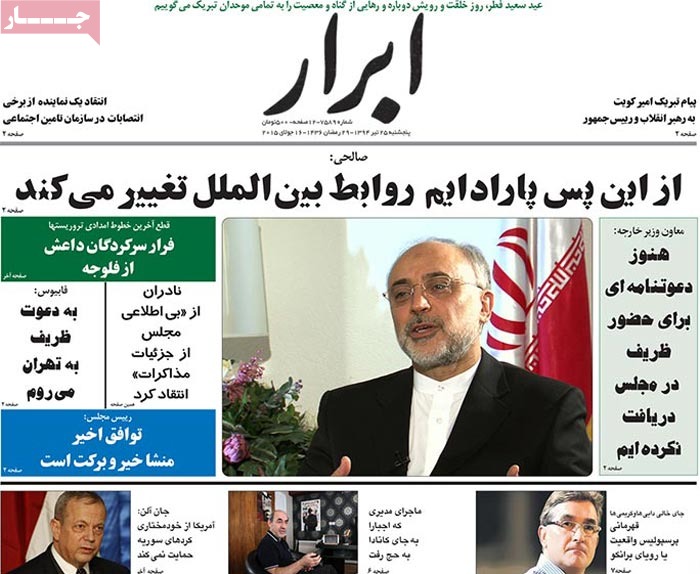
Abrar: “The Foreign Ministry has yet to receive a letter from parliament inviting Foreign Minister Zarif to the chamber,” said the deputy foreign minister.

Abrar: French Foreign Minister Laurent Fabius has said that he will pay a visit to Iran at the invitation of Foreign Minister Zarif.
 

A look at Iranian newspaper front pages on July 16


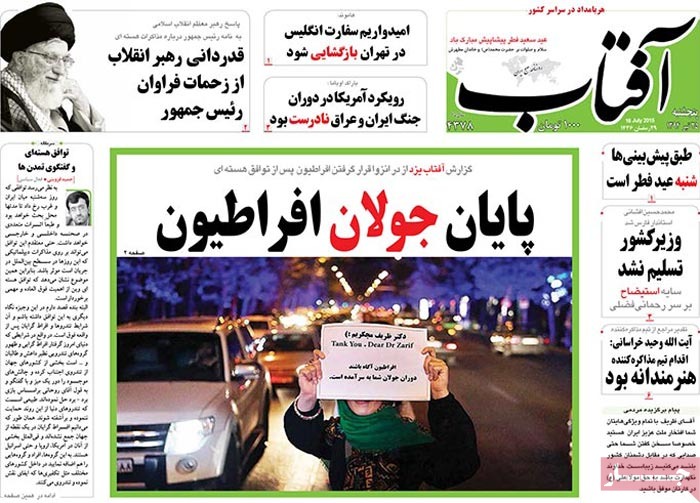
Aftab-e Yazd: The British foreign secretary has expressed hope that the British embassy in Tehran reopens.

Aftab-e Yazd: The interior minister did not budge [in the face of pressures by some MPs who didn’t want him to name whoever he wanted as the governor general of Fars Province].

That means clouds of impeachment will be hanging over the Interior Ministry premises.
 

A look at Iranian newspaper front pages on July 16


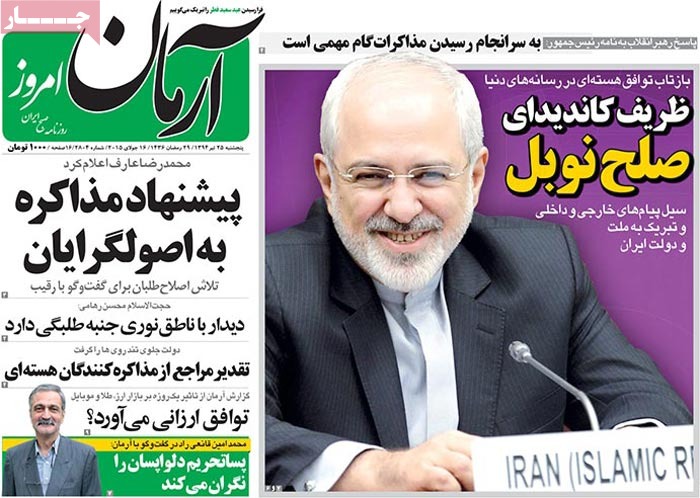
Arman-e Emrooz: Iranian Foreign Minister Mohammad Javad Zarif has been nominated for the Nobel Peace Prize.

Messages of congratulations to the Iranian people and government [on conclusion of a nuclear deal with six world powers] are streaming in.

Arman-e Emrooz: Mohammad Reza Aref [a reformist leader and a former vice-president] has offered to hold talks with principlists.
 

A look at Iranian newspaper front pages on July 16


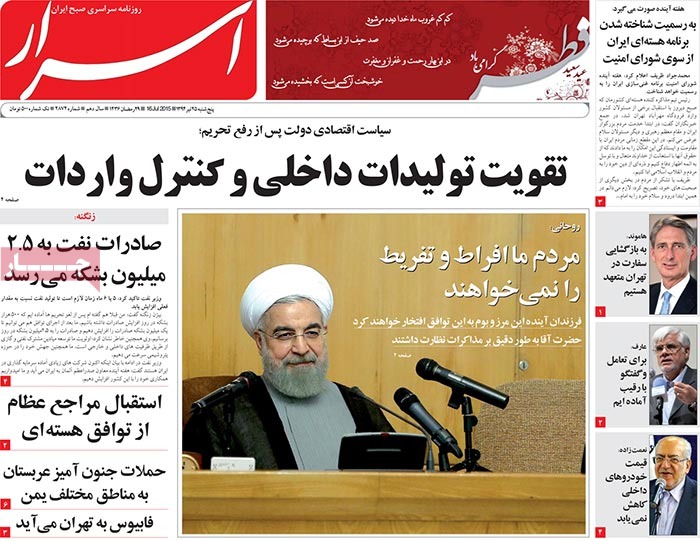
Asrar: “The Iranian people do not want to go to extremes,” said the president.
 

A look at Iranian newspaper front pages on July 16


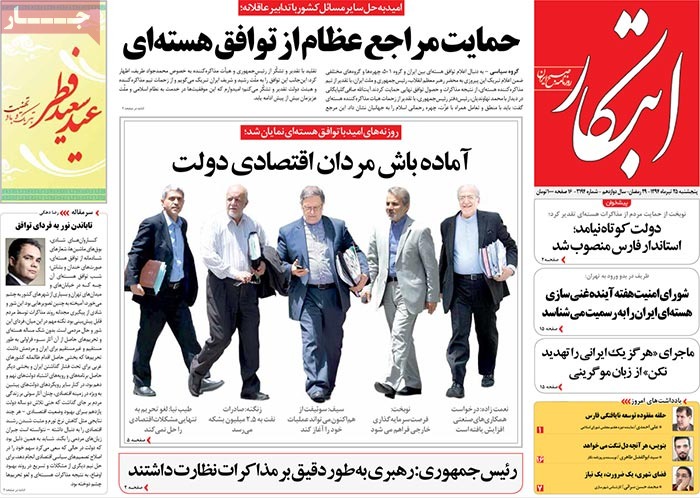
Ebtekar: “The Supreme Leader kept a watchful eye on nuclear talks with P5+1,” said President Rouhani.

Ebtekar: The government’s economic team is on alert.

Industry minister: There has been an uptick in applications for industrial cooperation with Iran.

Government spokesman: The stage will be set for foreign investment.

Oil minister: Oil exports will hit 2.5 million barrels per day.

Economy minister: Termination of sanctions by itself won’t settle the country’s economic problems.
 

A look at Iranian newspaper front pages on July 16


Etemad: Some $28 billion in oil revenues frozen in India, Japan, South Korea and the US will return home.

Etemad: A Tehran visit

The foreign ministers of France and Germany hope to visit Tehran [for the first time in 12 years] in the wake of the “agreement of the century”.
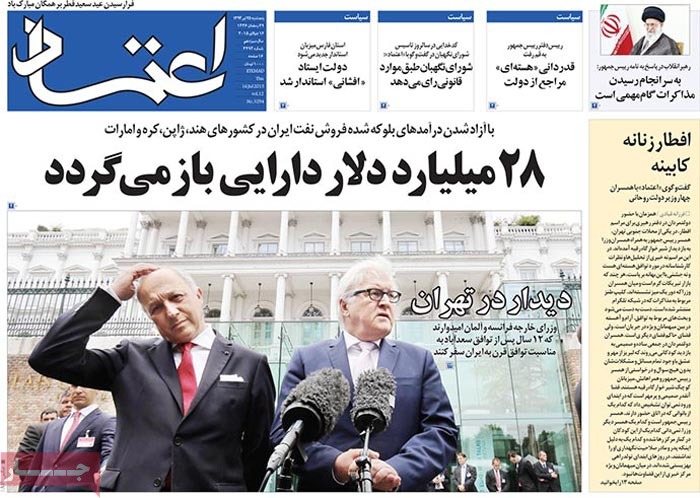
 

A look at Iranian newspaper front pages on July 16


Ghanoon: The end of Zarif as a hero; the beginning of Zarif as the man who should provide answers
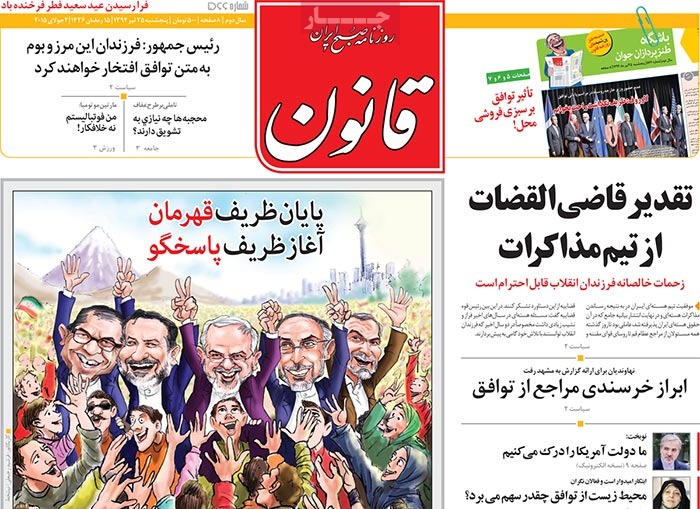
 

A look at Iranian newspaper front pages on July 16


Hemayat: “Our red lines should be guarded during the implementation phase of the nuclear deal,” said Judiciary chief Ayatollah Sadegh Amoli Larijani.

He also described the sincere efforts of the Iranian nuclear negotiating team as praiseworthy.
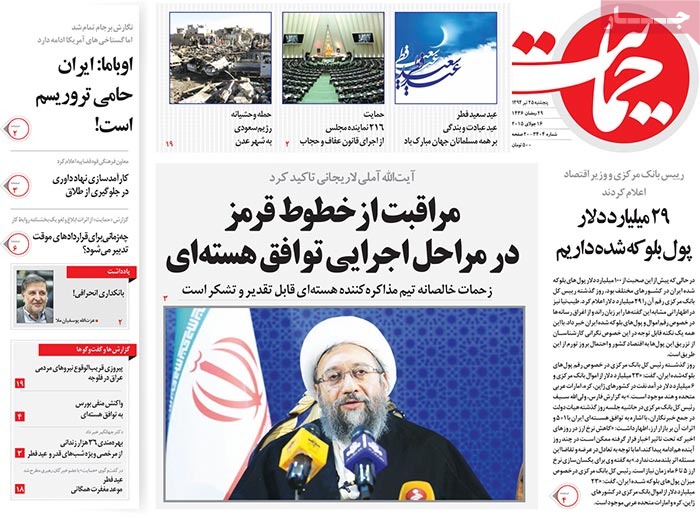
 

A look at Iranian newspaper front pages on July 16


Iran: The new governors of Fars and Qom provinces have been named.

Iran: Sources of emulation have welcomed the nuclear deal Iran has struck with P5+1.
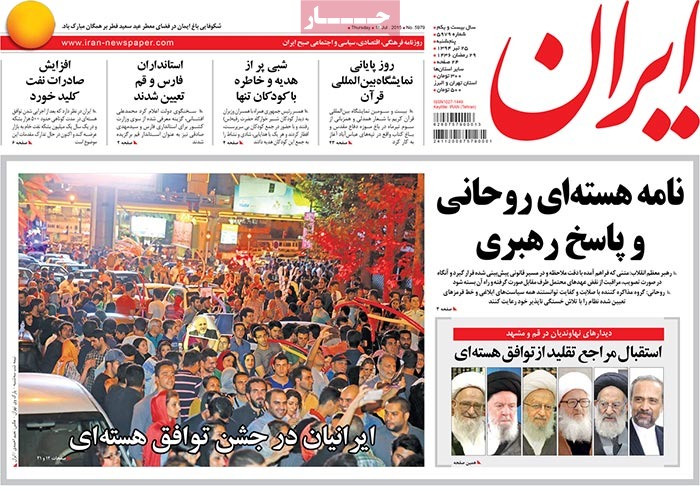
 

A look at Iranian newspaper front pages on July 16


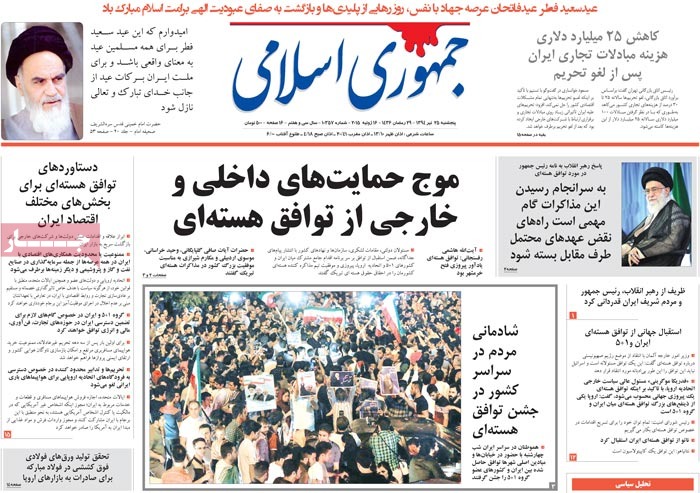
Jomhouri Islami: “Iran’s trade transactions will cost $25 billion less in the wake of sanctions,” said the chairman of Tehran Chamber of Commerce.

Jomhouri Islami: The world has welcomed Iran’s nuclear deal with P5+1.
 

A look at Iranian newspaper front pages on July 16


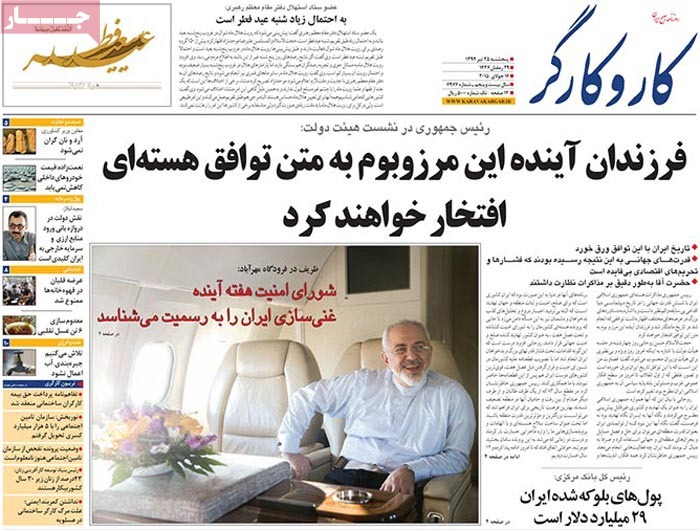
Kar va Kargar: “The future generations of this land will take pride in this nuclear deal,” said President Hassan Rouhani.
 

A look at Iranian newspaper front pages on July 16


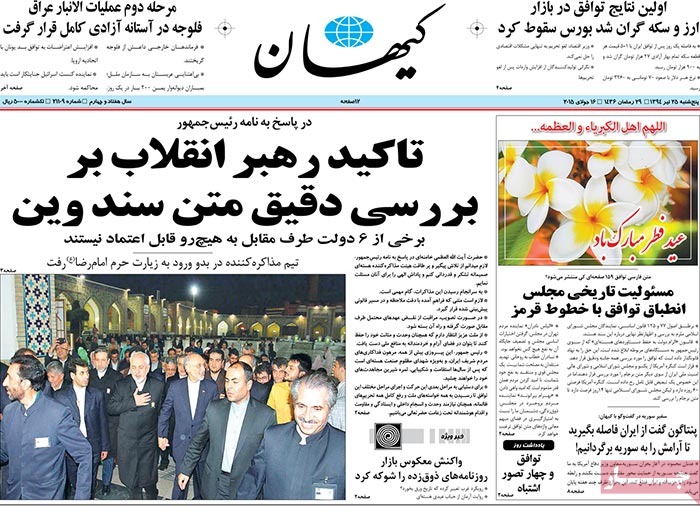
Kayhan: In response to a letter by the president, the Supreme Leader has called for the wording of the Vienna deal to be closely examined.

Kayhan: The Iranian negotiating team paid a pilgrimage visit to the holy shrine of Imam Reza in Mashhad upon arrival home from Vienna.

Kayhan: The first results of the nuclear deal; gold prices went up; the rial lost part of its value against foreign currencies and the stock market shed points.
 

A look at Iranian newspaper front pages on July 16


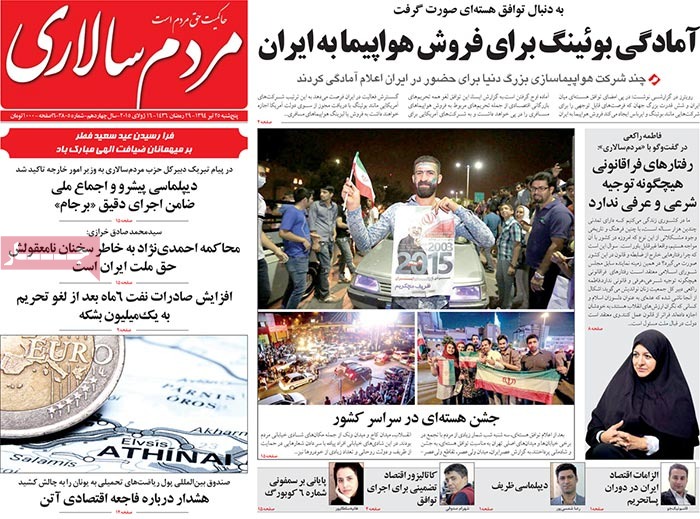
Mardomsalari: Boeing is ready to sell aircraft to Iran.

Mardomsalari: “The Iranians are entitled to see Ahmadinejad tried for his illogical comments,” said Sadegh Kharrazi, a former Iranian ambassador.

Mardomsalari: People across Iran held celebrations [Tuesday night] to mark the conclusion of a nuclear deal with P5+1.
 

A look at Iranian newspaper front pages on July 16


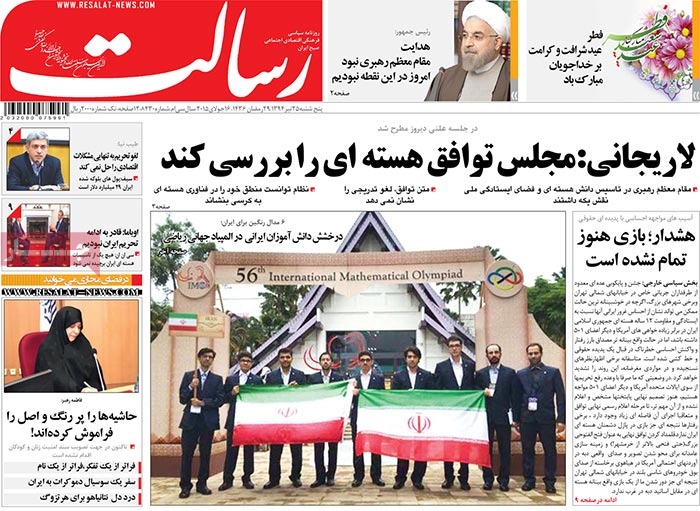
Resalat: Iranian students have bagged six medals at the 56th International Mathematical Olympiad.
 

A look at Iranian newspaper front pages on July 16


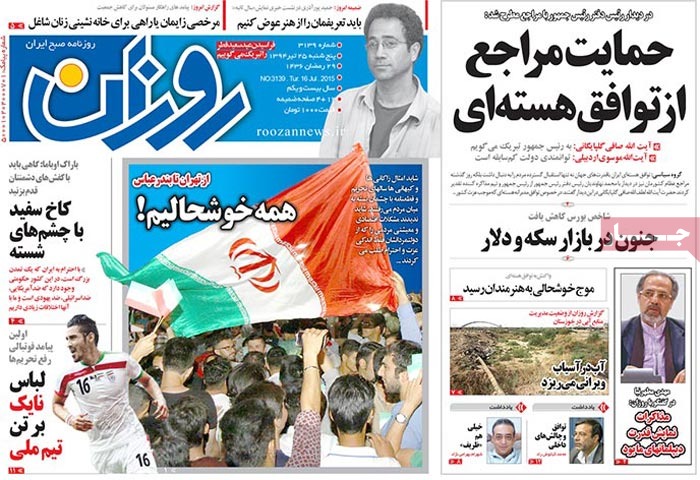
Roozan: The first impact of the lifting of sanctions on Iran’s soccer; the national team players will sport Nike jerseys.
 

A look at Iranian newspaper front pages on July 16


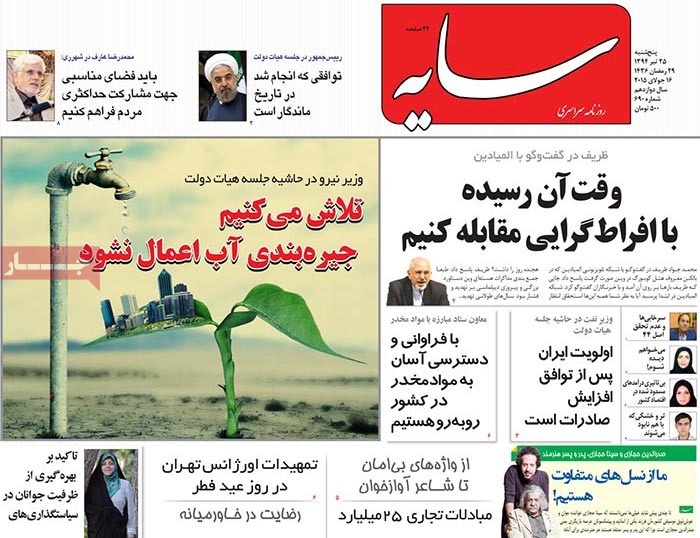
Sayeh: “The time has come to take on extremism,” said Iranian Foreign Minister Mohammad Javad Zarif in an interview with Al-Mayadeen.
 

A look at Iranian newspaper front pages on July 16


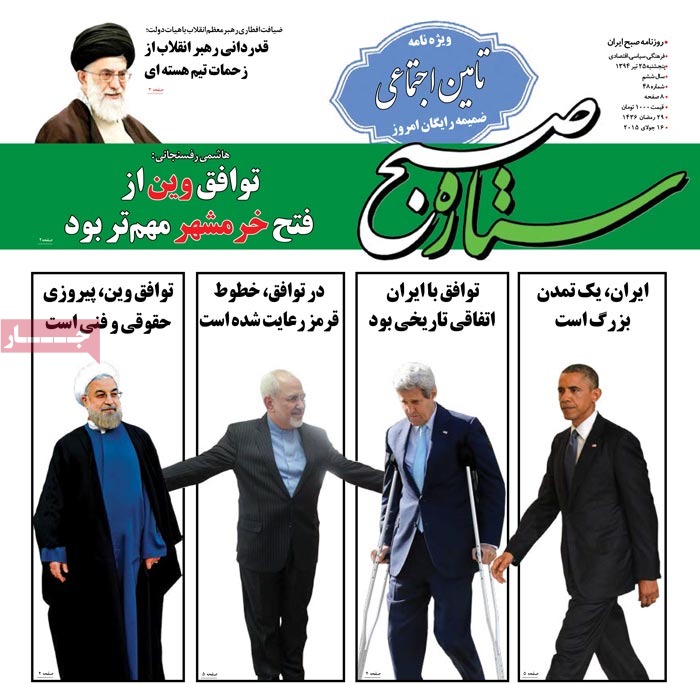
Setareh Sobh: “The Vienna deal was more important than the liberation of Khorramshahr [from Iraqi occupation during the Iran-Iraq war],” said Chairman of the Expediency Council Ayatollah Akbar Hashemi Rafsanjani.
 

A look at Iranian newspaper front pages on July 16


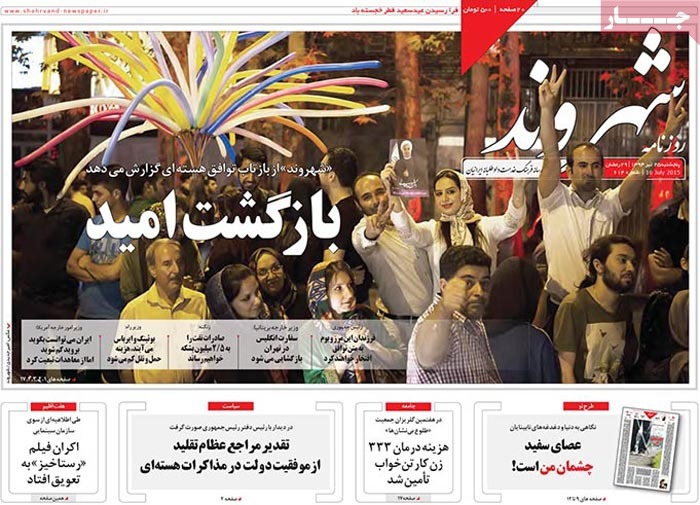
Shahrvand: The return of hope as a result of the nuclear deal
 

A look at Iranian newspaper front pages on July 16


No emotional statements on Iran talks: Russia to Israel

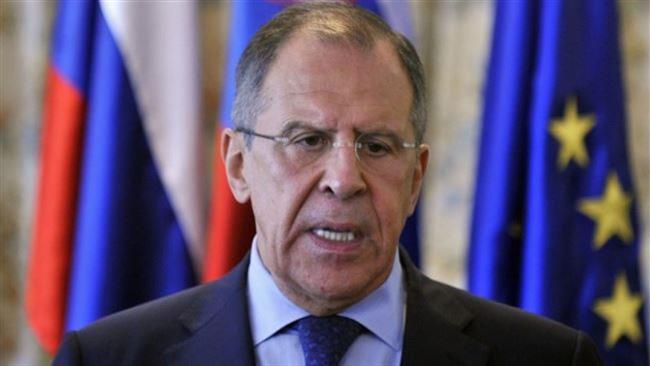
Lavrov

Russian Foreign Minister Sergey Lavrov has criticized Tel Aviv’s opposition to the conclusion of nuclear talks between Iran and P5+1, calling on Israeli authorities not to make “emotional statements” on the achievement.

“Any emotional statements regarding the reached agreement should probably be postponed until all states have studied the reached deal,” Lavrov said on Wednesday, a day after Iran and P5+1 — the United States, Britain, France, China, Russia and Germany — reached a conclusion on the Joint Comprehensive Plan of Action (JCPOA) in the Austrian capital city of Vienna.

The top Russian diplomat’s remarks came after Israeli Prime Minister Benjamin Netanyahu described the conclusion of talks over Iran’s nuclear program as a “stunning, historic mistake.”

“Israel is not bound by this deal with Iran, because Iran continues to seek our destruction,” Netanyahu added.

Israel has for months been engaged in attempts to block the efforts for the conclusion of nuclear talks between Iran and P5+1.

The JCPOA will put limits on Iran’s nuclear program in exchange for the removal of sanctions against the Islamic Republic.

Lavrov also defended the achievement in Vienna, saying, “It contains a reliable, checkable, fair balance that ensures not only implementation but also strengthening of the nonproliferation regime for nuclear weapons, which ensures Iran’s right for nuclear activity, and purely peaceful nuclear activity.”

“And documents that were approved outline clear unambiguous procedures that make it possible to make sure at each stage of the deal that no one is giving up their commitments,” he stressed.

The United States on Wednesday submitted a draft resolution to the United Nations Security Council on the outcome of the nuclear talks between Tehran and the world powers. The draft resolution seeks formal UN endorsement of the outcome of the talks, and according to diplomatic sources, a vote on it could come as early as July 20 or 21.

German Foreign Minister Frank-Walter Steinmeier and Britain’s Foreign Secretary Philip Hammond have previously criticized Israel’s opposition to the conclusion of talks between Iran and P5+1.

Boosting oil exports top priority for Iranian Oil Ministry: Zanganeh

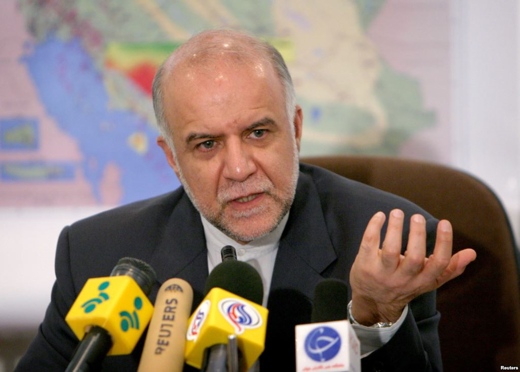
Zangeneh

Iranian Oil Minister Bijan Namdar Zanganeh announced that the country plans to increase oil exports after the implementation of the agreement Iran clinched on Tuesday with six world powers over Tehran’s peaceful nuclear program.

“After (the implementation) of the agreement, our major work would just begin,” Zanganeh said, referring to the agreement between Iran and 5+1 (Russia, China, the US, Britain, France and Germany), known as the Joint Comprehensive Plan of Action (JCPOA).

“The first step is to prepare for increasing (oil) exports,” he said.

Iran and 5+1 concluded more than two weeks of talks over Tehran’s nuclear program in Vienna on Tuesday, July 14.

The negotiating parties reached an agreement over the text of a comprehensive deal on Tehran’s nuclear program after 22 months of diplomatic negotiations, ending more than a decade of standoff over Tehran’s civilian nuclear program.

Iran accord could better Tehran-Vienna ties: Rouhani

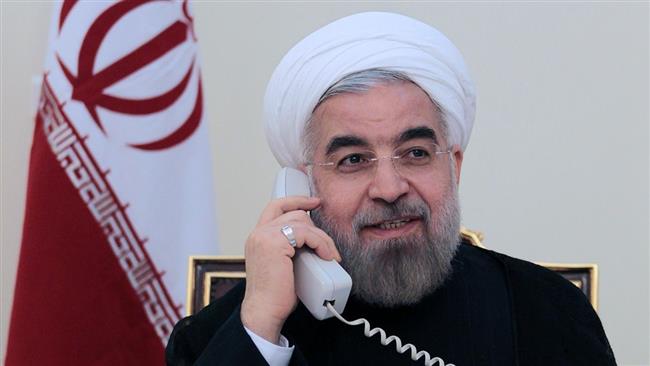
Rouhani-Phone

Iranian President Hassan Rouhani says “the win-win” conclusion of Iran’s nuclear talks, whose latest rounds were hosted by Austria, could pave the way for better Tehran-Vienna ties.

President Rouhani told his Austrian counterpart Heinz Fischer in a Wednesday phone conversation that the nuclear accord announced earlier this week in Vienna was associated with the European country, which he described as “a good host” for global talks.

After 18 days of marathon talks in the Austrian capital, Iran and P5+1 – the United States, Britain, France, China, Russia and Germany – reached a conclusion on the Joint Comprehensive Plan of Action (JCPOA.)

“Doubtlessly, the Iranian nuclear agreement with global powers is a win-win accord for all the negotiating sides,” said the Iranian president, adding that it “will lay the groundwork for the expansion of ties between Tehran and Vienna.”

President Rouhani further hailed an upcoming visit by Fischer, saying it could mark a “new stage” in the mutual cooperation between the two countries.

The Austrian president, for his part, said the nuclear conclusion meant the world’s issues could be solved through “dialogue and peaceful methods.”

At a joint press conference on Tuesday, European Union foreign policy chief Federica Mogherini and Iranian Foreign Minister Mohammad Javad Zarif marked a “historic day” by announcing an end to the tough talks.

Zarif and Iran’s Atomic Energy Organization Director Ali Akbar Salehi, another top negotiator, are setnext Tuesday to deliver a report to Iran’s parliament regarding the talks.

Deputy Parliament Speaker Mohammad-Hassan Aboutorabi Fard told the Iranian media that they would talk to the lawmakers in an open as well as a separate closed session of parliament.

Meanwhile, Secretary of Iran’s Supreme National Security Council Ali Shamkhani also commented on the nuclear conclusion, saying the case has always been on the council’s agenda and will remain there.

The accord came about thanks to “sincere” efforts by many Iranian experts and directors, he said.

“Achievements gained from a policy of constructive interaction with the world, which is among the most major approaches of the respected administration, have brought about new potential for the country to move speedily towards development and prosperity,” Shamkhani noted.

He added that the council would still monitor the conclusion to ensure “the achievement of all expected results.”