Monday, December 22, 2025
Home Blog Page 4765

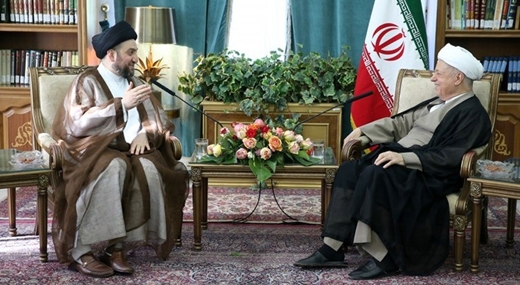
Fanning sectarian crises in Iraq ordered by enemies: Rafsanjani

jpg

Beating the drum of war among followers of different Islamic schools of thought and other religious minorities in Iraq is a plot hatched by the enemies of Islam, said Chairman of Expediency Council Ayatollah Akbar Hashemi Rafsanjani Tuesday.

“The prominent religious scholars, leaders of political groups and parties, and even heads of tribes in Iraq are expected to promote harmony, cooperation and solidarity in their words and their deeds,” said Ayatollah Rafsanjani at a meeting with Seyyed Ammar Hakim, the chairman of the Islamic Supreme Council of Iraq.

Stressing the immense importance of Iraq’s strategic position and rich resources, he said that Iraq has potential for both positive and negative developments in political and economic fields.

“If the central Iraqi government manages to strengthen the security index in that country, the outcomes of the development will benefit the entire region,” he added.

Hakim, for his part, said that the implementation of a moderate approach in a society which has suffered from dictatorship for decades and the scourge of terrorist groups is a very tough task.

“One of the factors for backwardness of such societies is that the people are not in harmony with the political groups,” he added.

On the latest status of the IS terrorists in Iraq, he said that with the vast mobilization of the popular forces in the war against terrorism, the retreat of IS from Iraq is gradually accelerating, adding that the terrorists are no longer capable of recruiting forces even from the Iraqi Sunni Muslims.

“The crimes those terrorists have committed against people, particularly women and children, and even Sunni Muslims have created hate among the Iraqi nation for the terrorist group,” he said.

Ammar Hakim also met with Secretary of the Supreme National Security Council Ali Shamkhani.

Iran supports Iraq fight against IS: Zarif

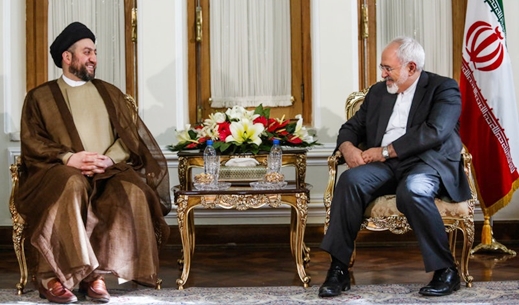
Zarif-Hakim

Iran’s Foreign Minister Mohammad Javad Zarif says the Islamic Republic throws its weight behind the Iraqi government’s fight against Daesh (an Arabic acronym for IS) terrorists.

“The Islamic Republic of Iran always views the expansion of Tehran-Baghdad ties as one of its priorities and supports the Iraqi government’s campaign against Daesh that aims to destabilize Iraq’s security and unity,” Zarif said in a meeting with Chairman of the Islamic Supreme Council of Iraq (ISCI) Ammar Hakim in Tehran on Tuesday.

Daesh’s heinous campaign of terror spread from Syria to the northern and western parts of Iraq in June 2014.

The militants have been committing heinous crimes against all ethnic and religious groups in Iraq, including Shias, Sunnis, Kurds, Christians and others.

The Iranian foreign minister further said during his recent visits to Lebanon and Syria, he had held consultation with senior Lebanese and Syrian officials to find solutions to the ongoing crises in the two countries.

Zarif traveled to the Lebanese capital of Beirut on August 11 before visiting Syria, Pakistan and India.

The Iranian minister also assessed as “constructive and useful” his talks with Russian officials in Moscow, which, he said, focused on support for Syria’s sovereignty, respect for Syrian people’s demands and finding reasonable solutions to the Syrian conflict.

He said Tehran and Moscow agreed that serious threats posed by Daesh’s growing extremism and anti-human violence should be prioritized in regional talks.

Iraq’s major steps to fight Daesh

For his part, Hakim said Iraq has taken effective and major steps in the fight against Daesh, adding that cooperation between the Iraqi Army and popular forces has contributed to better security conditions in the country.

The ISCI chief said all Iraqi people, including Shiite and Sunni Muslims and Christians, have closed ranks in their efforts against Daesh threats.

Iran-Syria ties backbone of Mideast relations: Velayati

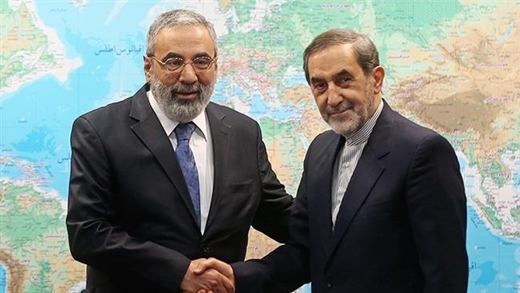
de396c60-0589-4d28-86a0-b6b30419a4e6

A senior Iranian official says the Islamic Republic’s ties with Syria constitute the cornerstone of Tehran’s relations with other states in the Middle East.

“Since the beginning of the [Islamic] Revolution [in 1979], relations between Iran and Syria have been strategic and these relations are the backbone of Iran’s aggregate ties with the region, i.e. Iraq, Lebanon and Palestine,” Ali Akbar Velayati, an advisor to Leader of the Islamic Revolution Ayatollah Seyyed Ali Khamenei, told reporters in Tehran on Tuesday after a meeting with Syrian Minister of Information Omran Ahid al-Zoubi.

Noting that the Syrian nation must decide its own fate, he said the approval rating of Syria’s President Bashar al-Assad among the Syrian people has been increasing with time.

“We believe that the Syrian government and nation will emerge victorious in the end and that it will certainly be the Americans and the Zionist regime (Israel) who will suffer defeat,” Velayati said.

He added that Iran rejects as “unacceptable” any regional and international solutions proposed for the Syrian conflict that do not have the approval of the Syrian people and government.

In a statement on Monday, the 15-member UN Security Council endorsed the initiative by the UN special envoy for Syria, Staffan de Mistura, which calls for resolving the Syrian crisis through talks among “intra-Syrian working groups.”

The statement emphasized that “The only sustainable solution to the current crisis in Syria is through an inclusive and Syrian-led political process that meets the legitimate aspirations of the Syrian people.”

Velayati further said, “Iran is the top power in the region and plays an important role in supporting the resistance front against the American expansionism and the Zionist regime’s hegemony and will not allow the US and its allies to infiltrate the region anew.”

Velayati’s remarks came a day after Ayatollah Khamenei said the Islamic Republic will counter Washington’s policies to hold sway in the region to pursue its objectives.

“They are after disintegrating Iraq and Syria,” the Leader said, adding that Washington’s plots will fall flat.

Zoubi, for his part, told reporters that Iran and Syria enjoy cordial relations and hailed the Islamic Republic’s support for Damascus.

He said cooperation between Damascus and Tehran helped the Syrian government and nation resist enemies’ pressure.

The Syrian minister added that the Leader’s guidelines helped Syria stand against terrorist attacks.

Syria has been grappling with a deadly crisis over the past four years. According to reports, close to a quarter of a million Syrians have been killed in the crisis and 12 million people have fled their homes.

Expansion of ties with neighbors tops Iran foreign policy: Minister

n2849054-4274539

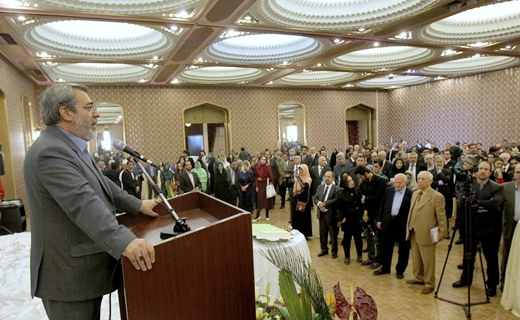
Interior Minister Abdolreza Rahmani Fazli said on Tuesday that closer cooperation with neighboring countries is the principal strategy in the foreign policy of Iran.

Speaking at a ceremony to mark National Day of Afghanistan, he said President Rouhani has always underscored a boost in all-out ties with Iran’s neighbors.

Recalling common religion, language, culture, history and geography between Iran and Afghanistan, he said Iran stood by Afghan people during the country’s occupation by Soviet army, against Taliban militia and in the reconstruction period.

He welcomed the formation of a national reconciliation government in Afghanistan and said common viewpoints of Tehran and Kabul outnumber their disagreements on certain bilateral issues.

He said that Iran cannot remain indifferent to insecurity at its borders and added that we are ready for closer cooperation in regional and international plans against terrorism and narcotics despite its huge costs.

To restore security in Afghanistan, he added, there is no need for the presence of foreign troops since Afghan forces who have gained considerable experience can defend the sovereignty of the country.

The minister said Iran has spent $370 million on development projects in Afghanistan and is ready to help in the fight against narcotics and terrorism in cooperation with regional countries and the international community.

He also said that some 850,000 Afghan refugees are in Iran and 97 percent of them live in urban areas while in other countries, people with similar status are held in camps or special centers.

Cabbie returns briefcase worth $25,000 to owner

Untitled-1

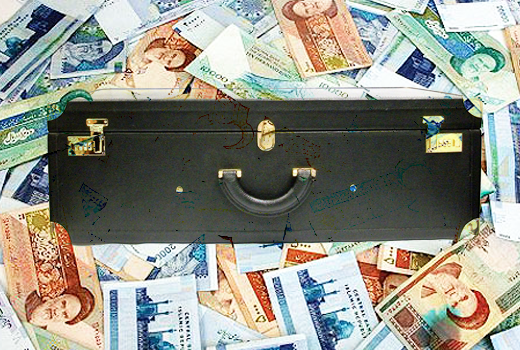
A few days ago, a cabdriver in the northeastern Iranian city of Bojnurd found a briefcase – which turned out to contain a lot of cash – left behind in his taxi by a passenger he had just dropped off.

The following is the translation of a report filed by Mehr News Agency (August 18) on what the cabdriver did next:

To find the owner of the briefcase and return it, the cabbie opens the case and much to his surprise, he finds it full of cash, traveler’s checks and valuable documents.

Untempted to take the money for himself, Mahmoud Garivani searches in the papers in the case for a phone number to return the briefcase to its owner.

Finally, he finds a number and calls the owner who coincidentally is in a nearby town without knowing that he has left behind his briefcase.

The good-natured cabbie drives all the way from Bojnurd to Shirvan, another town in North Khorasan Province, to hand in the briefcase.

Despite insistence by the owner of the case, he turns down an award and even refuses to charge for the out-of-town trip.

In a ceremony held at a mosque in his hometown on August 17, officials with Bojnurd City Council and Municipality praised Garivani for his faithfulness.

In a similar incident three years ago, Ahmad Rabani, a 39-year-old dustman in North Khorasan Province, found a portfolio containing more than $330,000 in cash, gold and documents and returned it to its owner.

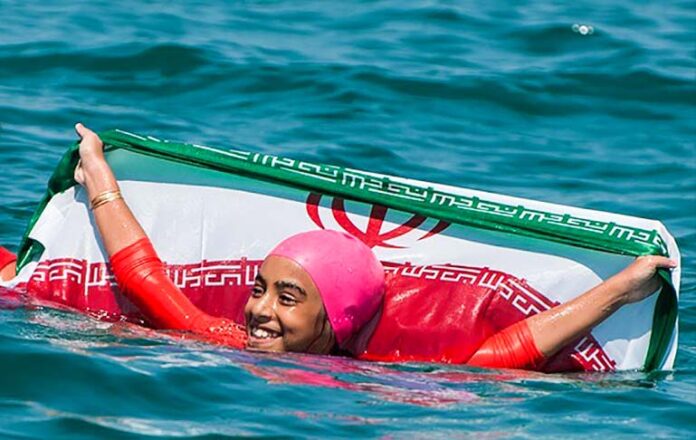
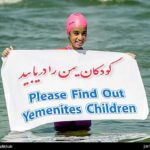
10-year-old Iranian girl sets Asian swimming record in Caspian Sea (PHOTOS)

girl-swimming000

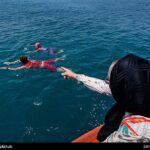
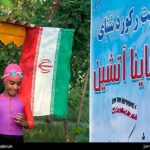
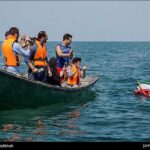
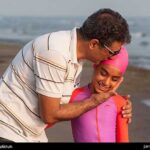
Saina Atashin, aged 10, has swum for more than seven hours in the Caspian Sea, covering 10.2 km and setting an Asian record.

Images of the young girl swimming at sea released online by jamejamonline.ir:

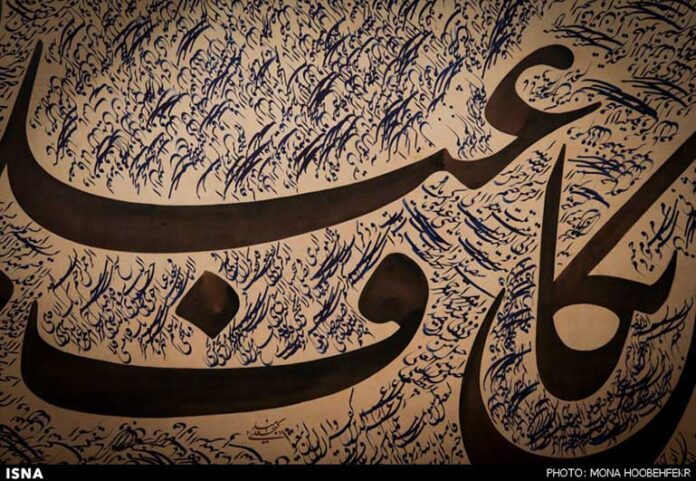
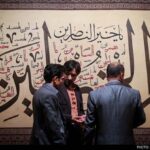
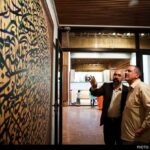
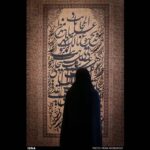
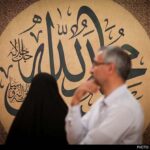
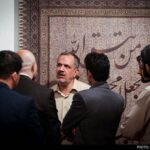
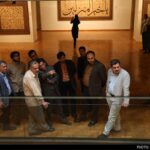
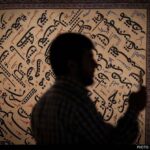
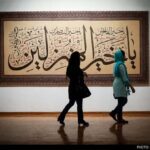
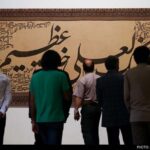
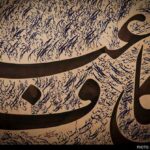
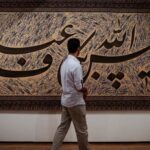
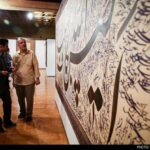
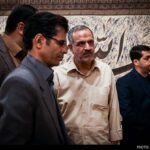
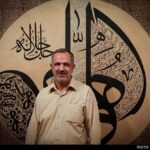
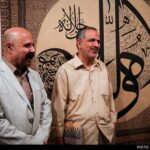
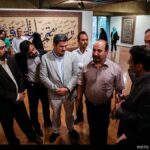
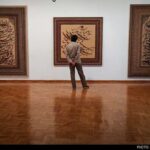
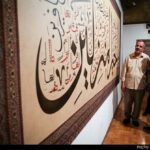
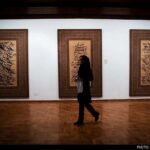
Calligraphy exhibition at Niavaran Cultural Center (PHOTOS)

Iran Objects to Turkey’s “Islamic Calligraphy” Proposal to UNESCO

Traditional Iranian arts would be sponsored by royal funds and kept along with precious jewelry in royal treasuries. In this day and age, however, artworks need spiritual support and more publicity, Ahmad Masjed Jamei, a Tehran City Council member, said at the opening ceremony of a calligraphy and textile printing exhibition in the capital.

Rafi Razavi, an organizer of the exhibition at Niavaran Cultural Center, said, “The 36 works of art on display at the expo depict an integration of calligraphy and textile printing. The collection is the result of efforts of seven artists during a 32-month period. ”

He further said calligraphers Omid Ganjali and Mohsen Soleimani have cooperated with a team of professional textile printing artists to craft the artworks on display.

He added, “Istanbul [where the collection was previously on display] was a great experience. Although, Istanbul is a global calligraphy hub, Turkish calligraphers were impressed by Iranian calligraphy and the thick pens used by Iranian artists.”

Razavi said the exhibition is scheduled to be held in the United Arab Emirates in late October.

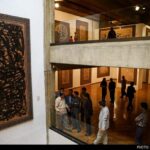
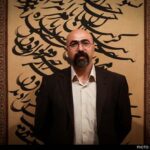
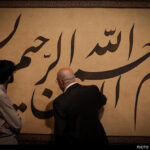
Images of the Tehran calligraphy and textile printing exhibition released by the Iranian Students’ News Agency:

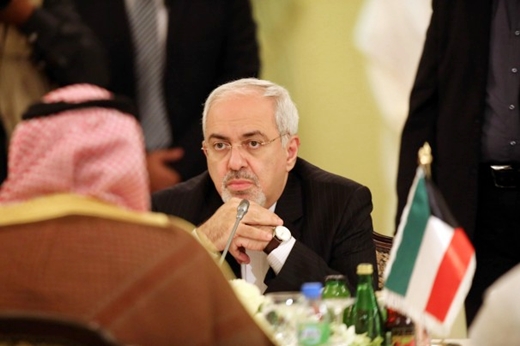
What do Zarif’s regional trips signify? Will his plan bring Saudi Arabia to the negotiating table?

452736851

The multiphase plan Foreign Minister Mohammad Javad Zarif has devised is like a puzzle whose pieces are gradually falling into place. The Iranian top diplomat’s initiative will ultimately get Saudi Arabia to accept a new regional order.

Khabaronline.ir on August 17 published a piece by Saeed Jafari on the foreign minister’s new regional initiative. The following is the translation of that piece:

Zarif has traveled to Qatar, Kuwait, Syria, Lebanon, Iraq, India and Pakistan over the past two weeks with his trips drawing global attention. A closer look at comments by officials meeting Zarif shows that these countries all want to improve their ties with Tehran. This comes after the regional isolation of Iran courtesy of the previous government’s policies [both at home and] on the world stage.

During his regional tour and in an interview with an Iranian monthly, Zarif revealed his new plan which first drew the attention of Lebanon’s As-Safir newspaper. In an article in the Lebanese newspaper, Zarif floated the idea of establishing a regional security forum to encounter potential threats the Middle Eastern countries are exposed to.

This is nothing new. Since the establishment of the Islamic Republic, Iran has always stressed the need for regional countries to solve their issues themselves, without the involvement of world powers, but the mechanism Zarif has put forward this time is new. Furthermore, the foreign minister’s recent remarks suggest that he has developed a good mechanism for this initiative and is seeking to put it into effect.

Why does Saudi Arabia have issues with Iran?

After the establishment of the Islamic Republic, Arab countries in the Middle East kept their guard up when they heard Iran was to export the Islamic Revolution and became concerned about the rise to power of a nascent government in Tehran. This concern caused Arab brothers to stand by [Iraq’s] Saddam Hossein so that they could nip the new regional player in the bud.

That Arab dream never came true and certain players in the Persian Gulf and Middle East started to improve their ties with Tehran, but the big brother of the Arabs [a reference to Saudi Arabia] did little to hide its dissatisfaction with the growth of Iran’s strategic depth.

According to Mohammad Kazem Sajjadpour, a former Iranian diplomat, blunders of other players and Iran’s good gambit over the past three decades have strengthened Iran’s hand in regional disputes and weakened that of Iran’s rivals. This has left a bad taste in the mouth of the Saudis and others. That’s why Riyadh has expressed dissatisfaction and taken practical measures to undermine Tehran’s strategic depth.

The growth of Salafi and Takfiri movements in Syria and Iraq which led to the emergence of ISIL, support for the radical opponents of the Assad government, assistance to the March 14 Alliance led by Saad Hariri [in Lebanon], and finally military action against Yemen are chief among those measures.

Impartial observers believe these measures have not brought about benefits for Saudi Arabia; rather, they have plunged the kingdom deeper into trouble. The futility of Riyadh’s individual efforts has made this country reach out to Israel, whose regime is the No. one enemy of the Islamic Republic.

At this juncture, Iran took the right path and refrained from fuelling tensions with Saudi Arabia. At a time when Israel sternly sought to entrap Tehran in a direct military confrontation with Riyadh, the astute statesmanship of Iran’s Foreign Ministry [in particular] and the eleventh government [in general] helped the country insightfully and calmly avoid this trap.

What does Saudi Arabia want?

Saudi Arabia – which is unhappy with regional developments because it has realized that Iran holds sway in areas the kingdom used to wield its influence – has a special demand. Riyadh is asking Tehran to leave Syria, Lebanon, Iraq and even Yemen and then open talks. A demand Iran will undoubtedly reject.

What should be done? Should the tensions be heightened? The answer is definitely in the negative, because the balance in the Middle East region is being tipped in favor of Iran.

Today a relative calm has taken hold in Syria, but two years ago the whole world was unanimously talking about the inevitability of Assad’s departure and the clouds of war were hanging over Damascus. Or, to say the least, things in Syria have gone so far that the US secretary of state is now echoing remarks Iranian officials were making three years ago. “There is no military solution. [There is only a political solution” to the Syrian crisis.]

The situation in Iraq and Lebanon is similar. The internal developments in these two countries are to the benefit of Iran. Consequently, Iran is about to turn into a conservative player that is willing to maintain the status quo, and Saudi Arabia – which was traditionally the conservative player in regional developments – is to change into a revisionist element.

With that being the case, Iran has to avoid getting caught in a serious confrontation with Saudi Arabia. Instead, it should try to stabilize the status quo. The question is whether the status quo will be maintained by sitting idly by and doing nothing and just talking about the betterment of ties between regional Muslim countries. Definitely not! How such stabilization can be pursued should be sought in Zarif’s hands.


Zarif’s fruitful plan

After the successful end of nuclear talks, Zarif once again took the first step [and moved his piece] to say “Check” to Saudi Arabia before his king is in check. By traveling to regional countries and meeting with different players in the Middle East and on the [Indian] Subcontinent, Zarif did his best to outline his security forum plan. What he did helps Iran get the upper hand vis-à-vis Saudi Arabia.

Although he knows this idea is hard to materialize, he – in his meetings – stresses the need for discussing such a plan and says Iran is determined to form a regional forum to provide the Middle East’s security. What is the fruit of such efforts? Will such a security forum form? In Saudi Arabia’s absence, this plan will certainly lead nowhere.

What’s the use of such a plan? Firstly, Iran will be identified as an active regional player which seeks to maintain regional stability and peace and supports the security of its neighbors; and secondly, Saudi Arabia is characterized as a disgruntled player which refuses to accept a mechanism for regional stability.

Zarif has built on accurate calculations to be part of this win-win game for Iran. Iran knows well that regional disputes will not be defused through unilateralism and that the presence of Saudi Arabia, especially for the equations in the Persian Gulf, seems necessary.

Iran has time and again emphasized that it views the security of its neighbors as its own and never seeks to pose a security threat to Saudi Arabia. But all Riyadh cares about is its identity, and it sees any ideological advances by Shiite Iran in regional countries as a threat to the ideology of Salafism and Wahhabism.

But adherence to the current policy of Iran, that is to say insistence on achievements and thoughts, along with continued efforts as a powerful regional power which favors a peaceful solution to regional crises, will prompt Saudi Arabia to believe in these changes and come to the negotiating table not to miss out on opportunities anymore.

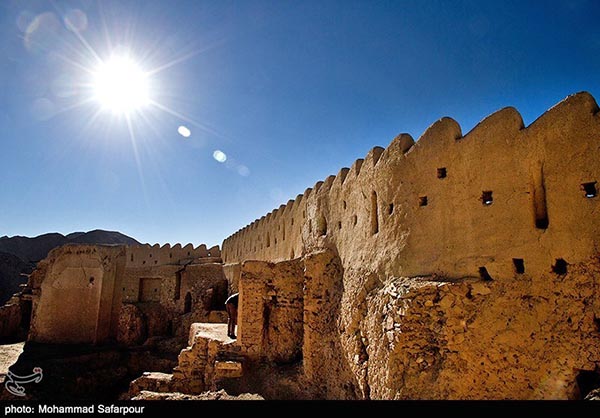
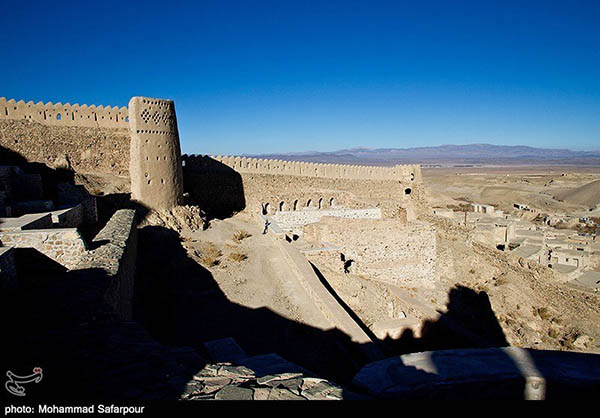
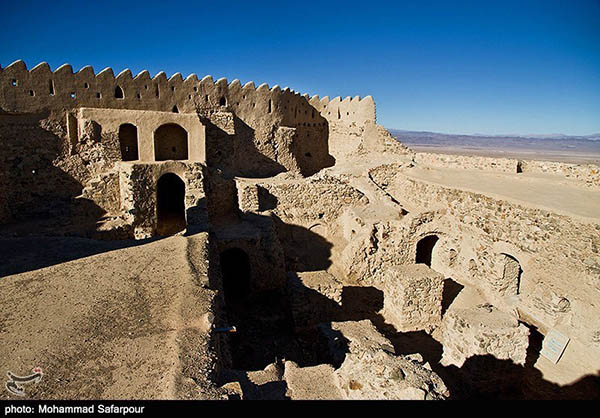
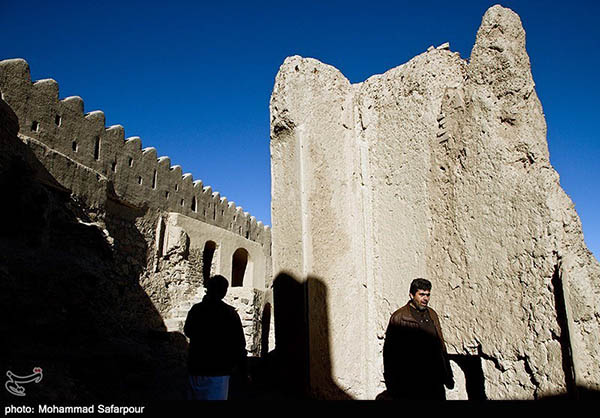
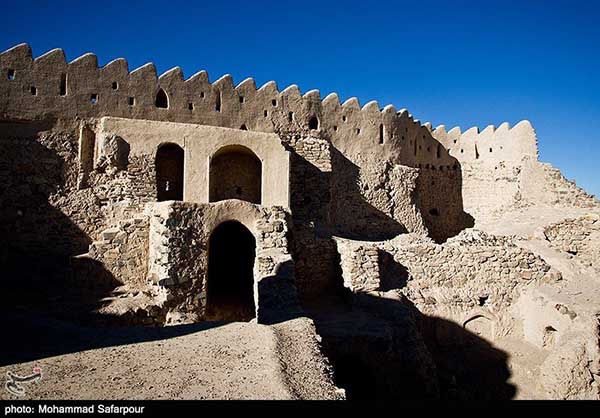
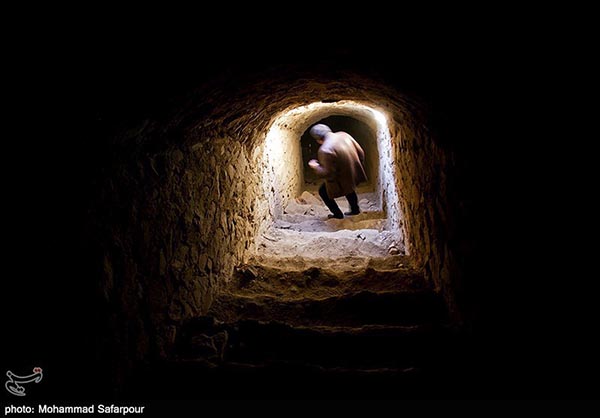
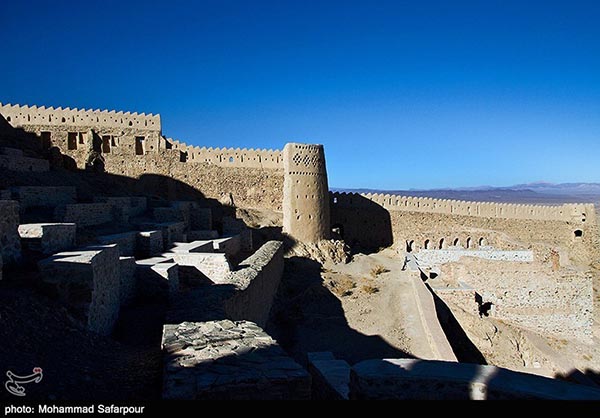
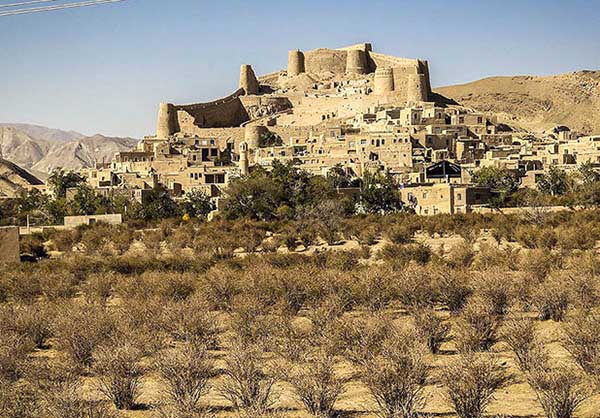
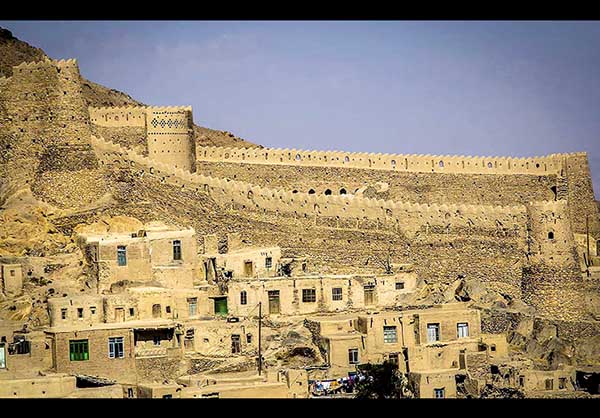
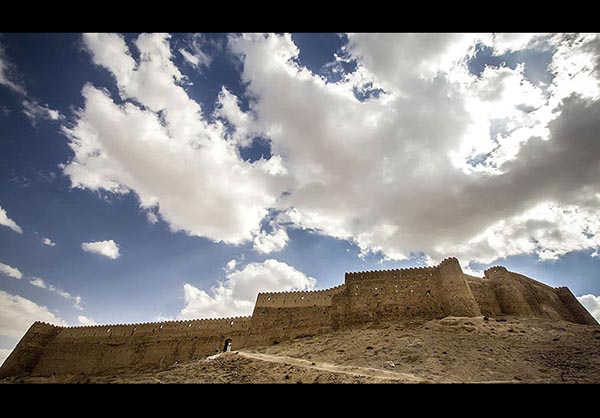
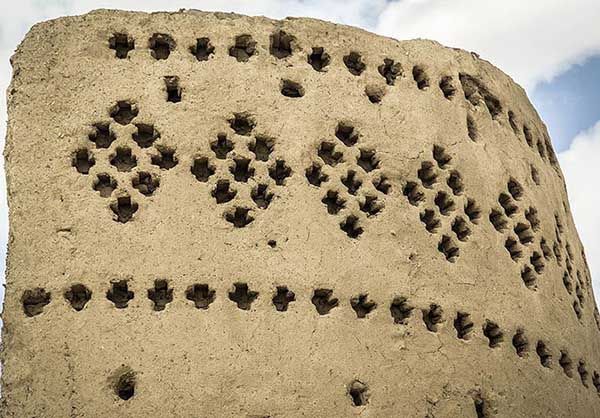
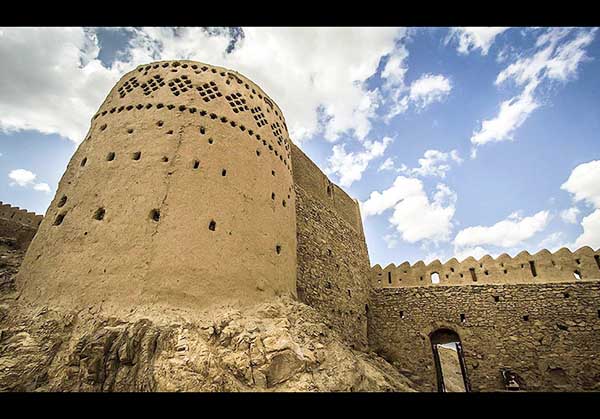
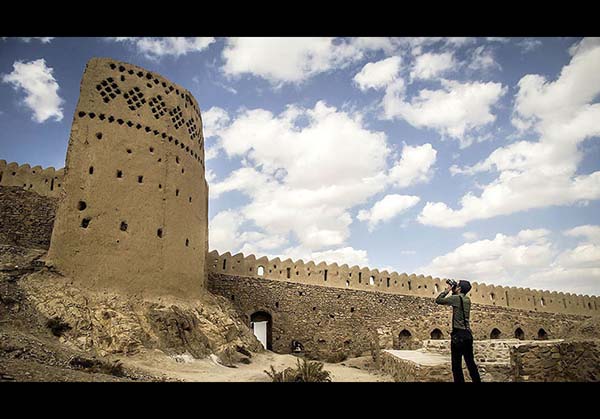
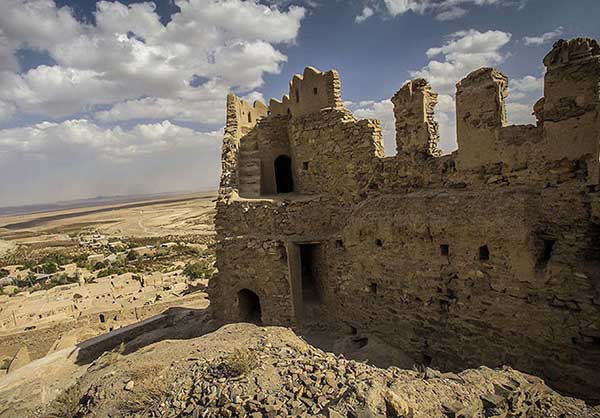
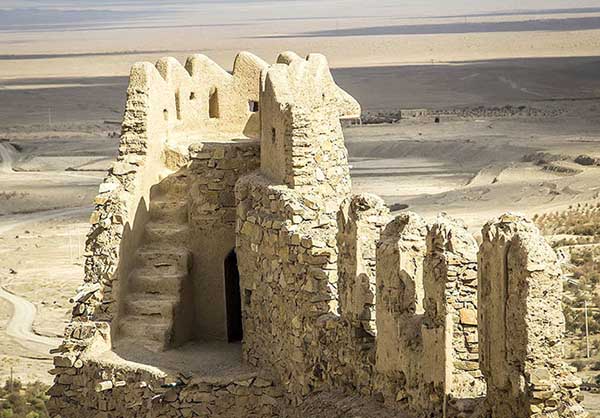
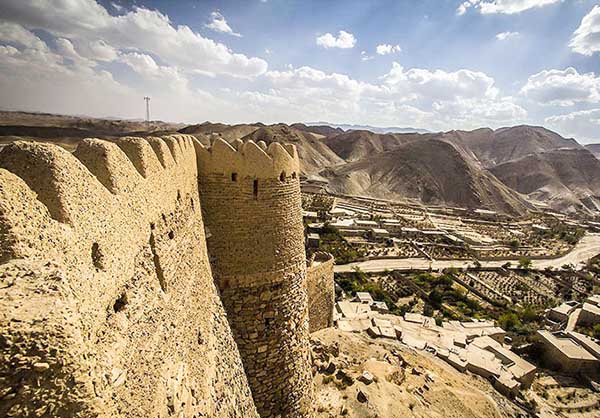
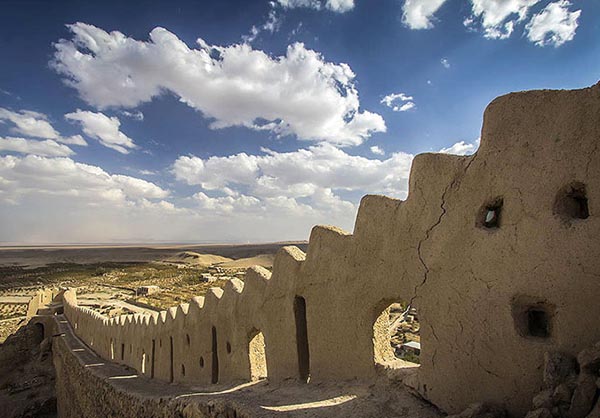
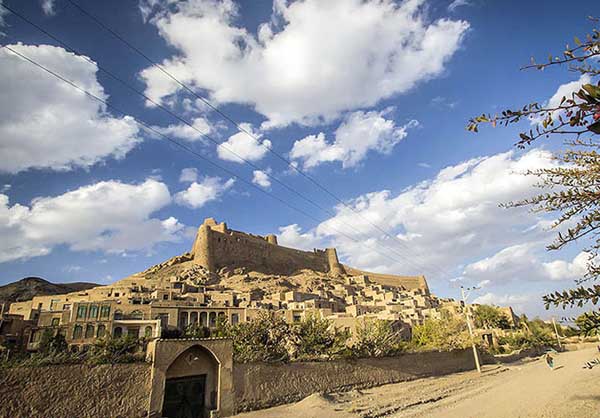
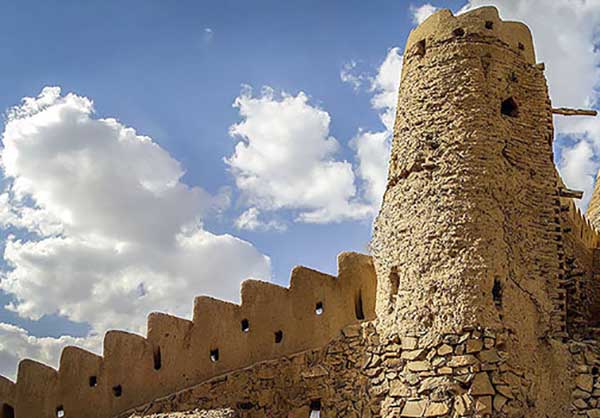
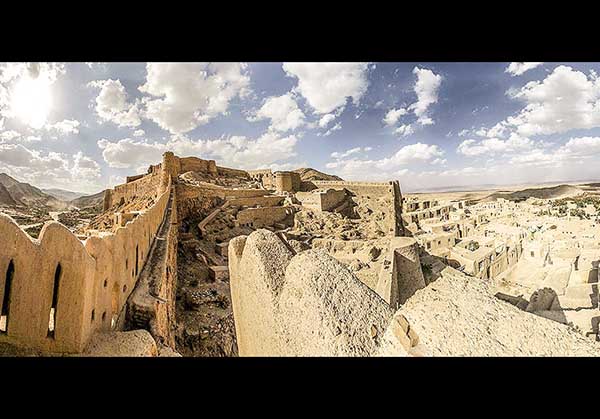
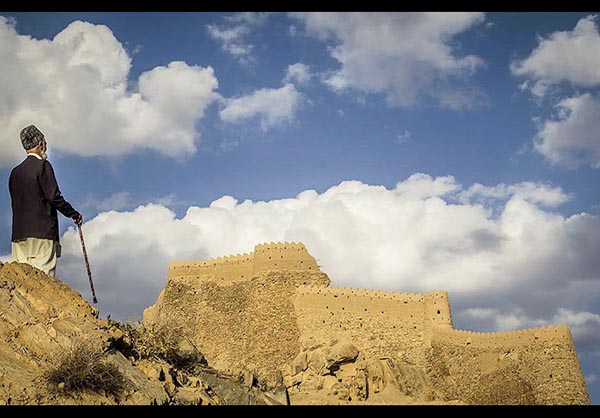
Furg Citadel in eastern Iran (PHOTOS)

Furg Citadel000

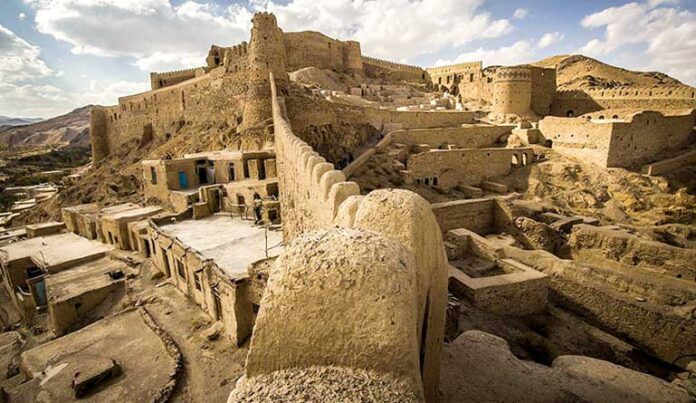
Furg Citadel in South Khorasan was built in 1747 when Nader Shah [King of Persia (1736–47)] was in power.

Stones, bricks, stucco, and lime were used in the construction of the fort, which was the second most important training site for the followers of Nizari Ismaili after the Alamut Castle.
Furg has 18 round watchtowers which overlook nearby villages and roads. The interior of the structure shows that it has been renovated a few times to meet the need for more space during the Afsharid and Qajar eras.
The following are images of the citadel released by different websites:

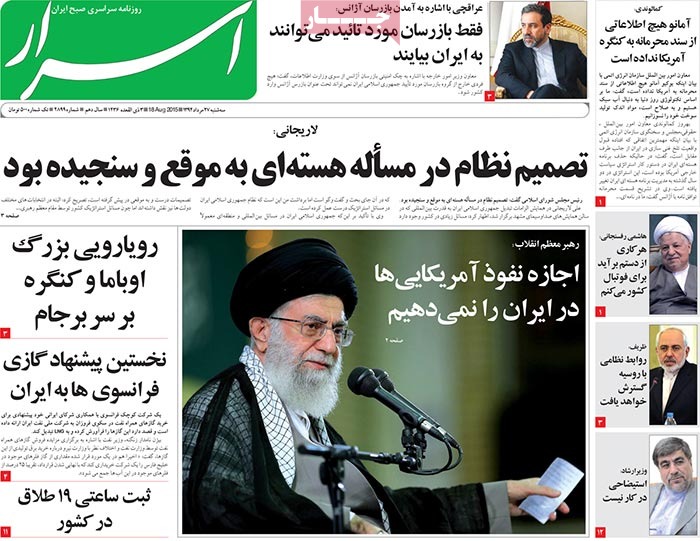
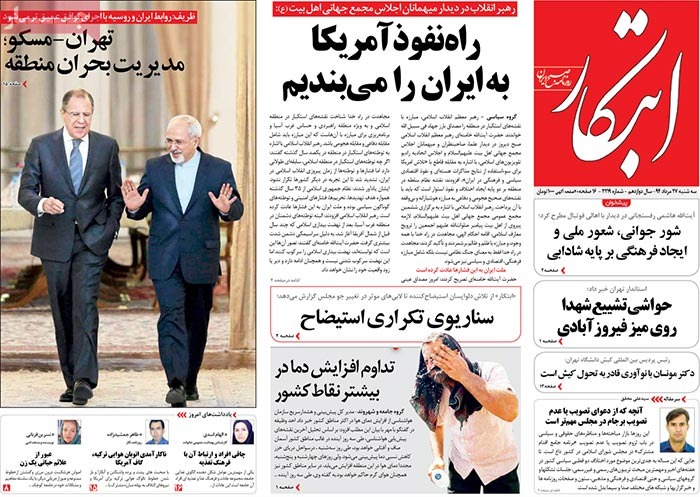
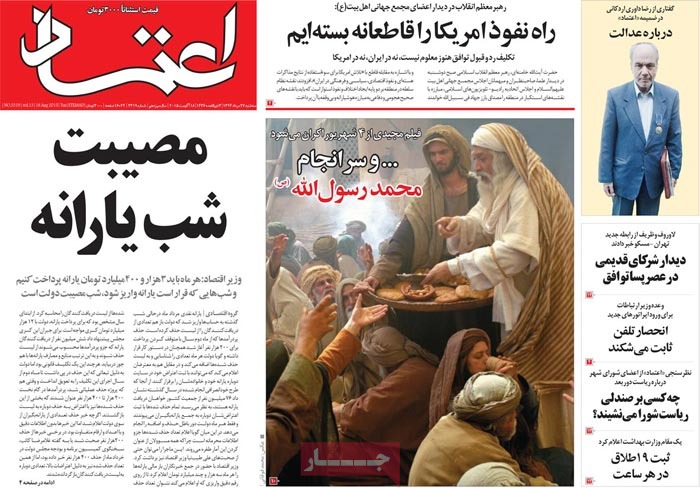
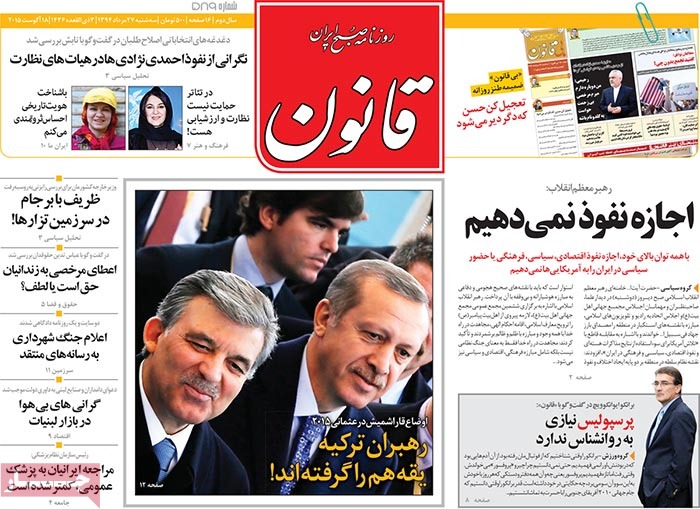
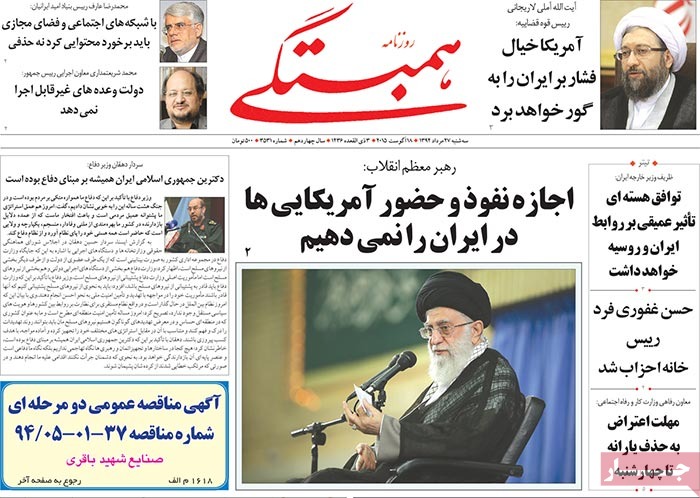
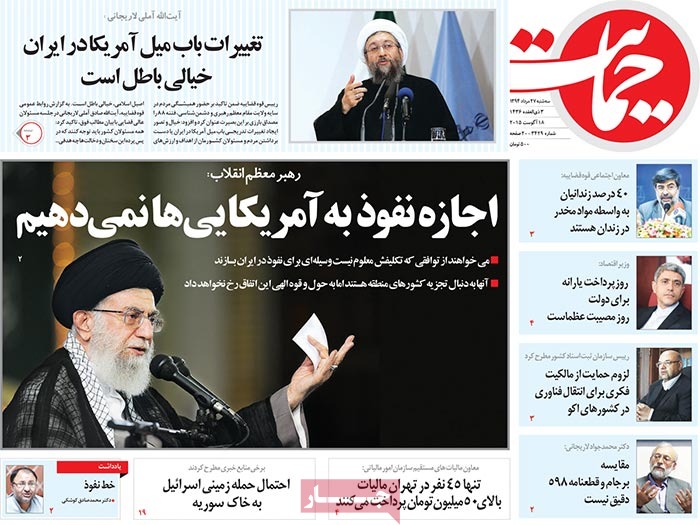
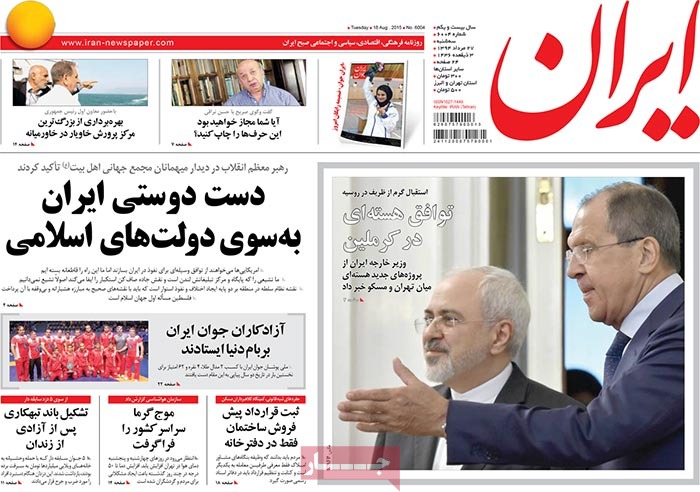
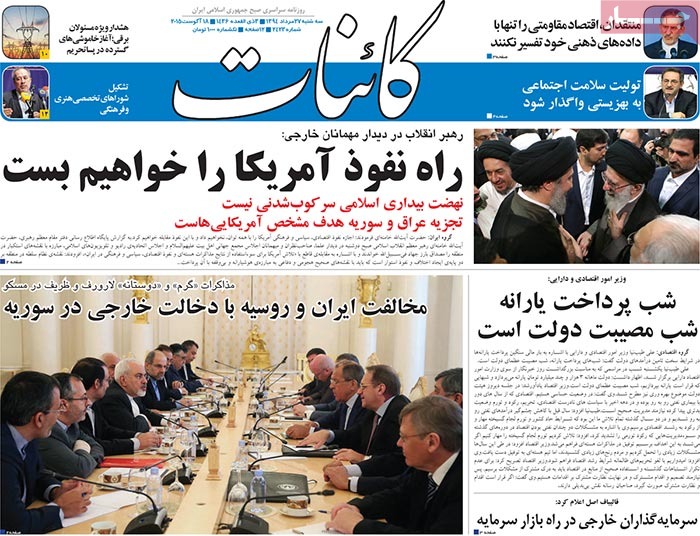
A look at Iranian newspaper front pages on August 18

Iranian Newspapers Headlines

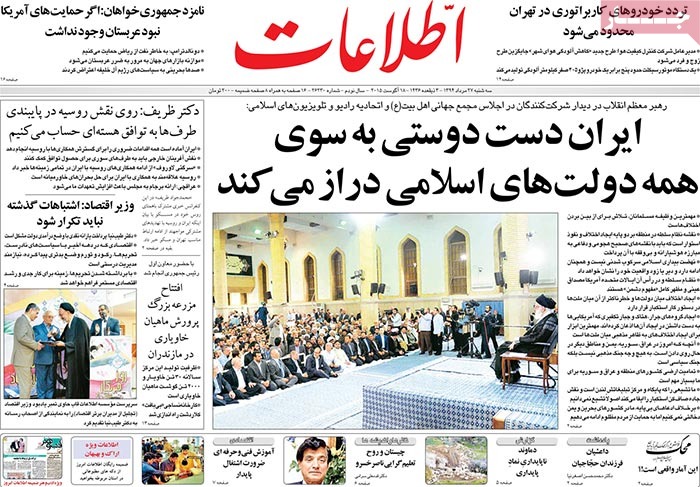
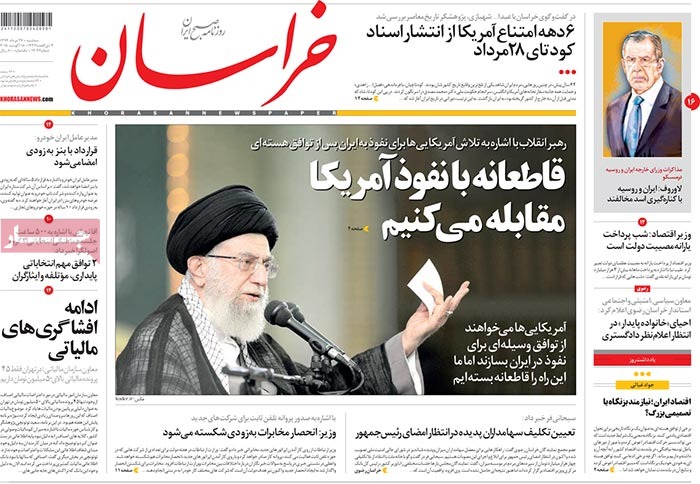
The comments of the Supreme Leader about the stance of the Islamic Republic vis-à-vis the US and Muslim unity dominated the front pages of Iranian newspapers on Tuesday.


Ettela’at: “Iran extends a hand of friendship to all Islamic states,” the Supreme Leader said at a meeting with those who participated in the general assembly of an Islamic Radio and Television Union and the AhlulBayt World Assembly in Tehran.

Ayatollah Khamenei further said the most important responsibility of Muslims is to make efforts to eliminate divisions among themselves.


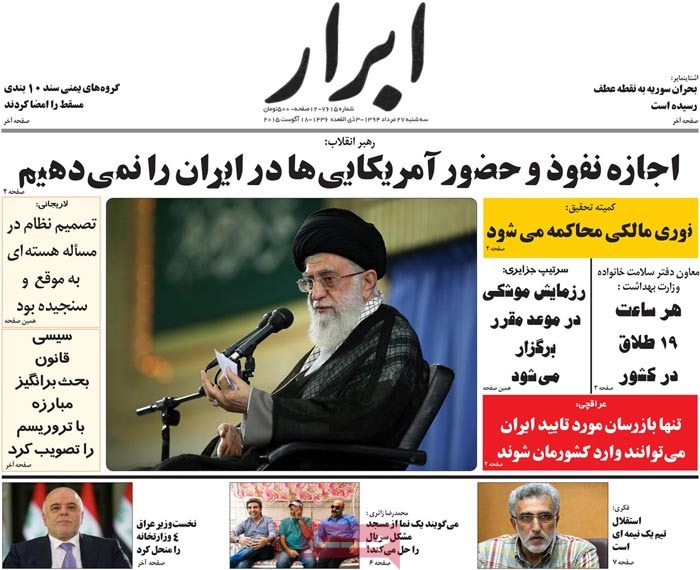
Abrar: “[IAEA] Inspectors who are approved of by Iran are the only ones who can arrive here for inspections,” said Iranian nuclear negotiator Abbas Araghchi.

Abrar: “The decision the establishment made on the nuclear issue was timely and well-founded,” said Parliament Speaker Ali Larijani.


A look at Iranian newspaper front pages on August 18


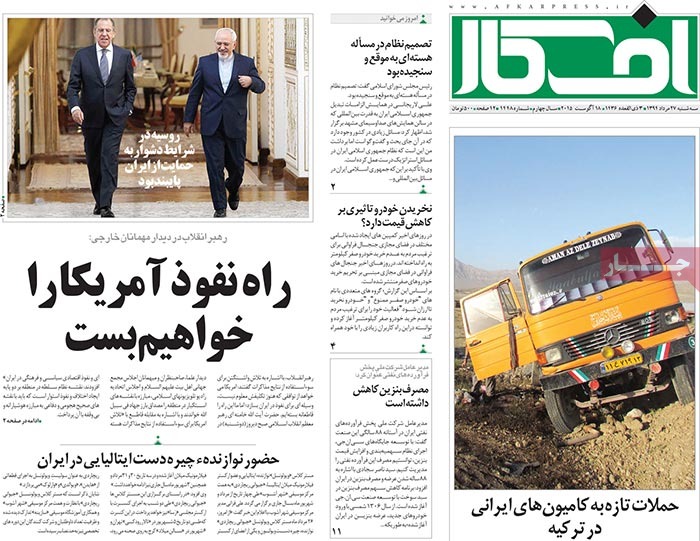
Afkar: There have been fresh attacks on Iranian trucks in Turkey.

Afkar: A veteran Italian musician is in Tehran to teach a master class.


A look at Iranian newspaper front pages on August 18


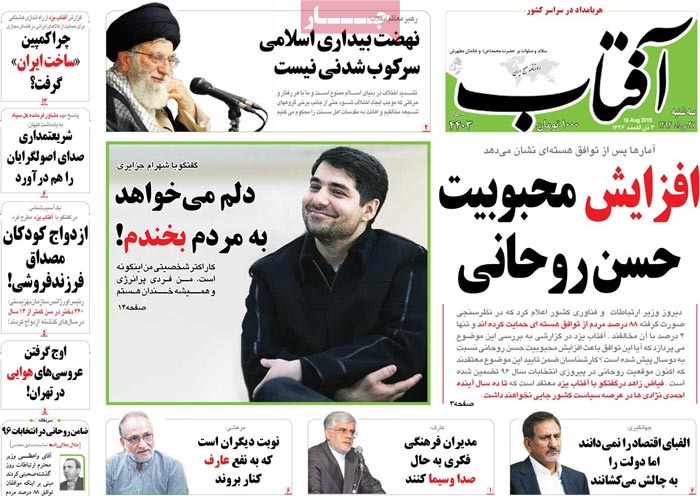
Aftab-e Yazd: Following the conclusion of the Vienna deal, the popularity of President Rouhani has increased.

Aftab-e Yazd: “Some individuals who do not know the ABCs of economy doubt the economic policies of the government!” First Vice-President Eshagh Jahangiri complained.


A look at Iranian newspaper front pages on August 18


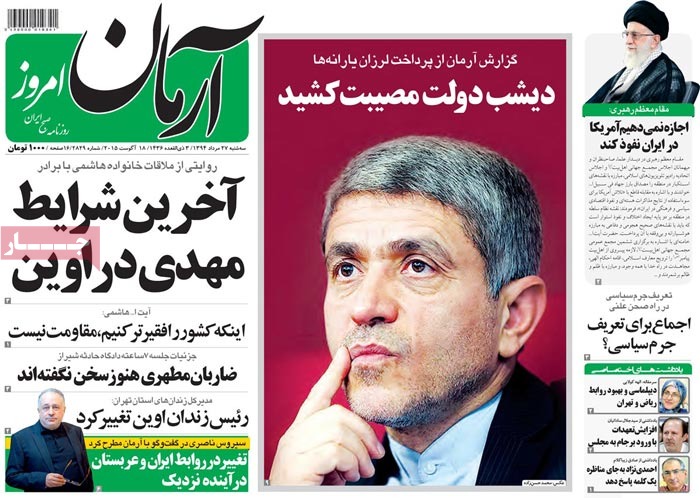
Arman-e Emrooz: “Rendering the country poorer is not resistance,” said Chairman of the Expediency Council Ayatollah Akbar Hashemi Rafsanjani.

Arman-e Emrooz: Assailants who attacked Tehran MP in Shiraz earlier this year have yet to talk in their defense in court.


A look at Iranian newspaper front pages on August 18


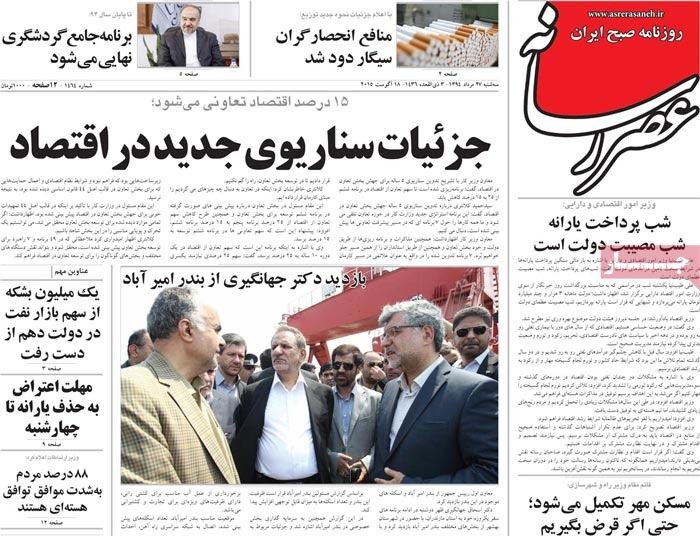
Asr-e Rasaneh: The minister of communications and information technology has said that 88 percent of Iranians are strongly in favor of the nuclear deal.


A look at Iranian newspaper front pages on August 18


Asrar: The chairman of the Expediency Council has said he will do anything within his powers to shore up football in the country.

Ayatollah Rafsanjani made the comment at a meeting with senior officials of the Football Federation.

Asrar: Foreign Minister Zarif has said that military ties with Russia will be boosted.


A look at Iranian newspaper front pages on August 18


Ebtekar: Temperatures will continue to hike in much of the country.


A look at Iranian newspaper front pages on August 18


Etemad: An official with the Health Ministry has said that each hour as many as 19 divorces are registered in the country.


A look at Iranian newspaper front pages on August 18


Ghanoon: Turkish leaders are at each other’s throats.

Disarray reigns in Ottoman Empire 2015!


A look at Iranian newspaper front pages on August 18


Hambastegi: “Iran’s military doctrine has always been defensive,” said the Iranian defense minister.

Hambastegi: “Government does not make promises it cannot keep,” said the Iranian vice-president for executive affairs.


A look at Iranian newspaper front pages on August 18


Hemayat: “American-style changes in Iran are only a pipe dream,” said the judiciary chief.

Hemayat: “Some 40 percent of all prisoners in Iran are behind bars for drug-related offenses,” said a judiciary official.

Hemayat: Some news sources say Israel may launch a ground offensive against Syria.


A look at Iranian newspaper front pages on August 18


Iran: Iranian Foreign Minister Zarif has been warmly welcomed by Russian officials in Moscow.

Zarif said Iran and Russia will implement new nuclear projects.

Iran: Iran’s junior wrestlers have been crowned world champions in Brazil.


A look at Iranian newspaper front pages on August 18


Kaenat: Iran and Russia are opposed to foreign interference in Syria.


A look at Iranian newspaper front pages on August 18


Khorasan:”We will firmly stand up against American inroads,” said the Supreme Leader as he recalled American attempts to find its way back into Iran following the nuclear deal.

Khorasan: “The telecommunications monopoly will soon be broken,” said the minister of communications.


A look at Iranian newspaper front pages on August 18


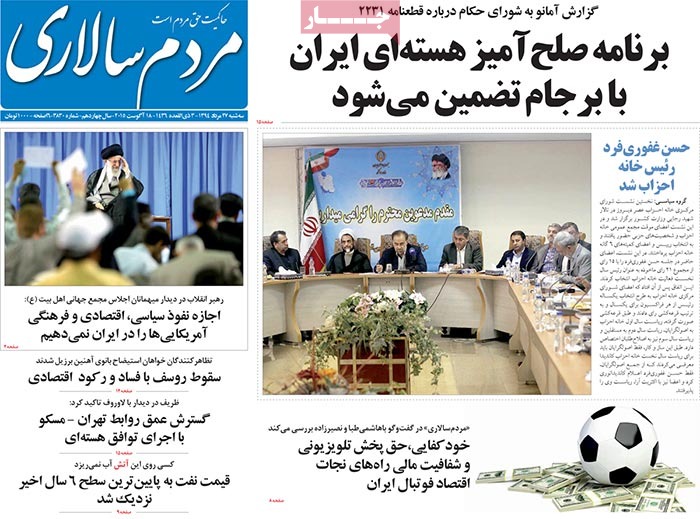
Mardomsalari: Hassan Ghafurifard, a onetime MP and Cabinet minister, has been named chairman of the House of Political Parties.

Mardomsalari: Oil prices are closing in on 6-year lows.


A look at Iranian newspaper front pages on August 18


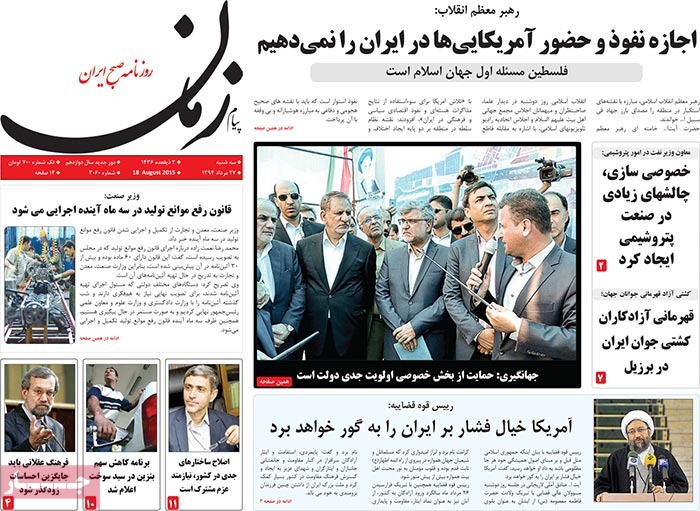
Payam-e Zaman: “The law that eliminates the obstacles standing in the way of production will be implemented in three months,” the industry minister said.


A look at Iranian newspaper front pages on August 18


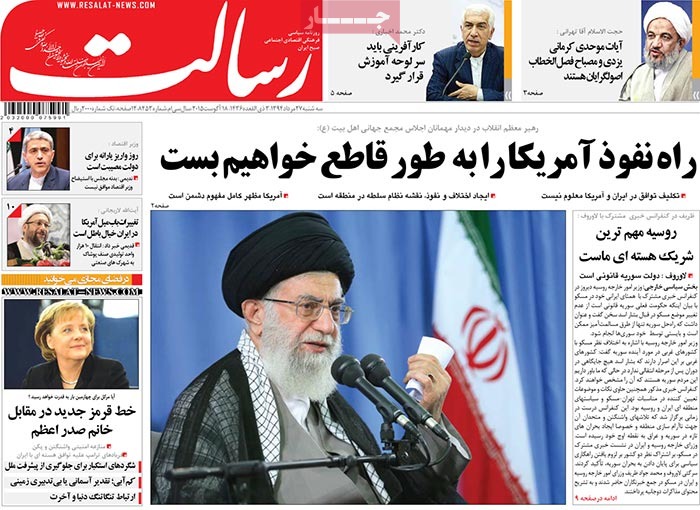
Resalat: “The day cash subsidies are paid is a very sad day for government,” said the economy minister as he talked about existing monetary problems to sustain cash handouts [introduced by the government of Ahmadinejad].


A look at Iranian newspaper front pages on August 18


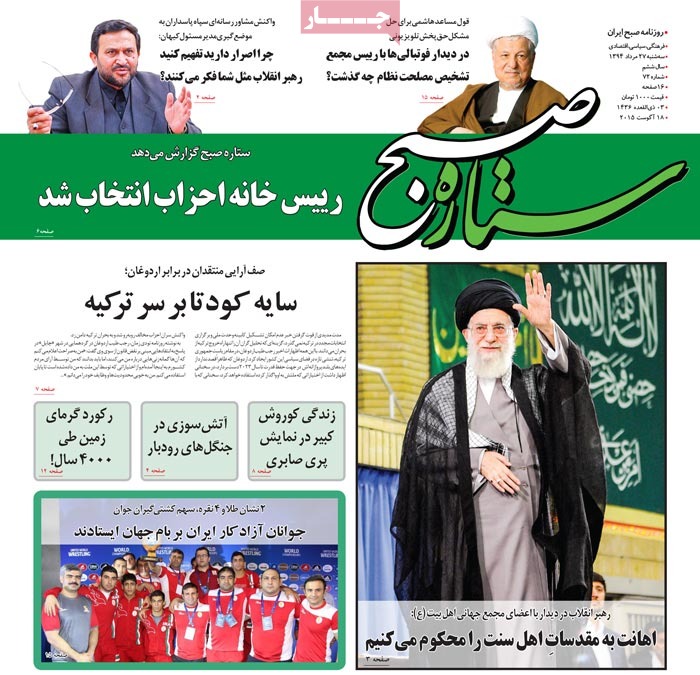
Setareh Sobh: “We condemn any measure disrespectful of Sunni sanctities,” the Supreme Leader said.


A look at Iranian newspaper front pages on August 18


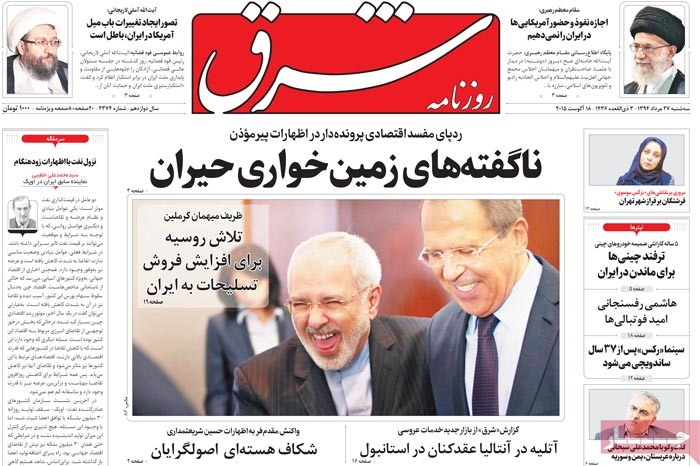
Sharq: Russia is trying to increase its arms sales to Iran.

Sharq: The Chinese ploy to remain on the Iranian market: five-year warranties on Chinese-made cars.


A look at Iranian newspaper front pages on August 18